Showing posts with label Dress in the Victorian Era. Show all posts

Monday, July 24, 2023

Victorian Aesthetic Dress


From 1895 Punch cartoon. Gertrude: "My dear Jessie, what on earth is that Bicycle Suit for?"
Jessie: "Why, to wear, of course."
Gertrude: "But you haven't got a Bicycle!"
Jessie: "No; but I've got a Sewing Machine!"
 

The Victorian aesthetics seen in clothing also often reflected the worldly state of the British Empire. Women of considerable means wore dresses made from coloured silk from the Far East. In the Victorian era, women who were well-off often didn’t work, and so their clothing wasn’t needed to have much practicality. Instead, tight-fitting corsets and layered petticoats were the standard. Embroidered trim and other fine decorative elements were also reserved for wealthy women. Middle class and working women wore similar styles, although lacking the added decoration and luxurious fabrics.

Over the course of the Victorian era, women’s clothes became more form-fitting. Necklines dropped, with significant ‘v’ shapes becoming popular. Off-shoulder sleeves were also stylish in the mid-1800s. By the turn of the 20th century, the prominent bustles and hoop skirts that had exemplified Victorians were much less popular. Instead, tight dresses with bustles that created more of an hourglass or ‘mermaid’ shape rose to the fore.

Men and women wore significant jewelry throughout the Victorian era. For men, pocket watches, signet rings, tie pins, and cufflinks were commonplace. Brooches were a piece of jewellery that was particularly prominent for Victorians, serving as decoration and practicality. They could be worn as ornamentation on a coat lapel just as easily as they could be used to affix a lady’s hairstyle in place.

Victorian jewellery evolved throughout the period, with changing aesthetics and purposes. Queen Victoria herself was massively influential throughout the British Empire, being the closest thing to an international celebrity at the time. As she grew and her life circumstances changed, so did her taste in jewellery. One prominent theme seen throughout Victorian jewellery pieces is the snake. To Victorians, snakes were seen as a romantic icon, representing an eternal love between two people. Snake jewellery includes men’s jewelry just as much as women’s jewellery pieces—From the AC Silver Site Blog, 2023


🍽Etiquette Enthusiast, Maura J. Graber, is the Site Editor for the Etiquipedia© Etiquette Encyclopedia

Tuesday, June 28, 2022

Etiquette Needed for Theatre Bonnets

Fashions from 1873: Small late Victorian hats and bonnets from Paris set with flowers, ribbons and feathers.
–Photo: Hulton Archive, Getty Images / Hulton Archive

Among items of theatrical news may be mentioned the death of Mrs. Ternan, (Miss Jarman,) an old friend of Charles Dickens. Some of the London managers have just begun to admit bonnets to the boxes, at the moment when bonnets have become hats and shut out the view of the stage from those behind. It is suggested that the managers should make a rule as to the height of ladies' bonnets. – F. H. J. In the New York Times, 1873


🌹Etiquette Enthusiast, Maura J .Graber, is the Site Editor for Etiquipedia© Etiquette Encyclopedia


Monday, August 12, 2019

Victorian Era Church Etiquette

“When the minister is dull, and you cannot listen — this happens often enough to make a rule — study phrenology; examining the bumps of heads before you. An hour maybe passed thus politely and pleasantly...” – “Phrenology” enjoyed great mass appeal from the late 1700’s, the Victorian era and well into the 20th century. It has been wholly discredited by scientific research, however. Phrenology is the study of the conformation and bumps of the human skull, as indicative of mental faculties and traits of character, especially according to the hypotheses of 18th century German doctor, Franz Joseph Gall, and 19th-century adherents George Combe and Johann Kaspar Spurzheim

As to-morrow is Sunday, and many we know of are not quite as perfect in church etiquette as they might be, we give the following rules which should guide them in attending divine worship. We may remark first, that there is no etiquette for any place like the etiquette of common sense; it avails when the rules of the Chesterfields and the Hickmans often make one ridiculous. In entering church, then, with a lady, precede her when ascending and descending stairs, as also in seeking a seat. In one case it is especially polite; you act a sort of shield to her modesty, and then you save her the confusion of selecting a pew. 
It is proper, if you arc a believer, to kneel or stand at prayer, according to the custom of the church. To disregard these is vulgar — at least, it shows too much false pride, or too little reverence for the requirements of Christianity. Excessive whispering during service is decidedly vulgar. It is sometimes necessary to address an undertone remark to your companion or companions, but seldom. Listen to the service— especially the sermon. 
In this age of church opera, called music, you cannot help bearing that part of the ceremony. It would wake up a Van Winkle, but the sermon you may sleep over or disregard. It is wrong. Appear to hear, if you do not. A good way, is when the minister is dull, and you cannot listen — this happens often enough to make a rule — study phrenology; examining the bumps of heads before you. An hour maybe passed thus politely and pleasantly. 
If you chew tobacco, do not use it in church. It is annoying to those around you, and then the Sexton gives you jessie. 
Never leave church during service, unless it is absolutely necessary — as in sickness, a house on fire, or a professional call. It is vulgar to come late. Sometimes it is unavoidable; a person wishes to display it new dress, watch-chain, or perhaps a beau. It will occur sometimes that a poor goose wants to be driven from his seat — then it is proper enough also. These causes and the like excuse late coming, and the congregation endure them. Any other delay is unendurable. 
Dress as plainly as possible. We don't mean that a lady should appear in her morning wrapper, nor a gentleman in his shirt-sleeves. A nice medium is the thing in all matters—ladies should not be taken for milliners’ showcases. nor gentlemen for be-jewelled and neck-tied monkeys. A plebian goes to church to show fine clothes, an aristocrat to show respect to God. 
In entering and leaving the house, don't walk too slow like the shoddies, nor too fast like the bashfuls. In the one case, people ridicule yon for affectation; in the other, there is danger of knocking down the pews or of running over somebody, “Hasten slowly.” 
When you look around too much in church, people think you want to show your profits, or that you want to attract attention to your style, or that you want to marry, or that, like poor wheat, there is not enough weight about your head to keep it still. Don't look too pious In church, either— it is as suspicious as too much levity. Religious worship is neither a joke nor an emetic. 
If you feel extraordinarily devotional, begin to think about putting something into the treasury, and it willl shorten your face quickly, and spread over it the pleasant look of duty. – Lynchburg Virginia News, 1870


🍽️Etiquette Enthusiast, Maura J. Graber of The RSVP Institute of Etiquette, is the Site Editor for Etiquipedia© Etiquette Encyclopedia

Thursday, May 4, 2017

Etiquette and a Grecian Bend

The Grecian Bend... it is the latest "thing" in polite accomplishments. Not to know the Grecian Bend at Saratoga and Newport this season is to "vote yourself out of refined society." 

Letter from New York

As I have not yet learned the "Grecian Bend," I have declined a visit to the watering places. Your fashionable readers, of course, know what the Grecian Bend is. But your more fashionable folk may require to be told that it is the latest "thing" in polite accomplishments. Not to know the Grecian Bend at Saratoga and Newport this season is to "vote yourself out of refined society." 

When first your correspondent heard of the Grecian Bend, in the innocency of his heart and the antiquity of his ideas, he thought it referred to archery practice, including the drawing of the long bow by the newspaper correspondents at these watering places. Then it occurred to him that it might mean that graceful action by which a man in tight-fitting habiliments gets at his pocket book — a gentle stoop to prepare the pocket for the insertion of the digitals. As this is the most frequent action at our watering places, it seemed proper that it should possess a studied grace. But this is not the Grecian Bend.

Not to keep your readers longer in suspense, here is what the newest accomplishment of our belles and beaux really is. You must know in the first place that the very extreme of the present Paris toilette prevails at Saratoga, Newport and the other fashionable summer resorts this season. 

The most striking costumes are the chignon, worn on the top of the head, from which two long switches of loose hair depend, hanging from each side of the center down the back. The "pannier" is worn at the top of the hoop, and around and upon it are gathered five or six yards ot material, forming what is called the "blancbisseuse," or "washwoman's" style. A band encircles the wearer's hips, just below this monstrous hump, and the dress below falls straight to the feet. To relieve this straightness and give effect to the hump aforesaid, the belles assumed what is called the Grecian Bend. 

This is performed, says a fashion critic, "by pulling the lower hips up to a point, even with the lower ribs, drawing the stomach in and throwing the shoulders forward, with the hands dropping pendent from the upraised elbows, like the paws of a dancing bear, or, to use a politer simile, like the shaking​ quakers in a dance." 

"When the whole affair is carried out in a dance," says a correspondent, "by a gay and luxuriant youth, with his hair parted in the middle, placing his right arm under the belt of the lady, with fingers extended as in a spasm between the shoulder-blades, while with the thumb and second finger of the other hand he holds her wrist, leaving the hand to hang lifelessly pendent, we have an exhibition of snobbishness and cockneyism which might put all sensible Americans to the blush." –Letter from New York, August 15, 1868


🍽️Etiquette Enthusiast, Maura J Graber, is the Site Editor for the Etiquipedia© Etiquette Encyclopedia

Thursday, August 4, 2016

19th C. Bicycling Fashion Etiquette

In taking up cycling attire for women we wish first of all to launch a protest against those abominable modern cycling garments, the bloomers. Don't wear them! Don't make them! Don't have anything to do with them! ~ Polite society has always dictated the etiquette expected for fashion, especially for the newest trends and styles in outdoor activities.

For Women Who Wheel 

New York Sartorial Art Journal contains the following interesting remarks anent bicycle costumes for women:

In taking up cycling attire for women we wish first of all to launch a protest against those abominable modern cycling garments, the bloomers. Don't wear them! Don't make them! Don't have anything to do with them! For of all the monstrosities of this day, a woman with a tightly laced waist und with limbs encased in baggy bloomers is the worst. Skirts are made nowadays of such design and length as not to hinder the free movements of the riders' limbs, so on that score there is no reason for complaint. It is much better from an artistic point of view, for a woman to wear knickerbockers than the hideous bulging bloomers, which no woman who has good taste will wear.

The short skirts of last season would blow up when the wearer pedaled fast or coasted down hill, even though knickerbockers and leggings were worn underneath, which exposed the rider to some mortification. This, however, is done away with by the increased length worn today. Regarding accessories to women's cycling attire, there is not much in the way of novelty to chronicle. The fourteen-button, tan kid boots remain very popular, with now and then a high lace and a high French kid boot in evidence. Some women wear knickerbockers and golf stockings underneath their skirts, and some, in hot weather, wear low Oxford shoes, the high lace button boot being rather warm. Shirt waists will of course, be in vogue as soon as the warm weather strikes us, and the high-banded turndown collar, worn with a cotten tie, will be popular.

A new thing for women's use in cycling furnishings will be the riding stock, which will be used either with shirt waist or jacket. It will fold twice around the neck, like a man's riding stock, though it will tie in the form of a bow instead of an Ascot. The tie proper in both the women's and men's articles will be of a material to match tho shirt or shirt waist. In mentioning women's cycling hats we can only say that there is such a variety of headgear for cycling that it would be an impossible task to enumerate and describe all of them. It is enough to say that the Tam-o-Shanter and the Tourist form of hats, neatly trimmed, and of a color to match the suits worn, and a black straw sailor, will be proper and most effective. Almost any kind of a stout glove goes well for cycling, although there are varlous special designs of cycling gloves on the market. — San Francisco Examiner, 1896


Etiquette Enthusiast, Maura J. Graber, is the Site Editor for the Etiquipedia© Etiquette Encyclopedia

Monday, August 5, 2013

Gilded Age Correct Personal Habits

Lady in striped dress with a hat and an umbrella, Newark, NJ, 1880s 

Dress 
“From little matters let us pass to less, And lightly touch the mysteries of dress; The outward forms the inner man reveal; We guess the pulp before we eat the peel.” —O. W. Holmes. 

I.—THE LANGUAGE OF DRESS 

Dress has its language, which is, or may be, read and understood by all. It is one of the forms in which we naturally give expression to our tastes, our constructive faculties, our reason, our feelings, our habits—in a word, to our character, as a whole. This expression is often greatly modified by the arbitrary laws of Fashion, and by circumstances of time, place, and condition, which we can not wholly control; but can hardly be entirely falsified. Even that arch tyrant, the reigning Mode, whatever it may be, leaves us little room for choice in materials, forms, and colors, and the choice we make indicates our prominent traits of character.

II.—THE USES OF DRESS
Playing croquet 
“Dress,” that admirable Art Journal the Crayon says, “has two functions—to clothe and to ornament; and while we can not lose sight of either point, we must not attribute to the one a power which belongs to the other. The essential requirement of dress is to cover and make comfortable the body, and of two forms of dress which fulfill this function equally well, that is the better which is most accordant with the laws of beauty. But fitness must in nowise be interfered with; and the garb which infringes on this law gives us pain rather than pleasure. We believe that it will be found that fitness and beauty, so far from requiring any sacrifice for combination, are found each in the highest degree where both are most fully obtained—that the fittest, most comfortable dress is that which is most graceful or becoming. Fitness is the primary demand; and the dress that appears uncomfortable is untasteful (sic).

“But in the secondary function of dress, ornamentation, there are several diverse objects to be attained—dignity, grace, vivacity, brilliancy, are qualities distinguishing different individuals, and indicating the impression they wish to make on society, and are expressed by different combinations of the elements of beauty, line, or form, and color. When the appareling of the outer being is in most complete harmony with the mental constitution, the taste is fullest.”

III.—THE ART OF DRESS 
True art adapts dress to its uses, as indicated in the foregoing extract. It is based on universal principles fundamental to all art. The art-writer already quoted says, very truly, that “Dress is always to be considered as secondary to the person.” This is a fundamental maxim in the art of costume, but is often lost sight of, and dress made obtrusive at the expense of the individuality of the wearer. A man's vest or cravat must not seem a too important part of him. Dress may heighten beauty, but it can not create it. If you are not better and more beautiful than your clothes you are, indeed, a man or a woman of straw.

The next principle to be regarded is the fitness of your costume, in its forms materials, and colors, to your person and circumstances, and to the conditions of the time, place and occasion on which it is to be worn. Fashion often compels us to violate this principle, and dress in the most absurd, incongruous, unbecoming, and uncomfortable style. A little more self-respect and independence, however, would enable us to resist many of her most preposterous enactments. But Fashion is not responsible for all the incongruities in dress with which we meet. They are often the result of bad taste and affectation.

The first demand of this law of fitness is, that your costume shall accord with your person. The young and the old, we all instinctively know, should not dress alike. Neither should the tall and the short, the dark and the light, the pale and the rosy, the grave and the gay, the tranquil and the vivacious. Each variety of form, color, and character has its appropriate style; but our space here is too limited to allow us to do more than drop a hint toward what each requires, to produce the most harmonious and effective combination. In another work, now in the course of preparation, this important subject will be treated in detail.

“In form, simplicity and long, unbroken lines give dignity, while complicated and short lines express vivacity. Curves, particularly if long and sweeping, give grace while straight lines and angles indicate power and strength. In color, unity of tint gives repose—if somber, gravity but if light and clear, then a joyous serenity—variety of tint giving vivacity, and if contrasted, brilliancy.”

Longitudinal stripes in a lady's dress make her appear taller than she really is, and are therefore appropriate for persons of short stature. Tall women, for this reason, should never wear them. Flounces are becoming to tall persons, but not to short ones. The colors worn should be determined by the complexion, and should harmonize with it. "Ladies with delicate rosy complexions bear white and blue better than dark colors, while sallow hues of complexion will not bear these colors near them, and require dark, quiet, or grave colors to improve their appearance. Yellow is the most trying and dangerous of all, and can only be worn by the rich-toned, healthy-looking brunette."

In the second place, there should be harmony between your dress and your circumstances. It should accord with your means, your house, your furniture, the place in which you reside, and the society in which you move.
Ladies in Walking Dresses; “... your costume should be suited to the time, place, and occasion on which it is to be worn.” 

Thirdly, your costume should be suited to the time, place, and occasion on which it is to be worn. That summer clothes should not be worn in winter, or winter clothes in summer, every one sees clearly enough. The law of fitness as imperatively demands that you should have one dress for the kitchen, the field, or the workshop, and another, and quite a different one, for the parlor; one for the street and another for the carriage, one for a ride on horseback and another for a ramble in the country. Long, flowing, and even trailing skirts are beautiful and appropriate in the parlor, but in the muddy streets, draggling in the filth, and embarrassing every movement of the wearer, or in the country among the bushes and briers, they lose all their beauty and grace, because no longer fitting.

The prettiest costume we have ever seen for a shopping excursion or a walk in the city, and especially for a ramble in the country, is a short dress or frock reaching to the knee, and trowsers of the common pantaloon form, but somewhat wider. Full Turkish trowsers might be worn with this dress, but are less convenient. The waist or body of the dress is made with a yoke and belt, and pretty full. The sleeves should be gathered into a band and buttoned at the wrist. A saque or a basque of a different color from the waist has a fine effect as a part of this costume. Add to it a gipsy hat and good substantial shoes or boots, and you may walk with ease, grace, and pleasure. This was the working and walking costume of the women of the North American Phalanx, and is still worn on the domain which once belonged to that Association, though the institution which gave it its origin has ceased to exist. If you reside in a place where you can adopt this as your industrial and walking costume, without too much notoriety and odium, try it. You must judge of this for yourself. 

We are telling you what is fitting, comfortable, and healthful, and therefore, in its place, beautiful, and not what it is expedient for you to wear. The time is coming when such a costume may be worn anywhere. Rational independence, good taste, and the study of art are preparing the way for the complete overthrow of arbitrary fashion. Help us to hasten the time when both women and men shall be permitted to dress as the eternal principles, harmony, and beauty dictate, and be no longer the slaves of the tailor and the dressmaker.

But without adopting any innovations liable to shock staid conservatism or puritanic prudery, you may still, in a good measure, avoid the incongruities which we are now compelled to witness, and make your costume accord with place and occupation.

In the field, garden, and workshop, gentlemen can wear nothing more comfortable and graceful than the blouse. It may be worn loose or confined by a belt. If your occupation is a very dusty one, wear overalls. In the counting-room and office, gentlemen wear frock-coats or sack coats. They need not be of very fine material, and should not be of any garish pattern. In your study or library, and about the house generally, on ordinary occasions, a handsome dressing-gown is comfortable and elegant.

A lady, while performing the morning duties of her household may wear a plain loose dress, made high in the neck, and with long sleeves fastened at the wrist. It must not look slatternly, and may be exceedingly beautiful and becoming.

In reference to ornament, “the law of dress,” to quote our artist-friend again, "is, that where you want the eye of a spectator to rest (for we all dress for show), you should concentrate your decoration, leaving the parts of the apparel to which you do not want attention called, as plain and negative as possible—not ugly, as some people, in an affectation of plainness, do (for you have no right to offend the eye of your fellow-man with any thing which is ugly), but simply negative.

IV.—MATERIALS, ETC…
Ladies in outdoor dresses, in the 1880s 
The materials of which your clothes are made should be the best that your means will allow. One generally exercises a very bad economy and worse taste in wearing low-priced and coarse materials. For your working costume, the materials should of course correspond with the usage to which they are to be subjected. They should be strong and durable, but need not therefore be either very coarse or at all ugly. As a general rule, it costs no more to dress well than ill.

A gentleman's shirts should always be fine, clean, and well-fitted. It is better to wear a coarse or threadbare coat than a disreputable shirt. The better taste and finer instincts of the ladies will require no hint in reference to their "most intimate appareling." True taste, delicacy, and refinement regards the under clothing as scrupulously as that which is exposed to view.

The coverings of the head and the feet are important and should by no means be inferior to the rest of your apparel. Shoes are better than boots, except in cases where the latter are required for the protection of the feet and ankles against water, snow, or injury from briers, brambles, and the like. Ladies' shoes for walking should be substantial enough to keep the feet dry and warm. If neatly made, and well-fitting, they need not be clumsy. Thin shoes, worn on the damp ground or pavement, have carried many a beautiful woman to her grave. If you wish to have corns and unshapely feet, wear tight shoes; they never fail to produce those results.

The fashionable fur hat, in its innumerable but always ugly forms, is, in the eye of taste, an absurd and unsightly covering for the head; and it is hardly less uncomfortable and unhealthful than ugly. The fine, soft, and more picturesque felt hats now, we are glad to say, coming more and more into vogue, are far more comfortable and healthful. A light, fine straw hat is the best for summer.

The bonnets of the ladies, in their fashionable forms, are only a little less ugly and unbecoming than the fur hats of the gentlemen. A broad-brimmed or gipsy hat is far more becoming to most women than the common bonnet. We hope to live to see both “stove-pipe hats” and “sugar-scoop bonnets” abolished; but, in the mean time let those wear them who must.

V.—MRS. MANNERS ON DRESS 
“Good taste is indispensable in dress, but that, united to neatness, is all that is necessary—that is the fabled cestus of Venus which gave beauty to its wearer.”

Mrs. Manners, the highest authority we can possibly quote in such matters, has the following hints to girls, which we can not deny ourselves the pleasure of copying, though they may seem, in part, a repetition of remarks already made:

“Good taste is indispensable in dress, but that, united to neatness, is all that is necessary—that is the fabled cestus of Venus which gave beauty to its wearer. Good taste involves suitable fabrics—a neat and becoming 'fitting' to her figure—colors suited to her complexion, and a simple and unaffected manner of wearing one's clothes. A worsted dress in a warm day, or a white one in a cold day, or a light, thin one in a windy day, are all in bad taste. Very fine or very delicate dresses worn in the street, or very highly ornamented clothes worn to church or to shop in, are in bad taste. Very long dresses worn in muddy or dusty weather, even if long dresses are the fashion, are still in bad taste.

“Deep and bright-colored gloves are always in bad taste; very few persons are careful enough in selecting gloves. Light shoes and dark dresses, white stockings and dark dresses, dark stockings and light dresses, are not indicative of good taste. A girl with neatly and properly dressed feet, with neat, well-fitting gloves, smoothly arranged hair, and a clean, well-made dress, who walks well, and speaks well, and, above all, acts politely and kindly, is a lady, and no wealth is required here. Fine clothes and fine airs are abashed before such propriety and good taste. Thus the poorest may be so attired as to appear as lady-like as the wealthiest; nothing is more vulgar than the idea that money makes a lady, or that fine clothes can do it.”

VI.—WEARING THE HAIR AND BEARD
Gentleman with moustache wearing a hat, NY in 1889
The hair and beard, in one of their aspects, belong to the dress. In reference to the style of wearing them, consult the general principles of taste. A man to whom nature has given a handsome beard, deforms himself sadly by shaving—at least, that is our opinion; and on this point fashion and good taste agree. The full beard is now more common than the shaven face in all our large cities.
Victorian hairstyles and bonnets 

In the dressing of the hair there is room for the display of a great deal of taste and judgment. The style should vary with the different forms of face. Lardner's “Young Ladies' Manual” has the following hints to the gentler sex. Gentlemen can modify them to suit their case:

After a few experiments, a lady may very easily decide what mode of dressing her hair, and what head-dress renders her face most attractive.

Ringlets hanging about the forehead suit almost every one. On the other hand, the fashion of putting the hair smoothly, and drawing it back on either side, is becoming to few; it has a look of vanity instead of simplicity: the face must do every thing for it, which is asking too much, especially as hair, in its pure state, is the ornament intended for it by nature. Hair is to the human aspect what foliage is to the landscape.

Light hair is generally most becoming when curled. For a round face, the curls should be made in short, half ringlets, reaching a little below the ears. For an oval face, long and thick ringlets are suitable; but if the face be thin and sharp, the ringlets should be light, and not too long, nor too many in number.

When dark hair is curled, the ringlets should never fall in heavy masses upon the shoulders. Open braids are very beautiful when made of dark hair; they are also becoming to light-haired persons. A simple and graceful mode of arranging the hair is to fold the front locks behind the ears, permitting the ends to fall in a couple of ringlets on either side behind.

Another beautiful mode of dressing the hair, and one very appropriate in damp weather, when it will keep in curl, is to loop up the ringlets with small hair-pins on either side of the face and behind the ears, and pass a light band of braided hair over them. 

Persons with very long, narrow heads may wear the hair knotted very low at the back of the neck. If the head be long, but not very narrow, the back hair may be drawn to one side, braided in a thick braid, and wound around the head. When the head is round, the hair should be formed in a braid in the middle of the back of the head. If the braid be made to resemble a basket, and a few curls permitted to fall from within it, the shape of the head is much improved. 

VII.—ART VS. FASHION 
Fine gentleman greeting a lady on the street 

Observe that we have been laying down some of the maxims deduced from the principles of art and taste, in their application to dress, and not promulgating the edicts of Fashion. If there is a lack of harmony on some points, between the two, it is not our fault. We have endeavored to give you some useful hints in reference to the beautiful and the fitting in costume, based on a higher law than the enactments of the fashion-makers. You must judge for yourself how far you can make the latter bend to the former. We have been talking of dress as an individual matter. In future chapters we shall have occasion to refer to it in its relation to the usages of society.


VIII.—SIGNS OF “THE GOOD TIME COMING.” 
N. P. Willis, in the Home Journal, writing on the dress-reform agitation, thus closes his disquisition:

“We repeat, that we see signs which look to us as if the present excitement as to one fashion were turning into a universal inquiry as to the sense or propriety of any fashion at all. When the subject shall have been fully discussed, and public attention fully awakened, common sense will probably take the direction of the matter, and opinion will settle in some shape which, at least, may reject former excesses and absurdities. 

“Some moderate similarity of dress is doubtless necessary, and there are proper times and places for long dresses and short dresses. These and other points the ladies are likely to come to new decisions about. While they consult health, cleanliness, and convenience, however, we venture to express a hope that they will get rid of the present slavish uniformity—that what is becoming to each may be worn without fear of unfashionableness, and that in this way we may see every woman dressed somewhat differently and to her own best advantage, and the proportion of beauty largely increased, as it would, thereby, most assuredly be.”


FOOTNOTE: “Hints toward Physical Perfection; or, How to Acquire and Retain Beauty, Grace, and Strength, and Secure Long Life and Perpetual Youth.” 
From the book “How To Behave: A Pocket Manual Of Republican Etiquette, And Guide To Correct Personal Habits” 
by Samuel R Wells, 1887


 🍽Etiquette Enthusiast, Maura J. Graber of The RSVP Institute of Etiquette, is the Site Editor for the Etiquipedia© Etiquette Encyclopedia

Friday, April 5, 2013

19th C. Women’s Etiquette and Dress

Victorian Attire for Women 

Women in pink capes, France, 1860
“A lady is never so well dressed as when you cannot remember what she wears.”

No truer remark than the above was ever made. Such an effect can only be produced where every part of the dress harmonizes entirely with the other parts, where each color or shade suits the wearer's style completely, and where there is perfect neatness in each detail. One glaring color, or conspicuous article, would entirely mar the beauty of such a dress. It is, unfortunately, too much the custom in America to wear any article, or shape in make, that is fashionable, without any regard to the style of the person purchasing goods. If it is the fashion it must be worn, though it may greatly exaggerate a slight personal defect, or conceal or mar what would otherwise be a beauty. It requires the exercise of some judgment to decide how far an individual may follow the dictates of fashion, in order to avoid the appearance of eccentricity, and yet wear what is peculiarly becoming to her own face or figure. Another fault of our fair countrywomen is their extravagance in dress. No better advice can be given to a young person than to dress always according to her circumstances. She will be more respected with a simple wardrobe, if it is known either that she is dependent upon her own exertions for support, or is saving a husband or father from unnecessary outlay, than if she wore the most costly fabrics, and by so doing incurred debt or burdened her relatives with heavy, unwarrantable expense. If neatness, consistency, and good taste, preside over the wardrobe of a lady, expensive fabrics will not be needed; for with the simplest materials, harmony of color, accurate fitting to the figure, and perfect neatness, she will always appear well dressed.

GENERAL RULES.

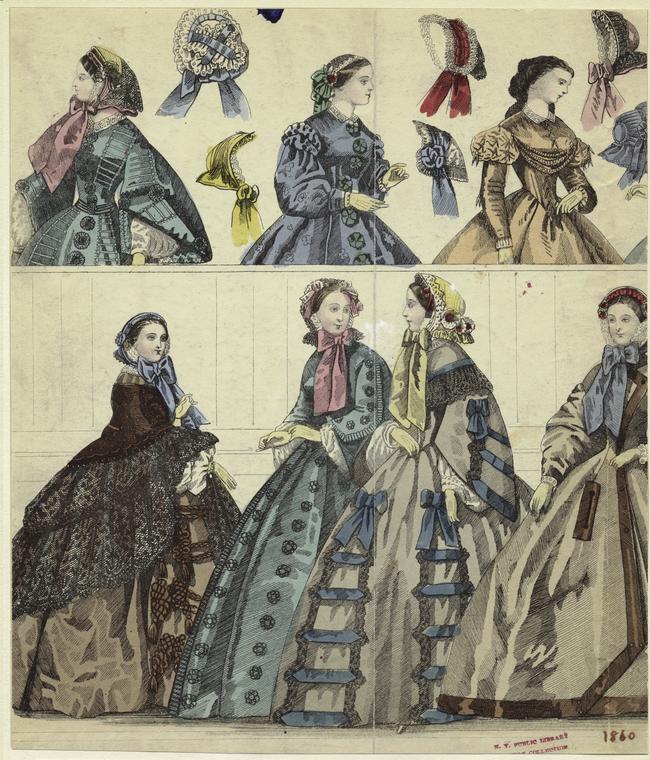
Women in dresses and bonnets, 1860

NEATNESS—
This is the first of all rules to be observed with regard to dress. Perfect cleanliness and careful adjustment of each article in the dress are indispensable in a finished toilet.  Let the hair be always smooth and becomingly arranged, each article exquisitely clean, neat collar and sleeves, and tidy shoes and stockings, and the simplest dress will appear well, while a torn or soiled collar, rough hair, or untidy feet will entirely ruin the effect of the most costly and elaborate dress. The many articles required in a lady's wardrobe make a neat arrangement of her drawers and closets necessary, and also require care in selecting and keeping goods in proper order. A fine collar or lace, if tumbled or soiled, will lose its beauty when contrasted with the same article in the coarsest material perfectly pure and smooth. Each article of dress, when taken off, should be placed carefully and smoothly in its proper place. Nice dresses should be hung up by a loop on the inside of the waistband, with the skirts turned inside out, and the body turned inside of the skirt. Cloaks should hang in smooth folds from a loop on the inside of the neck. Shawls should be always folded in the creases in which they were purchased. All fine articles, lace, embroidery, and handkerchiefs, should be placed by themselves in a drawer, always laid out smoothly, and kept from dust. Furs should be kept in a box, alone, and in summer carefully packed, with a quantity of lump camphor to protect from moths. The bonnet should always rest upon a stand in the band-box, as the shape and trimming will both be injured by letting it lie either on the face, sides, or crown.


ADAPTIVENESS —
Let each dress worn by a lady be suitable to the occasion upon which she wears it. A toilet may be as offensive to good taste and propriety by being too elaborate, as by being slovenly. Never wear a dress which is out of place or out of season under the impression that "it will do for once," or "nobody will notice it." It is in as bad taste to receive your morning calls in an elaborate evening dress, as it would be to attend a ball in your morning wrapper.


HARMONY—
To appear well dressed without harmony, both in color and materials, is impossible. When arranging any dress, whether for home,  street,  or evening,  be careful that each color harmonizes well with the rest, and let no one article, by its glaring costliness, make all the rest appear mean. A costly lace worn over a thin, flimsy silk, will only make the dress appear poorer, not, as some suppose, hide its defects. A rich trimming looks as badly upon a cheap dress, as a mean one does upon an expensive fabric. Observe this rule always in purchasing goods. One costly article will entirely ruin the harmony in a dress, which, without it, though plain and inexpensive, would be becoming and beautiful. Do not save on the dress or cloak to buy a more elaborate bonnet, but let the cost be well equalized and the effect will be good. A plain merino or dark silk, with a cloth cloak, will look much better than the most expensive velvet cloak over a cheap delaine dress.

"The war stopped being a joke when a girl like you doesn't know how to wear the latest fashion. And those pantalettes: I don't know a woman in Paris who wears pantalettes any more..." Rhett Butler after bringing Scarlett O'Hara the gift of a new hat, and she doesn't know how it's worn

FASHION—
Do not be too submissive to the dictates of fashion; at the same time avoid oddity or eccentricity in your dress. There are some persons who will follow, in defiance of taste and judgment, the fashion to its most extreme point; this is a sure mark of vulgarity. Every new style of dress will  admit of adaptation to individual cases, thus producing a pleasing, as well as fashionable effect. Not only good taste, but health is often sacrificed to the silly error of dressing in the extreme of fashion.  Be careful to have your dress comfortable and becoming, and let the prevailing mode come into secondary consideration; avoiding, always, the other extreme of oddity or eccentricity in costume.


STYLE AND FORM OF DRESS—
Be always careful when making up the various parts of your wardrobe, that each article fits you accurately. Not in the outside garments alone must this rule be followed, an ill-fitting pair of corsets, or wrinkles in any other article of the under-clothes, will make a dress set badly, even if it has been itself fitted with the utmost accuracy. A stocking which is too large, will make the boot uncomfortably tight, and too small will compress the foot, making the shoe loose and untidy. In a dress, no outlay upon the material will compensate for a badly fitting garment. A cheap calico made to fit the form accurately and easily, will give the wearer a more lady-like air than the richest silk which either wrinkles or is too tightly strained over the figure. Collars or sleeves, pinned over or tightly strained to meet, will entirely mar the effect of the prettiest dress.

ECONOMY—
And by economy I do not mean mere cheapness. To buy a poor, flimsy fabric merely because the price is low, is extravagance, not economy; still  worse if you buy articles because they are offered cheap, when you have no use for them. In purchasing goods for the wardrobe, let each material be the best of its kind. The same amount of sewing that is put into a good material, must be put into a poor one, and, as the latter will very soon wash or wear out, there must be another one to supply its place, purchased and made up, when, by buying a good article at first, this time and labor might have been saved. A good, strong material will be found cheapest in the end, though the actual expenditure of money may be larger at first.


COMFORT—
Many ladies have to trace months of severe suffering to an improper disregard of comfort, in preparing their wardrobe, or in exposure after they are dressed. The most exquisite ball costume will never compensate for the injury done by tight lacing, the prettiest foot is dearly paid for by the pain a tight boot entails, and the most graceful effects will not prevent suffering from exposure to cold. A light ball dress and exquisite arrangement of the hair, too often make the wearer dare the inclemency of the coldest night, by wearing a light shawl or hood, to prevent crushing delicate lace or flowers. Make it a fixed rule to have the head, feet, and chest well protected when going to a party, even at the risk of a crushed flower or a stray curl. Many a fair head has been laid in a coffin, a victim to consumption, from rashly venturing out of a heated ball room, flushed and excited, with only a light protection against keen night air. The excitement of the occasion may prevent immediate discomfort in such cases, but it adds to the subsequent danger.

DETAILS—
Be careful always that the details of your dress are perfectly finished in every point. The small articles of a wardrobe require constant care to keep in perfect order, yet they will woefully revenge themselves if neglected.  Let the collar, handkerchief, boots, gloves, and belts be always whole, neat, and adapted to the dress. A lace collar will look as badly over a chintz dress, as a linen one would with velvet, though each may be perfect of its kind. Attention to these minor points are sure tests of taste in a lady's dress. A shabby or ill fitting boot or glove will ruin the most elaborate walking dress, while one of much plainer make and coarser fabric will be becoming and lady-like, if all the details are accurately fitted, clean, and well put on. In arranging a dress for every occasion, be careful that there is no missing string, hook, or button, that the folds hang well, and that every part is even and properly adjusted. Let the skirts hang smoothly, the outside ones being always about an inch longer than the under ones; let the dress set smoothly, carefully hooked or buttoned; let the collar fit neatly, and be fastened firmly and smoothly at the throat; let shoes and stockings be whole, clean, and fit nicely; let the hair be smooth and glossy, the skin pure, and the colors and fabric of your dress harmonize and be suitable for the occasion, and you will always appear both lady-like and well-dressed.

HOME DRESSES

Woman in a "Home" or "Promenade" Dress 1860

MORNING DRESS—
The most suitable dress for breakfast, is a wrapper made to fit the figure loosely,  and the material, excepting when the winter weather requires woolen goods, should be of chintz, gingham, brilliante, or muslin. A lady who has children, or one accustomed to perform for herself light household duties, will soon find the advantage of wearing materials that will wash. A large apron of domestic gingham, which can be taken off,  if the wearer is called to see unexpected visitors, will protect the front of the dress, and save washing the wrapper too frequently. If a lady's domestic duties require her attention for several hours in the morning, whilst her list of acquaintances is large, and she has frequent morning calls, it is best to dress for callers before breakfast, and wear over this dress a loose sack and skirt of domestic gingham. This, while protecting the dress perfectly, can be taken off at a moment's notice if callers are announced. Married ladies often wear a cap in the morning, and lately, young girls have adopted the fashion. It is much better to let the hair be perfectly smooth, requiring no cap, which is often worn to conceal the lazy, slovenly arrangement of the hair. A few moments given to making the hair smooth and presentable without any covering, will not be wasted. Slippers of embroidered cloth are prettiest with a wrapper, and in summer black morocco is the most suitable for the house in the morning.


DRESS FOR MORNING VISITS—
A lady should never receive her morning callers in a wrapper, unless they call at an unusually early hour, or some unexpected demand upon her time makes it impossible to change her dress after breakfast. On the other hand, an elaborate costume before dinner is in excessively bad taste. The dress should be made to fit the figure neatly, finished at the throat and wrists by an embroidered collar and cuffs, and, unless there is a necessity for it, in loss of the hair or age, there should be no cap or head dress worn. A wrapper made with handsome trimming, open over a pretty white skirt, may be worn with propriety; but the simple dress worn for breakfast, or in the exercise of domestic duties, is not suitable for the parlor when receiving visits of ceremony in the morning.

 
EVENING DRESS—
The home evening dress should be varied according to circumstances. If no visitor is expected, the dress worn in the morning is suitable for the evening; but to receive visitors, it should be of lighter material, and a light head-dress may be worn. For young ladies, at home, ribbon or velvet are the most suitable materials for a head-dress. Flowers, unless they be natural ones in summer, are in very bad taste, excepting in cases where a party of invited guests are expected. Dark silk in winter, and thin material in summer, make the most suitable dresses for evening, and the reception of the chance-guests ladies in society may usually expect.


WALKING DRESSES—
Walking dresses, to be in good taste, should be of quiet colors, and never conspicuous. Browns, modes, and neutral tints, with black and white, make the prettiest dresses for the street. Above all, avoid wearing several bright colors. One may be worn with perfect propriety to take off the sombre effect of a dress of brown or black, but do not let it be too glaring, and wear but little of it. Let the boots be sufficiently strong and thick to protect the feet from damp or dust, and wear always neat, clean, nicely fitting gloves. The entire effect of the most tasteful costume will be ruined if attention is not paid to the details of dress. A soiled bonnet cap, untidy strings, or torn gloves and collar will utterly spoil the prettiest costume. There is no surer mark of vulgarity than over dressing or gay dressing in the street. Let the materials be of the costliest kind, if you will, but do not either wear the exaggerations of the fashion, or conspicuous colors. Let good taste dictate the limits where fashion may rule, and let the colors harmonize well, and be of such tints as will not attract attention.

FOR MORNING CALLS—
The dress should be plain, and in winter furs and dark gloves may be worn.


FOR BRIDAL CALLS—
The dress should be of light silk, the bonnet dressy, and either a rich shawl or light cloak; no furs, and light gloves. In summer, a lace or silk mantle and white gloves should be worn.


SHOPPING DRESSES—
Should be of such material as will bear the crush of a crowded store without injury, and neither lace or delicate fabrics should ever be worn. A dress of merino in winter, with a cloth cloak and plain velvet or silk bonnet is the most  suitable.  In summer,  a dress and cloak of  plain mode colored Lavella cloth, or any other cool but strong fabric, with a simply trimmed straw bonnet, is the best dress for a shopping excursion.

Women's fashions for winter in England

STORM DRESSES—
A lady who is obliged to go out frequently in bad weather, will find it both a convenience and economy to have a storm dress. Both dress and cloak should be made of a woolen material, (varying of course with the season,) which will shed water. White skirts are entirely out of place, as, if the dress is held up, they will be in a few moments disgracefully dirty. A woolen skirt, made quite short, to clear the muddy streets, is the proper thing. Stout, thick-soled boots, and gloves of either silk, beaver-cloth, or lisle thread, are the most suitable. The bonnet should be either of straw or felt, simply trimmed; and, above all, carry a large umbrella. The little light umbrellas are very pretty, no doubt, but to be of any real protection in a storm, the umbrella should be large enough to protect the whole dress.


MARKETING—
Here a dress of the most inexpensive kind is the best. There is no surer mark of vulgarity, than a costly dress in the market. A chintz is the best skirt to wear, and in winter a dark chintz skirt put on over a delaine dress, will protect it from baskets, and the unavoidable soils contracted in a market, while it looks perfectly well, and can be washed if required.


"A friendly hint to young ladies who wear those dear delightful barege dresses. Always let the slip (or whatever the mysterious garment is called) be as long as the outer dress?"- Punch


TRAVELING—
Traveling dresses should be made always of some quiet color, perfectly plain, with a deep mantle or cloak of the same material. When traveling with a young babe, a dress of material that will wash is the best, but it should be dark and plain. A conspicuous traveling dress is in very bad taste and jewelry or ornaments of any kind are entirely out of place. Let the dress be made of dark, plain material, with a simple straw or felt bonnet, trimmed with the same color as the dress, and a thick barege veil. An elastic string run through a tuck made in the middle of the veil, will allow one half to fall over the face, while the other half falls back,  covering the bonnet, and protecting it from dust. If white collars and sleeves are worn, they should be of linen, perfectly plain. Strong boots and thick gloves are indispensable in traveling, and a heavy shawl should be carried, to meet any sudden change in the weather. Corsets and petticoats of dark linen are more suitable than white ones, as there is so much unavoidable dust and mud constantly meeting a traveler.

Woman in Ball Costume 1860

EVENING DRESSES—
Must be governed by the number of guests you may expect to meet, and the character of the entertainment to which you are invited. For small social companies, a dark silk in winter, and a pretty lawn, barege, or white muslin in summer, are the most appropriate. A light head-dress of ribbon or velvet, or a plain cap, are the most suitable with this dress. For a larger party, low-necked, short-sleeved silk, light colored, or any of the thin goods made expressly for evening wear, with kid gloves, either of a color to match the dress or of white; black lace mittens are admissible, and flowers in the hair. A ball dress should be made of either very dressy silk, or light, thin material made over silk. It should be trimmed with lace, flowers, or ribbon, and made dressy. The coiffure should be elaborate, and match the dress, being either of ribbon, feather, or flowers. White kid gloves, trimmed to match the dress, and white or black satin slippers, with silk stockings, must be worn.

"There is such a variety of opinion upon the subject of mourning, that it is extremely difficult to lay down any general rules upon the subject." Mourning Dresses 1860

MOURNING—
There is such a variety of opinion upon the subject of mourning, that it is extremely difficult to lay down any general rules upon the subject. Some wear very close black for a long period, for a distant relative; whilst others will wear dressy mourning for a short time in a case of death in the immediate family. There is no rule either for the depth of mourning, or the time when it may be laid aside, and I must confine my remarks to the different degrees of mourning.

For deep mourning,  the dress should be of  bombazine, Parramatta cloth, delaine, barege, or merino, made up over black lining. The only appropriate trimming is a deep fold, either of the same material or of crape. The shawl or cloak must be of plain black, without border or trimming, unless a fold of crape be put on the cloak; the bonnet should be of crape, made perfectly plain, with crape facings, unless the widow's cap be worn, and a deep crape veil should be thrown over both face and bonnet. Black crape collar and sleeves, and black boots and gloves. The next degree is to wear white collar and sleeves, a bow of crape upon the bonnet, and plain white lace facings, leaving off the crape veil, and substituting one of plain black net. A little later, black silk without any gloss, trimmed with crape, may be worn, and delaine or bombazine, with a trimming of broad, plain ribbon, or a bias fold of silk. The next stage admits a silk bonnet trimmed with crape, and lead color, dark purple, or white figures on the dress. From this the mourning passes into second mourning. Here a straw bonnet, trimmed with black ribbon or crape flowers, or a silk bonnet with black flowers on the outside, and white ones in the face, a black silk dress, and gray shawl or cloak, may be worn. Lead color, purple, lavender, and white, are all admissible in second mourning, and the dress may be lightened gradually, a white bonnet, shawl, and light purple or lavender dress, being the dress usually worn last, before the mourning is thrown aside entirely, and colors resumed. It is especially to be recommended to buy always the best materials when making up mourning. Crape and woolen goods of the finest quality are very expensive, but a cheaper article will wear miserably; there is no greater error in economy than purchasing cheap mourning, for no goods are so inferior, or wear out and grow rusty so soon. 

From “The Ladies’ Book of Etiquette and Manual of Politeness” by Florence Hartley, 1860

🍽️Etiquette Enthusiast, Maura J. Graber of The RSVP Institure of Etiquette, is the Site Editor for Etiquipedia© Etiquette Encyclopedia