Showing posts with label Smoking Manners. Show all posts

Tuesday, September 22, 2026

Did 80’s Manners Kill Smoking Customs?

Smoking in public is again becoming bad manners. The private label “impolite” may ultimately have more effect on people’s behavior than the surgeon general’s label “unhealthy.”

BOSTON The man seated at the table on my right is smoking. Actually, he is just holding. The cigarette is smoking. Nevertheless, due to my own charm and magnetic appeal, the smoke has chosen to drift directly from his left hand to my right eye.

With a gesture born of years of experience, I subtly wave my menu at the offending current. The man doesn't notice. I then lean over, tap him on the shoulder and ask if he would mind redirecting his smoke. The man apologizes sheepishly, and shifts the cigarette from one hand to the other.

The smoke now begins to drift into the eyes of another diner. This man tips his chair back, touches the smoker on the arm and asks if he would please rechannel the flow. The smoker sighs and with a gesture of defeat, squashes the glowing offender into the glass ashtray.

At the moment his cigarette meets its premature end, it occurs to me that the same vignette is being repeated a thousand times a day in a thousand restaurants, offices, airports, and shopping lines.

The smokers who once owned the air are being pushed back into special zones and corners and closets. They can be seen searching desperately for ashtrays, stepping out for smokes, and holding their cigarette over their heads, directly under an exhaust fan. It's all a bit like watching the Virginia Slims reel go into reverse. Smoking in public is again becoming bad manners. The private label “impolite” may ultimately have more effect on people’s behavior than the surgeon general’s label “unhealthy.”

If so, it won't be the first time that social pressure has made social history. This is precisely what happened to an ancient and honorable habit known as spitting. In Norbert Elias’ book, “The History of Manners,” he describes a host of changing attitudes and habits from medieval times to ours. He even gives a brief chronology of how spitting became a victim of “civilization.”

Medieval etiquette authors started with the basics: “Do not clean your teeth with your knife. Do not spit on or over the table.” Spitting under the table in those days was allowed even among the best company.

Sometime during the 16th century, our genteel ancestors were being advised to refrain from spitting during mealtime. By the 17th century, they were admonished not to spit on the ground.

The spit repression went on for centuries. In 1859, when spittoons had become a proper substitute for the ground or the napkin, one arbiter of good taste was advising: “Spitting is at all times a disgusting habit. I need say nothing more than never indulge in it.” Fifty years later by 1910, even the spittoon had vanished like some relic of a coarser age.

By now, public spitting itself has virtually disappeared except among the crude, the coughing, and the baseball players. Even writing about it feels vaguely improper. We now consider spitting “uncivilized” and this whole change in social behavior is called “progress.”

As Elias describes the evolution of manners: “The decisive role (was) played in this civilizing process by a very specific change in the feelings of shame and delicacy.”

Admittedly, during the past half-century smoking flourished. There was little support in this era for the virtues of “shame and delicacy.” People worried more about repression than rudeness. I suspect that smoking was an example of pseudo-freedom.

But now, with the help of medical researchers, civilization is creeping up again on the tobacco barbarians. You can see it in clear signs — “Smoking Not Permitted” - and dirty looks. The balance of embarrassment has shifted from non-smokers to smokers. The balance of rudeness has shifted from the critics of smoke to the purveyors of smoke.

Will smoking go the way of spitting, from rude to extinct? Remember what happened to the spittoon. If you have any stock in ashtrays, sell. — By Ellen Goodman for the Boston Globe, 1982


 🍽Etiquette Enthusiast, Maura J. Graber of The RSVP Institute of Etiquette, is the Site Editor for the Etiquipedia© Etiquette Encyclopedia

Thursday, December 1, 2016

19th C. Global Cigarette Etiquette

The idea is that it is more courteous to allow a comrade the greater length of time. If he is handed the match first he naturally hurries in order to hand it back again. 

There is a fashion even in so small a thing as the lighting of a cigarette. In Cuba it is customary among gentlemen for one to place the cigarette between his lips, light it, take a few puffs and then hand it to his friend. In Spain the same fashion prevails. An Austrian is very punctilious about the etiquette of cigar lighting. He lights his cigarette first and then hands the lighted match to his companion. The idea is that it is more courteous to allow a comrade the greater length of time. If he is handed the match first he naturally hurries in order to hand it back again. 

A Frenchman always hands his companion the match first. An Englishman proffers the cigarette to his friend, lights a match, hands it to him, and then helps himself to another cigarette and match. An American usually hands his friend a lighted match and takes a light from his cigarette afterward. The small boy gets a light wherever he can, generally from some passer-by on the street. The habit of stopping men on the street to ask for a light is looked upon as ill-bred in all countries. In no country is it tolerated to such an extent as in the United States. — The New York Mail and Express, 1887


Etiquette Enthusiast, Maura J Graber, is the Site Editor for the Etiquipedia© Etiquette Encyclopedia
Wednesday, November 9, 2016

Gilded Age Tobacco Etiquette

The demoiselles of the Moulin Rouge and the Casino are not permitted to smoke in those temples of light amusement, and the girls of the boulevard do not smoke in the cafés.
Etiquette in Public
With regard to etiquette in the use of tobacco in public places there is not much to say, as smoke is as free as air. This is in accordance with the universal European custom. Men smoke in restaurants, cafés and at most of the hotel tables. Women do not smoke publicly. Whether or not they smoke in private is a matter for each man's experience.

I have never seen a French lady smoke. Once, in Dresden, I saw a married lady puff a cigarette after dinner in a fashionable restaurant; and once I saw two English girls, seemingly of the upper middle class, smoking cigarettes in a railroad carriage, where they were alone. Here my knowledge ends.

The demoiselles of the Moulin Rouge and the Casino are not permitted to smoke in those temples of light amusement, and the girls of the boulevard do not smoke in the cafés. At the Café Anglais, which is still nearly as chic as ever, smoking is not permitted until after eight p.m. But rules like these are resented and scarcely ever enforced. —Paris Correspondent, The Washington Star, 1892

Etiquette Enthusiast, Maura J Graber, is the Site Moderator and Editor for the Etiquipedia Etiquette Encyclopedia

Saturday, January 23, 2016

Etiquette of Women Smokers

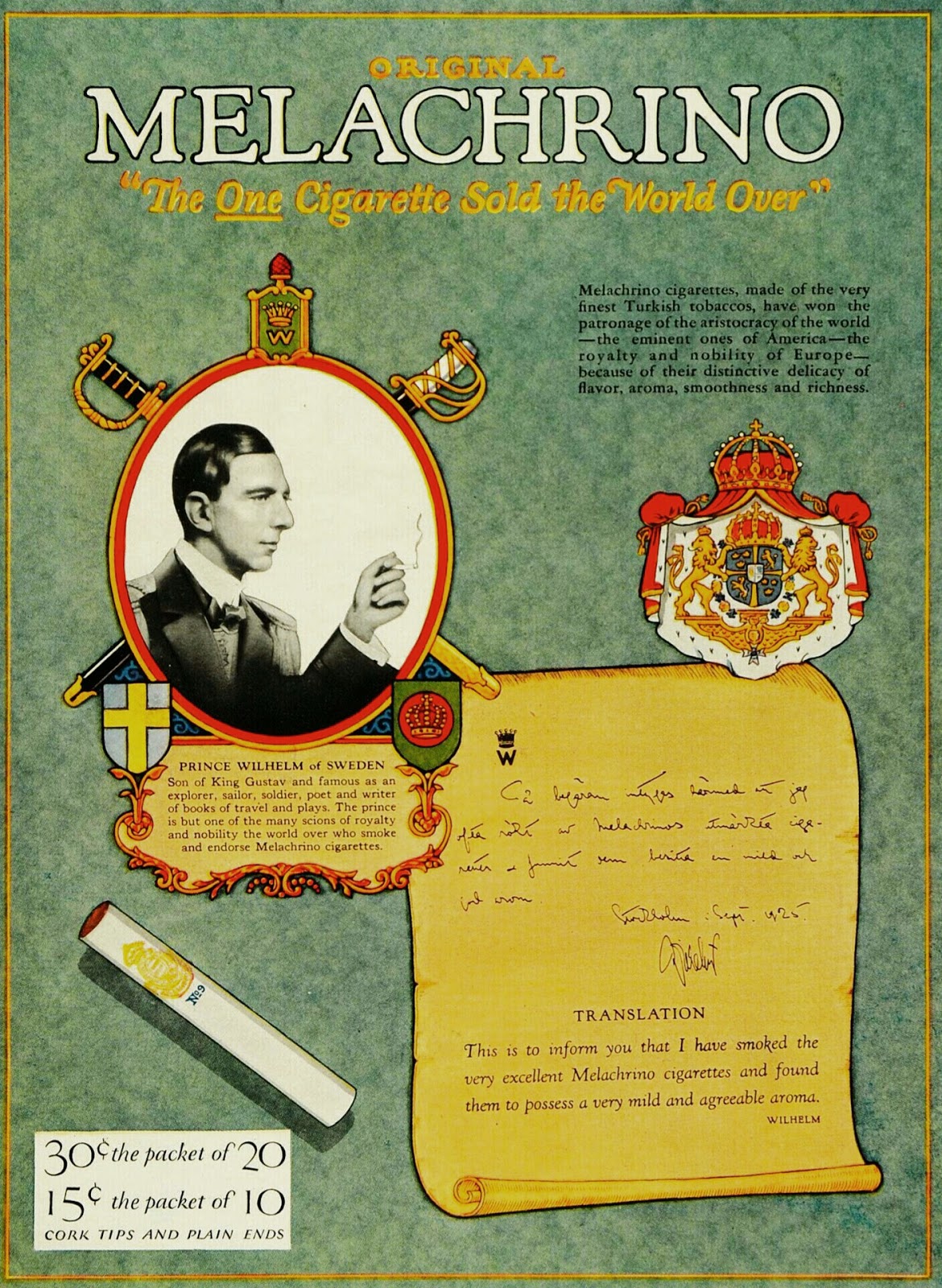
The Russian, Sobranie cigarette brand is one of the oldest luxury tobacco brands in the world. Sobranie of London was established in 1879 when smoking cigarettes became fashionable in Europe. Blended from a secret formula, the original cigarettes were handmade in the Russian tradition. Sobranie was the supplier of the Imperial Court of Russia, and of royal courts of Great Britain, Spain, Romania, and Greece. 


Women Smokers in Paris... This May Be Seen in All the Smart Hotels, Cafés and Restaurants

In these days when the congeniality of women and the cigarette is being so heatedly discussed on this side of the water, it is interesting to read this pen picture by the Paris correspondent of Vogue in regard to the prevalence of the habit on the Riviera; 

The habit prevails everywhere. In all the smart hotels, cafés and restaurants I have entered, and they are many. I have seen at tea time, after dinner, and after supper late at night, correct-appearing women of all ages, with equally correct men, sit calmly lighting with growing gestures, their tiny Russian cigarettes. 

Other women, women one counts out, do the same thing differently. Their gestures are more pronounced, their attitude more coquettlsh — their pretty feet are perhaps crossed, revealing dainty embroidered lingerie skirts and lace stockings to match their gowns. They make much of the pretty poses taken in the frequent lighting of their gold-tipped cigarettes from the wax taper held by an obsequious attendant. 

It is a living picture, and an interesting one — like a page from a French novel. When first I saw women of conventional manners smoke in a public room it was at the beginning of my stay here. I was sitting alone over my tea in the palm-shaded, flower-decked, tearoom of a great hotel, idly listening to sweet music from a hidden band. 

Just opposite me sat two women, unmistakably English, and, after the manner of many traveling English-women, rather dowdy in dress. A puff of smoke caught my eye; one had lighted a cigarette, the other was carefully selecting one from a carved sliver cigarette case. I looked about with interest, wondering what was going to happen. 

At the next table, I saw as I turned my head, a beautiful dark-browed woman, splendidly gowned in embroidered white cloth and wearing draped gracefully over her ams, a long, straight ermlne-llned velvet scarf. She lifted her hand with a slight gesture which brought a waiter to her side with a tiny tray of cigarettes. Daintily she selected one, lighted it, then leaned back luxuriously into the soft depths of the big easy chair to watch serenely the wreaths of smoke float above her head. — Lompoc Journal, 1908


Etiquette Enthusiast, Maura J. Graber is the Site Editor for the Etiquipedia© Etiquette Encyclopedia

Tuesday, November 10, 2015

Victorian Etiquette of Tobacco Use

You have the same right to smoke, take snuff, and chew that you have to indulge in the luxuries of a filthy skin and soiled garments, but you have no right, in either case, to do violence to the senses and sensibilities of other people by their exhibition in society. 


Victorian Etiquette Advice on Tobacco

If you use tobacco, in any forth, allow us to whisper a useful hint or two in your ear...

Smoking, snuff-taking, and especially chewing, are bad habits at best, and in their coarser forms highly disgusting to pure and refined people, and especially to ladies. You have the same right to smoke, take snuff, and chew that you have to indulge in the luxuries of a filthy skin and soiled garments, but you have no right, in either case, to do violence to the senses and sensibilities of other people by their exhibition in society. 

Smoke if you will, chew, take snuff (against our earnest advice, however), make yourself generally and particularly disagreeable, but you must suffer the consequences — the social outlawry which must result.

Shall we convert our parlors into tobacco shops, risk the ruin of our carpets and furniture from the random shots of your disgusting saliva, and fill the whole atmosphere of our house with a pungent stench, to the discomfort and disgust of everybody else, merely for the pleasure of your company? We have rights as well as you, one of which is to exclude from our circle all persons whose manners or habits are distasteful to us. You talk of rights. You can not blame others for exercising theirs.

There are degrees here as everywhere else. One may chew a little, smoke an occasional cigar, and take a pinch of snuff now and then, and if he never indulges in these habits in the presence of others, and is very careful to purify his person before going into company, he may confine the bad effects, which he can not escape, mostly to his own person. But he must not smoke in any parlor, or sitting-room, or dining room, or sleeping chamber, or in the street, and particularly not in the presence of ladies, anywhere. – From 1887's "How to Behave"


Etiquette Enthusiast, Maura J .Graber, is the Editor and Site Moderator for Etiquipedia© Etiquette Encyclopedia

Thursday, May 22, 2014

Gilded Age Tobacco Etiquette

If you are so unfortunate as to have contracted the low habit of smoking, be careful to practise it under certain restrictions; at least, so long as you are desirous of being “being considered fit for civilized society.

SMOKING


IF you are so unfortunate as to have contracted the low habit of smoking, be careful to practice it under certain restrictions; at least, so long as you are desirous of being “being considered fit for civilized society.

The first mark of a gentleman is a sensitive regard for the feelings of others; therefore, smoke where it is least likely to prove personally offensive by making your clothes smell; then wash your mouth, and brush your teeth. What man of delicacy could presume to address a lady with his breath smelling of onions ? Yet tobacco is .equally odious. -The tobacco smoker, in public, is the most selfish animal imaginable.  He perseveres in contaminating the pure arid fragrant air, careless whom he Annoys, and is but the fitting inmate of a tavern.

Smoking in the streets, or in a theatre is only practiced by shop-boys, pseudo-fashionables — and-the "SWELL MOB."

All songs that you may see written in praise of smoking in magazines or newspapers, or hear sung upon tne stage, are puffs, paid for by the proprietors of cigar divans and tobacco shops, to make their trade popular, — therefore, never believe nor be deluded by them.

'Chewing tobacco Is an abominable habit. One which has ascended to the better ranks in Africa from those "ancient mariners" who were the followers of the original settlers.  It is a custom, therefore, essentially vulgar — often lamented, indeed, by those unfortunate enough to practice it, who are without the strength of mind sufficient to discontinue it. The spitting consequent on chewing tobacco, has been made matter of grave comment, or of well-founded ridicule, by all foreigners who have visited the United States. It is, indeed, directly at variance with all the decencies of life. What an article is a spittoon as an appendage to a handsomely furnished drawing-room! What a nasty receptacle for a secretion entirely the result of an unnecessary practice!  Half the consumptions in America are brought on by people spitting up their lungs. Besides, how few men would like to "do the sentimental" to a lady given to "chaw"! Gentlemen, then, should reverse the case, and ask themselves whether ladies would not, at all times, give a preference to those who are not addicted to so disagreeable a practice.

In public places, too, only reflect on the offensive necessity of stepping over pools of brown spittle! or the still more disgusting task of wading through it! The first step towards becoming " gentlemen " is the abandonment of habits universally reprobated in civilized life.”

Never be seen in cigar divans or billiard rooms; they are frequented, at best, by an equivocal set. Nothing good can be gained there — and a man loses his respectability by being seen entering or of coming out of such places.

Those who have any brains never take snuff at all.

SNUFF


As snuff-taking is merely an idle, dirty habit, practised by stupid people in the unavailing endeavor to clear their stolid intellect, and is not a custom particularly offensive to their neighbors, it may be left to each individual taste as to whether it be continued or not. An " Elegant" cannot take much snuff without decidedly " losing caste."

" Doctor," said an old gentleman, who was an inveterate sriuff-taker, to a physician, " is it true that snuff destroys the olfactory nerves, clogs, and otherwise injures the brain ? " " It cannot be true," was the caustic reply, " since those who have any brains never take snuff at all.”  From George Rippey Stewart, 1895's, “Hints on etiquette and the usages of society with a glance at bad habits ; adapted to American society.” 

Smoking Etiquette


“In every class of life, in all professions and occupations, good manners are necessary to success. The business man has no stock-in-trade that pays him better than a good address. If the retail dealer wears his hat on his head in the presence of ladies who come to buy of him, if he does not see that the heavy door of his shop is opened and closed for them, if he seats himself in their presence, if he smokes a pipe or cigar, or has a chew of tobacco in his mouth, while talking with them, or is guilty of any of the small incivilities of life, they will not be apt to make his shop a rendezvous, no matter how attractive the goods he displays.

It is neither respectful nor polite to smoke in the presence of ladies, even though they have given permission, nor should a gentleman smoke in a room which ladies are in the habit of frequenting. In those homes when the husband is permitted to smoke in any room of the house, the sons will follow the father's example, and the air of the rooms becomes like that of a public house.” – From John H. Young, 1879's “Our Deportment / Or the Manners, Conduct and Dress of the Most Refined Society.” 


On Smoking


“One must never smoke, nor even ask to smoke, in the company of the fair. If they know that in a few minutes you will be running off to your cigar, the fair will do well—say it is in a garden, or so—to allow you to bring it out and smoke it there. 

One must never smoke, again, in the streets; that is, in daylight. The deadly crime may be committed, like burglary, after dark, but not before. 

One must never smoke in a room inhabited at times by the ladies; thus, a well-bred man who has a wife or sisters, will not offer to smoke in the dining-room after dinner. 

One must never smoke in a public place, where ladies are or might be, for instance, a flower-show or promenade. 

One may smoke in a railway-carriage in spite of by-laws, if one has first obtained the consent of every one present; but if there be a lady there, though she give her consent, smoke not. In nine cases out of ten, she will give it from good nature. 

One must never smoke in a closed carriage; one may ask and obtain leave to smoke when returning from a pic-nic or expedition in an open carriage. 

One must never smoke in a theatre, on a race-course, nor in church. This last is not, perhaps, a needless caution. 

In the Belgian churches you see a placard announcing, ‘Ici on ne mâche pas du tabac.’ One must never smoke when anybody shows an objection to it. 

One must never smoke a pipe in the streets; one must never smoke at all in the coffee-room of a hotel. 

One must never smoke, without consent, in the presence of a clergyman, and one must never offer a cigar to any ecclesiastic.

But if you smoke, or if you are in the company of smokers, and are to wear your clothes in the presence of ladies afterwards, you must change them to smoke in. A host who asks you to smoke, will generally offer you an old coat for the purpose. You must also, after smoking, rinse the mouth well out, and, if possible, brush the teeth. 

You should never smoke in another person’s house without leave, and you should not ask leave to do so if there are ladies in the house. When you are going to smoke a cigar you should offer one at the same time to anybody present, if not a clergyman or a very old man. You should always smoke a cigar given to you, whether good or bad, and never make any remarks on its quality.
 – From Cecil B. Hartley's 1873, “The Gentlemen's Book of Etiquette and Manual of Politeness / Being a Complete Guide for a Gentleman's Conduct in all / his Relations Towards Society.”


Etiquette Enthusiast, Maura J. Graber, is the Site Editor for the Etiquipedia© Etiquette Encyclopedia