Showing posts with label French Royal Court Etiquette. Show all posts

Friday, November 4, 2022

Etiquette of Placing the Furniture

“During the palmy days of the French Bourbon Kings, when court etiquette reached a point of greater complexity than it has ever reached before or since, there was quite a lot that the well bred— that is to say courtly man or woman— had to know about managing himself with respect to furniture.” — The table at which Marie Antoinette ate at Versailles

“Habit is a second nature.”— Montaigne


During the palmy days of the French Bourbon Kings, when court etiquette reached a point of greater complexity than it has ever reached before or since, there was quite a lot that the well bred— that is to say courtly man or woman— had to know about managing himself with respect to furniture. And more time was spent in teaching the future grandee of France how to wave a person to a chair, how to take his own seat in the presence of the king, and otherwise how to manipulate the furniture than unfortunately was spent on teaching him the principles of good government.

Though we don't worry much about how we manage the furniture now, still there are some things that every person who wants to appear at ease in his own or other people’s houses should remember. Children should be very early reminded and impressed with the fact that chairs were meant to sit on, and not to be used as rocking horses, for sometimes your children in other people’s houses forget this and the furniture that someone else values highly is put out of commission as a result.

It is in really bad form to tip back on two legs of a chair, save possibly among men in their club or in their offices. One very good reason for this is that most fine furniture will not stand such rough treatment. At dinner table it is in bad form to turn your chair out of its straight position before the table to facilitate conversation with a person at one side or the other or for the purpose of taking a more comfortable position in the chair. 

When the custom is for women to leave the dining room after dessert, the men, left to their smokes and their own conversation, may, however, place their chairs to suit themselves, even leaving their given places at table to go talk to someone in some other position at the table. But this would never be done save after the women of the party had left the room.

It is not customary to change the position of a chair in another person’s house. If you wish to change your positon take another chair. However, the considerate hostess often makes rearrangements of smaller chairs to suit the convenience of guests or asks some man present to do this for her. For instance, in order that a guest might get a better light for a bit of needle work or might better see some pictures that were being shown.

A house guest would hardly move any piece of furniture, save possibly a small chair, in her room unless it were for some very good reason and then she should consult her hostess about it. — By Mary Marshall Duffee, 1918


🪑Etiquette Enthusiast, Maura J Graber, is the Site Editor for the Etiquipedia© Etiquette Encyclopedia

Thursday, October 6, 2022

Etiquette is a Social Lubricant

There is no special etiquette for our way of bathing, though there was for poor little Queen Marie Antoinette, who always bathed with a group of ladies-in-waiting looking on. Because we bathe in private, we can hold the soap as we please and splash as loudly as we want without running the risk of being ill bred. All society asks us is that, we shall be well tubbed and we can suit ourselves as to the method of securing that result. —Kirsten Dunst and Judy Davis portraying a young Marie Antoinette and “Madame Etiquette” in the 2006 film, “Marie Antoinette” — Photo source, Pinterest 


Sometimes, as was the case in the court of Louis XIV of France, etiquette runs away with itself and becomes ridiculous. In that court it was a breach of etiquette if anyone but a certain nobleman handed the King his Royal undershirt when he awoke in the morning. Another noble held his wash basin and another held the taper to his prayer book when he went through his friendly devotions. If we look far enough back in history we could find that even these absurd regulations had their basis in a matter of convenience.

Etiquette is the lubricating oil that makes the wheels of society run smoothly, and when Royal etiquette stipulates that a dozen or so graybeards, including the Prime Minister, should be present at the birth of a King’s son, you may be sure that that rule originated so that later no one might suggest that the heir to the throne was a changeling or an imposter. And the custom or etiquette goes on after most folk have forgotten the “why or wherefore” of it.

In present day American etiquette a constant weeding-out process is taking place. Almost as soon as the need for a certain rule of etiquette passes out, the etiquette becomes old fashioned, too. Practically every regulation of our etiquette can be traced to convenience or consideration. Take, for instance, the matter of table etiquette, the whole idea of our so-called table manners is to make meal time a period of pleasing process. 

If we all ate in private we might have the manners of pigs and give no one offense. But since we usually eat with our friends or families we must be very careful. We must go about it noiselessly and hence we have a certain list of rules for the management of the spoon and fork and knife, and because we would give offense to others if we spilled our food and were untidy about it, we have another set of rules for the management of the napkin, our position at the table and our mode, of masticating. In determining how to eat the various kinds of foods the idea seems to be to find a way by which the process can be made less offensive. 

There is no special etiquette for our way of bathing, though there was for poor little Queen Marie Antoinette, who always bathed with a group of ladies-in-waiting looking on. Because we bathe in private, we can hold the soap as we please and splash as loudly as we want without running the risk of being ill bred. All society asks us is that, we shall be well tubbed and we can suit ourselves as to the method of securing that result.

If we were hermits or Robinson Crusoes we should have few pages to our books of etiquette. So the closer we live, together, the more careful we should be of our manners. And for this reason, the city folks who dwell close together have to think more of etiquette than country folk. Complicated machinery always needs more lubricating oil than machinery of few parts and so folk who live in close contact with one another need the most rules of etiquette. — By Mary Marshall Duffee, 1917


🍽Etiquette Enthusiast, Maura J. Graber, is the Site Editor for Etiquipedia© Etiquette Encyclopedia

Monday, May 2, 2022

Thoughts on Etiquette Absurdities

“It was a rule of etiquette in France during the reign of ‘Le Roi Soleil,’ the great Louis XIV, that when the King visited a sick subject the King, too, must lie down in a bed on the ground that it would never do for a subject to maintain a more informal attitude than his master during the audience. Louis XIV visiting the Marshal de Villars after Malplaquet, lay in a bed beside the suffering soldier in that way.


Etiquette… An Old Fashioned Man Frees His Mind About Its Absurdities

“Whether to eat fish with a fish knife and fork or a fork and a bit of bread, whether to serve champagne in a tumbler or a goblet—it is quite absurd to regard one of these courses as right and the other as wrong and to admire or despise a person accordingly. The average rule of etiquette has nothing to do with courtesy, with good breeding, and it is no criterion of courtesy or of good breeding.” The speaker, an old fashioned gentleman from the country, knotted the ends of his napkin more firmly about his neck. ‘‘Smile at me, nephews and nieces,” he resumed, “because I tuck my napkin under my chin. Yet, why should I spoil my black broadcloth coat with turkey stains or smears of cranberry sauce? 

It is a rule of etiquette, you say, that the napkin may only be placed across the knee—an absurd, ephemeral rule! “It was a rule of etiquette in France during the reign of ‘Le Roi Soleil,’ the great Louis XIV, that when the King visited a sick subject the King, too, must lie down in a bed on the ground that it would never do for a subject to maintain a more informal attitude than his master during the audience. Louis XIV visiting the Marshal de Villars after Malplaquet, lay in a bed beside the suffering soldier in that way. Behold the absurdities of etiquette and let me do with my napkin what I please.” —New Orleans Times-Democrat, 1909


Etiquette Enthusiast, Maura J. Graber, is the Site Editor for the Etiquipedia© Etiquette Encyclopedia

Saturday, April 1, 2017

Squalor and Etiquette at Versailles

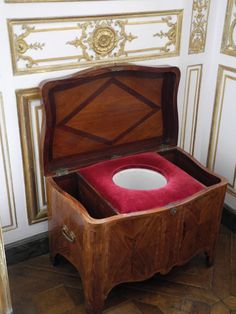
A royal chamber pot from Versailles -There were no bathrooms as we would know them. Courtiers and royalty used decorative commodes in each room, while commoners simply relieved themselves in the hallways or stairwells. No one bothered to house-train the royal dogs, and servants did not consider cleaning up after them to be part of their job description.

The palace of Versailles was once the most lavish large home in the world, the residence of the French royal family along with hundreds of their courtiers and servants. Containing half-a-million square feet, the palace compound has 700 rooms and 67 staircases. With lofty ceilings, gilded crown moldings, decorative floors, and 6000 paintings, there were also extensive servants’ quarters, kitchens, stables, and services.

Versailles was the creation of Louis XIV of France, who obsessively enlarged and enhanced his residence for more than 30 years during the 1600s. Today it’s toured by three million visitors annually, all hoping for a glimpse of the royal lifestyle.


This was the royal family’s private chapel for religious services

The Baroque aesthetic was to leave no surface unadorned. Every royal chamber has gilded paneling and crown molding; every wall has brocaded or flocked wall coverings; every ceiling is covered with allegorical paintings of Greek gods; every floor is patterned parquet or colored tiles. The hallways were done up with contrasting colors of veined marble. Everything inside, from furniture to finishes, is a visual froth of embellishments. Versailles in its day was so visually overpowering that it inspired copycat palaces all across Europe.

The chateau began as a hunting lodge built by Louis XIV’s father, fifteen miles southwest of Paris. Louis grew up during a tumultuous French civil war called the Fronde, during which he was surrounded by conspirators, had no pocket money and slept on ragged sheets. His mother even had to pawn the crown jewels. After consolidating his power as King, Louis compensated for childhood privations by building himself the most luxurious palace imaginable. He continued enlarging it throughout much of his life.


The public could watch the royals from behind the golden railing (at the bottom of the photo), so that there was no privacy for the royal family, even in bed.

The original hunting lodge was embedded within a vast series of newer buildings. Floors were added on top of existing structures, courtyards were filled in by new living spaces, wings were built, stables were constructed, staircases were built and then moved, service hallways added and then altered. The place became a complex maze containing sparkling state apartments as well as uncomfortable attic garrets tucked beneath the roof.

Ongoing construction at the palace provided job security to hundreds of masons, carpenters, plasterers, gilders, painters and landscapers. An immense support staff was maintained, consisting of cooks, valets, gardeners, grooms, hairdressers, and tailors. Vegetables and fruits to feed the masses were provided by a large potager, or kitchen garden.

But life in a palace wasn’t necessarily peaceful or enjoyable. The place was a vast hive of activity. Hundreds of courtiers lived alongside the royal family at Versailles, with their families as well. Nobles who could afford it often moved out of the crowded palace and constructed their own houses beyond the golden gates in the town of Versailles.

Versailles became a tourist destination almost from the beginning. The first visitor’s guide was published in the late 1600s. Anyone was granted entry to the grounds and the palace as long as the dress code was observed. (Hats and swords for men could be rented from the concierge at the gate.) Entry included the ability to enter into the royal apartments. 

A gilded railing separated the royal half of each room from the spectators’ portion. Behind these gilded railings, a series of private doors were built into the back paneling of the royal apartments, leading to secret hallways and stairs which allowed royalty to move from one room to another while remaining hidden from public view. Years later, in 1789, Queen Marie-Antoinette temporarily escaped the revolutionary mob by slipping through one of these doors to the king’s chamber.

Marie-Antoinette (married to Louis XIV’s great-great-grandson, Louis XVI) chafed at being on display even when in her bedroom. When she gave birth to her first child at Versailles, the entire royal family and all the major state officials came to witness the event. Hordes of other inquisitive people crowded in as well, in such numbers that spectators were crushed against the furniture and walls and movement was impossible.

It’s difficult to believe today when gazing at the gleaming golden palace, but life at Versailles was actually quite dirty. There were no bathrooms as we would know them. Courtiers and royalty used decorative commodes in each room, while commoners simply relieved themselves in the hallways or stairwells. No one bothered to house-train the royal dogs, and servants did not consider cleaning up after them to be part of their job description. The constantly-altered chimneys did not draw well, so everything inside was covered with soot. The filth and disorder at Versailles during the ancient regime were noted in many records of the time.

Life at Versailles was not just foie-gras served on golden plates. In need of cleaning, requiring expensive maintenance, and with in-laws living in the wings, Versailles was not so very different from many homes today. — A previous version of this article appeared in the Bloomington, Herald-Times in 2009


 🍽Etiquette Enthusiast, Maura J. Graber of The RSVP Institute of Etiquette, is the Site Editor for the Etiquipedia© Etiquette Encyclopedia

Friday, March 17, 2017

Etiquette and Marie Antoinette


Anne d'Arpajon, aka "Madame Etiquette" ~A French aristocrat and First Lady of Honour to Queens of France, Marie Leszczyńska and Marie Antoinette, Anne d'Arpajon was called "Madame Etiquette" by Marie Antoinette for her insistence that no minutia of court etiquette ever be disregarded or altered in any way. 

Dressing the French Queen

What a cruel ceremony was the dressing of that tame Queen! When Maria Antoinette, in the days of her cumbersome greatness, stood of a morning in the centre of her bed chamber, awaiting, after her bath, her first article of dress. It was presented to her, or rather it was passed over her royal shoulders by the "Dame d'Honneur." Perhaps, at the moment, a "Princess of the Blood" entered the room (for French Queens both dressed and dined in public), the right of putting on the primal garment of Her Majesty immediately devolved upon her, but it could not be yielded to her by the "Dame d'Honneur;" the latter, arresting the chemise de la reine as it was passing down the royal back, adroitly whipped it on, and, presenting it to the "Premiere Dame," that Noble lady transferred it to the "Princess of the Blood."

Madame d'Arpajon had once to give it up to the Duchess of Orleans, who, solemnly taking the same, was on the point of throwing it over the Queen's head, when a scratching (it was contrary to etiquette to knock) was heard at the door of the room. Thereupon entered the Countess de Provence, and she being nearer to the throne than the Lady of Orleans, the latter made over her office to the new comer, in the meantime, the Queen stood like Venus as to covering, but shaking with cold, for it was mid-winter, and muttering, "what an odious nuisance." The Countess de Provence entered on the mission which had fallen to herself, and this she did so awkwardly, that she entirely demolished a head-dress which had taken three hours to build. The Queen beheld the devastation, and got warm by laughing outright. – D. Doran, 1855


Etiquette Enthusiast, Maura J Graber, is the Site Moderator and Editor for the Etiquipedia© Etiquette Encyclopedia

Tuesday, April 19, 2016

Napkin Etiquette at Versailles

The Table Napkin — Curiously enough, that article now considered almost indispensable, the table napkin, was first used only by children and was only adopted by elder members of the family about the middle of the 15th century. In etiquette books of an earlier date than this, among other sage pieces of advice for children, are instructions about wiping their fingers and lips with their napkins. It seems that the tablecloth was long enough to reach the floor and served the grown people in place of napkins. When they did begin to use napkins, they placed them first on the shoulder, then on the left arm and finally tied them about the neck.—Youth's Companion, 1893


French Court Napkin Etiquette

The French court imposed elaborate codes of etiquette on the aristocracy, among them the way to use a napkin, when to use it, and how far to unfold it in the lap. A French treatise dating from 1729 stated that "It is ungentlemanly to use a napkin for wiping the face or scraping the teeth, and a most vulgar error to wipe one's nose with it." And a rule of decorum from the same year laid out the protocol:

"The person of highest rank in the company should unfold his napkin first, all others waiting till he has done so before they unfold theirs. When all of those present are social equals, all unfold together, with no ceremony."

Fashionable men of the time wore stiffly starched ruffled collars, a style protected while dining with a napkin tied around the neck. Hence the expression "to make ends meet." When shirts with lace fronts came into vogue, napkins were tucked into the neck or buttonhole or were attached with a pin. In 1774, a French treatise declared, "the napkin covered the front of the body down to the knees, starting from below the collar and not tucked into said collar."


Etiquette Enthusiast, Maura J Graber, is the Site Editor for the Etiquipedia© Etiquette Encyclopedia

Thursday, January 28, 2016

Etiquette for Snuff

Offering a pinch of snuff —Throughout the 17th Century, the use of snuff was growing in Europe, however it was Louis XV of France who banned the use of snuff from the French Court, during his reign.

On Snuff Etiquette 
The art of snuff taking has historically had a variety of etiquette rules and hidden references of significance in one's social status. There has been wide use amongst noblemen and the common man alike, but the more elegant the manner in which snuff was stored and taken, the higher the social status of the snuffer. 
The French historian Henri d'Allemagne aptly describes this: “To take snuff, people of noble birth were meant to tap on the lid, take a few grains with the tip of their slender fingers, to make a slight gesture and to inhale the powder with ecstasy. 
On the contrary, the countryman digged his thumb and forefinger inside the snuff box in order to take out a large pinch of tobacco, putting it on the back of his left hand and snorted it in a noisy way while rubbing his nose.”          

According to the book, “Drugs in Society,” snuffing first became fashionable in the court of France during King Louis XIII’s reign, though he actually would not permit it in his presence.  It was considered daintier and more elegant than inhaling smoke.
“As snuff-taking is merely an idle, dirty habit, practised by stupid people in the unavailing endeavor to clear their stolid intellect, and is not a custom particularly offensive to their neighbors, it may be left to each individual taste as to whether it be continued or not. An ‘Elegant’ cannot take much snuff without decidedly  ‘losing caste.’ 
‘Doctor,’ said an old gentleman, who was an inveterate snuff-taker, to a physician, ‘is it true that snuff destroys the olfactory nerves, clogs, and otherwise injures the brain?’ ‘It cannot be true,’ was the caustic reply, ‘since those who have any brains never take snuff at all.’” — George Stewart Rippey, 1895   
“Snuffing, hawking and expectorating must never be done in society.”– John H. Young, 1881 
“Never refuse with disdain a pinch of snuff, and rather than disoblige people, take one, even if you throw it away, after having pretended to take it. Beware of presenting to ladies, in balls or assemblies, a box of sweet things, under penalty of having the air of a caricature.” –Elisabeth Celnart, 1833 
“Never take the chair usually occupied by the lady or gentleman of the house, even though they be absent, nor use the snuff-box of another, unless he offers it.” –Arthur Martine, 1866


Etiquette Enthusiast, Maura J. Graber, is the Site Editor for the Etiquipedia© Etiquette Encyclopedia