Showing posts with label American Fork History. Show all posts

Thursday, September 28, 2023

Use of Fork an Index to Breeding

A screenshot of a dining scene in the “Cranford” series shows a young woman eating with her knife after her host models the behavior himself. The dining scene is set in 1840 England. – “It is only within the last half century that the practice of eating with forks has prevailed; yet nowadays it would be regarded almost as an insult to one’s readers even to mention the fact that the knife should never be put in the mouth.”

“It is the manner which is better than all.” 
-Sir Phillip Sidney

Many persons have an idea that it is consistent with good table manners to assist the fork with a small piece of bread held in the left hand. Of course, if enough well bred persons though do so and acted accordingly it would be correct, for after all, good manners are nothing in the world but the present usage of those persons who form what, for lack of a letter term, we call the “better class.” 

This does not mean the wealthier people or the people who claim most aristocratic ancestry; but it does mean the people who take life seriously enough and care enough for their neighbors and for themselves to wish to conduct themselves in the way that will be most congenial and will be most conductive to their own success and happiness. So, although some careful persons use bread to help push food on the fork, the consensus of opinion seems to be unfavorable to the practice. As one recent authority on table manners puts it; “The resort to the bit of bread as a pusher is merely childish.”

Worse than childish is the habit of loading the fork with the knife: at least it is contrary to the best American usage. Children ought to be taught very early the knack of managing their fork, without the assistance of fingers, fork or knife. It is not easy, but to eat with chopsticks must be considerably more difficult, and very young Japanese children learn to be skillful with those implements. 

It might be said that the proper use of the fork is as much a test of the good manners of the American as the ability to use chopsticks is of the Asian. But the fork has been used as an eating implement only in comparatively recent times. The Asians were facile with chopsticks hundreds of years , ago, when the only forks in our homes were those employed in the kitchen for lifting meat in cooking. It is only within the last half century that the practice of eating with forks has prevailed; yet nowadays it would be regarded almost as an insult to one’s readers even to mention the fact that the knife should never be put in the mouth. 

About thirty-five years ago, Alfred Ayres, writing in a little handbook of good manners, warns his readers not to be inconsiderate of the feelings of others in this matter of eating with the fork. He tells his readers that if they happen to be dining at a home where only the old fashioned steel forks are used, that they should eat with their knives, as others do. “Do not let it be seen,” he says, “that you have any objection to doing so, nor let it be known that you ever do otherwise. He that advised us to do in Rome as the Romans do was a true gentleman.” – Mary Marshall Duffee, 1917


 🍽Etiquette Enthusiast, Maura J. Graber, is the Site Editor for the Etiquipedia© Etiquette Encyclopedia

Wednesday, July 19, 2023

Fork History: From France to the U.S.


An individual Gorham, Chantilly pattern “bird set” for carving duck, quail or Cornish game hen-sized, individual birds. – Writing in Harper's New Monthly Magazine in 1868, James Parton explained: “From spoons, Jabez Gorham advanced to fruit knives, butter knives, thimbles, napkin rings and combs– the only articles commonly made by American silversmiths thirty years ago. Silver forks were then scarcely known in the United States. They had been an article of luxury among the nobility of France for a century or more, and had been introduced from that country into England; but in the United States, as recently as 1835, their use was confined to persons who possessed considerable wealth.


When Charles Lutwidge Dodson, under his pseudonym of Lewis Carroll, wrote the line, "They pursued it with forks and hope," he attributed it to the mild-mannered baker who was hunting the Snark to serve with greens. He might well have used the same line to describe the plight of many guests at contemporary Victorian dinners, where stern, social orthodoxy decreed that "a knife or spoon is never used when a fork will suffice." Judged by the controversy that raged through the press of the time, many of the guests relied more on hope than on the implement as they pursued ice cream, berries, and other elusive foods with the correct but ill-adapted fork.

But the arbiters of fashion were not alone responsible for the changing patterns of etiquette that brought a bewildering array of forks and spoons and knives to the late Victorian table; changing patterns of eating and entertaining, rapidly altering economic and social conditions, even an increasing abundance and availability of many foods, contributed to the new concept of the art of dining.

At the beginning of the Victorian period, silver services were comparatively simple, as was serving at the table. In the section devoted to "Furniture of the Table" in The American Chesterfield, published in 1828 in Philadelphia by John Grigg, the following extract describes table setting in a fashionable house:
  • Every person at table should be provided with knife and fork, plate, bread, etc… and, before every meat dish, a carving knife, fork and spoon; and a spoon before every dish of vegetables. 
  • At the corners of the table, spoons, a salt cellar, and small spoon for the salt; and, if pickles are there placed, a small knife and fork. 
  • If the table is large, the furniture of the corners should likewise be placed at short and convenient intervals. It has lately become common, in our Atlantic towns, and particularly at tables where light wines are used with water as a long drink, to place, at convenient distances around the table, bottles of Sauterne, Claret or other light wine (the corks slightly drawn and inserted slightly in the bottle) and goblets of water. 
  • This is found, by experience, to be an admirable arrangement for convenience, and gives the waiters more time to attend, among other duties, to the frequent changes of plates which modern refinement has introduced.
  • On the sideboard should be arranged, in order, all those articles of furniture which are necessary for the tableThese are, the great supplies of knives and forks, plates of different sizes, spoons, bread, etc…, etc… but, in a particular manner, the castors. 
  • These should always consist of five bottles, at least; viz; cayenne pepper, black pepper, mustard, vinegar and sweet oil. Let the castors be filled -not half filled-with condiments of good quality, that is, the sweet oil not rancid, nor the vinegar sweet, nor the pepper in grains like hailstones, nor the mustard stale; and one word more, madame, before we dismiss the castors-a little spoon for the mustard, though it be of wood-and-and-remember the salt spoons.
After a word of caution regarding industry among servants, and a discussion of the rules of waiting, The American Chesterfield continues:
  • If there is soup for dinner, according to the number of the company, lay each person a flat plate, and a soup plate over it; a napkin, fork, knife and spoon; and to place the chairs. If there is no soup, the soup plate may be omitted.
There can be no doubt that The American Chesterfield was directed toward the sons of American families of established wealth and position; that is made clear by the references to forks in the table settings. Writing in Harper's New Monthly Magazine in 1868, James Parton explained:
“From spoons, Jabez Gorham advanced to fruit knives, butter knives, thimbles, napkin rings and combs– the only articles commonly made by American silversmiths thirty years ago. Silver forks were then scarcely known in the United States. They had been an article of luxury among the nobility of France for a century or more, and had been introduced from that country into England; but in the United States, as recently as 1835, their use was confined to persons who possessed considerable wealth. They were not common at that time in any but the best hotels, and not one person in ten had ever seen them used.” — American Silver Flatware… 1837-1910, Noel D. Turner


🍽Etiquette Enthusiast, Maura J. Graber, is the Site Editor for the Etiquipedia© Etiquette Encyclopedia
Saturday, March 11, 2023

Traveling Utensils and Fork History

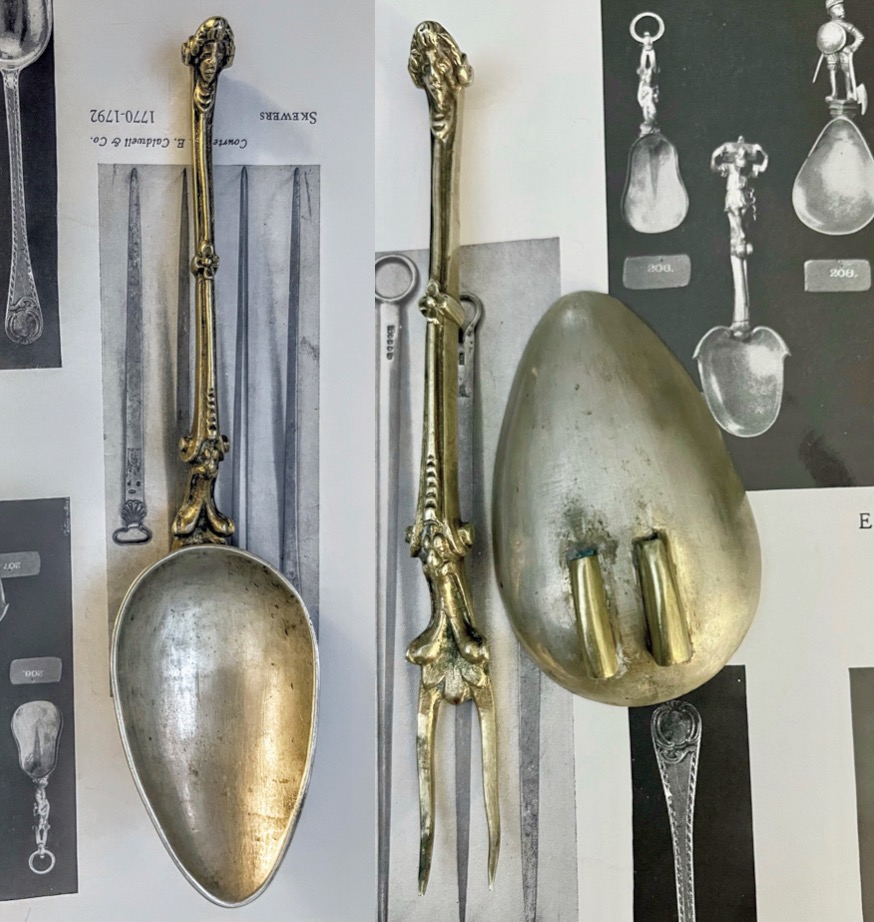
Photo of a retractable travel spoon bowl with the fork attached, alongside a photo of the back of the spoon bowl, sitting next to the two-tined fork which fits inside it to make a spoon. Presumed age is any time from the mid-1500’s to early 1700’s

Around the year 1400, when people carried their eating utensils with them, a folding silver spoon was made to fit the pocket. Later a fork was added. Even the wealthy did not provide these utensils; only royalty seemed to have had enough for their feasts and banquets.

Everyone carried his knife in a scabbard fastened to his belt, to use at mealtime and on any other occasion when a knife was needed. Those who could not afford silver used spoons, knives, and forks of pewter. Copper and brass spoons were used, too, by persons of limited means, although copper soon lost favor due to its tendency to rapid oxidation. 

During the fifteenth and sixteenth centuries, in the Tudor period, it was fashionable to give a christening gift of twelve spoons, each adorned with a miniature statue in silver of one of the twelve apostles. Sometimes a “Master” spoon bearing the figure of Christ was included. These sets are exceedingly rare today. Our “pitcher spoon” originated in Elizabethan days, when great starched ruffles were worn around the neck, making long-handled spoons a necessity.

In Italy, in the 1500s, knives and forks generally appeared on the tables of the cultured, but it was another century before they were popular in France and England. At one time in England it was considered effeminate to use a fork and it took several decades for the people other than the upper classes to adopt it. The clergy even protested its use “as a substitute for God-given fingers.”

In America, too, forks were freakish novelties: when the first fork was imported by Governor Winthrop in 1633, people thought it comical. They could not see any need for it, since most of their meats were cut up and cooked in ragouts and stews. Recipes of the time called for meat to be “y-mynced, hewed on a gobbet, hacked, diced and skerned.” Two-pronged forks to spear food were the most commonly used at first, but early models were made with three and four prongs too.— From “The Book of Old Silver,” by Seymour B. Wyler, 1937


🍽️Etiquette Enthusiast, Maura J. Graber, is the Site Editor for the Etiquipedia© Etiquette Encyclopedia