Showing posts with label Queen Victoria and Etiquette. Show all posts

Monday, September 27, 2021

Etiquette and a Dinner with the Queen

In her youth, Victoria was reprimanded for her tendency to eat too much and to gobble. There was no privacy for a Queen in waiting and the grisly realities of 19th-century digestive problems were agonised over by everyone – including Victoria’s mother, her uncle Leopold and Lord Melbourne, the prime minister. The young Victoria herself fretted over her weight – at her very slimmest, she was just over seven stone. After Albert’s death, she became a trenchant if joyless eater, ploughing through course after course, still gobbling. The weight piled on. A politician forced to endure a meal with the old Queen wrote that it was a dismal experience: “I personally never heard her say anything at dinner which I remembered the next day. Her manners were not affable; she spoke very little at meals, and she ate fast and very seldom laughed.” Her physician Sir James Reid left detailed notes on the weary regularity of the Queen’s problems with flatulence, bowel irritation and stomach upsets. – The Guardian on Annie Gray’s Book on Queen Victoria, 2017

Regarded from a gastronomic point of view, it appears that there is nothing particularly, desirable in dining with the Queen, although it is a privilege much coveted by ambitious men. A distinguished divine, who occasionally preaches at Windsor, and dines and sleeps there afterward, said the other day that the dinner was a remarkably unsatisfactory affair to a hungry man. It is not etiquette to continue eating of any particular course after the Queen has partaken of it to her satisfaction; and as Her Majesty eats very little the courses are harried over. 

After dinner there is hardly time to take even one glass of wine before coffee is brought in. The Queen does not put her cup on tbe table, but sips a little as the servant holds it on the salver. Then Her Majesty rises, and of course the guests all rise and stand back from the table. The Queen the makes the round of the room, stopping to talk a few minutes to any one of the guests whom she may delight to honor, and then goes out, leaving the guests to amuse themselves as they like for the evening. – Hour, 1880


Etiquette Enthusiast, Maura J. Graber, is the Site Editor for the Etiquipedia© Etiquette Encyclopedia

Saturday, July 3, 2021

Henry’s Breach of Etiquette

Henry was a morganatic descendant of the Grand Ducal House of Hesse and joined the British Royal family when he married Queen Victoria’s daughter, Princess Beatrice. Through his own daughter, Princess Victoria Eugenie of Battenberg, who became the Queen of Spain by marriage, Henry is a direct ancestor of current members of the Spanish royal family.
Public domain image of Prince Henry of Battenberg

At Queen Victoria's recent state ball, Prince Henry of Battenberg first appeared wearing black gloves. These were seen to leave marks on the white dress of the Princess Victoria. Then the Prince of Wales approached him and whispered in German, “English etiquette prescribes white gloves.” Prince Henry soon slipped out of the room, and when he returned, his hands were clothed in white.—Pioneer Press, 1897


 Etiquette Enthusiast, Maura J. Graber, is the Site Editor for the Etiquipedia© Etiquette Encyclopedia

Friday, July 2, 2021

Etiquette of Queens, Kings and Dukes

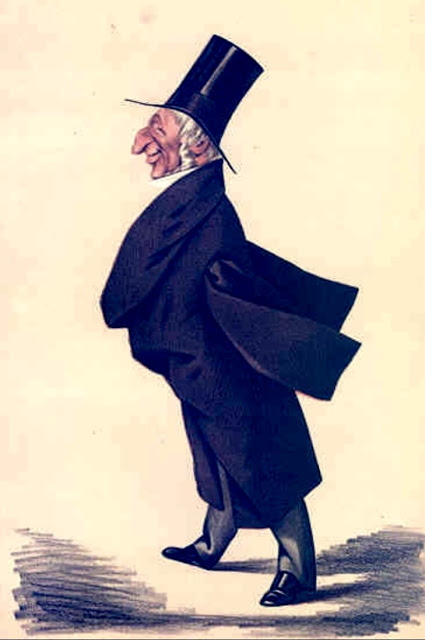
“The son of Waterloo” – The Duke of Wellington (or Weggington) as caricatured in Vanity Fair, June 1872


On one occasion Queen Victoria, Louis Philippe and the Duke of Wellington paid a visit, to Eton college. They were invited to sign the visitor’s book. The French King thoughtlessly took up the pen and signed his name at the top of the page. Etiquette, however, forbade Queen Victoria to sign her name under, any other. She therefore signed on the top of the next page. She then took up the pen and handed it to the Duke of Wellington, who was so excited at the contretemps that he actually signed his name “Weggington.” And, by the way, it may be recorded that etiquette forbids the Queen to converse with tradesmen. When a purveyor waits upon her, the Queen addresses her remarks to an equerry, who in turn, addresses the expectant merchant.—Philadelphia Times, 1896


👑Etiquette Enthusiast, Maura J. Graber, is the Site Editor for the  Etiquipedia© Etiquette Encyclopedia

Tuesday, June 29, 2021

What a Queen May Not Do

Any one who wishes to send the Queen a personal poem or a communication of any kind (except a personal letter, which the poor lady isn’t allowed to have at all) must have it printed in gilt letters on one of these silk sheets with a gold fringe, just so many inches wide and no wider, all about it. These gold trimmings will be returned to him in time, as they are expensive, and the Queen is kindly and thrifty, but for the Queen’s presence they are imperative. 

Queen Victoria Denied Many Things Her Humblest Subject Enjoys


Queen Victoria, not being born a Queen, probably learned to read just like other persons. But after she became afflicted with Royalty, she found that a Queen is not allowed to have a great many privileges that the humblest of her subjects can boast. For instance, she is not allowed to handle a newspaper of any kind, nor a magazine, nor a letter from any person except her own family, and no member of the Royal family or household is allowed to speak to her of any piece of news in any publication. 

All the information the Queen is permitted to have must first be strained through tbe intellect of a man whose business it is to cut out from the papers each day what he thinks she would like to know. These scraps he fastens on a silk sheet with a gold fringe all about it and presents to her unfortunate Majesty. This silken sheet with gold fringe is imperative for all communications to the Queen. 

Any one who wishes to send the Queen a personal poem or a communication of any kind (except a personal letter, which the poor lady isn’t allowed to have at all) must have it printed in gilt letters on one of these silk sheets with a gold fringe, just so many inches wide and no wider, all about it. These gold trimmings will be returned to him in time, as they are expensive, and the Queen is kindly and thrifty, but for the Queen’s presence they are imperative. 

The deprivations of the Queen’s life are pathetically illustrated by an incident which occurred not long ago. An American lady sent her Majesty an immense collection of the flowers of this country, pressed and mounted. The Queen was delighted with the collection and kept it for three months, running over the leaves frequently with great delight. At the end of that time, which was as long as she was allowed by court etiquette to keep it, she had it sent back with a letter saying that, being Queen of England she was not allowed to have any gifts, and that she parted from it with deep regret. This passes for good nursery government in this country, but would hardly be accepted among adults, let alone Queens. - The Philadelphia Inquirer, 1892


Etiquette Enthusiast, Maura J Graber, is the Site Editor for the Etiquipedia© Etiquette Encyclopedia

Friday, June 25, 2021

Royal Dignity and Etiquette Melted

Rare photo of Queen Victoria dining with members of her family. The Queen was well-known for her terrible table manners. It was said she could easily put away nine courses in 30 minutes.


Queen Victoria’s Dignity Melted

Just about this time, and for a month or more longer, look out for anecdotes of Queen Victoria. There promises to be a large crop of them, and many are already being harvested. Some are quite true and authentic, while more are not, but it is never a good plan to spoil a readable story because of a little question of veracity. 

One of the most recent Victorian anecdotes is told by a correspondent of the Chicago Times-Herald, who declares that Victoria has ever been very exacting in the matter of Court etiquette. When she holds a reception she always insists upon the performance of every detail of custom. Persons who are fortunate enough to be invited to Court have, therefore, to drill themselves and rehearse their parts, for fear of offending the Queen by any little neglect of manners. Now and then, however Her Majesty unbends. 

On one occasion, in very hot weather, she was receiving a line of sweltering noblemen and ladies. Everybody was suffering from the heat. The Queen turned to an attendant suddenly and exclaimed: “My! Ain't it hot!” It is Court etiquette never to contradict royalty, and the lady addressed replied: “Yes, madam, you are!” On this occasion the Queen forgot both her manners and her grammar.– Placer Herald, 1897


Etiquette Enthusiast, Maura J. Graber, is the Site Editor for the Etiquipedia© Etiquette Encyclopedia

Wednesday, September 4, 2019

Legacies of Lords and Their Queen

Lord Stanley, the 17th Earl of Derby, was a Conservative Party politician in the United Kingdom. He was a British soldier, diplomat, and racehorse owner. He was twice Secretary of State for War and also served as British Ambassador to France. His father, also “Lord Stanley” and the 16th Earl of Derby, was the sixth Governor General of Canada, and gave Canada a treasured national icon, hockey’s Stanley Cup.

On the late Lord Derby – The man who was the life and soul of the Conservative party in England for years was in private life one of the most genial and childlike of men. To the last, his spirit of natural gayety never left him, and his wife was, as it were, the shadow of himself. A story was current in London society about this characteristic buoyancy of his, and his son’s no less characteristic ponderosity, not to say boorishness. Dining with the Queen one day, he had been speaking of light and amusing matters, entirely sinking the statesman in the polished man of the world, when the Queen, during a pause in the conversation, suddenly asked him his opinion on a certain political matter then before Parliament. 

He gave it at once, whereupon his royal hostess, seemingly very much amused, said to him, “Lord Stanley (his eldest son now Lord Derby, and a very able politician) was dining with me the other day, and I asked him the same question, which he answered very differently; so I said to him, ‘Your father does not think so.’” ‘No, ma’am,’ he said very gravely, ‘I know it; but my father, ma’am, is a very sanguine man.’” Lord Derby laughed, and, assuming all his son’s cumbersome manner and cumbersome, guttural speech, said with a roguish twinkle in his eye, “And my son, ma’am, is a very cautious man.” 

This anecdote is a capital illustration of the oral characters to whom it refers, the Queen delighting and having great tact in drawing out her guests by judicious little remarks of her own. Thus those Windsor dinners, despite the very strict etiquette of the English court, were skillfully shorn of their tedium, and rendered a pleasant remembrance to all who partook of them. That, however, was before Prince Albert’s death. 

In his own house in St. James’ Square, London, Lord Derby was peculiarly charming. Indeed, he was more charming than absolutely clever, yet it was so strange to think that the same man who at the informal meal of luncheon (of which, unlike many men, he was very fond) could so sparkle with harmless vivacity of spirits, was the same whom other men, cleverer than himself, could, listen to without wearying for a whole night in the House of Lords. 

Sometimes at dinner, when his son was present (which never happened except under moral compulsion), he would purposely start a heavy argument, and keep up a close fire of political repartee with his solemn younger self, to the immense but suppressed amusement of his guests, while Lord Stanley would fall unconsciously into the trap, and miss the kindly satire of his father’s imitative voice. Then after awhile, the elder man would drop the argument as if weary of it, and conclude thus: “But then, Stanley, you are so much older and wiser, and know things so well. You must be right.”— Lady Blanche Murphy, in the October number of Lippincott's Magazine, 1872


Etiquette Enthusiast, Maura J Graber, is the Site Editor for the Etiquipedia© Etiquette Encyclopedia 

Thursday, May 2, 2019

Glove Etiquette Ignored by Queen

Despite the Victorian era news reports of Queen Victoria’s odd habits, modern depictions of her do not give an accurate picture. Her non-adherence to the commonly accepted glove etiquette of the day is never accurately represented or discussed.


Queen Victoria at Dinner

The strict ceremonial of the dinners of Queen Victoria has not changed since her assumption of the throne. A quarter of an hour before the time fixed for the repast —generally eight o’clock—all the party invited to dine with the Queen meet in the Grand Salon and form themselves into a half circle about the door where her august Majesty is presently expected to enter. The Queen, on entering, makes a beautiful courtesy, (for which she is renowned, then bows to the gentlemen, and gives her hand to the ladies, who courtesy deeply. She then goes in first to table, accompanied generally by one of her sons. 

If any Imperial or Royal person is present, he sits at her right hand. But even in the ease of Gen. Grant, she placed the Princess Beatrice between them. The Queen never removes her gloves during dinner, except at state banquets. This is a singular piece of etiquette, and one would think it would be exactly the reverse. Her gloves are new, of white kid, embroidered with black, never worn but once, and become, after using, the perquisites of the Ladies-in-Waiting.

 The Queen has a small and beautiful hand. As soon as she finishes a certain “plat’’ every one else stops, as when she finishes her fish every one else stops eating fish, etc... After she has spoken to her guests on either side conversation may become general, but in a subdued tone, always deferring to the Sovereign. Sir Arthur Helps, who was her private secretary, used to tell an amusing anecdote of being snubbed by her for telling a rather funny story down the table, amongst the Ladies-in-Waiting, to relieve the monotony of a rather dreary dinner, when the Queen remarked, — “What is it? We are not amused.” She has, however, a love of fun, and sometimes laughs heartily. – The Morning Union, 1888


Etiquette Enthusiast, Maura J Graber, is the Site Editor for the Etiquipedia Etiquette Encyclopedia 

Friday, December 28, 2018

Etiquette and Palace Arrogance


“The Queen rose herself and, with her own hand, performed the act which her haughty attendants had felt was below their dignity.” – Court Ladies or Ladies in Waiting were personal attendants/personal assistants at a royal court. These ladies attended and accompanied Queens, Tsarinas, Empresses and other noblewomen. In Europe, historically, Ladies in Waiting were noblewomen themselves, but of a lower rank than the women they attended.

The Queen’s Haughty Attendants

Court etiquette is a fearful and a wonderful thing. It is told that on one occasion when the lamp in Queen Victoria's sitting room at Osborne was smoking, her majesty appealed to one of her Ladies in Waiting to lower the wick a trifle. The lady appealed to declined to recognize turning down a lamp as one of her official duties. She passed the information about the lamp to the next Lady in Waiting, who told the third lady, and so it traveled from attendant to attendant while the moments fled and the smoke continued to ascend. Finally, the Queen rose herself and, with her own hand, performed the act which her haughty attendants had felt was below their dignity. – San Bernardino Sun, 1899

Etiquette Enthusiast, Maura J Graber, is the Site Editor for the Etiquipedia© Etiquette Encyclopedia

Friday, September 7, 2018

British Coronation Etiquette – Queen Victoria


Even though an entire era of purported graceful living and good manners was named after Victoria, her manners needed quite a bit of work – According to Kate Hubbard, in her book, “Serving Victoria: Life in the Royal Household” Victoria, “loved her food. She was greedy and she gobbled. She liked her dinners to last no more than half an hour. Guests would quite often find their plates whisked away while they were still eating because once she had finished, all the plates were removed. She was a hearty eater and she was a fast eater.” And as for courtly conversation" at the table? She did not like politics to be brought up, and, oddly, “She didn't like marriage being discussed in front of her youngest daughter, Beatrice, before Beatrice married. Anyone who mentioned marriage at dinner was swiftly reprimanded.


Remarkable incidents in this most important occasion of a British ruler’s life. Striking features of ceremony from the earliest day to the last great Coronation event of the 19th Century
👑👑👑👑👑👑👑👑👑👑👑👑
The Coronation of England’s Victoria

At seventeen minutes past three on the morning of June 28, 1838, a Royal salute of twenty-one guns announced that the sun was then rising upon the Coronation day of Victoria. By 4 o'clock the streets were so thronged with carriages and pedestrians, that they were in many places impassable and the whole population seemed to have poured out in the direction of the parks and of Westminster Abbey. It was not until half-past ten that her Majesty's carriage passed Apsley House. It moved on amid the loud acclamations of her subjects. The state coach was drawn by eight cream-colored horses and attended by a yeoman of the guard at each wheel and two footmen at each floor. 


Endless grooms and guards attended the long procession. It was as splendid as befitted the rejoicing of the people over a Coronation, that made them happier than any since the time of Alfred. The London Sun of the 28th reported that: The Queen, attended, passed to the altar. Her Majesty, kneeling upon the cushion, made her first offering of a pail of altar-cloth of gold, which was delivered by an Officer of the Wardrobe to the Lord Chamberlain, by his Lordship to the Lord Great Chamberlain, and by him to the Queen, who delivered it to the Archbishop of Canterbury, by whom it was placed on the altar.


After elaborate services followed the sermon by the Bishop of London, then came the oath and the anointing. Then there were further ceremonies of the spurs, the sword, the mantle, the orb, ring and scepters, and at last came the Dean of Westminster bearing the Crown. Tho Archbishop took and placed it on her Majesty's head, when the people, with loud and repeated, shouts, cried: “God save the Queen.” There was a doffing of caps, a sound of trumpets, a beating of drums, a firing of guns. The old report says: “Never did we hear louder or more hearty plaudits, that almost rent the walls of the old abbey, setting at naught all etiquette and ceremony, than those which burst from the lips and hearts of her attached and loyal people, when the Crown was placed on the head of their young and lovely Sovereign.” –San Francisco Call, 1901


Etiquette Enthusiast, Maura J. Graber, is the Site Editor for the Etiquipedia© Etiquette Encyclopedia

Wednesday, May 23, 2018

Royal Dinner Party Etiquette

Sir Henry Frederick Ponsonby, was a British soldier and royal court official who served as Queen Victoria's Private Secretary.

Royal Dinner Parties in England of 1889

The royal dinner parties of England are the most formal and studied in the world. To beginners, they become a frightful ordeal, and they rarely at the end can tell what the meal consisted of; to old stagers they are a frightful bore. The novices are expected to arrive early so as to be posted by Sir Henry Ponsonby in court etiquette. The Queen usually receives her guests for afternoon tea in her own sitting room, and remains a short time with them chatting on light subjects; then they are permitted to wander over the castle or stay in their rooms till dinner time, which is at 9:00. She says a few words to each guest as she enters the dining room, and then leads the way to the table. 

It always seems so discourteous for no one to step up and offer the old lady his arm, but it would require an equal in rank to do so, and she enters and leaves the room alone. There is very little conversation at the table. Each guest is asked one question by the Queen and can make one reply. The pauses between are dreadful, and the mechanical parceling out of questions and answers makes it seem as if the Queen were putting a Bible class through its catechism. Each one waits for his turn to come next, and in the embarrassment the “answers” are often of the most stupid kind.—New York Star

Etiquette Enthusiast, Maura J. Graber, is the Site Editor for the Etiquipedia© Etiquette Encyclopedia 

Friday, April 13, 2018

Queen Victoria’s Breakfast Etiquette

A trend for tartan and tweed was inspired across the Kingdom due to Queen Victoria’s and Albert’s love of Scotland. They visited Scotland repeatedly, and after taking possession of Balmoral in 1848, they actually built a castle of their own.

The Queen’s Scottish Breakfast

A correspondent, after picturing the simplicity of the life at Balmoral during the Queen’s stay there, describes one of her ordinary, everyday breakfasts. The following is the menu of the breakfast served one day last week: 
Scotch porridge, cold rump steak pie, hot rump steak, cold gammon of bacon, boiled eggs, Scotch scones, brown bread, butter, honey, tea, coffee, and a kind of cocoa specially prepared for the Queen. The porridge was placed on the sideboard, and was served to each guest in blue and white china basins. These basins were filled by the attendants, as a matter of course, without any question as to whether porridge was wanted or not. It was evidently required by Court etiquette that the meal should be begin with this solid foundation, and that individual tastes of the honored visitors had to be kept in abeyance. 
Our informant expresses surprise that there was no game on the table, considering that to his certain knowledge, the larder was full of grouse shot by Prince Henry and the keepers, which certainly wanted eating. He is probably not aware that the Queen cannot tolerate the smell of game the first thing in the morning, and only allows it at the  later meals, out of deference to the tastes of others.—London Correspondent for The New York World, 1888

Etiquette Enthusiast, Maura J. Graber, is the Site Editor for the Etiquipedia© Etiquette Encyclopedia

Tuesday, January 9, 2018

Etiquette and a Royal Wild Heir


Famous for his philandering and partying, Prince Albert, or “Dirtie Bertie” as he was nicknamed, spent much of his time in France and had affairs with the most famous Parisian actresses, courtesans and can-can dancers of the day. Victoria was not amused! –“It is impossible to blame the Queen if she takes deeper and more serious view of the responsibilities of His Royal Highness than His Royal Highness does himself. To her, at any rate, Windsor Castle is not only the home of the English Monarchy, it is the home of a multitude of august and sacred memories. To the Prince of Wales, unaccompanied by the compliant friends of his heart, Windsor would certainly be intolerable, even during the Ascot week. Excitement and society have become necessities of his nature, with which he can submit to an extraordinary amount of fatigue, without which his whole nature seems to instantly collapse...


Why Queen Victoria Declined to Invite Her Son, Albert, to Visit Windsor
At an age at which the most thoughtless and frivolous of men have a higher notion of obligation than a rigid and mechanical compliance with the dictates of conventional etiquette; when they choose their companions and regulate their ways of life in deference to other considerations than those of personal enjoyment. 

“The Prince of Wales has recently visited the Queen at Osborne, where he took up his residence in the cottage which established custom has consecrated for his use. Her Majesty's subjects may perhaps, feel disposed to ask themselves whether the time has not yet arrived when the heir-apparent should be lodged beneath a royal roof when he happens to be temporarily sojourning at a less distance from the capital than the Isle of Wight— why, in fact, when he is in the immediate neighborhood of Windsor during the Ascot week, Windsor Castle should not receive him, instead of the house –which, as matters are, it is his custom to engage within convenient distance of the course. 


“Certainly, it would be gratifying, not only to the Royal borough of Windsor itself, but to the whole nation, if the King of England that is to be, were to be installed for some days once in the year, as the chief tenent of the ancestral and traditional home of the British Sovereign. The Queen, however, has her reasons for declining to place the Castle at the Prince's disposal ; and it is not difficult to conjecture what those reasons are. As it happens, we are not justified in thinking that the day has yet come when Her Majesty will take a different view of the matter. The point, therefore, now to consider is the course which, things being as they are, the Queen would, with due regard to expediency, adopt.

“It would be idle to pretend to deny that there is any doubt why 
Windsor Castle knows so little of its future proprietor, and in the extremely difficult business the Queen has displayed nothing less or more than that sound judgment and admirable feeling which she never fails to exhibit when she is left to be the arbiter of her own actions. The Prince of Wales is now of an age at which the most thoughtless and frivolous of men have usually contracted some higher notion of obligation than a rigid and mechanical compliance with the dictates of conventional etiquette ; when they have higher ideals of duty than to refrain, if they refrain at all, from indulging the momentary whim because such indulgences would be a violation of the proprieties of an exalted existence ; when they choose their companions and regulate their ways of life in deference to other considerations than those of personal enjoyment. 


“In three months from to-day, the Prince of Wales will have entered upon his thirty-sixth year, and, with the sole exceptions that he has learnt something more about the mysteries of Court etiquette, that he has enlarged his notions of his personal irresponsibility, and that he has become the master of a manner which cannot fail to charm all who are brought into contact with him, he is precisely the same man that he was before he attained his majority subject to the same influences, regulated by the same motives, ready to go through enormous sacrifice of time and comfort to please the public, but unwilling to realize or act upon the truth, that certain petty and irksome responsibilities are the inseparable penalty which he must pay for his position, and must therefore claim his diligent submission. That, it may be said, is a hard lot, and no doubt it is — very hard indeed. The only thing is, that it is inevitable. Even a Prince of Wales is impotent to alter facts, and he must, perforce, accept the situation.

“It is impossible to blame the Queen if she takes deeper and more serious view of the responsibilities of His Royal Highness than His Royal Highness does himself. To her, at any rate, Windsor Castle is not only the home of the English Monarchy, it is the home of a multitude of august and sacred memories. To the Prince of Wales, unaccompanied by the compliant friends of his heart, Windsor would certainly be intolerable, even during the Ascot week. Excitement and society have become necessities of his nature, with which he can submit to an extraordinary amount of fatigue, without which his whole nature seems to instantly collapse. When the Prince of Wales shall have become Albert Edward of England, if years have not even brought the philosophic mind, no one will be able to gainsay him the companionship of his choice. The responsibility will rest absolutely upon himself. 


“At present tbe humors and amenities which would certainly characterize a week at Windsor spent by a young man who is not King of England, and who has merely the best chance of becoming King of England, with his customary satellites, could not be matter that would concern the Prince of Wales alone. The Queen, therefore, is, from her point of view, entirely justified in the course which she adopts. At the same time, it may be impossible that the effects of throwing Windsor Castle open to the Prince of Wales would be beneficial to himself ; and if they were beneficial, they would certainly be gratifying to the English people.” –From the London World, 1876

Etiquette Enthusiast, Maura J. Graber, is the Site Editor for the Etiquipedia© Etiquette Encyclopedia

Sunday, December 31, 2017

Royal Proposal Etiquette

“By the rules of etiquette, the proposal itself had to come from the young Queen, whose maidenly modesty was somewhat embarrassed at the prospect.” — An illustration from 1840 titled “Leap Year'” shows Queen Victoria proposing to Prince Albert at Windsor Castle in 1839. “Some say that this custom originated in fifth-century Ireland, where St. Patrick allowed women to take the initiative every four years after St. Brigid complained to him that they were having to wait too long for husbands. Others credit a Scottish law enacted in 1288 under the unmarried Queen Margaret, which allowed a maiden “liberty to bespeak ye man she likes” during leap year. The knave who refused to marry her and could not prove his engagement to another was assessed a fine.”
- From “Speak Up: It's Leap Year!”

The courtship of Queen Victoria brings us into a pleasant atmosphere. On Prince Albert's first visit to England, she liked and appreciated him at once, and his tastes agreed with hers. “Every grace had been showered by nature on this charming boy,” says Baron Stockman of him at this time. The Baron judged him critically, calmly and impartially until he finally became his most attached and devoted friend and adviser. Queen Victoria and her cousin, met at first unconscious of the object of their acquaintance, and when the desired impression had been produced, the young Prince, like a second Sir Galahad, was sent away to travel and fit himself by study and careful education for his great position. 

On his return to England the Queen writes: “Albert's beauty is most striking, and he is most amiable and unaffected — in short, fascinating.” The young couple were genuinely in love, and the Queen informed Lord Melbourne that the conquest of her heart was complete. So serious, so dignified, so studious and so excellent a young man would infuse an element of poetry and deep feeling into his love making; but by the rules of etiquette, the proposal itself had to come from the young Queen, whose maidenly modesty was somewhat embarrassed at the prospect. She summoned him to her boudoir, where he found her alone. After some desultory talk due to her shyness, she suddenly said: “Could you forsake your country for me?” The Prince answered by clasping her in his arms in such simple fashion did a young Sovereign, woo and win the husband of her choice. — Los Angeles Herald, 1906


Etiquette Enthusiast, Maura J. Graber, is the Site Editor for the Etiquipedia© Etiquette Encyclopedia 

Thursday, December 14, 2017

Royal Etiquette for Afghan Prince

In 1895 the Emir Abdur Rahman Khan had intended to undertake a state visit to England, but his health prevented him from making the trip, and so he sent his son the Shahzada Nasrullah Khan, in his place. Nasrullah departed Bombay on April 29, 1895, with a group of priests for the observance of religious functions and high-ranking Afghan nobles – an entourage which totaled over 90. On May 23 the Shahzada landed at Portsmouth in England. He was received by the Queen at Windsor Castle, and during his trip he made a gift of £2,500 to Abdullah Quilliam to support the work of the Liverpool Muslim Institute, visited the Liverpool Overhead Railway, went to Ascot, Glasgow, and the Elswick Company Gun Range at Blitterlees Banks.

All who know Afghanistan were well convinced that neither the ruler, nor his heir apparent would leave their native country. As a matter of courtesy the invitation was addressed to the Ameer and the latter accepted it, “health permitting,” but from the first, all who are posted on the subject were confident that the Ameer would not leave Cabul. It was, however generally believed that the eldest son would represent his father, and it was somewhat of a disappointment when it was announced that the second son— who, by the way, is the child of a slave woman – would visit the capital of his father’s ally. Considerable difficulty as to the etiquette to be observed was felt, and until about a week before the Prince’s arrival it had not been settled how he was to be styled. As everything, however, has been smoothed over, the authorities are seeking to impress upon the young Afghan, the greatness of the British Empire, and by this means to confirm the Ameer to his preference for Great Britain over his near neighbor, Russia.

From the moment the young Prince— he is only 23 years of age— set foot on British soil he was received in right royal form and with every possible distinction. Addresses innumerable have been presented to him. He has been received by the highest officials everywhere, and his journey here was one long series of receptions. The Prince, as already stated, brought with him a large suite and detachment of Afghan troops. Being a Mohammedan, the religious peculiarities of the Moslem have had to be taken into consideration. Among his attendants are a number of cooks to prepare their leader’s food in accordance with Moslem customs. He has also in attendance upon him Colonel Talbot of the Foreign Department of the Indian Government, and T. A. Martin, the Afghan agent. Throughout his six weeks’ stay in this country the Prince will be received as the Shahzada (son of a King). He is attended by Royal escorts, has been received by the Queen, is received by Royalty, and will, in fact, have a Royal progress until his departure. – San Francisco Call, 1895


🍽Etiquette Enthusiast, Maura J Graber of The RSVP Institute of Etiquette, is the Site Editor for the Etiquipedia© Etiquette Encyclopedia  

Suffering Etiquette of Victoria’s Table

Dinner with Queen Victoria could be quite trying... “The etiquette is, do not open your mouth unless Royalty condescends to speak to you. Do not expect such a compliment. That is reserved for a few favored guests in the immediate vicinity of the regal hostess. The dinner occupies from sixty to ninety minutes, and, when ended, the Queen rises, all other ladies rising and retiring with her.” –1862

When Dining with a Queen

The London correspondent of the Philadelphia Press gives the following description of a dinner at Windsor Castle, with Queen Victoria:


At this season, except that fashion is slightly less bustling in Lent, London is generally very much alive— taking its tone from the Court. Queen Victoria’s little dinners always draw a certain number of invited - no, commanded guests; for the etiquette is, not that Royalty requests the pleasure of one's company, but orders it, indeed, for very autocratical is the system, that supposing you have arranged to give a dinner to a number of your own friends, and received a card from the Lord Chamberlain of the Queen’s household, desiring you to dine, on the same day, at the Queen’s table, there is no refusing on any other plea than that of positive illness. 

Not to go would be a sort of petty treason, and you would have to send a circular round to your own guests, stating that the Queen’s command, compelling you to dine at the palace, has compelled you to uninvite them. Nor, except the honor and glory of the thing, can there be much comfort or satisfaction in having one’s legs under the Royal mahogany. First of all, the guest must put himself into a Court dress, which makes him look like a footman in private life, with knee breeches and silk stockings, lace cravat and ruffles, amplest of waistcoats and shad bellyist of coats. Then, if he does not keep his own coach he must hire one looking like a private vehicle, for it is doubtful whether, since creation commenced, any one ever walked to a Royal dinner, and the idea of going thither in a cab would probably have a moral effect on the enormous porter, in scarlet and gold toggery, who receives your card of invitation when he admits you. 

Nor, supposing all the preliminary trouble ended — supposing that you have found your way to the drawing-room, and bowed to the Queen, and stealthily looked round at the pictures, and counted over (all the time in solemn silence) the spots of flowers on the carpet, for the tenth time, and marched in file into the salle a manger — supposing all this, do not imagine that you are going to enjoy yourself. No, indeed. None but Mark Tapley could be “jolly” at such a feast. Royalty has already dined, about 3 o'clock, probably off the hereditary leg of mutton and turnips, and has added the usual quantum of rice pudding, and the bit of old Cheshire, or rich Stilton, or double Glouster cheese, and imbibed the accustomed mug or two of Guinness or Meux. This repast, called lunch, is really a good, homely filling of dinner, and at the solemn repast, five hours later, people are expected to merely tip and taste through several courses, so that one is reminded of the famous feast of the Barmecide. 

The viands are of the best, the cuisine perfect, the vintages superb — but one can merely taste. Royalty’s appetite was blunted on the leg of mutton and pudding, the cheese and the bottled porter, and the guests should have taken the edge off theirs by a similar process. At these sadly solemn reunions dull silence grimly reigns. There is not even a whisper to your neighbor — if you know him. The etiquette is, do not open your mouth unless Royalty condescends to speak to you. Do not expect such a compliment. That is reserved for a few favored guests in the immediate vicinity of the regal hostess. The dinner occupies from sixty to ninety minutes, and, when ended, the Queen rises, all other ladies rising and retiring with her. The male guests remain some ten minutes longer, silently sipping their wine, or whispering in small knots with bated breath. 

At last the senior officer of the household present, rises on his hind legs and majestically gives “the Queen” as a toast, which every one drinks. It any male member of the Royal family be present, he bows an acknowledgment. Coffee follows, and then the guests depart— a few to the drawing room where the Maids of Honor are yawning, the rest going home, where it is supposed each man gets out of his livery, at once, and gets rid of his gnawing hunger by means of oysters and stout. Such, I am informed by one who experienced it, is the routine of a royal dinner. He was an East Indian, and suffered much . – Daly Alta California, 1862


🍽Etiquette Enthusiast, Maura J Graber of The RSVP Institute of Etiquette, is the Site Editor for the Etiquipedia© Etiquette Encyclopedia 


Friday, December 8, 2017

Royal Proposal Etiquette


It may not be generally known that Royal etiquette forbids any Royal personage of lesser degree, to propose marriage to a female Sovereign.

How Queen Victoria Proposed

It may not be generally known that Royal etiquette forbids any Royal personage of lesser degree, to propose marriage to a female Sovereign. Accordingly, it became necessary that Queen Victoria should ask Prince Albert whether he would share her lot. For a young woman this was naturally an awkward and rather delicate duty, but the most trying ordeal was when the Queen had to make the announcement of her wedding to the privy council. 

At one time there was a possibility that the marriage would not take place, owing to the desire of the Queen that she should not be married too early. In 1839, Prince Albert confessed that he came to England with the intention of telling his royal sweetheart that if she could not then make up her mind, she must understand that he could not wait for a decision as he had done at a former period, when the marriage was first talked about. 

It was at Windsor, at a ball, that the Queen broached the subject, by giving the Prince certain flowers from the bouquet she carried, and her boy lover, understanding the significance of the gift, and being tightly buttoned up, from waist to throat, in a green Rifle uniform, made a cut in his tunic just above the heart and put the flowers within it. The next day the Queen put the critical question, and the contract was sealed from that moment. —London Telegraph, 1897


Etiquette Enthusiast, Maura J. Graber, is the Site Editor for the Etiquipedia© Etiquette Encyclopedia 

Wednesday, May 31, 2017

Victoria's Victorian Etiquette

The Belgian Queen whispered to her son who was present, to pour out a glass of water and offer it to the Queen; this being done, it was graciously accepted, the act being, etiquette would not allow her Majesty to pour out a glass of water for her self when a servant was present! — Château d'Eu in Eu, Seine-Maritime, France


The Queen Can Never Go Shopping!


What belle of Chestnut street will envy her Majesty when she knows the fact, that according to royal etiquette, a Queen cannot speak to a tradesman! A late work says: "Victoria has been standing not a yard away from one, addressing all her inquiries to an equerry, who repeated them to a tradesman, and again repeated to her Majesty all his answer.” And the writer gives the additional information that the Queen must die of thirst rather than pour out a glass of water for herself!

“When on a visit to the royal family of France, at Eu, the Queen of Belgium had been told that her Majesty of England took, every morning at ten o'clock, a glass of iced water. Accordingly, on the day after her arrival, a servant duly made his appearance at the appointed hour, bearing on a silver salver, a carafe and two glasses, which he tendered to the sovereign, who declined the refreshments with a wave of her hand. The Belgian Queen seeing this, whispered to her son who was present, to pour out a glass of water and offer it to the Queen; this being done, it was graciously accepted, the act being, etiquette would not allow her Majesty to pour out a glass of water for her self when a servant was present!”


Etiquette Enthusiast, Maura J Graber, is the Site Editor for the Etiquipedia© Etiquette Encyclopedia 

Tuesday, October 11, 2016

Queen Victoria's Court Etiquette

“The son of Waterloo” – The Duke of Wellington as caricatured in Vanity Fair, June 1872

The Queen, the Duke, and the Crown

True politeness has been variously defined. One little boy said it meant “making everybody feel satisfied,” and another, that it was “doing the kindest thing in the kindest way.” I think good Queen Victoria understood and practiced it too, when she spoke so kindly to the old Duke of Wellington at the time the crown fell from his hands.

It was on some grand occasion—perhaps the opening of Parliament—and the whole Court was in attendance. The Duke, then quite an old man, carried the crown on the little cushion used for the purpose, when, backing out, according to Court etiquette, he forgot the little step at the foot of the throne, stumbled, and in attempting to regain his foothold, dropped the massive crown from his hands. It came with great violence to the floor, and rolled quite across the hall, badly bruising the diadem, and scattering the costly jewels in every direction.

The old Duke, accomplished courtier as he was, stood for a moment, aghast at the injury inflicted on so precious an article, and then would have stooped to gather up the scattered jewels. But the Queen saw in an instant his evident distress, as well as embarrassment, and rightly judged that he would prefer to be left alone. So, with the genuine kindness of heart and quick perception for which she is remarkable, she stepped gracefully forward, and, offering her hand to the venerable statesman, as if to assist him in rising, said, cordially, “I trust your grace is not hurt; and that you will wholly have recovered from the unpleasant shock by the morning.” Then, without a glance at crown or jewels, and apparently quite unaware of the casualty, she passed out, the Court following, and the Duke was left to recover his equanimity, and collect the scattered jewels at his leisure.

How grateful he must have felt for this graceful consideration on the part of his Sovereign : and how beautiful the model, not only of true politeness, but of genuine Christian forbearance, that we find in this little incident. It is by such acts of thoughtful kindness that England's gentle Queen has enthroned herself in the hearts of her subjects; and the tourist in England seldom hears the name of Victoria called by Prince or peasant, without being coupled with expressions of the highest veneration and warmest affection. – Christian Weekly, 1872


Etiquette Enthusiast, Maura J Graber, is the Site Editor for the Etiquipedia© Etiquette Encyclopedia

Sunday, September 18, 2016

Royal Victorian Sunday Etiquette

She seldom leaves her bedroom much before 1:00, at which hour breakfast is taken with any member of the royal family who may be there, a cup of tea and a little toast having been previously conveyed to her Majesty's bedside by one of the “dressers.”

The Queen's Sundays

Among the articles in the November ' Quiver" is one by Mary Spencer Warren telling how the Queen spends Sunday. In former years it was customary for her Majesty to rise quite early on the Sunday morning—as, in fact, she did every day in the week. Of later years, however, she seldom leaves her bedroom much before 1:00, at which hour breakfast is taken with any member of the royal family who may be there, a cup of tea and a little toast having been previously conveyed to her Majesty's bedside by one of the "dressers." After breakfast the Queen has a turn around the grounds in her donkey carriage, the donkey being the one she bought at Florence.


To preach before the Queen is, of course, a greatly coveted honor, and etiquette formal and prescribed has to be observed. No personal reference to her Majesty is permissible, a pure Gospel discourse being de rigueur, delivered as though her Majesty was not present. Many have tried to evade these rules. The Queen likes and enjoys a plain, practical discourse, selected from the lessons or Gospel of the day, to occupy about twenty minutes in delivery. Questions of the day, and, above all, politics, must be entirely excluded. A celebrated divine broke this rule one Sunday, and preached a very strong political sermon; but it was his last opportunity—the royal pulpits have neither of them been filled by him again. Wherever her Majesty may be it is now her inevitable custom to drive out in a pair-horse carriage on Sunday afternoon.

 Dinner subsequently is somewhat stately. Very often the Queen partakes of it with only the members of her own family present, or any royal guest who may be staying there, save and except that the officiating clergyman of the day and the minister in attendance generally receive an invitation. As a rule, other guests are not asked. 

After dinner the Queen retires direct to her own special drawing-room, where, together with any of her family who may be present, she will enjoy some music of the old masters, preferably Beethoven and Mendelssohn. The Queen herself often takes part in duets with one of her daughters, and the Duke of Edinburgh, when present, contributes with his violin. — Sacramento Daily Union, 1897


Etiquette Enthusiast, Maura J Graber, is the Site Editor for the Etiquipedia© Etiquette Encyclopedia

Sunday, September 4, 2016

Breaking Royal Etiquette

Prince Albert with Queen Victoria ~ In Prince Albert's days the etiquette of the Court was extremely severe...


Court Etiquette

In Prince Albert's days the etiquette of the Court was extremely severe, and some of the young ladies in attendance had occasionally to be reminded that they were expected to remain standing when the Queen or the Prince was in the room, and that, moreover, they must not mix in the conversation by word or laughter, unless requested. A certain maid of honor who had a beautiful singing voice, and has since become a charming peeress, relates Truth, was one day bidden to sit down at the piano and play something. She declined, forgetting thut the Queen's wishes were a command. The Queen insisted kindly, but the maid urged that she had a cold. "Well, then, you had better go to bed," said her Majesty, " Oh, no thank you," was the answer, " but, if you don't mind, I'll sit down," and she did.

On another occasion, a maid of honor who had accompanied the Queen to the opera, and who ought by rights to have taken a seat at the back of the box, heedlessly sat down in a chair reserved for the Prince Consort. A glance from the Queen warned her that she had committed a blunder, but the girl was either obtuse or stubborn, for she merely removed to the next chair in the front row, intended for another member of the royal family, and this time she not only stuck to her place, she ignored the fitness of things by applauding throughout the performance, like the rest of the audience. 


This, however, is not so bad as the conduct of the newly appointed equerry, who had been told that he must appear in knee-breeches at the Royal dinner table, but who came down in trousers, and naively apologized to the Queen, saying that he had found his new breeches too tight. – Mariposa Gazette, 1879

Etiquette Enthusiast, Maura J. Graber, is the Site Editor for the Etiquipedia© Etiquette Encyclopedia