Showing posts with label Teaching Children Manners. Show all posts

Thursday, July 2, 2020

Instill Manners Early at Home


Children usually do not intend to be rude, but the very novelty of a situation sometimes embarrasses and so surprises them that they do not know what to do. Consequently “acting smart” is their refuge, and too often it appears at the table. A little home practice would save all this humiliation for both mother and child.

“Making Manners”

“Mary, Betty has such nice manners. I wish my children would behave like her when we go out to dine!” How often we hear a mother comment thus on some little girl who is “conspicuous” for her ladylike ways. Indeed, manners are to be valued as much in children as in grown people. These very little ones are later to be the grown people, and if their manners are to become a part of their everyday life, these graces and little courtesies must be encouraged to grow up with them, so they will reach perfection in later years. 

I have in mind a mother who has made a special point of good manners in bringing up her six-year-old daughter. This does not mean that she wants the little one to have an affected society suavity, but that she wants her to reflect the charm and refinement of the household. The mother demands company manners every day in the week. She serves the dinner each night in the dining room rather than amid the informality of the breakfast room or kitchen nook, although she does her own work and it means extra household tasks. 

This may seem a trivial step in manner making, but children respond more quickly to example and surroundings than they do to preaching and instructions. Dinner in the dining room, in this case, means that extra pains are taken to have the meal pleasant and attractive, and everyone is expected to help maintain this atmosphere. The mother may still wear her house dress, but it is sure to be spick and span and the little six-year-old is dressed late in the afternoon after her nap, ready for the evening meal. Her manners are practiced with the rest of the family, and she learns that politeness is not to be put on when going out to dine or having company, but is to be worn on all occasions.

Children usually do not intend to be rude, but the very novelty of a situation sometimes embarrasses and so surprises them that they do not know what to do. Consequently “acting smart” is their refuge, and too often it appears at the table. A little home practice would save all this humiliation for both mother and child. Eating in the dining room is just one means of teaching children that certain conventions help to make things pleasantly and that good breeding makes people welcome. As mothers train their children, so will they reflect that training as they go out into the world, and when they meet praise because of their conduct and manners, they will be grateful to her for the trouble she has taken. —Mill Valley Record, 1926


Etiquette Enthusiast, Maura J Graber, is the Site Editor for the Etiquipedia© Etiquette Encyclopedia

Tuesday, August 9, 2016

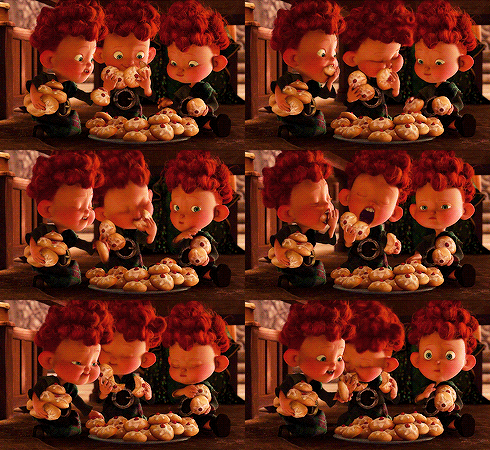
Etiquette and Dining vs Gobbling

There is a big difference between eating and dining. Eating ones food quickly, or gobbling ones food, causes much to be lost, not only in health, but in good manners and the companionship at the table. Dining is a way of leisurely savoring ones food, and enjoying ones company.

To eat fast is one of the bad habits of American people which we ought to avoid. If acquired in childhood, it will be hard to overcome, and will cause us much mortification when, later in life, we find ourselves with empty plates long before well-bred people in the company have finished theirs. 

Since we do not leave the table before others, there is nothing gained, even in time, while much is lost in health and in good manners. – From Edith E. Wiggin's 1884, “Lessons on Manners / For School and Home Use.”


Etiquette Enthusiast, Maura J Graber, is the Site Moderator and Editor for the Etiquipedia© Etiquette Encyclopedia

Wednesday, February 17, 2016

Teach Etiquette with Games

Not like this below.             Do this below instead!                            
Playing games to teach good manners ahead of time, is better than the alternative of scolding a child later on for exhibiting acquired bad manners.


POINTS FOR PARENTS

Playing games which teach good manners is more effective and much pleasanter than is scolding about bad manners.

Mother: "I was so ashamed of you last night when we had guests—reaching clear across the cake plate to take the biggest piece!" 

Mother: "Let's pass the plate of cookies around the table and you have each one of the dolls take the cookie that is nearest to her."
By Edyth Thomas Wallace, 1953

Etiquette Enthusiast, Maura J Graber, is the Site Moderator and Editor for the Etiquipedia© Etiquette Encyclopedia

Tuesday, January 12, 2016

Gilded Age Etiquette and Wise Parents

She does not begin with exhaustive attention to the minutia of etiquette, knowing in that way lies the danger of making her boys prigs, and her girls self-conscious society misses, before they are in their teens.

“The Wise Mother”

Your wise mother is not given to worrying over trifles, says Harper's Bazar. She does not expect perfection in a day. And she has put from her, as far as the East is from the West, the ghastly possibility of setting vanity up in the room of love. So she does not begin with exhaustive attention to the minutia of etiquette, knowing in that way lies the danger of making her boys prigs, and her girls self-conscious society misses, before they are in their teens.

She lays down as the law of her household, the broad principles of respect for elders, reverence for women, kindliness for all; and she permeates the home atmosphere with her finest conception of the deference and the sympathy due from soul to soul. Her children very early delight to place a chair for grandmother and to save father steps. They learn to be proud of that restraint, which enables them to keep self in the background, and to defer to brother and sister.

It never enters their heads that servants are less worthy of respect than other people. They are as unabashed in the presence of wealth and power as they are tender toward suffering and poverty. When she teaches them from time to time her code of manners — and she is careful to perfect it according to her best judgment—she teaches it for home use, and it becomes fixed by becoming natural. —From 1891


Etiquette Enthusiast, Maura J. Graber, is the Site Editor for the  Etiquipedia© Etiquette Encyclopedia

Saturday, December 12, 2015

Etiquette and Education

Good manners should be taught to very young children, and the inculcation of the principles and practice of polite society should be continued throughout the whole period of adolescence.

Child, Where Did You Learn Your Good Manners?

WRITING from New York, where the rush and bustle of crowded city life make incivilities the rule and courtesy the exception, Margery Rex declares that the public school authorities of that city contemplate including the teaching of politeness in the educational curriculum.

Good manners should be taught to very young children, and the inculcation of the principles and practice of polite society should be continued throughout the whole period of adolescence; indeed it should not stop with the adult, but become a habit to follow one through life. 


Good manners ought to be taught at home, and are the more easily inculcated by force of example. But when parents are ignorant of, or indifferent to, the courtesies of domestic life—deference to one’s elders, chivalrous attention of the masculine to the feminine, the helping hand to smaller and weaker ones, repression of one’s own selfishness and tender of kindly offices at table and in the daily goings and comings—when these courtesies are quite disregarded by the elders it cannot be expected that children will show the gentlemanly and ladylike traits of good breeding. 

So that if normal courtesies and conventions of etiquette are not taught at home it becomes doubly necessary that the school strive to make amends. Else it will happen that in the crucible of the schoolroom and playground the mixture of good manners and bad will result in lowering the average rather than raising it. Children somehow learn evil from each other more readily than good. But that is because no child is ideal to another child. 

Juvenile ideals are the grownups. The father and mother first have most influence over the growing child, the school teachers next, and thereafter other elder persons of distinction and accomplishments. Politeness is not natural to children, because every child is a little savage and a bigger barbarian before it can be civilized. 

In a land of independence and of struggle to attain the high prizes, the amenities of self-denial in little things are an efflorescence of later life. Good manners should be the accompaniment of learning. They deserve to be incorporated as a course of study from kindergarten to university. — 1921 Los Angeles Herald

Etiquette Enthusiast, Maura J. Graber, is the Site Moderator and Editor for Etiquipedia© Etiquette Encyclopedia

Saturday, April 18, 2015

19th C. Italian Etiquette vs American... cont.

More on...

 "How Italians Educate Their Children:
A regimen which gives prominence to fine manners, free intercourse of the different classes in Italy, and why it pays to be polite."
I do not think that Mr. Jarves had any Italian offspring like Madoonna in mind when he wrote his 1880 article on Italian parenting and etiquette, but still, she is sending his message, "Italians do it better," all the same ~ The talent, or "smartness" which finds success in any chosen line is considered to be the most enviable quality children can show. Absorbed in their own business or pleasure, they are disinclined to make time, as do Italian and French fathers, to instruct and initiate their children in the customs and wisdom of the world, while winning their confidence in multiform sympathetic ways.

The sincerity of affection of American fathers for their children cannot be questioned, but the quality of its practical manifestation as a whole is open to comment. American fathers are too reserved and undemonstrative; two little given to intimate association with the joys, chagrins, and personal training of their children. From want of practice they do not know how, as do European fathers, to participate in their lives and become their confidential companions. They are over-solicitous to see them on an independent, self-made footing early in life, working out their own careers prematurely, in their separate responsibility, while relieving them of theirs in the matter.

The talent, or “smartness” which finds success in any chosen line is considered to be the most enviable quality children can show. Absorbed in their own business or pleasure, they are disinclined to make time, as do Italian and French fathers, to instruct and initiate their children in the customs and wisdom of the world, while winning their confidence in multiform sympathetic ways. A New-England father, cold and commanding in deportment, when not forgetful and indifferent; austere and abrupt and speech, if not taciturn and careless, bountifully provides the means of education, comfort, and entertainment of his offspring, and is prompt to enunciate Lycurgian rules and abstract apothegms for their guidance by already physically and mentally over-taxed mothers, or those whom he liberally pays to vicariously execute the most needful of his own duties, in the inculcation of those habits and principles on which the future welfare of his family depends.
 
Hence, between American fathers and sons there is less free intercourse and affectionate courtesy, with intermingling of pleasures and interests, than in European families. Domestic life has more centrifugal than centripetal force. In infancy there is begotten a restraint which tinges all subsequent intercourse between them, and leaves uncomfortable associations on both sides. This state of domestic life is more a defect of the head than heart, chiefly arising from the neglect to cultivate those endearing habits and manners which should be the crowning grace of intellectual accomplishments and parental authority.

The tact with which cultivated Italians pay compliments is equal to their fastidious sense of personal beauty. Nothing elicits more heartfelt admiration than grace or brightness, particularly in children. The most common place are noticed, while any special attraction gets enthusiastically praised. Their quick eyes, even in adults, seize on any distinguishing feature, if it be only a well shaped ear or nose, or other minor organ, and cordially praise that, politely ignoring the homely ones out of consideration of the feelings of their possessor. Their aesthetic sympathies are so keen that they detect charms which untrained senses overlook. They are much less prone than Anglo-Saxons to see only defects and crudely condense them into one sweeping condemnation of absolute ugliness or badness, with no discrimination of mitigating or compensating details.
 
In social intercourse they are less inclined to the superficial, impressive, and wholesale prejudices of people of coarser fibre and colder hearts, in regard to persons of unprepossessing appearance. Instead, they charitably discover something to recommend the most forbidding in looks, if, like themselves, well bred, while their respect to age is particularly commendable. Whether this conduct springs from charity of heart or policy of head, it is certainly good breeding. 
The habit of considering others sometimes brings unexpected results. There lived in Florence some years back and Irish painter of merit, who was on the verge of starvation from inability to sell his works. One evening as it so happened that the journal he had taken up at a café to distract him was asked for by a stranger. He immediately handed it to the inquirer, saying another would serve his purpose as well. This led to an acquaintance, which ended in his selling all of his Winter's work to his new friend, who was an amateur, and placing him at once in a comfortable position. 
Another more remarkable instance is the following: An elderly gentleman, partially paralyzed, was traveling by himself in a railway carriage, in which was a young lady, unknown to him. Accidentally dropping the newspaper he was reading, and finding it difficult to recover it, she promptly assisted him, following it up by other little services and pleasant conversation. When the train stopped she considerately assisted him out. He begged her address, which she gave him, and soon the incident faded out of her mind. 
A year afterward, to her astonishment, she received a letter from the old gentleman's lawyer with the intelligence that he had died, and bequeathed her $150,000, "because of her politeness to a stranger." This was indeed casting her bread of civility on the waters of life to some purpose, and forcibly illustrates the power of "politesse de coeur," as the French aptly designate this humane accomplishment.
Matthew Arnold defines civilization as the “humanizing of man in society.” Politeness is one of the most efficient agents in affecting this transmutation of human nature. Poetry, music, painting, and sculpture or even less direct agencies in its improvement, for polite manners are apostolic in their proselytizing functions. No supreme civilization is reached, however, on a single line of progress. To form a complete, well-rounded humanity, scope must be given to every healthful aspiration and no faculty left to lie dormant. The ideal race is yet to be created out of the perfections of all. Hebrewism has given us religion, the spiritual aspects of faith, sacrifice, obedience, duty, and worship as its supreme ideal; Hellenism, the might of philosophy, beauty, and mind in heroic guise of earthly mold; Rome, The power of unity and supremacy of law. 
Germany now proffers inquiry, scientific analysis, and thought; the Latin races, their sensitiveness to beautiful form and behavior; their delicacy of apprehension and technical touch; England, her broad eclecticism, practical skill, and resolute utilitarianism, while inventive, receptive America, the mosaic of nations, opens her doors with the impartial welcome to all but benign influences. Let us hope that humanities highest polish and finest amalgamation will finally be ours. But to secure, this something besides a deep-seated passion for beauty, abstract truth, or prosaic utility is required. 
Progress toward the ideal to be lasting, must be as deeply rooted in the heart as the head. It's complete code exists only in the divine principles of the gospel of Jesus Christ, who is the most beautiful manifestation of spirit in the flesh vouchsafed to men. He was the complete gentleman. His perfect brotherhood, gentleness, truth, sympathy, sacrifice, intuition, forbearance, courtesy, kindness to women and children; His energy, courage, and righteous anger; His devotion to His one great object, the alleviation of life's miseries, succor of the afflicted, healing of the sick, regeneration of all man; His exalted, purifying doctrines and practice- all this, combined with an aesthetic temperament that made Him, the most radical of reformers, enjoy nature and art, wear fine apparel, and come "eating and drinking;" a Saviour appreciating the refinements and blessings of life, not despising and fearing them like a misery-coveting, cowardly ascetic; this makes Jesus, after 18th centuries of example, still the "first gentleman" of all time, universal Teacher and ideal man of humanity. 


From “How Italians Train Their Youth,” an article originally published in the NY Times, sent from Florence, Italy, August 10, 1880, by James Jackson Jarves


🍽️Etiquette Enthusiast, Maura J. Graber of The RSVP Institute of Etiquette, is the Site Editor for Etiquipedia© Etiquette Encyclopedia