Showing posts with label Italian Fork History. Show all posts

Saturday, March 11, 2023

Traveling Utensils and Fork History

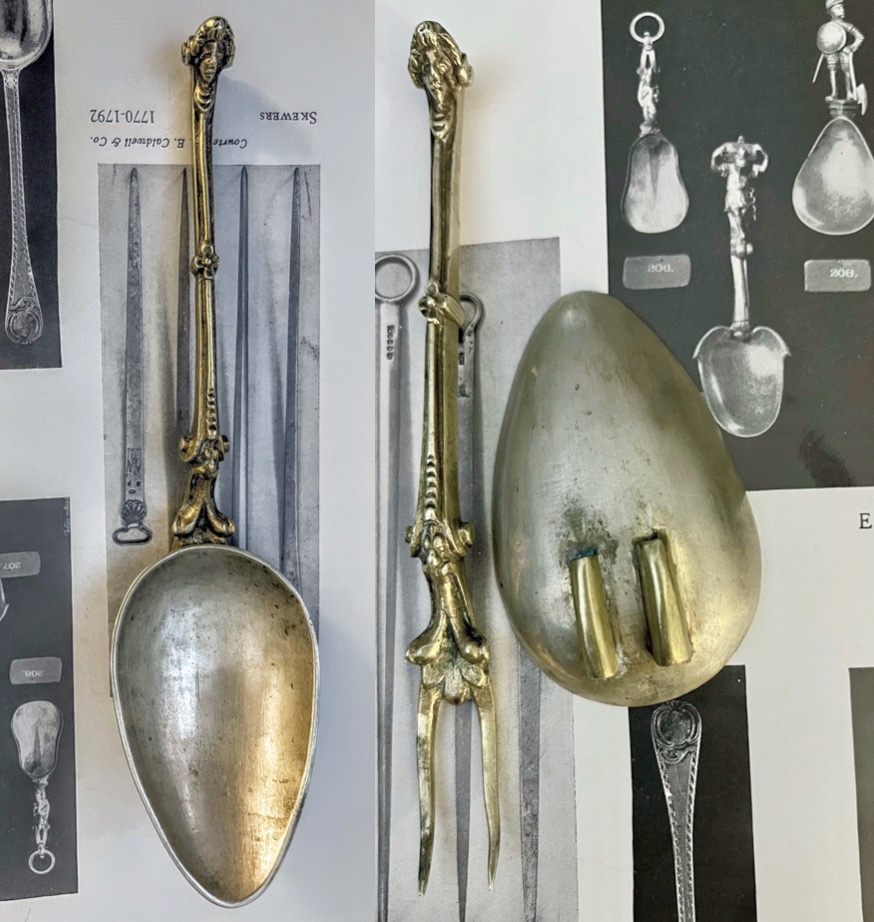
Photo of a retractable travel spoon bowl with the fork attached, alongside a photo of the back of the spoon bowl, sitting next to the two-tined fork which fits inside it to make a spoon. Presumed age is any time from the mid-1500’s to early 1700’s

Around the year 1400, when people carried their eating utensils with them, a folding silver spoon was made to fit the pocket. Later a fork was added. Even the wealthy did not provide these utensils; only royalty seemed to have had enough for their feasts and banquets.

Everyone carried his knife in a scabbard fastened to his belt, to use at mealtime and on any other occasion when a knife was needed. Those who could not afford silver used spoons, knives, and forks of pewter. Copper and brass spoons were used, too, by persons of limited means, although copper soon lost favor due to its tendency to rapid oxidation. 

During the fifteenth and sixteenth centuries, in the Tudor period, it was fashionable to give a christening gift of twelve spoons, each adorned with a miniature statue in silver of one of the twelve apostles. Sometimes a “Master” spoon bearing the figure of Christ was included. These sets are exceedingly rare today. Our “pitcher spoon” originated in Elizabethan days, when great starched ruffles were worn around the neck, making long-handled spoons a necessity.

In Italy, in the 1500s, knives and forks generally appeared on the tables of the cultured, but it was another century before they were popular in France and England. At one time in England it was considered effeminate to use a fork and it took several decades for the people other than the upper classes to adopt it. The clergy even protested its use “as a substitute for God-given fingers.”

In America, too, forks were freakish novelties: when the first fork was imported by Governor Winthrop in 1633, people thought it comical. They could not see any need for it, since most of their meats were cut up and cooked in ragouts and stews. Recipes of the time called for meat to be “y-mynced, hewed on a gobbet, hacked, diced and skerned.” Two-pronged forks to spear food were the most commonly used at first, but early models were made with three and four prongs too.— From “The Book of Old Silver,” by Seymour B. Wyler, 1937


🍽️Etiquette Enthusiast, Maura J. Graber, is the Site Editor for the Etiquipedia© Etiquette Encyclopedia

Tuesday, August 23, 2022

The Luxury and Etiquette of Utensils

During the middle ages, records show man using a knife for dining. The first table knife was designed with a flat, broad blade opposite the cutting edge. The flat part was recommended “for eating of peas and jelly.” It has been said that “he who dined out during the stirring days of the fifteenth century brought his own eating utensils with him.” One of the rules of etiquette the day was to “smack thy lips resoundingly if thou wouldst show due appreciation to thine host.” –Antique utensils and reproduction 18th century glassware work well when mixed with black and white transfer-ware on a rustic farm table. 
Eating Utensils for Dining – History is Revealing

It is hard to believe that the everyday convenience of knife, fork, and spoon were ever a luxury enjoyed only by the very rich and noble. In the fifteenth century man ate with his fingers most of the time, aided only by a homemade spoon. The first spoons, history tells us, were shells. Where shells were not available in the inland countries, spoons of a sort were cut from wood. Eventually, to make the shell a little easier to manage, handles of wood and bone were attached to the cup-shaped base. In excavations of ancient ruins relics of spoons of bone and ivory have been found. In this way, we are able to trace the history of the first designs and usage of eating utensils.

It is interesting to note that in the beginning people carried their own spoons. Knives made of flintstone were usually carried in a scabbard at the belt. But the knife was not generally brought to the table for the purpose of dismembering or slicing. It was used mainly for hunting. A metal knife was not developed until many years later. In areas where copper, silver, bronze, or gold were found, those who could afford it had spoons and knives fashioned of these precious metals. The kind of material a man’s knife was made of often was a clue to his station and wealth.

Spoons were sometimes designed so that they could fold and were more easily carried. In England, spoons of copper, pewter, or brass were used by people of limited means as early as the sixteenth century. During the reign of the Tudors and Stuarts, a fashionable gift at Christmas time was an Apostle spoon. To own a collection of the twelve Apostles was considered a luxury that few Englishmen could afford. A thirteenth “Master” spoon was one fashioned after the figure of Christ, a coveted possession.

There was not too much of a problem about packing the family flatware when early settlers came to America. A “personal spoon” is all a man or woman needed.

During the middle ages, records show man using a knife for dining. The first table knife was designed with a flat, broad blade opposite the cutting edge. The flat part was recommended “for eating of peas and jelly.” It has been said that “he who dined out during the stirring days of the fifteenth century brought his own eating utensils with him.” One of the rules of etiquette the day was to “smack thy lips resoundingly if thou wouldst show due appreciation to thine host.”

The fork was a later introduction after the knife and spoon. At first forks were used just for serving. But we can imagine that the earliest forks were those cut of sticks and used to hold meat over a fire for roasting. Forks were not a table implement until the sixteenth century.

Italy is accredited with being the first country where forks were used. However, it was only the nobility and upper classes who enjoyed this additional eating utensil. Historians do not credit the Italians with the invention of the fork. It was supposed to have been brought to Italy by visitors from the Byzantine Empire.

Even though the fork was very useful as an eating assistant, it was not accepted by the middle classes, because they regarded its use as something effeminate. It took about ten or twenty years after the introduction of the fork for its use to become generally accepted. In spite of slow means of transportation, the idea finally became widespread. Forks were not used in England until the seventeenth century. This was true possibly because the clergy would not approve the use of forks. They claimed it a sacrilege and that man should use his fingers “as God intended.” In spite of these protests, however, the fork was too useful to be given up once it became generally known.

Italy, the seat of culture and art, produced forks of great artistry and beauty. The first ones were designed with two, three, or four prongs, but the two pronged fork was the most popular. People were still carrying eating utensils in a scabbard at the waist when the fork was introduced. Sometimes both fork and spoon were designed with one handle, and often the spoon was designed so that it folded as a part of the fork.

When a man could not afford silver eating utensils he sometimes had them fashioned of pewter, copper, or bronze. Shell, bone, and wood had to be good enough for the very poor.

— From Patricia Kroh’s 1966 book, “Contemporary Table Settings” 


🍽Etiquette Enthusiast, Maura J. Graber, is the Site Editor for the Etiquipedia© Etiquette Encyclopedia

Monday, May 25, 2020

How Forks Replaced Knives

The fork was originally, and up to very modern times, used only to hold meat and other pieces of food, while the knife was cutting them. The putting of it into the mouth instead of the knife was only an afterthought, due probably to the unclean appearance of the knife blade after it had been used to shovel into the mouth, gravies, egg yolks, acids, etc... – Photo by site editor Maura J. Graber

Questioning the Fork: 
The Origins of This Very Useful Article and Why it Replaced Eating From Knives


One of those heterodox fellows, who may be found to question everything, asks upon what  sound principle is the law founded that forbids the putting of the knife into the mouth in eating. Why should a plate of steel, he asks, be interdicted from an office that the same steel, bifurcated, trifurcated or quadrafurcated, may properly perform? There is no objection to be made on the score of cutting one’s mouth, for in all ages of the past, when everybody ate with the knife, nobody ever cut his mouth. This heretic asserts that a certain consistency of food can be ‘‘hoisted,” as a western man would say, much more readily by a knife than by a fork. Of course, you can get the bulk of a mashed potato
 or turnip by dexterously fishing with a fork, but you can do it much neater and in better time with a knife, he continues; and thru the knife will secure all the gravy, which is mostly sifted out by the operation of the fork, and one thus loses the richest part of the meal. 

It is a matter of history that knives played an important part in domestic life long before forks were invented, and that when first the latter implements appeared, it was considered a mark of effeminacy or ultra refinement to use them. To such a degree was this prejudice against them indulged in France, that in the Sixteenth century the use of forks was considered sinful in monasteries, and the monks split up into two parties on the question. Forks originally came into use to save the fingers from soiling, and Italy was the first place where they were used. Ben Jonson writes of “the laudable use of forks brought into custom here as they are in Italy, to the sparing of napkins.” Some time later, a writer praises the King of Hungary for eating without a fork without soiling his clothes. An old writer explains why the Italian used the fork by saying that he could not “endure to have his dish touched with his fingers, seeing that all men's fingers are not clean alike.” 

But the fork was originally, and up to very modern times, used only to hold meat and other pieces of food, while the knife was cutting them. The putting of it into the mouth instead of the knife was only an afterthought, due probably to the unclean appearance of the knife blade after it had been used to shovel into the mouth, gravies, egg yolks, acids, etc... For this reason, silver forks were made; they are cleaner than iron and steel forks. Every step, then, from the original use of the fork as a substitute for the fingers, to its more extended use a substitute for the knife, together with the employment of silver in place of iron, has been dictated by cleanliness. —Good Housekeeping, 1880

Etiquette Enthusiast, Maura J Graber, is the Site Editor for the Etiquipedia©️ Etiquette Encyclopedia