Monday, August 31, 2026

Tea Etiquette and Gracious Bachelors

You will need a covered sugar bowl filled with block sugar, a pretty, shallow dish for sliced lemon, with a lemon server on it... (these) may find a permanent place on this table.


Afternoon Tea and Unexpected Callers

The following suggestions are offered for those who have no maid or who live in bachelor apartments, and wish to extend their gracious courtesy in an informal way to unexpected callers. Some of the needful things are, first, a kettle, usually of brass, with a lamp for burning alcohol, so that the water may be boiled freshly and the tea made at once, without absenting yourself from your guests for any part of their call, except to bring in the plate of wafers, or the fresh water and any other articles not practicable to keep on the table. 

Of course, if you have a gas stove in a room near by, and all your needful things close at hand, you may do all the necessary work outside, in a brief time. But unless you can do it quickly, do not attempt it, for anything which savors of time and trouble for the hostess detracts from the guest’s enjoyment, and the pleasure of the guest is greatly enhanced by watching the process in the hands of a graceful hostess. If you have no table convenient to keep in readiness in your room, or you do not approve of the custom, you may easily have a table, light in weight and easy to lift, or one with a handle made expressly for this purpose, which may be fitted with the tea service and kept in some convenient place ready to be brought in at short notice. 

A covered sugar bowl filled with block sugar, a pretty, shallow dish for sliced lemon, with a lemon server on it, a plate or small metal tray under the lamp, a fancy bottle holding half a cup or more of alcohol, a small caddy for the tea, a tea ball with an extra cup to hold it when not in use, small sugar tongs, as many cups and saucers of your prettiest patterns as you will need, and spoons in the same proportion, may all find a permanent place on this table. If you prefer to have the tea steeped longer than is practicable with a ball, you may provide a teapot, since in this case, if there are many to be served, it will be convenient to put the tea in small bags made of thin muslin, which may be removed when fresh tea is to be made, with less trouble than when the tea is put directly in the pot, or when the tea ball is used and has to be emptied frequently. 

Milk and cream are not often served with afternoon tea, but as many persons do not enjoy the tea without one or the other, it will seem more hospitable to provide them. Do not omit the small bowl which will be so handy for the tea bags, or any portion which may be left, if a second cup is desired. Small hemstitched napkins of the finest linen, or, if your means will not permit this, the dainty paper napkins, will give your guest a measure of enjoyment far in excess of your labor in providing them. — Mary J. Lincoln, Copyright, 1901


🍽️Etiquette Enthusiast, Maura J Graber, is the Site Editor for the Etiquipedia© Etiquette Encyclopedia

Sunday, August 30, 2026

The Etiquette of Kaiseki Ryori

Note the lack of a Western tradition of using serving utensils in one color and style. If you wish, of course, you can buy a set with many bowls, various plates and saucers, but this is not a requirement of good form.


Kaiseki Ryori


Kaiseki Ryori (会席料理) is an important part of Japanese dining etiquette. Translated from Japanese, it means "a meal served during a meeting." This style of Japanese cuisine, which is evident in the content of kaiseki ryori, is entirely original, which automatically increases the price of the meal. The art of “kaiseki” was shaped by several factors - most notably the culinary preferences of the Heian-period (794–1185) imperial aristocracy, samurai traditions, and everyday Japanese and Buddhist cuisine. “Kaiseki ryōri” gained its greatest popularity during the Edo period (1603–1868). The meal is typically served at large, traditional Japanese-style banquets held in rooms featuring Japanese-style décor. Guests sit on tatami mats, with three footed trays placed before each person: a main tray in the center and smaller trays on either side.

Over time, this style of Japanese cuisine became synonymous with the most exquisite dishes prepared for guests gathered to celebrate or simply to enjoy the pleasure of friendly company. “Kaiseki ryōri” also became an integral part of Japanese aesthetics, encompassing the appreciation of creatively crafted and beautifully presented food, refined tableware, the exquisite flavors and pairings of ingredients, and a skillfully composed menu - but above all, the joy of conversation and time spent together.

Kaiseki is often served at traditional Japanese hotels (ryokan) and high-end restaurants (ryōtei), but the most delicious and visually stunning examples of this style are found in Kyoto. Typically, kaiseki ryōri consists of 14 or more courses, each a work of art reflecting the chef's unique vision - from the carefully curated selection of dishes to their presentation on an individual low table for each guest.

The kaiseki ryori style must meet two fundamental requirements: -the serving vessels must be impeccably refined and elegant-crafted by renowned artisans - and reflect the highest standard of service; -there must be a balance of flavor, texture, and exquisite presentation, utilizing only fresh, seasonal ingredients - ideally of local origin. A specific menu is served for each season. Particular attention is paid to the presentation of each dish, often incorporating real leaves, flowers, and edible garnishes shaped to resemble plants or animals.

The Japanese place paramount importance on the visual presentation of a dish; the finest examples are regarded as works of art, and their creators earn the highest praise. Indeed, the concept of beauty - which lies at the heart of all classical art forms and the philosophy of the "Way" (“do”) - permeates every aspect of Japanese life, including cuisine, for classical national art has never been divorced from daily existence. 

Japanese chefs command special respect and are viewed as "poets" who create masterpieces with every dish they prepare.
Traditionally, a kaiseki ryōri meal includes “ichijū-sansai”, comprising four dishes: “ichijū” (miso soup) and three accompanying dishes: “yakimono” (grilled or roasted food), “nimono” (boiled or stewed food), and “namasu” (raw marinated fish). Rice prepared with seasonal ingredients is also an essential component. A sample “kaiseki ryōri” menu is as follows:
  1. sakizuke – a small appetizer served at the beginning; 
  2. gohan – white rice with seasonal additions; 
  3. suimono – clear soup served in a small lidded lacquer bowl;
  4. hassun – a selection of seasonal appetizers and side dishes that establish the seasonal theme (served on a tray with a diameter of 8 “sun” or approximately 24 cm); 
  5. yuto – a lacquer vessel for hot drinking water; 
  6. ko-no-mono – seasonal pickled vegetables accompanying the hassun; 
  7. mukozuke – pickles or appetizers (served on the far side of the dining tray, while rice and soup in lidded lacquer bowls are placed on the near side); most commonly sashimi;
  8. nimono – an assortment of vegetables and seafood simmered over low heat, served in individual bowls;
  9. yakimono – grilled fish; 
  10. takiawase – vegetables with meat, fish, or tofu, simmered separately; 
  11. suzakana – a small dish to stimulate the palate, typically vegetables in vinegar; 
  12. hiyashi-bachi – chilled vegetables, sometimes with shrimp or crab; served only in summer;
  13. naka-choko - like suzakana, a dish designed to cleanse the palate, typically a sour soup; 
  14. shiizakana - the main course; fried or simmered beef, poultry, or fish; 
  15. tome-wan - the final soup, usually miso soup with various additions such as shallots, tofu, seafood, mushrooms, etc.;
  16. mizumono - a seasonal dessert: fruit or ice cream.
Among the most popular types of kaiseki ryori, the following stand out: tofu-kaiseki (dishes based on tofu, complemented by various vegetables) and soba-kaiseki (featuring various preparations of buckwheat soba noodles). As a rule, the dishes are vegetarian, although kaiseki can include fish and meat.
Kaiseki ryori is one of the most expensive cuisines in the world. Restaurants serving this style of cuisine offer private rooms for diners -featuring either tatami mats or chairs - that often overlook a Japanese garden.

                                                            
By contributor, Elena Gavrilina-Fujiyama especially for Etiquipedia. Elena is a specialist in Japanese protocol and etiquette, and European social etiquette. The founder of the project Etiquette748, Elena is also a member of the National Association of Specialists of Protocol. She authored the best-selling book “Japanese Etiquette: Ancient Traditions and Modern Rules” after living in Japan for over 20 years. Elena recently was awarded the Diploma of the World Prize “Woman of the Russian World” in the category “Entrepreneurship” (Japan). The theme of the 2024 award is “Preservation and strengthening of the traditional family values.” 

🍽️Etiquette Enthusiast, Maura J. Graber of The RSVP Institute of Etiquette, is the Site Editor of the Etiquipedia© Etiquette Encyclopedia

Saturday, August 29, 2026

Etiquette and Treatment of Servants

“If you have only one servant, speak of her by her Christian name; if you have more, talk of them by the names of their offices, such as nurse, cook, housemaid, footman, etc...”


SERVANTS

Do not imagine that you will increase your importance by hauteur to your own or to other people’s servants.

At the house of your friend always preface your request to a servant by the words, “I would thank you for so and so;” and do not omit the usual courtesy on receiving it.

Do not scold your servants; you had better turn them away at once. When they need reproof, give them it in a calm, dignified, and firm manner; but on no account, if you can possibly avoid it, find fault with them in the presence of strangers, even though they should let fall the tray with your best set of china upon it.

If you have only one servant, speak of her by her Christian name; if you have more, talk of them by the names of their offices, such as nurse, cook, housemaid, footman, etc..., but always address them by their Christian names.— True Politeness, A Handbook of Etiquette for Ladies, By An American Lady, 1847


🍽️Etiquette Enthusiast, Maura J. Graber of The RSVP Institute of Etiquette, is the Site Editor of the Etiquipedia© Etiquette Encyclopedia

Friday, August 28, 2026

1840’s General Etiquette for Ladies


Perfect order, exquisite neatness and elegance, which easily dispense with being sumptuous, ought to mark the entrance of the house, the furniture, and the dress of the lady. — Image source, Etiquipedia private library


GENERAL OBSERVATIONS 

On Etiquette of A Lady 

In entering any public room with a gentleman, let him precede you and obtain a seat.

If at another's house you should break anything, do not appear to notice it. Your hostess, if a lady, would take no notice of the calamity, nor say, as is sometimes done by ill-bred persons, “Oh! it is of no consequence.”

Do not beat the “devil's tattoo,” by drumming with your fingers on a table. 

Never read in an audible whisper; it disturbs those near you.

You should never take the arms of two gentlemen, one being upon either side.

A lady ought not to present herself alone in a library or museum, unless she goes there to study or work as an artist.

Perfect order, exquisite neatness and elegance, which easily dispense with being sumptuous, ought to mark the entrance of the house, the furniture, and the dress of the lady.

The most obvious mark of good breeding and good taste is a sensitive regard for the feelings of others...— True Politeness, A Handbook of Etiquette for Ladies, By An American Lady, 1847


🍽️Etiquette Enthusiast, Maura J. Graber of The RSVP Institute of Etiquette, is the Site Editor of the Etiquipedia© Etiquette Encyclopedia

Thursday, August 27, 2026

Antebellum Dinner Table Etiquette

Forks were not commonplace in the United States until the 1830’s to 1840’s, thus this etiquette book written in 1847 instructs that, “… silver forks are now met with in almost every respectable house. Steel forks, except for carving, are now seldom placed upon the dinner table.
Always feed yourself with the fork; a knife is only used as a divider. Use a dessert spoon in eating tarts, puddings, curries, etc…” — 
A historical reproduction, period 1855 place setting, created by site editor, Maura Graber and artist, Eda Bierman. The word antebellum literally means “before the war” (from the original Latin “ante” meaning “before” and “bellum” meaning “war.”) In modern vernacular, it is generally referring to the period before the 1860’s Civil War in the United States. 

American DINNER-TABLE 
ETIQUETTE OF 1847

INVITATIONS to dinner must of course be answered to the lady. Cards of invitation to a dinner party are usually issued from three days to a fortnight previous to the entertainment; they should specify the hour of meeting. 

The proper number for such a party is somewhat in dispute: the happy medium may be considered ten.

As persons are necessarily introduced at a dinner party, only such persons as are known to each other, or who mutually desire to be acquainted should be invited.

Be punctual to the hour appointed.

When an invitation is accepted, let nothing but imperative necessity compel you to break the engagement, or at the last moment to send an excuse.

When your guests enter, present them to the others, and if any delay occur, let the conversation be light and on common-place topics.

It is usual for the host or hostess to point out to the gentlemen the ladies they are to conduct to the dining-room, according to some real or imaginary standard (age or distinction). If persons of distinction are present, it is desirable that this should be done - of course giving them precedence.

The hostess follows her guests to the dining-room, the host having led the way with the lady of most consideration; the gentleman of the greatest distinction accompanies the hostess to the dining-room.

The hostess takes the head of the table: the seat of honor for a gentleman is at her right hand; for a lady, it is to the right of the host.

Ladies do not wear gloves during dinner.

In the best houses, the operation of carving is performed at the side tables; i. e. the principal joint, or joints, which require strength in the operation, are there carved.

Table napkins are indispensable at the dinner table; and silver forks are now met with in almost every respectable house. Steel forks, except for carving, are now seldom placed upon the dinner table.

It is usual to commence with soup, which never refuse; if you do not eat it, you can toy with it until it is followed by fish; of either of which never take more than once.

When all are seated, send a plate of soup to every one. Do not ask any one if they will be helped, as every one takes it, of course.

Always feed yourself with the fork; a knife is only used as a divider. Use a dessert spoon in eating tarts, puddings, curries, etc., etc.

If what you are eating before the dessert has any liquid, sop the bread and then raise it to the mouth. For articles of the dessert having liquid, a spoon is usually provided.

In helping sauce or vegetables, place them upon the side of the viands on the plate.

If anything is sent you from the host or hostess, do not offer it to any other person; and when helped do not wait until others are served, but at once arrange your napkin, and proceed to the important business of the moment.

In helping a joint, do not overload a person's plate; and if game, or any particularly select dish is placed before you, serve it with discretion.

In helping, wherever a spoon can be conveniently used, it is preferable to the use of a knife and fork

Fish must be helped with a fish slice: you may carve it more dexterously by taking a spoon in your left hand.

Soup must be eaten from the side, not the point of the spoon; and, in eating it, be careful not to make a noise, by strongly inhaling the breath: this habit is excessively vulgar; you cannot eat too quietly.

In helping soup, recollect that a little more than a ladle full is sufficient.

As hostess, do not press people to eat more than they appear inclined to take, nor force upon them any particular dish which you may think super excellent. If any difficulty occurs in carving, you should feel no diffidence in requesting the gentleman to your right or left to assist you: it is a part of their duty and privilege.

Do not ask any one at the table to help you to anything, but apply to the servant.

The hostess should never send away her plate until all the guests have finished.

When you send your plate for anything, leave your knife and fork upon it. When you have done, place both together on one side of the plate.

Servants wait at table in white gloves, or have a fine napkin in their hand, which prevents its contact with your plate.

Finger-glasses come on with the dessert; wet a corner of your napkin and wipe your mouth; then immerse your fingers in the water and dry them with the napkin.

As hostess, you will give the signal for retiring by rising from the table. The time for so doing varies in different companies, and must be left to your discretion.

Should your servants break anything while you are at table, do not appear to notice it. If they betray stupidity or awkwardness, avoid reprimanding them publicly, as it only draws attention to their errors, and adds to their embarrassment.

During the week which follows the entertainment, each of the guests owes a visit to the entertainer. Converse about the dinner, the pleasure you have enjoyed, and of the persons whom you have met there.

The mistress of the house should never appear to pride herself regarding what is on her table, nor confuse herself with apologies for the bad cheer which she may offer you; it is much better for her to observe silence in this respect, and leave it to her guests to pronounce eulogiums on the dinner.

Ladies should not leave the table before the end of the entertainment, unless from urgent necessity. If it is a married lady, she requests some one to accompany her; if unmarried, she goes with her mother.— True Politeness, A Handbook of Etiquette for Ladies, By An American Lady, 1847


🍽️Etiquette Enthusiast, Maura J. Graber of The RSVP Institute of Etiquette, is the Site Editor of the Etiquipedia© Etiquette Encyclopedia

Wednesday, August 26, 2026

1957’s Modern Etiquette

Q. … what am I supposed to do at a wedding dinner when a toast is drunk to the bride?
A. You hold the drink which has been poured for you in your hand, lift it when the toast is made, and then put it down at the first opportunity.

MODERN ETIQUETTE

Q. Is it improper for a man to tell a woman friend that her slip is showing?
A. This is quite all right, if there is a place where she can go to fix it. Otherwise, it would be more thoughtful if he keeps quite about it to avoid making her feel un- comfortable.

Q. Since I do not drink alcoholic beverages, what am I supposed to do at a wedding dinner when a toast is drunk to the bride?
A. You hold the drink which has been poured for you in your hand, lift it when the toast is made, and then put it down at the first opportunity.

Q. Is it a matter of etiquette for a new father to give out cigars and candy to his friends?
A. There are no rules of etiquette regarding this. It's just an old widespread American custom. — By Roberta Lee, in “Modern Etiquette,” Press Tribune, 1957

 🍽️Etiquette Enthusiast, Maura J. Graber of The RSVP Institute of Etiquette, is the Site Editor of the Etiquipedia© Etiquette Encyclopedia

Tuesday, August 25, 2026

Lunchroom and Hotel Table Etiquette


How shall I tip the waiter when there are just three or four ladies traveling together?

An Agony Aunt column Q & A

Dear Mrs Adams,

Kindly advise me on the following questions relative to table etiquette in hotels and lunchrooms:

1. How to use napkin.
2. Where to place individual dishes such as bread, butter, water, fish, so on to salad.
3. When dishes are placed by a waiter, should they be moved to suit one’s convenience,
4. How to eat different bread stuffs, such as biscuit and hot rolls.
5. What to do when one does not care for courses that are brought on.
6. Is one supposed to eat from side dishes or dinner plate?
7. When a waiter brings courses ‘round should I take them off of the tray and place them on the table, or should the waiter?
8. How shall I tip the waiter when there are just three or four ladies traveling together?

🍽️  🍽️  🍽️  🍽️  🍽️  🍽️  🍽️  

1. The napkin is taken from the table, unfolded and laid across the knees. At the close of the meal, it should be placed unfolded, a little to the side of one’s plate.
2. The bread and butter plate is placed to the left of one’s plate and the tumbler of water to the right. These, as well as the dishes that follow, will be placed correctly by the waiter.
3. Yes, in an unobtrusive manner.
4. Bread, biscuit or rolls are eaten in the same manner. A piece is broken off each time one wishes to convey any to the mouth.
5. The best way to do this is to make a pretense of eating it, or to continue eating bread or crackers, so that you will not make yourself conspicuous by sitting back and not eating. Of course, if you are asked whether you would care for a certain dish when the order is given, you can then give your explanation.
6. If small portions are brought in on side dishes, you should take the food directly from them.
7. Leave the amount you desire to give the waiter on the tray when he brings your change. — The Los Angeles Herald, 1911


Etiquette Enthusiast, Maura J Graber, is the Site Editor for the Etiquipedia© Etiquette Encyclopedia

Monday, August 24, 2026

Etiquette and Superiority Complexes

Similar to Chinese coolies, Japanese “Jinrikisha boys” were considered rough and without any manners. They pulled rickshaws. The word rickshaw originates from the Japanese word jinrikisha  jin or “human” and riki or “power.” Sadly, they did not have the power to change the perceptions of those people in society with superiority complexes!

One thing a really polite man or woman never does is to call attention to another person, particularly one inferior in any way. It often happens that we are brought in some way into contact with persons who are of another race, religion or merely another strata of society than ours. It is most rude to, in any way, make these people feel that they are any different than we are. 

One of my dearest friends is a young Englishwoman, born and raised in China. All of her former life was spent in what we would consider the lap of luxury. She was surrounded by servants and coolies to do her bidding. She was brought up to consider the Chinese coolies as lower than the dust. She still can not feel that the Chinese youth that we have here in San Francisco are any more than their parents in the old country —just servants. I have argued and tried to explain to no avail. She simply can not change her training! — By Deborah Ames, Calexico Chronicle, 1936


🍽️Etiquette Enthusiast, Maura J Graber, is the Site Editor for the Etiquipedia© Etiquette Encyclopedia

Sunday, August 23, 2026

1930’s Etiquette for Gents and PDA

“A man never takes a woman’s arm, but offers his. It is definitely bad taste to walk arm in arm. I have always felt that any display of emotion in public was very poor taste.”

Beware Showing Public Emotion

I THINK it was a man named Phelps who gave what is to me the almost perfect definition of etiquette. He said, “The essence of politeness consists in so conducting ourselves, in manner and word, that others may be pleased both with us and with themselves.” There are innumerable little tests of good manners that distinguish, the well-bred person in public. A truly polite person never calls attention to himself in any way, at any time. When he meets a friend, he does so quietly and graciously. He is cordial without being conspicuous. A gentleman offers his arm to an old lady or an invalid. He helps his companion to alight from a car, to step across a puddle, or in walking down dark stairs.

A young man may offer to assist an older or infirm man in any of these instances without seeming forward. A man never takes a woman’s arm, but offers his. It is definitely bad taste to walk arm in arm. I have always felt that any display of emotion in public was very poor taste. I never punish my children before other people, neither do I allow them to “make scenes” in places where they will attract attention. This fashion of kissing upon meeting and leaving one’s friends, is particularly distasteful. If you start kissing people the second time you meet them, it is like eating your dessert before you finish the salad and entrée. It leaves you nothing to grow, to nothing to look forward to, in the development of your friendship. Kissing is something that should be kept for one’s family or dearest friends. When it is done promiscuously, it becomes meaningless. — By Deborah Ames, Calexico Chronicle, 1936


🍽️Etiquette Enthusiast, Maura J Graber, is the Site Editor for the Etiquipedia© Etiquette Encyclopedia


Saturday, August 22, 2026

Spoon History and Etiquette

“Spoons are older than forks, because nature provides them. Where people live near the sea, sea shells are often used as spoons. Gourds and sections of bamboo have been used too, and spoons are easy to carve out of wood. In a few places, as among the Native Americans of the Pacific Northwest, the “spoon” might actually be almost flat, like a paddle, because its real use was to fish out solid bits of food for the honored guest.”— Shown above, three small antique silver spoons, from left to right, a mustard spoon, salt spoon and a snuff spoon
—Photo source, Etiquipedia private library 

Tiny Bowls

What’s a spoon, really? A tiny bowl with a long handle so that we don’t have to drink clumsily from a larger bowl.

We use it for soup, but that’s just the elegant modern way to do it. The original way (which survived in rural areas well into the 19th century) was to pick up the whole bowl and chug it down. Sticklers for good usage insist that we should say we “drink” soup, rather than “eat” it, but in the old days that went without saying.

Spoons are officially intended for liquid or semi-liquid  food, so we use a spoon for pudding or ice cream (hence the expression “X could eat Y with a spoon,” meaning X considers Y a luscious treat). But we use a fork for pie, because it’s a pastry, a distinction that has infuriated many a small child who wanted to get all of a pie’s drippy fruit filling.

Spoons are older than forks, because nature provides them. Where people live near the sea, sea shells are often used as spoons. Gourds and sections of bamboo have been used too, and spoons are easy to carve out of wood. In a few places, as among the Native Americans of the Pacific Northwest, the “spoon” might actually be almost flat, like a paddle, because its real use was to fish out solid bits of food for the honored guest.

In many parts of the world, people eat out of a communal plate and even take soup from a common bowl. Obviously, this poses a risk of spreading disease. But people have ways of getting around that. In Central Asia, for instance, the soup spoon has a remarkably wide bowl— sometimes it looks like two bowls side by side— and etiquette requires that you scoop away from you into the common bowl of soup or yogurt. So the part of the spoon that goes into the soup is not the part that goes into your mouth. Clever. — By Charles Perry, 1999


🍽️Etiquette Enthusiast, Maura J Graber, is the Site Editor for the Etiquipedia© Etiquette Encyclopedia
Friday, August 21, 2026

Etiquette and Self- Control


You can never be rude if you bear the rule always in mind, for what lady likes to be treated rudely? — Image source, Etiquipedia private library

Self Control ~
"Will Power is the rudder of the ship of life."

A woman's life is about what she makes it. She is her own Fate. The law that governs one, governs all humanity, because the laws of thought are the laws of the universe. The mind and body are co-workers. "As a man thinks, so is he." Great men are those who see to it that the mental force is stronger than the material, and who "Will" that thought shall rule their world. Every thought stimulates certain brain cells, and exercises some nerve, tissue or muscle. Man's superiority to animal is due to this mental action.

Actions speak louder than words. They are published thoughts. Every movement of every portion of the body has significance. Picking up a glass, a cup, or tools and other habits reflect the mind and its superiority to the physical. There is no surer way to judge people.

Every face tells a tale and we read character from the physical form—the head, the backbone, the eye, the mouth, the chin, or hand. The uplifted eye, the corners of the mouth, the manner in which one eats or stands, in fact every movement has a special meaning, which may be easily read. The body is like a camera, it tells the truth; it is the outward sign of inward grace, or vice versa.

Some one has said "Women's characters are writ large on their faces and God writes a perfectly plain hand." Because women are more emotional than men and because they often indulge themselves in emotions, the signs are frequently very evident. If we study these signs when we meet others we may "size them up," and almost know what is passing through their minds. Because of sexual magnetism men read women more easily than they read men.

Mental habits soon become reflective or automatic. In order to read others we must study ourselves, discover our habits and tendencies and trace them to their source for correction.

The time has arrived for new thoughts, new studies, and new habits. Colored women must be led along the new lines of thinking. Although many have seemed stupid about some of the abstract studies, they have native powers that have too long lain dormant.

Many are permitting their forces to go to waste instead of controlling them. They must discipline themselves to gain self control over such habits as over-eating, coarseness, inertia, anger, and other beauty destroyers. Any excessive emotion debilitates the nervous system and thus affects good looks.

Proper poise prolongs life because pressure on certain organs is evenly distributed and no strain is placed on any particular muscles to cause abscesses or tumors, etc. Improved circulation of the blood results, and good circulation spells health. One can think better when poise is correct for the same reason.

The conversation of people gives a pretty correct estimate of character. Complaints from people who are sorry for themselves is one of the tell-tale evidences of a weak character.

There is a present day need of knowledge concerning a certain contagion of emotions. Strong feeling sometimes vibrates that which is hostile and selfish. One fretful, scolding woman can upset a neighborhood, to say nothing of a household.

One's thoughts should be of love and peace, instead of worry and fear, lest she may harm others. A woman should be unafraid to conquer life's problems. She should have faith in herself or she will be a dreamer instead of a doer. She must be positive instead of negative, but be positive in the right way which includes the thought and help for others.

Voices reflect the mind and soul, so the colored woman should control the speaking voice. Ella Wheeler Wilcox has said, "Some voices affect us like music, Some voices arouse to action and ambition. Some voices fill you with despondency. Some voices irritate like a buzz-saw. Some voices snap like turtles, and some hiss like serpents." Control of the speaking voice is one of the most admired evidences of self control.

The power of the mind over the body is said to be greater than any germ. Compelling the mind to perform some one useful

disagreeable act each day is a splendid habit trainer. The influences that we exert over others will depend to a great extent

upon the control over our own habits as well as the resistance to influence that others might exert over us.

One must conquer habits of laziness, untidiness, extravagance, voice, gestures, clothing, to gain
power to concentrate thought. — From, “The Colored Girl Beautiful,” by Emma Azalia Smith Hackley, 1916


🍽️Etiquette Enthusiast, Maura J. Graber of The RSVP Institute of Etiquette, is the Site Editor of the Etiquipedia© Etiquette Encyclopedia

Thursday, August 20, 2026

Etiquette and E. Azalia Smith Hackley

Emma Azalia Smith Hackley was an extremely accomplished, African American woman. A teacher, newspaper editor, concert soprano, and a political activist, she promoted racial pride through her support and promotion of music education for African Americans. Her book, “The Colored Girl Beautiful,” published in 1916, was said to have been written as a a "how to" of sorts, for becoming a refined African American lady. She died in Detroit in 1922 at the age of 54. —Public domain image of Emma Azalia Smith Hackley 


The Colored Woman Beautiful

In spite of everything to be said on the subject the womanly woman is always the strongest magnet whether she is called beautiful or not.

If the colored girl has not been taught by her mother or guardian to train herself for a beautiful maturity even after she has passed girlhood, it is not too late to train herself.

Good begets good, so she will exert herself to make a wide circle of friends altho she will be careful not to grow too intimate with any. She may be a real friend without undue intimacy.

It is conceded that most women "must talk" to someone but too much intimacy means too much freedom and this often destroys friendship.

One cannot argue, quarrel, or criticize and still expect real friendship. One definition of a friend is, "One you know all about and still like." One should not try to "make her friends over" and one never says disagreeable things to her friends nor does she make unfavorable comments about their personal attire or weaknesses. She lets her friends learn all unpleasant things from others. "The links of the chain of friendship are held by a very delicate thread." The tiniest word, doubt or action may sever the links.

The colored woman beautiful will try to love that she may be loved. She believes that "man is his brother's keeper" and she has ideals and visions for the race. She has a moral obligation; she reaches out a helping hand to others. She can mix without being mixed. We can not help others unless we mix. There must be close contact-touch to lift up others.

The colored woman beautiful believes that everyone who gets up must pull up, or else she will be kept down by the weight of the racial burden. Each one's welfare is closely bound with that of the masses. The race as a whole must progress and prosper, or else no unit may prosper. The colored woman beautiful gives the best in her for race advancement. She works, thinks, and reads to be ready for the need of the tomorrow and its problems.

The colored woman beautiful will not carry "chips on her shoulder," looking for slights and insults. If she carries the thought too strongly it becomes catching and someone will take up the idea. She will set into motion lesser vibrations in the minds and bodies of others and the things she imagines will happen.

She should resist thoughts of suspicion. She must not think about the things she wishes to keep secret, for thoughts are contagious.

The colored woman beautiful does not call another woman "bad" just because she does not measure up to her ethical code. She must be so persistent in being good herself that everyone else seems to look and act good. If God loves the lowest, she can afford to do likewise. She follows the rule, "Judge not that ye be not judged." She does not make the mistake of criticising those who have not her strong will power, lest having stronger projection this unkindness may return swift and sure to her. To permit the absent to be disparaged or depreciated in her presence is almost as harmful to herself as if she had said things.

What is "good" in (another) woman? What is "bad" in (another) woman? These are two difficult questions to answer and a woman must not judge by her own standard for herself. Women are inclined to be too narrow in their viewpoint in judging other women. While one may boast of her virtue of virtues some women may have a bundle of lesser virtues of which to boast. It takes more than one virtue to make a good woman. Many women are unduly vain of their escape from the "sin of sins" and some of these may have known no temptation.

When one notes how many good friends a so-called "bad" woman may have, one wonders why it is. Those who understand the law of vibrations recognize that the woman has projected something of herself which has brought her a rich return in spite of her one weakness.

It is a terrible thing to be a bad example along any line to young girls, so every colored woman should try to conquer herself and live down any weakness or error. She should give out the best that is in her that she may be a good example to younger women. She lets the light of love and purity shine in her face and transform it, and it will reflect in the faces of others and make her own soul the happier.— From, “The Colored Girl Beautiful,” by Emma Azalia Smith Hackley, 1916


🍽️Etiquette Enthusiast, Maura J. Graber of The RSVP Institute of Etiquette, is the Site Editor of the Etiquipedia© Etiquette Encyclopedia

Wednesday, August 19, 2026

Etiquette for Ethiopian Emperor

“The official reception was conducted with formal court etiquette that required each couple to bow or curtsy upon entering the throne room, to bow or curtsy again half way across as they approached the Emperor, and to bow or curtsy a final time when they were presented to this dignified personage who is the Elect of God, Conquering Lion of the Tribe of Judah, King of Zion, Negusa Nagast (King of Kings) and Emperor of Ethiopia.” — Public domain image of Ethiopian Emperor, Haile Selassie

Trailers Intrigue Emperor

One of the most interesting tales the Africa Caravanners who are pioneering with Wally Byam from Capetown to Cairo in their Airstream Land Yachts are going to tell when they get back will be about their official reception at the Imperial Palace of Ethiopia's Emperor, Haile Selassie.

This was conducted with formal court etiquette that required each couple to bow or curtsy upon entering the throne room, to bow or curtsy again half way across as they approached the Emperor, and to bow or curtsy a final time when they were presented to this dignified personage who is the Elect of God, Conquering Lion of the Tribe of Judah, King of Zion, Negusa Nagast (King of Kings) and Emperor of Ethiopia.

After the presentation, champagne was served to the Caravanners and His Imperial Majesty asked to talk to various couples. He was most interested to learn just who these people were and why they had worked so hard to get over primitive camel trail "roads" to visit his country.

THE CARAVANNERS explained that they had no connection with the U.S. government except to pay their taxes, and that they had come entirely as tourists, just to meet the Ethiopian people and see their country.

AS A PARTING salute to Ethiopia, before they headed north to Khartoum, the Caravanners entertained Haile Selassie at the Caravan encampment. The ladies of the Caravan baked up batches of their favorite cookies, brewed pots of coffee, and iced up coke for the youngsters. His Majesty toured the whole camp and asked to visit in about 12 of the 36 Land Yachts parked at the Royal Race Track. — Long Beach Telegram, 1960


🍽️Etiquette Enthusiast, Maura J. Graber of The RSVP Institute of Etiquette, is the Site Editor of the Etiquipedia© Etiquette Encyclopedia

Tuesday, August 18, 2026

Etiquette?: “But this is California!“

There is a Disneyland and Disney Resort Etiquette list, requiring appropriate attire be worn for the Disney Parks. You can find a copy here: An early souvenir photograph from the Submarine ride, of two couples enjoying an afternoon at Disneyland, in the late 1950’s. — image source, Etiquipedia private library.


“There isn't a separate etiquette book for California. We're part of the human race, too…”

Every time I have devoted this space to scholarly remarks about tourists, I have been brought under fire via the U. S. Mail. Great literary violence has been heaped upon my head by members of the sunglasses and flowing shirt tail set.

The latest episode was different in only one respect. If you will recall, a few weeks ago I remarked about hideous appearance of so-called sports who travel to Catalina Island. As usual, many of my fans here at the paper stuck their heads inside the door to give me Bronx cheers and other forms of invective, but this time the mail brought a pleasant departure.

A charming lady named Grace Seiger Walton took the time to write a letter and say that she agreed with my viewpoint. I'd like to share parts of her letter with you today.

"My husband and I had just returned from four days over there across the channel and were just fascinated by the variety of 'sport' attire. My good spouse took a sport coat (and wore it) in spite of the fact that I kept warning him that he would look like a freak to the rest of the visitors. So you see - your article brought us much mirth and we immediately recalled the couple coming into the little bar at the St. Catherine in their swim suits. Boy times have changed over there!"

MRS. WALTON continued: "But my real purpose in writing is to mention if you think the people in Avalon look like a bunch of ill-dressed clowns you evidently have not been to Disneyland lately!

"That by far is the most complete array of sartorial disgust that I have ever seen gathered in one community. It would take a ream of paper to commentate on the combinations we saw over there last week. But, one couple (dames) fat-ish, forty-ish, giddy-ish - dressed in short-shorts with more showing than Sally Rand ever let show beyond her fans."

You are correct in your assumption, dear lady, that I have not been to Disneyland yet. I've been saving that for a time when my spirits are at a low ebb. Usually, I can pick out enough sloppy attire on the streets of Long Beach to fill this column adequately.

However, I would add that I HAVE been to Knott's Berry Farm several times. The most recent trip was a few weeks ago when my wife and I went there for dinner with our two small nieces.

“DON’T MOW YOUR LAWN!
Forget it! It’ll only need cutting again next week.
Instead, bring your family to Disneyland
now. You’ll have fun, and so will they!” —
So reads a newspaper advertisement
 for Disneyland from 1958. It features a cantankerous looking Donald Duck, and was placed in the paper next to this very article. Presumably, Disneyland wanted you to visit, but just not wearing the same clothes you were going to mow the lawn in! 

Something for the Boys:
Ol' Ted Finds Ally in Tourist Battle

All I can say is that I KNOW what you MEAN! I haven't seen such a collection in years.

It seems to me that the management at Knott's used to frown on women frequenting the establishment while attired in shorts -but those days evidently are gone forever. Women of all shapes and sizes stroll the area, showing much more skin than sense. And the men? Well, most of them look like in they've just been rescued from a sinking at sea!

We ate in the big dining room-where they serve the chicken dinners and I am forced to admit that the state of dress of most of the patrons reminded me of pictures I have seen of meal time at Devil's Island!

I REALIZE that by saying this I am making myself a target for more jibes by the dirty-fingernail-and-uncut-hair set, but I can't understand how people with an ounce of pride in their make- up will be seen in public in such ratty attire.

I'm all for comfort. I don't think you have to wear a business suit for a visit to Disneyland or Knott's or Catalina. There are clothes made expressly for such trips they are called sport clothes. There's nothing wrong with them, they look wonderful under these circumstances. And most bona-fide sport outfits include a coat for men!

This isn't a quirk on my part - it's just common decency, good manners.

"But this is California!" the alibi artists will wail. To which I reply, "So WHAT?" There isn't a separate etiquette book for California. We're part of the human race, too. And I stand by my guns - I don't care WHO a man is, if he isn't dressed neatly, I know WHAT he is… he's a SLOB! — By Ted Krec, for the Long Beach Independent, 1958


🍽️Etiquette Enthusiast, Maura J. Graber of The RSVP Institute of Etiquette, is the Site Editor of the Etiquipedia© Etiquette Encyclopedia

Monday, August 17, 2026

Etiquette and Excitement at “Le Bal”

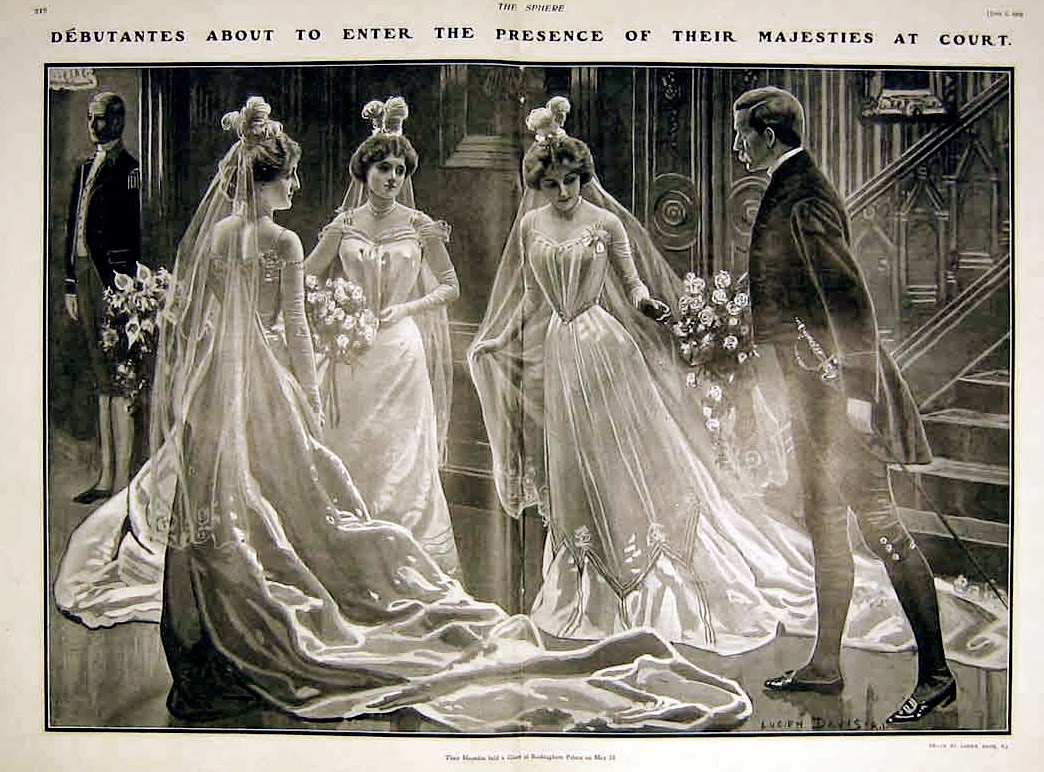
Debutantes of Old in White, Readying to Meet Royalty — To make one’s “debut,” or to enter into society, has its roots in the Royal Court of France. By the reign of Britain’s King George III, Queen Charlotte started a tradition of introducing and presenting the young aristocratic women of court to society. Known as “Debutantes” from Queen Victoria’s reign in 1837 and on, there was strict etiquette to follow regarding proper costume for court presentations; Fashionable evening dresses with head-dresses of veiling, feathers and a train trailing the dress from the waist. Long, white kid gloves, pretty fans or fragrant bouquets added to the look and offered a bit of diversity in look for the young debutantes. Fashion and etiquette have evolved over the years, however the excitement, pomp and ceremony remain the highlight of a young woman’s entrance to society.

Le Bal des Débutantes Paris’ Etiquette:

The Dos, Don’ts & the Couture

Le Bal is coming! On November 28, 2026, at the Shanghai-La Paris Hotel, a new group of Debutantes and their Cavaliers will gather — and yes, I’ll be watching. 

Le Bal takes inspiration from the traditional Debutante ball, but the etiquette has evolved along with the fashion.

Historically, Debutantes were presented in white gowns, white gloves and tiaras. At modern Le Bal, each Deb is dressed by a couture or haute couture house, while her Cavalier wears traditional white tie.

So, what does Le Bal etiquette look like today?

DO: Embrace Individuality… The Debs aren't expected to look alike. Color, different silhouettes and distinctive couture allow each young woman to have her own moment.

DON'T: Automatically Choose Black or White. Unlike traditional Debutante presentations, Le Bal generally steers its Debs away from black and white.

 DO: Respect the Dress Code! The couture may be modern, but this is still an exceptionally formal occasion. The Cavaliers' traditional white tie is a perfect reminder that some dress codes haven't gone anywhere.

 DON'T: Confuse Formality With Being Old-Fashioned Etiquette is kinetic. It evolves. Le Bal keeps the ceremony and formality of the debutante tradition while allowing fashion to move forward.

DO: Remember Your Comportment
The gown may get you photographed, but how you carry yourself completes the look. Posture, introductions, conversation, dancing and gracious interaction with your fellow guests are all part of formal social etiquette. 

And then, of course, there are the gowns…Last year we saw Bronwyn Vance, daughter of Angela Bassett and Courtney B. Vance; Spanish royal Eulalia de Orleans-Borbón in Tony Ward; and Lady Araminta Spencer-Churchill in Armani Privé. And who could forget Apple Martin's Valentino moment?

Hollywood? Royalty? Aristocracy? Couture? November 28th can't come quickly enough! 

Who will debut? Who will dress them? And most importantly… What are they going to wear?!?

Meet our newest contributor, Eileen Copeland. Eileen is the founder of Southern California Etiquette™, a modern etiquette and social refinement platform which explores dining culture, hosting, presentation, and contemporary social behavior. A native Southern Californian, Eileen’s background includes executive and personal assisting, real estate, wellness, modeling, beauty, and luxury client services. Married for over 15 years, Eileen is a mother of two and grandmother of two, whose broad experiences, including living internationally for nearly a decade, helped shape her appreciation for culture, hospitality, and refined living. She shares life with her husband, her mini Goldendoodle, Teddy, and Luna, her sphynx cat, while continuing her etiquette studies under mentor Maura Graber of The RSVP Institute of Etiquette.


 🍽️Etiquette Enthusiast, Maura J. Graber of The RSVP Institute of Etiquette, is the Site Editor of the Etiquipedia© Etiquette Encyclopedia

Sunday, August 16, 2026

Edwardian Era Luncheon Etiquette

“Gentlemen, on the contrary, are expected to avail themselves of this proffered hospitality without ceremony, as the presence of a gentleman visitor at luncheon is considered an acquisition…” – Quote from A Member of the Aristocracy

Invitations to Luncheon

A week's notice is the longest usually given, very little notice being considered requisite.

Many hostesses give their friends carte blanche invitations to luncheon; but ladies as a rule seldom avail themselves of this façon de parler, as they consider it, and prefer to await a more direct form of invitation. 

Gentlemen, on the contrary, are expected to avail themselves of this proffered hospitality without ceremony, as the presence of a gentleman visitor at luncheon is considered an acquisition, the reason, perhaps, being that ladies are usually in the majority at luncheon, and also that the unexpected arrival of one or two ladies would call for a greater amount of attention on the part of a hostess seated at luncheon than would the unexpected arrival of gentlemen, ladies requiring especial attention to be shown to them in the matter of a place at table, etc., while gentlemen are ready to offer attention instead of requiring it, and to take any place at table, whether convenient or otherwise.

As a rule, the number of ladies present at luncheon greatly exceeds the number of gentlemen present, unless at a luncheon-party, when a hostess usually endeavours to equalise the numbers as far as possible; but it is not imperative for her to do this, and it is immaterial whether there are as many gentlemen as ladies present at luncheon or not.

Luncheon is a very useful institution to a mistress of a house, as it enables her to show a considerable amount of civility to her friends and acquaintances.

She can invite to luncheon those it might not, for various reasons, be convenient to invite to dinner; as for instance, young ladies, single ladies, elderly ladies, ladies coming to town, or into the neighbourhood for a few days only, and so on.

The usual rule in houses where there are children old enough to do so, is for the children to dine at luncheon with their governess, whether there are guests present or not. —
Book of Manners and Rules of Good Society; or, Solecisms to be Avoided, by “A Member of the Aristocracy”


🍽️Etiquette Enthusiast, Maura J. Graber of The RSVP Institute of Etiquette, is the Site Editor of the Etiquipedia© Etiquette Encyclopedia