Showing posts with label Ward McAllister. Show all posts

Thursday, May 9, 2024

Etiquette Enthusiasts? Or Extremists?


Throughout history, there have been those who have taken etiquette to extremes. Ward McAllister (above) was one such social butterfly of the gilded age. We make every attempt to not go to extremes at Etiquipedia. We are etiquette enthusiasts, but we understand custom, culture and respect for others are equally as important to etiquette.

Extreme Enthusiasm for Etiquette

Etiquette enthusiasts are usually supersensitive people. “Good form,” in their eyes, is of paramount importance. Ward McAllister was one of these. The extremes of etiquette enthusiasm and of superficiality usually go hand in hand. Frequently the less a man knows the more enthusiastic is he over the punctilious observance of what is vulgarly known as “good form.”
 
Active, intelligent men are too busy with the serious affairs of life to devote much thought to the etiquette of enthusiasts. Official life demands much etiquette and its observance is then as commendable as is a good dinner, such as is served at the Hotel Florence, to a hungry guest. — San Diego Union and Daily Bee, March 1896


🍽Etiquette Enthusiast, Maura J Graber, is the Site Editor for the Etiquipedia © Etiquette Encyclopedia

Saturday, June 25, 2022

More Criticism of McAllister’s Manners


Nathan Lane as Ward McAllister and Carrie Coon as the fictional Berth Russell in HBO’s “The Gilded Age”

Another small portion of a dismal review of 

Ward McAllister’s book, 

“Society as I Have Found It”


The Paris dressmaker Worth receives an extensive advertisement throughout the pages of “Society As I Have Found It.” The author’s “distinguished” friends– an adjective which he applies indiscriminately to all of his friends, but which is quite superfluous, since we are perfectly aware from his own admissions that he would avoid the acquaintance of anyone who was not distinguished– are invariably described as having been arrayed in magnificent Worth gowns at the entertainments recorded in his book. The impression which he thus endeavors to convey, that the ladies in the foremost ranks of New York society get their dresses from Worth, is likely to create a considerable impression among his feminine readers in the Western and Southern States, and to prove of much pecuniary value to the once famous faiseur in question. 

For there has been a very marked decrease in the latter’s formerly important transatlantic clientele since the American élégante have at length began to realize that his Vogue disappeared with the fall of the Empire, and to discover that his European customers are almost entirely restricted to the wives of Levantine bankers and to the princesses of the stage and of the demi-monde. No leader of fashion in either London, Vienna or St. Petersburg, nor indeed any Parisian élégante, would ever dream of confining the construction and design of her toilette to the somewhat heavy hands of the Gallicized Yorkshire man in the Rue de la Paix, whose questionable and inartistic taste betrays his north-country origin, and who invariably strives to conceal the vulgarity of his coupe by overloading his creations with parvenu magnificence.

Mr. McAllister's readers, especially those who hope to derive from its pages social experience and a knowledge of etiquette, would likewise do well to avoid following too closely “the forms of invitations used by Mr. McAllister.” It is possibly owing to his connection with trade that he has adopted the commercial method of abbreviating words, such as, for instance, “yrs.” for “yours.” Abbreviations infer that the writer does not regard the person whom he is addressing as worthy of the trouble involved by writing out the word in full, and are therefore discourteous.

More over, it is hardly good form to refer in a letter to a “polite” invitation, while the expression “pray present me most kindly to Mrs. I and believe me yours, etc.,” must surely be an Americanism pure and simple, and the use of which is restricted to Mr. McAllister's “swell” friends. For it is certainly never used in Mayfair or Pall Mall. All these lapses, not only of language, but also of ordinary breeding and education, appear trivial, however, when we come to the appalling confusion of pronouns, which he introduces in his attempts to show his readers how to write a note in the third person.

In conclusion, permit me to express the earnest hope that young America will not regard as a model of European fashions, nor Europe consider as an example of American fashion, this feeble imitation of the Calais– not the London– Beau Brummel, whose manners, breeding, education and form are like his Huguenot legs– “very, very groggy.” –
 By an Ex-Diplomatist in the New York Tribune, 1890 


🍽Etiquette Enthusiast, Maura J. Graber, is the Site Editor for the Etiquipedia© Etiquette Encyclopedia

Tuesday, June 14, 2022

Ward McAllister’s Etiquette Questioned

A small portion of a dismal review of Ward McAllister’s book, “Society as I Have Found It”

I can imagine the silent glance of contempt which the cook, if she be worthy of that name, must dart at the man who, while claiming supreme authority and pre-eminence in such matters, is ignorant of the difference between the releve and the piece de resistance of a dinner, who considers that Johannisberg should go with cheese, and who fondly imagines that “les quatres mendiants” – the most bourgeois and vulgar of desserts, only to be found in France at tenth-rate table d'hotes –constitutes a fit conclusion to a dinner-given by himself – which he describes as having been absolutely perfect. – Nathan Lane (as Ward McAllister) with Carrie Coon (as the fictional Bertha Russell), in HBO’s ‘The Gilded Age’

M’allister’s Book – What a Foreigner Says of the Remarkable Production
The “Autocrat of Society” Mercilessly Ridiculed.
His Manners, Breeding, Education and Form, Like His Huguenot Legs, are “Very, Very Groggy”

“… The latter is equally at sea with regard to the Court of the Tuileries; for he declares he landed in France for the first time in 1857, that he was present at the baptism of the Prince Imperial, and that he visited the International Exhibition. The christening of the ill-fated prince in question took place, however, on March 16, 1856, just eighteen months previous to Mr. McAllister's first arrival in Paris, while the International Exhibition to which he refers was held even still earlier, namely, in 1855.

Nor is the pheasant incident above mentioned the only demonstration of Mr. McAllister's imperfect acquaintance with the ethics of the table and of the cuisine; and when I picture him to myself, engaged in what he describes as his principal daily task of commenting to his cook on her performance of the previous day, much in the same manner as Emperor William is accustomed to address “la critique” to his generals at the close of a sham battle. 

I can imagine the silent glance of contempt which the cook, if she be worthy of that name, must dart at the man who, while claiming supreme authority and pre-eminence in such matters, is ignorant of the difference between the releve and the piece de resistance of a dinner, who considers that Johannisberg should go with cheese, and who fondly imagines that “les quatres mendiants” – the most bourgeois and vulgar of desserts, only to be found in France at tenth-rate table d'hotes –constitutes a fit conclusion to a dinner-given by himself – which he describes as having been absolutely perfect.

With regard to wines– a subject to the discussion of which, by the by, Mr. McAllister devotes several chapters of his book– he does not appear to be acquainted with the important operation of chambre-ing red Bordeaux wines. No gourmet of the old world would ever dream of putting his lips to a claret which had not undergone this process– a process so vital to the taste of the wine that none but skilled hands are intrusted with the task. 

He seems likewise to be unaware that there is absolutely no Tokay in the market, and that the wine which he dignifies with that name is but merely a feeble imitation of that nectar of the gods which is served in thimble-sized glasses at the Imperial tables at Vienna-one glass being sufficient to perfume an entire room, and which is so highly prized and so rare that Emperor Francis Joseph's gift of four dozen bottles to Queen Victoria, at the time of her Jubilee, was regarded in Europe as constituting one of the most valuable and magnificent of the thousands of costly presents which she received on that occasion.– By an Ex-Diplomatist in the New York Tribune, 1890


 🍽Etiquette Enthusiast, Maura J. Graber, is the Site Editor for the Etiquipedia© Etiquette Encyclopedia

Tuesday, May 10, 2022

Gilded Age Tastemaker Displeased

The Southern drawl voiced, velvety smooth talking tastemaker to The 400 in New York City of the Gilded Age, Ward McAllister (brilliantly played by a restrained Nathan Lane) was knocked from his lofty perch by 1889. He was not happy about this fall from the unofficial governing board of the highest level of the social etiquette strata.
🎩🎩🎩🎩🎩
Regarding a ball he was NOT asked to oversee, an angry McAllister reveled in the aftermath: “
Even the humble reporter admits to share his enjoyment, and to them paints he the ball in the gloomiest possible colors. Doubtless the ball had its drawbacks, but still it was not quite the orgy that in his scorn he not unaccountably chooses to make it. Doubtless the throng was dense and the supper room much over crowded, and there was excess of wine, both honey-hearted and très sec. Doubtless there is an objection to launching young girls in society, even as ships are sped from the well-greased ways to the water, with the breaking over their bows of foaming bottles of champagne. Doubtless when three thousand men demand all their hats at one moment of three sable and sleepy attendants there must be confusion.”


The Wrath of McAllister
Musing yet once more the destructive wrath of McAllister, not yet appeased nor in the least likely to be so till the committee in general, and Stuyvesant Fish in particular, are covered over with shame and sent into permanent Coventry. Truly revenge is sweet even to leaders of germans, howbeit for that function the much disgusted McAllister now may seem to himself somewhat too old and rheumatic. Nathless, when he departed to sulk in his tent at the capital, he did not wholly forsake the sacred cause of society. Still his address might be had and still he might have been sent for when the intrusive committee had got things into a tangle. Doubtless a swell deputation from Stuyvesant Hamiltonides, calling him back to retrieve the results of presumptuous rashness, would have been kindly received and its message considered with patience. Even the swift-footed telegram might have brought back to the rescue (if properly winged and prepaid by the patient but few-counseled Bowen) him who alone could bring some order out of the chaos.

But the besotted committee did not do any of these things, and the lost leader comes back to amuse himself over their downfall. Even the humble reporter admits to share his enjoyment, and to them paints he the ball in the gloomiest possible colors. Doubtless the ball had its drawbacks, but still it was not quite the orgy that in his scorn he not unaccountably chooses to make it. Doubtless the throng was dense and the supper room much over crowded, and there was excess of wine, both honey-hearted and très sec. Doubtless there is an objection to launching young girls in society, even as ships are sped from the well-greased ways to the water, with the breaking over their bows of foaming bottles of champagne. Doubtless when three thousand men demand all their hats at one moment of three sable and sleepy attendants there must be confusion. If to his plans it is that we owe the success of the banquet, why were his plans for the ball not equally wise and foresighted ? 

While he was losing his rest for the sake of taking sweet counsel with learned and eminent cooks concerning suitable dishes, having especial regard to comparative quickness of service, why did he not put on record his views on the care of the cloak room? If he did so, it is but too plain that a fearful responsibility rests on the rash and wretched committee. Still it is hard to believe that a mind absorbed, like the mind of McAllister, with the abstruser points of deep gastronomical problems could at the same time find room for the consideration of hat checks. As to the famous quadrille, his view is doubtless the right one. When the officials declined the committee should have selected statesmen and sages and bards and men of weight and distinction. Personages like these might have felt very awkward and looked so, but the quadrille would have been much more impressive in history danced by a number of wretched and eminent fish out of water than if en joyed by a number of dapper and well-greaved New-Yorkers.

Now that Peleides has left his tent and come forth to take part in the battle, he engages to give us a ball that will shame the committee. Doubtless the scheme he has formed will result in something more pleasant than the crush that afflicts him still, though it happened last Monday. He may not be able to handle with ease the promiscuous nation, but to cull and arrange the flower of New-York in a ballroom is a part he is fitted to shine in by art and by nature. This fitness it is that makes us renew the suggestion of a place and a title to suit a society leader. The place is St.Thomas's Church, and the title of sexton. though humble, has been borne and exalted by Brown to the McAllisterian function. A sexton has charge of funerals and weddings as well as of balls and of banquets. As a sexton McAllister’s sphere would be widened as well as exalted, with power of revenge on committees and on Stuyvesant Hamiltonides. _The New York Times, May 4, 1899


Etiquette Enthusiast, Maura J. Graber is the Site Editor for the Etiquipedia© Etiquette Encyclopedia

Monday, April 18, 2022

The Only 400 According to McAllister


“It is incomplete and does injustice, you understand, to many eligible millionaires. Think of leaving out such names (from the official 400 list), don’t you know, as … Mr. and Mrs. Luther Kountze… and many others! Don't you understand, it is absurd, senseless.” According to Ward McAllister. Yet he himself did, when Mr. and Mrs. Luther Kountze were left off of his own list. 
Public domain image of Gilded age banker, Luther Kountze

THE ONLY FOUR HUNDRED

Ward Mc Allister Gives Out the Official List
 Here are the Names, Don’t You Know, on the Authority of Their Great Leader, You Understand, and Therefore Genuine, You See.
“The so-called Four Hundred has not been cut down or dwindled to 150 names,” said Ward McAllister yesterday. “The nonsense, don't you know, printed to that effect in the World and some other papers, has made a very had impression that will reflect badly against them, you understand. That list of names, you understand, printed on Sunday, did not come from me, don't you see. It is unauthorized, don't you know. But it is accurate as far as it goes, you understand.

“It is incomplete and does injustice, you understand, to many eligible millionaires. Think of leaving out such names, don't you know, as Chauncey M. Depew, Gen. Alexander S. Webb, Mr. and Mrs. Edward Cooper, Mr. and Mrs. Luther Kountze, Mr. and Mrs. Robert Goelet, Mrs. and Miss Wilson, Miss Greene, and many others! Don't you understand, it is absurd, senseless.

“Let me explain, don't you know. There are three dinner dances, don't you know, during the season, and the invitations, don't you see, are issued to different ladies and gentle men each time, do you understand? So at each dinner dance, you know, are only 150 people of the highest set, don't you know. So. during the season, you see, 400 different invitations are issued.

“Wait a moment and I will give you a correct list, don't you know, of the people who form what is known as the Four Hundred. Do you understand it will be authorized, reliable, and, don't you know, the only correct list.” The society leader then gave the following list of names, which, he declared, constitutes the beau monde of New York to-day:

    1. Mr. and Mrs. F. R. Appleton
    2. Fred H. Allen
    3. Mr. and Mrs. Ástor
    4. Mr. and Mrs. J. J. Astor 
    5. Mr. and Mrs. George H. Bend
    6. Miss Amy Bend
    7. Miss Beatrice Bend, 
    8. Mr. and Mrs. Lloyd Bryce
    9. Mrs. Cavendish Bentinok 
    10. Mr. and Mrs. F. Bronson
    11. Heber Bishop
    12. Miss Bishop
    13. William Harold Brown
    14. Mr. and Mrs. Edmund N. Baylies
    15. Mr. Temple Bowdoin 
    16. Mr. and Mrs. J. Townsend Burden
    17. Miss Burden
    18. Mrs. Barbey
    19. Miss Barbey
    20. Harold Brown
    21. Edward Bulkley
    22. Mr. and Mrs. James L. Barclay
    23. C. C. Baldwin
    24. Miss Baldwin 
    25. C. C. Baldwin, Jr.
    26. Gen. and Mrs. Henry L. Burnett
    27. Mr. Thomas Cushing
    28. Miss Edith Cashing
    29. Mr. F. Bayard Cutting
    30. Miss Coster
    31. Mr. Harry Coster
    32. Mr. and Mrs. Charles Carroll
    33. Mr. and Mrs. Clarence Cary 
    34. Mr. and Mrs. Winthrop Chandler
    35. Mrs Brockholst Cutting. 
    36. Mr. and Mrs. Harry Cannon
    37. Robert L. Cutting, Jr. 
    38. Col. J. Schuyler Crosby
    39. Miss Crosby
    40. Mr. and Mrs. W. Bayard Cutting,
    41. Mr. and Mrs. S. V. R. Cruger
    42. Rawlings Cottenet
    43. F. Brockholst Cutting
    44. W. Cutting, Jr.
    45. Sir Roderick Cameron
    46. Duncan Cameron
    47. The Misses Cameron
    48. Mr. and Mrs. James Cross
    49. Mr. and Mrs. Edward Cooper
    50. The Misses Chanler
    51. William P. Coster
    52. Mr. and Mrs. Elisha Dyer, II
    53. Mr and Mrs. Duncan Elliott
    54. Mr. and Mrs George B. De Forest
    55. Mr. and Mrs. Chauncey M. Depew
    56. Mr. and Mrs. Frederic de Peyster
    57. Dr. and Mrs. Francis Delafield
    58. Miss Delafield
    59. Mr. and Mrs. Paul Dana
    60. H. De Courcy Forbes
    61. Mr. and Mrs. Stuyvesant Fish
    62. Mr. and Mrs. C. G. Francklyn
    63. J. C. Furman, 
    64. Mr. and Mrs. Hamilton Fish, Jr.
    65. Theodore Frelinghuysen
    66. Augustus C. Gurnee 
    67. Mr. and Mrs. Ogden Goelet
    68. Mr. Frank G. Griswold
    69. Miss Greene
    70. McAllister Greene
    71. Miss Grant 
    72. Robert F. Hawkers 
    73. Mr. and Mrs. Thomas Howard
    74. Mr. and Mrs. Carly Havemeyer
    75. Meredith Howland
    76. Mr. and Mrs. Valentine
    77. G. Hall
    78. Miss Hall
    79. Joha A. Hadden, Jr. 
    80. Mr. and Mrs. Columbus Iselin
    81. Isaac Iselin
    82. Mrs. William Jaffray
    83. Miss Jaffray
    84. Mrs. F. R. Jones
    85. Miss Beatrix Jones
    86. Shipley Jones
    87. Mr. and Mrs. De Lancey Kane
    88. Nicholson Kane
    89. Miss Knowlton
    90. Miss Sybel Kane
    91. Mr. and Mrs. J. P. Kernochan
    92. Col and Mrs. Kip
    93. Miss Kipp
    94. Mr. and Mrs. Frederick Kernochan
    95. Clement March
    96. Mr. and Mrs. O. Mills
    97. Mr. and Mrs. B. Martin
    98. F. T. Martin 
    99. Peter Mario
    100. Mr. and Mrs. H. W. McVickar
    101. Mr. and Mrs. A.N. Morris
    102. Miss Morris
    103. Mr. and Mrs. R. Mortimer
    104. Miss Morgan
    105. Mr. and Mrs. T. Newbold
    106. Mrs. Frederick Nelson
    107. S. H. Olin
    108. Mr. and Mrs. O. Oelrichs
    109. James Otis
    110. Miss Otis
    111. Edward Post
    112. Richard Peters 
    113. Mr. and Mrs. B. C. Porter
    114. Mr. and Mrs. Frank Pendleton
    115. Julian Potter
    116. L.V. Packer
    117. Mr. and Mrs. H.N. Potter
    118. Gen. and Mrs. Pierson
    119. Miss Pierson
    120. Mr. and Mrs. George B. Post
    121. Mrs. William H. Perry
    122. Miss Perry 
    123. Gould H. Redmond
    124. Mrs. Rogers
    125. Miss Rogers
    126. J. Ritchie
    127. T. J. Oakley Rhinelander
    128. Miss Cora Randolph
    129. Mrs. Burke Roche
    130. Mr. and Mrs. S. O. Ripley
    131. D. T. L. Robinson
    132. R. K. Richards
    133. Mr. and Mrs. Douglas Robinson 
    134. Jr. Mr. and Mrs. H. Robins
    135. Miss Sands
    136. Mr. and Mrs. Willlam D.Sloane
    137. Mr. and Mrs. Philip Schuyler
    138. Mr. and Mrs. Byam K. Stevens
    139. Lispenard Stewart 
    140. Mr. and Mrs. W. W. Sherman
    141. Miss Adele Sloane
    142. Mr. and Mrs. Anson Phelps Stokes
    143. Miss Stokes,
    144. Mr. and Mrs. Walter L. Suydam
    145. Mr. and Mrs. F. K. Sturgis
    146. Miss Elizabeth Stevens
    147. G. Mead Tooker
    148. Miss Tooker 
    149. E. N. Tailer
    150. Mr. and Mrs. H. McKay Twombly
    151. Miss Taller
    152. Marquise de Talleyrand
    153. Miss Mable Van Rensselaer
    154. Miss Alice Van Rensselaer
    155. Mr. and Mrs. Cornelius Vanderbilt 
    156. George W. Vanderbilt
    157. Mrs. A. Van Rensselaer
    158. James Varnum
    159. Mr. Worthinglon Whitehouse
    160. Mr. and Mrs. W. Seward Webb
    161. Barton Willing 
    162. Miss Willing
    163. Gov. and Mrs.Wetmore
    164. Miss Wetmore
    165. Egerton Winthrop
    166. Thomas C. Winthrop
    167. F. B. Winthrop
    168. Mr. and Mrs. Buchanan Winthrop.
    169. Miss Winthrop
    170. Mr. and Mrs. Ben. Wells
    171. Mr. and Mrs. W. C. Whitney
    172. Miss Georgiana L. Wilinerding
    173. Mrs. C. A. Whittier
    174. Mr. and Mrs. Wysong
    175. M.A. Wilkes
    176. Mr. and Mrs. W. Storrs Wells 
    177. Gen. and Mrs. Alexander S. Webb
    178. Miss Carrie Webb
    179. Alexander S. Webb
    180. Miss Luck
    181. Arthur Leary
    182. Mrs. Maturin Livingston
    183. Mr. and Mrs. James Lanier
    184. Mr. and Mrs. Henry B. Livingston
    185. Edward Livingston
    186. Miss Clarissa Livingston
    187. Edward De Peyster Livingston
    188. Mr. and Mrs. Clement C. Moore
    189. Ward McAllister
    190. Mr. and Mrs. Charles N. Marshall

    “Now,” concluded Mr. McAllister, “that is all, don’t you know. Good morning.” — The New York Times, February 16,1892


    Etiquette Enthusiast, Maura J. Graber, is the Site Editor for the Etiquipedia© Etiquette Encyclopedia

    Monday, February 28, 2022

    Ward McAllister’s Society Patriarchs

    “We then resolved that the responsibility of inviting each batch of nine guests should rest upon the shoulders of the Patriarch who invited them, and that if any objectionable element was introduced, it was the Management's duty to at once let it be known by whom such objectionable party was invited, and to notify the Patriarch so offending, that he had done us an injury, and pray him to be more circumspect.”

    There is one rule in life I invariably carry out never to rely wholly on my own judgment, but to get the advice of others, weigh it well and satisfy myself of its correctness, and then act on it. I went in this city to those who could make the best analysis of men; who knew their past as well as their present, and could foresee their future. In this way, I made up an Executive Committee of three gentlemen, who daily met at my house, and we went to work in earnest to make a list of those we should ask to join in the undertaking. 

    One of this Committee, a very bright, hit upon the name of Patriarchs for the Association, which was at once adopted, and then, after some discussion, we limited the number of Patriarchs to twenty-five, and that each Patriarch, for his subscription, should have the right of inviting to each ball four ladies and five gentlemen, including himself and family; that all distinguished strangers, up to fifty, should be asked; and then established the rules governing the giving of these balls all of which, with some slight modifications, have been carried out to the letter to this day. The following gentlemen were then asked to become “Patriarchs,” and at once joined the little band:
    Ward McAllister’s List of  “Patriarchs” from his book, “Society as I Have Found It”

    The object we had in view was to make these balls thoroughly representative; to embrace the old Colonial New Yorkers, our adopted citizens, and men whose ability and integrity had won the esteem of the community, and who formed an important element in society. We wanted the money power, but not in any way to be controlled by it. Patriarchs were chosen solely for their fitness; on each of them promising to invite to each ball only such people as would do credit to the ball. 

    We then resolved that the responsibility of inviting each batch of nine guests should rest upon the shoulders of the Patriarch who invited them, and that if any objectionable element was introduced, it was the Management's duty to at once let it be known by whom such objectionable party was invited, and to notify the Patriarch so offending, that he had done us an injury, and pray him to be more circumspect. He then stood before the community as a sponsor of his guest, and all society, knowing the offense he had clever man.– Ward McAllister in, “Society as I Have Found It”


    Etiquette Enthusiast, Maura J. Graber, is the Site Editor for the Etiquipedia© Etiquette Encyclopedia

    Saturday, February 26, 2022

    Gilded Age Society Wine Etiquette

    “The first object to be aimed at is to make your dinners so charming and agreeable, the invitations to them are eagerly sought for, and to let all feel that it is a great privilege to dine at your house, where they are sure there will be only those whom they wish to meet. You cannot instruct people buy a book on how to entertain, though Aristotle is said to have applied his talents to a compilation of a code of laws for the table. Success in entertaining is accomplished by magnetism and tact, which combined constitute social genius. It is the ladder to social success. If successfully done, it naturally creates jealousy.” — Quote from Ward McAllister, in his book, “Society as I Have Found It”

    There is no need of having a large cellar of wine in this country, for we Americans are such Arabs, that we are never contented to stay quietly at home and enjoy our country, and our own perfect climate. No sooner have we built a charming residence, including a wine cellar, than we must needs dash off to Europe, to see what the Prince of Wales is doing, so that literally a New Yorker does not live in his New York residence, at most, more than four or five months in the year.

    In the other seven or eight, his servants have ample time to leisurely drink up the wine in his cellar, bottle by bottle; therefore, I advise against laying in any large supply of wine. Your wine merchant will always supply you with all wines excepting old clarets; these you must have a stock of; and, as servants do not take to claret, you are comparatively safe in hoarding up a good lot of it. Your old champagnes you can order from London, i.e. a winter's supply, every year, for as they say it will not keep in this climate, you must do so to get it of any age. When sherry becomes old and has been kept some time in glass, they then drink it in Spain as a liqueur.

    If you cannot get hold of the best, the very best and finest old Madeira, give up that wine and take to sherry. I have seen sherry that could not be distinguished from Madeira by experts. Again, I have seen a superb sherry bring a hundred dollars a dozen. The most perfect sherry I ever drank was the “Forsyth sherry,” given to Vice-President Forsyth by the Queen of Spain, when he was the American Minister at her Court. I give during dinner a light, delicate, dry Montilla sherry. At dessert, with and after fruit, a fine Amontillado.— Ward McAllister on Wines, in “Society as I Have Found It,” 1890


    Etiquette Enthusiast, Maura J. Graber, is the Site Editor for the Etiquipedia© Etiquette Encyclopedia

    Friday, September 10, 2021

    Gilded Age Champagne Etiquette

    “What!” said he, “drink a champagne of 1880. Why, it is too absurd!” I told him it was that or nothing, for we were far behind them in England, drinking new champagnes and having no old ones. The idea is prevalent that champagne will not keep in this climate. After a few years, one will always order his supply from abroad yearly, keeping his champagne at his London wine merchant’s or at the vineyard.

    Brut Champagne – Another Revolution in treatment of this Wine – It must be Old to be good –‘74 Champagne worth $8 a bottle in Paris– How to frappé Champagne


    THE fashionable world here have accepted the Brût champagne, and avoid all other kinds; ladies even more than men. But another revolution is to occur in this country in the next five years in the treat ment of this wine. We will soon follow the example of our English brethren and never drink it until it is from eight to ten years old.

    A year or two ago one the most fashionable men in London asked me to assist him in ordering a dinner at Delmonico's. When we came to ordering the wines, he exclaimed against the champagne. “What!” said he, “drink a champagne of 1880. Why, it is too absurd!” I told him it was that or nothing, for we were far behind them in England, drinking new champagnes and having no old ones.

    The idea is prevalent that champagne will not keep in this climate. After a few years, one will always order his supply from abroad yearly, keeping his champagne at his London wine merchant’s or at the vineyard. To evidence the improvement in champagne by age, I can only cite that the champagne of 1874 has sold in London at auction for $7 a bottle, and now in Paris and London you pay $8 a bottle for a '74 wine at a restaurant, and $6 for an 1880 wine; at the vineyard itself $45 a dozen, and hard to obtain at this price. If you once drink one of these old champagnes you will never again drink a fresh wine. In England, they now drink no Madeira; it is never served. At their dinners they pride themselves on giving 1874 champagne. If they can give this wine, with a Golden Sherry and a fine glass of Port, they are satisfied.

    It will be well to remember that champagnes are now known to connoisseurs by their vintage. Wines of some vintages do not keep at all. In keeping champagnes, keep only, or order kept for you, the champagnes of the best vintages. Of course, there is much risk in keeping any champagne; but what all strive for, is to possess something that no one else has; that is not purchasable, I mean, in any quantity, and this now is 1874 champagne.

    To properly frappé champagne, put in the pail small pieces of ice, then a layer of rock salt, alternating these layers until the tub is full. Put the bottle in the tub; be careful to keep the neck of the bottle free from the ice, for the quantity of wine in the neck of the bottle being small, it would be acted upon by the ice first. If possible, turn the bottle every five minutes. In twenty-five minutes from the time it is put in the tub, it should be in perfect condition, and should be served immediately. What I mean by perfect condition is, that when the wine is poured from the bottle, it should contain little flakes of ice; that is a real frappé. — From “Society As I Have Found It” by Ward McAllister


    Etiquette Enthusiast, Maura J. Graber, is the Site Editor for the Etiquipedia© Etiquette Encyclopedia

    Thursday, April 15, 2021

    Gilded Age Dinner Lengths

    Napoleon III insisted on meals which were 3/4 of an hours’ long. Too short for Gilded Age society, according to Ward McAllister. — Nathan Lane as Ward McAllister in HBO’s “The Gilded Age”

    As to the length of a good dinner, Napoleon III insisted on being served in 3/4 of an hour. As usual, here we run from one extreme to another. One of our most fashionable women boasted to me that she had dined out the day before, and the time consumed from the hour she left her house, until her return home, was but one hour and forty minutes. This is absurd.

    A lover of the fleshpots of Egypt grumbled to me that his plate was snatched away from him by the servant before he could get half through the appetizing morsel on it. This state of things has been brought about by stately, handsome dinners, spun out to to great links. One hour and a half at the table is long enough.— Ward McAllister, 1890


    Etiquette Enthusiast, Maura J. Graber, is the Site Editor for the Etiquipedia© Etiquette Encyclopedia

    Wednesday, April 14, 2021

    Gilded Age Etiquette of Seating at Table

    “Society as I have found it,” the 1890 book by social arbiter, Ward McAllister, detailing the doings of Post Civil War society and Gilded Age society, in the United States and abroad.


    The Boston fashion adopted here for years, of one’s finding, on entering the house in which he was to dine, a small envelope on a silver salver in which was enclosed a card bearing on it the name of the lady assigned to him to take him to dinner, though still in use, is, however, going out of fashion. We are returning to the old habit of assigning the guests in the drawing-room.

    In going to dinner, there is but one rule to be observed. The lady of the house in almost every case goes in last, all her guests proceeding her, with this exception, that if the President of the United States dines with you, or Royalty, he takes in the lady of the house, preceding all of the guests. When no ladies are present, the house should ask the most distinguished guest, or the person to whom the dinner is given, to lead the way into dinner, and he should follow all the guests. The cards on the plates indicate his place to each one. By gesture alone, the host directs his guests to the dining room, saying aloud to the most distinguished guest, “Will you kindly take the seat on my right?”

    The placing of your guests at table requires an intimate knowledge of society. It is only by constant association that you can know who are congenial. If you were assigned one you are indifferent to, your only hope lies in your next neighbor; and with this hope and fear you enter the dining room, not knowing who that will be. At the table conversation should be crisp; it is in bad taste to absorb it all. Macauley, at a dinner, would so monopolize it, that the great wit, Sydney Smith, said he did not distinguish between monologue and dialogue.— Ward McAllister, 1890


    Etiquette Enthusiast, Maura J. Graber of The RSVP Institute of Etiquette, is the Site Editor for the Etiquipedia© Etiquette Encyclopedia


    Tuesday, April 13, 2021

    Gilded Age Etiquette Observations

    My English friend was very much struck with the fact that American women all sat on the left side of the carriage, the opposite side from what they do in England. “Ladies,” he said, “Should always sit behind their coachman, but the desire to see and be seen, prompts them here to take the other side.


    A short time ago, a handsome, well-dressed Englishman, well up in all matters pertaining to society, went with me to my tailor to see me try on a dress coat. I was struck with his criticisms. Standing before a glass, he said, “You must never be able to see the tails of your dress coat; if you do, discard the coat. Again he advised one’s always wearing a hat that was the fashion, losing sight of the becoming, but always following the fashion.


    “At a glance,” he said, “I can tell a man from the provinces, simply by his hat.” If you are stout, never wear a white waistcoat, or a conspicuous watch-chain. Never call attention by them to what you should try to conceal. And going to the opera, if you go to an opera box with ladies, you should wear white or light French gray gloves. Otherwise, gloves are not worn. A boutonnière of white hyacinths or white pinks on dress coats is much worn, both balls and the opera.


    My English friend was very much struck with the fact that American women all sat on the left side of the carriage, the opposite side from what they do in England. “Ladies,” he said, “Should always sit behind their coachman, but the desire to see and be seen, prompts them here to take the other side. In this city, some half a dozen ladies show their knowledge of conventionalities and take the proper seat.” — Ward McAllister, 1890


    Etiquette Enthusiast, Maura J. Graber, is the Site Editor for the Etiquipedia© Etiquette Encyclopedia

    Thursday, April 8, 2021

    A Social Arbiter Loses Lofty Perch

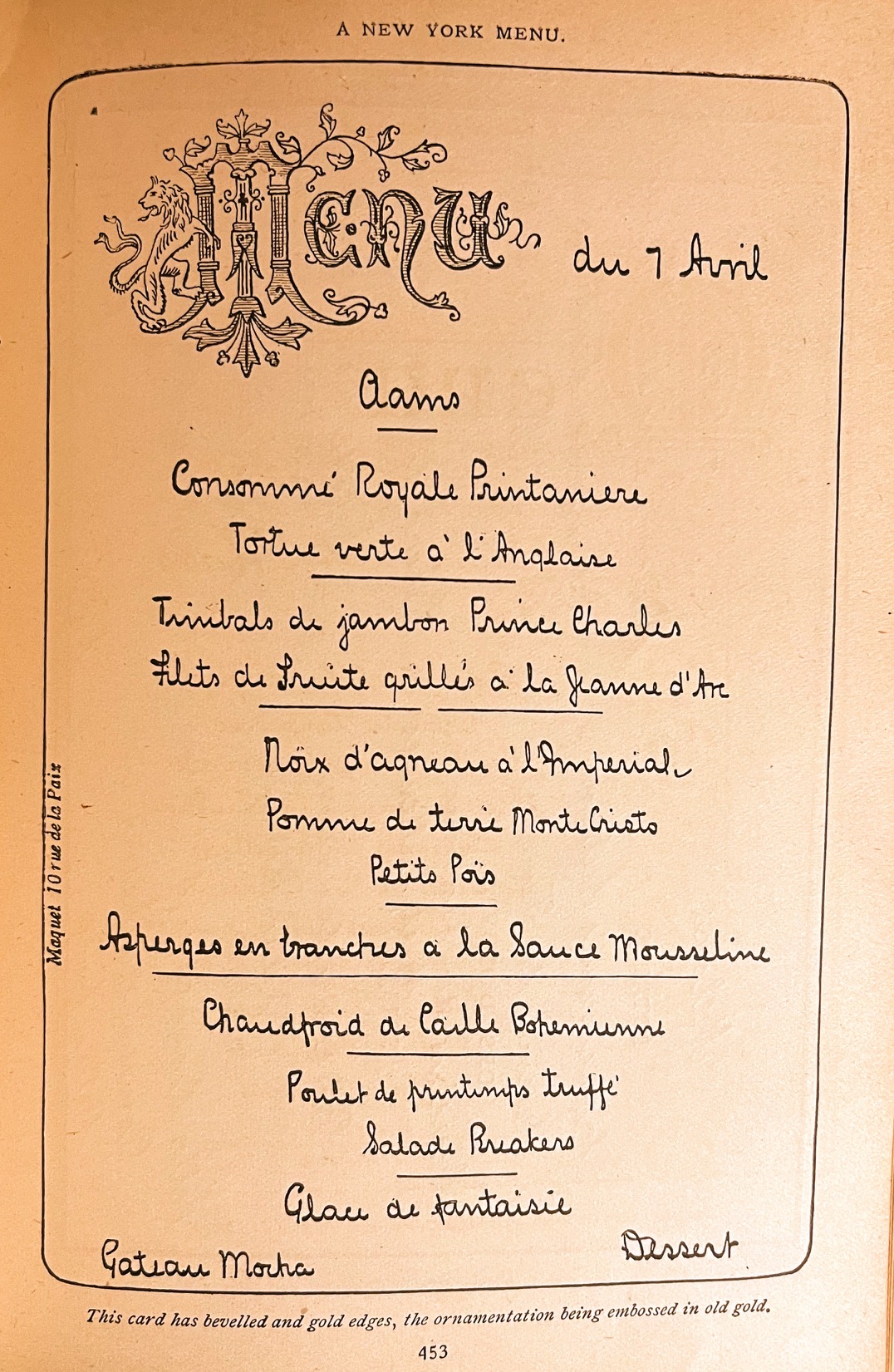
    “The first object to be aimed at is to make your dinners so charming and agreeable, the invitations to them are eagerly sought for, and to let all feel that it is a great privilege to dine at your house, where they are sure there will be only those whom they wish to meet. You cannot instruct people buy a book on how to entertain, though Aristotle is said to have applied his talents to a compilation of a code of laws for the table. Success in entertaining is accomplished by magnetism and tact, which combined constitute social genius. It is the ladder to social success. If successfully done, it naturally creates jealousy.” — Menu and quote from Ward McAllister, in his book, “Society as I Have Found It”


    First Talk of Deposing the 400’s Ward McAllister from His Societal Dictatorship 

    Ward McAllister's venture into the ranks of the great public to take a hand in the management of the centennial ball is likely to be attended with disastrous results to him as a social leader. When Mr. McAllister awoke to the fact that he was not the entire committee— merely a member of it—it astonished him.
    To have his dictates questioned in social affairs was a new, novel, and rather unpleasant experience. That the world should continue to move after his deposition from the absolute dictatorship was a surprise indeed. But the world does move, and the motion doesn’t suit ward McAllister.


    The trouble is that the deposition from leadership in centennial affairs isn’t all that is liable to be the outcome of the sudden and startling discovery that the social world can wag without the assistance of Mr. McAllister. The latter factor struck the society leaders, or those who would be such, with peculiar force. At the clubs it has created as much of a sensation as did the recent cable bulletin to the effect that the Prince of Wales had appeared in public without gloves. 

    It has led to more animated discussion in the Union and Knickerbocker Clubs than has any subject since the announcement that trousers were to be one and one-half inches narrower in the vicinity of the knees, than they were last season. The matter was started at the Union Club, when a member, who is also a Patriarch, is said, after an hour’s deep thought, to have created almost a panic by the inquiry: “I say there, would it be possible to give a Patriarch’s Ball and have it managed by a committee instead of Mr. Ward McAllister, doncher know?”


    The question alone seemed like the starting of a social rebellion. A revolution it would be, at least. The news that the question had been to asked spread to the Brunswick and thence to the Knickerbocker with cyclonic speed and before the members of the Union had fairly recovered from its effects, it was the only question of any moment discussed or even thought of. Social circles caught it up, and now the ladies talk of it with bated breath between discussions cut painfully short about the hitherto all important questions, as to how to trim hats or whether costumes shall tend toward the Directoire or Empire style.


    Society is deeply agitated about the matter. The Knickerbocker Club has already decided against Mr. McAllister. The Union Club is very evenly divided just now, with a tendency committee word, though the official action of the governing committee had not been bullet and up to midnight last night. The general belief, however, is that the next assembly of the patriarchs will be under the management of a committee instead of under a dictatorship. Social lights fear that the result may be disastrous, but the male element in the much talked of 400 seem determined, because Mr. McAllister has actually brought them into scorn and ridicule by his failure to retain his dictatorship and thus their prestige. — The New York Times April 1889


    🍽️Etiquette Enthusiast, Maura J. Graber of The RSVP Institute of Etiquette, is the Site Editor of the Etiquipedia© Etiquette Encyclopedia

    Tuesday, February 23, 2021

    “Society As I Have Found It”- A Review

    It is not that his book is given up to trivialities, but that his solemn way of dealing with them creates the impression that he imagines himself occupied in a kind of philosophical research. Darwin, in his evolution of his evolution theory, was not more impressed with the magnitude of his theme than Ward McAllister in establishing a rule of etiquette.


    Oh! That Mine Enemy, Etc...

    The enemies of Mr. Ward McAllister are indebted to that gentleman for a means of retaliation. Mr. McAllister’s book on “Society As I Have Found It” exposes him to merciless criticism. As a conductor of entertainments he was above reproach. He had studied one thing until he knew it well. No man in either hemisphere is more competent authority on such important matters as the month in the year in which salmon may be served at a swell dinner or the kind of sauce which may be served with it, he has given many, years’ study to intricate problems of this nature, and if he has not solved them satisfactorily, the man does not live who can prove that he has not. But a clever man with Mr. McAllister’s knowledge of society, in both Europe and America, ought to write an entertaining book. That is precisely what Mr. McAllister has failed to do. 

    It is not that his book is given up to trivialities, but that his solemn way of dealing with them creates the impression that he imagines himself occupied in a kind of philosophical research. Darwin, in his evolution of his evolution theory, was not more impressed with the magnitude of his theme than Ward McAllister in establishing a rule of etiquette. In most pursuits, earnestness is an element of success. A writer impresses a public in proportion, as he is able to convince them that he believes his own theories and regards them as important. But with society as a theme, a man may be wise or witty, satirical or indulgent, a scoffer or a worshiper, but he must be bright. McAllister’s book is both trivial and dull. — San Francisco Call, 1890


    Etiquette. Enthusiast, Maura J Graber, is the Site Editor for the Etiquipedia© Etiquette Encyclopedia


    Monday, February 8, 2021

    Another Gilded Age Social Arbiter Rises


    We at Etiquipedia are looking to find some other documentation for a Gilded Age Los Angeles “400” but have had no success to date. We are convinced many cities of the era emulated the New York’s society circle of “400,” —actually only 319 names were on the famous list—  but this is the first time we’ve seen a rival to Ward McAllister’s lofty, self-proclaimed perch, be presented or suggested in a news report.
    —————————————  
    “Four hundred might be one of the only numbers that has a place in the dictionary. Its definition reads: ‘The social elite of a community.’ But it wasn’t until the late 1800s that ‘400’ had any real value. Before The Real Housewives of NYC, Mrs. Caroline Schermerhorn Astor dominated Gilded Age New York society, throwing the balls that everyone who was anyone attended. The problem was that her ballroom only held 400 people, and thanks to the Civil War and the Industrial Revolution, there were now many more than 400 high society millionaires in New York City. So she had to narrow down the list of invitees to the absolute most important and elite New Yorkers. She enlisted self-proclaimed society expert Ward McAllister to help her whittle down the numbers, and The Four Hundred was born. Those who made the cut included Roosevelts and Winthrops, among other famously fancy last name.” — Du Jour.com 


    The Los Angeles “400” is Impressed!


    The promotion of Lieutenant John A. Dapray to the position of paymaster in the army with the rank of major and the salary of $4800. per annum is greeted by the Los Angeles “400” with enthusiastic empressement. Perhaps there is no officer in the army who has won more laurels in leading a german victoriously across the deadly floor or in heading the grand march of a ballroom in its bold reconnoissance at the opening festivities of a soirée dansante. When he was here on the staff of General Miles, he was distinguished as a master of society etiquette, and by his exquisite conventionality in dress and his coolness and bravery in charging the social sideboard or the festive table, he was the cynosure of all eyes. 

    He has passed the rubicons of several winters in Washington, and society there has acclaimed him as the conquering hero of its routs and social functions. It is not too much to say recognition of the young lieutenant's transcending merits by promotion to a height which in actual field service on the frontier of forty years rarely attains, will elevate him to the position of a dangerous rival to Ward McAllister. He wears an overcoat all bedizened with frogs and bullion, and that's something in his favor. — Los Angeles Herald, 1893


    Etiquette Enthusiast, Maura J Graber, is the Site Editor for the Etiquipedia© Etiquette Encyclopedia

    Saturday, February 6, 2021

    McAllister... Supreme on Social Matters

    The son of Ward McAllister, the self-appointed “social arbiter of the Gilded Age,” was reportedly permanently removed without pay from his job as a District Court Judge for Alaska, due to “drunkenness, indolence and incompetency.”
     ————— 
    When asked about the court’s decision, McAllister said that in social matters, he recognized no authority except his own, but in matters legal, he took off his hat to the authority of the Supreme Court of the United States.

    — Photo source, Pinterest


    The “McAllister Decision”


    New York, May 20.— Ward McAllister was interviewed by the World To-day on the Supreme Court decision that his son (the ex-Alaska Judge) was not entitled to a salary after his removal. McAllister says that in social matters, he recognizes no authority except his own, but in matters legal, he takes off his hat to the authority of the Supreme Court of the United States. Just like any other good citizen, he had nothing to say as to the propriety, etiquette and good taste of such decision. — San Francisco Call, 1891


    Etiquette Enthusiast, Maura J Graber, is the Site Editor for the Etiquipedia© Etiquette Encyclopedia

    Sunday, January 31, 2021

    Etiquette: That was No “Lady,” Sir!


    When speaking of females one has encountered while out and about, please keep mindful of the fact that the terms “Lady” and “ Woman,” just like the terms “Men” and “Gentlemen”— are not always synonymous.
    ———————————
    “There are many good chances wasted by lack of promptness and businesslike habits, also by the inability to take up new ideas.” from ‘The Lady Magazine,’ on ‘How to Live,’ 1903
    Photo source, Pinterest 

    No True “Lady” Would Indulge in Such Bad Manners

    Not long ago, a resident of New York went into the post office in that city to procure a money order. As there were half a dozen persons ahead of him he naturally awaited his turn, although he was in a great hurry, as most New Yorkers try to make themselves believe they always are. The other prospective customers of Uncle Sam did not form into line, but herded themselves about the window. When those who were there first had transacted their business, this New Yorker, considering that his turn had arrived, stepped to the window to be served. What happened at this juncture, he relates in these words:

    “Just as I was about to enter my application, a lady, who had just come, crowded past several people who had been waiting, as I had, and calmly shoved her application in before mine. I told her as politely as I could that I had been waiting there at least fifteen minutes and thought that, seeing I was in a great hurry, I should have precedence before her, whereupon she told me I was the rudest man she had ever seen, and besides went into a long discourse concerning the manners of modern men. I, nevertheless, held to my point and saw that I was served first.” After having cooled off he asks: “Was I right In doing so?” He thinks he was, but to satisfy himself on the ethics of the case, he has asked, through the New York Times, that others express their opinions regarding his course of action. 

    We are genuinely surprised that any man who has long enjoyed the refining social advantages of the peerless town upon the historic Hudson; who has knocked elbows with the descendants of Diedrich Knickerbocker; who has been privileged to gaze upon the sacred person of a descendant of the famous game-leged governor of New Amsterdam; who, perhaps, may have enjoyed the more than a bowing acquaintance with the creator of that justly prized appendage which in a later day wrought the undoing of the distinguished mollycoddle from Indiana; who certainly must have read more or less of the newspaper condensations of the work of the illustrious Ward McAllister, entitled “How to Behave After You Have Succeeded in Breaking In” — we are surprised, aye, we are astounded that there should have arisen any doubt as to the channel into which this anxious inquirer should have diverted his behavior.

    Under any and all circumstances this New Yorker, whose appeal for enlightenment indicates his gross ignorance of the commonest laws of etiquette as they relate to social intercourse between ladies and gentlemen, should have.

    Avaunt there! The Herald narrowly escaped committing itself! It retreats in time! It seeks further enlightenment, more definite evidence, before it dare to pass judgment.

    This New Yorker has not been fair. He has tried to trip us. He is paradoxical, equivocal, deceitful — we may be pardoned, we trust, for suggesting the possibility that he has innocently perpetrated an untruth, lacking the antecedent intention to deceive.

    He says: “A lady who had just come crowded past several people who had been waiting.”

    Impossible. No “lady” would ever “crowd past several people who had been waiting.” Our friend from New York needs one of two things: A new pair of spectacles or a new lexicon.— Los Angeles Herald, 1907


    🍽️Etiquette Enthusiast, Maura J. Graber of The RSVP Institute of Etiquette, is the Site Editor for the Etiquipedia© Etiquette Encyclopedia