Wednesday, June 8, 2022

Etiquette of a Romantic Repast

Table by Mrs. William Sarnoff from the 1981 book, “The New Tiffany Table Settings” — The gold and white setting has the gilded flatware turned upside down, in the French fashion. The stemware is in the American or British fashion, and not lined up above the dinner plate. It is in a small triangular cluster. Placement of the champagne saucer is is incorrect for this setting, unless the order is with a water glass first, then a champagne, then a red or possibly rosé, or white wine. It’s possible that the soup is being served with the champagne, but that is unlikely.


The monarchical decor of the Hapsburg Court, its red velvets, its white satins, its gold laces and embroideries, and its jewels, are recalled by Mrs. William Sarnoff in this intimate dinner whose multiple richness of elements burgeons with the romance of things past.

Mrs. Sarnoff's state portrait by the court painter Winterhalter of the beautiful young Princess Elizabeth of Hungary and the Two Sicilies sets the tone. Colors are restricted to the Hapsburgs’ red and white. An antique gold lace scarf from Mrs. Sarnoff’s family decorates the satin-covered table set with “Chrysanthemum” vermeil turned down in the European fashion, gold and white “Sheffield” bone china, “Antoinette” cut crystal, and Royal Berlin birds. 

A leaf-shaped vermeil ravier holds a ruby and diamond ring tied into pearl lariats, all by Tiffany jewelry designer Angela Cummings and all reminiscent of the jewels worn by the Princess Elizabeth in her portrait. Black lacquer side tables hold a bouquet of red silk flowers and a nineteenth-century black lacquer birdcage.— The New Tiffany Table Settings, 1981
There are wine and roses and candlelight, and Viennese waltzes in the background.


🍽Etiquette Enthusiast, Maura J. Graber, is the Site Moderator for the Etiquipedia© Etiquette Encyclopedia

Tuesday, June 7, 2022

The New Tiffany Table Settings

“The New Tiffany Table Settings” of 1981 is filled with simple to elegant tables and table settings, created by some of the most successful hosts and hostesses of the late 1970’s and early 1980’s. Below is the book’s foreword.


The history of modern table setting opened on a momentous day in 1633 when Charles I of England declared once and for all that “it is decent to use a fork.” Since then the table's arts have prospered while all manner of refinements and curiosities have been seen, some practical, some stylish, some simply preposterous.

Tables are as much as ever stages that we set for action, miniature theaters of social behavior where a good percentage of every life is played out. There love blossoms or withers, careers are made or undone, fortunes are founded or squandered. The table is a place for enjoyment, for wit, for discovery, for celebration, for art, for intrigue. There we set out props that forecast the order of events and that imply whatever we desire from social exchange.

Anyone can set a table, and anyone can set it well with whatever means are available, provided that imagination and vitality are both brought to the task. The success of a table setting depends not on financial considerations but on having a point of view, on having a personal style rather than timidly depending on bland and faceless conventionalities.

In the pages that follow, there are table settings done at the request of Tiffany & Co. by some seventy-five well-known personalities of society, entertainment, the arts, business, and design. They have brought to their settings the same flair and authority that have brought them such remarkable success in the world. Each setting is in a way the self-portrait of its author. There are no answers given to the question of how to set a table, but the collective answer is: “Do what you want, and do your best.”

In 1808 the great French authority on entertaining Alexandre Balthasar Laurent Grimod de La Reynière published his famed Manuel des Amphitryons. In it he exhorted the good host or hostess not to hold back or to be ashamed of originality and generosity, and his advice remains valid: “Don't be afraid to put your fortune in evidence and do honor to it; do nothing to pardon its sources as there is no more honorable way to use it than to offer food.” — Foreword from “The New Tiffany Table Settings,”1981


🍽Etiquette Enthusiast, Maura J. Graber, is the Site Editor for the Etiquipedia© Etiquette Encyclopedia

Monday, June 6, 2022

A Gilded Age Tiffany Table

A gilded age luxury table by Mrs.William Randolph Hearst features a sterling flatware pattern accented with inlaid copper called ‘The Aztec,” designed exclusively for her by Tiffany's in the early twentieth century. Each handle has a different Indian motif sculptured on it. The excitement of the “Far West” permeated American design in this epoch. Note the dessert utensils of just a knife and spoon. Etiquipedia would love to know the planned menu!

“The Turn of the Century”
Mrs. William Randolph Hearst 
For the Tiffany Hostesses’ Show


Mrs. William Randolph Hearst has set a table to recall with nostalgia another era-the turn of the century. In the “Mauve Era” the most elaborate of centerpieces would dominate the dinner party (Mrs. Hearst's is a monumental arrangement of fruit, vegetables, lilies, gardenias, and orchids).

On a green satin cloth she has used richly-decorated service plates Tiffany made for her many years ago, as well as a sterling flatware pattern accented with inlaid copper called ‘The Aztec,” designed exclusively for her by Tiffany's in the early twentieth century. Each handle has a different Indian motif sculptured on it. The excitement of the “Far West” permeated American design in this epoch.

In the close-up we see the detail on the intereting flatware, as well as the rococo candlesticks and Charles II covered cups flanking the center piece. The stemware is all Tiffany glass–the translucent iridescent "favrile glass" invented by Louis Comfort Tiffany. It became one of the leading elements of the “art nouveau” movement.

This whole table represents imaginative design and elegance from another era, a period of rapid growth in America's history, as well as in her economic power and cultural sophistication. — Tiffany Table Settings, 1960


🍽 Etiquette Enthusiast, Maura J Graber, is the Site Editor for the Etiquipedia© Etiquette Encyclopedia


Sunday, June 5, 2022

Gilded Table Setting Etiquette

It is a shame that the Tiffany Table Settings book was not done fully in color. This table with gilded silver must have been a spectacular sight!

From “Luxury Tables” :
The White House Vermeil Collection

For four weeks Tiffany had the pleasure, courtesy of President and Mrs. Eisenhower, of showing to the public the late Margaret Thompson Biddle's collection of antique vermeil (sterling silver gilt), which had been willed to the White House. Everything from punch sets to cigarette boxes, from knight figurines to wine coolers, was included in the White House collection. 

Shown here is part of a large formal dinner table, set entirely in vermeil with the exception of the crystal goblets, which was part of the exhibition. The center footed tureen is a very famous seventeenth-century piece of silver: it was the gift of Louis XV to the Prussian Ambassador to the Royal Court. 

The artichoke finial lends an attractive accent to this handsome piece. To the left of it is one of a pair of covered tureens made by the English silversmith Paul Storr in 1806. The three-light candelabra are Sheffield (1821); the service plates, shell salt dishes, and flatware are also English, of a later period.— Tiffany Table Settings, 1960


🍽Etiquette Enthusiast, Maura J. Graber, is the Site Moderator for the Etiquipedia© Etiquette Encyclopedia

Saturday, June 4, 2022

Etiquette of Tiffany Hostesses' Show

Etiquipedia’s initial thoughts: This is a strange order of courses for a formal, mid-century dinner. It appears to be a soup course, a fish course, a salad course and then a main course. Typical for the era would have been a soup, fish, a sorbet as palate cleanser, a main course, and then a salad. There are no dessert utensils, but at a formal dinner, these would be brought to the table with or without a finger bowl, but with the dessert plate. — Above is “A Dinner with Antique Silver, by Mrs. Charles Suydam Cutting, for Tiffany Hostesses' Show” 

Mrs. Charles Suydam Cutting has set a table that is a jewel of antique silver. She has used her own table ornaments: cigarette boxes for each place with hunting scenes sculptured in low relief; an Irish potato ring for the center of the table; columnar Irish candlesticks; cups, bowls, and all sorts of objects from the Charles II, Queen Anne, and early Georgian periods. 

She has made an unusual arrangement of pomegranates and grapes, red ampelopsis, and brown cypripedium from her greenhouses for the center decoration. Mrs. Cutting's écru fine linen cloth is embroidered with “Dixiana.” The finely monogrammed napkins are from France. She uses a simple English reproduction sterling flatware pattern, and a very plain stemware pattern. The dinner plates are white, with a subtle gold scratch-line decoration on the scalloped border.

Mrs. Cutting has grouped her antique silver objects on the table for decorative as well as for utilitarian purposes. The warm tone of the cream-colored cloth brings forth the glow of the old silver.— From Tiffany Table Settings, 1960


🍽Etiquette Enthusiast, Maura J. Graber, is the Site Moderator for the Etiquipedia© Etiquette Encyclopedia 

Friday, June 3, 2022

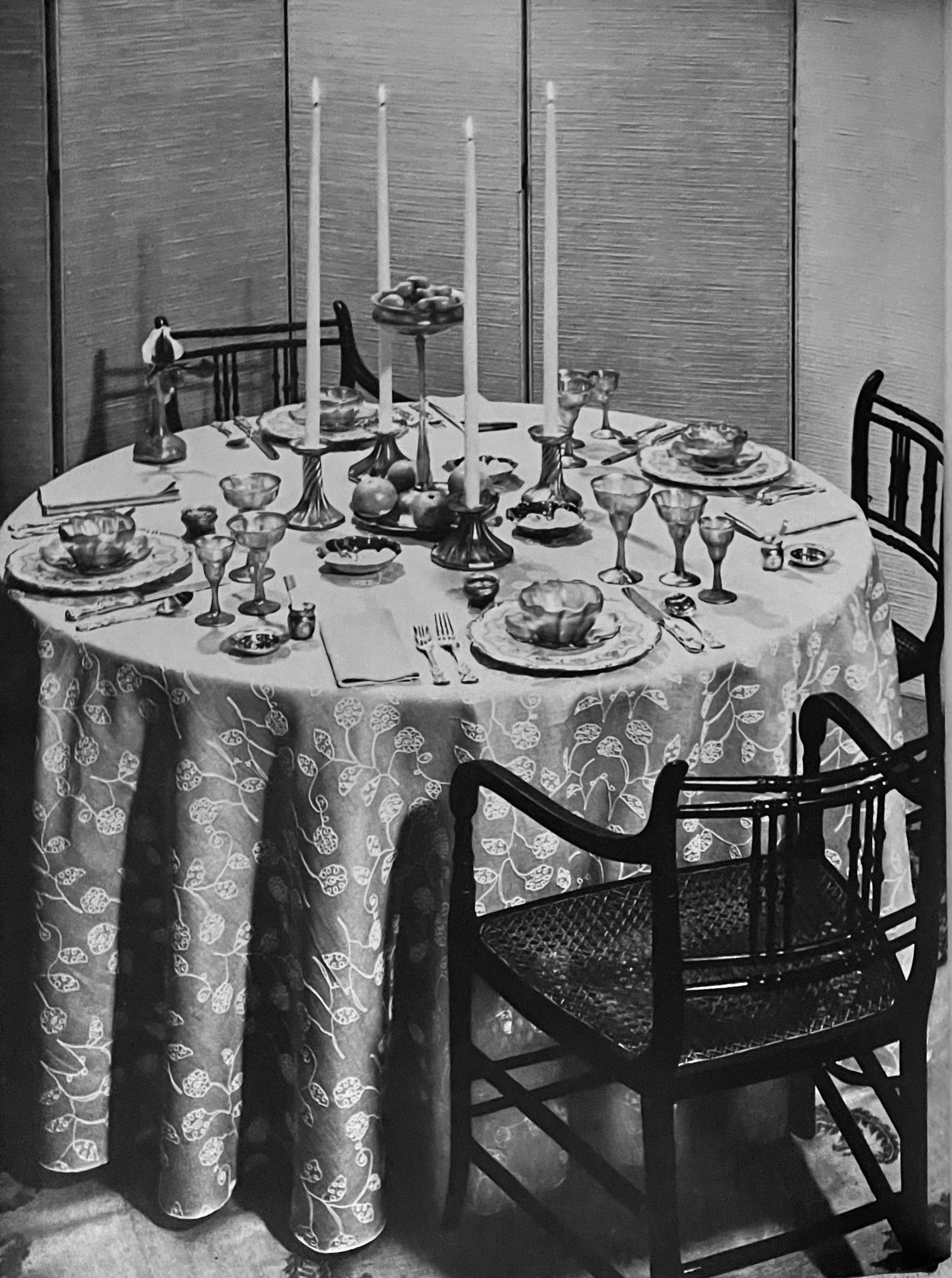
Etiquette and Tiffany’s Table Settings


This beautifully set dining table for four features elements from Tiffany’s. It is the first of the settings shown in the 1960 book, “Tiffany Table Settings.” The book was a companion offering to the women who not only participated in the yearly event, but notably to those who couldn’t attend the popular show of tabletop artistry. Etiquipedia will be featuring more from the book in the coming days, along with etiquette critiques of the late-1950’s to 1960 settings.

In 1956 Tiffany & Co., the famous Fifth Avenue jewelers and silver smiths, inaugurated an active program to present table settings of taste and imagination to the public. The purpose of this program a continual round of exhibitions-is to inspire and provoke greater interest in this area of design. When the exhibits are held, thousands of people visit Tiffany's weekly to view the settings by New York's leading hostesses and interior decorators. The store holds that a "per fect party" implies a beautiful table as well as a distinguished menu. Those who are chosen to design tables select Tiffany china, silver, and glass as accessories on their tables, combining these elements with their own furniture, linens, and antiques.

This collection of settings has not been compiled to instruct in the "book of etiquette" sense. Rather, it is hoped that the presentation of these settings will be a source of inspiration and a focus of ideas to any hostess.

There is infinite variety of design in these tables. Some of the set tings are based on the theory of switching objects created for one purpose to other uses, as well as juggling to make new combinations of color, fabric, and shape. Some of the settings are classic examples of subtle orthodox statement. Others are frankly based on fantasy.

The common denominator of good style, however, underlies all the designs, regardless of the occasion or spirit of formality or infor mality. A table set with inexpensive earthenware, for example, on a checked cotton cloth can be as enticing and appetizing as one of rare porcelain, crystal, and silver.

The editors believe that a woman is not using her own creative abilities unless she can turn her imagination to lending a fresh look to her table. It is hoped that this book will encourage a new point of view in this field of interior design. — Tiffany Table Settings, 1960


🍽Etiquette Enthusiast, Maura J. Graber, is the Site Moderator for the Etiquipedia© Etiquette Encyclopedia

Thursday, June 2, 2022

Fascinating Details of an Astor Ball

A gilded age depiction of the fickle and oft-engaged, but only once married, Miss Van Alen. She was great granddaughter to Caroline Astor

NEW YORK, Jan. 18.-Mrs. Astor gave a ball last night and when Mrs. Astor gives a ball, society has something to talk about. In view of the splendor of the house the floral decorations were comparatively simple.

Scarcely more than the usual number of palms lined the foyers and tall vases filled with American beauty roses in the drawing rooms and clusters of orchids on the supper tables were the principal flowers used.

The guest of honor was Miss Van Alen, the eldest daughter of James J. Van Alen and a great granddaughter of the hostess. This is the second grand ball given by Mrs. Astor in honor of her young kinswoman. 

Another guest, who practically shared honors with Miss Van Alen was Mrs. George Haig of England, formerly Mrs. J. Coleman Brayton, the favorite daughter of Mrs. Astor, and who, to gether with Mr. Haig, will sail for England on Wednesday.

Nearly all the guests came from the opera, so that it was well on toward midnight when the carriages began to roll up to Mrs. Astor's door. The picture galleries of Mrs. Astor's house and John Jacob Astor's house, which are also the ballrooms, were thrown into one.

Supper was served at sixty tables in the dining room. Mrs Astor presided at a large table of ten of her intimates and Mrs. John Jacob Astor at another of twelve. The remaining tables were smaller. 

When the company returned to the ballroom a litttle before 2 o'clock this morning, it was bordered with gilded chairs for the cotillion which began at once. Elisha Dyer, Jr., was the leader, with Mrs. John Jacob Astor for a partner. But so vast was the assemblage that Craig Wadsworth was requested to lead at the old end of the double ball room. He danced with Mrs. Orme Wilson.— The Associated Press,1898 


🍽Etiquette Enthusiast, Maura J Graber, is the Site Editor for the Etiquipedia© Etiquette Encyclopedia

Wednesday, June 1, 2022

Gilded Age Lawn Party Etiquette Humor

“In the matter of the cherries he was especially troubled, as he did not in the least know what was the proper method of disposing of the stones when once the fruit had passed his lips.”
🍒🍒🍒🍒🍒🍒🍒🍒🍒🍒🍒
The etiquette rule for fruit stones and pits is this: Anything that goes in to one’s mouth with the fingers is removed politely from the mouth with the fingers  –
Gilded Age diminutive cherry forks with gilded tines 


Far as He Could Go

The drummer was bidden to that festivity known as a “lawn party,” and among the refreshments provided upon that festive occasion were some cherries. The drummer was conscious that there were depths of social etiquette which he had never been able to sound, and as he was after all a fellow of sense, with the American adaptability, and did not wish to do that which was not according to the best usage, he bethought him that it were well to watch those about him with a view to getting clews (sic). 

In the matter of the cherries he was especially troubled, as he did not in the least know what was the proper method of disposing of the stones when once the fruit had passed his lips. He decided, therefore, that before he attempted to eat any of the luscious looking fruit he would wait and see what his young and beautiful hostess did in this delicate matter. 

“I watched her,” he goes on to say, “and soon had the pleasure of seeing her slip a cherry between her lips, redder than the fruit itself. I took up one from my own plate, preparing to eat it as soon as I saw how she disposed of the stone, but when she took the stone between her fingers and snapped it at her grandmother, I found myself quite as much at a loss as before– for you see, I had no grandmother there.” – Boston Courier, 1891


🍽Etiquette Enthusiast, Maura J Graber, is the Site Editor for the Etiquipedia© Etiquette Encyclopedia