Thursday, November 5, 2020

Etiquette and Beauty in Penmanship

Up until the last 20 years or so, one’s penmanship was considered an insight into one’s character. In fact, resumes and CVs in Japan are still most welcome in a handwritten form, so that potential employers can judge a person by their handwriting. Penmanship and letter writing were always important in terms of etiquette. Books on penmanship and letter writing were among the most read by those who wished to get ahead in life, in the 18th and 19th centuries. “Spencerian Script” was developed in 1840, and by 1866, the book, Spencerian Key to Practical Penmanship, was published and subsequently widely read. Spencerian Script became the standard across the United States. This form of penmanship remained the standard until the 1920s when the popularity of the typewriter was rising and rendered Spencerian Script’s use in business communication, suddenly obsolete.
Above, from Etiquipedia’s private library, a handwritten letter dated March, 6, 1893, from the Meriden Britannia silver company. 


There seems to be a reaction against the rectangular style of writing which has obtained for some time, in many of the schools. A number of women were talking of it the other day, and with one voice spoke against it. One of these was a teacher of the public schools, and the others had all had experiences with young members of their families who had been taught the rectangular style, and whose writing they agreed, it had entirely ruined, as far as beauty was concerned. 

It is attractive for the little children, the teacher said, while their writing is unformed, and they follow the copy book, but the rectangular combined with the twists which character gives as it develops, is abominable. Every one of the women told as her personal experience of young girls who, beginning with the Spencerian system, had given promise of beauty in handwriting, and with the change of methods developed an ugly, and not easy style. — New York Times, 1902


Etiquette Enthusiast, Maura J. Graber, is the Site Editor for the Etiquipedia© Etiquette Encyclopedia

Etiquette for Awkward State Dinners

White House tables set for the Obama administration’s last State Dinner. His administration’s first State Dinner was memorable for the now divorced, notoriety seeking, party-crashing couple, Tareq and Michaele Salahi. With no invite, they managed to not only skirt Secret Service scrutiny and attend the State Dinner, but get photographed meeting the President, just a few feet away from the Indian Prime Minister. 
— Photo source, Pinterest 


WASHINGTON — President Obama’s first state dinner was memorable for who showed up uninvited. His sixth, a high-glitz affair for the President of France, may be remembered for who was initially invited but did not attend.

Obama opened the White House doors Monday to French President Francois Hollande — but not to his former First Lady, journalist Valerie Trierweiler. Hollande’s first state visit to the U.S. comes after he announced his breakup with Trierweiler amid a swirl of reports
linking him to an actress.

That development threw preparations into confusion. Two days of events culminate in a state dinner on the White House lawn for more than 300 people.

Like any good host, the White House did its best to make Hollande comfortable, dismissing the trouble of crossing Trierweiler off the guest list. Officials would not comment on whether they had tossed out invitations bearing Trierweiler’s name. They would not say who would take her coveted place next to the President at the head table. They released details on the entrees (American), the entertainment (singer Mary J. Blige) and the dessert (whimsical, including orange-zest-dusted cotton candy).

On Monday, the Presidents traveled to Charlottesville, Va., to tour Thomas Jefferson’s Monticello estate, keeping the focus on the storied Franco-American alliance. (Some saw ties to infidelity even there, however: Historians believe Jefferson fathered children out of wedlock with Sally Hemings, a slave.)

For the world of efficient and polite protocol experts, a guest of honor traveling without a companion is nothing compared with the embarrassment of party crashers like the ones who talked their way into Obama’s dinner for the Indian prime minister in 2009.

“This is not difficult to manage,” said Anita McBride, former chief of staff for First Lady Laura Bush, who now heads the Center for Congressional and Presidential Studies at American University. Sure, the image of the two couples standing in their finest at the North Portico will be a person short, but c’est la vie.

“This is an interesting visit, isn’t it?” said Mary Mel French, chief of protocol during the Clinton administration and author of “United States Protocol: The Guide to Official Diplomatic Etiquette.”

At one time, a head of state bringing a guest who was not a spouse would have caused headaches for the Office of Protocol and the Secret Service, French said. That has changed with the times as more heads of state have remained unhitched. The Secret Service now typically gives companions, married or not, the same level of protection as spouses.

Indeed, though often described as dictated by strict protocol and decades of tradition, state visits are also shaped by the times. Politics, personal whim and predicaments all factor in. Franklin D. Roosevelt scandalized some Americans by staging a picnic with hot dogs for Britain’s King George VI during a state visit in 1939. President George W. Bush hosted many foreign leaders at his ranch in Texas, a reflection of his preference for casual, personal interaction, McBride said.

President Clinton held 23 state dinners, a reflection of his love of a good Washington schmoozefest. By contrast, and perhaps reflecting the differences in their personalities, Tuesday’s state dinner is Obama’s sixth. White House officials say the low count is a result of tighter budgets and sensitivity to tight economic times.

With fewer parties, each becomes more important — a more meaningful gesture of gratitude or praise for an ally the White House wants to spotlight, said one senior administration official, who asked not to be named discussing the White House’s approach to state visits.

In this case, the ceremonials are a sign of appreciation for an ally that has stuck with the Obama administration when others, particularly in Europe, have not.

“Let’s just say that we’ve come a long way from freedom fries and are now working together on multiple continents,” a senior administration official said.

The White House kept a lid on discussion of the French President’s personal life, with a senior official saying the administration is “studiously neutral.”

After a magazine published photos that appeared to link Hollande to French actress Julie Gayet, Trierweiler was hospitalized for a week.

The incident reignited a debate in France on privacy and the role of the press.

Hollande promised to clarify his relationship with Trierweiler before leaving for the U.S. On Jan. 25, he announced he’d be traveling alone.

He has tried to cast his U.S. visit as a reboot. “For President Hollande, it comes at a useful moment for him to show him operating at a world stage,” said Erik Goldstein, a professor of international relations at Boston University who has written about state visits.— Los Angeles Times, 2014


🍽️Etiquette Enthusiast, Maura J. Graber of The RSVP Institute of Etiquette, is the Site Editor for the Etiquipedia© Etiquette Encyclopedia

Wednesday, November 4, 2020

Zigzagging Table Manners


It’s in everyone’s best interest that we all retain our senses of humor and our best manners. Here’s a fun article about the history of our table manners. It’s full of facts that you can use as small talk, when attempting to gracefully sit through one more holiday with a mask on your face! — The most cherished, family-oriented holidays are just around the corner and we’re still in the midst of a global pandemic. Celebrating with any sense of tradition or normalcy, seems unattainable with the crazy sounding restrictions put in place across the globe. In California, the Governor has issued these restrictions:   “No more than three households can gather together at a time. Gatherings must be held outside and should last less than two hours. Attendees may go inside to use restrooms as long as the restrooms are frequently sanitized. Also, singing, chanting, and shouting are strongly discouraged.”


For the holidays, a brief history of manners


According to Emily Post, “All rules of table manners are made to avoid ugliness.” They exist to shield us from other people’s effusions and emissions — and to conceal our own. Manners can act as a lubricant, minimizing social friction, but mostly their purpose is protective. They muffle our primal urges. In effect, they turn our natural warrior-like selves into elegant courtiers.

That may be something to keep in mind today, especially if you find yourself seated between fastidious Uncle Eric and belligerent Cousin Kenneth at the Thanksgiving table.

Early guides to manners were fixated on proper behavior at table. In medieval England, meals were occasions not only for celebration, but also for diplomacy. A leading arbiter of manners was Petrus Alfonsi, who served at the court of King Henry I. He urged his readers (male, aristocratic) not to speak with their mouths full or let crumbs shower from their lips. King David I of Scotland, who spent time in Henry’s household, proposed that any of his subjects who learned to eat more neatly should get a tax rebate.

Disappointingly, that idea never caught on. Yet the prescriptions of writers such as Petrus Alfonsi endured. They were amplified by later writers such as Desiderius Erasmus, a Dutchman who produced a systematic account of manners in the early 16th century, in which he gave guidance on how to share a bed (don’t steal all the blankets for yourself) and how to pass wind (mask the sound with a well-timed cough).

Later that century it was Italians who dominated the field. None was more influential than Baldassare Castiglione, who wrote suavely about the need to control one’s social space. His key concept was sprezzatura, a stylishly effortless excellence: The truly decorous individual must be both self-possessed and unassertive.

Castiglione thought of manners as a technology, and during the Renaissance there were real technical developments that changed notions of correct behavior. None of these was more significant than the introduction of the table fork: Previously there had been large crude forks for hoicking food from a shared dish, but now the fork became an implement for the individual.

It was the traveler Thomas Coryat who introduced the table fork to Britain. When he returned from Italy in 1608 with this fancy novelty, he met with a torrent of ridicule. Twenty-five years after Coryat’s Italian jaunt, the first table fork reached America — a gift for John Winthrop, governor of the Massachusetts Bay Colony. In the accompanying missive, the sender suggested Winthrop use his discretion in handling this precious item, and Winthrop saw fit to keep it in a special leather case. Gradually, as forks became popular, they brought finesse to the act of eating, making it possible, for instance, to consume berries without staining one’s fingers.

Nearly 300 years later Emily Post reflected on the need for forks (though “If you are able to eat a peach in your fingers and not smear your face … [you may] continue the feat”). Parsing such matters, she was the inheritor of traditions at once profuse and prolix. She had to concede that among those rules of the table “there are a number of trifling decrees of etiquette that are merely finical, unreasonable, and silly.” She cited as an example the insistence that one shouldn’t cut salad into small pieces. She went on to damn those who choose to “condemn the American custom of eating a soft-boiled egg in a glass, or cup, because it happens to be the English fashion to scoop it through the ragged edge of the shell.”

It was George Bernard Shaw, of course, rather than this doyenne of American social niceties, who supposedly observed that Americans and Britons are “divided by a common language.” That assessment may be a little less apt where manners are concerned than in questions of vocabulary. Yet while most of the essentials are the same on both sides of the Atlantic, there are a few clear differences between what’s normal in Los Angeles and what holds true in London.

Comment on this gap tends to veer into rueful specifics: A Californian friend of mine complains that the British have no grasp of the potluck dinner. Alternatively, it drifts toward generalizations about American directness and British reserve, or Americans’ comparatively fluid sense of social class.

But there is one really salient difference — and we observe it at table. In the U.S., when food needs cutting with a knife, you cut a bite, then lay aside the knife and transfer your fork to your right hand. Then, with the fork’s tines pointing upward, you pick up one bite at a time.

By contrast, the British keep the fork in the left hand and don’t lay the knife down. The American cut-and-switch method, which Post termed “zigzag,” may have been influenced by fashionable French practices in the early 19th century. Other theories abound. The zigzag technique may stem from the fact that early American forks were unwieldy and needed careful manipulation, or from the belief — a hangover from medieval culture — that it is best to put down a knife when it’s not in use. It may also have been calculated to draw attention, as Coryat once did, to the sheer magnificence of one’s modish fork.

As globalization fosters a new international standard of manners — pragmatic rather than necessarily refined — the zigzag method seems to be in the first stages of decline. Those who stick with it are preserving something distinctively American. They are also hanging on to a form of behavior that, like so much in the realm of manners, favors tortuous delicacy above blunt efficiency. — 
By Henry Hitchings, the author of, “Sorry! The English and Their Manners,” 2013


Etiquette Enthusiast, Maura J. Graber, is the Site Editor for Etiquipedia© Etiquette Encyclopedia
Tuesday, November 3, 2020

The Geisha: An Exquisite Hostess

                                                                                
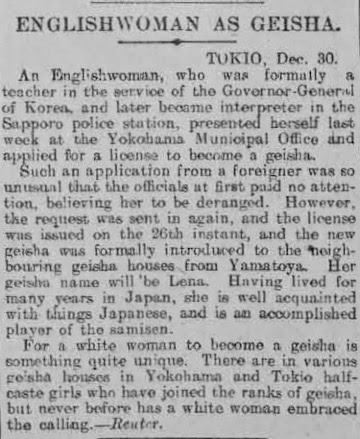
A geisha is a traditional entertainer trained in classical arts such as dance, tea ceremony, and music. In the modern era geisha are understood to be female, but historically there were male geisha as well. In 1913, an Englishwoman applied for a license to become a geisha. There were already many "half-caste" girls who were geisha in Japan, however "Lena" would be the first white woman to hold such a license.  The application was at first thought to be from someone who had to be "deranged," so it was ignored by Yokohama officials. A second application was sent in and she was granted the license on the 26th of December, 1913.


Like ghosts from another time, the real geisha seem to float silently along the streets at twilight, making their way to tea houses and restaurants where they will entertain elite, powerful men.

Trained to be exquisite hostesses, they are accomplished musicians, singers, dancers and most importantly conversationalists. To have a geisha in your company, to be in the presence of a beautiful, articulate, talented companion for the evening, is considered a status symbol. Their clients used to be samurai and shogun. Now it’s politicians, actors and corporate CEOs who hire the geisha by the hour for private dinners at ryotei (traditional Japanese restaurants) and ochaya (tea houses).

They are not courtesans or prostitutes. Before World War II, a geisha’s virginity was auctioned to the highest bidder, but sex is no longer part of the transaction. To be a geisha is to be part of a community, a vocation. They are career women. They are performance artists.

An endangered species, the numbers of real geisha in Japan are dwindling. From a reported 80,000 throughout Japan in the early 20th century, they now number only a few thousand. “In Kyoto, there are about 150 geiko geisha in the local dialect and maiko, geisha in training, left in Kyoto,” according to Anne Alene, an in-country guide for a recent trip to Japan arranged by the Carnegie Museums of Pittsburgh Travel Program.

The group toured the Gion district, one of several historically preserved neighborhoods in Kyoto and the place where the 2005 movie “Memoirs of a Geisha” was filmed. It was based on the novel of the same name by Arthur Golden.

In Kyoto, authentic geisha are not nearly as prevalent as faux geisha young women who dress in traditional Japanese kimono complete with obi, white tabi socks and wooden geta sandals. While they enjoy being stopped by tourists to have pictures taken, wearing traditional ensembles also appeals to the Japanese reverence for ritual and tradition.

“For many Japanese girls, it’s fun to dress up in something they would never ordinarily get to wear,” said Amy Boots, executive director of the Japan-America Society of Pennsylvania.

“I think it might be like doing a Renaissance or Old West-style photo shoot for us.”

Visitors can also give it a try. In Kyoto, there are several places that rent a kimono ensemble or the men’s version, a black kimono with montsuki haori, the short coat over top. 
                                                        
A hand-colored photo of a group of Geishas, 1890
—Photo source Pinterest


“Kimonos have many layers and are difficult to put on without a helper,” said Katsuko Shellhammer, education outreach coordinator for the Japan-America Society of Pennsylvania. “They are also very expensive, and seasonal patterns are important. It can be like wearing a piece of art.”

Department stores in both Tokyo and Kyoto have sections dedicated to kimono wear; you can buy off the rack or have a custom-made kimono and obi from the bolts of material offered. A less expensive option is a used kimono, and there are many stores that deal strictly in pre-owned. Kimonos are often passed down from mother to daughter.

Modernizing the look is all about the material and new, more graphic patterns. Sou Sou, a Japanese clothing company, has taken the plain tabi shoe and sock and covered them in a riot of color and designs. They have also re-imagined other traditional Japanese garments.

Just looking like geisha is not enough for some young women. Turning away from Hello Kitty and the modernity of Japanese life, they make the choice to earn a living as a geisha. Maiko as young as 15 must live in the geisha house, or okiya, learning the nuances of life under the robes and white makeup. The apprentice period lasts between three and five years, during which the okiya and the geisha mother invest in them, paying for lessons and kimonos and providing room and board. Maiko, pronounced MY-ko, are tested before they can advance. At the erikae ceremony, they don the white collar of geisha.

Twice a year, in spring and fall, the public is treated to a display of geisha talents during the Miyako Odori at the theater in the Gion district. The 142nd annual Miyako Odori was held earlier this month during the Carnegie Museums group’s visit. The travelers enjoyed a glimpse into this exclusive world, including a very brief tea ceremony with a complicated etiquette that must become second nature to real geisha.

As the living embodiment of history and fantasy, geisha are not allowed to marry ever. If they do they must leave.

“Geisha and maiko are very special to the Japanese people. They are part of a separate world from ordinary Japanese life,” Boots said. — Pittsburgh Post-Gazette, Kyoto, Japan, 2014


Etiquette Enthusiast, Maura J. Graber, is the Site Editor  for Etiquipedia© Etiquette Encyclopedia 

Homebuyer Open House Etiquette

Though it’s allowable to turn on faucets or flush a toilet while in a bathroom to see if the plumbing is up to snuff, please resist the urge to do anything else... “Another tricky situation that comes up in open houses is whether or not it’s deemed impolite to use the bathroom... ‘As a rule of thumb, most people try not to, the situation isn’t always so black and white.’”


The Do’s and Don’ts for Homebuyers


In an era where most prospective homebuyers start their home search online, open houses afford the buyer the opportunity to see if the real-life version of the home stacks up to its virtual counterpart.

Aesthetics aside, touring the home also relays important details that can’t be discerned from an online listing: how the space makes us feel, if we like the neighborhood or whether you could envision your life here.

Yet, despite how ubiquitous open houses are, many of us still scratch our heads when it comes to open house etiquette. While many of us want to do our due diligence when checking out a home, sometimes our good intentions toe the line of being an engaged prospective buyer and being insensitive to the seller’s home. To break down the dos and don’ts of open house etiquette, local real estate agents advise us on what’s acceptable and what we should shy away from.


Treat the home with respect

Although there are definitely gray areas, open house etiquette ultimately boils down to respect, according to Jessica Vooz, Associate Broker at Keller Williams in Allentown.

“I think that buyers should respect the home in the way they would want their home to be treated,” Vooz said, “for example, would they want people going through their things?”

Since most of us would answer a resounding “no,” keep the seller’s privacy in mind — in other words, no going through medicine cabinets or other personal items — and take care when touring the home. Overall, keep in mind that by opening their home to the public, sellers are put in a vulnerable position, so they can only hope potential buyers would regard their home in a dignified way. “Sellers want their home sold, they just don’t want things disrespected,” Vooz said.

Leave your shoes at the door

While it may seem like an obvious courtesy, upon entering an open house, make sure to take off your shoes, advises Irving Noble, a real estate agent with RE/MAX Unlimited in Whitehall. “Sometimes a client will put a sign on door asking visitors to remove their shoes,” Noble said, “I’ve even had a client provide little booties for people to put over their feet, depending on how strict they are about that.” While some sellers don’t explicitly request you remove your shoes, Noble said it airs on the side of unacceptable to not concede to that simple courtesy. Ultimately, when in doubt, lose your shoes at the door.

Take a seat — if you need to

You’re in the house, your shoes are off, you’ve taken a look around, and now you’re tired. Is it okay to sit on the furniture? According to Noble, some people find that taking a seat is a helpful exercise to get a feel for what the place is like to live in — for example, picture where the TV would be in relation to the sofa. That said, however, Noble said that “there’s a difference between someone making themselves too at home and someone looking at the home with the intention of buying it.”

Vooz said that it’s a tricky balance considering “some people come in make themselves overly comfortable and take over the house, while others feel that comfortable and end up buying the house. It’s about being respectful, but also seeing if you can live in the house.”


When in doubt, don’t ‘go’

Another tricky situation that comes up in open houses is whether or not it’s deemed impolite to use the bathroom.

While Vooz said that “as a rule of thumb, most people try not to,” the situation isn’t always so black and white.

“You know, it’s one of those things where you can make a defined rule,” Noble said. “You don’t know who’s coming through, you don’t know their needs, their health situation and you can’t be insensitive to that basic human need.”

While Noble said it’s usually on rare occasions that someone does use the restroom, it’s hard to set hard guidelines, at the risk of isolating someone and losing the sale.


Leave the inspections to a pro

While your parents, friends or family members may have good intentions when accompanying you to an open house, make sure that you leave the “inspector” role to a professional.

“I’ve had people bring their parents, who come in and say, ‘well, look at the crack here,’ and then I ask them what they do — thinking perhaps they’re a contractor — and they say ‘oh, I’m an accountant,’” Vooz said. Case in point: “I had the one gentleman climb on chair and move ceiling tiles. You need to be licensed and insured to inspect someone’s home.”

While most buyers mean no disrespect, Vooz said it’s best to let a state-insured inspector look for flaws during their three hour inspection of the home when the house is under contract.

“We do have checks and balances in place for a buyer to be safe and have an educated decision,” Vooz said, “the contract is so detailed, it’s very buyer friendly.”


Check closets

While general snooping is best avoided, inquisitive buyers will be happy to learn that opening closets is definitely welcomed.

“Opening up every door is totally acceptable,” Vooz said. Noble agreed that checking closets are necessary to determine what’s in them.

“It could be a walk-in closet or a tiny closet that you can’t fit anything in,” Noble said. “You can’t perceive that with the doors closed.” To that end, some people base their decisions around what they find behind those doors. “People say yes or no to houses based on closet space,” Noble said, “if you’re going to picture yourself in the house, you need to know what’s there.”


Take a closer look — at the showing

Although it may be tempting to look at the home under a magnifying glass, Vooz suggested first decoding how the house makes you feel. “At the open house, you should be asking yourself ‘do I like the house?’ or ‘can I envision living here?’”

If the answer is yes, then Vooz said schedule a private showing, where you can better scrutinize the details of the home. “For showings, you’re with your buyers agent — the seller knows you’re there to turn the lights on and off,” Vooz said, “but open houses are kind of different — anyone can come in.” — Special to the Morning Call, 2016


Etiquette Enthusiast, Maura J. Graber, is the Site Editor for Etiquipedia© Etiquette Encyclopedia

Monday, November 2, 2020

An Idea of French Etiquette

It is hard to understand here, however, just how the French hostess will be able to insist that “all young people shall join energetically in every dance.”  
Photo source, Pinterest, from from tenement.org
This immigration museum tells the story of families who immigrated to Manhattan.


Here is an idea of French etiquette which will delight every hostess in America: This year, sitting out, never a formally recognized practice at French parties, but occasionally winked at, will not be countenanced at all. Fashion has decreed, and hostesses will insist, that all the young people shall join energetically in every dance.

It is hard to understand here, however, just how the French hostess will be able to insist that “all young people shall join energetically in every dance.” It is a secret our hostesses would be glad to learn. They would have applied the methods, if they had known them, long ago to the young men who will not dance, and who oblige the young women who delight in the art of Terpsichore to remain wall-flowers.

It recalls that story of Frank Stockton, trying to drag Prof. John Fiske home on Storytellers’ Night at the Author’s Club, as told in one of the recent numbers of THE TIME'S SATURDAY REVIEW. “Isn't there some way which I can drag him forcefully away and still be polite?” quoth Mr. Stockton. Is there any way in which any hostess can drag and obdurate young man upon the ballroom floor and still be polite? — The New York Times, 1902


Etiquette Enthusiast, Maura J. Graber, is the Site Editor for Etiquipedia© Etiquette Encyclopedia

Sunday, November 1, 2020

Replicating Royal Etiquette for Big Visit

To a woman encumbered with a train, and condemned to back down, or up a flight of stairs, this difficulty presents an interesting exercise in calisthenics. It is quite out of the question that all the women who are going to the ball should surmount it successfully, and even if they should, this is only one of many points of Spanish Court etiquette their struggles with which, are likely to amuse the Infanta, who has several times since she arrived upon these shores, betrayed a sense of humor which she will have some difficulty in concealing when society undertakes to treat her as she would be treated at home.  
Public domain image of Infanta Eulalia of Spain, from Wikipedia 


The Infanta and Society

No feeling heart will withhold its meed of sympathy from the women of New-York society who have been, for three or four days, struggling with the mysteries of Spanish Court etiquette, and whose struggles have straggled into the public prints. It is not known who is instructing them in these intricacies, which are many and various. That which is reported to weigh most upon their spirits, is the approved method of backing before Spanish Royalty. 

To a woman encumbered with a train, and condemned to back down, or up a flight of stairs, this difficulty presents an interesting exercise in calisthenics. It is quite out of the question that all the women who are going to the ball should surmount it successfully, and even if they should, this is only one of many points of Spanish Court etiquette their struggles with which, are likely to amuse the Infanta, who has several times since she arrived upon these shores, betrayed a sense of humor which she will have some difficulty in concealing when society undertakes to treat her as she would be treated at home.

The curious point about all this futile training, is that it is superfluous as it is futile. The Spanish Government has already shown its faith in the good-will of the American people by waiving, in effect, the ceremonial of Madrid, and leaving the American people at liberty to entertain the Infanta in the American way. It is not the way of the Court of Madrid, but it is not a bad way in its way. The ball to the Infanta is to be exclusive, and hence it is expected to eclipse the ball to the foreign naval officers. 

That was the most democratic and comprehensive function from which nobody was excluded, who could and would pay $10 for a ticket. It was also highly successful, and every New-Yorker who attended it must have been proud of the appearance and behavior of his promiscuous fellow citizens. Unless the projectors of the ball to the Infanta abandon their absurd notion of entertaining her as if she and they were in Spain, the ball to the Infanta is likely to furnish more occasion of satisfaction to the satirist than to the patriot. — New York Times, May 24, 1893


Etiquette Enthusiast, Maura J. Graber, is the Site Editor for Etiquipedia© Etiquette Encyclopedia

Mid-20th C. Russian Manners


Things are different today and “the time has come to look anew at the outward forms of people's behavior,” he wrote. Training for good manners should start with the first class in school, or better still from the kindergarten, he advised... Russian kindergarteners in the mid-20th century
Photo source, Pinterest.ru


Russians Admonished To Improve 
Manners

MOSCOW, Oct. 8 (Reuters)—Russians were told today that the time had come to improve their manners. A long article in the government newspaper Izvestia told them good manners were not just a survival of the Czarist past, but a useful asset in a modern, cultured society.

Recalling how habits had changed after the revolution of 1917, the writer said that in the 1920's a young girl's feelings of equality with men would be offended if her escort offered to help her with her coat.

Things are different today and “the time has come to look anew at the outward forms of people's behavior,” he wrote. Training for good manners should start with the first class in school, or better still from the kindergarten, he advised. — New York Times,1966


Etiquette Enthusiast, Maura J. Graber, is the Site Editor for Etiquipedia© Etiquette Encyclopedia