Monday, April 19, 2021

Tea Etiquette and Use in Early America

 The bitter concoction that New Englanders made with tea was enough to discourage anyone from adopting it. Few knew how to prepare it. Most often they boiled the leaves much too long, and then, after drinking the liquid, they salted the leaves and ate them with butter, as had been done in England in the 1650s. — Pictured above is grouping of Georgian and Regency Era tea equipage, including a rare mote spoon. 
—Photo source, Etiquipedia private library


“Tea was first brought to America in the late 17th century. At that time cider, ale, and wine were the favorite table drinks, and the bitter concoction that New Englanders made with tea was enough to discourage anyone from adopting it. Few knew how to prepare it. Most often they boiled the leaves much too long, and then, after drinking the liquid, they salted the leaves and ate them with butter, as had been done in England in the 1650s. After New Amsterdam passed into the hands of the English and became New York, it took on English customs, and tea, though still expensive, became more popular.

“At fashionable dinner parties, the ladies withdrew after the meal was finished, and were rejoined later by the gentleman in the parlor. Dessert in the form of fruit, biscuits, or cakes, was then served with tea. Tea was also taken privately in the morning and socially in the afternoon, following the English custom. In the homes of professional men, tea was served with their earlier family supper. And so drinking tea went hand-in-hand with the development of the private and social life of the 18th century. Acquiring the proper equipage and the etiquette for serving tea was the ambition of every housewife with social obligations. And even the very young used dolls’ tea sets in the very serious world of make-believe.” — Patricia Easterbrook Roberts, 1960


Etiquette Enthusiast, Maura J. Graber, is the Site Editor for the Etiquipedia© Etiquette Encyclopedia

Thursday, April 15, 2021

Gilded Age Dinner Lengths

Napoleon III insisted on meals which were 3/4 of an hours’ long. Too short for Gilded Age society, according to Ward McAllister. — Nathan Lane as Ward McAllister in HBO’s “The Gilded Age”

As to the length of a good dinner, Napoleon III insisted on being served in 3/4 of an hour. As usual, here we run from one extreme to another. One of our most fashionable women boasted to me that she had dined out the day before, and the time consumed from the hour she left her house, until her return home, was but one hour and forty minutes. This is absurd.

A lover of the fleshpots of Egypt grumbled to me that his plate was snatched away from him by the servant before he could get half through the appetizing morsel on it. This state of things has been brought about by stately, handsome dinners, spun out to to great links. One hour and a half at the table is long enough.— Ward McAllister, 1890


Etiquette Enthusiast, Maura J. Graber, is the Site Editor for the Etiquipedia© Etiquette Encyclopedia

Wednesday, April 14, 2021

Gilded Age Etiquette of Seating at Table

“Society as I have found it,” the 1890 book by social arbiter, Ward McAllister, detailing the doings of Post Civil War society and Gilded Age society, in the United States and abroad.


The Boston fashion adopted here for years, of one’s finding, on entering the house in which he was to dine, a small envelope on a silver salver in which was enclosed a card bearing on it the name of the lady assigned to him to take him to dinner, though still in use, is, however, going out of fashion. We are returning to the old habit of assigning the guests in the drawing-room.

In going to dinner, there is but one rule to be observed. The lady of the house in almost every case goes in last, all her guests proceeding her, with this exception, that if the President of the United States dines with you, or Royalty, he takes in the lady of the house, preceding all of the guests. When no ladies are present, the house should ask the most distinguished guest, or the person to whom the dinner is given, to lead the way into dinner, and he should follow all the guests. The cards on the plates indicate his place to each one. By gesture alone, the host directs his guests to the dining room, saying aloud to the most distinguished guest, “Will you kindly take the seat on my right?”

The placing of your guests at table requires an intimate knowledge of society. It is only by constant association that you can know who are congenial. If you were assigned one you are indifferent to, your only hope lies in your next neighbor; and with this hope and fear you enter the dining room, not knowing who that will be. At the table conversation should be crisp; it is in bad taste to absorb it all. Macauley, at a dinner, would so monopolize it, that the great wit, Sydney Smith, said he did not distinguish between monologue and dialogue.— Ward McAllister, 1890


Etiquette Enthusiast, Maura J. Graber of The RSVP Institute of Etiquette, is the Site Editor for the Etiquipedia© Etiquette Encyclopedia


Tuesday, April 13, 2021

Gilded Age Etiquette Observations

My English friend was very much struck with the fact that American women all sat on the left side of the carriage, the opposite side from what they do in England. “Ladies,” he said, “Should always sit behind their coachman, but the desire to see and be seen, prompts them here to take the other side.


A short time ago, a handsome, well-dressed Englishman, well up in all matters pertaining to society, went with me to my tailor to see me try on a dress coat. I was struck with his criticisms. Standing before a glass, he said, “You must never be able to see the tails of your dress coat; if you do, discard the coat. Again he advised one’s always wearing a hat that was the fashion, losing sight of the becoming, but always following the fashion.


“At a glance,” he said, “I can tell a man from the provinces, simply by his hat.” If you are stout, never wear a white waistcoat, or a conspicuous watch-chain. Never call attention by them to what you should try to conceal. And going to the opera, if you go to an opera box with ladies, you should wear white or light French gray gloves. Otherwise, gloves are not worn. A boutonnière of white hyacinths or white pinks on dress coats is much worn, both balls and the opera.


My English friend was very much struck with the fact that American women all sat on the left side of the carriage, the opposite side from what they do in England. “Ladies,” he said, “Should always sit behind their coachman, but the desire to see and be seen, prompts them here to take the other side. In this city, some half a dozen ladies show their knowledge of conventionalities and take the proper seat.” — Ward McAllister, 1890


Etiquette Enthusiast, Maura J. Graber, is the Site Editor for the Etiquipedia© Etiquette Encyclopedia

Monday, April 12, 2021

Whatever Happened to Manners?

Manners ... should we be more old school? — Perhaps nowhere is more prone to the evidence of gross bad manners than on internet forums, where some think it is open season on being unnecessarily rude and disrespectful to people whose opinions they take disagree with.

R-E-S-P-E-C-T


Spitters, swearers, armrest hoggers and interrupters be warned: there is a growing gang of radicals coming after you.

Taking aim at what he sees as the demise of good manners, demographer Bernard Salt and his increasing army of followers want to eradicate rudeness.

Affronted by bad manners at business functions Mr. Salt recently formed a Facebook group called the Society for Normal People as a place where people "who feel aggrieved by the bad manners of others can publicly, but ever so politely express displeasure".

He has attracted over 2000 people mad about manners.

"We are a group of normal people and we intend taking over the world with our radical ideas of manners and respect for everyone," Mr Salt said.

"This all flowed from an article I wrote maybe two months ago, where I said I was sick of ... people not returning phone calls, not returning emails, people who hog the armrest on a plane.

"People who go to functions and they talk to each other in tight little circles, so that if you don't know anyone you're effectively excluded.

"Have you ever felt that when you come away from an event like that and you think: 'Am I the only normal person in the world that sees that rudeness?"'

Among the group's pet peeves are people who swear, spit, interrupt others or push their shopping trolleys straight down the middle of a supermarket aisle, he said.

Mr. Salt said he blamed bad manners on people being brought up to think only of themselves.

"I think we are now a society of individuals - we all think we're special, we're all unique.

"We're being told we're special and unique by parents, by teachers, by employers and all of a sudden it's all about us, it's all about me."

Perhaps nowhere is more prone to the evidence of gross bad manners than on internet forums, where some think it is open season on being unnecessarily rude and disrespectful to people whose opinions they take disagree with.

Etiquette queen June Dally-Watkins said it is websites like Facebook and Twitter that are contributing to a demise in manners.

"I think people spend too much time on Facebook and their mobile phones, just pressing buttons," Ms Dally-Watkins said.

"They're losing touch with human beings and they're losing their personality and their charm.

"The greatest part of good manners is being kind and respectful to other human beings."

"Good manners and correct etiquette are all about being courteous and thoughtful and considerate to other people."

Her tips for improving manners included saying "thank you", moving aside to let others through and being aware of other people's feelings.

Ms Dally-Watkins also felt strongly about people who wear sunglasses during conversations.

"When you speak to people you look them in the eye. Don't talk with sunglasses on because our eyes are the window to the soul."

Sydney University's Associate Professor Penny Russell, the author of Savage or Civilised? Manners in Colonial Australia, said manners were once very elaborate rules that helped people define what class they belonged to.

In the 19th century etiquette was something you could read up on, but navigating manners is a little more complex in modern society.

"We do live in so much more of a multicultural society today and also we travel so much more, we belong in a global culture, which means ... being aware of the fact that there are enormous differences across ethnic and social groups about what constitutes good manners.

"So I think we're all aware we can all break rules that we don't even know about in the eyes of other people.

"In the 19th century there was a particular type of rudeness that was 'you should all behave as I do'.

"Now we're required to have a different level of courtesy that is ... how to be respectful of difference rather than to judge people by our own rules."

Etiquette books in the 19th century used to speak of the importance of both good form and good feeling in social settings and the same principle applies today, she said.

"I think it's the most important thing.

"When people launch into tirades about other people's bad manners, when they get personal about it, I think probably the rudest thing that you can do is to point out somebody's else's faults in a way that is designed to expose them as, in some way, inferior or inadequate or as coming from the wrong class." —
 Sydney Morning Herald, 2011


Etiquette Enthusiast, Maura J. Graber, is the Site Editor for the Etiquipedia© Etiquette Encyclopedia

Sunday, April 11, 2021

Etiquette and Flatware Placement

What’s wrong with this illustration? The cocktail, or oyster fork, on the left makes four forks — there should be no more than three. It would be easy to encroach on the next place setting, and better to place the cocktail fork to the right of the soup spoon. — “Place settings should be orderly and symmetrical, with convenient room on either side for each person’s comfort. The basic minimum place setting in flatware include six pieces: knife, fork, teaspoon, soup spoon, salad fork, and butter knife or spreader.”


Whatever the menu calls for, no more than three forks should be set at the left and three knives and the oyster fork at the right. If more pieces are required, they can be brought in as needed. This will avoid a cluttered appearance. Desert flatware, except at family meals, when it is placed with the rest of the utensils, is brought with the dessert service and finger bowl. The finger bowl is set on the dessert plate, with or without a doily, and the desert fork on the left and the desert spoon on the right.

The diner, following the hostess, should remove the flatware to the table, and place the finger bowl above the fork on the left. Spoons for coffee served with the dessert, come with the service at that time. Otherwise, when this service is set up in another room, to be served at the end of the meal, they are placed on each individual saucer.

The cutting edges of all knife should be turned toward the plate. Lay all flatware one inch from the edge of the table, inline with the service plate and napkin, making a neat, parallel row. The exception would be at a round table; there the row of utensils would start at the table edge, on the outside, but the last piece to be used should be one inch in, and next to the plate. Place them far enough apart for convenience, yet sufficiently close to avoid and untidy or careless appearance.

Place settings should be orderly and symmetrical, with convenient room on either side for each person’s comfort. The basic minimum place setting in flatware include six pieces: knife, fork, teaspoon, soup spoon, salad fork, and butter knife or spreader.— Patricia Easterbrook Roberts, 1960


Etiquette Enthusiast, Maura J. Graber, is the Site Editor for the Etiquipedia© Etiquette Encyclopedia

Saturday, April 10, 2021

Etiquette for “Touching Up” in Public

At the risk of sounding absolutely inflexible, Etiquipedia disagrees with this advice from the dawn of the Women’s Liberation movement of the 1960’s. Powdering one’s nose at the dinner table, or anywhere in public (except possibly the privacy of one’s automobile), is not condoned as good manners. Limit your touch ups to lipstick. Anything more should be taken care of in the nearest powder-room (called such with good reason!) or ladies room.


Fixing Up in Public


Your clothes should be fitted, worn and anchored so you need not pull them down, tuck them in, or twist them around once they are on. If they don’t stay where they should, excuse yourself and make your adjustments in the ladies room. 

It is common practice these days for a lady to renew her lipstick or powder her nose after dinner at the table if she does it lightly and unobtrusively. But anything more elaborate than that should be taken care of privately. Particularly if it involves hair, which many people find repulsive in juxtaposition with food. — From “McCall’s Book of Everything Etiquette,” 1960


🍽Etiquette Enthusiast, Maura J. Graber, is the Site Editor for the Etiquipedia© Etiquette Encyclopedia


Friday, April 9, 2021

Etiquette for First Fork Placement


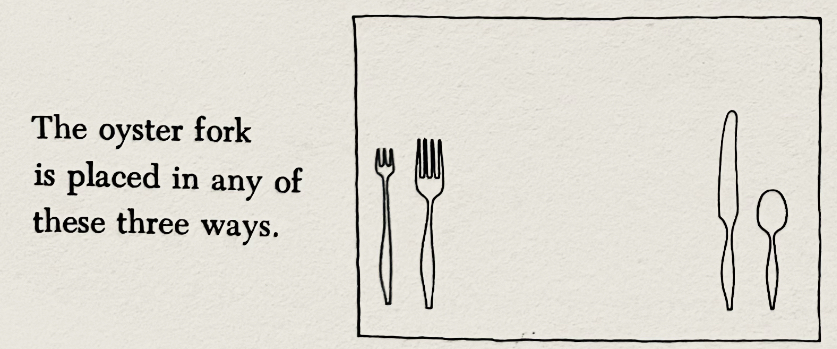
There are 3 different places you can properly find a “first” fork or “oyster fork.” 

Since the Gilded Age in the latter 1800’s, more than 3 forks on the left side of the place setting at one time has been frowned upon. “First” forks, however, cocktail forks, oyster forks, fruit forks, etc..., are allowed to be placed to the right of the setting, with the tines resting in the bowl of the soup spoon (so a diner on one’s right doesn’t think it goes with his or her forks on the left of their setting), or placed flat on the right, next to where the spoon sits. This leaves plenty of room. 

More dinner course forks can always be brought out with subsequent courses. And dessert forks are either allowed to be set above the dinner plate or may be brought out with the dessert course or finger bowl.


Images from the McCall’s “Book of Everyday Etiquette”


🍽Etiquette Enthusiast, Maura J. Graber, is the Site Editor for the Etiquipedia© Etiquette Encyclopedia