Thursday, April 8, 2021

A Social Arbiter Loses Lofty Perch

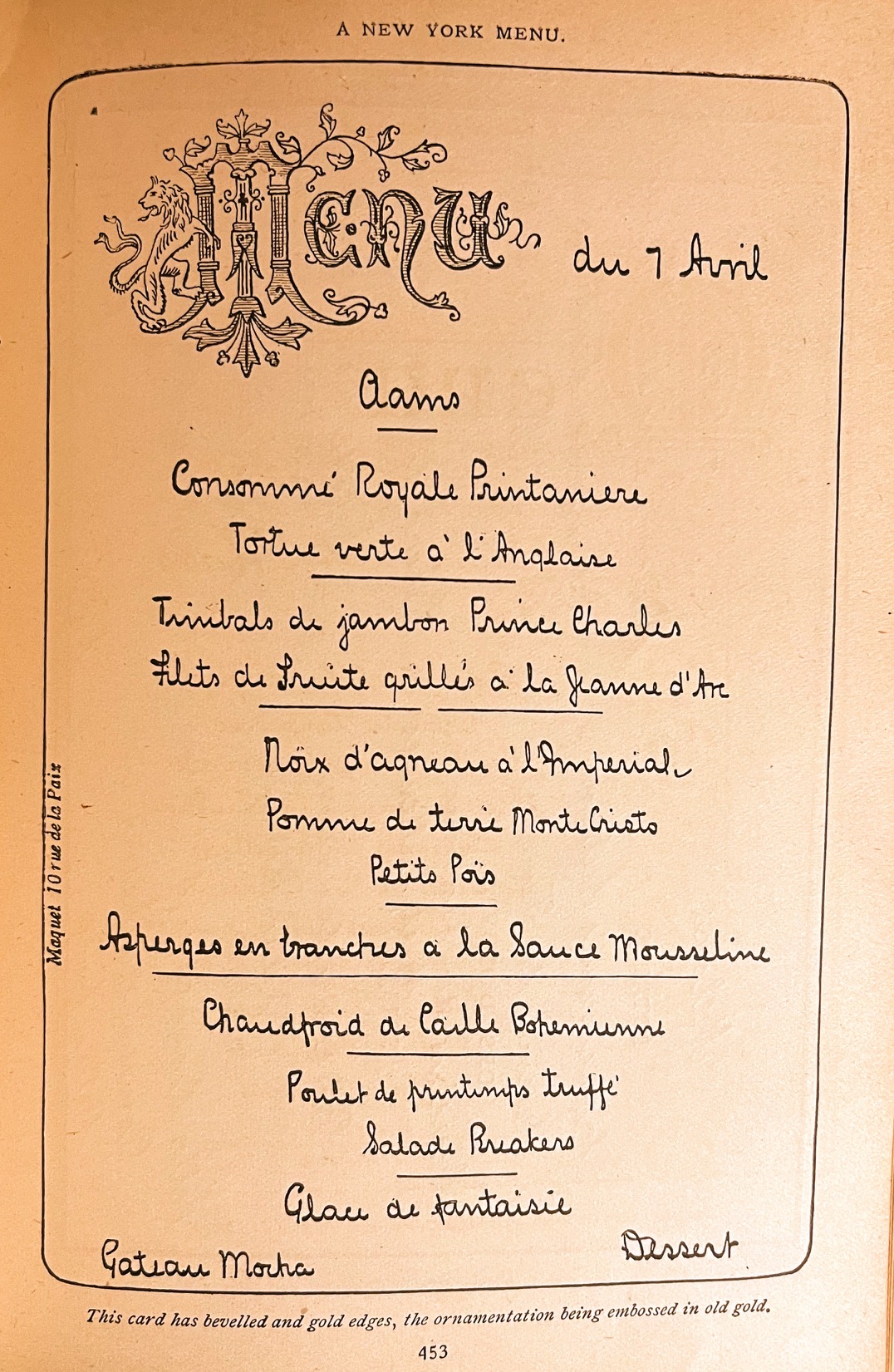
“The first object to be aimed at is to make your dinners so charming and agreeable, the invitations to them are eagerly sought for, and to let all feel that it is a great privilege to dine at your house, where they are sure there will be only those whom they wish to meet. You cannot instruct people buy a book on how to entertain, though Aristotle is said to have applied his talents to a compilation of a code of laws for the table. Success in entertaining is accomplished by magnetism and tact, which combined constitute social genius. It is the ladder to social success. If successfully done, it naturally creates jealousy.” — Menu and quote from Ward McAllister, in his book, “Society as I Have Found It”


First Talk of Deposing the 400’s Ward McAllister from His Societal Dictatorship 

Ward McAllister's venture into the ranks of the great public to take a hand in the management of the centennial ball is likely to be attended with disastrous results to him as a social leader. When Mr. McAllister awoke to the fact that he was not the entire committee— merely a member of it—it astonished him.
To have his dictates questioned in social affairs was a new, novel, and rather unpleasant experience. That the world should continue to move after his deposition from the absolute dictatorship was a surprise indeed. But the world does move, and the motion doesn’t suit ward McAllister.


The trouble is that the deposition from leadership in centennial affairs isn’t all that is liable to be the outcome of the sudden and startling discovery that the social world can wag without the assistance of Mr. McAllister. The latter factor struck the society leaders, or those who would be such, with peculiar force. At the clubs it has created as much of a sensation as did the recent cable bulletin to the effect that the Prince of Wales had appeared in public without gloves. 

It has led to more animated discussion in the Union and Knickerbocker Clubs than has any subject since the announcement that trousers were to be one and one-half inches narrower in the vicinity of the knees, than they were last season. The matter was started at the Union Club, when a member, who is also a Patriarch, is said, after an hour’s deep thought, to have created almost a panic by the inquiry: “I say there, would it be possible to give a Patriarch’s Ball and have it managed by a committee instead of Mr. Ward McAllister, doncher know?”


The question alone seemed like the starting of a social rebellion. A revolution it would be, at least. The news that the question had been to asked spread to the Brunswick and thence to the Knickerbocker with cyclonic speed and before the members of the Union had fairly recovered from its effects, it was the only question of any moment discussed or even thought of. Social circles caught it up, and now the ladies talk of it with bated breath between discussions cut painfully short about the hitherto all important questions, as to how to trim hats or whether costumes shall tend toward the Directoire or Empire style.


Society is deeply agitated about the matter. The Knickerbocker Club has already decided against Mr. McAllister. The Union Club is very evenly divided just now, with a tendency committee word, though the official action of the governing committee had not been bullet and up to midnight last night. The general belief, however, is that the next assembly of the patriarchs will be under the management of a committee instead of under a dictatorship. Social lights fear that the result may be disastrous, but the male element in the much talked of 400 seem determined, because Mr. McAllister has actually brought them into scorn and ridicule by his failure to retain his dictatorship and thus their prestige. — The New York Times April 1889


🍽️Etiquette Enthusiast, Maura J. Graber of The RSVP Institute of Etiquette, is the Site Editor of the Etiquipedia© Etiquette Encyclopedia

Wednesday, April 7, 2021

A History of Mealtimes and More


From the 16th to the 19th centuries, courses were not served separately; several dishes would be set on the table together as part of one “remove.” A dinner might involve three “removes,” and a banquet, many more.
——————
The 
“Removes,” a popular Gilded Age dinner course, is the most confusing of courses.“The Removes” or “Remove” wasn’t originally referring to a food. Its name was merely referencing the time used to remove and switch out side dishes and crumb the table perhaps, in the preparation for the inexplicably named, “Second Main Course” (an oxymoron — which sounds like poor grammar to us at Etiquipedia), or the British “Roast Course.” 

The Changeable Hours of Mealtime


The excepted normal hours for eating varied from century to century and from country to country, and indeed they have varied, and still vary to some degree, in each individual household.


By the 16th century the French and Italians had developed elaborate, highly season dishes. English fare, by comparison, was simple, although just as hearty. The Elizabethan table was a gargantuan display of meat, bird, fowl, and vegetables, and special dishes like salmagundi and peacock pâté.


In those days dinner was served to the upper classes at about 11 o’clock in the morning and was the day’s main meal. Supper, usually the only other meal, might appear at about 5 o’clock p.m. It was considered smart to dine early, for the working classes, and some merchants, ate later in the day.


There are also references to people breaking their fast earlier in the morning before going on a long journey, or if they were ill, and to certain ladies in London, who “break their fast in their beds”. On occasions there were also snacks in between of bread, butter, milk, and cheese with ale or beer, that extended to “rear suppers... when it was time to go to rest.”


Travelers ate at the inns— “ordinaries“ —which supplied an assortment of snacks for those who did not bring their own food along. There were no restaurants, even in London, but one could buy pies and prepare dishes from the cooked-meat shop.


From the 16th to the 19th centuries, courses were not served separately; several dishes would be set on the table together as part of one “remove.” A dinner might involve three “removes,” and a banquet many more.


Silver, pewter, and wooden platters were used, and the same one kept throughout the meal. Some wooden platters, flat ones, were turned over for another “remove.” Poorer people used a thick slice of bread (or trenchers) to set their food on. This absorbed the juices and was eaten at the end of the meal.


There were many changes in English and American eating habits before the present pattern began to evolve at the turn of the 20th century. Dinner, the chief meal of the day, is ordinarily thought of as the evening meal. This was not always so. In some European countries the main meal is still taken mid-day, while in others – particularly Spain —it is eaten after 10:00 p.m.


In the 17th century, the day began with a good, healthy breakfast. This was followed by a heavy noonday meal, served at about 1 or 2 o’clock, and a comparatively light supper. In America, the custom of eating supper (usually three or four hours after tea) was in keeping with the English practice of earlier decades. Among the fare served to the settlers at suppertime, we read of such tidbits, mentioned by Jean McClure in her booklet, “Early American Table Settings,” as “hogs ears forced, pickled pigs feet and ears, ox-Palates.”


In farmhouse is on both sides of the Atlantic, tables were “set out” with all the food at once, but in the village, the squire’s wife “set out two courses” in English fashion. In city homes, the two courses were extremely elaborate and offered great variety.


This habit of covering the table with platters of food was not so that each person would sample everything, but so that each would find something to his taste. Since it was considered ungenteel at the time for the ladies to drink more than one glass of wine, they retired to the drawing room or parlor, after the desert course. Later, the gentleman join them for tea or coffee.– Patricia Easterbrook Roberts, 1967


Etiquette Enthusiast, Maura J. Graber, is the Site Editor for the Etiquipedia© Etiquette Encyclopedia


Tuesday, April 6, 2021

Etiquette and Lebanese Cuisine

When Lebanese expatriates are asked what they miss the most about the country, oftentimes the answer is the same: “The food!”. The lavish cuisine consists of more than forty mezzé dishes with a variety of cold plates followed by hot ones artfully presented in Service à la Française. 
—————————
Table layout for the second course, in Elizabeth Raffald's The Experienced English Housekeeper, 4th Edition, 1775. Identifiable dishes include three mammal species, four birds, and four of fishes and seafood.
  Image source, Public Domain Wikipedia 


Lebanese cuisine is not only a reflection of national heritage, but also a world- famous cultural staple, elevating Lebanon to prominent gastronomic standards. The food is rich with aromatic flavors, inspired at once by the cooking of regional influences and of dominant powers throughout history. Even so, the most famous dishes remain the home-made recipes passed down from one generation to another and among communities from grandmothers, to mothers, daughters, granddaughters, neighbors and friends.

When Lebanese expatriates are asked what they miss the most about the country, oftentimes the answer is the same: “The food!”. The lavish cuisine consists of more than forty mezzé dishes with a variety of cold plates followed by hot ones artfully presented in Service à la Française.
Unlike other Arab cultures, Lebanese enjoy chatting at mealtimes. Conversations can easily shift from travel, fashion and TV shows to heated political discussions, which most likely end with pleasantries and good laughs to cheer up the mood.

Lebanese indulge their guests by offering them meals with abundance. Invitees should gracefully appreciate the generosity of the hosts, for no food gets wasted at the end of these feasts. Based on Arab customs, food charity is practiced by caring and sharing with others, be it the relatives, the neighbors, the helpers or the needy ones in the community.

A lot of mezzés are eaten with Arabic bread, otherwise known as the pita bread. The traditional Lebanese table setting does not include a bread plate however. Therefore, once the bread is cut by hand, it is best to place it on the side of the plate rather than on the table cloth.

When guests are not familiar with some ingredients offered by the host, it is mannerly not to refuse the suggestions, unless for health reasons, but to savor them graciously, as much as possible. For this shows humility, kindness and appreciation to the hosts’ efforts.

Contributor, Irma Vartanian Balian, founding Director of ProtocolWise ™ has lived in North America, Europe and the Middle East. Her rich cultural background, her commitment to excellence, along with her expertise in Protocol and Soft Diplomacy, equipped lrma to provide valuable advice to her clients while putting them at ease. Irma trains leaders, corporate teams, diplomats, individuals, families and professionals, both regionally and internationally with assurance and professionalism.


Etiquette Enthusiast, Maura J Graber, is the Site Editor for the Etiquipedia© Etiquette Encyclopedia


Monday, April 5, 2021

An Improper Formal Dinner Course

The term “fruit cup” denoted a type of “fruit cocktail” which was chopped fruits amidst the occasional maraschino cherry, served in a thick, sweet syrup. Special orange cups or fruit holders, like these which were developed in the gilded age, made oranges enticing and eating the fresh fruit elegant. These antiques would have been a welcome and refreshing change to the 1960’s formal table, as a break from that ‘ubiquitous fruit cup.’


“No Fruit Cup!”

“Avoid anything sweet for the beginning of a menu. If you serve fruit, serve it in its natural state, such as a melon with a wedge of lime or lemon, or a grapefruit cut in half. One of the famous banquet menu-makers in this country says that the ‘ubiquitous fruit cup’ is badly placed on American menus as a beginning course and should appear only at the end of a meal, ‘its normal place.’ Out of his experience he added that the custom of fruit cup came in during Prohibition, as a substitute for cocktails, frequently ‘bathed in a pink sweet liquid vaguely reminiscent of liquor, and the custom continued after repeal.’ — Helen Sprackling, 1960


Etiquette Enthusiast, Maura J. Graber, is the Site Editor for the Etiquipedia© Etiquette Encyclopedia

Sunday, April 4, 2021

12 Rules for American Formal Dinners

From 1 to 4 —1. Service plate, 2. Water glass, 3. White wine goblet, 4. Red wine goblet. A to H — A. Large dinner making, triple folded, B. First course fork, C. Main course fork, D. Salad fork, E. Main course knife, First course knife, G. Soup spoon (oval bowl for formal meals and soup plates, H. Seafood fork or Appetizer cocktail spoon.— Patricia Easterbrook Roberts — At very formal dinners, bread and butter is not served, so the bread plate is omitted. 

1. Invitations are sent in the third person, answered by the guests in writing, and in the third person. 
2. Full evening dresses required. This means white tie and tails for the men. 
3. While still in the hall, each male guest is given a card naming his dinner partner. 
4. Guests are announced by the butler as they enter the drawing room. 
5. The indicated dinner partners go arm in arm into the dining room. 
6. The table is covered with a cloth, white or in the palest of tints. The candle-and-flowers and fruit arrangement is lavish and elegant. 
7. Place cards have the names written in full. 
8. There are menus written in French. 
9. There are usually 6 or 7 courses of food, which is strictly traditional in type. 
10. The 6 or 7 courses are served with meticulous form. There are never second helpings. 
11. Large, broad rim suit plates are customarily used and the soup spoon is the large table-size. 
12. Unless specific entertainment is provided, one usually leaves earlier than if dining at an intimate little dinner, but not until after the guest, or guests, of honor, no matter how long they stay. — Helen Sprackling


🍽️Etiquette Enthusiast, Maura J. Graber of The RSVP Institute of Etiquette, is the Site Editor for Etiquipedia© Etiquette Encyclopedia

Saturday, April 3, 2021

Retro Etiquette for Female Smokers

Etiquette rules for the woman smoker are the same as those for men, except for the fact that she can't smoke on the street and look ladylike. Even today, this gives her a Sadie Thompson or beatnik or washerwoman effect, depending on her age and build.


When should a man light a woman's cigarette? According to 1953's The New Esquire Etiquette: A Guide to Business, Sports & Social Conduct, on secretaries who smoke, "If she's sitting within reach of a lighter and if she's not crippled, nobody expects you to walk a mile with a match." but "Light her cigarettes, be you ever so far across the room whenever she is apparently lightless." 

Two errors in etiquette are still committed occasionally by the woman smoker. One is never having cigarettes or matches, only the habit. Most men consider this fairly charmless. (And these lassies learn quickly, of course, that they can't get away with it at all, with other women.) The second error is expecting her cigarettes to be lit for her even though matches are on the table beside her. I know a camellia blossom who will sit endlessly with cigarette poised, waiting for some man to quit whatever he's doing and light it. This is bad manners, for it makes other people uncomfortable, and it is not the action of a lady, but of a blob of glup.

Which brings up the question: When should a man light a woman's cigarette? Most women would answer, not when he must cross the room to do so.** If a man lunges with a lighter from 15 feet away every time she fumbles, a woman will presently get the uneasy feeling that she's smoking too much. And he shouldn't butt in if she has her own cigarette lighter already to flick. After all, she didn't bring that cute little gadget along for a paperweight. She likes to use it and show off its pretty monogram. Also, lighting her own cigarette gives her a small feeling of accomplishment, which, in this push-button age, isn't to be sneezed at.

One more tobacco crumb: Formerly, when two smokers were lighting up, it was de rigueur to light one's own cigarette first. But that was in the days of sulfur matches, when the first cigarette lit was apt to taste of the fumes of hell. Today, courtesy dictates that the lighter light his own last. — From Peg Bracken’s, “I Try to Behave Myself”


Etiquette Enthusiast, Maura J. Graber, is the Site Editor for the Etiquipedia© Etiquette Encyclopedia

Friday, April 2, 2021

Etiquette and Eye Contact

Create Connections Through 
Eye Contact

Couple Making Eye Contact

Making eye contact is a natural part of daily life for most people.  You probably don't even realize how many times each day you do it.

When you look directly at someone with a relaxed facial expression you use one of the best methods of acknowledging that person, making yourself memorable, and keeping everyone honest.

Creating Connections

Have you ever noticed how babies meet or follow your gaze?  If you look directly at a baby, she will look into your eyes.  Look away, and she will follow your eyes to their change of direction.  Studies support this, proving that eye contact is natural, human habit.

Why?  Because humans want connections with other humans.  And the eyes have it.

When you first meet someone, etiquette guides you to look them in the eye as you shake hands.  It's a global response indicating that you acknowledge this person and validate his presence.  You are giving the gift of two things all humans crave - acknowledgement and validation - with one look and the touch of your hand.

This is also where the term "love at first sight" comes from.  The simple act of locking eyes with someone lets you know instantly if there is an attraction.  The longer the eyes meet, and the frequency of those glances, are a telltale sign of how strong the attraction is.  Keep this in mind the next time you attempt to get the attention of a potential special someone.

Reading People

Most of us think we can spot a liar because he doesn't make eye contact.  Well, this is sometimes true and sometimes not.

Research indicates that dishonest words are often coupled with purposeful eye contact.  Yes, a person will look you in the eye and lie to you!

However, if you suspect someone is not on the up-and-up and you confront her about it, attempt to make eye contact with her as you do so.  If she avoids your gaze, she's most likely lying to you.

In other situations, looking away can indicate shyness, sadness, or an attempt to avoid discord.  Be sure you consider the environment and situation you are in as you read the individual.  It's best not to jump to conclusions about someone.

But you can imagine how someone feels when shaking hands and eye contact is not made, and you may have experienced that yourself. 

Notice the body language of people when they greet and introduce people.  You'll know when eyes were met and when they were not.

When and How to Make Eye Contact

There's rarely a bad time to make eye contact.  When doing so, you make someone feel he has your full attention, that he is important, and that he is being heard.  Use this method of connecting with another person when . . .

  • You are participating in a conversation
  • You say hello, arrive at a meeting, see a friend at a party
  • You are introduced to someone

When you meet someone's gaze with a smile, you instantly create a positive connection in that person's mind.  This is important when you are entering a job interview, need to comfort someone, or are attracted to someone. 

But remember, staring or holding a gaze too long can make others uncomfortable.  Maintaining good eye contact leaves room for blinking and looking away for a second.  This provides a little relief, especially if you are concentrating on making sure you are doing it correctly.  I use the term, “long glances” as a way to think about it.

Culture is another consideration when employing eye contact to make a connection.  When traveling to another country, study the culture-specific rules.  Even though we value this practice here in the United States, there are some countries where it is considered offensive.

It is said the eyes are the windows of the soul.  As you peer into those belonging to other people, make sure yours are "open" as well.  Human connections are sometimes the best gifts we can offer.

Sources:  

"Eye contact detection in humans from birth," Teresa Farroni, Gergely Csibra, Francesca Simion, and Mark H. Johnson, accessed September 27, 2016, http://www.pnas.org/content/99/14/9602.abstract

"The Science of Eye Contact Attraction," The Art of Charm, accessed September 27, 2016, http://theartofcharm.com/flirting-and-attraction/science-eye-contact-attraction/


Contributor Candace Smith, teaches university students and professionals, the soft skills of etiquette and protocol. She found these skills necessary in her own life after her husband received international recognition in 2002. Plunged into a new “normal” of travel and formal social gatherings with global leaders, she discovered how uncomfortable she was in many important social situations. After extensive training in etiquette and protocol, Candace realized a markedly increased confidence level in meeting and greeting and dining skills and was inspired to share these skills that will help others gain comfort and confidence in dining and networking situations. Learn more at http://www.candacesmithetiquette.com/


Etiquette Enthusiast, Maura J. Graber, is the Site Editor for the Etiquipedia© Etiquette Encyclopedia


Thursday, April 1, 2021

Spaghetti’s Western Etiquette


Old Italian artwork in background on magazine cover, shows how pasta was once properly eaten.


“A North American father, presumably initiating his son, aged 15, into the world of adult business affairs, took him out to what the boy described as ‘a big dinner meeting.’ When the company was served spaghetti, the boy ate it with his hands. ‘I would slurp it up and put it in my mouth,’ he admitted. ‘My dad took some grief about it.’ The October 1985 newspaper article does not describe the response of the rest of the company. The son was sent to a boarding school to learn how to behave. ‘When we have spaghetti,’ he announced later, ‘you roll it up real tightly on your fork and put it in your mouth with the fork.’ 

What he described, after having learned it, is the dinner-table ritual —as automatic and unquestioned by every participant in it, as impossible to gainsay, as the artificial rules and preferences which every cannibal society has upheld. Practical reasons can be found for it, most of them having to do with neatness, cleanliness, and noiselessness. Because these three general principles are so warmly encouraged in our culture, having been arrived at, as ideals to be striven for, after centuries of struggle and constraint, we simply never doubt that everyone who is right-minded will find a spaghetti eating companion disgusting and impossible to eat with where even one of them is lacking. 

Yet we know from paintings and early photographs of spaghetti eaters in 19th century Naples (where the modern version of spaghetti comes from) that their way of eating pasta was with their hands— not that the dish was likely to appear at a formal dinner. You had to raise the strings in your right hand, throwback your head, then lower the strings, dexterously with dispatch, and without slurping (there are invariably ‘polite’ and ‘rude’ ways of eating), into your open mouth. (The spaghetti in the picture does not seem to have sauce on it.) Today, spaghetti-eating manners demand forks, and fist fulls of wet pasta are simply not acceptable on any 'civilized' occasion.” —Margaret Visser, The Rituals of Dinner


Etiquette Enthusiast, Maura J. Graber, is the Site Editor for the Etiquipedia© Etiquette Encyclopedia