Saturday, March 20, 2021

The History of Seating Etiquette

“It was a common fiction that the order of precedence mattered more to the women than the men. The idea was that the men were too busy getting on with the work that needed to be done to worry about unintended flights. One suspects this fiction was no more true than the idea that men do not gossip.” From “Forgotten Elegance”
  — Image source, The RSVP Institute of Etiquette
                                     
To the Victorians (and diplomats today), where one sat at the table was very important. Feelings would be hurt, and tempers would flare, if these rules were violated.

In England, the order of precedence was set by one's rank in the tables of Nobility. Dukes ranked above Counts, and so forth. If two people held the same rank, then the order in which the titles were granted was the deciding factor. The holders of the title were men, and women took the precedence of their husbands.

For example, when 19 year old Consuelo Vanderbilt, as the wife of the Duke of Marlborough, went to dinner, she took precedence over women in their fifties and sixties who had not married as well.

In British colonial society this was carried further, and the order of precedence depended on the husband's job. Books of official order of precedence were published to set out the relationship between different jobs and time in those jobs. If one wanted to know the order of precedence of an assistant inspector general of forests, a District Judge in Lower Burma, a Lieutenant with seven years of service, and a sanitary commissioner, one merely looked in the official warrant of precedence.

In the United States, the question of precedence was mostly confined to Washington D.C., where the order among diplomats and politicians' ranks was important. Many hostesses did not use precedence in seating their guests — they placed people to ensure good conversation.

It was a common fiction that the order of precedence mattered more to the women than the men. The idea was that the men were too busy getting on with the work that needed to be done to worry about unintended flights. One suspects this fiction was no more true than the idea that men do not gossip.

In most of the United States there was little order of precedence, there being no nobility, or diplomatic or bureaucratic ranking to go by. What order there was took the form of the oldest woman being first or perhaps an out of town woman being first. If a new bride was present she often took precedence.— From Forgotten Elegance, 2002


 🍽Etiquette Enthusiast, Maura J. Graber of The RSVP Institute of Etiquette, is the Site Editor for the Etiquipedia© Etiquette Encyclopedia

Friday, March 19, 2021

U.S. Diplomatic Order of Precedence

“The new British diplomatic representative to the United States, Anthony Merry, and his wife were shocked and insulted when the President received them in worn clothing and slippers. In December 1803 at a formal dinner in the White House, no one offered to escort Mrs. Merry to dinner. In the dining room, Merry and his wife had to scramble for places at the table in competition with the other guests. The Marquis d'Yrujo, the Spanish diplomat, had the same experience. He and Merry agreed that this treatment was an insult to them and to their countries. The two diplomats and their wives sought to retaliate.”


In 1908, the Roosevelt Administration created the first U.S. Order of Precedence as a means of settling a history of embarrassment, confusion, and miscommunication amongst officials invited to events at the White House. As the structure of the federal government evolved, this list has adapted and grown. The President of the United States may make adjustments to the Cabinet, to give certain White House positions the status of Cabinet-rank which then follow the heads of the executive departments.

The U.S. Order of Precedence is used primarily in diplomacy. International rules on precedence were first established at the Congress of Vienna in 1815. By determining that envoys of equal title would be ranked according to the date and hour that they presented their credentials to the government that accredited them for service, the Congress of Vienna solidified a fair and justifiable system for diplomatic relations. These same rules are still used to determine the order of precedence of the Diplomatic Corps in Washington, D.C. Additionally, when on official business in the United States, foreign government officials are afforded the same protocol ranking as their corresponding position in the United States government.

A few basic principles regarding precedence should be noted. First, the host or hostess of a meeting or event always takes the primary position of precedence, regardless of their title or traditional ranking. Second, a person’s relative precedence may increase or decrease depending on the policy or context behind the specific meeting or event, or based on the wishes of the host on any occasion.

The methodology used in ordering officials for this list includes the United States Code; statutory prescription on precedence, including executive orders; well-established and widely- accepted principles, procedures, and traditions throughout the history of the order of precedence; the current structure of the federal government and the executive departments; and finally, recommendations by the Chief of Protocol based on practical treatment of a particular position or positions.

For any questions regarding the U.S. Order of Precedence, please email the Office of the Chief of Protocol at ProtocolHelp@state.gov. — From U.S. Order of Precedence


Etiquette Enthusiast, Maura J. Graber, is the Site Editor for the Etiquipedia© Etiquette Encyclopedia

Thursday, March 18, 2021

Etiquette for Escargot


The classic shape of an escargot dish is round with 6 divots for the snail shells to sit in. Shown above is an antique escargot dish from France, accompanied by an escargot fork and escargot tongs from Chicago’s famous “Pump Room” restaurant.— “Occasionally, escargot was served at elegant meals. Snails call for their own special plates. The 1893 book, The Epicurion, gives several recipes for escargot and relates that they are often served in earthen or metal dishes, especially intended to receive the snail or the shell and the snail. It also notes a silver skewer or pick is used to remove the snail. The dishes must be earthen or metal as snails have to be cooked and served very hot to keep the butter from congealing. This type of dish could be placed in the oven and then carried directly to the dinner table.” — Wendell and Wes Schollander in Forgotten Elegance, 2001


Etiquette for Eating Escargot:
  • Escargot is properly served as a hot appetizer. 
  • Escargot tongs, with which to grip hot snail shells, are usually provided.
  • The appetizer fork sits to the far right of a place setting, with the tines resting in the bowl of a soup spoon, or the fork sits flat on the table if there is no spoon for a soup course. It can occasionally be found at the left of the setting, if there are fewer than normal subsequent courses to be served which require forks.
  • The escargot tongs are most often brought to the table when the escargot is served, as opposed to being pre-set at the place setting. In this manner, the tongs will not encroach on other the other settings. 
  • If a hostess wishes to place them at the place settings beforehand, they can be placed to the left of the forks, but this can make each place setting much wider than planned, making them closer to the other guest’s settings.
  • The plates should be very hot, so use caution when picking up snail shells with your tongs.
  • The holder grips the shell with the left hand, while the right pulls out the snail with an escargot fork, pick or even an oyster fork. 
  • After removing the snail from the shell, it is brought to the mouth with one’s fork after the tongs are set back down on the under-plate or dish, in a “rest position.”
  • If there are no tongs, you may hold the shell with your napkin protecting the fingers, as the snails must be dug out of the shells. 
  • Occasionally, snails are simply served in a round dish without their shells. They may be eaten, one at a time, with your escargot fork.
  • Snails are eaten whole, like raw oysters. 
  • After eating the snails, when the snail shells have cooled, it is proper to tilt them into the mouth to get the garlic butter and snail liquor, or one may sop this up with bits of French bread.
  • Drop a few small pieces of bread into the dish and shells and sop up the butter sauce.
  • Retrieve each piece individually with your escargot fork, and bring them to your mouth one at a time, using your fork to convey them.


Etiquette Enthusiast, Maura J. Graber, is the Site Editor for Etiquipedia© Etiquette Encyclopedia

Wednesday, March 17, 2021

Flatware for Informal Place Settings


“A few of the people you'll meet at every party. It will pay you to get along with them.” — It will also pay to know their names and primary uses so that you can easily “read” your place settings at luncheons and dinner parties.

Informal Place Setting Diagram —Only a luncheon or a very informal dinner setting will feature a cup, saucer and teaspoon. At formal dinner parties, coffee or tea are served away from the dining table. The service for coffee, tea or after dinner liqueurs, is brought out after the meal and usually served away from the table.


Eating is the one social activity common to everyone around the globe, but eating and dining are two different things. Practice dining when you are not in public and it will help you to avoid merely eating when among others.
“Table manners grew out of the fact that unless he is eating in a room empty of all but himself, a man eats in company and food is less appetizing if the other fellow's table manners are sloppy and disgusting. It matters little what sort of food is being served, whether the table is loaded with priceless silver and china or tin and graniteware; the simplest meal is made more attractive by the use of good table etiquette.”— From “Manners for Moderns,” 1938


Etiquette Enthusiast, Maura J. Graber, is the Site Editor for the Etiquipedia© Etiquette Encyclopedia


Tuesday, March 16, 2021

Formal Dinner Seating Arrangements

This diagram shows what was, in the Gilded Age, a reportedly popular French-style, dinner party seating arrangement. This savvy seating arrangement places the host and hostess in seats across from one another, midway to the center of the table on each side. The couple, seated in such close proximity to one another, can direct or control the conversation with their guests, and help the dinner party flow along more easily throughout the evening.
These diagrams above show a popular dinner party seating arrangement for rectangular tables, at which the host sits at one end and the next male “of importance” is seated at the opposite end. At these tables, the hostess sits on that guest’s left, while the woman next in importance sits on his right. Note that “importance” is a relative term. It can refer to rank, seniority, age or even to which guest traveled the furthest distance or who will next be celebrating a birthday.
“When the party numbers 6, 10, 14 and so forth, the more modern way of dispensing with end places entirely, and seating the host and hostess directly in the center of each side, is increasingly used. To make this come out right, the number along each side, as you can see, must be an uneven one such as three, five, seven. This places the host and hostess opposite in the midst of their party, allows them to direct and control the conversation as necessary and look after the general welfare of their guests. At the usual friendly dinner party, there is seldom a special “guest of honor.” If, however, you were giving the dinner party in honor of a particular woman guest, you would seat her at the right of the host. If a man were the one to be so distinguished, you would see him at the right of the hostess.”— From Helen Sprackling, 1960


Etiquette Enthusiast, Maura J. Graber, is the Site Editor for the Etiquipedia© Etiquette Encyclopedia

Monday, March 15, 2021

U.S. vs U.K. Crescent Plate Etiquette

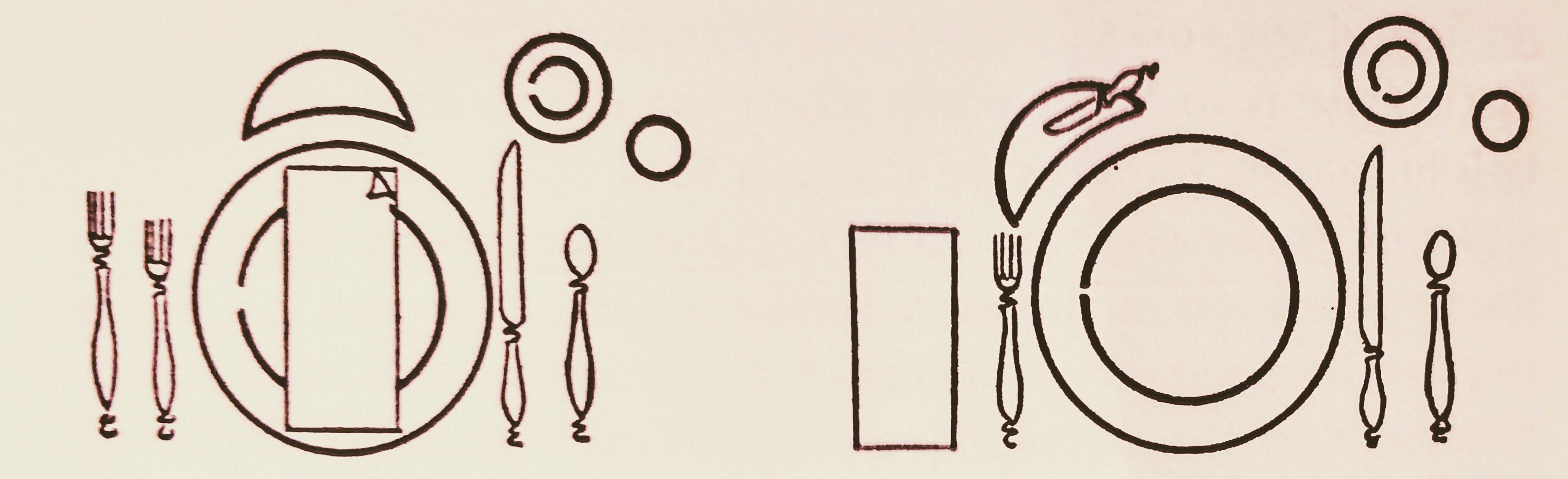
A crescent plate as side dish, is a uniquely Victorian era creation. The use of crescent plates presented some practical problems not associated with the regular salad or other side plates. The crescent plate normally sits off to the left of the main plate but the crescent plate must be placed next to the main plate in space taken by silverware. Because of this problem, the crescent plate was placed above the forks on the left, or at times, to the top of the main plate.— Diagram from “Setting Your Table” by Helen Sprackling


“Salad plates are generally smaller versions of the dinner plate and may or may not be used at a formal dinner. They're almost certainly found at an informal dinner or luncheon. If the salad course is to be served with the game course, a practical problem arises — the game is hot, and the salad is cold. Anyone who has ever eaten a congealed salad with hot meat knows the salad will melt. In addition, the salad oils tend to mix with the game. To avoid these problems, the English started using a crescent salad plate.

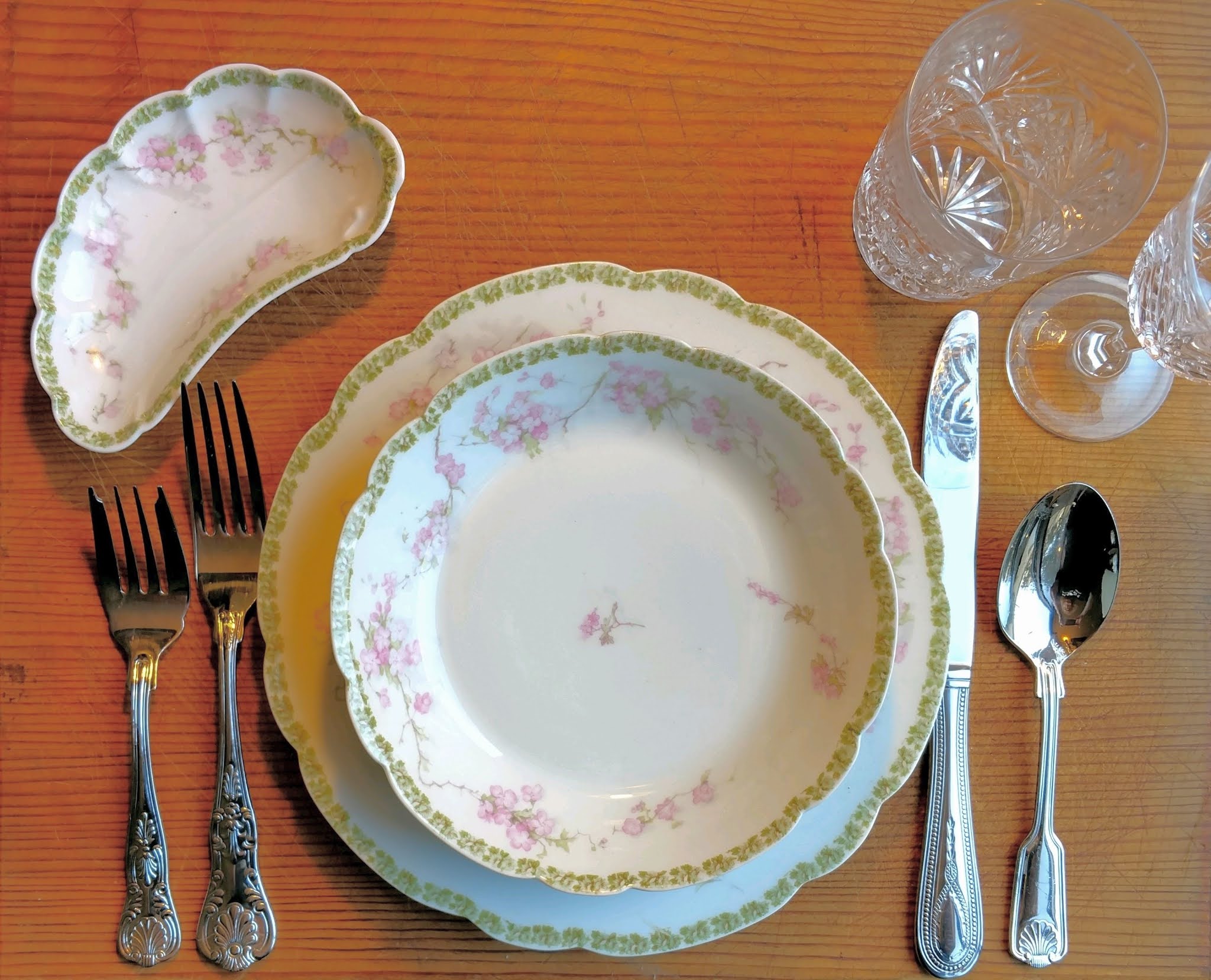
“In the United States, such large crescent salad plates were not often produced; however, a smaller crescent bone plate was fairly common in American patterns. The crescent bone plate was used to hold the bones that were exposed when diners deboned their fish with their knives and forks. One can readily see the difference in size between a salad plate and a bone plate.

“The use of the crescent plates presented some practical problems not associated with the regular salad or other side plates. The crescent plate normally sits off to the left of the main plate but the crescent plate must be placed next to the main plate in space taken by silverware. Because of this problem, the crescent plate was placed above the forks on the left, or at times, to the top of the main plate.” — From “Forgotten Elegance,” 2002


 🍽Etiquette Enthusiast, Maura J. Graber of The RSVP Institute of Etiquette, is the Site Editor for the Etiquipedia© Etiquette Encyclopedia

Sunday, March 14, 2021

Using Crescent Plates Properly

Originally, crescent side plates at place settings were for depositing bones or other indigestibles from one’s meal in the U.S. and for eating one’s salad from in Great Britain. They came in a variety of sizes and shapes, depending on the manufacturer and design. Salad plates were larger. Bone plates were smaller.

The crescent plate may be used as a salad plate with the roast course. It was used in this manner at Queen Elizabeth's coronation dinner. 

“Many hostesses who have inherited lovely old French or English china services with the crescent salad plate, are now proudly using them. The crescent plate may be used as a bread and butter plate, as in photo #2, whenever one would be needed or, more formally, as a salad plate with the roast course. It was used in this manner at Queen Elizabeth's coronation dinner. See photo #1.”

The crescent plate may be used as a bread and butter plate, as in photo #2, whenever one would be needed.


 —From "Setting Your Table... Its Art, Etiquette and Service," by Helen Sprackling, 1960


Etiquette Enthusiast, Maura J Graber, is the Site Editor for the Etiquipedia© Etiquette Encyclopedia

Saturday, March 13, 2021

Gilded Age Hair, Toilettes and Fashion


I'll think about that tomorrow! 
“The toilet then wants harmony, which is the soul of elegance as well as of beauty.” 


A lady in her decline, dressed in her hair, and wearing a dress with short sleeves, adorned with collars, bracelets, etc... offends against propriety as much as against her interest and dignity. The rigorous simplicity of the dress of men establishes but very little difference between that of young and old. The latter, however, ought to choose grave colors, not to follow the fashions too closely; to avoid garments too tight or too short, and not to have in view in their toilet any other object but ease and neatness.

Old ladies, whom custom requires to conceal this respectable sign of a long life, should at least avoid hair too thick or too full of curls. If they would not appear ridiculous and clothed in a manner disagreeable or offensive, ladies ought to adopt in summer light garments, and delicate colors, and in winter, furs, thick and warm fabrics, and deep colors. Men till lately were almost free from this obligation; they used to be constantly clothed in broadcloth in all seasons: but now, although this may form the basis of their toilet, they must select stuffs for winter or summer, as may be suitable.


A Toilet Comb, patented in 1910 to help ladies push stray, shorter hairs under longer hairs, when finishing their style. 


Unless the care of their health, or complete baldness, requires them to wear a wig, it is more proper that old persons should show their white and noble heads. It is in good tone for gentlemen to wear a rich cloak; an outer garment over the coat (especially one of silk,) is left for men of a certain age. It only belongs to septuagenarians and ecclesiastics to wear doublets or wadded outer coats.

To finish our instructions relative to the toilet, it only remains for us to make a few observations. It is superlatively ridiculous for a lady to go on foot, when dressed in her hair, or attired for the drawing-room or a ball. If one dwells in a provincial town where it is not customary to use carriages, they should go in a chair. Who does not perceive how laughable it is to see a lady who is clothed in satin lace, or velvet, laboriously traveling in the dust or mud. Vary your toilet as much as possible, for fear that idlers and malignant wits, who are always a majority in the world, should amuse themselves by making your dress the description of your person.
 

Certain fashionables seek to gain a kind of reputation by the odd choice of their attire, and by their eagerness to seize upon the first caprices of the fashions. Propriety with difficulty tolerates these fancies of a spoiled child: but it applauds a woman of sense and taste, who is not in a hurry to follow the fashions and asks how long they will probably last before adopting them; finally, who selects and modifies them with success according to her size and figure. It would be extremely clownish to carry dirt into a decent house, especially if one makes a ceremonious visit; and, when there is much mud, or when we cannot walk with skill, it is proper to go in a carriage, or at least to put in requisition the services of a shoe-black at a short distance from the house.

 
“Patent for a Hair Receiver” from 1901 


Young people who become bald, should not hesitate to have recourse to wigs. Nothing more saddens the appearance, than those bald skulls, which seem always to invite the observations of the anatomist.


From “The Gentleman and Lady's Book of Politeness and Propriety of Deportment, Dedicated to the Youth of Both Sexes” by Elisabeth Celnart 


Etiquette Enthusiast, Maura J. Graber, is the Site Editor for the Etiquipedia© Etiquette Encyclopedia