Saturday, April 4, 2020

First Impressions Etiquette

Your smile is your most powerful asset. Since we are all capable of smiling, unless facial impairments prevent us from doing so, we must make use of it as it can only work for our advantage.


First Impressions: Using Seven Steps within Seven Seconds


Do you recall someone who impressed you the first time you met? A colleague, a potential client, your boss, your future spouse, a VIP, a well-respected leader, etc...? Do you know that it takes only about seven seconds to form an impression of someone you just met? The rest is just a cherry on top, or not! Now think about how you come across when you meet someone for the first time.

The following are 7 easy steps to help you build upon your first impression...


Step 1: The Physical Appearance
Your clothes must match the image you want to reflect at any given occasion. If you have to project a professional image then choose suitable attire. For social settings, it is best to find out about the dress code and the venue beforehand. Ladies try to keep the make up discrete and shy away from overly done looks. Elegance, regardless of material capabilities, is best acquired when dressing appropriately to the age and the body form. As for men, avoid shirts that are too tight which might reveal some parts of the abdomen or shirt buttons open till the middle of the chest. Looks also incorporate the hair factor. The hairstyle and the cleanliness of it also contribute to the appeal of your physique. Therefore make sure to get the most suitable hairstyle for the shape of your face. You can work on your looks by seeking a professional stylist.

Step 2: The Posture

The proper posture helps you stand confidently and positively. With the right posture you will look more welcoming and interesting. When meeting someone for the first time, avoid fidgeting or slouching, for it can make you look anxious and confused or less attractive and insecure. While standing to meet someone, in order to improve your body posture, first pull your head back and make sure your chin is parallel to the floor. Then push your shoulders down and relax them all the while aligning them with your chest. Keep your feet parallel on the floor, unlock your knees and imagine a string pulling you up from your head towards the ceiling. Furthermore look straight ahead while walking. It will give your walk the sense of a purposeful direction. Finally, to maintain a healthy body posture you need to exercise regularly and/or practice the appropriate Yoga or Pilates techniques.

Step 3: The Voice

When you speak, your voice must commend assertiveness and confidence. The sound of your voice must be loud enough but not too hasty or anxious, yet soft enough but well articulated. Avoid using filler words such as “you know what I mean,” “like,” “yeah,” “umm,” etc... as they make you sound boring or hesitant. One way to check for your verbal communication skills is to record your voice on your phone and listen to it meticulously. Do your words sound clear? Are you pronouncing the consonants properly? Is your voice level going down unintentionally at the end of each sentence? You must aim at sounding pleasant yet assertive, approachable yet professional. Remember, in most cases and particularly in the case of first impressions, how you say something is more important than what you say. One might not remember the content of a first conversation with you but will recall how you sounded.

Step 4: The Eye Contact
No first impression could be significant enough without the required level of eye contact. When meeting someone for the first time, you must make eye contact. Before extending your arm, while extending it, throughout the shaking of the hand and until exchanging each other’s names, you must continue to make eye contact. In the Armenian culture, as with most Western cultures, under no circumstance can you get away with a positive first impression without the proper eye contact. Eye contact implies respect and acknowledgement to the person you are being introduced to.

Step 5: The Handshake
Do you know that people can tell a lot from your handshake? A firm and proper handshake, as opposed to a loose one, is what you need to be perceived as an assertive and sincere person during introductions. When meeting for the first time extend your arm; make sure the web of your hand touches that of the other person; have a good grip of your converser’s hand with the palms touching while your fingers and thumb are resting on the back of the other person’s palm and continue to shake hands until you both get introduced to each other properly. Also try not to hold too tightly your counterpart’s hand, since you will come across as a bone crusher!

Step 6: The Smile
Your smile is your most powerful asset. Since we are all capable of smiling, unless facial impairments prevent us from doing so, we must make use of it as it can only work for our advantage. But be careful of course and do it wisely! For instance, a cheeky smile to your friend’s spouse or your boss unnecessarily, might get you in trouble. Here I emphasize on the way you smile and the appropriateness of the occasion. Your smile must project sincerity, respect and genuine enthusiasm towards the situation and the person with whom you are conversing. Smiling is also contagious, so when you smile at a person you just met, your kind gesture is appreciated and meeting you is remembered as a pleasant experience.

Step 7: The Body Hygiene
Under no circumstance must you meet someone without considering the proper etiquette of hygiene. It can either make you look attractive or unpleasant. Proper hygiene is a necessity. It is a reflection of a healthy condition, while poor hygiene is associated with infections and germs. Teeth, hair and body must be washed and taken care of on a regular basis. Therefore, make sure your daily routine keeps your body, hair and teeth clean.

To recap, when meeting someone for the first time, you must make eye contact, smile and extend your arm to give an assertive handshake. Most of the time we all get only one chance to make a positive impression. Following the above seven steps as a guideline can help you sound more confident, impressive and unforgettable in a positive way. 


Meet our newest contributor, Irma Vartanian Balian, founding Director of ProtocolWise ™. She has lived in North America, Europe and the Middle East. Her rich cultural background, her commitment to excellence, along with her expertise in Protocol and Soft Diplomacy, equipped lrma to provide valuable advice to her clients while putting them at ease. Irma trains leaders, corporate teams, diplomats, individuals, families and professionals, both regionally and internationally with assurance and professionalism.


Etiquette Enthusiast, Maura J Graber, is the Site Editor for the Etiquipedia©️ Etiquette  Encyclopedia 


Friday, April 3, 2020

Notable Feline Petiquette

“ He looks around the table, and without a word or suggestion, he puts out his paw, and a gentle stroke of the table bell summons the waitress to clear away the course and bring on the next. He waits for the roast, and then his special feast of sponge cake is put before him in a Sevres saucer. He eats with better manners than some folks...”–  Was Platt’s cat Julius an inspiration for Disney’s “Three Lives of Thomasina?” – photo source, Pinterest

Feline Fancies of New York’s Famous Easy Bosses

Ex-Senator Thomas O. Platt has a collection of cats which he would not part with for a nation. One of these cats is of the tiger breed, big and gentle, and rejoices in the name of Julius. This cat is the chief point of interest at Mr. Platt’s country home at Highland Mills. No meal is taken at that house that Julius is not a favored guest at the table. He has an infant’s high-chair, expressly for his use, and when the meal is announced, Julius jumps into this high chair. He sits up straight and the waitress ties about his throat an embroidered bib.

Julius is one of the most polite cats on earth. He is not fond of soup or fish or entrees and the like, but he knows full well when the course is over and the next should be brought on. He looks around the table, and without a word or suggestion, he puts out his paw, and a gentle stroke of the table bell summons the waitress to clear away the course and bring on the next. He waits for the roast, and then his special feast of sponge cake is put before him in a Sevres saucer. He eats with better manners than some folks, and does not leave the table till coffee is served. Mr. Platt takes endless delight in Julius and the six other cats on the farm, but Julius is the king pet of them all, and could not receive greater consideration if he were the ex-senator’s eldest son. – Minneapolis Times, 1896

Etiquette Enthusiast, Maura J Graber, is the Site Editor for the Etiquipedia© Etiquette Encyclopedia

Tales of Table Manners of Old

“I saw a fellow eating with his knife. A few years ago any man might have eaten with his knife and no one would have cared. But manners are better than they used to be... He was an elderly man and evidently had learned his manners in the old days.”


“In a restaurant of the lower middle class” said an epicure, “I saw a fellow eating with his knife. A few years ago any man might have eaten with his knife and no one would have cared. But manners are better than they used to be, and this man's proceedings attracted attention all over the room. He was an elderly man and evidently had learned his manners in the old days.

“By the way, are children still taught to leave the last piece of bread or cake for ‘Manners?’ In Charles Leland's child's book, ‘Johnnykin and the Goblins,’ Mr. Manners appears—a thin, cadaverous gentleman in evening clothes, who is supported by what the children leave for him in the dish. 


“Do you still cut off the tip of the boiled tongue before you begin to serve the tongue?” I don't know why that used to be done. Perhaps as a sacrifice to the gods? I think that most of the tongues nowadays come in cans, so that perhaps the tips cannot he cut off as of old. – San Diego Union and Daily Bee, 1895


Etiquette Enthusiast, Maura J Graber, is the Site Editor for the Etiquipedia© Etiquette Encyclopedia

Good Form in Dining of 1894

It is good form to sit erect, to keep the arms off the table, to look pleasant, and to keep room in the mouth for a laugh...


It is good form to break off morsels of bread, toast, biscuits and cake. It is vulgar to bite into a slice. It is good form to train the left hand to use the fork. A gentleman does not lay down his knife and take the fork in his right hand, when the course consists of meat and a salad. 

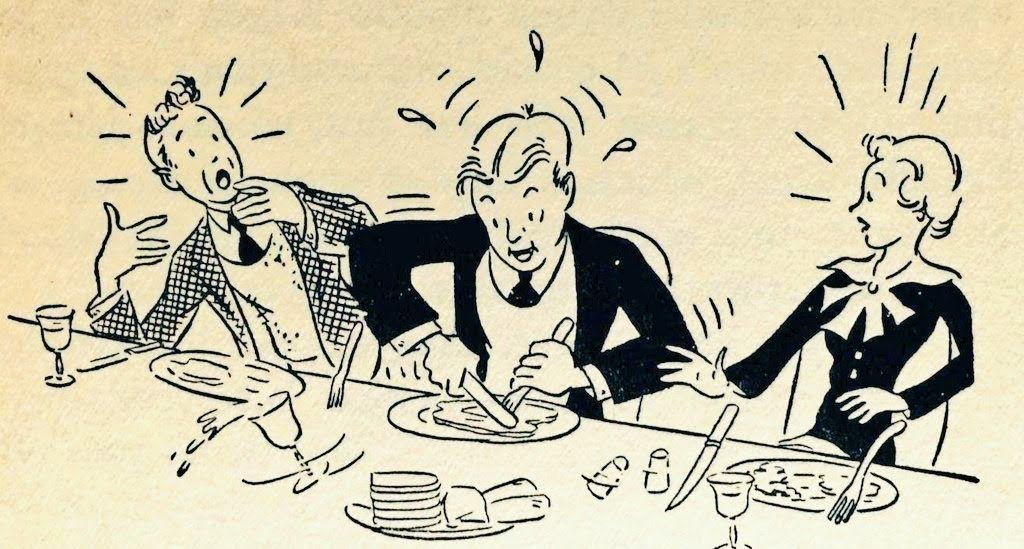
It is good form to eat slowly and quietly. Only vulgar people are noisy. It is good form to sit erect, to keep the arms off the table, to look pleasant, and to keep room in the mouth for a laugh. People who eat like cattle should be induced to take meals in sheds or vacant lots. Babies and men and women in their “second childhood” can be excused for slobbering at table. – San Jose Herald, 1894


Etiquette Enthusiast, Maura J Graber, is the Site Editor for the Etiquipedia© Etiquette Encyclopedia 

Neglect in Teaching Manners

Oh dear... playing with one’s food is not on the menu! —“In any case, they show the most profound indifference to the forms of good breeding as established by long custom And the most unmitigated contempt for their mother’s visitors.”


On Young People’s Manners... 
and Parental Neglect of the Gracious Art ot Good Breeding


In some homes the belief in the ability of youth to guide itself aright is carried to the extent of forbearing to teach the very rudiments of good manners. It is assumed that contact with their fellows and the self education resulting from social attrition will turn the young people out at length as finished ladies and gentlemen Meanwhile they are allowed to be as objectionable as it pleases them to be, and no one lifts hand or voice in warning, in correction, in teaching. The boys slouch into the room, their grubby hands in their pockets, their caps on their unkempt heads. Perhaps they whistle; perhaps they shout, two or three in chorus. They are not checked, not taught better manners, not interfered with in any way. The girls, maybe at the awkward age when it is difficult to make them well bred with the greatest pains one can take, come ramping in with their brothers, giving the impression of a babel of voices, a forest of heads, a maddening group of windmills, whereof the sails are arms. 

If of the more studious kind, they “flump” themselves down in an easy chair doubled up in a half hoop and bury themselves in a book laid on their crossed knees. They take no notice of their mother’s guests, not even to say the usual formula, “How do you do?” or to answer “Quite well, thank you.” If frivolous, they snicker and giggle and talk in whispers one to the other; if quarrelsome, shout and wrangle. In any case, they show the most profound indifference to the forms of good breeding as established by long custom And the most unmitigated contempt for their mother’s visitors. How should they not? From the earliest days when they came in to the “5 o’clock,” where they demanded all they saw, yelled for cake, interrupted the conversation, were soothed when they ought to have been snubbed and indulged when they ought to have been expelled—from that time to now they have been suffered to do as they like. They have been taught nothing better, poor things, and the mistakes they make are due to ignorance rather than to direct intention and to thoughtlessness rather than design. 

Cognate with these rude forms, this high treason against that thing we call manners, is a certain kind of impoliteness, of negligence to which the young are prone unless made to do better and taught the more gracious way. They do not acknowledge the kindnesses done them, as those who have been duly taught that gracious art of good breeding know they ought to do. Chary of letter writing, they accept tickets for a ball or a theater, with thanks galore doubtless in their hearts, but never a word on paper. They spend a charming time at a friend’s house, then let weeks elapse before writing their thanks and expressing their pleasure, after which they wonder at the coolness which springs up between them and their quondam hostess and think themselves hardly used, being very sure they have done no wrong. — San Jose Herald, 1893


Etiquette Enthusiast, Maura J Graber, is the Site Editor for the Etiquipedia©️ Etiquette Encyclopedia 

Thursday, April 2, 2020

Lord Melbourne’s Tea Etiquette

Lord Melbourne (1779-1848) was British Prime Minister on two occasions. The first  ended when he was dismissed by King William IV in 1834. He was the last British PM to be dismissed by a Monarch. Six months later he was re-appointed and served for six more years. He is best remembered for being Prime Minister in Queen Victoria’s early years. He coached her in the ways of politics, acting almost as a private secretary and confidante. – Public domain image


Manners at Tea Drinking

On one point at least we may congratulate ourselves, and that is on the improvement in tea table manners. Some old fashioned folk used to signalize the conclusion of their tea drinking by turning the cup upside down in the saucer. In other circles, the recognized sign of a disinclination for more tea was the placing of the spoon in the cup instead of in the saucer. 

When the Queen's first Prime Minister, Lord Melbourne, was a lad, residing at Glasgow in the house of one of the university professors —about the end of the last century—he wrote to his mother an account of the Glasgow table manners. “We drink healths at dinner,” he writes, “hand round the cake at tea and desire to have no more exactly in the same manner that we used to behave at Hatfield, at Eton and at Cambridge.”— All the Year Round, 1893


Etiquette Enthusiast, Maura J Graber, is the Site Editor for the Etiquipedia© Etiquette Encyclopedia 

Wednesday, April 1, 2020

Company Table Manners

As soon as a child is old enough to come to the table he should be taught by precept and example what good table manners are... Let it be understood that good manners are not the acquiring of every new wrinkle that fashionable society may prescribe. There is a great difference between good manners and good form. What is good form to-day may be very bad form tomorrow, but good manners are not changeable.

There seems to be an idea among many people that there must be a different set of manners for company from what is observed in everyday life. While it is the proper thing to have for an invited company a more elaborate dinner and a little more ceremony in the service than at the family table, it must be remembered that one should not put on and take off good manners as one would a garment. They are a part of one's self, and whether the family meal consist of many courses, or only a cup of tea and a slice of toast, it should always be served decently and in order, and the manners of the members of the household should be such that one need not blush for them, even in the finest company. As soon as a child is old enough to come to the table he should be taught by precept and example what good table manners are. If the father and mother be so unfortunate as not to have had proper training themselves, they should study to correct any bad habits they may have, for the sake of their children. 


Let it be understood that good manners are not the acquiring of every new wrinkle that fashionable society may prescribe. There is a great difference between good manners and good form. What is good form to-day may be very bad form tomorrow, but good manners are not changeable. Unselfishness, kindly feelings and politeness are the foundation of good manners. Good table manners demand that one shall take soup from the side of a spoon; shall eat with a fork, rather than a knife; shall take small mouthfuls of food and masticate quietly, making no unpleasent sound; shall take in the fingers no food except fruit, confectionary, olives, bread, cake,celery, etc., and that the members of the family shali be as polite to each other as to any guest. Where people rush through their meals there is not much chance fo: table maners or good digestion. If properly managed, the table can be made one of the most refining influences of the home. —Ladies Home Journal, 1892


Etiquette Enthusiast, Maura J Graber, is the Site Editor for the Etiquipedia©️ Etiquette Encyclopedia 

Monday, March 30, 2020

Cale-Assiette and French Etiquette

Among the small objects found in flea markets, people are intrigued by funny little glass tabs with notches. Some sellers believe these to be knife holders. But they are not very practical for that use. They are, in fact, cale-assiette or ‘plate holders’ — inclined planes with notches, allowing to slightly raise a plate on one side. What purpose? They were very useful when eating artichokes or asparagus. Very fashionable at the end of the 19th beginning of the 20th century, these objects fell a little in obsolescence, although it is still possible to get some. Manufactured by the majority of large French glass and crystal glassworks, they could also be made of silver and other metals or porcelain.” These appeared in the old catalogs including that of Baccarat, but under the name ‘plate holder’. — information from Andre Ganter of  Verrelene

The Baccarat cale-assiette shown above, and others like it, were produced and used at French tables not so long ago, but have become all but forgotten. Unsure regarding the etiquette of cale-assiette, as Site Editor for Etiquipedia, I decided to ask the debonair, Guillaume Rué de Bernadac, of Academie de Bernadac about them. 

Guillaume is one of the most sought after etiquette instructors in the world — Etiquette runs in his blood. His great-grandfather tutored Moroccan royalty. Cale-Assiette are so archaic, even Guillaume, who learned etiquette at a very early age, admitted he had to ask family members for more details on them. He has not seen them used in many years.

I have a lovely box of Baccarat cale-assiette, but I have never found information on exactly how they were used, so I had several etiquette questions for Guillaume: 

  • Were cale-assiette part of mid-19th century French place settings? 
  • If not part of each place setting, were cale-assiette brought out to the table by the server? 
  • Did the server prop the dish up on one side for each diner? 
  • If the server did not, did the dinner guest prop up one side of the plate? 
  • Were cale-assiette ever used for tilting soup plates or bowls of soup?

Baccarat cale-assiette tilting a plate of asparagus with  sauce —According to Guillaume, cale-assiette, can mean two different things. “What we nowadays call “cale-assiette” in French can designate either something to tilt the plate or something to sort plates out on the table.” Adding that they were, “very trendy during the second part of the 19th century and early 20th. There are some at my grand-mother’s and it’s not uncommon to see a few of them at some flea markets in France.”
“The staff would place one on the table first and then the plate on top of it. The guest could potentially place the plate higher on the ’steps’ at the end of the meal to have more sauce...”
And the etiquette for their use? “They were indeed specifically for artichokes and asparagus, and any other type of dishes which were supposed to be served with a sauce and dipped in with the fingers. For private use mostly, in the bourgeoise familles, the staff would place one on the table first and then the plate on top of it. The guest could potentially place the plate higher on the ’steps’ at the end of the meal to have more sauce collected. It was removed once the dish was finished.” 

Cale-Assiette do work well when eating soup, provided one is eating soup from the olde-fashioned, low and wide, soup “plates” as opposed to soup bowls, as cale-assiette will easily tip a deeper soup bowls over if moved too far under one side of the bowl.


Guillaume Rué de Bernadac is the President & Founding Director of the luxury etiquette institution, Académie de Bernadac in Shanghai and Paris. He has been featured in Michelin Guide, L’Officiel, Global Times, The Guardian, M6, CNN, etc... Académie de Bernadac


The Verrelène company was created in 2011. The blog provides all of our research on antiques and flea markets, in the form of small notices sometimes also published in the regional press (Vosges Matin, l'Echo des Vosges and Vosges Info). The illustrations used generally come from our personal documentation and our photos. When we use illustrations and / or extracts from articles, we generally put references. If we forgot to quote this or that person or reference, please be so kind as to let us know so that we can correct our mistakes and give back to Caesar what belongs to him.


Etiquette Enthusiast, Maura J Graber, is the Site Editor for the Etiquipedia© Etiquette Encyclopedia