Showing posts with label White House Etiquette. Show all posts

Monday, January 20, 2025

White House Civilities for Incomings

During her residence in the White House, Mrs. Grover Cleveland stood up in all the beauty of her young womanhood and bravely shook hands with the mighty public until she had to take her rings and gloves off, until her fingers were swollen, her arm was lame and her hand was like a puff ball. After every reception her maid had a solution ready to bathe her dislocated members, and it was often necessary to rip her sleeve up in order to get it off. 


It is an unwritten law of etiquette that the family of the out-going President should receive the family of the incoming President at the White House on inauguration day and immediately after the ceremonies at the Capitol. President and Mrs. Cleveland made an exception and asked President-elect and Mrs. Harrison to dine with them at the White House on the evening preceding the day of the inauguration. They did not, however, remain in the White House on inauguration day, and when President and Mrs. Harrison went there the employees and servants alone received them. President Harrison will observe the usual etiquette and will omit no courtesy. After the ceremonies at the Capitol Mr. Harrison will return to the White House, where Mrs. McKee will remain, and, as the outgoing hostess, will assist him in receiving President and Mrs. Cleveland. — Philadelphia Times, March, 1893


🍽️Etiquette Enthusiast, Maura J. Graber, is the Site Editor for the Etiquipedia© Etiquette Encyclopedia

Monday, October 28, 2024

More Etiquette, Menus from the White House Cook Book


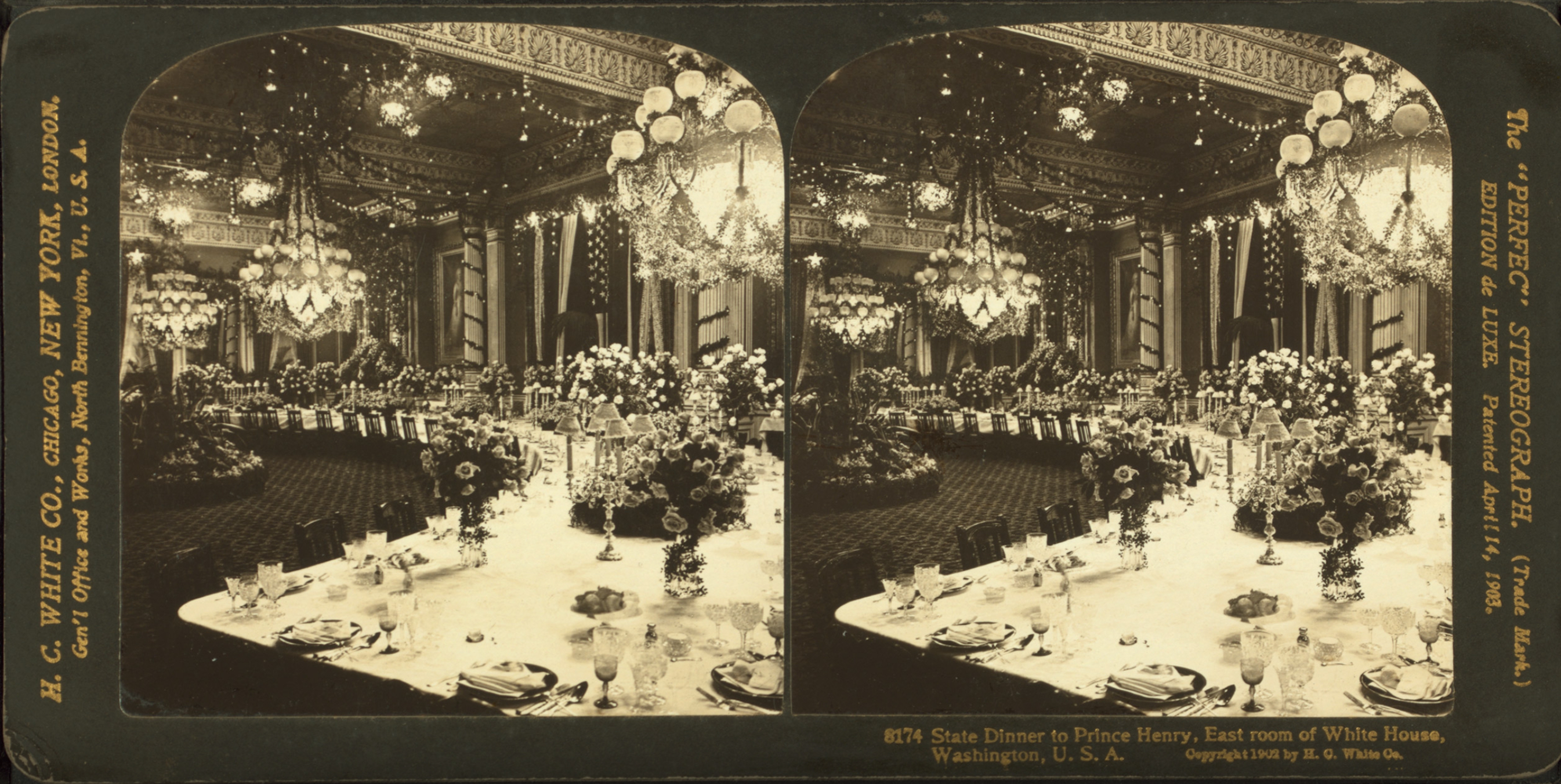
“Delicacy of manner at table stamps both man and woman, for one can, at a glance, discern whether a person has been trained to eat well and to hold the knife and fork properly, to eat without the slightest sound of the lips, to drink quietly, to use the napkin rightly, to make no noise with any of the implements of the table, and last, but not least, to eat slowly and masticate the food thoroughly.” From the White House Cook Book – Above, stereographic card of the White House tables, elaborately set and ready for a dinner in honor of Prince Henry, in 1903


White House Cookbook has a style all its own

One day when I was a little girl, my great grandmother let me look through some of her things. In a stack of her cookbooks, of which there were many, I came across one called “The White House Cookbook” with no author's name. Actually, the book undoubtedly had an author, but it was so old even then some of the pages were missing off the front. Nevertheless, to me this cookbook seemed like one of the greatest treasures a person could have recipes that were really used by the Presidents of the United States. When my grandmother and I were going through my great grandmother’s things after she passed away I found the cookbook again and asked if I could have it. Needless to say, she agreed.

Since then, other cookbooks have come out with collections of Presidential recipes, but none are written in the style of this one. I cannot attest to the President who was in office when it was written, because the copyright date is on one of the missing pages, but I know for sure it was a long time ago.

To celebrate the birthdays of presidents George Washington and Abraham Lincoln, which are coming up next month, I thought it would be fun to share some of the passages of this book with you. Although I find many things about it to be funny today, it is still a special “treasure.”

To prepare one for a Presidential dinner, I suppose, “Small Points on Table Etiquette” is the heading of one of the sections.

It begins, “Delicacy of manner at table stamps both man and woman, for one can, at a glance, discern whether a person has been trained to eat well and to hold the knife and fork properly, to eat without the slightest sound of the lips, to drink quietly, to use the napkin rightly, to make no noise with any of the implements of the table, and last, but not least, to eat slowly and masticate the food thoroughly.”

It goes on to warn, “Be careful to keep the mouth shut closely while masticating the food. It is the opening of the lips which causes the smacking which seems so disgust- ing. Chew your food well, but do it silently, and be careful to take small mouthfuls.”

“Another generally neglected obligation,” it continues, "is that of spreading butter on one's bread as it lies in one's plate, or but slightly lifted at one end of the plate. It is very frequently buttered in the air, bitten in gouges, and still held in the face and eyes of the table with the marks of the teeth on it.

“This is certainly not altogether pleasant, and it is better to cut it, a bit at a time, after buttering it, and put piece by piece in the mouth with one's finger and thumb.”

“Don't when you drink.” it admonishes, “elevate your glass as if you were going to stand it inverted on your nose. Bring the glass perpendicularly to the lips, and then lift it to a slight angle. Do this easily.”

And finally, “One’s teeth are not to be picked at table; but if it is impossible to hinder it, it should be done behind the napkin.”

Why the author found it necessary to give instructions like these to those who might be attending a presidential dinner is a wonder, but it could be a clue to the time it was written. Our forefathers were many terrific things, but they were also rough-hewn pioneers, who were undoubtedly lacking in social graces.

The next section, “Management and Directions of Dinners and Receptions on State Occasions at the White House,” includes a table-seating chart, and instructions written with errors in syntax which would have been “X'd” out by any editor of today. The directions themselves, in fact, lead to humorous speculation.

It begins, “Etiquette as observed in European courts is not known at the White House... The President’s seat is in the middle of the table.” (That must have been a sight.) “The most distinguished guests sit on his right and left. If their wives are present they will occupy these seats, and the gentlemen will be seated next to the President’s wife whose seat is directly opposite the President.” (Considering where the President was sitting, this would have been quite a sight too.)

“Corsage bouquets for ladies consist of not more than 8 large roses tied together by silk ribbon,” (I wonder how many women were trying to wear more than eight?) “with the name of the lady stamped on in gold letters.”

“Gentlemen's boutonnieres consist only of one rosebud.” (Only one. The poor things.)

And, “Liquors, cordials, and cigars are served on a separate table after the ladies have retired to the parlor.”

Times have definitely changed, haven't they? But, why the author felt it necessary to let the reader in on the fact that etiquette found in European courts was not known at the White House, and then clue him in, in the same book, that picking his teeth at the table was not “de rigueur” beats me.

It seems to me that if the reader knew what was going on in European courts he'd also know what to do at table. But then, what do I know?

Mrs. Cleveland's wedding lunch, the books says, was held June 4, 1888 and the menu consisted of  “consommé en tasse (a cup of consommé), soft-shell crabs, Coquilles de Ris de Vean, (rice in sea shells) snipes (a wading bird) on toast, lettuce and tomato salad, fancy ice cream, cakes, tea, coffee, fruits and mottos.”

Now, I really don't know what else “mottos” would be but little sayings to live by, a serving custom which, if popular then, has definitely fallen into disuse at luncheons I've attended recently as have snipes, come to think about it tut, tut, what a pity.

The wines served are still quite “the thing” however Chateau d’Iquem is possibly the most expensive dessert wine available today, at $175 a bottle. And, Moet and Chandon champagne is still very popular.

Unfortunately, the book does not list a menu for Lincoln’s Birthday, I don't know why. But here is one for Washington’s Birthday oysters on the half shell, mock turtle soup, baked white fish with béchamel sauce, boiled turkey with oyster sauce, boiled sweet potatoes, stewed tomatoes, scalloped onions, salmi of game (a highly seasoned dish of game partly roasted then stewed in wine), olives, Bavarian Cream, Washington Pie, marble cake, variegated jelly (a three- layered molded gelatin), candied fruits, raisins, nuts and coffee.

The coffee recipe is kind of different.

COFFEE

“One full coffee cup full of ground coffee, stirred with one egg and part of the shell, adding a half cupful of cold water. Put it into the coffee boiler, and pour on to it a quart of boiling water. As it rises and begins to boil, stir it down with a silver spoon or fork. Boil hard for 10 or 12 minutes. Remove from the fire and pour out a cupful of coffee, then pour back into the coffee pot. Place it on the back of the stove or range where it will keep hot (and not boil); it will settle in about 5 minutes. Send to the table hot. Serve with good cream and lump sugar. Three-quarters of a pound of Java and 4 pound of Mocha make the best mixture of coffee.”

And here is the recipe for Washington Pie:

WASHINGTON PIE (Like a Boston Cream Pie)

“Cream Part Put on a pint of milk to boil. Break 2 eggs into a dish and add 1 cup of sugar and a cup of flour previously mixed. After beating well, stir it into the milk just as the milk commences to boil; add 1½ ounces butter and keep on stirring one way until it thickens. Flavor with vanilla or lemon.

“Crust Part (a cake) 3 eggs beaten separately, 1 cup of granu- lated sugar, 1½ cups of sifted flour, 1 large teaspoonful of baking powder and 2 tablespoonfuls of milk or water. Divide the batter in half and bake in 2 medium-sized pie tins. Bake in a rather quick oven to a straw color. When done and cool, split each one in half with a sharp broad-bladed knife, and spread half the cream between each.

Serve cold. The cake part should be flavored the same as the custard." As you can see this recipe leaves a bit to the imagination. But, try it if you like. They also suggest serving the pie very cold with a dish of strawberries or raspberries. – By Patty Brown, Desert Sun Food Editor, 1985


🍽Etiquette Enthusiast, Maura J. Graber, is the Site Editor for the Etiquipedia© Etiquette Encyclopedia 
Monday, December 27, 2021

A Congressman’s Etiquette Lessons

Photo of a White House State Dinner place setting for President Lyndon Johnson. Cigarettes and matches were requirements for a properly set formal table of the era. Smoking was not banned in the White House until the Clinton Administration in the 1990’s


LIGHTER SIDE OF WASHINGTON 
Congressman Gets Seven Cards Telling Of Proper Dinner Behavior


WASHINGTON (UPI) By no standards that I know of could Rep. John F. Baldwin be described as a bumpkin. He is a graduate of the University of California; he was president of his law class for three years; he was a practicing attorney for five years, and he has served in Congress since 1954. You would think a person with this background would feel at home in almost any company. Yet there is something about a State Dinner at the White House that makes even a relatively sophisticated congressman uncertain about his manners. 

Baldwin was one of the guests at the dinner that President Kennedy gave for the Shah of Iran last week, and I suppose it was the invitation that put him on edge. As he related a report on the affair to his constituents, the envelope contained no less than five cards, which seemed to take nothing for granted. The first card told what the occasion was. The second one gave the time and place of the dinner. The third one told him what to wear. The fourth one told him where to respond. And the fifth one told him what gate to enter. When he and his wife arrived at the White House, they were handed still another card which told them where to sit. At the table, they found a seventh card which made it clear they had found the right place. It was at this point, apparently, that Baldwin’s confidence in his table etiquette was shattered. 

“I must confess that my main concern during the dinner, was whether I was using the proper knife or the proper fork at the right time,” he said. “There were three different knives on the right, and three different forks on the left.” Expressing hope that he “represented you properly at this state dinner,” he said, "I think I only used the wrong fork once." Well, gee, I don’t want to embarrass the congressman or anything, but I must point out that when you have three forks, it is impossible to use the wrong fork only once. Silverware errors are cumulative and cannot be rectified as the meal progresses. In other words, if Baldwin used his dinner fork on the salad, then he must have used his salad fork during the main course or desert. But Baldwin needn’t feel chagrined about it, for it was the fault of the White House staff. They should have provided yet another card showing which fork to use.– Madera Tribune, 1962


Etiquette Enthusiast, Maura J. Graber, is the Site Editor for the Etiquipedia© Etiquette Encyclopedia

Saturday, September 4, 2021

Etiquette of Prospective First Ladies

Although a lot has been spoken and written about the capabilities of Presidential candidates in the coming campaign, very little has been said of the woman who may share the success of any one of them. Of course, Mrs. Franklin D. Roosevelt, wife of New York's Governor, who is the leading Democratic candidate, needs no introduction to Americans. Born a Roosevelt, she kept the illustrious name intact by marrying one. Mrs. Roosevelt is no stranger to polities and diplomatic usage, so in the event of her husband's victory in the coming campaign she would fit into the role of White House hostess like a hand into a glove. Mrs. John Nance Garner, wife of the Speaker of the House, would also make an ideal “First Lady.” Since her marriage in 1895, she has been “Texas Jack’s” secretary and advisor. Their ideal partnership constitutes as romantic a story as any in the pages of fiction. Then there is Mrs. Newton D. Baker, who is equipped for the job of presiding at the White House by reason of her association with diplomatic society during her husband's tenure of office as Secretary of War in the late President Wilson's cabinet. One unusual possibility deserves mention. In the event of Governor George White of Ohio being nominated and elected, he will bring the youngest “First Lady” in history to the White House– his 24-year-old daughter, Mary, who is now his official hostess in the Gubernatorial mansion of Ohio.

These Potential First Ladies Well Qualified for Position
Wives of Three Leading Democratic Candidates and Daughter of a Fourth Ideally Suited for Job of White House Hostess.

WASHINGTON, June 17. Although it is an oft-repeated truth that every American boy may consider himself a potential President of these United States, we rarely, if ever, hear a word about the prospects of the girls who are destined to marry these boys. A strange oversight this, seeing that it is perfectly logical that if every boy has a chance of becoming "First Gentleman" of the land every girl has an equal chance of acquiring the coveted title of "First Lady."

Take a few of the present candidates for the Democratic nomination for the Presidency: Governor Franklin D. Roosevelt, of New York: Speaker John Nance Garner, of Texas; Newton D. Baker, of Cleveland, Ohio, and Governor George White, of Ohio. The capabilities of these candidates are well known, but how much is known of the woman who will share the success of any one of them? Of course, Mrs. Roosevelt, by reason of her distinguished family tree, is the more familiar of the potential “First Ladies.” Born a Roosevelt, she kept the illustrious name intact by marrying one on March 17, 1905. Most of Mrs. Roosevelt's life has been spent in the service of her family and more than a half-dozen civic movements.

Mrs. Roosevelt is no stranger to national politics, having proved her metal on many a campaign platform. In the last Presidential campaign, she fought tooth and nail in support of Alfred E. Smith, the Democratic standard-bearer. Ironically, Smith is her husband's bitterest opponent in the present fight for nomination.In the event of her husband's victory in the coming campaign, Mrs. Roosevelt would fit into the role of White House hostess like a hand in a glove.

Mrs. John Nance Garner, wife of the Speaker of the House, though not as widely known as Mrs. Roosevelt, would also make an 18 carat “First Lady.” Since “Texas Jack” married the former Ettie Rheiner, in November, 1895, she has been his secretary, helper and advisor. There is very little about politics that Mrs. Garner does not know. The story of Speaker John and his wife deserves a whole volume to itself if justice is to be done to one of the most ideal partnerships in politics or any other field. Their struggles and triumphs constitute a romantic story rarely found outside the pages of fiction.

Then there is Mrs. Newton D.Baker, who, as Elizabeth Leopold, of Pottstown, Pa., married the present Democratic “Dark Horse,” in 1902. Mrs. Baker would also make an admirable White House Lady, knowing, as she does, the highways and byways of social and diplomatic etiquette. Though her. home is in Cleveland, O., Mrs.. Baker has been established as one of the capital's most popular hostesses since the day in 1916 when her husband took office as Secretary of War in the cabinet of the late-President Wilson. She has persistently worked for the cause of working women for many years; knows politics inside out and her pet ambition is to be an artist and to sing. Though she is not very hopeful of her husband's chances of being named to carry the banner of Democracy, Mrs. Baker is the most consistent admirer of the “Dark Horse.”

While on the subject of potential “First Ladies,” one unusual possibility deserves mention. In the event that Governor George White, of Ohio, should win the nomination. and be victorious at the polls, he would bring the youngest “First Lady” in history to the White House. She is his daughter, Mary, 24, the eldest of five children. Governor White is a widower and when he was elected Governor of Ohio, in 1930, Mary automatically be came his official hostess. Who knows, she may yet rule the social functions in the House of Presidents. – Calexico Chronicle, 1932


 Etiquette Enthusiast, Maura J. Graber, is the Site Editor for the Etiquipedia© Etiquette Encyclopedia

Monday, January 4, 2021

Supreme Court Etiquette of Old


Pictured above, Chief Justice Morrison-Waite . Morrison-Waite was the Chief Justice of the U.S. Supreme Court from 1874 to 1888. At the time, the wife of the Chief Justice of the Supreme Court was considered the official “First Lady” of the United States, as the Supreme Court positions were appointments for life, unlike the position of President, which is merely a temporary position, or “temp job.”

In former times, lawyers were expected to appear before the Court in full evening dress, but that custom has been relaxed, and the customary dress for members of the Bar is a black frock coat and black trousers. Occasionally, though, a deviation from this is observed, chiefly among lawyers from the West, where such things are not closely attended to, and the Court passes it over. But when a Western lawyer some time ago presumed to appear before the Court without a cravat, the Justices caused it to be intimated to him that such free and easy attire was not agreeable to them. 

The Supreme Court takes precedence of every other body in the Government, ranking in official etiquette next to the President and his official family. On formal occasions, the members walk next the President and his Cabinet, and they are entertained at dinner at the White House before either House of Congress. On the day they organize for the full term — the first Monday in October — they immediately proceed to the White House to pay their respects formally to the President. As soon as the members of the Court are ushered into the East Room, the President appears. To keep the Court waiting five minutes would be an unpardonable breach of etiquette. — Daly Alta, 1886


Etiquette Enthusiast, Maura J. Graber, is the Site Editor for the Etiquipedia© Etiquette Encyclopedia

Tuesday, January 22, 2019

Washington’s Etiquette Obligations


News photographers crowd in to take photos of the White House state dining room tables set for a formal State Dinner. – Originally, White House tables were very long and rectangular. The round tables were the idea of former First Lady, Jacqueline Kennedy, who felt round tables spread throughout the room would be more conducive to conversations. They have remained this way ever since.


Social Obligations That the President's Wife Cannot Escape 

The etiquette of Washington life in its official, diplomatic and social phases is truly exacting even to those who keep to the head and front in the obligations of their own small circle. Therefore, how much more puzzling it must of necessity be to one who, like Mrs. McKinley, has been practically transplanted from the environment of invalidism to the position and duties that devolve upon the wife of the President: To her there must come many moments of indecision, and a faux pas committed is heralded from one end of the United States to the other. 

Therefore, it is well for all American women to be told what would be expected of them if some day they should become First Ladies of the land, for in this democratic country there is a chance for all of them to occupy the exalted position into which Mrs. McKinley has just stepped. The wife of the President is the one woman in official life exempt from making a first call, as during her husband’s administration she is the First Lady of the land, upon whom every American as well as every foreigner of distinction.

Washington must pay the mark of respect of a first call. When the wife of an ex-President arrives in Washington she must at once make the first call at the White House. The President's'wife must then return that call within the period of three days. The courtesy is greater when the call is returned the following day. When a member of royalty or person of any exalted rank arrives in Washington, it is etiquette for such person to make a first call at the White House. This ceremonial call generally lasts about five minutes, and in the event of such caller being a woman has to be returned by the wife of the President within three hours. In official circles dinner cards designating the place at table are written with the name of the office of the person for whom intended, as “The Vice-President,” “The British Ambassador,” etc. 


At the beginning of each season, generally in the latter part of December, the official list of dinner parties to be given at the White House is made out by one of the private secretaries after due consultation with the President. The order of official entertainments at the White House is given each season as follows: January 1, the President’s reception from 11 a. m. to 2. p. m. The first State Dinner is in honor of the cabinet. The first state evening reception is in honor of the Diplomatic Corps, from 9 to 11 oclock. The second State Dinner is in honor of Congress and the Judiciary. The third State Dinner is in honor of the Supreme Court. The third state reception is in honor of the Army, Navy and Marine Corps. The fourth evening reception is in honor of the public. For this reception, no cards are issued. 

At the State Dinners, invitations are generally sent to a limited number of the resident society of Washington or other large cities, such as may be selected by the President or his wife for the dinner. An invitation to a State Dinner is equivalent to a command, in as much as it should be accepted, even if in so doing another previously accepted invitation has to be declined. When, on account of illness, death in the family or absence from the city, it is found impossible to attend a State Dinner, the reason should be stated in the reply to the invitation. At State Dinners, the President does not make his appearance in the East Room, where the guests are received, until the exact hour at which the dinner takes place. The President's wife, on such occasions, precedes him to the East Room five or ten minutes in advance of the time set for the dinner, in order to greet the guests as they arrive. 

When the signal is given for the company to pass down the corridor ito the State Dining Room, the President leads with such guest of honor as has been selected in accordance with the requisite official rank necessary for the occasion. The President always leads the way at any dinner or entertainment he may attend. The President's wife always walks last at a State Dinner, her partner having been selected with the same due regard to rank as prevailed in the selection of the President's dinner companion.– Sacramento Daily Union, 1897

 Etiquette Enthusiast, Maura J Graber, is the Site Editor for the Etiquipedia© Etiquette Encyclopedia 

Wednesday, April 11, 2018

Common Sense and Etiquette

A confused Senator unwittingly holds the Emperor of Brazil and other White House guests until 3:00 a.m. – Above, the 19th century Imperial family of Brazil, Dom Pedro II his wife and grandson.

Held Hostage by Etiquette


When Dom Pedro, then Emperor of Brazil, was entertained at the White House, he had been told by a confused Senator that it would be expected that he, the Emperor, should be the last of the guests to depart.

The President’s wife, however, informed her other guests that they would be expected to follow, not precede, the royal party in leaving the house. The result was that no one dared to go for fear of a breach of etiquette. But at 3 o'clock in the morning, a tired woman pretended illness, and the deadlock was broken.

Great is etiquette, but common sense is sometimes allowable. – Amador Ledger, 1901


Etiquette Enthusiast, Maura J. Graber, is the Site Editor for the Etiquipedia© Etiquette Encyclopedia 

Thursday, February 1, 2018

Punctilious White House Etiquette

Washington D.C.’s social etiquette was changed greatly during the first Roosevelt administration. A social secretary for the President’s wife came just in time to help out. Isabella Hagner had worked as a social secretary for several women, and among them was Anna Roosevelt Cowles, President Theodore Roosevelt's sister. She was later employed by Mrs.Theodore Roosevelt as the first salaried White House social secretary. 

How the White House Changed Under Theodore Roosevelt 

Under the name of “An Old Resident,” a correspondent of the New York Herald writes extensively of what he declares to be the prevalence of “manners and customs of Courts in favor at the White House.” His statements are in part as follows: 
It is the talk of the clubs in Washington that there is a marked “inching up” toward the manners and customs of Royal Courts at the White House. It is the gossip of the kettledrums that they are at last learning how to do things properly in America. The women buzz over it with delight. They think the more formal a thing is and the more showy its accompaniments, the more desirable it is that it should mark the goings on in the home of the head of the government. And some of them unconsciously speak of him as the “Ruler.” As a matter of fact, the social doings at the White House now, and especially since the verdict of last November, differ in a widely marked degree from anything ever known. 
There is something in the formal etiquette, of the increased gold braid, which hints at a Court rather than the home of the American President. The most remarkable innovation in the White House ceremonies is that of having a constantly increasing number of army and navy officers in attendance. This has been a custom of slow growth. Former Presidents adopted it and then abandoned it, as the custom suited them, and then adopted it again. But it has now increased into proportions so great as to cause widespread comment.  
When Captain Cowles, a brother-in-law of the President, was the President’s aid at the White House he instituted the rule of having everybody arise when the President entered the room and remain standing until the President was seated. On one occasion, at a musicale or tea, he endeavored to put this into effect. Many of the women openly rebelled, and Captain Cowles had to desist in his efforts to have that deference shown to the President. They have adopted a punctiliousness without precedent at the White House under President Roosevelt. 
On state occasions army officers march ahead of the President and lead the way into the dining room. At the table all the guests remain standing until the President is seated. In leaving the table, all guests rise and remain in their places until the President has taken his departure. The President is invariably seated first. This is true not only of state dinners but of private dinners, informal luncheons and family dinners. Not even Mrs. Roosevelt is served first. The rules of the White House in connection with receptions will undoubtedly be more strictly enforced this year than ever. Those governing reporters are very strict. They are required to stand in a given place, and it must be confessed that they are at a disadvantage.
One of the reporters last winter, Miss Margaret Wade, of the Washington Post, declined to stand where she had been told to because her work was interfered with by other women spectators, who were not practicing the newspaper vocation. For this, she was excluded from the White House and has not been there since, nor would she be admitted if she applied. A singular complication now arises from the fact that Miss Made has been appointed social secretary to Mrs. Fairbanks, wife of the Vice-President. 
The custom is being recognized more and more of regarding an invitation or a summons of any kind to the White House as a command. This, of course, is borrowed from Royalty. President McKinley invited Senator Platt, of New York, to the White House near the end of his first term to meet a distinguished company at dinner. Senator Platt did not go. When he was asked why, he pleaded that he had a previous engagement. But so far as known, no person since Mr. Roosevelt has been President, has pleaded any reason other than illness for declining an invitation to dinner or luncheon, and, indeed, there is little doubt that if a plea of a previous engagement were made now the President would resent it. Even the French Ambassador had to call off a dinner on one day's notice because he had been bidden to the White House. – Press Democrat, 1905

Etiquette Enthusiast, Maura J. Graber, is the Site Editor for the Etiquipedia© Etiquette Encyclopedia

Thursday, July 27, 2017

White House China Etiquette

The White House "China Room" in 1918

The ground floor China Room is where the White House collection of china is kept. Even the earliest Presidents received government funds to purchase state china. However, by a special clause in the appropriation bills, "decayed furnishings" could be sold and the proceeds used to buy replacements. Such "furnishings" included state china, and during the 19th century the cupboards were frequently swept clean and the contents carted off to auction. The money could then be used to order a new china service that better suited the President and his family.

Even into the 20th century, White House china was often given away if it was chipped or broken. Later, Congress passed a law that required that all U.S. Presidential china be kept or destroyed. When new dessert plates for the Johnson administration turned out badly, the White House staff smashed it against a basement wall painted with caricatures of the President's assistants.

Today, nearly all Presidents are represented in the china collection one way or another. And full services suitable for state dinners exist for the B. Harrison, Wilson, F.D. Roosevelt, Truman, L. Johnson, Reagan, and Clinton sets, although the older sets are much smaller than the newer ones and cannot be used for the largest events. Replacement pieces are occasionally ordered for these, as pieces become chipped or broken.

Wilson — 120 settings

F.D. Roosevelt — 120 settings

Truman — 120 settings

L Johnson — 216 settings

Reagan — 220 settings

Clinton — 300 settings

Bush — 320 setting formal set, 75 setting informal set

Above from the White House Museum.Org

Etiquette Enthusiast, Maura J Graber, is the Site Editor for the Etiquipedia© Etiquette Encyclopedia

Saturday, July 9, 2016

19th C. Washington Etiquette

State dinners are attended by those only who are formally invited—which invitation cannot be declined on account of any prior engagement. 


A writer, in view of the approaching season at the capital, gives a resume of certain points of etiquette, which he asserts will be found to accord with old time usages at Washington: "All officials and non-officials call on the President. He is not required to return calls or accept invitations, but may waive this exemption at discretion.

All are admitted to his public or formal receptions without cards or invitation, as well as to Mrs. President's receptions on stated days, of which notice is usually given to the city papers. State dinners are attended by those only who are formally invited—which invitation cannot be declined on account of any prior engagement. Senators who observe the old usages make no 'first calls,' on account of recognized superior rank, except on the President of the United States. 

Through courtesy to their own presiding officer, they make the 'first call' on the Vice President, but not by the virtue of any supposed higher official position. But Senators are expected to return calls like other mortals, and among themselves to observe the usual rules regulating the intercourse of private gentlemen. Those first at the capital make the advance, welcoming after arrivals.

Heads of departments and foreign ministers make 'first-calls' on the President, Vice-President and Senators. Members of the House make 'first calls' on the foregoing officials, and Judges of the Supreme Court of the United States. None of the classes above mentioned are expected to make 'first calls' on citizens, sojourners, and visitors, but are expected to return such calls in person, or 'by card' when personal calls are impracticable.

These usages have not been established without much friction, discussion, and even rebellion on the part of certain ambitious ones. Of course, officials may voluntarily waive their privilege; and men of brains, culture, and acknowledged power are never tenacious about their observance, and act at Washington very much as they do at home among their old neighbors, calling socially whenever they find agreeable society." — Marin Journal, 1873


Etiquette Enthusiast, Maura J Graber, is the Site Editor for the Etiquipedia© Etiquette Encyclopedia 

Wednesday, May 4, 2016

Etiquette Coach to White House


Etiquette arbiter— The young woman who is practically the ruler of Washington Society

She Coaches the President's Wife in Social Affairs 

Unique Position Occupied by Miss Isabel Hagner in Mrs. Roosevelt's Household, Where It Will Be Her Duty to Supervise Details of State Functions and Name Guests 

WASHINGTON— Miss Isabel Hagner, daughter of Dr. Charles E. Hagner of this city, is the first appointee to the unique office of social secretary of Mrs. Roosevelt. Miss Hagner is eminently fitted for this position. She has for the past three or four years been the recognized authority on all social forms and conventions.

She has made a profound study of the laws of etiquette and she brings to her work the experience gained by acting in a similar capacity for Mrs. Hay, wife of the Secretary of State; Mrs. Root, wife of the Secretary of War; Mrs. Charles Emory Smith, wife of the Postmaster General; Mrs. Hanna and Miss Paulding, niece of Senator Depew.

As the social secretary of Mrs. Roosevelt, Miss Hagner's duties will be arduous and various. Besides keeping up the large private correspondence she will supervise all the details of the state functions. She will know the little private enmities and animosities which often embarrass hospitable occasions, and it will be her task to arrange the functions with a view to personal harmony.

A revision of the guest list will be confided to her, and this alone is no light duty. The unofficial functions at the White House probably outnumber the official events. Miss Alice Roosevelt's debut and the entertainment given especially for her will be under Miss Hagner's direction and it will be her duty to name the young women figuring in official, and resident society, who are entitled to invitations from the President's daughter. — San Francisco Call, 1901


Etiquette Enthusiast, Maura J Graber, is the Site Editor for the Etiquipedia© Etiquette Encyclopedia

Thursday, March 31, 2016

Etiquette and the Merry Affair

Rudeness is no proper response to another’s rudeness! Portrait of Mrs Elizabeth Merry, wife of the new British diplomatic representative to the United States, Anthony Merry– “The two diplomats and their wives sought to retaliate. At their parties, for instance, no one escorted the wives of the Cabinet members to the dinner table. This social war greatly enlivened Washington.”

Thomas Jefferson's Washingtonian Merry Affair

Jefferson believed that the President's dress and manners should reflect the republican simplicity and informality of the country. Pomp and show reminded him too much of the European courts. In fact, Jefferson worked so hard to avoid ostentation that he began to dress not merely plainly, but sloppily.

As for manners, he refused to observe the rules of protocol in seating his dinner guests. First come, first served was the rule in the Presidential mansion, the White House. Jefferson explained: In social circles, all are equal, whether in, or out, of office, foreign or domestic; and the same equality exists among ladies and gentlemen … “pell mell” and “next the door” form the basis of etiquette in the societies of this country.

The new British diplomatic representative to the United States, Anthony Merry, and his wife were shocked and insulted when the president received them in worn clothing and slippers. In December 1803 at a formal dinner in the White House, no one offered to escort Mrs. Merry to dinner. In the dining room, Merry and his wife had to scramble for places at the table in competition with the other guests. The Marquis d'Yrujo, the Spanish diplomat, had the same experience. He and Merry agreed that this treatment was an insult to them and to their countries.

The two diplomats and their wives sought to retaliate. At their parties, for instance, no one escorted the wives of the Cabinet members to the dinner table. This social war greatly enlivened Washington. The President refused to retreat from his pell mell rule, and Merry and Yrujo became increasingly angry and receptive to the plottings of Jefferson's opponents, the Federalists and Aaron Burr.

From www.knowsouthernhistory.net


Etiquette Enthusiast, Maura J Graber, is the Site Editor for the Etiquipedia© Etiquette Encyclopedia

Wednesday, February 3, 2016

White House Etiquette, 1897

Mrs. Grover Cleveland experimented with the White House protocol.

Precedence and Protocol 
of Being the U.S. President's Wife
in the 1890s

When the President and his wife drive out, the President sits on the right hand and his wife on the left, says the Illustrated AmericanIf there are others in the carriage, whether ladies or gentlemen, they must sit with their backs to the horses. 
When Mrs. Cleveland was first married she tried the experiment of placing her mother opposite the President and herself in the Presidential landau, but the people laughed at it so immoderately and professed to think Mrs. Folsom (as she was then) to be the maid, that it was speedily dropped. When the President's wife drives alone, she sits in the right-hand corner — the place of honor. 
The lady of the White House cannot set foot within those splendid houses in Washington whose flagstaffs mark the foreign embassy or legation. She could not go without the President, and as an embassy or legation is technically a part of the country it represents, the President could not go — so that she never sees the inside of a diplomatic house as long as she presides at the executive mansion. 
The President dines only at Cabinet houses and his wife cannot dine anywhere without him. President Arthur dined with Judges of the Supreme Court and with Senators, but as he had no wife, the whole system was very much simplified for him. 
The President's wife may, if she chooses, go to luncheons where there are no gentlemen, or to teas, both being regarded as strictly informal, but the danger of giving offense by accepting one invitation and declining another is so great, that it is seldom or never risked. — The San Francisco Call, 1897


🍽️Etiquette Enthusiast, Maura J Graber, is the Site Editor of the Etiquipedia© Etiquette Encyclopedia 

Friday, November 20, 2015

Gilded Age Etiquette in Washington DC

Ida Saxton McKinley was the wife of the 25th President, William McKinley

"Notwithstanding the mid-Lenten season capital society is extremely busy exchanging courtesies with the newcomers in high places. The latter are beginning to realize the bitter-sweets of their position, for the polite tactics that govern the social side of all things official involve much downright hard work.

An immutable law of local etiquette requires the ladies of official families to see to it that their husband's or father's visiting cards, together with their own, are properly distributed within a given number of days, to everyone of the hundreds who have left addresses in the traditional peck measure of bits of Bristol board which every weekly reception brings. The value of a former residence in Washington, and the experience in its social requirements, which differ from those of any other city, is plainly to be seen in the present administration.

Mrs. McKinley is a charming example of this. She knows the natural interest in the nation's house and the president's wife, and she makes everybody welcome at all times and in the most informal fashion. It is already apparent that the White House will be much more accessible to the general public during this administration than the last.

There will be a great many more receptions outside the official clique, and the whole mansion beyond the east room will not be so closed and guarded as formerly, as if each visiting stranger were a vandal bent on destruction or theft.

Mrs. Sherman, too. besides her many years as a senator's wife, has filled a position similar to that she now occupies when her husband was secretary of the treasury. The Longs, also the Algers, the Grays, and others in the present topmost circle have spent precious seasons in Washington, and are familiar with its peculiar social usages." —Special Correspondence to The Herald. WASHINGTON, D.C, March 30, 1897


Etiquette Enthusiast, Maura J Graber, is the Site Editor of Etiquipedia© Etiquette Encyclopedia

Saturday, May 23, 2015

Etiquette for 19th C. State Dinners


The long White House tables, all dressed up, for a State Dinner being held in honor of Admiral Dewey


State Dinner Etiquette
Just What the Host and Guests are Expected to Do 


The usual hour for a state dinner is 8 p.m. As the guests arrive, which should be fifteen minutes before the hour set, they are shown to the rooms for the removal of wrappings, and descend by the private stairway to the grand corridor and proceed direct to the East Room, where the President and lady await them. 
                                     
Benjamin Harrison was the President of the United States in 1890. This is a photo of the "Harrison Presidential china." For more on Presidential china, read our post on The Etiquette of White House Table Service and State Dinners or Etiquette and Dishing on White House China for State Dinners
Each gentleman, upon entering the room, is handed by an usher, a small envelope containing a card inscribed with the plan of the table and bearing the name of the lady he will escort. On the diagram, the number of the seats he and the lady will occupy are marked. After being received by the President, he examines the card and immediately joins the lady he will accompany to the State Dining Hall. The lady whom he has brought remains with him until her escort appears. 
                                            
"The President with the first lady guest, leads the way to the State Dining Room, followed by the remaining guests. The residing lady, escorted by the principal man, close the line." The first lady guest was the female guest of greatest importance. The residing lady was who is now known as the "First Lady" or "FLOTUS." For more who the original "First Ladies"of Washington D.C. society were, read our post on 19th C. Washington Societal Etiquette Above~ A stereoscopic view of the unset White House tables.


All the guests having arrived at the appointed hour, the steward announces the dinner is in readiness. The President with the first lady guest, leads the way to the State Dining Room, followed by the remaining guests. The residing lady, escorted by the principal man, close the line. The Marine band meanwhile performs a suitable march. In the dining room, the guests find their places and take the seats assigned them by the plate cards, which correspond in location with the diagram handed them upon entering the East Room.
A corner of the East Room, modern day.

There are four services at all State dinners. The dishes in their order are served on silver salvers by waiters, the guests helping themselves. The chief waiter serves the President first, and then proceeds toward the the right, and the second waiter toward the left. The same course is observed on the opposite side of the table, beginning with the presiding lady. No one is ever served twice. The plates of one course are removed as soon as each guest is finished, and the plate for the next is put in its place.
"There are four services at all State Dinners. The dishes in their order are served on silver salvers by waiters, the guests helping themselves."~ The first White House Cookbook was published in 1887. Not only did it have Presidential favorite foods, recipes and the menus from important meals and events held in the Executive Mansion, but it also had "recipes" for cosmetics and cleaners, basic etiquette of the day and tips on child rearing. It really had everything a lady of the Victorian Era ought to know. Its menus, recipes and helpful tips, made this a favorite cookbook of wives across the U.S. 
At the close of dinner, which lasts about three hours, it has been the custom of late years for the gentleman to leave the table with the ladies and not return. The custom during the earlier administrations was for the ladies to have their coffee served in the drawing-room, and for the gentleman to return to drink a single glass of wine to the health of the President. Gentlemen wishing to enjoy a cigar retire during the coffee to the corridor of the foot of the private stairway, but join the ladies when the presiding lady makes the motion to retire. After the promenade through the suite of parlors, the gentlemen surrender the ladies to the gentleman with whom they came, and with their own ladies take leave of the President and his lady. They should receive their wrappings and leave the building quietly and promptly. The last of the guests should have retired within thirty minutes after leaving the table. –From the Washington Star, March 15, 1890 


 🍽️Etiquette Enthusiast, Maura J. Graber of The RSVP Institute of Etiquette, is the Site Editor of the Etiquipedia© Etiquette Encyclopedia 

Thursday, September 18, 2014

Etiquette and Protocol in Government Circles

Eleanor Roosevelt

On the Question of Rank

The question of rank and precedence has always been a touchy one in government circles, yet these apparently ridiculous or archaic rules agreed upon among the nations have a strong practical reason for their existence. In 1661 a sword battle in London between the attendants of the French and Spanish ambassadors, over whose carriage should precede the other's, brought France and Spain dangerously close to war. In 1756 a violent quarrel between the French and Russian ambassadors at a ball in London over precedence led to a duel and a serious threat of war between Russia and France. A slight to an ambassador is not a personal affront, it is an insult to his nation.


"Monday 30 September 1661 ~ This morning up by moon-shine, at 5 o’clock, to White Hall, to meet Mr. Moore at the Privy Seal, but he not being come as appointed, I went into King Street to the Red Lyon to drink my morning draft, and there I heard of a fray between the two Embassadors of Spain and France; and that, this day, being the day of the entrance of an Embassador from Sweden, they intended to fight for the precedence!" From the famous diary of Samuel Pepys 
Even in the Democratic United States of America, where rank is of less importance than it is in Europe, many famous quarrels over precedence have occurred in Washington. During the administration of President Theodore Roosevelt, when Miss Helen Cannon, daughter of "Uncle Joe" Cannon, a widower and Speaker of the House, demanded precedence over the wives of Senators and Representatives and was overruled, she announced that she would send regrets to further invitations to the White House if she were not given at least equal status with the wives of the members of Congress. During the Hoover administration Dolly Mann, sister and hostess of Vice-President Curtis, created a long-drawn-out controversy by her demand that she be given precedence over Alice Roosevelt Longworth, wife of speaker Nicholas Longworth. Admiral of the Navy George Dewey precipitated a similar commotion when he demanded (in vain) that he be given precedence over foreign ministers because he rated a salute of seventeen guns as compared to only fifteen for the foreign ministers.


The Bryan Times called Miss Helen Cannon, daughter of then widower and U.S. Speaker of the House, “One of the First Ladies of Official Society at National Capital” and referred to her as a “Famous Housekeeper” 

Some of these controversies have brought about modifications in the orders of precedence; others have left them unchanged. Sometimes other factors have brought about modifications. The intent has always been to arrange the order of precedence in such a way as to indicate properly the degree of vested authority represented.


From Eleanor Roosevelt's 1962, “Common Sense Book of Etiquette”

Etiquette Enthusiast, Maura J Graber, is the Site Editor for the Etiquipedia© Etiquette Encyclopedia

Saturday, May 10, 2014

Etiquette of White House Table Service and State Dinners


State dinners had become so large by Ronald Reagan's presidency that none of the china could accommodate the number of guests. First Lady Nancy Reagan ordered 4,370 pieces of Lenox china, enough place settings of 19 pieces for 220 people. This was nearly twice as many placesettings as other recent services. The Reagans wanted a design that would display a strong presence for the subtly colored State Dining Room, now painted white. Nancy Reagan worked closely with Lenox designers to create a pattern with bands in a striking scarlet red, which was her favorite color. The pattern was bordered on each side with etched gold, which created a sparkling contrast with the soft ivory china. The presidential seal was in raised gold in the center, partially overlaying the red border. On pieces such as the service and dessert plates, fine gold crosshatching overlays the red.  The Reagans were often criticized for the $209,508 cost, but the china was not funded by taxpayers. It was paid for by the J.P. Knapp Foundation.

All through the Cold War, the White House maintained the tradition of Russian table service at its official luncheons and dinners. And now that the Russians have switched from threatening to bewildering, there is talk of abolishing Russian service.

Trust Miss Manners to discover the one political issue that excites no one except herself. But perhaps she can stir something up.The question is only whether food at formal meals should be offered around on platters, with guests taking what they want, or whether each guest should be handed a pre-filled plate, with some of everything on it. Who cares?

But we're talking about a republic. Surely we can turn this into an emotional debate with charges of elitism and the stifling of creativity on one side, and of throwing people out of work and wasting the earth's resources on the other.

Stereoscopic view of the White House State Dining Room tables set in the latter half of the 19th century.  The tables were long at the time.  Jacqueline Kennedy changed White House dining when she opted to make a switch to smaller, and more intimate, round tables during the Kennedy Administration.   They remain round to this day.

The teams are: Russian, French, American (known to the English as English) and Restaurant, listed in reverse order of probable popularity. But since people seem to feel so passionately about their food nowadays (which is why Miss Manners figured that restaurants would claim loyalty before any country), their respective positions - long since removed from any real national claims - should be examined.

All of these are types of formal service, in the modern sense of meaning that guests do not actually have to bus their own dishes. (The equivalent understanding of informal service probably involves keeping the refrigerator door open, and Miss Manners doesn't want to know the details.)

In French service, huge numbers of dishes are set out in symmetrical patterns on the dining table, guests being expected to help themselves and one another from what they find within reach. Standard until the late 19th century, this may be said to survive in today's buffet table. But how we evolved to being dumber than the Victorians, who realized how foolish it was to ask human beings to eat standing up, Miss Manners cannot say.

In Russian service, which replaced the French, food is arranged on platters that are taken around to the seated guests, who serve themselves. Leaving enough to go around depends on the honor system.


The success of a state dinner tends to hinge on a well-choreographed series of social gestures. Other than not fighting, the rules are common-sensical: For example, don't wear a pink pantsuit like the one Martha Stewart did during the official visit of the president of Hungary- to much derision at a state dinner in June 1999 - and never sit down until the president does.
"You stand in deference, you don't begin eating until everyone at the table is served, you talk to everybody," according to Letitia Baldrige,  the late etiquette expert who was social secretary to Jacqueline Kennedy. "And you never complain about the food."

In formal American service, the only formal service that still honors the noble and ancient ritual of personally carving for one's guests, the host or hostess carves the meat at the table after inquiring about the preferences of each guest. If the veggies are put on, too, and if everyone passes the plates down the table (and, if they are overly polite, all the way around and back again), it is "family style," but if servers do all that, it is formal.

In Restaurant service, which is to say at all except the truly best restaurants, food is "plated" in the kitchen, and each person is given some of everything. The commercial attraction is that this is the speediest service, which employs the fewest people.


Notice that this is the only formal service in which guests are not allowed to choose what they take (although in restaurants, they have already stated their preferences when they ordered).


You see where Miss Manners is leading. She is about to suggest that if the White House changes from Russian service to Restaurant (the French system being defunct and the American being impractical for big dinners, however comfy it would be to see the president carving), good food will be wasted.


And that guests may find things on their plates to which they have philosophical, medical or religious objections. And that worthy people with families to support may find themselves out of jobs.

Miss Manners really doesn't want to use those tedious arguments, any more than she wants to fight the even worse arguments that Russian service inhibits the creativity of chefs who would prefer to dribble sauces artistically on plates rather than on platters, or that it is elitist because the citizenry doesn't eat that way every day.


She prefers to argue that the mere continuing of a graceful tradition to distinguish special-occasion dining from more practical methods for everyday use is what is important. There is a vast difference between dignity and pretentiousness.


For Dining and Diplomacy; The Clinton White House's Tables for Queen Elizabeth II's visit. Gaffes in this setting are long remembered. For example, Jimmy Carter's 1979 state dinner for Mexican president, Jose Lopez Portillo. Carter shocked his guests with an indiscreet joke about getting "Montezuma's revenge" (a severe diarrhea) while visiting Mexico. And protocol can only go so far when so many ambitious people are going to be crammed into one room. Social secretaries of past administrations can recall movie stars refusing to give the Secret Service their actual birth dates for security clearances and guests who ran into the State Dining Room, attempting to change name cards for better schmoozing potential.

Dining at the White House has been steadily de-formalized over the past few administrations, until it is nearly comparable to eating in a fancy restaurant. Guests regularly bring dates, reply by telephone (or forget to reply and have to be called), dress for shock rather than decorum, or refuse the invitation altogether, if they have something better to do.

First-timers who consider it a command performance and strain to live up to it by polishing their conversation, their shoes and their manners soon find that the custom is to treat it casually.


And that the unflattering rationale is that anything nicer and more special would be wasted on ordinary citizens, who wouldn't know how to handle it.


The main article was originally published on June 14 1994, and was written by Judith Martin, aka Miss Manners


Etiquette Enthusiast, Maura J. Graber, is the Site Editor for Etiquipedia© Etiquette Encyclopedia