Showing posts with label White House Butlers. Show all posts

Monday, December 27, 2021

A Congressman’s Etiquette Lessons

Photo of a White House State Dinner place setting for President Lyndon Johnson. Cigarettes and matches were requirements for a properly set formal table of the era. Smoking was not banned in the White House until the Clinton Administration in the 1990’s


LIGHTER SIDE OF WASHINGTON 
Congressman Gets Seven Cards Telling Of Proper Dinner Behavior


WASHINGTON (UPI) By no standards that I know of could Rep. John F. Baldwin be described as a bumpkin. He is a graduate of the University of California; he was president of his law class for three years; he was a practicing attorney for five years, and he has served in Congress since 1954. You would think a person with this background would feel at home in almost any company. Yet there is something about a State Dinner at the White House that makes even a relatively sophisticated congressman uncertain about his manners. 

Baldwin was one of the guests at the dinner that President Kennedy gave for the Shah of Iran last week, and I suppose it was the invitation that put him on edge. As he related a report on the affair to his constituents, the envelope contained no less than five cards, which seemed to take nothing for granted. The first card told what the occasion was. The second one gave the time and place of the dinner. The third one told him what to wear. The fourth one told him where to respond. And the fifth one told him what gate to enter. When he and his wife arrived at the White House, they were handed still another card which told them where to sit. At the table, they found a seventh card which made it clear they had found the right place. It was at this point, apparently, that Baldwin’s confidence in his table etiquette was shattered. 

“I must confess that my main concern during the dinner, was whether I was using the proper knife or the proper fork at the right time,” he said. “There were three different knives on the right, and three different forks on the left.” Expressing hope that he “represented you properly at this state dinner,” he said, "I think I only used the wrong fork once." Well, gee, I don’t want to embarrass the congressman or anything, but I must point out that when you have three forks, it is impossible to use the wrong fork only once. Silverware errors are cumulative and cannot be rectified as the meal progresses. In other words, if Baldwin used his dinner fork on the salad, then he must have used his salad fork during the main course or desert. But Baldwin needn’t feel chagrined about it, for it was the fault of the White House staff. They should have provided yet another card showing which fork to use.– Madera Tribune, 1962


Etiquette Enthusiast, Maura J. Graber, is the Site Editor for the Etiquipedia© Etiquette Encyclopedia

Saturday, May 23, 2015

Etiquette for 19th C. State Dinners


The long White House tables, all dressed up, for a State Dinner being held in honor of Admiral Dewey


State Dinner Etiquette
Just What the Host and Guests are Expected to Do 


The usual hour for a state dinner is 8 p.m. As the guests arrive, which should be fifteen minutes before the hour set, they are shown to the rooms for the removal of wrappings, and descend by the private stairway to the grand corridor and proceed direct to the East Room, where the President and lady await them. 
                                     
Benjamin Harrison was the President of the United States in 1890. This is a photo of the "Harrison Presidential china." For more on Presidential china, read our post on The Etiquette of White House Table Service and State Dinners or Etiquette and Dishing on White House China for State Dinners
Each gentleman, upon entering the room, is handed by an usher, a small envelope containing a card inscribed with the plan of the table and bearing the name of the lady he will escort. On the diagram, the number of the seats he and the lady will occupy are marked. After being received by the President, he examines the card and immediately joins the lady he will accompany to the State Dining Hall. The lady whom he has brought remains with him until her escort appears. 
                                            
"The President with the first lady guest, leads the way to the State Dining Room, followed by the remaining guests. The residing lady, escorted by the principal man, close the line." The first lady guest was the female guest of greatest importance. The residing lady was who is now known as the "First Lady" or "FLOTUS." For more who the original "First Ladies"of Washington D.C. society were, read our post on 19th C. Washington Societal Etiquette Above~ A stereoscopic view of the unset White House tables.


All the guests having arrived at the appointed hour, the steward announces the dinner is in readiness. The President with the first lady guest, leads the way to the State Dining Room, followed by the remaining guests. The residing lady, escorted by the principal man, close the line. The Marine band meanwhile performs a suitable march. In the dining room, the guests find their places and take the seats assigned them by the plate cards, which correspond in location with the diagram handed them upon entering the East Room.
A corner of the East Room, modern day.

There are four services at all State dinners. The dishes in their order are served on silver salvers by waiters, the guests helping themselves. The chief waiter serves the President first, and then proceeds toward the the right, and the second waiter toward the left. The same course is observed on the opposite side of the table, beginning with the presiding lady. No one is ever served twice. The plates of one course are removed as soon as each guest is finished, and the plate for the next is put in its place.
"There are four services at all State Dinners. The dishes in their order are served on silver salvers by waiters, the guests helping themselves."~ The first White House Cookbook was published in 1887. Not only did it have Presidential favorite foods, recipes and the menus from important meals and events held in the Executive Mansion, but it also had "recipes" for cosmetics and cleaners, basic etiquette of the day and tips on child rearing. It really had everything a lady of the Victorian Era ought to know. Its menus, recipes and helpful tips, made this a favorite cookbook of wives across the U.S. 
At the close of dinner, which lasts about three hours, it has been the custom of late years for the gentleman to leave the table with the ladies and not return. The custom during the earlier administrations was for the ladies to have their coffee served in the drawing-room, and for the gentleman to return to drink a single glass of wine to the health of the President. Gentlemen wishing to enjoy a cigar retire during the coffee to the corridor of the foot of the private stairway, but join the ladies when the presiding lady makes the motion to retire. After the promenade through the suite of parlors, the gentlemen surrender the ladies to the gentleman with whom they came, and with their own ladies take leave of the President and his lady. They should receive their wrappings and leave the building quietly and promptly. The last of the guests should have retired within thirty minutes after leaving the table. –From the Washington Star, March 15, 1890 


 🍽️Etiquette Enthusiast, Maura J. Graber of The RSVP Institute of Etiquette, is the Site Editor of the Etiquipedia© Etiquette Encyclopedia 

Monday, December 9, 2013

Etiquette and Duties of Butlers

“He places the silver and plated articles on the table, sees that everything is in its place, and rectifies what is wrong...”
The domestic duties of the butler are to bring in the eatables at breakfast, and wait upon the family at that meal, assisted by the footman, and see to the cleanliness of everything at table. On taking away, he removes the tray with the china and plate, for which he is responsible. At luncheon, he arranges the meal, and waits unassisted, the footman being now engaged in other duties. At dinner, he places the silver and plated articles on the table, sees that everything is in its place, and rectifies what is wrong. He carries in the first dish, and announces in the drawing-room that dinner is on the table, and respectfully stands by the door until the company are seated, when he takes his place behind his master's chair on the left, to remove the covers, handing them to the other attendants to carry out. After the first course of plates is supplied, his place is at the sideboard to serve the wines, but only when called on.
“After the first course of plates is supplied, his place is at the sideboard to serve the wines, but only when called on.”
The first course ended, he rings the cook's bell, and hands the dishes from the table to the other servants to carry away, receiving from them the second course, which he places on the table, removing the covers as before, and again taking his place at the sideboard.

At dessert, the slips being removed, the butler receives the dessert from the other servants, and arranges it on the table, with plates and glasses, and then takes his place behind his master's chair to hand the wines and ices, while the footman stands behind his mistress for the same purpose, the other attendants leaving the room. Where the old-fashioned practice of having the dessert on the polished table, without any cloth, is still adhered to, the butler should rub off any marks made by the hot dishes before arranging the dessert.

Before dinner, he has satisfied himself that the lamps, candles, or gas-burners are in perfect order, if not lighted, which will usually be the case. Having served every one with their share of the dessert, put the fires in order (when these are used), and seen the lights are all right, at a signal from his master, he and the footman leave the room.

He now proceeds to the drawing-room, arranges the fireplace, and sees to the lights; he then returns to his pantry, prepared to answer the bell, and attend to the company, while the footman is clearing away and cleaning the plate and glasses.

At tea he again attends. At bedtime he appears with the candles; he locks up the plate, secures doors and windows, and sees that all the fires are safe.
 
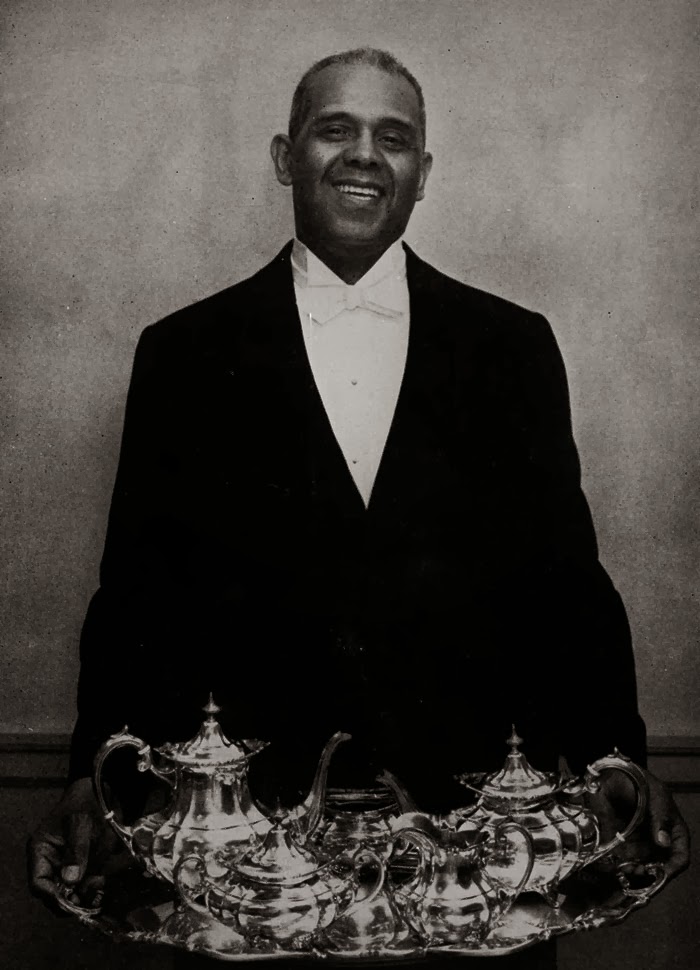
One of the most famous butlers in U.S. history (pictured) was Alonzo Fields (1900-1994). For more than two decades, he served in the White House, under United States Presidents Hoover, Roosevelt, Truman and Eisenhower. – “The office of butler is thus one of very great trust in a household.”

In addition to these duties, the butler, where only one footman is kept, will be required to perform some of the duties of the valet, to pay bills, and superintend the other servants. But the real duties of the butler are in the wine-cellar; there he should be competent to advise his master as to the price and quality of the wine to be laid in; "fine," bottle, cork, and seal it, and place it in the bins. Brewing, racking, and bottling malt liquors, belong to his office, as well as their distribution. These and other drinkables are brought from the cellar every day by his own hands, except where an under-butler is kept; and a careful entry of every bottle used, entered in the cellar-book; so that the book should always show the contents of the cellar.
At tea he again attends.
The office of butler is thus one of very great trust in a household. Here, as elsewhere, honesty is the best policy: the butler should make it his business to understand the proper treatment of the different wines under his charge, which he can easily do from the wine-merchant, and faithfully attend to it; his own reputation will soon compensate for the absence of bribes from unprincipled wine-merchants, if he serves a generous and hospitable master. Nothing spreads more rapidly in society than the reputation of a good wine-cellar, and all that is required is wines well chosen and well cared for; and this a little knowledge, carefully applied, will soon supply.

The butler, we have said, has charge of the contents of the cellars, and it is his duty to keep them in a proper condition, to fine down wine in wood, bottle it off, and store it away in places suited to the sorts. Where wine comes into the cellar ready bottled, it is usual to return the same number of empty bottles; the butler has not, in this case, the same inducements to keep the bottles of the different sorts separated; but where the wine is bottled in the house, he will find his account, not only in keeping them separate, but in rinsing them well, and even washing them with clean water as soon as they are empty.

There are various modes of fining wine: isinglass, gelatine, and gum Arabic are all used for the purpose. Whichever of these articles is used, the process is always the same. Supposing eggs (the cheapest) to be used,—Draw a gallon or so of the wine, and mix one quart of it with the whites of four eggs, by stirring it with a whisk; afterwards, when thoroughly mixed, pour it back into the cask through the bunghole, and stir up the whole cask, in a rotatory direction, with a clean split stick inserted through the bunghole. Having stirred it sufficiently, pour in the remainder of the wine drawn off, until the cask is full; then stir again, skimming off the bubbles that rise to the surface. When thoroughly mixed by stirring, close the bunghole, and leave it to stand for three or four days. This quantity of clarified wine will fine thirteen dozen of port or sherry. The other clearing ingredients are applied in the same manner, the material being cut into small pieces, and dissolved in the quart of wine, and the cask stirred in the same manner.
Having carefully counted the bottles, they are stored away in their respective bins
 To Bottle Wine.—Having thoroughly washed and dried the bottles, supposing they have been before used for the same kind of wine, provide corks, which will be improved by being slightly boiled, or at least steeped in hot water,—a wooden hammer or mallet, a bottling-boot, and a squeezer for the corks. Bore a hole in the lower part of the cask with a gimlet, receiving the liquid stream which follows in the bottle and filterer, which is placed in a tub or basin. This operation is best performed by two persons, one to draw the wine, the other to cork the bottles. The drawer is to see that the bottles are up to the mark, but not too full, the bottle being placed in a clean tub to prevent waste. The corking-boot is buckled by a strap to the knee, the bottle placed in it, and the cork, after being squeezed in the press, driven in by a flat wooden mallet.

As the wine draws near to the bottom of the cask, a thick piece of muslin is placed in the strainer, to prevent the viscous grounds from passing into the bottle.

Having carefully counted the bottles, they are stored away in their respective bins, a layer of sand or sawdust being placed under the first tier, and another over it; a second tier is laid over this, protected by a lath, the head of the second being laid to the bottom of the first; over this another bed of sawdust is laid, not too thick, another lath; and so on till the bin is filled.

Wine so laid in will be ready for use according to its quality and age. Port wine, old in the wood, will be ready to drink in five or six months; but if it is a fruity wine, it will improve every year. Sherry, if of good quality, will be fit to drink as soon as the "sickness" (as its first condition after bottling is called) ceases, and will also improve; but the cellar must be kept at a perfectly steady temperature, neither too hot nor too cold, but about 55° or 60°, and absolutely free from draughts of cold air.

“Sophistication might be described as the ability to cope gracefully with a situation involving the presence of a formidable menace to one's poise and prestige (such as the butler, or the man under the bed -- but never the husband).”  James Thurber 

–From Mrs. Beeton, 
“The Book of Household Management.”


🍽️Etiquette Enthusiast, Maura J. Graber of The RSVP Institute of Etiquette, is the Site Editor for Etiquipedia© Etiquette Encyclopedia