Showing posts with label Washingtonian Etiquette. Show all posts

Friday, December 17, 2021

Etiquette Restraints for “Commoners”

 “A deferential manner need not be any barrier to pleasant intercourse,” a proposition that it rather nullified by a later reminder that if “presented to any member of the royal family, or if they shake hands on meeting any one whom they know, it is quite wrong to speak unless some remark is first made,” presumably by the royal person, though this fact is not altogether clear in the reading. How “pleasant intercourse” is going to be brought about by such a one-sided condition of affairs is not at once apparent. – Above, Princess Victoria. She was the fourth child and second daughter of King Edward VII and Alexandra of Denmark, and the younger sister of King George V. 
– photo source, Pinterest  


It is very illuminating to the democratic American mind to read of the restraints and ceremonials that surround royalty on the other side of the water. A weekly journal in a paper on “Etiquette Regarding Royalty,” starts off with a warning that “it is a fatal mistake to relax any etiquette due to them,” meaning the royal personages, and regrets that this is sometimes done. The writer then goes on with the gracious intimation that “a deferential manner need not be any barrier to pleasant intercourse,” a proposition that it rather nullified by a later reminder that if “presented to any member of the royal family, or if they shake hands on meeting any one whom they know, it is quite wrong to speak unless some remark is first made,” presumably by the royal person, though this fact is not altogether clear in the reading. How “pleasant intercourse” is going to be brought about by such a one-sided condition of affairs is not at once apparent.


Further on in the paper it is pointed out that “If any one is dancing in the circle where the royal family may be waltzing, either at a Court ball or otherwise, it is etiquette to stop when they are dancing, so as to avoid the possibility of being in their way. As a rule, one part of the ballroom at Buckingham Palace is specially kept for the royal circle, and the general company do not dance in it. Partners for any of the young Princesses are chosen, and the Vice Chamberlain or other officials inform the gentleman that he is to have the honor of dancing with a Princess. In no case would any one ask for a dance unless such intimation be given.” All of which is enlightenment that most Americans prefer to read about than to have to conform to, and makes one turn with relief to the simplicity of our White House code of manners. – The New York Times, 1893


Etiquette Enthusiast, Maura J. Graber, is the Site Editor for the Etiquipedia© Etiquette Encyclopedia

Wednesday, May 12, 2021

Etiquette and White House Mistresses


During her residence in the White House, Mrs. Cleveland stood up in all the beauty of her young womanhood and bravely shook hands with the mighty public until she had to take her rings and gloves off, until her fingers were swollen, her arm was lame and her hand was like a puff ball. After every reception her maid had a solution ready to bathe her dislocated members, and it was often necessary to rip her sleeve up in order to get it off. 


Presidents’ Wives: Different Views of Different Mistresses of the White House

Mrs. James A. Garfield never got into harmony with the ostentation, excitement and vulgarity of public life. She is a woman of innate refinement, very domestic in her tastes, and the presumptions of the public grated on her. She could not reconcile herself to the privileges assumed by agents representing photographic and advertising companies, business firms, newspapers, artists and charitable, industrial and social organizations, and when she sent down word that she did not wish to become an adverting medium, that she did not want to be photographed, painted, interviewed or entertained, and that she begged to decline the testimonial of the club to which she was a stranger, she was most severely and cruelly assailed by message, letter and paragraph. 

In all her public life she did not receive ten reporters, says the New York World. Scores applied to her for audience, and very often poverty was offered as a plea for the coveted interview. To these importunators she frequently sent a sealed envelope containing a bill and a “please excuse me from newspaper comment” written on the back of her visiting card. She used to say that she “felt like a baby elephant” every time she received with the President. While fully recognizing her obligations as the wife of the Chief Magistrate, she argued at home and among her friends that she was not a politician, was not in office, and in no way compelled to make un exhibition of herself, her home and her children. There was no time between the election and burial of her husband, when she would not have gladly paid the newspaper writers and artists to decline the work assigned them. 

These very sentiments are entertained by Mrs. Harrison, who dreads publicity, suffers from the demands made upon her by strangers and shrinks from the ordeal of handshaking, committees and delegates bearing testimonials, resolutions or documents inquiring her approval. Last winter, while a member of Mrs. Wanamaker's Delsarte class, she entered the drawing-room just as Mrs. Russell was showing the Wanamaker girls how to bow. There was the little bow of the head, which would suffice for an employee in the “depot”; there was the warmer salutation, with an advancing of the chest, for the formal caller: there was a still more cordial salute, accompanied by a responsive movement of the head and torso, and finally the low, grand, sweeping bow from the head to the ankles, expressive of great respect, such as the Queen is accustomed to receive. 

Mrs. Harrison listened with undivided attention, and when the lesson was ended asked to be presented to Mrs. Russell, and during the conversation that ensued, talked very lively to the New York aesthete. She referred to the Grand Army reception when she carried a fan and bouquet, so as to have ample excuse for not shaking hands, and to which innovation the Logan division took swift violent offense. “I was sorry,” Mrs. Harrison said. “I did not mean to show an indisposition to kindness or courtesy, but it was a physical impossibility for me to extend my hand. Had I been permitted to shake hands it would have been different, but to have others do it was more than my strength was equal to.” Mrs. Harrison is very frank on the subject, and while disposed to be pleasant and gracious refuses to manifest for strangers the cordiality that only her friends are entitled to. 

The approach of a stalwart from the mud lakes and prairies of the Sieto, Des Moines and Kansas rivers, with beaming face and open hand, gives her a chill, the discomfort of which is increased by the vigorous fanning necessary to the safety of her wrist. This aversion of the First Lady to cross hands with the grasping multitude will be the means of amending the etiquette of the reception and draw rooms of Washington, if not the United States. 

During her residence in the White House, Mrs. Cleveland stood up in all the beauty of her young womanhood and bravely shook hands with the mighty public until she had to take her rings and gloves off, until her fingers were swollen, her arm was lame and her hand was like a puff ball. After every reception her maid had a solution ready to bathe her dislocated members, and it was often necessary to rip her sleeve up in order to get it off. This girl bride liked the public, and the affection was returned. She was gracious obliging and indulgent to a degree, but impertinence was met by revolt. She sent to Paris for her clothes because she was too well known in Washington, Albany and New York to buy them at home. When she wanted shoes, bonnets or gloves, an order was sent to her dress-maker, who purchased them in her own name. 

Mrs. General Grant has not one adverse criticism to pass on the great unwashed. She admits that she cried like a baby the day she left the White House. A special train carried the General's party to New York, but she says, “I watered the journey with my tears. The General stood between me and any annoyances that might have occurred, but I was very happy; my life was eight years of bliss and one round of pleasure.”– San Francisco Call, 1890


Etiquette Enthusiast, Maura J. Graber, is the Site Editor for the Etiquipedia© Etiquette Encyclopedia

Friday, April 30, 2021

Washington Society Destroys Buffet

The American people, in general, we are ashamed to say, have not yet learned how to behave at table; and that species of etiquette, not too prevalent in private, is certainly always absent at public suppers. So it was not strange that we should have had warning visions of a grand rush, then a crush, and a demolition in the twinkling of an eye of all the confectioner's handiwork, the frantic snatching of viands from the tables, the brandishing aloft of wine cup, and plate, and cutlery, laden with articles alike dangerous to toilet and stomach; of munching and crunching sans ceremonis; of defilement and ruin to precious apparel, the result perhaps of weeks of the dressmaker's effort; of the loss of temper, and loud cries of complaint. And indeed we harbored a a fear as a consequence that a graceful assemblage of dignified ladies and gentlemen might be transformed, as if by the wand of some evil spirit, into a social raffle, where he who was rudest should be most successful in appeasing the cravings of the appetite, and in pocketing the delicate ornamentations of the table.  
– Photo courtesy of the National Park Service


The Inauguration Ball 
Magnificent Finale of the Season Full and Graphic Description of the Ceremonies and Festivities — Splendid and Magnificent Toilettes of the Ladies —
Terrific Crush at the Supper Table

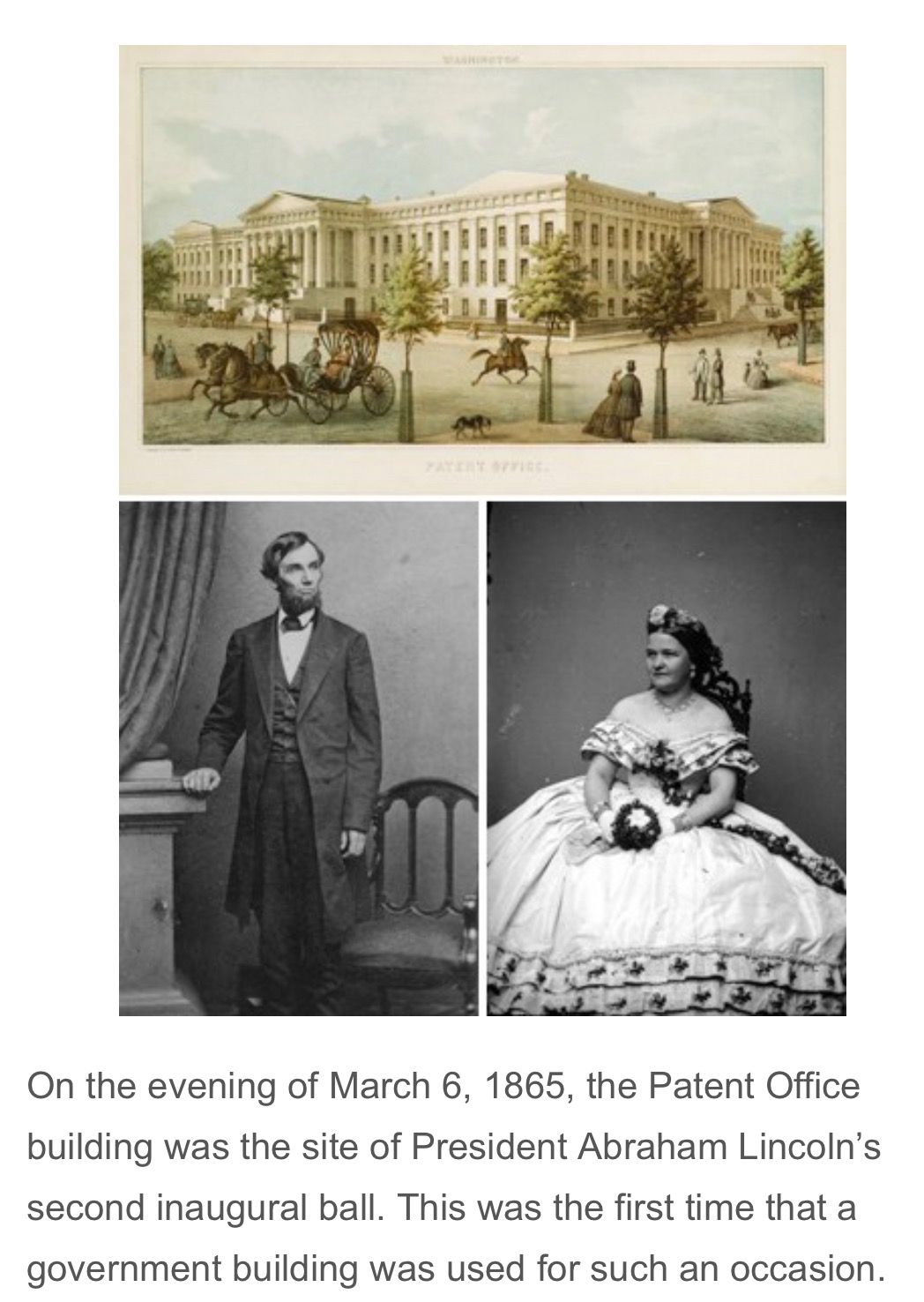
The Washington “season” is past, and there certainly could not have been a more magnificent nor graceful finale; not alone to the Winter's gaities, but to the ceremonies which have made Abraham Lincoln our President again for the next four years, than the time-honored National Inauguration Ball which came off last night; and it is entirely appropriate that not alone with firing of cannon and waving of banners, in which men alone participate, but with music and dancing should we meet and celebrate this signal occasion, when the gentlemen are expected to be as gallant, and the ladies as lovely as possible.
 

The marble halls of the Patent-office were selected as the most commodious and best adaped in the city. The hall appropriated to dancing is two hundred and eighty feet long, by about sixty feet in width; and the floor is laid in large blocks of blue and white marble. Its decorations were really beautiful -- emblems, banners and devices being tastefully disposed on the walls, while the elaborately frescoed ceiling imparted an air of decided grandeur. Among the decorations the American flag was most prominent, while the various flags of the different army corps formed an appropriate accompaniment. A gallery at the east end was occupied by a fine brass band, which gave music for the promenade, while in the centre, on the south side, a splendid string band furnished music for the dance.

Beside this spacious hall, a wing, three hundred feet in length, was appropriated for the promenade, and a corresponding one on the opposite side for the supper-room. The music was excellent, and had the several halls and the entire building been thoroughly lighted, which they were not, the effect would have been much finer. But gas is certainly not good in Washington, though said to be very abundant. On a dais, at the northern side, were sofas and chairs in blue and gold for the President and family.

All the arrangements see med to be under the management of capability and distinction. The tickets for the ladies were very elaborate and prettily designed, six by ten inches in size, and ornamented with portraits of the President and Vice-President, beside two very good likenesses of the American eagle.

As early as 9 o'clock the carriages began to arrive, and soon the ball-room was thronged. The excellent bands of music soon set the lovers of Terpsichore into the graceful mazes of the dance. At about 10:30 o'clock an avant courrier cleared the way from the main entrance, when His Excellency, accompanied by Speaker Colfax, entered the hall. Following was Mrs. Lincoln upon the arm of Senator Sumner. They walked down the centre of the long hall, and turning at the upper end returned mid-way to the dais, when they became seated. Mr. Lincoln was evidently trying to (throw off care for the time; but with rather ill success, and looked very old; yet he seemed pleased and gratified, as he was greeted by the people. He wore a plain black suit and white gloves.

Mrs. Lincoln looked extremely well, and was attired in the most elegant manner; her dress was made of white satin, very ample and rich, but almost entirely covered by a tunic or rather skirt of the finest point applique. Her corsage, which was low, and the short sleeves, were ornamented richly by a Bertha collar made of the same material, and the shawl, also of the same rich lace, was most exquisite. Passementerie of narrow fluted satin ribbon and nouds completed the dress. Her jewels were of the rarest pearls, necklace, earrings, brooch and bracelets. Her hair, which was put plainly back from her face, was ornamented with trailing jessamine and clustering violets most gracefully. She looked exceedingly well with her soft, white complexion, and her toilet was faultless. Her manners are very easy and affable.

Mr. Robert Lincoln, a fine-looking young man, wearing the uniform of a Captain in the regular army, was also present.

About 11 o'clock Secretaries Seward, Welles, Attorney-General Speed and a large number of diplomats, accompanied by their wives and daughters, made their appearance. Mrs. Secretary Welles, a lady of rather petite figure, was dressed in a mode-colored silk, with black lace shawl. Mrs. Secretary Usher, of about the same stature, wore a rich dress of garnet satin, very plainly but richly made. Mrs. Postmaster- General Dennison, who is a very fine-looking lady, wore a most becoming dress of heavy black velvet, brilliant jewels and hair plainly dressed. Her daughter was in white muslin, embroidered with black. Mrs. Fred. Seward, wife of the Assistant Secretary of State, was attired in a pretty rose-colored silk, handsomely trimmed. Mrs. Senator Harris, who has the appearance of a a well-preserved English lady, wore a most elegant dress of corn-colored silk, trimmed with point appliqué. Mrs. Senator McDougall was also richly attired. The wife of our artist Carpenter was dressed in light silk, with a ruche of tulle. One of the most elaborate and rich dresses in the room was worn by Mrs. George Francis Train; it was a very finely plaided blue silk, trimmed with a flounce of thread lace, almost as deep as her skirt, and other laces to match. Her hair was powdered with gold. Mr. Train was also present.

The multitude of recherche dresses worn by ladies of distinction, it would be impossible to enumerate. There was a prependerance of sensible, high-necked dresses; but a few, and some not American, wore corsages shockingly decolettee. Many ladies who wore velvets, moires and heavier silks, dispensed with hoops altogether, thereby displaying their good taste as well as their regard for the appreciation of some approximation to the female form which still inheres or lingers in the mind of man; one, a matron and evidently a Spanish lady, wore a dress of cloth of gold, with raised crimson velvet flowers, such an one as is seldom seen in this country, or afforded, in any other. In her hair she wore a cluster of five or six enormous diamond rings, strung on a bandeau of velvet. Her laces were also of the finest quality. In her hand she carried a large fan of the gayest and most brilliant workmanship, which seemed to give a breeze of a more ardent clime than ours. A moire antique dress, high-necked and ample-skirted, of the most delicate shade of green imaginable, and worn by a young lady, was indeed exquisite; and also a very light lavender moire antique, trimmed heavily upon the skirt and waist with long silver fringe, was superb. Silks predominated over the more airy textures. Diamonds and other precious jewels were worn in great abundance; and rich laces were plentiful. Some ladies displayed the bad taste of wearing their rings over their gloves. Every lady makes the most of her -- " or somebody's else" -- hair, which is frizzed and puffed and curled in the most extensive manner, and is powdered frequently with diamond and gold dust. One dress of mauve velvet, trimmed with deep point lace, we must not omit to mention. It was royal.

Doubtless the shoddy and petrolia family were represented, to a limited degree; but "oil" will tell very soon, as it spreads so rapidly, and cloth not unfrequently makes the man. Tehre were not, however, any colored persons present, as the Washington Secessionists insisted would be the case.

The Supper

It had been rumored -- and the foundation for the report was only rumor -- that the supper was to be something extraordinary. We were surprised at this, because we knew good taste and modern custom, in small places like New-York, have, of late years, literally eschewed the practice of immense suppers at public balls; and this reform had been necessitated by the fact that such attempts had generally ended in catastrophes to the toilets and tempers of all participants. It was, therefore, with misgivings that we saw it announced that a grand supper would be served in one of the corridors of the extensive building. The American people, in general, we are ashamed to say, have not yet learned how to behave at table; and that species of etiquette, not too prevalent in private, is certainly always absent at public suppers. So it was not strange that we should have had warning visions of a grand rush, then a crush, and a demolition in the twinkling of an eye of all the confectioner's handiwork, the frantic snatching of viands from the tables, the brandishing aloft of wine cup, and plate, and cutlery, laden with articles alike dangerous to toilet and stomach; of munching and crunching sans ceremonis; of defilement and ruin to precious apparel, the result perhaps of weeks of the dressmaker's effort; of the loss of temper, and loud cries of complaint. And indeed we harbored a a fear as a consequence that a graceful assemblage of dignified ladies and gentlemen might be transformed, as if by the wand of some evil spirit, into a social raffle, where he who was rudest should be most successful in appeasing the cravings of the appetite, and in pocketing the delicate ornamentations of the table.

The name of the cuisinier has escaped us, and it is not worth while to hunt it up now. Suffice it to say it was not Delmonico, therefore we did not expect perfection. The hall set apart for supper was the grand corridor in the west wing. The table was set in the centre, and it gave standing-room for about three hundred persons at one time. The cabinets of the works of genius and invention, placed at intervals, served to form alcoves on each side of the supper-table. On one side, some of these were provided with seats; on the other, they were reserved for depositing the extraordinary quantity of material necessary for such a host, and for the operations of the waiters.

The ornamentation of the table, though limited in extent, was in excellent taste, and perhaps quite as profuse as the unfortunately small space devoted to the supper would permit. There were three leading and conspicuous pieces from the confectioner's hands, placed at appropriate points in the centre and at each end of the table; in the centre, our imposing Capitol, perfect in miniature; at one end an exquisite representation of the heroic deeds of the gallant army; at the other, a similar device of the proud achievements of the navy. The representation of the Capitol was admirably executed; no detail seemed to be too minute for imitation. Even the lamps at the entrance seemed to give forth light. 

The columns, pedestals, cornices, frieze entablatures, windows, statuary, and the majestic dome, and towering above all else, the Goddess of Liberty, were all there as perfect as the mould and model could make them. In addition, there were several allegorical representations of the progress of civilization, the genius, the arts, the sciences and literature of the day. The piece on the right, was in honor of the army; and the glory and fame of the defenders of our liberty were illustrated by a pyramid, around which were clustered in tasteful profusion all the insignia of war, the paraphernalia of battle, and the emblems of victory. The navy was honored in the same manner, the representation being surmounted with Admiral Farragut's old flagship Hartford, gallantly riding the white crested waves, while aloft might be seen the Admiral himself lashed to the rigging, emblematical of the old hero's achievements in the Bay of Mobile; then battered Fort Sumter, the sad epitome of secession; then Neptune with chariot and trident, and the Goddess of Liberty, inspiring the brave sailor to greater glory and higher fame. There were other ornamentations, principally pyramids of which the detail is unimportant, for nougate, croquant, and chocolate are the same here as elsewhere.

The bill of fare provided a select and tasteful variety, and no better idea of it can be obtained than by inserting it right here verbatim.

Bill of Fare

Oyster stews, terrapin stews, oysters pickled; beef-roast beef, fillet de beef, beef a la mode, beef a l'anglais; veal -- leg of veal, fricandeau, veal Malakoff; poultry-roast turkey, boned turkey, roast chicken; grouse - boned and roast; game -- pheasant, quail, venison. patetes, patete of duck en galee, patete de foie gras; smoked ham, tongue en gelee, tongue plain; salades, chicken, lobsters; ornamental pyramids -- nougate, orange, caramel with fancy cream candy, cocoanut, macaroon, croquant, chocolate; tree cakes -- cakes and tarts, almond sponge, belle alliance, dame blanche, macaroon tart, tart a la Nelson, tarte a l'Orleans, tarte a la Portuguese, tarte a la Vienne, pound cake, sponge cake, lady cake, fancy small cakes; jellies and creams -- calf’s foot and wine jelly, Charlotte a la Russe, Charlotte a la vanilla, blanc mange, creme Neapolitane, creme a la Nelson, creme Chateaubriand, creme a la Smyrna, creme a la Nesselrode, bombe a la vanilla, ice cream, vanilla, lemon, white coffee, chocolate, burnt almonds, maraschino, fruit ices, strawberry, orange, lemon; dessert -- grapes, almonds, raisins, &c., coffee and chocolate.

A Terrific Crush

This was the programme for the feast. The only thing which did not seem promising was the fact that but three hundred could be comfortably accommodated at one time, while there were five thousand persons to be accommodated, and a large majority of them ladies.

About the hour of 12, the Presidential party were escorted by a private entrance to privileged places. Soon afterward the doors were opened, and a throng of more than a thousand, who had collected at that end of the hall, poured into the supper-room. Of course, when three persons occupy the space barely sufficient for one, a “crush” is the result; and the crush which followed can better be imagined than depicted.

But this was not the worst feature. With that indecency of conduct and want of politeness and etiquette which characterizes many American people at table, and which is the certain accompaniment of a large crowd at a public supper, many gentlemen, and even some of our own sex who delight to be esteemed ladies, seized upon the most ornamental and least nutritious part of the table decorations, demolished them, carried the pieces off in handkerchiefs or crushed them under foot. Then the more substantial viands were served likewise. Large dishes of choice meats, pattetes, salades and jellies were carried off vi et armis into the alcoves, or elsewhere. One gentleman presented a very ludicrous attitude with a large plate of smoked tongue, requiring both hands to hold it, no place to sit down, and no way to eat it! He looked the picture of despair.

In less than an hour the table was a wreck; a few ornaments not destroyed were removed, and the array of empty dishes and the debris of the feast were positively frightful to behold.

The doors were now wide open, and hundreds of ladies in elegant silks, satins and velvets, and gentlemen in dainty broadcloth, surged and struggled back and forth. A few obtained something to eat, others very little, and many more only succeded in ruining their toilets. As much was wasted as was eaten, and however much may have been provided more than half the guests went supperless. But it was a public supper; we were not much disappointed, and though the gentlemen who managed it may have been to blame for the want of room, the fact remains that the supper was a disaster, and detracted from the otherwise pleasant aspect of the occasion.

Up to midnight, there was little opportunity for dancing, owing to the immense number present; but after the departure of the President and party, which occurred soon after 12 o'clock, the assemblage became sensibly smaller, promenading easier, and dancing quite comfortable. Those who love to “thread the mazes of the dance” then indulged themselves to their entire satisfaction, and the ball went on almost until the dawn of day.

Conspicuous upon the floor were the military and naval officers, who seemed to prefer dancing to any other amusement. One set in the Lancers, in which were Admiral Farragut and Gen. Banks, attracted much attention. Among other military and naval officers of distinction on the floor during the evening were Major-Gens. Halleck and Hooker, and Brevet Major-Gens. Webb and Robinson, Brig.-Gen. Harden, and others whose names are forgotten in the recollection of that brilliant throng. Young and graceful Lieut. Cushing was also there, and we learned that he soon expects to unfurl his flag on foreign shores.

The leading men of politics were also there. Secretary Seward, active, agile and graceful, a marked man anywhere. Senators Morgan and Harris, of New-York; Sumner and Wilson, of Massachusetts; Lane, of Indiana; Yates, of Illinois; Chandler, of Michigan; Wilkeson, of Minnesota; McDougal, of California; Nye, of Nevada; Williams, of Oregon; and others. The House was also well represented by Speaker Colfax, and also by numerous members whose names and utterances have so often been printed in the TIMES as to render it unnecessary here. The arrangement of the ladies' retiring-rooms and the gentlemen's cloak and hat-room were among the very best we have ever seen. Everything was safely and degnitely checked, and there were plenty of attendants. The carriage arrangements were also good; and, take it all in all, the whole affair, save the calamity of the supper, was as successful as such a thing can ever be in Washington.

Such an assembly of American ladies, dressed so magnificently, cannot fail to be surpassingly lovely. In no foreign court could such a number of beautiful, graceful and intelligent women be gathered. Well may they shine and rejoice upon such an occasion as this; for well have they done their duty during this terrible war. They have sent their first and latest born, their lovers, husbands and fathers, giving their lives to the sacrifice of liberty and nationality, and as we stood and glanced over that happy, sparkling throng, we thought how many of those smiling lips had grown tremulous as they bade the loved one good-bye and God-speed; how many of those happy hearts had ached through the long absence; how many fair fingers had ministered at home, scraping lint, knitting stockings, or writing to the absent one; or in the hospital with the living and the dying; and it is but meet that now when the voice of peace is being heard in the land, and justice and liberty restored, that they should meet to rejoice and congratulate upon this befitting occasion. The great, warm heart of the nation has little sympathy with that neuralgic nerve which forbids the expression of exuberant feeling at this most suspicions moment. Then let the eyes which have wept by dried and sparkle, and let music fill the air, and ion be unconfined, and, more than all else, let the nation, rejoice in her beautiful, virtuous, Christian women. -E.J.M. —
 Special Correspondence of the New-York Times. WASHINGTON, March 8, 1865


🍽️Etiquette Enthusiast, Maura J. Graber of The RSVP Institute of Etiquette, is the Site Editor of the Etiquipedia© Etiquette Encyclopedia

Friday, January 19, 2018

Etiquette and Royal Fads

Barely 125 years after the United States discarded the yoke of the British monarchy, and barely a hundred years after President Thomas Jefferson experimented with his crazy “Pell-Mell” etiquette, a “sham aristocracy” had developed in Washington D.C. and everyone wanted to be treated like royalty. – “Precedence is killing Washington as a place of residence. It is destroying its chief charm. If one thinks of going there to live it is because he expects to have the opportunity to meet in the easy circumstances of social intercourse people who are interesting or amusing or curious.”
Social Precedence Fads and
a Growth of Monarchical Customs at the Nation's Capital

Other parts of the country may be amused by the wrangling and heartburnings incident to the Coronation of King Edward, but Washington follows them with serious and sympathetic interest. Only a few Americans have any idea of the rigid system of etiquette which has grown up at the national capital. The other day, a high officer of the government said: “My daughter went to lunch with the daughter of Secretary yesterday. She did not come home until long after she was expected, and her mother asked her what was the matter. ‘Oh,’ she said, ‘Secretary’s daughter, was there, and none of us could go until she left, and we thought she never would go.’ And I find that precedent is carried out in the strictest possible way all through Washington society in all of its sets, down to the very children.” 


If there are any persons in official life in Washington who do not attach importance to precedence, do not resent being seated out of rank at table or in other ways given less than their exact official amount of deference, these persons keep extremely quiet. In Washington, one ceases to be surprised at hearing of persons of national reputations complaining fiercely because they have been subjected to some trivial slight in this matter of precedence. It irritates a cabinet officer to be put a shade out of his rank just as much as it irritates a congressman from nowhere or a government clerk. 

Precedence is killing Washington as a place of residence. It is destroying its chief charm. If one thinks of going there to live it is because he expects to have the opportunity to meet in the easy circumstances of social intercourse people who are interesting or amusing or curious. That social intercourse is becoming practically impossible. No one giving any sort of entertainment, however informal, dares to arrange his or her guests according to congeniality. The same people must always be put next to each other. The same man must take the same woman into dinner. The same youth must dance with the same girl. And as official life expands the blight of precedence spreads. 

It is difficult for an outsider to listen without laughing or showing irritation, as the Washingtonians discuss precedence and relate incidents of national and international catastrophes almost brought about by violations of it. But as some of the persons who most strenuously insist upon it, are otherwise high above the human average. It would be well, before utterly condemning the Washingtonians, to reflect whether the craze for precedence not a universal human weakness, latent —happily latent —in most of us because it has no chance to show itself. However, if Washington is to be saved as a residence city, some scheme must be devised whereunder precedence, and its complications and its depressing influences, shall be confined to formal international functions for the Diplomatists, who are primarily responsible for the present state of affairs.— New York Times, 1902

Etiquette Enthusiast, Maura J. Graber, is the Site Editor for the Etiquipedia© Etiquette

Monday, October 23, 2017

Presidential Etiquette Privilege

Rank has its privilege, and for past Presidents, it offered even more –– “The President may walk where he pleases in the streets of Washington, meeting with no further notice than the tipping of the hat, unless of his own motion be stops to speak with someone.” 

The President In Public

It is a point of etiquette, universally observed at the national capital, never to obtrude attentions upon the President when he appears in public. On the street or in any place of amusement in Washington, the President has the undisputed privilege of appearing as any private citizen, he is never stared at unless it is by strangers, and his appearance in a theater is not greeted with any sort of demonstration. The President may walk where he pleases in the streets of Washington, meeting with no further notice than the tipping of the hat, unless of his own motion be stops to speak with someone. 


Office seekers and petitioners never venture to approach him on the street. His surest riddance of the importunities of the throng is to go out among them. Sir Julian Pauncefote, speaking of the American customs that had impressed him, remarked that, while a foreigner's first impression might be that the seeming indifference of the public toward the President when he appeared on the street or at the theater was the result of an exaggerated idea of democracy, it must become apparent on closer observation that it was the highest possible tribute of respect and consideration. —San Francisco Argonaut, 1899


Etiquette Enthusiast, Maura J Graber, is the Site Editor for the Etiquipedia© Etiquette Encyclopedia 

Friday, October 20, 2017

Presidential Etiquette and Politics


Some men do not seem to consider that the President's Cabinet is his family, just as a general officer's staff is his military family – Oregon’s Cape Kiwanda... A gorgeously stunning beach, where “Pacific Slopers” can contemplate Washington D.C.’s Presidential etiquette. Or not.


Senator Williams, of Oregon, may well exclaim " Save me from my friends!" Well meaning friends they were, to be sure; but when they went in procession and asked President Grant to put the Senator into his Cabinet, they unintentionally committed a breach of etiquette, incurred the Preidential displeasure and thereby jeoparded whatever chances the distinguished Oregonian had for a seat in the Executive councils. 

Some men do not seem to consider that the President's Cabinet is his family, just as a general officer's staff is his military family; so, when the luckless Pacific-Slopers bolted into the private family sitting-room (so to speak), of the President, and asked that their friend be adopted into the domesticity thereof, they were guilty of an enormous breach of decorum, and unwittingly invited the severe snubbing they received. The President ought, however, to consider that the breezy manners of "the Pacific Slope" are not specially refining, and that the backwoods and the sage-brush may turn out very skillful politicians, but not men who are au fait in all the "social amenities." – Daily Alta, 1871


Etiquette Enthusiast, Maura J. Graber, is the Site Editor for the Etiquipedia© Etiquette Encyclopedia 
Thursday, July 13, 2017

Washington Centenary Etiquette

William Henry Harrison was the 9th President of the United States. The last president born as a British subject, Harrison died of pneumonia merely 31 days into his term, thereby serving the shortest tenure in United States presidential history. He was the first president to die in office. Harrison's death briefly sparked a constitutional crisis, leaving unsettled Constitutional questions as to the presidential line of succession. 

If we could be carried back into the 18th century we should behold a country totally unfamiliar to us, and the material transformation which the progress of a hundred years has wrought, but measures a corresponding change in the national attitude. Though only the Chief Magistrate of a Government which was viewed with scant respect abroad, and composed of a few factious states that offered many intricate puzzles in statecraft, and sharply checked any extension of the executives power, nevertheless the Republican Court was hedged in by much more formality than is now permitted, to rule the White House.


Were we to apply the principle of evolution to social forms, we could see how well they have been demonstrated in the changes wrought in the etiquette of the Federal Capital. Washington's attendance, upon Congress in a cream-colored coach, drawn by six white horses, with outriders and postilions, escorted by the Secretary of State and the Secretary of the Treasury, savored of Kingly state. His receptions were chillingly formal, but in strict accordance with his sense of Presidential propriety, which forbade the ceremonial of hand-shaking as too familiar. England's yoke had been thrown off, but her influence was still apparent in the aristocratic tinge of society and the imitation of her form.


As the notion of the Republic has been developed, these remaining traces of Royal ceremonies have disappeared, until now. President Harrison steps from the ranks of private citizenship into the executive chair of a nation great in extent and influence without any essential change in the etiquette of his intercourse with his fellow-citizens, and now Americans see nothing derogatory to the indignity of the high position when our President serves his guests to refreshments or assists them in the cloakroom. 

These changes have deep seated causes. The cheers which will re-echo for President Harrison on his progress to New York will have a widely different keynote from those that greeted Washington. The pulse of the nation, then struggling to its feet, beat high with hope and with fear for their new Government. Under the Confederation, the United States were hopelessly drifting toward anarchy, and the terrors of the French revolution filled American elites with forebodings for their own future. 

The Federal Government seemed to offer a remedy, but might not the President become an absolute Monarch, and the Senate arrogate to itself aristocratic privileges and relentlessly crush the liberty of the States. Thus it was that a deep undercurrent of anxious emotion surged through the hearts of the citizens who greeted Washington, while the cheers which will resound for Harrison as he follows in his predecessor's footsteps will arise from hearts full of proud satisfaction in their President, and trusting with perfect confidence in the form of Government that has so well stood the test of the century, and under which the country has achieved such unparalleled progress. — Pacific Rural Press, 1889

Etiquette Enthusiast, Maura J Graber, is the Site Editor for the Etiquipedia© Etiquette Encyclopedia 

Friday, December 2, 2016

Etiquette and Diplomatic Ethics

The sinking of the U.S.S. Maine: While the incident is still fresh in the memory of the people, our Secretary of State has seen fit to give a public dinner, and to include in the list of invited guests the Spanish Minister at Washington!

Disgusting Subserviency

The ethics of Diplomacy seem to have no limitations. While the dead of the Maine were being fished out of the slime of Havana harbor, our ambassador at the Spanish Court was engaged in wining and dining and toasting the Ministers and Diplomats of that country.

So outraged was the American sense of propriety over this incident that public sentiment was voiced in a Congressional resolution of censure, which, although not adopted, at least served to emphasize the universal conviction that good taste did not call for any such demonstration at that time.

Yet, while the incident is still fresh in the memory of the people, our Secretary of State has seen fit to give a public dinner, and to include in the list of invited guests the Spanish Minister at Washington.

While the wine was being passed around at Sherman's Washington home, the wife of Minister Woodford was hurrying out of Spain, and the consuls of this government in Cuba were being concentrated at Havana, ready to flee for their lives upon the first announcement of a break in Diplomatic intercourse, a precaution never before deemed requisite in dealings between recognized civilized nations.

If diplomatic etiquette demands any such sacrifices of national dignity to have been laid at the doors of Minister Woodford and Secretary Sherman, it will be conceded that they are in sore need of revision. — Los Angeles Herald, 1898


Etiquette Enthusiast, Maura J Graber, is the Site Editor for the Etiquipedia© Etiquette Encyclopedia

Saturday, April 2, 2016

Etiquette and Diplomatic Order

Embassador Sir Julian Paunceforte from England, felt he ranked higher than even the U.S. Vice-President and widow of the late-President, Ulysses Grant, for the unveiling of Grant's tomb and monument.
  
The Embassador of England at Washington has had his tail feathers clipped. When the Grant tomb and monument were solemnly unveiled, the British Embassador insisted that in procession and in position, he must occupy the next place to the President. He held that he must have precedence over all officials, except the head of the nation, because he represented the English Empire and its Queen-Empress. This caused a great fluster, for it meant the crowding out of even the widow of Grant and the Vice-President of the United States. 

These, for the sake of peace, yielded, but when Mr. Hobart became Vice-President, he determined to have the matter settled by authority that Sir Julian Paunceforte could not question. He appealed therefore to the British Government through Embassador Hay for a ruling as to rank and precedence. The result has been that the English Foreign Office has held Mr. Hobart to be in precedence of the English Embassador, because he stands in the relation of heir-apparent, so to speak. 

So a question of etiquette and propriety has been settled in official circles at Washington, peace reigns and amity has been restored. The whole country is gratified to learn that what threatened to create a breach between functionaries of such importance as our Vice-President and the Embassador of the Queen-Empress has been rendered harmless. Now we can go on with every day life duties. — Sacramento Daily Union, 1898


Etiquette Enthusiast, Maura J Graber, is the Site Editor for the Etiquipedia© Etiquette Encyclopedia

Thursday, March 31, 2016

Etiquette and the Merry Affair

Rudeness is no proper response to another’s rudeness! Portrait of Mrs Elizabeth Merry, wife of the new British diplomatic representative to the United States, Anthony Merry– “The two diplomats and their wives sought to retaliate. At their parties, for instance, no one escorted the wives of the Cabinet members to the dinner table. This social war greatly enlivened Washington.”

Thomas Jefferson's Washingtonian Merry Affair

Jefferson believed that the President's dress and manners should reflect the republican simplicity and informality of the country. Pomp and show reminded him too much of the European courts. In fact, Jefferson worked so hard to avoid ostentation that he began to dress not merely plainly, but sloppily.

As for manners, he refused to observe the rules of protocol in seating his dinner guests. First come, first served was the rule in the Presidential mansion, the White House. Jefferson explained: In social circles, all are equal, whether in, or out, of office, foreign or domestic; and the same equality exists among ladies and gentlemen … “pell mell” and “next the door” form the basis of etiquette in the societies of this country.

The new British diplomatic representative to the United States, Anthony Merry, and his wife were shocked and insulted when the president received them in worn clothing and slippers. In December 1803 at a formal dinner in the White House, no one offered to escort Mrs. Merry to dinner. In the dining room, Merry and his wife had to scramble for places at the table in competition with the other guests. The Marquis d'Yrujo, the Spanish diplomat, had the same experience. He and Merry agreed that this treatment was an insult to them and to their countries.

The two diplomats and their wives sought to retaliate. At their parties, for instance, no one escorted the wives of the Cabinet members to the dinner table. This social war greatly enlivened Washington. The President refused to retreat from his pell mell rule, and Merry and Yrujo became increasingly angry and receptive to the plottings of Jefferson's opponents, the Federalists and Aaron Burr.

From www.knowsouthernhistory.net


Etiquette Enthusiast, Maura J Graber, is the Site Editor for the Etiquipedia© Etiquette Encyclopedia

Saturday, March 12, 2016

Washington Etiquette and Precedence

Franklin Pierce and his Cabinet — Franklin Pierce, 14th President of the United States, became President at a time of seeming tranquility. The United States, by virtue of the Compromise of 1850, seemed to have weathered its sectional storm. By pursuing the recommendations of southern advisers, Pierce — a New England Democrat who saw the abolitionist movement as a fundamental threat to the unity of the nation —hoped to prevent still another outbreak of that storm. But his policies, far from preserving calm, hastened the disruption of the Union.


The New York Commercial, in an article on “Etiquette and Precedence,” tells its readers what are the rules and regulations observed, in that connection, at Washington : 
The representatives of foreign governments are somewhat punctilious on points of etiquette, and attach considerable importance to the right of the first visit, and to precedence in entering a room or being seated at a table. 
We believe that formerly Senators of the United States on going to Washington for the session, called upon the President and Vice President, and there stopped, received the first call from all others, including Judges of the Supreme Court, Cabinet Ministers, Foreign Representatives, etc... 
The Judges of the Supreme Court now claim the first visit, and consequently precedence of place, for the one necessarily implies the other; and Senators are understood generally to waive the question in favor of the Judges, though Mr. Clay and some of the older Senators are said to have resisted the concession. 
A concession of precedence has also been made in favor of the Speaker of the House of Representatives, on the grounds that he is next to the Vice President in the line of succession to the Presidency in case of death, resignation, etc... So that the following would seem to be the order of official precedency:
1. President 
2. Vice President 
3. Speaker of the House 
4. Judges of the Supreme Court 
5. Senators 
6. Cabinet and Foreign Ministers
7. House of Representatives 
The Secretary of State, we believe, takes the precedence of the other members of the Cabinet, but we are not sure that the claim is allowed. — 1853

Etiquette Enthusiast, Maura J Graber, is the Site Editor for the Etiquipedia© Etiquette Encyclopedia

Wednesday, February 3, 2016

White House Etiquette, 1897

Mrs. Grover Cleveland experimented with the White House protocol.

Precedence and Protocol 
of Being the U.S. President's Wife
in the 1890s

When the President and his wife drive out, the President sits on the right hand and his wife on the left, says the Illustrated AmericanIf there are others in the carriage, whether ladies or gentlemen, they must sit with their backs to the horses. 
When Mrs. Cleveland was first married she tried the experiment of placing her mother opposite the President and herself in the Presidential landau, but the people laughed at it so immoderately and professed to think Mrs. Folsom (as she was then) to be the maid, that it was speedily dropped. When the President's wife drives alone, she sits in the right-hand corner — the place of honor. 
The lady of the White House cannot set foot within those splendid houses in Washington whose flagstaffs mark the foreign embassy or legation. She could not go without the President, and as an embassy or legation is technically a part of the country it represents, the President could not go — so that she never sees the inside of a diplomatic house as long as she presides at the executive mansion. 
The President dines only at Cabinet houses and his wife cannot dine anywhere without him. President Arthur dined with Judges of the Supreme Court and with Senators, but as he had no wife, the whole system was very much simplified for him. 
The President's wife may, if she chooses, go to luncheons where there are no gentlemen, or to teas, both being regarded as strictly informal, but the danger of giving offense by accepting one invitation and declining another is so great, that it is seldom or never risked. — The San Francisco Call, 1897


🍽️Etiquette Enthusiast, Maura J Graber, is the Site Editor of the Etiquipedia© Etiquette Encyclopedia 

Thursday, April 23, 2015

Gilded Age Etiquette, Gossip and Feminine Fancies

More harmless than malicious, with the exception of the description of one Gilded Age wife, "Feminine Fancies" was the title of a Gilded Age newspaper society column. Without the likes of today's TMZ, Extra, E!, this was a way to cover the society women of the day, and pass on a bit of gossip at the same time. The following is one such column: Gilded Age beauty, and wife to U.S. President, Grover Cleveland, Frances Cleveland, didn't fancy wine.

Mrs. Cleveland never drinks wine.

Mrs. William Masters is credited with owning $2,000,000 worth of jewelry.

Drop on inn to Lady Henry Somerset's
Lady Henry Somerset, so it appears in the parliamentary statistics, is the owner of two licensed inns.            
Unless Mrs. Henry M. Stanley was living like someone on "Hoarders," due to her parasol collection, I'm not sure why this "marvelous" collection was deemed "peculiar" society column news fodder. 
Mrs. Henry M. Stanley has a peculiar fad. Her hobby is parasols, of which she has a truly marvelous collection.

Mrs. Ann Walter Thomas, and English lady otherwise noted as a linguist, has the credit of being the best Welsh scholar living.

New York's well-known society woman, Mrs. Marshall O. Roberts who took to husband Colonel Ralph Vivian, of the English army, is said to have presented him a policy on her own life for $100,000.


After writing three recent posts on the very popular Washington D.C. wives of the Chinese Minister and Corean Chargés d'Affaires, we at Etiquipedia, sadly, have not been able to find a photo or depiction of either. We especially are quite taken with the descriptions of Mrs. Ye Cha Un. If any of our readers can lead us to a photo, we would be very grateful! The photo above is a depiction of what a Corean/Korean woman of the late 19th Century would have worn. It is from http://english.chosun.com/
Mrs. Tsue Kwo Yin, wife of the Chinese Minister at Washington, never goes out with her husband, but Mrs. Ye Cha Yun, wife of the Corean Chargés d'Affaires left Corean customs at home and goes almost every where her husband goes.
Everyone can breathe a sigh of relief... Congressman Springer's wife is NOT a bluestocking intellectual!
Congressman Springer's wife is described as a charming little woman, as lively as a cricket, devoted to her home and the interests of her husband. She has written more or less for publication, though she is not a bluestocking. All the young people like her.
Poor Mrs. Kipling was on the receiving end of a mean spirited comment, and we are not sure why. We are happy to read she is “bright” and “entertaining,” though.
Miss Balastier, who wedded writer Rudyard Kipling, was a New York girl until she went to live with her brother, Walcott Balastier, in London. Kipling's bride is not pretty, but she is very bright and entertaining. She is very petite, blue-eyed and brown haired.
A grown up Consuelo Vanderbilt, in a photograph with her two young children.
Miss Consuelo Vanderbilt, the 14-year-old daughter of Mr. W. K. Vanderbilt, is a handsome child, with hair and eyes as dark as a Spanish gypsy and the imperious manners of a young princess. She is quite a marvel of erudition and speaks German and French, Chinese and Italian with equal fluency.

From Rome New York's, Daily Sentinel, 1891


Etiquette Enthusiast, Maura Graber, is the Site Editor for the Etiquipedia© Etiquette Encyclopedia

Wednesday, April 22, 2015

Gilded Age D.C. Society and Etiquette

Gilded Age Washington society life was one of granduer and continual entertainment and parties, even in the coldest of Washington DC months. The etiquette was rigid and all of the details were scrupulously covered in the press - nationally and internationally.
Washington Social Life

Dinner at the White House to the Diplomatic Corps., a Luncheon by Mrs. Leland Stanford, a Reception by Mr. and Mrs. A. C. Barney, and a Tea by the Corean Minister and Wife...


Washington, February 2, 1892-
The state dinner given at the White House tonight was in honor of the Diplomatic Corps, which august body of Ministers Plenipotentiary and Chargés d'Affaires was well represented. The dinner, as compared with that of last season, was attended by unusually large number of ladies of the Corps. The decorations in the East Room were on a more elaborate scale than at the dinner given to the Cabinet. A large oval basket of maidenhair fern, thickly studded with pink orchids of the variety Cattleya triannal, formed the centerpiece, on each side of which were semi-circular plates of ferns, surrounded by narrow gilt railing and filled with crotons, cypripediums, and dracenaes, from the middle of which rose the spiked leaves of variegated pineapple. At each end of the transverse sections of the table were oval baskets of ferns and Dendrobium nobilis orchids, flanked on the sides with smaller circular plats of ferns and different varieties of orchids.
                              
Exotic flowers were en vogue and considered very proper for entertaining.
Boutonnieres for the gentlemen were of Dendrobium Wardianum. For the ladies, in place of the conventional bouquets, were Watteau bows of Heliotrope pink in the shade of the orchids. One end of the ribbon was painted in gold with the name of the guest, and on the other was engraved the front view of the White House and grounds. The guests were Secretary and Mrs. Blaine, Minister and Mme. Romero, Chargés d'Affaires of the Italian Legation; the Ministers of the Netherlands, Turkey, France, Austria-Hungary, Colombia, Switzerland, Argentine Republic, Belgium; Sweden, China, Portugal, Guatemala, Salvador, the Chargés d'Affaires of Russia, Spain, and Germany; Chargés d'Affaires of Costa Rica and Señora Calvo, Minister of Japan and Mme Tateno, the Hawaiian Minister and Mrs. Mott-Smith, the Corean Chargés d'Affaires and Mrs. Ye Cha Yun and Nicaraguan Minister and Mrs. Guzman.
Spiked leaves of variegated pineapple... No expense was spared for entertaining the Diplomatic Corps.
England was the only country not represented at the dinner, owing to the six weeks' mourning to be observed by the members of the legation for the late Duke of Clarence. There were also present the Haitian Minister, Senator and Mrs. Manderson, Senator and Mrs. Frye, Senator and Mrs. Sherman, Representative and Mrs. Blount, Representative and Mrs. Holman, Mrs. Russell, Mrs. Dimmick. Count and Countess Sponneck sent regrets in the afternoon upon receipt of a cablegram announcing the death of a near relative.
                                 
Mr. and Mrs. Leland Stanford, photographed with their son, Leland Stanford, Jr. on a trip to Paris in the 1880s. Their son died shortly after, and the Stanfords later founded Stanford University in his honor.
The most elegant luncheon of the season was the one given today by Mrs. Leland Stanford in honor of Mrs. Harrison. The long table was laid in the spacious blue and white banquet hall recently added to her residence on K St. In the bay window to the east, among the plants, was an aquarium filled with goldfish, with birds in cages on each side. From the white buffet and mantel hung the branches of branches of orange trees laden with fruit and tied with gold-colored ribbon. Over the cloth of blue and white brocaded satin damask at each end or squares of blue satin under lace on which rested gilt baskets on jonquils tied with yellow ribbon. Beyond these were low epergnes holding varieties of California fruit, single bunches of grapes filling flat cut-glass dishes. 

The centerpiece of lilies of the valley and yellow tulips filled a scalloped shell epergne of gold and silver, which restaurant on the silver-bordered mirror. At the end of each of this were silver and cut-glass stands of fresh strawberries. White tapers burned under white-and-gold shades. The flagons and wine glasses were Bohemian glass, beautifully decorated in figures and flowers. Souvenirs of the luncheon were card cases of different colors in satin, on the cover of which, and gold lettering, was the name of the guest. A service of repoussé gold was used at the first course. About the room were groups and figures of marble statuary, while the walls were hung with valuable paintings.
“A service of repoussé gold was used at the first course.” Repoussé flatware remains a popular choice for hosts and hostesses today.
The guests at lunch and were Mrs. Harrison, Mrs. Morton, Mrs. Elkins, Mrs. Noble, Mme. Romero, Mrs. Schofield, Mrs. Justice Brown, Mrs. Sheridan, Mrs. Gorman, Mrs. Senator Dixon, Mrs. John Sherwood, Countess Esterhazy, Mrs. Menocal, Mrs. Swift of California, Mrs. Montgomery, Mrs. McKenna of California, Mrs. Justice Field, Mrs. Sherman, Mrs. Carlisle, Miss Gray, Mrs. Washburn, Mrs. McPherson, and Mrs. Bruen.


Mr. and Mrs. A. C. Barney gave a large reception tonight at their residence on Rhode Island Ave. The host and hostess received in the music room. The hostess wore a gown of white satin brocade and lace, with diamonds. Among the guests were Vice President and Mrs. Morton, secretary and Mrs. Blaine, Secretary Elkins, Justice and Mrs. Fields, Justice Blatchford, Senator Hale, Representative and Mrs. Bellamy Storer, Senator and Mrs. McPherson, Senator and Mrs. Manderson, Commander and Mrs. Train, General and Mrs. Nicholas Anderson, Senator and Mrs. and Miss McMillan, Mr. and Mrs. Marcellus Bailey, Dr. and Mrs. McKim, Dr. and Mrs. Lincoln, Miss Gale, Miss Biddle, Miss Pendleton, Dr. Bispham, Mrs. Sheridan, Mr. and Mrs. Audenreid, Mrs. and Miss Holick, Miss James, Mrs. and Miss Richardson, mr. and Mrs. Pollak, Miss Brewster of New York, Mr. and Mrs. Newlands, Miss McAllister, Mr. and Mrs. Nelson Brown, Miss Brown, Lieutenant and Mrs. T.M.B. Mason, Miss Phenix, Mr. and Mrs. Emmons, Mr. and Miss Linden Kent, Mr. and Mrs. Slater, Mr. and Mrs. and Miss Warder, Representative and Mrs. Hitt, Assistant Secretary and Mrs. Stoley, Minister Leghalt, Mr. von Mumm, Minister Paternostre, Mr. Botkin, Mr. Horace Washington, Captain Cowles, Mr. Stevens, Mr. Jesse Brown, General Fullerton, Dr. Murray, Captain Dewey, and Lieutenant Buckingham.

The Corean Minister and Mrs. Ye Cha Yun gave a tea from 4 to 7 o'clock this afternoon which was largely attended by society. The parlors of the location were decorated with growing plants and smilax. Mrs. Ye received her guests in a native gown of light blue brocade with a waist of yellow, trimmed in garnet velvet. Her English is now quite perfect, and there was not the slightest hesitation in starting or sustaining conversation with the many who approached her desirous of that pleasure. Minister Ye remained by his wife's side during the earlier portion of the afternoon, as the company increased he mingled with the guests, escorting friends now and then to the dining room where the receiving party, in pretty light gowns, dispensed with the refreshments. 


In the first parlor Mrs. Sevellon Brown assisted in receiving. In the adjoining room Miss Thompson poured tea, and in the dining room Miss Moore served coffee frappé. Miss Cuthbert served bouillon, and Miss Beatrice Farquhar presided at a large bowl of punch. The other young ladies were Miss Riggs and Miss Thompson of Philadelphia.
Stunning, Gilded Age private ballroom in 1890s Washington D.C.
Mrs. Dixon, wife of Representative Dixon of Montana, gave a tea from 4 to 7 o'clock this afternoon in the ballroom of the Shoreham, which was elaborately decorated with flags which lined the walls on all sides and waved from the chandeliers and balconies about the apartment. In the south balcony, behind an arrangement of palms and plants, an orchestra played, the young people present availing themselves of the good music and perfect floor to enjoy dancing. The effect of the decorations and the elegant gowns of the receiving party as one entered the apartment was very agreeable. The hostess stood at the doorway leading to the ballroom, receiving in a gown of silver-gray satin with silver brocade and passementerie, with vest of pink crêpe. A bouquet of La France roses was carried.


Mrs. Charles Gibson wore black thread lace over ivory-tinted satin; Mrs. Carrie, white satin-striped tulle; Mrs. Governor McCreary, white satin brocaded in pompadour colors; Mrs. Hemphill, black lace with scarlet flowers; Miss McCeney, white brocade flowered in colors; Miss Carrie Parker, grey tulle with pink ribbons. The other ladies of the receiving party were Miss Lieutenant Williams, Miss Lieutenant Hare, Miss Howell, the Misses Newberry, Miss Helm, Mrs. Senator Saunders, and Mrs. Sutherland.


At the rear of the ballroom a delightful collation of salads, ices, sandwiches, cakes, confections, and champagne punch was served from an immense round table, in the center of which was a plant of ferns. From a smaller table tea was served by the young ladies.


Miss Lenore Armstrong gave a pink luncheon today in honor of Miss Lansing of Watertown. The guests were Miss Hazeltine, Miss Davidson, Miss Warfield, Ms. Scott, Miss Church, Miss Deering, Miss Buriitt, Miss Rundlett, Miss Kerr, Miss Todd, Miss Hunter, and Miss August. 
New York Times, February 3, 1892

Etiquette Enthusiast, Maura J Graber, is the Site Editor for the Etiquipedia© Etiquette Encyclopedia