Friday, October 8, 2021

Mid-1800’s Wine Etiquette

An assortment of 19th century glassware – “Wine is considered an indispensable part of a good dinner, to which ladies and gentlemen have been formally invited. Even if you are a total-abstinence man yourself, you will not, if you are really a gentleman, attempt to compel all your guests to be so against their wish.”
– Image source, Corning Glass


ALMOST every gentleman has wine at his table whenever he has invited guests. Indeed, wine is considered an indispensable part of a good dinner, to which ladies and gentlemen have been formally invited. Even if you are a total-abstinence man yourself, you will not, if you are really a gentleman, attempt to compel all your guests to be so against their wish. If you are so fanatical that you have what is called “conscientious scruples” against furnishing wine, then you should invite none to dine who are not as fanatical and bigoted as yourself. 

You must consider that a gentleman may have “conscientious scruples” against dining with you on cold water, for there are even temperate and sober gentleman who would go without meat as soon as be deprived of their glass of wine at dinner. The vegetarian, who would force his guests to dine on cabbages and onions, is hardly guilty of a greater breach of etiquette than the total-abstinence fanatic who would compel his guests to go without wine. — From Arthur Martine’s Handbook, 1866


Etiquette Enthusiast, Maura J. Graber, is the Site Editor for the Etiquipedia© Etiquette Encyclopedia


Thursday, October 7, 2021

Gilded Age Dinner Party Etiquette

None but a low-bred clown will ever carry fruit or bon-bons away from the table.

To use one's own knife, spoon or fingers, instead of the butter knife, sugar-tongs or salt-spoons, is to persuade the company that you have never seen the latter articles before, and are unacquainted with their use. 

Never eat all that is on your plate, and above all never be guilty of the gaucherie of scraping your plate, or passing your bread over it as if to clean it. 

Never fill your mouth so full that you cannot converse; at the same time avoid the appearance of merely playing with your food. 

Eat in small mouthfuls, and rather slowly than rapidly.

Peel fruit with a silver knife in your right hand. Eat it in small slices cut from the whole fruit, but never bite it, or anything else at table. Need I say no fruit should ever be sucked at the table? 

If upon opening fruit you find it is not perfect, or there is a worm in it, pass your plate quietly and without remark to the waiter, who will bring you a clean one. 

None but a low-bred clown will ever carry fruit or bon-bons away from the table. 

Drinking wine with people is an old custom, but it will nowadays be found to exist only among the past or passing generation. 

When the hostess thinks her lady friends have taken as much dessert as they wish, she catches the eye of the principal among them; an interchange of ocular telegraphing takes place, the hostess rises, and with her all the company rise; the gentlemen make a passage for the ladies to pass; the one who is nearest to the door opens it, and holds it open until all the ladies have passed out of the room. 

As soon as the ladies have retired the gentlemen may resume their seats for more wine and conversation, but it is a very poor compliment to the lady guests to linger long in the dining-room. 

The ladies upon leaving the dining-room, retire to the drawing-room, and occupy themselves until the gentlemen again join them. 

It is well for the hostess to have a reserve force for this interval, of photographic albums, stereoscopes, annuals, new music, in fact, all the ammunition she can provide to make this often tedious interval pass pleasantly. 

If you dine in the French fashion, the gentlemen rise with the ladies, each offering his arm to the lady he escorted to dinner, and all proceed to the drawing-room together. 

If the gentlemen remain to have coffee served in the dining-room, tea may be served in the drawing-room to the ladies. 

Upon returning to the drawing-room the gentlemen should never cluster round the door, but join the ladies at once, striving to repay the hospitality of the hostess by making themselves as agreeable as possible to the guests. 

From two to three hours after dinner is the proper time to leave the house. From Sarah Annie Frost, 1877


Etiquette Enthusiast, Maura J. Graber, is the Site Editor, for Etiquipedia© Etiquette Encyclopedia

Wednesday, October 6, 2021

Chinese Etiquette for Guests

“It is the rule to place the guest at one's left hand, though curiously enough this only dates from the middle of the fourteenth century, previous to which the right hand was the place of honour.” – Chinese culture in Marysville, California, with a Chinese dragon for the Independence Day Parade, July 4, 1902
-Photo source, Etiquipedia© Private Library


There is a curious custom in connection with the invariable cup of tea served to a visitor on arrival which is often violated by foreigners, to the great amusement of the Chinese. The tea in question, known as guest-tea, is not intended for ordinary drinking purposes, for which wine is usually provided. 

No sooner does the guest raise the cup of tea to his lips, or even touch it with his hand, than a shout is heard from the servants, which means that the interview is at an end and that the visitor's sedan-chair is to be got ready. Drinking this tea is, in fact, a signal for departure. A host may similarly, without breach of good manners, be the first to drink, and thus delicately notify the guest that he has business engagements elsewhere.

Then again, it is the rule to place the guest at one's left hand, though curiously enough this only dates from the middle of the fourteenth century, previous to which the right hand was the place of honour.

Finally, when the guest takes his leave, it is proper to escort him back to the front door. That, at any rate, is sufficient, though it is not unusual to accompany a guest some part of his return journey. In fact, the Chinese proverb says, “If you escort a man at all, escort him all the way.” This, however, is rhetorical rather than practical, somewhat after the style of another well-known Chinese proverb, “If you bow at all, bow low.” —From “China and the Chinese,” by H. A. Giles, 1902


Etiquette Enthusiast, Maura J. Graber, is the Site Editor for the Etiquipedia© Etiquette Encyclopedia

Tuesday, October 5, 2021

Etiquette for Chinese Hosts

Former US president and civil war general Ulysses S Grant meets Chinese Viceroy Li Hung Chang in Tianjin, 1879. The two enjoyed friendly relations and discussed how to develop China and improve her trade with the world. 
-Library of Congress


Take the case of a Chinese visitor. He should be received at the front door, and be conducted by the host to a reception-room, the host being careful to see that the visitor is always slightly in advance. The act of sitting down should be simultaneous, so that neither party is standing while the other is seated. If the host wishes to be very attentive, he may take a cup of tea from his servant’s hands and himself arrange it for his guest.

Here comes another most important and universal rule: in handing anything to, or receiving anything from an equal, both hands must be used. A servant should hand a cup of tea with both hands, except when serving his master and a guest. Then he takes one cup in each hand, and hands them with the arms crossed. I was told that the crossing was in order to exhibit to each the “heart,” i.e. the palm, of the hand, in token of loyalty. — From “China and the Chinese,” by H. A. Giles, 1902


Etiquette Enthusiast, Maura J. Graber, is the Site Editor for the Etiquipedia© Etiquette Encyclopedia

Monday, October 4, 2021

Early 20th C. Chinese Dinner Invitations

“You will receive a red envelope containing a red card, red being the colour associated with festivity, on which it is stated that by noon on a given day the floor will be swept, the wine-cups washed, and your host in waiting to meet your chariot.”The bustle of the city: Hong Kong's Queen's Road on Chinese New Year's Day 1902
  
– Library of Congress

A Chinese invitation to dinner differs somewhat from a similar compliment in the West. You will receive a red envelope containing a red card, red being the colour associated with festivity, on which it is stated that by noon on a given day the floor will be swept, the wine-cups washed, and your host in waiting to meet your chariot. Later on, a second invitation will arrive, couched in the same terms; and again another on the day of the banquet, asking you to be punctual to the minute. To this you pay no attention, but make preparations to arrive about 4 P.M., previous to which another and more urgent summons may very possibly have been sent. All this is conventional, and the guests assemble at the same hour, to separate about 9 P.M. — From China and the Chinese by LL.D. Herbert Allen Giles, 1902

Etiquette Enthusiast, Maura J. Graber, is the Site Editor for the Etiquipedia© Etiquette Encyclopedia

Sunday, October 3, 2021

Etiquette for “Meeting His Mother”

There is an etiquette for meeting his mother (father, sister, brother, business partner, secretary, ex-wife) and its basis is essentially what makes any first-meetings successful ... self confidence and some forethought.

A day will come, inevitably, when he announces, “I want to take you home to meet my mother.” Panic! Suddenly blood seems to have stopped circulating to the outer regions of your toes. You're numb... a condition you feel will become permanent unless you can hire some one to take your place. No way! If you want him, it is essential to face her.

Calm down! To refuse, or even invent a reason not to go, is insulting to your love and his family. There is an etiquette for meeting his mother (father, sister, brother, business partner, secretary, ex-wife) and its basis is essentially what makes any first-meetings successful ... self confidence and some forethought.

Your man plays a large role in providing the confidence— he can complain about your appearance all the way to his parents’ door or assure you that freckles do not make you look thirteen. Here are some suggestions on pre-planning:

1. Fix hair the day before the visit so it feels natural. 

2. Don't buy a new dress. Wear a tested favorite . . . something he likes and that is comfortable to move in. If a particular color makes you feel cheerful, wear it. Avoid clanky jewelry.

3. Ask your love about his parents’ likes and dislikes so you'll know what subjects not to bring up.

4. Bring a hostess gift if at all appropriate, and remember that something you made-food or handwork will show how home-oriented you can be.

5. If the occasion is dinner and his mother doesn’t have help, ask if you can lend a hand in the kitchen or clear the table. (It will help if you don't break anything.)

6. Love her veal paprikash, crewel draperies, streaked hair, anything you can admire without sounding like an idiot.

7. Disagree (politely) on one minor point (pantsuits, a TV show) so she won't think you're playing up to her. Don’t talk too much or momma in-law will decide you’re pushy.

8. Don't act possessive about their son; you've won him, no need to irritate her by flaunting it.

9. Do say something sweet about him he'd like his mother to hear.

10. Remember... she knows you wouldn’t be there if you weren’t important to her boy... that makes her as scared as you are, at least. Think about putting her at ease, and your tensions will vanish too. — The Cosmo Girls’s Guide to New Etiquette, 1971


 Etiquette Enthusiast, Maura J. Graber, is the Site Editor for the Etiquipedia© Etiquette Encyclopedia

Saturday, October 2, 2021

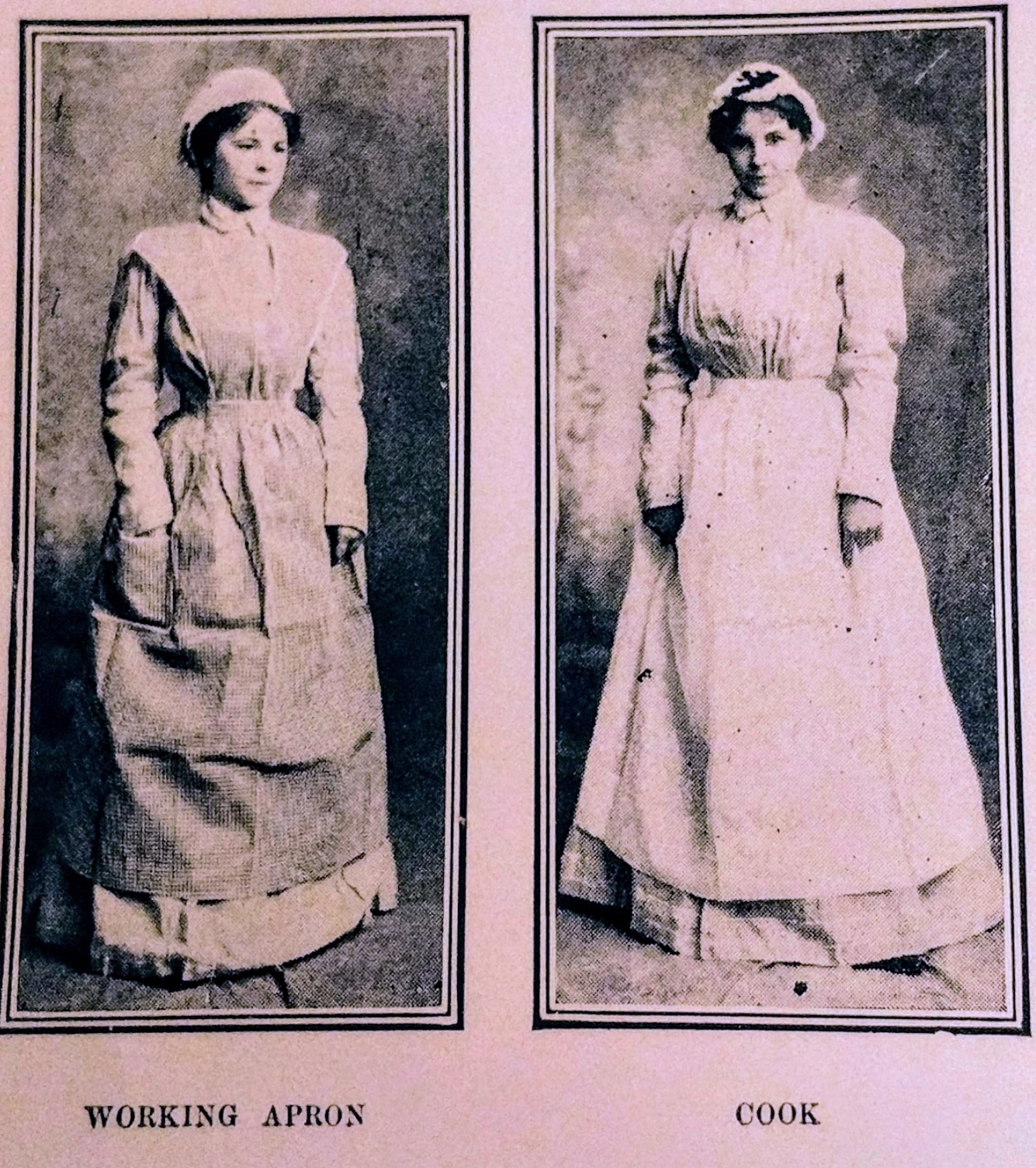
Dressing Gilded Age Cooks and Kitchen Help

“The dress was the final piece of clothing; it would still have had a high neckline in the 1890s-no low scoop-and long sleeves that had to be pushed up for cooking. Fabric colors were solid and muted: a light blue or gray, perhaps. The final touches were sensible shoes, perhaps boots, hair pushed into a mobcap or cook's cap, and a spotless apron. (Women almost never cut their hair and therefore a cap was necessary. In fact, a short-haired cook applying for a job would be regarded with suspicion. A woman had her hair cut for just two reasons: to remove lice or to sell hair for money.) According to a 1904 House Beautiful article, outfits were often changed mid-afternoon to provide a more formal appearance for the evening.”

In a large private household, the kitchen maid was always the first to rise, cleaning the stove, firing it, scrubbing the floor, making tea, and then bringing a cup to the cook, who might request help in getting dressed. The first article of clothing donned in the morning was a set of split drawers followed by a camisole: cotton in the summer, wool in the winter. The lady of the household, however, wore a one-piece version that was made of silk or extremely fine cotton, so thin that it could pass through her wedding ring, much like a handkerchief. This distinction in the quality of clothing between employer and cook was continued within the household hierar chy: kitchen and housemaids wore even coarser fabrics than the cook. The same inequality was also true between households of different social sta tus: a wealthy family provided better garments for its cook than did one of merely middle-class stature.

Next were the wool stockings, held up by ribbons or, toward the end of the nineteenth century, elasticized garters. The cook would then slip on a petticoat: red flannel in the winter, cotton in the summer. The corset was next, loosely laced and ending above the hips so that the cook would bend easily while working. (Her mistress wore a tightly laced corset to appear as narrow-waisted as possible; a thin cook was never a good sign. Corsets also provided bust support since brassieres were not invented until the 1920s.) The stays were made of a springlike steel, rather than whalebone, another contribution of the Industrial Revolution. One inevitably wonders how one tightened a corset when dressing alone. One clever solution was to install a metal ring on the wall of a servant's bedroom. The wearer would tie the corset strings to the ring and simply walk away to tighten it. A cook was likely to wear a corset made of coarse material and there fore a sleeveless corset cover was often slipped on next; this protected the petticoat or dress that rubbed up against it from chafing and wear. 

The dress was the final piece of clothing; it would still have had a high neckline in the 1890s-no low scoop-and long sleeves that had to be pushed up for cooking. Fabric colors were solid and muted: a light blue or gray, perhaps. The final touches were sensible shoes, perhaps boots, hair pushed into a mobcap or cook's cap, and a spotless apron. (Women almost never cut their hair and therefore a cap was necessary. In fact, a short-haired cook applying for a job would be regarded with suspicion. A woman had her hair cut for just two reasons: to remove lice or to sell hair for money.) According to a 1904 House Beautiful article, outfits were often changed mid-afternoon to provide a more formal appearance for the evening.

As the century progressed, however, social equality became the cry of the working class and so the workmen, maids, and cooks often chose clothing that mimicked that of their employers. Harper's Bazaar noted this trend in 1867, pointing out that crinoline and a flowing train of silk have no place next to a red hot stove or dirty kitchen floor. Instead, they promoted looser, more practical clothing, preferring the flowing blouse of the French workman to the tight-fitting coats and pants often worn by the lower classes in imitation of their masters. This smacked of putting the working class in their place, however, as in this printed admonition: "Let her take the advice of the tasteful, who will tell her that the rude freshness of natu ral appears to the greatest advantage in a plain setting."

The pay was modest-a few hundred dollars per year-although cooks in wealthy households were at the high end of the scale and were usually treated well, since a good cook was hard to come by: poaching within one's social circle was not uncommon. (Cooks had their own menu books collections of personal recipes and the mistress of the household would choose among them to create menus.) Life with a middle-class family, however, was often a nightmare; the mistress of the house often had little experience with managing servants, so they were often poorly treated and paid. To get by, then, the cook had her own bag of tricks. When interviewing for employment, she would ask if she could choose the tradesmen. This was crucial, since she often asked purveyors to mark up their prices, paying her the difference. She would also inquire as to the dispensation of the pan drippings and candle ends, both of which could be sold for ready money. On the other hand, servants, including cooks, had their quarterly pay docked if they broke a plate or burned the pudding. In some cases, the servant owed the household money at payday.

As for washing, undergarments, including petticoats, would be laundered either commercially or in-house, but dresses would only be spot cleaned, since they were usually made of finer, more expensive material and could not withstand constant soap and water. One could purchase "double-motion" hand-cranked washing machines, fashioned from galva nized iron and white cedar tubs. Also for sale were endless designs for racks to dry clothes outside (including one model that attached to a window frame), wash benches, ironing tables, ironing boards, and bosom boards, designed specifically for ironing shirts.

By the early 1900s, however, a private home was often no longer staffed by numerous household servants but reduced to employing just one all purpose maidservant. In the 1904 The Expert Maid-Servant, the mistress of the household is cautioned that cooking would be just one of the maid servant's many duties and therefore one had to inquire whether the potential employee understood plain cooking and could follow a simple recipe. “More elaborate accomplishments can rarely be looked for in a maid-of-all-work.” By 1920, after the devastation of the First World War and the influenza epidemic, and the increased availability of factory and other nondomestic jobs, the era of the well-staffed Victorian household was at an end both here and in England. – From Christopher Kimball’s book, “Fannie’s Last Supper”


Etiquette Enthusiast, Maura J. Graber, is the Site Editor for the Etiquipedia© Etiquette Encyclopedia
Friday, October 1, 2021

Turkish Coffee House Etiquette

In Turkey, I have seen a newcomer salute one after another, each person in a crowded coffee room, once on entering the door and again after taking his seat, and be so saluted in return —either by putting the right hand to the heart and uttering the greeting “Merhaba,” or by making that triple sweep of the hand which is the most-graceful of salutes.
– Image source Wikipedia


In a Turkish Coffee House the Politeness is Effusive and the Prices are Very Low

The etiquette of the coffee house in Turkey or, those coffee houses which have not been too much infected by Europe, is one of their most characteristic features. Something like it prevails in Italy, where you tip your hat on entering and leaving a cafe. In Turkey, however, I have seen a newcomer salute one after another, each person in a crowded coffee room, once on entering the door and again after taking his seat, and be so saluted in return —either by putting the right hand to the heart and uttering the greeting “Merhaba,” or by making that triple sweep of the hand which is the most-graceful of salutes. I have also seen an entire company rise upon the entrance of an old man and yield him the corner of honor. 

When your coffee is ready it is poured into an after dinner coffee cup or into a miniature bowl and brought to you on a tray with a glass of water. A foreigner can almost always be spotted by the manner in which he finally partakes of these refreshments. A Turk sips his water first, partly to prepare the way for the coffee, but also because he is a connoisseur of the former liquid as other men are of stronger ones. And he lifts his coffee cup by the saucer, whether it possess a handle or no, managing the two together in a dextrous way of his own. The current price for all this, not including the water pipe, is 10 paras —a trjfle over a cent—for which the kahvehji will cry you “blessing.” More pretentious establishments charge 20 paras, while a giddy few rise to a piaster—not quite 5 cents —or a piaster and a half. That, however, begins to look like extortion. 

And mark that you do not tip the waiter. I have often been surprised to be charged no more than the tariff, although I gave a larger piece to be changed, and it was perfectly evident that I was a foreigner. That is an experience which rarely befalls a traveler among his own co-religionaries. It has even happened to me, which is rarer still, to be charged nothing at all, nay, to be steadfastly refused when I persisted in attempting to pay, simply because I was a foreigner and therefore a guest.– H.G. Dwight in Scribner’s, 1913

 Etiquette Enthusiast, Maura J. Graber, is the Site Editor for the Etiquipedia© Etiquette Encyclopedia