Saturday, November 16, 2019

Basic Holiday Party Manners

Always try to be a happy conversationalist. (If you're not good at small talk, be an enthusiastic listener!) - Photo source, Pinterest

Q. This is my first big holiday season and the list of parties is almost endless. I am terrified that I may commit some social error and not even know it. Are there any definite party going rules one could learn for insurance ?  

A. There probably are as many rules as there are parties, but here are three tips which provide a general rule of thumb: 
  • Always try to be helpful, cooperative about any special party plans, and a happy conversationalist. (If you're not good at small talk, be an enthusiastic listener!)  
  • Be as thoughtful about the family and their home as you would want people to be about your own. 
  • Express your thanks for a good time and leave promptly when the party is over. These guideposts should make you the most popular guest of the season. – Junior Miss Etiquette Advice by Miss Deb, November 1964


Etiquette Enthusiast, Maura J Graber, is the Site Editor for the Etiquipedia© Etiquette Encyclopedia

Tuesday, November 12, 2019

Cocktails and Being Well Bred

The guests consumed a great deal more liquor than the hostess expected. After the last guest left, she found three cigarette holes in the carpeting and one bad burn the length of a cigar on the fireplace mantel. – On a side note, the gloved woman to the far right should not be gloved while drinking. That is simply “tacky.” – photo source Pinterest


Agony Aunt, Ann Landers, Gives Her Thoughts on Being “Well Bred” vs Being Polite
Dear Ann: I know your column does not deal with problems of etiquette, but this falls in the category of human relations. Please suggest what I should do. We gave a party last evening for fifty friends. It was a cocktail affair with an informal buffet. Everyone seemed to be having a fine time, although I must say they consumed a great deal more liquor than we expected. After the last guest left, I found three cigarette holes in the carpeting and one bad burn the length of a cigar on the fireplace mantel.  
Only one man could have burned the mantel and I know very well who he is. I have a hunch about the holes in the rug, too. Shall I phone these people and suggest they do something about “making, this right”? Bear in mind, our friends are all people of means who have had good upbringings. In fact, they are considered very well bred. –Upset Hostess

Ann’s Answer: Don’t call your friends and suggest that they pay for damages done during a party. This is just further proof that even the “well-bred” have a tendency to get crumby when they drink too much. When you invite guests to your home, you naturally assume they will not devalue the property. When “well-bred’’ people do damage, they offer to pay for it. Why don’t you review your guest list for next time. – Ann Landers, 1958


Etiquette Enthusiast, Maura J Graber, is the Site Editor for the Etiquipedia© Etiquette Encyclopedia

Saturday, November 9, 2019

Edwardian Fan Fads and Etiquette

In sharp contrast to the minute painted and spangled fans, are the immense ostrich plume und marabou feather fans, also having mother of pearl or curved ivory sticks. In black, especially, are these fans effective, but with a red or a white gown, red ostrich plumes are quite gorgeous.

Edwardian Fashion Decreed the Use of Richly Ornamented Fans of Lace, Ivory and Spangles


Once more does the fan form a most important part of the evening costume. Long ago it was almost a breach of etiquette to hold a fan which was not in some way a work of art, either because of its material, its history, or more generally because on its side was inscribed the labor of some famous artist. Then for a while the fan became simply on article of convenience or of comfort — pretty, perhaps, and well made, but not remarkable in any way for beauty or originality. And so on down to the present day — at one time an article of great cost, and again simply carried because in the ballroom it is found pleasant to have one on hand.
Now, again, there is no limit to the price of a handsome fan, and so exquisite are many in design and detail that one examines them in the same way as one would a wonderful picture. Newest of all in popularity are the hand-painted fans, painted on finest silk, Set on slabs of carved und painted ivory and studded with glittering gold and silver paillettes. Strange to say, it is upon the tiniest fan that the finest workmanship is expended, although large fans have begun lately to return to popular favor. 
At first glance one is astonished at the prices asked for these small bits of silk and ivory, wondering of what use so small a fan could be, but on examination it is discovered that the miniature painted, or the landscape scene depicted in the work of one noted artist, and that the rhinestones and spangles are of the most expensive kind, while the mother of pearl or ivory handles are also almost priceless. 

Slowly it dawns that these are fans for ornament; not use, and yet with every evening gown there is now included a fan to match. If the color of the gown cannot be matched and no good contrast can be found, then the fan must need be made to order, and there are today many artists who would be only too glad to have a chance to show their skill in this miniature work.

In sharp contrast to the minute painted and spangled fans, are the immense ostrich plume und marabou feather fans, also having mother of pearl or curved ivory sticks. In black, especially, are these fans effective, but with a red or a white gown, red ostrich plumes are quite gorgeous. In the pale shades also, pink, blue, green, lavender, etc, feather fans are very handsome, and for the opera box, show up better than the smaller fans, although naturally not so beautiful.

The more spangles there are on fans, the better. This certainly holds good with a spangled costume, where all must be sparkle and brilliance. With lace and chiffon gowns, as well as with the spangled costumes, an elaborately spangled fan will frequently give just the one note necessary to the effect. The spangles are simply placed en masse, or some design is worked out—butterflies, flowers, the center of which are clusters of sparkling paillettes, or various ribbon bow-knot and garland patterns.

Then there are the lace fans, the lace being generally made to order to match the trimming of some gown and of a certain unusual shape. The lace piece then placed either on sticks of tortoise shell on which are set in gold the initials of the purchaser, or, again, jewel-studded ivory sticks are used. The most effective lace fans are in black, set on tortoise shell, the gold letters being the only note of color. 


White lace is also very handsome, set either upon shell or mother of pearl. Not only upon the main part of the fan, but upon the ornamentation of the sticks, does the responsibility for the beauty of the article rest, Not satisfied with carving, hand-painting or rhinestone jewels are now placed in fascinating display upon the delicate sticks. Turquoise and matrix are both effective, the rich blue always showing up well, but even rubies, sapphires and pearls are now set almost at random, to carry out the new design upon the sticks.– Los Angeles Herald, 1905

Etiquette Enthusiast, Maura J. Graber, is the Site Editor for the Etiquipedia© Etiquette Encyclopedia 

Thursday, November 7, 2019

Etiquette and Obeisance


Lord Carisbrooke – The “Marquess of Carisbrooke“ was a title created in 1917 for Prince Alexander of Battenberg, the eldest son of Princess Beatrice of the United Kingdom (the youngest daughter of Queen Victoria) and Prince Henry of Battenberg. He was also made Viscount Launceston, in the County of Cornwall, and Earl of Berkhamsted at the same time, all in the Peerage of the United Kingdom. At this time, along with other German-surnamed relations of the British Royal family, Alexander changed his surname to Mountbatten. Confused yet??? Sadly, all of these titles became extinct upon his death in 1960, as he had no sons.- Photo Public Domain


It was hard for Gotham Society to know the right amount of deference and respect to show when they were unknowingly dealing with a “Minor Royal”

Gotham Society– with a very large, capital S– is considerably exercised over the proper amount of obeisance due Lord Carisbrooke, its at present most distinguished guest. Because he is a grandson of Queen Victoria and brother of the Queen of Spain, his hosts and fellow guests started in by giving him regular court curtsies and presenting women to him as rapidly as all the rest of what they deemed his due. Then along came carping critic and laughted them to scorn. 


“He’s not a Prince of the Blood” he told them. ‘‘He must he getting a lot of fine laughs out of you. Etiquette doesn’t let you treat him any different from any other gentleman.” The most embarrassed person among the mis-steppers is one who is credited with ambitions to be made ambassador to the Court of St. James and now he’s given it away that he doesn’t even know court etiquette!– Press Democrat, 1921


Etiquette Enthusiast, Maura J Graber, is the Site Editor for the Etiquipedia© Etiquette Encyclopedia 

1940’s Etiquette and Equal Rights

Hats may be hats, but etiquette still differentiates between the customs of men and women. In other words, it is never necessary for women to tip their hats, while it is often the rule for a gentleman. 


Why must the men take off their hats And wave them shoulder-high, While the women smugly keep theirs on when the flag is passing by. Why, in these days of “equal rights,” Should this fact be always true? Men’s hats come off when they meet the girls, why don’t girls doff theirs, too! The reason is that hats may be hats, but etiquette still differentiates between the customs of men and women. In other words, it is never necessary for women to tip their hats, while it is often the rule for a gentleman. 

The controversy arises as to whether the hat should be raised when a patriotic song, ether than the national anthem, is played. No, it is not necessary. The hat should be lifted only when thq flag is passing or when “The Star Spangled Banner” is played. Custom has changed the etiquette of tipping your hat to every lady you chance to meet. This is impractical, as you would soon wear your hat out. Nevertheless, the hat should be tipped when you meet a lady of your acquaintance, and should be taken off when in the theater, lobby of a hotel, church or an elevator. 

When you tip your hat to a lady, it need not be taken completely off, merely raised slightly. When the flag goes by, the hat should be taken off and held over the heart. Of course, in public buildings, as the theater, it is a matter of convenience to take it off and hold it in your hand. This bit of etiquette may seem very elementary to collegiates, but due to the fact hats are seldom worn on the campus, it is a good idea to check up on what to do when you do wear a hat. 

Ladies need never remove their hats in public places, but it is a good idea to let the people in the show behind you see some of the picture instead of your New York creation. So if you wear a reproduction of the leaning tower of Pisa or a similar style, remember we are all behind you! - Sally’s Social Slants in The Oak Leaf, 1940


Etiquette Enthusiast, Maura J Graber, is the Site Editor for Etiquipedia© Etiquette Encyclopedia

Monday, November 4, 2019

Etiquette for Champagne Stemware

Know your champagne and sparkling wine glasses. 
– Photo source Pinterest, from Wine Folly


Properly Holding Stemware with Champagne and Other Cold or Chilled Beverages 

Champagne and other chilled beverages are more easily kept cold when served in stemware. Held properly, by the glass’s stem as shown below, the beverage doesn't need to be diluted with melting ice, as the body's heat won't transfer to the drink through the stem. The beverage appears more elegant, as does the person drinking the beverage out of the stemware, as opposed to drinking from a glass tumbler. 


At informal parties when cold beverages or chilled champagne are served in trendy, stemless glasses, guests should be able to keep their hands dry, especially as their drinks are slowly warming. The host or hostess should provide plenty of cocktail napkins for condensation that accumulates on the outside of the glass.

No napkin is required (though it is always best to offer one to each guest, especially for catching drips, etc...) when glasses with stems are being used, unless one is eating, as well.


Etiquette Enthusiast, Maura J Graber, is the Site Editor for the Etiquipedia© Etiquette Encyclopedia 


Friday, November 1, 2019

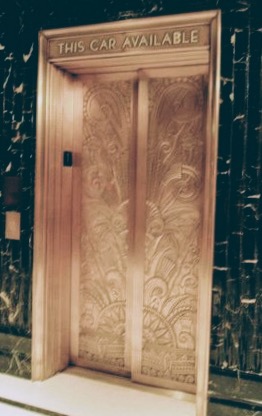
Modern University Elevator Etiquette

When riding the elevator, there is nothing more irritating than stopping one short level away from the end of an interminable ride.

There is nothing pleasant about being jammed into the elevator with a group of strangers. You may never have been bothered by claustrophobia before coming to UCSF, but after riding our elevators for a while, you may notice you are developing symptoms. We’ve all experienced the horrors of the morning elevator ride, packed like sardines and watching as the elevator stops at each and every level. The door slides open to reveal a person who always seems nonplussed that the elevator is so full! Or maybe they act nonplussed because everyone inside the elevator is glaring at them for interrupting the ride. At such moments, we have all had the thought “there's got to be a better way” while crawling slowly upward. Here are some ideas to make the ride a little easier for all of us: 
  • Don't take the elevator if you're only going one floor! (Important note: this does not apply to anyone with disabilities). When riding the elevator, there is nothing more irritating than stopping one short level away from the end of an interminable ride.
  • Watch those backpacks. Most students boarding the elevator are toting a large backpack. Have a care when boarding the elevator, particularly when you swing around to face the front. Any poor person standing too closely behind (and in UCSF elevators, we’re all standing too closely behind), can take the full brunt of your swinging backpack. It's not a fun way to start the morning. 
  • Don’t lean against the control panel.  The observant among us have noticed that there is a second control panel located on the side of the elevator, provided for those with disabilities. The unobservant among us do not notice this panel, and lean against the wall on which it is located, and then the fun begins. The wide-bodied can light up as many as four buttons at a time. The time it takes for the elevator to stop at levels D, E, F and G gives others in the elevator plenty of time to reflect on just how self-aware the inadvertent button pusher isn’t. 
  • Please let us suffer in silence. The elevator ride is bad enough; don't make it worse by squeezing in and making some lame joke. No one feels like laughing, especially in the morning. And after you've been here for a few months, you've heard all the jokes there are about squeezing into a crowded elevator. Take a vow of silence for the duration of the ride. 

Elevators, like life, have their ups and downs. Here's hoping all your rides are smooth ones. – From an article by T. Neagle, for The Synapse, 2003

Etiquette Enthusiast, Maura J. Graber, is the Site Editor for the Etiquipedia© Etiquette Encyclopedia

Learning American Etiquette

“Their first lecture drilled them in the rules of social intercourse —how to tip one’s hat “American fashion,” how to greet friends, followed by an explanation of the chaperone idea.”   Japanese immigrants in Hawaii, circa 1918
(Photo source http://www.misveteranshawaii.com/)

Japanese Boys in Hawaii Study American Etiquette 


(A.P.) Honolulu, Territory of Hawaii, Aug. 12.—After the study of social conventions and American etiquette, a number of Japanese youths of Honolulu have formed classes under the direction of the Y. W. C. A. Their first lecture drilled them in the rules of social intercourse —how to tip one’s hat “American fashion,” how to greet friends, followed by an explanation of the chaperone idea. 

Other lectures will deal with table etiquette, business etiquette, social calls, writing of notes, home life and other topics. Classes in etiquette were originated a year ago by the Y. W. C. A., for Japanese girls who expressed a desire to become fully Americanized. – San Diego Union and Daily Bee, 1918


Etiquette Enthusiast, Maura J Graber, is the Site Editor for the Etiquipedia Etiquette Encyclopedia