Friday, May 7, 2021

Dining Etiquette with Physical Challenges


(Above) A pie, pickle or even a “Nelson fork” — Some fork designs were sold for different purposes in different regions of the U.S. and in Europe. Other utensils were modified a bit to suit new foods, as foods that were considered delicacies, fell into and out of, fashion. A “Nelson fork” was a fork adapted for eating with one hand, after British Vice Admiral Horatio Nelson lost his arm while fighting Napoleon at Tenerife.


Two metal hooks where his hands should be was the distinctive feature of the man who sat opposite me at dinner last night. He was a strong, husky chap between 25 and 30, well groomed, but coatless and he walked into the French restaurant, was shown to a table, pulled his chair out and sat down without a motion that would single him out from the rest of the diners. Fortunately he sat apposite me, offering me opportunity not to stare at a man who fed himself with two iron hooks, but to look with admiration on a person, who has successfully made one of life’s most difficult adjustments. 

Of course, I didn’t and don’t now know his story. I didn’t have to him tell me that to know that there was a day, either in his boyhood or young manhood, when he awoke to the realization that his hands were gone, in a case like that one can entirely set aside any attendant physical suffering, and dwell upon the mental and nervous shock and the necessary adjustment that only the Individual himself can make. Life is going to go right on for a person in a fix of that kind, and he himself must decide it he is going to go right along with it.

 DECISION COMES FIRST 

This decision must come first. And after the decision is made there is the nerve-racking process of developing a new way of living that will approximate the normal course of things. There were no awkward moves as this fellow-diner of mine deftly adjusted the hook on his right arm with the one on the left. He picked up his napkin, unfolded it and placed it on his lap. When the soup was served he picked up a spoon and ate without spilling a drop. He broke French bread, which he seemed to enjoy, and now and then wiped his lips with his napkin and sipped water from the glass at his place. 

DEFIANT LOOK IN EYE 

He served himself salad and ate it, also the crisp potatoes and peas, and he was just as American in eating fried chicken with his “fingers” as you and I. But he didn’t stare at anyone else for everyone was staring at him. However, he wasn't embarrassed, in fact, I caught a defiant look in his eye and sensed an attitude of the satisfied victor. I wanted to shake his right hook, but I don’t believe he would want commendation any more than sympathy. A person who makes a difficult life adjustment as successfully as he has, doesn’t need either. – Estelle Lawton Lindsey, 1936


Etiquette Enthusiast, Maura J Graber, is the Site Editor for the Etiquipedia© Etiquette Encyclopedia


Thursday, May 6, 2021

Wine Etiquette for Hosts/Hostesses


The guests’ glasses should be poured counter clockwise  around the table, to the right of the host, who is served last.

... a few simple principles

Drinking and serving fine Sonoma County wines will be more pleasurable if you master a few simple principles. Here are some. 
  • The first ounce or two of California wine should be poured into the host’s glass. This enables the host to taste the wine first and also to inspect for possible cork debris. 
  • The guests’ glasses should be poured counter clockwise  around the table, to the right of the host, who is served last.
  • Fill the dinner wine glass about two-thirds full. This reduces chances of spillage and allows the aroma or bouquet to he better appreciated. 
  • In pouring Sherry or Port, the glass should be filled to within one-half inch of the top. 
  • When finished pouring into a glass, twist the bottle slightly before raising its mouth from the pouring position this catches the last few drops on the lip of the bottle preventing dripping. 
  • Drawing the cork is easy if a good corkscrew is used. 
  • Cut the foil or cellulose band with a sharp knife about l/4th of an inch beneath the lip of the bottle. 
  • The foil or cellulose band should not be torn or ripped off. A neat cut makes it easier to pour the wine. 
  • In the case of a metal band, it eliminates the possibility of a metallic taste.
  • The mouth of the bottle should be wiped clean with a napkin before inserting the corkscrew. Screw the worm through the center of the cork as far as possible. Give an extra part turn. Then pull firmly and slowly so that the cork is removed whole. 
  • If the cork is brittle or crumbly, a carbon pressure de-corker, is best.– Healdsburg Tribune, Enterprise and Scimitar, 1971


Etiquette Enthusiast, Maura J Graber, is the Site Editor for the Etiquipedia© Etiquette Encyclopedia

Wednesday, May 5, 2021

Table Napkin Etiquette and History


“That article now considered almost indispensable, the table napkin, was first used only by children but was only adopted by elder members of the family about the middle of the Fifteenth century.”– ¥ouch’s Companion, 1893


Curiously enough, that article now considered almost indispensable, the table napkin, was first used only by children but was only adopted by elder members of the family about the middle of the Fifteenth century. In etiquette books of an earlier date than this, among other sage pieces of advice for children are instructions about wiping their fingers and lips with their napkins. It seems that the tablecloth was long enough to reach the floor and served the grown people in place of napkins. When they did begin to use napkins, they placed them first on the shoulder, then on the left arm, and finally tied them about the neck. —Youth's Companion, 1893


Etiquette Enthusiast, Maura J Graber, is the Site Editor for the Etiquipedia© Etiquette Encyclopedia


Tuesday, May 4, 2021

Manners Nudging a 1980’s Comeback

The 1980’s was a decade of contradictions in etiquette and manners... Most saw etiquette and manners in the United Staes to still in be in a free fall of decline, following the pattens set in the 1960s and 1970s. That did not stop people, however, from writing and buying books in large numbers on etiquette and manners. This phenomenon became a lead up to “the 1990’s Etiquette Era.”
–––––––––––––––––––––– 
“Although Clare Boothe Luce has no plans to write an etiquette book, she has observed social mores from the time when, she says, life was ‘much more ceremonial.’ Manners today except for official life in Washington have, she believes, ‘virtually disappeared,’ and she sees ‘no signs of a renaissance.’ For Luce, ‘good manners is treating others with a certain distance and formality until a friendship is formed.’ As for the current American interest in manners and etiquette, ‘I do hope,’ Luce says, ‘they buy all the books they can.’ – Helping a young lady into her chair at the table, from Marjabelle Stewart’s book, “Stand Up, Shake Hands, Say ‘How Do You Do’”

NEW YORK - America, if the social soothsayers are accurate in their predictions, is about to become a land of kindness and courtesy. This is not merely because “Tiffany's Table Manners for Teen-Agers,” the paperback by Walter Hoving first published 21 years ago, is, according to Tiffany, “suddenly selling like croissants.” Rather, it is largely because of the burst of books on manners and etiquette – subjects that in the past inspired works from such concerned citizens as George Washington and Eleanor Roosevelt – which have recently been, or are about to be published. There are courses and lectures on the same subject for which people are lining up as if they were waiting to see “Conan the Barbarian.” Americans, these authors and teachers are saying, are currently craving tradition and hungering for the rules of proper behavior in social situations. 

Mary Susan Miller, who is working with Elizabeth L. Post, the granddaughter of Emily Post, on updating “The New Emily Post’s Etiquette,” said, “People have become so horrified, hurt and disgusted by rudeness” that a resurgence of manners was inevitable. Manners, says Miller, “are not a set of rules that someone out there arbitrarily says follow. Manners are to make other people, as well as yourself, comfortable.” She is currently teaching corporate executives, among others, to be comfortable. 

When Marjabelle Stewart was at the Waldorf Astoria recently to conduct a class on dining for children from the United Nations International School, it was yet one more stop in her constant etiquette campaign. Stewart, who has made manners her cottage industry, has written several books on the subject (“Marjabelle Stewart's, Book of Modern Table Manners,” the most recent, was published last year). Her children's etiquette classes (seven weeks, $65, graduation ceremony and tea party included) are franchised in 476 cities throughout the country. “Everyone wants to be upper crust today,” says Stewart, who also conducts courses (“Eating Your Way to the Top”) for both executives and college students. 

Ann Buchwald, a Washingtonian who is married to Art Buchwald and was Stewart’s co-author on such books as “White Gloves and Party Manners” and “Stand Up, Shake Hands, Say ‘How Do You Do,’” finds further evidence that manners are staging a comeback. “Women are wearing gloves for the first time in years, and there's a return to dresses,” she said. “How people look has a lot to do with the way they behave.” It was President and Mrs. Reagan, Buchwald adds, who “put the cap on the bottle.” Many of the parents who are most concerned about teaching their children good manners, Buchwald has found, were students who demonstrated in the 60's and 70's. “When they locked up the dean, they didn't much care about where glasses go on the dinner table,” she said, “but they now want their children to care.” 

For those who, like him, grew up in the 60s and 70s, P. J. O'Rourke is writing “Modern Manners: Etiquette for Extremely Rude People.” “We never learned how to dress properly or give cocktail parties,” O'Rourke says. “It was an era, when people erased the tapes on how to behave.” It is the family that is or should be the unit that teaches manners to youngsters, according to Letitia Baldrige, who revised and expanded the most recent edition of “The Amy Vanderbilt Complete Book of Etiquette.” “The many young people who grew up having dinner in front of the television set instead of the dining, table never did learn table manners,” Baldrige says. “Besides that, their parents were divorced and were never home to advise them.”

Another title, scheduled for publication later this year, is George Mazzei's “The New Office Etiquette,” which he says he wrote because “there's been a breakdown in business manners, and people are realizing they can no longer deal with the constant rudeness which became a part of the business world when crude young people became superstars.” Mazzei's book deals with “the new etiquette toward women in business" and sets guidelines for such business behavior as who should go through a revolving door first (the woman still does) and the correct way to deal with your boss's in-office lover (smile, nod, and don't talk about the affair). The book is scheduled for publication later this year. 

One can learn “How to Eat an Artichoke and Other Trying, Troublesome, Hard-to-Get-At Foods” in Rochelle Udell's just-published book. Udell wrote it, she says, “because food is so often a barrier to socializing across the dinner table.” She got the idea for her book, she says, while observing “someone's cherry tomato squirt across a dining room.” Although Clare Boothe Luce has no plans to write an etiquette book, she has observed social mores from the time when, she says, life was “much more ceremonial.” Manners today except for official life in Washington have, she believes, “virtually disappeared,” and she sees “no signs of a renaissance.” For Luce, “good manners is treating others with a certain distance and formality until a friendship is formed.” As for the current American interest in manners and etiquette, “I do hope,” Luce says, “they buy all the books they can.” – NYT News Service, 1982


Etiquette Enthusiast, Maura J. Graber, is the Site Editor for the Etiquipedia© Etiquette Encyclopedia

Monday, May 3, 2021

Journalistic Etiquette and “Mrs.”


The first sentence is: “Prefixes indicating marital status should be avoided.” Why? What about the woman who is proud to be Mrs. John Doe, along with any other accomplishments? What about the still unchanged etiquette rule that a married woman is Mrs. John Doe from the moment of marriage until death, unless she divorces or remarries? – Polyester Pantsuits for Women... Hallmarks of the 1960’s and 1970’s Women’s Liberation Movement


“No Phony Titles, Please”

I object! At the risk of having to burrow deeper and longer than the traditional groundhog, I will stand by my convictions and object to the “Guidelines for Newswriting about Women,” compiled by Stanford University Women’s News Service and being circulated by the League of Women Voters, Palm Springs Area. The first sentence is: “Prefixes indicating marital status should be avoided.” Why? What about the woman who is proud to be Mrs. John Doe, along with any other accomplishments? 

What about the still unchanged etiquette rule that a married woman is Mrs. John Doe from the moment of marriage until death, unless she divorces or remarries? It goes on: “A later reference should include last name only.” What about a newspaper’s individual style? A newspaper, like a smoker, has a few rights left, too. It is not The Desert Sun’s style to refer to a woman, a lady, or a girl as just “Doe.” I pray we never do.

In another section is the request (or is it an order?) that: ‘‘If you would not say, ‘The gray-haired grandfather of 3 won the Nobel Prize,' do not say, ‘The grayhaired grandmother of 3 won the Nobel Prize.’ ” Now, listen here. I am a gray-haired grandmother of two (newspapers use letters up to 10), the mother of two, the wife of one, and if I ever win the Nobel Prize (after this piece it won’t be for peace) I want all the data there. 

Along with the facts that I have been a news reporter and editor (Oh, God, don’t make me say “editress”) for 30 years, a homemaker, seamstress, cook, cleaning lady and loving wife for nearly 40 years. In addition, while handling a full time job I was a Boy Scout den mother and a Camp Fire leader. If I win any prize I want the public to know, that regardless of what it says, I won it for juggling. 

I object again to the mandate: “ ‘Man,’ used alone and in words like ‘chairman,’ is a sexually exclusive term and should be avoided when at all possible.’’ What about mankind? Are we going to change that to “person-kind?” Thank God, Neil Armstrong walked on the moon when he did. I’d have died if he had said, “ . . , one giant leap for person-kind.” 

Are we going to “person the pumps?” Call manikins “personikins?” Commit “person-slaughter?” Don’t you ever call my manx cat a “personx.” And let’s not forget man-eating sharks. Science has never found them to be discriminating. To lessen the fears of sons, and husbands they should definitely become “person-eating sharks,” the same for tigers. 

What about women with the last name of Mann? Should they petition to change it to Person? That means changing Hoffman to Hoffperson and can you imagine Milt and Evelanne Heyperson? According to the “Guidelines,” the U.S. Bureau of the Census has begun officially changing its occupation titles to eliminate sexism. Salesmen are now sales workers or sales agents, newsboys are newspaper carriers and airline stewardesses are now flight attendants. Well, what else can you expect in this day of Federalese and gobbledegook where a garbage collector is a sanitation engineer and being “affiliated with a chemical company” in truth means a fertilizer salesman, excuse me, fertilizer sales agent. 

After years in the working world, I believe in equal pay for equal work, community property, joint tenancy and other sensible strides, but I don’t want to be called, as the “Guideline” states: “ ‘Feminist’ is the correct term for a woman committed to equal rights for women” and that “ ‘Women's libber’ is unacceptable,” I don’t want to be called either of these. I’m a woman, proud of it; just call me Mrs. Charles A. Turner or Lisa Turner. No stupid titles, please. – By Lisa Larson Turner, Desert Living Editor, Desert Sun, 1978


Etiquette Enthusiast, Maura J. Graber of The RSVP Institute of Etiquette, is the Site Editor for the Etiquipedia© Etiquette Encyclopedia

Sunday, May 2, 2021

Society Girls’ Study of Grace

Grace is such on indescribable thing that negatives aid in the definition. It is not graceful to walk on the heels, to take long strides or to raise the foot from the ground more than two inches; it is not graceful to stump or to lay the foot down with a defiant or resounding noise; it is not graceful to square the shoulders soldier fashion or to set the elbows akimbo, as in driving; it is not graceful to hurry, hustle or fuss, for speed is not conducive to grace of motion, save among thoroughbreds.


Society girls have taken up the study of grace, which consists in being gently serpentine. To attain this undulating walk, the head must remain firm, the shoulders droop and the movements come from the hips. In this way there will be no tossing or shaking of the skirts, and the willowy, swaying motion at the waist will emphasize the snake effect sought. For the cultivation of this indefinable charm, walking, next to dancing, is the best exercise, as it brings the muscles into fairly uniform action. The undulations made by the head, chest and torso in a vertical plane are not only productive of Hogarth’s line of beauty but tend to perfect physical health. 

Grace is such on indescribable thing that negatives aid in the definition. It is not graceful to walk on the heels, to take long strides or to raise the foot from the ground more than two inches; it is not graceful to stump or to lay the foot down with a defiant or resounding noise; it is not graceful to square the shoulders soldier fashion or to set the elbows akimbo, as in driving; it is not graceful to hurry, hustle or fuss, for speed is not conducive to grace of motion, save among thoroughbreds. Another foe of grace is self consciousness. The really pleasing, graceful, gracious woman rises above her raiments, and once her toilet is complete she gives no more thought to it.— New York World, 1892


Etiquette Enthusiast, Maura J. Graber, is the Site Editor for the Etiquipedia© Etiquette Encyclopedia

Saturday, May 1, 2021

Editorial Etiquette: Judging Astors and Dingbats

Caroline Webster “Lina” Schermerhorn Astor was a prominent American socialite of the second half of the 19th century who led the Gilded Age 400. Famous for being referred to later in life as “The Mrs. Astor” or just “Mrs. Astor,” she was the wife of businessman, horse breeder and yachtsman William Backhouse Astor Jr.. She was the mother of five children, including Colonel John Jacob Astor IV, who perished on the Titanic.– Portrait of Mrs. William Astor
Public domain image


I heard a distinguished judge in an uptown club burst into a torrent of abuse because the papers devoted two or three columns to what he called the interminable nonsense about who Mrs. Astor might be. “Nobody cares a rap,” said the judge, throwing the paper across the room, “whether old Bill Astor's wife is called Mrs. Astor, Mrs. William Astor or Mrs. Dingbats. As for her niece, her name is Mrs. William Waldorf Astor, and everybody who knows her calls her Mamie. It's the most transparent nonsense for the papers to devote such valuable space to a family squabble.” Yet a moment's thought would have convinced the judge that the papers were on the right track. 

The question of which of the Mrs. Astors has the right to the distinctive title of the family was of more interest to thousands and thousands of feminine readers than Mr. Blame's letter to Mr. Frye or any Supreme Court decision that has ever been rendered. The subjects which claim the attention of women have a mortgage on publicity today. Women are everywhere. They are cashiers, typewriters, stenographers, clerks, canvassers, doctors, dentists, editors, lecturers, lawyers, deacons and railway presidents, and their influence is patent in every walk of life. Annie Goodwin was a working girl. This is one reason for the great uproar which has been aroused by her fate. —Philadelphia Times, 1890


Etiquette Enthusiast, Maura Graber, is the Site Editor for the Etiquipedia© Etiquette Encyclopedia

Friday, April 30, 2021

Washington Society Destroys Buffet

The American people, in general, we are ashamed to say, have not yet learned how to behave at table; and that species of etiquette, not too prevalent in private, is certainly always absent at public suppers. So it was not strange that we should have had warning visions of a grand rush, then a crush, and a demolition in the twinkling of an eye of all the confectioner's handiwork, the frantic snatching of viands from the tables, the brandishing aloft of wine cup, and plate, and cutlery, laden with articles alike dangerous to toilet and stomach; of munching and crunching sans ceremonis; of defilement and ruin to precious apparel, the result perhaps of weeks of the dressmaker's effort; of the loss of temper, and loud cries of complaint. And indeed we harbored a a fear as a consequence that a graceful assemblage of dignified ladies and gentlemen might be transformed, as if by the wand of some evil spirit, into a social raffle, where he who was rudest should be most successful in appeasing the cravings of the appetite, and in pocketing the delicate ornamentations of the table.  
– Photo courtesy of the National Park Service


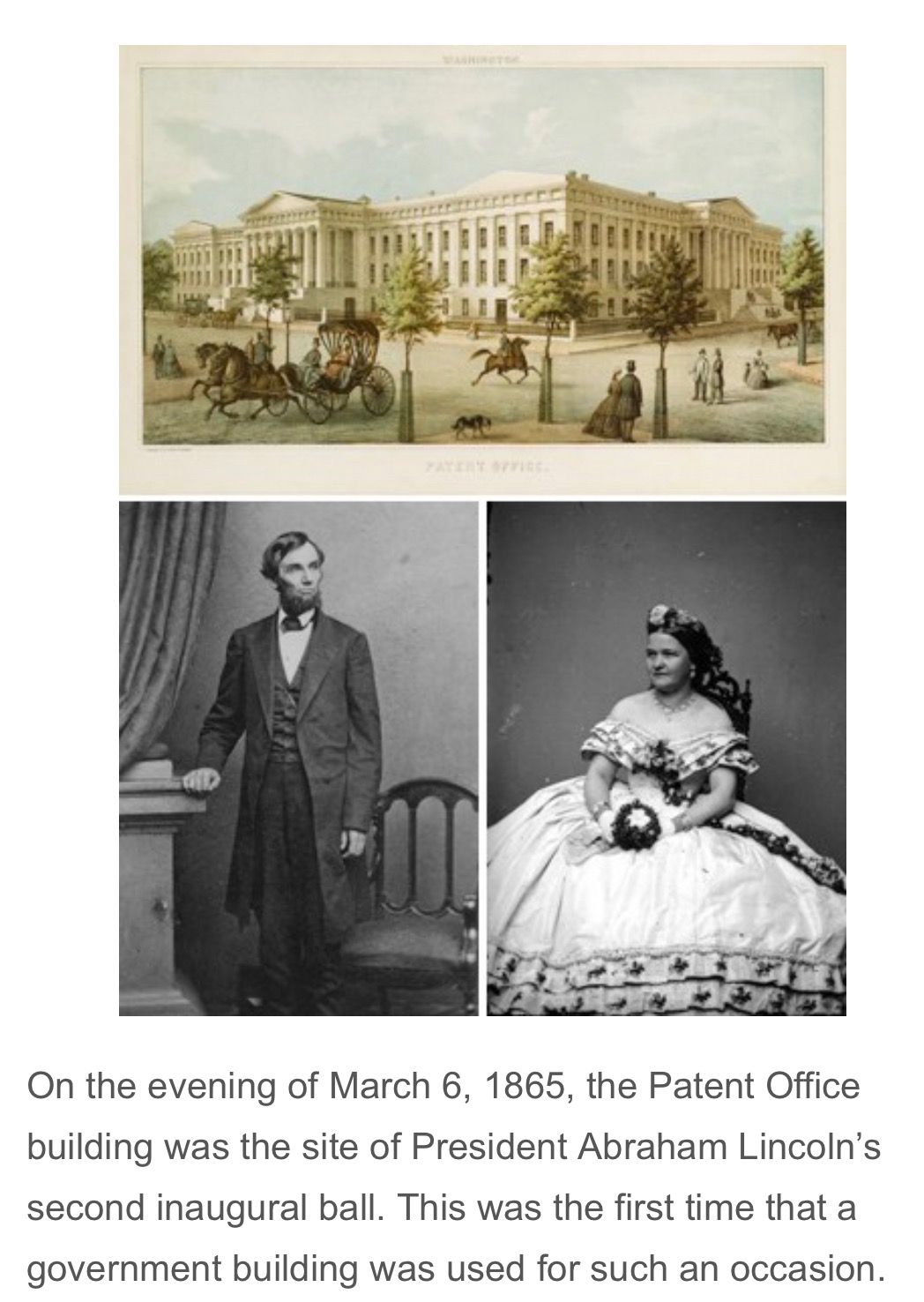
The Inauguration Ball 
Magnificent Finale of the Season Full and Graphic Description of the Ceremonies and Festivities — Splendid and Magnificent Toilettes of the Ladies —
Terrific Crush at the Supper Table

The Washington “season” is past, and there certainly could not have been a more magnificent nor graceful finale; not alone to the Winter's gaities, but to the ceremonies which have made Abraham Lincoln our President again for the next four years, than the time-honored National Inauguration Ball which came off last night; and it is entirely appropriate that not alone with firing of cannon and waving of banners, in which men alone participate, but with music and dancing should we meet and celebrate this signal occasion, when the gentlemen are expected to be as gallant, and the ladies as lovely as possible.
 

The marble halls of the Patent-office were selected as the most commodious and best adaped in the city. The hall appropriated to dancing is two hundred and eighty feet long, by about sixty feet in width; and the floor is laid in large blocks of blue and white marble. Its decorations were really beautiful -- emblems, banners and devices being tastefully disposed on the walls, while the elaborately frescoed ceiling imparted an air of decided grandeur. Among the decorations the American flag was most prominent, while the various flags of the different army corps formed an appropriate accompaniment. A gallery at the east end was occupied by a fine brass band, which gave music for the promenade, while in the centre, on the south side, a splendid string band furnished music for the dance.

Beside this spacious hall, a wing, three hundred feet in length, was appropriated for the promenade, and a corresponding one on the opposite side for the supper-room. The music was excellent, and had the several halls and the entire building been thoroughly lighted, which they were not, the effect would have been much finer. But gas is certainly not good in Washington, though said to be very abundant. On a dais, at the northern side, were sofas and chairs in blue and gold for the President and family.

All the arrangements see med to be under the management of capability and distinction. The tickets for the ladies were very elaborate and prettily designed, six by ten inches in size, and ornamented with portraits of the President and Vice-President, beside two very good likenesses of the American eagle.

As early as 9 o'clock the carriages began to arrive, and soon the ball-room was thronged. The excellent bands of music soon set the lovers of Terpsichore into the graceful mazes of the dance. At about 10:30 o'clock an avant courrier cleared the way from the main entrance, when His Excellency, accompanied by Speaker Colfax, entered the hall. Following was Mrs. Lincoln upon the arm of Senator Sumner. They walked down the centre of the long hall, and turning at the upper end returned mid-way to the dais, when they became seated. Mr. Lincoln was evidently trying to (throw off care for the time; but with rather ill success, and looked very old; yet he seemed pleased and gratified, as he was greeted by the people. He wore a plain black suit and white gloves.

Mrs. Lincoln looked extremely well, and was attired in the most elegant manner; her dress was made of white satin, very ample and rich, but almost entirely covered by a tunic or rather skirt of the finest point applique. Her corsage, which was low, and the short sleeves, were ornamented richly by a Bertha collar made of the same material, and the shawl, also of the same rich lace, was most exquisite. Passementerie of narrow fluted satin ribbon and nouds completed the dress. Her jewels were of the rarest pearls, necklace, earrings, brooch and bracelets. Her hair, which was put plainly back from her face, was ornamented with trailing jessamine and clustering violets most gracefully. She looked exceedingly well with her soft, white complexion, and her toilet was faultless. Her manners are very easy and affable.

Mr. Robert Lincoln, a fine-looking young man, wearing the uniform of a Captain in the regular army, was also present.

About 11 o'clock Secretaries Seward, Welles, Attorney-General Speed and a large number of diplomats, accompanied by their wives and daughters, made their appearance. Mrs. Secretary Welles, a lady of rather petite figure, was dressed in a mode-colored silk, with black lace shawl. Mrs. Secretary Usher, of about the same stature, wore a rich dress of garnet satin, very plainly but richly made. Mrs. Postmaster- General Dennison, who is a very fine-looking lady, wore a most becoming dress of heavy black velvet, brilliant jewels and hair plainly dressed. Her daughter was in white muslin, embroidered with black. Mrs. Fred. Seward, wife of the Assistant Secretary of State, was attired in a pretty rose-colored silk, handsomely trimmed. Mrs. Senator Harris, who has the appearance of a a well-preserved English lady, wore a most elegant dress of corn-colored silk, trimmed with point appliqué. Mrs. Senator McDougall was also richly attired. The wife of our artist Carpenter was dressed in light silk, with a ruche of tulle. One of the most elaborate and rich dresses in the room was worn by Mrs. George Francis Train; it was a very finely plaided blue silk, trimmed with a flounce of thread lace, almost as deep as her skirt, and other laces to match. Her hair was powdered with gold. Mr. Train was also present.

The multitude of recherche dresses worn by ladies of distinction, it would be impossible to enumerate. There was a prependerance of sensible, high-necked dresses; but a few, and some not American, wore corsages shockingly decolettee. Many ladies who wore velvets, moires and heavier silks, dispensed with hoops altogether, thereby displaying their good taste as well as their regard for the appreciation of some approximation to the female form which still inheres or lingers in the mind of man; one, a matron and evidently a Spanish lady, wore a dress of cloth of gold, with raised crimson velvet flowers, such an one as is seldom seen in this country, or afforded, in any other. In her hair she wore a cluster of five or six enormous diamond rings, strung on a bandeau of velvet. Her laces were also of the finest quality. In her hand she carried a large fan of the gayest and most brilliant workmanship, which seemed to give a breeze of a more ardent clime than ours. A moire antique dress, high-necked and ample-skirted, of the most delicate shade of green imaginable, and worn by a young lady, was indeed exquisite; and also a very light lavender moire antique, trimmed heavily upon the skirt and waist with long silver fringe, was superb. Silks predominated over the more airy textures. Diamonds and other precious jewels were worn in great abundance; and rich laces were plentiful. Some ladies displayed the bad taste of wearing their rings over their gloves. Every lady makes the most of her -- " or somebody's else" -- hair, which is frizzed and puffed and curled in the most extensive manner, and is powdered frequently with diamond and gold dust. One dress of mauve velvet, trimmed with deep point lace, we must not omit to mention. It was royal.

Doubtless the shoddy and petrolia family were represented, to a limited degree; but "oil" will tell very soon, as it spreads so rapidly, and cloth not unfrequently makes the man. Tehre were not, however, any colored persons present, as the Washington Secessionists insisted would be the case.

The Supper

It had been rumored -- and the foundation for the report was only rumor -- that the supper was to be something extraordinary. We were surprised at this, because we knew good taste and modern custom, in small places like New-York, have, of late years, literally eschewed the practice of immense suppers at public balls; and this reform had been necessitated by the fact that such attempts had generally ended in catastrophes to the toilets and tempers of all participants. It was, therefore, with misgivings that we saw it announced that a grand supper would be served in one of the corridors of the extensive building. The American people, in general, we are ashamed to say, have not yet learned how to behave at table; and that species of etiquette, not too prevalent in private, is certainly always absent at public suppers. So it was not strange that we should have had warning visions of a grand rush, then a crush, and a demolition in the twinkling of an eye of all the confectioner's handiwork, the frantic snatching of viands from the tables, the brandishing aloft of wine cup, and plate, and cutlery, laden with articles alike dangerous to toilet and stomach; of munching and crunching sans ceremonis; of defilement and ruin to precious apparel, the result perhaps of weeks of the dressmaker's effort; of the loss of temper, and loud cries of complaint. And indeed we harbored a a fear as a consequence that a graceful assemblage of dignified ladies and gentlemen might be transformed, as if by the wand of some evil spirit, into a social raffle, where he who was rudest should be most successful in appeasing the cravings of the appetite, and in pocketing the delicate ornamentations of the table.

The name of the cuisinier has escaped us, and it is not worth while to hunt it up now. Suffice it to say it was not Delmonico, therefore we did not expect perfection. The hall set apart for supper was the grand corridor in the west wing. The table was set in the centre, and it gave standing-room for about three hundred persons at one time. The cabinets of the works of genius and invention, placed at intervals, served to form alcoves on each side of the supper-table. On one side, some of these were provided with seats; on the other, they were reserved for depositing the extraordinary quantity of material necessary for such a host, and for the operations of the waiters.

The ornamentation of the table, though limited in extent, was in excellent taste, and perhaps quite as profuse as the unfortunately small space devoted to the supper would permit. There were three leading and conspicuous pieces from the confectioner's hands, placed at appropriate points in the centre and at each end of the table; in the centre, our imposing Capitol, perfect in miniature; at one end an exquisite representation of the heroic deeds of the gallant army; at the other, a similar device of the proud achievements of the navy. The representation of the Capitol was admirably executed; no detail seemed to be too minute for imitation. Even the lamps at the entrance seemed to give forth light. 

The columns, pedestals, cornices, frieze entablatures, windows, statuary, and the majestic dome, and towering above all else, the Goddess of Liberty, were all there as perfect as the mould and model could make them. In addition, there were several allegorical representations of the progress of civilization, the genius, the arts, the sciences and literature of the day. The piece on the right, was in honor of the army; and the glory and fame of the defenders of our liberty were illustrated by a pyramid, around which were clustered in tasteful profusion all the insignia of war, the paraphernalia of battle, and the emblems of victory. The navy was honored in the same manner, the representation being surmounted with Admiral Farragut's old flagship Hartford, gallantly riding the white crested waves, while aloft might be seen the Admiral himself lashed to the rigging, emblematical of the old hero's achievements in the Bay of Mobile; then battered Fort Sumter, the sad epitome of secession; then Neptune with chariot and trident, and the Goddess of Liberty, inspiring the brave sailor to greater glory and higher fame. There were other ornamentations, principally pyramids of which the detail is unimportant, for nougate, croquant, and chocolate are the same here as elsewhere.

The bill of fare provided a select and tasteful variety, and no better idea of it can be obtained than by inserting it right here verbatim.

Bill of Fare

Oyster stews, terrapin stews, oysters pickled; beef-roast beef, fillet de beef, beef a la mode, beef a l'anglais; veal -- leg of veal, fricandeau, veal Malakoff; poultry-roast turkey, boned turkey, roast chicken; grouse - boned and roast; game -- pheasant, quail, venison. patetes, patete of duck en galee, patete de foie gras; smoked ham, tongue en gelee, tongue plain; salades, chicken, lobsters; ornamental pyramids -- nougate, orange, caramel with fancy cream candy, cocoanut, macaroon, croquant, chocolate; tree cakes -- cakes and tarts, almond sponge, belle alliance, dame blanche, macaroon tart, tart a la Nelson, tarte a l'Orleans, tarte a la Portuguese, tarte a la Vienne, pound cake, sponge cake, lady cake, fancy small cakes; jellies and creams -- calf’s foot and wine jelly, Charlotte a la Russe, Charlotte a la vanilla, blanc mange, creme Neapolitane, creme a la Nelson, creme Chateaubriand, creme a la Smyrna, creme a la Nesselrode, bombe a la vanilla, ice cream, vanilla, lemon, white coffee, chocolate, burnt almonds, maraschino, fruit ices, strawberry, orange, lemon; dessert -- grapes, almonds, raisins, &c., coffee and chocolate.

A Terrific Crush

This was the programme for the feast. The only thing which did not seem promising was the fact that but three hundred could be comfortably accommodated at one time, while there were five thousand persons to be accommodated, and a large majority of them ladies.

About the hour of 12, the Presidential party were escorted by a private entrance to privileged places. Soon afterward the doors were opened, and a throng of more than a thousand, who had collected at that end of the hall, poured into the supper-room. Of course, when three persons occupy the space barely sufficient for one, a “crush” is the result; and the crush which followed can better be imagined than depicted.

But this was not the worst feature. With that indecency of conduct and want of politeness and etiquette which characterizes many American people at table, and which is the certain accompaniment of a large crowd at a public supper, many gentlemen, and even some of our own sex who delight to be esteemed ladies, seized upon the most ornamental and least nutritious part of the table decorations, demolished them, carried the pieces off in handkerchiefs or crushed them under foot. Then the more substantial viands were served likewise. Large dishes of choice meats, pattetes, salades and jellies were carried off vi et armis into the alcoves, or elsewhere. One gentleman presented a very ludicrous attitude with a large plate of smoked tongue, requiring both hands to hold it, no place to sit down, and no way to eat it! He looked the picture of despair.

In less than an hour the table was a wreck; a few ornaments not destroyed were removed, and the array of empty dishes and the debris of the feast were positively frightful to behold.

The doors were now wide open, and hundreds of ladies in elegant silks, satins and velvets, and gentlemen in dainty broadcloth, surged and struggled back and forth. A few obtained something to eat, others very little, and many more only succeded in ruining their toilets. As much was wasted as was eaten, and however much may have been provided more than half the guests went supperless. But it was a public supper; we were not much disappointed, and though the gentlemen who managed it may have been to blame for the want of room, the fact remains that the supper was a disaster, and detracted from the otherwise pleasant aspect of the occasion.

Up to midnight, there was little opportunity for dancing, owing to the immense number present; but after the departure of the President and party, which occurred soon after 12 o'clock, the assemblage became sensibly smaller, promenading easier, and dancing quite comfortable. Those who love to “thread the mazes of the dance” then indulged themselves to their entire satisfaction, and the ball went on almost until the dawn of day.

Conspicuous upon the floor were the military and naval officers, who seemed to prefer dancing to any other amusement. One set in the Lancers, in which were Admiral Farragut and Gen. Banks, attracted much attention. Among other military and naval officers of distinction on the floor during the evening were Major-Gens. Halleck and Hooker, and Brevet Major-Gens. Webb and Robinson, Brig.-Gen. Harden, and others whose names are forgotten in the recollection of that brilliant throng. Young and graceful Lieut. Cushing was also there, and we learned that he soon expects to unfurl his flag on foreign shores.

The leading men of politics were also there. Secretary Seward, active, agile and graceful, a marked man anywhere. Senators Morgan and Harris, of New-York; Sumner and Wilson, of Massachusetts; Lane, of Indiana; Yates, of Illinois; Chandler, of Michigan; Wilkeson, of Minnesota; McDougal, of California; Nye, of Nevada; Williams, of Oregon; and others. The House was also well represented by Speaker Colfax, and also by numerous members whose names and utterances have so often been printed in the TIMES as to render it unnecessary here. The arrangement of the ladies' retiring-rooms and the gentlemen's cloak and hat-room were among the very best we have ever seen. Everything was safely and degnitely checked, and there were plenty of attendants. The carriage arrangements were also good; and, take it all in all, the whole affair, save the calamity of the supper, was as successful as such a thing can ever be in Washington.

Such an assembly of American ladies, dressed so magnificently, cannot fail to be surpassingly lovely. In no foreign court could such a number of beautiful, graceful and intelligent women be gathered. Well may they shine and rejoice upon such an occasion as this; for well have they done their duty during this terrible war. They have sent their first and latest born, their lovers, husbands and fathers, giving their lives to the sacrifice of liberty and nationality, and as we stood and glanced over that happy, sparkling throng, we thought how many of those smiling lips had grown tremulous as they bade the loved one good-bye and God-speed; how many of those happy hearts had ached through the long absence; how many fair fingers had ministered at home, scraping lint, knitting stockings, or writing to the absent one; or in the hospital with the living and the dying; and it is but meet that now when the voice of peace is being heard in the land, and justice and liberty restored, that they should meet to rejoice and congratulate upon this befitting occasion. The great, warm heart of the nation has little sympathy with that neuralgic nerve which forbids the expression of exuberant feeling at this most suspicions moment. Then let the eyes which have wept by dried and sparkle, and let music fill the air, and ion be unconfined, and, more than all else, let the nation, rejoice in her beautiful, virtuous, Christian women. -E.J.M. —
 Special Correspondence of the New-York Times. WASHINGTON, March 8, 1865


🍽️Etiquette Enthusiast, Maura J. Graber of The RSVP Institute of Etiquette, is the Site Editor of the Etiquipedia© Etiquette Encyclopedia