Wednesday, December 18, 2013

Japanese Transit Etiquette

Japanese Etiquette for the Train

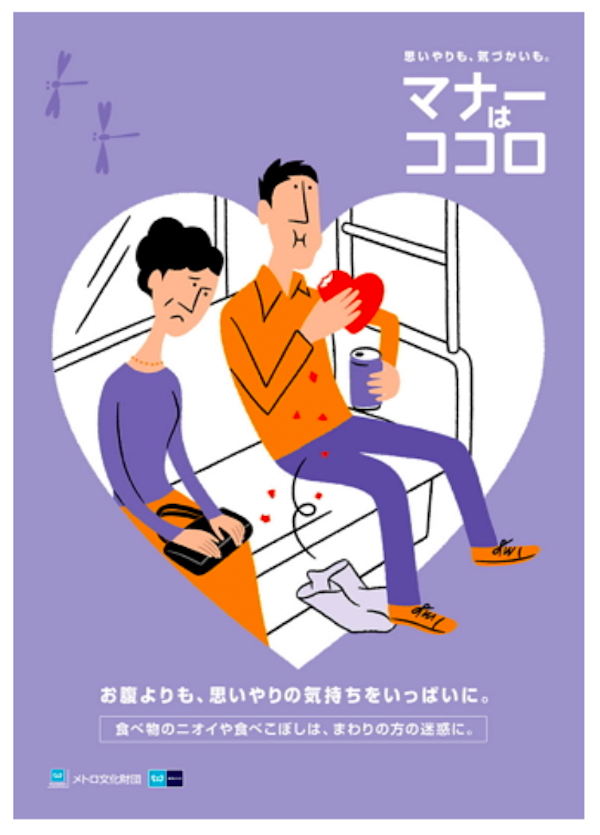
“The Japanese adopt rules and mannerisms different from other cultures. Some rules are the same as other countries, such as eating on subways is not allowed; however, there are others—such as talking on your phone—that are considered rude in Japan. To help foreigners avoid public transport faux pas on its trains—and as a reminder to locals—the Tokyo Metro creates a series of courtesy posters each year to display in its stations and platforms. For 2013, a series of vibrantly colored posters were unveiled—one poster was created for each month, inspired by the months’ activities and season.

Presented in illustrations that accurately and easily get the message across, the posters depict various scenes to help you know how to behave on the subways—and the perils you could cause for behaving in ways that you should not. Even if you don’t read or speak Japanese, you’d know what is considered discourteous, and what you should or should not do, just by looking at the illustrated posters.”
 

Please "do it at home" campaign-


Vintage Tokyo subway manners posters from Pink Tentacle: Here are a few manner posters that appeared in the Tokyo subways between 1976 and 1982.


I'll stand up (July 1979)

Uesugi Teppei, a character from the popular manga "Ore wa Teppei," offers to give up his seat to the elderly and infirm.


Space Invader (March 1979)

This 1979 poster pays tribute to the extremely popular Space Invaders video arcade game and encourages passengers to read their newspapers without invading the space of other passengers.
Don't forget your umbrella (October 1981)

The text at the top of this poster -- which shows Jesus overwhelmed with umbrellas at the Last Supper -- reads "Kasane-gasane no kami-danomi" (lit. "Wishing to God again and again"). The poster makes a play on the words "kasa" (umbrella) and "kasane-gasane" (again and again).
Coughing on the platform (January 1979)

Modeled after the paintings of Henri de Toulouse-Lautrec, this poster -- titled "Hōmu de Concon" (coughing on the platform) -- urges people not to smoke on the train platforms during the designated non-smoking hours (7:00-9:30 AM and 5:00-7:00 PM). The poster makes a play on the words "concon" (coughing sound) and "cancan" (French chorus line dance).


Umbrellas left behind in the subway (June 1976)

This Marilyn Monroe poster aims to remind passengers to take their umbrellas with them when they leave the train. The text in the top right corner -- "Kaerazaru kasa" (umbrella of no return) -- is a play on "Kaerazaru Kawa," the Japanese title for "River of No Return," the 1954 movie starring Monroe.
Directly above and below- From Vibrant Posters For Tokyo Subway, Teach Tourists Manners With Fun Illustrations, By Anthea Quay


Etiquette Enthusiast, Maura J. Graber, is the Site Editor for the Etiquipedia© Etiquette Encyclopedia 

Friday, December 13, 2013

Paris Metro Etiquette

Paris’ public transport body has released a special “politeness” manual to reduce uncouth behaviour in the metro, with a list of “commandments” on how to improve civility from helping clueless tourists to ensuring body odour is not wafted around the carriage.


Arms should be kept by your side at all times on the Paris Metro

“In the context of a global theme of incivility on public transport,” reads the forward, RATP solicited ideas for a guide to manners for our times. From more than 2,000 entries, it culled a dozen ways to be polite, helpful, courteous and not a letch. The result: a clever, tongue-in-cheek 32-page e-book, filled with old-fashioned line drawings and commentary by local personalities.


The guide advises travelers not to play music loudly on the Metro 

The online "manual on savoir-vivre for the modern traveller" includes an array of tips split into four categories: "helpfulness", "courtesy", "manners" and "politeness", drawn up from among more than 2,000 suggestions from the general public.

The first "commandment" on the platform defines courtesy as "understanding that the huge crossed out cigarette on the platform is not a work of art but a ban on smoking".

The "manners" section invites Parisians to help out lost tourists "in Bermuda shirts with a metro map in one hand and the other hand in their hair". "It's worth losing two minutes of your time for a good cause if only to hear the (foreign) passenger struggle to pronounce (the metro stops) 'Trinité d'Estienne d'Orves' or 'La Motte Piquet-Grenelle'," the accompanying text says.


Staring at beautiful women is rude, the online Metro guide says 

  • The key etiquette for the Paris Metro is:
  • Not playing music too loudly through headphones
  • Resisting the temptation to stare for a long time at beautiful women
  • Holding back from starting a fight with someone who’s just stepped on your toes
  • Loud phone conversations should also be avoided
  • Old lady’s bags should be carried up stairs
  • Armpits should be covered by arms and not exposed to the carriage
  • Handkerchiefs not just used to wave someone off with, but to sneeze into.
  • Last but not least – the Metro is not to be mistaken for a lavatory.
Click on link to read ‘Manuel du savoir-vivre à l’usage du voyageur moderne’ – or ‘politeness manual for the modern traveller’ - Paris metro bosses release 'politeness manual'

Etiquette Enthusiast, Maura J. Graber, is the Site Editor for the Etiquipedia© Etiquette Encyclopedia 

Canadian Transit Etiquette

Canadian Public Transit Etiquette

Share the Ride in Halifax-


Common courtesy never goes out of style. In today's world of eco-friendly travel, public transit is becoming a popular commuter option. It’s cost effective and convenient – but what about the experience on board?

Over the years, Metro Transit has heard of ‘bus buddies’ who meet on board our buses and ferries, and stories of chivalry, kindness, and even lifesaving encounters. Our customers want a safe, comfortable, and pleasant ride from point A to B; how can we work together to make sure this happens?

We can Share the Ride–

The Share the Ride campaign is intended to remind customers to exhibit good passenger etiquette on board our buses and ferries by highlighting key behaviours in a humourous way that may keep all passengers from enjoying their journey. Together, let's:
    • Share the seats and space
    • Be mindful of others around you
    • Be courteous and respectful
By engaging in proper behaviour while onboard Metro Transit, we will all experience a better commute.
Not Your Favourite Musk
Share the Ride, not your Favourite Musk

  • Please remember that some people are scent sensitive. Many people suffer from allergies to scented products so avoid wearing strongly scented perfumes on board our buses and ferries.

Not Your Baggage

  • Share the Ride, not your Baggage
  • Please keep the seats next to you free for other passengers.
  • Ensure you take up only one seat; bags should be placed on your lap or stowed under your seat. 
  • Also, be aware of the designated courtesy seating intended for the elderly, mobility-impaired, pregnant women, and children. 


Calgary Transit Etiquette


Etiquette on Transit

Taking transit means sharing space. Literally and figuratively, we're all in it together, so it's important that you treat your fellow riders with courtesy and respect. Even the simplest actions can ensure that everyone, including you, has a more positive transit experience.

In partnership with TransLink, Calgary Transit is launching an etiquette campaign to help promote courteous behaviour on public-transit. Every two months, a different ad will be placed in CTrains and buses to tackle a new passenger habit that could affect other riders.

 
1. Courtesy seating
Seats closest to the doors are for persons with disabilities and/or seniors. People appreciate you offering these seats to them. It's worth remembering that some people have disabilities that aren't always obvious. If someone asks you to give up a seat because they have a disability, please take their word for it.

    
2. Personal audio devices
If other people can hear music through your headphones – it's too loud. Just think about what all that excessive volume is doing to your eardrums. For yourself, and for those around you, please – keep it down.

    
3. Food & Drink
If you are going to eat or drink while riding the system, remember to keep it clean and don’t litter.

    
4. Cell phones
Unless you want to share your conversation with everyone around you, please keep your voice down. The microphone is only a few millimetres from your face - there's no need to yell.

    
5. Keep doorways clear
In order for people to get on the CTrain, people first need to be allowed to get off. Before you board, please stand back and allow passengers to exit.

When on the bus, the area around an exit door might look like a convenient place to lean, but standing there makes it difficult for people wanting to get off (and can be confusing for the driver). Please stand clear and allow people to exit easily.

   
6. Backpacks, luggage, grocery bags, & laptops
Your large bags can be a pain for people around you. Please remove your backpack and put it on the floor – especially when standing as it's easy to bump someone. If seating space is limited, ensure that your personal items are not taking away seats from other passengers. Does your bag really need its own seat?

    
7. Personal hygiene
Rush hour could mean having to be in close quarters with other passengers. Deodorant can make all the difference. But be mindful; many people suffer from allergies to certain scents. Please apply any perfumes and colognes sparingly.

   
8. Make room for others
Our system can get very busy during rush hour and we do not want to leave people behind. When boarding a bus, move towards the back to allow space for others. When on the CTrain, move towards the centre of the train.

    
9. Smoking
Smoking on Transit property is an offense and you can get fined (see Transit Bylaw 4M81, section 14).  Nobody likes second-hand smoke or seeing cigarette butts on the ground.

City of Calgary - Transportation Department - Calgary Transit 

Mid-20th Century Public Transit Etiquette from Toronto


Images below from the City of Toronto Archives


ttc subway cards advertisements wife change husband
The "HATS OFF" SERIES:
ttc subway cards advertisements hats off bill morettc subway cards advertisements hats off heddyttc subway cards advertisements hats off mctushttc subway cards advertisements hats off weir rear
"WE ALL LIKE" SERIES:
ttc subway cards advertisements drape feetttc subway cards advertisements exact fare manttc subway cards advertisements signal earlyttc subway cards advertisements woman shopper rush hour
"SHIPBUILDERS" SERIES:
ttc subway cards advertisements daddy changettc subway cards advertisements big helpttc subway cards advertisements farettc subway cards advertisements lookit empty carttc subway cards advertisements forget changettc subway cards advertisements shipbuilders
"BUMBLING MAN" SERIES:
ttc subway cards advertisements fares readyttc subway cards advertisements move down streetcarttc subway cards advertisements my stopttc subway cards advertisements use rear doorsttc subway cards advertisements ten spot billttc subway cards advertisements tracks
MISCELLANEOUS:
ttc subway cards advertisements birdsttc subway cards advertisements elephantttc subway cards advertisements move away streetcarttc subway cards advertisements kids play roadttc subway cards advertisements remember sawttc subway cards advertisements sinking troubles missed streetcarttc subway cards advertisements sudden stop


Monday, December 9, 2013

Etiquette and Duties of Butlers

“He places the silver and plated articles on the table, sees that everything is in its place, and rectifies what is wrong...”
The domestic duties of the butler are to bring in the eatables at breakfast, and wait upon the family at that meal, assisted by the footman, and see to the cleanliness of everything at table. On taking away, he removes the tray with the china and plate, for which he is responsible. At luncheon, he arranges the meal, and waits unassisted, the footman being now engaged in other duties. At dinner, he places the silver and plated articles on the table, sees that everything is in its place, and rectifies what is wrong. He carries in the first dish, and announces in the drawing-room that dinner is on the table, and respectfully stands by the door until the company are seated, when he takes his place behind his master's chair on the left, to remove the covers, handing them to the other attendants to carry out. After the first course of plates is supplied, his place is at the sideboard to serve the wines, but only when called on.
“After the first course of plates is supplied, his place is at the sideboard to serve the wines, but only when called on.”
The first course ended, he rings the cook's bell, and hands the dishes from the table to the other servants to carry away, receiving from them the second course, which he places on the table, removing the covers as before, and again taking his place at the sideboard.

At dessert, the slips being removed, the butler receives the dessert from the other servants, and arranges it on the table, with plates and glasses, and then takes his place behind his master's chair to hand the wines and ices, while the footman stands behind his mistress for the same purpose, the other attendants leaving the room. Where the old-fashioned practice of having the dessert on the polished table, without any cloth, is still adhered to, the butler should rub off any marks made by the hot dishes before arranging the dessert.

Before dinner, he has satisfied himself that the lamps, candles, or gas-burners are in perfect order, if not lighted, which will usually be the case. Having served every one with their share of the dessert, put the fires in order (when these are used), and seen the lights are all right, at a signal from his master, he and the footman leave the room.

He now proceeds to the drawing-room, arranges the fireplace, and sees to the lights; he then returns to his pantry, prepared to answer the bell, and attend to the company, while the footman is clearing away and cleaning the plate and glasses.

At tea he again attends. At bedtime he appears with the candles; he locks up the plate, secures doors and windows, and sees that all the fires are safe.
 
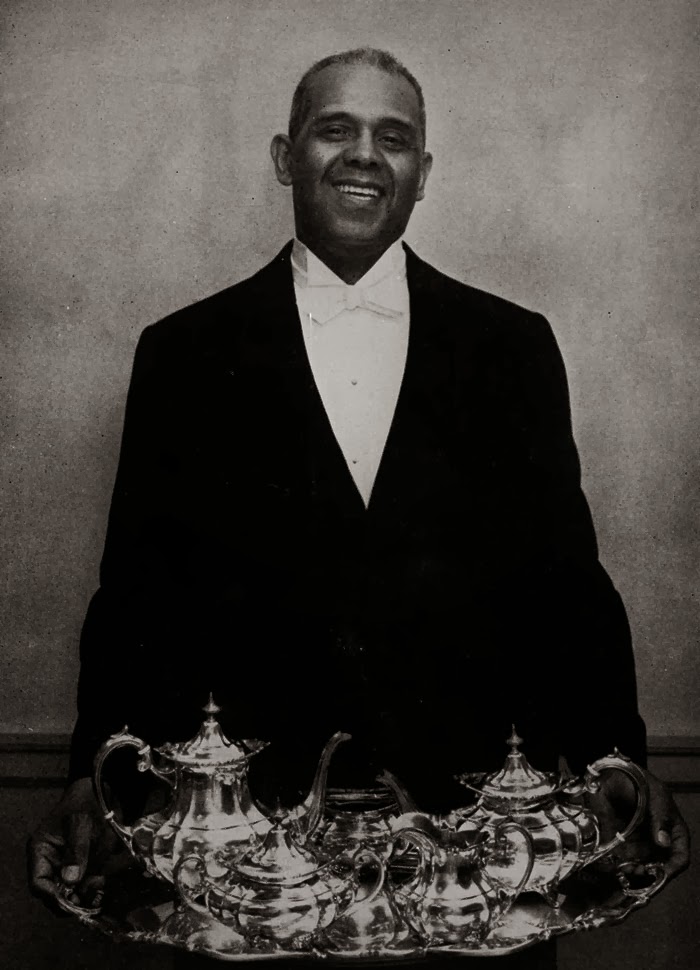
One of the most famous butlers in U.S. history (pictured) was Alonzo Fields (1900-1994). For more than two decades, he served in the White House, under United States Presidents Hoover, Roosevelt, Truman and Eisenhower. – “The office of butler is thus one of very great trust in a household.”

In addition to these duties, the butler, where only one footman is kept, will be required to perform some of the duties of the valet, to pay bills, and superintend the other servants. But the real duties of the butler are in the wine-cellar; there he should be competent to advise his master as to the price and quality of the wine to be laid in; "fine," bottle, cork, and seal it, and place it in the bins. Brewing, racking, and bottling malt liquors, belong to his office, as well as their distribution. These and other drinkables are brought from the cellar every day by his own hands, except where an under-butler is kept; and a careful entry of every bottle used, entered in the cellar-book; so that the book should always show the contents of the cellar.
At tea he again attends.
The office of butler is thus one of very great trust in a household. Here, as elsewhere, honesty is the best policy: the butler should make it his business to understand the proper treatment of the different wines under his charge, which he can easily do from the wine-merchant, and faithfully attend to it; his own reputation will soon compensate for the absence of bribes from unprincipled wine-merchants, if he serves a generous and hospitable master. Nothing spreads more rapidly in society than the reputation of a good wine-cellar, and all that is required is wines well chosen and well cared for; and this a little knowledge, carefully applied, will soon supply.

The butler, we have said, has charge of the contents of the cellars, and it is his duty to keep them in a proper condition, to fine down wine in wood, bottle it off, and store it away in places suited to the sorts. Where wine comes into the cellar ready bottled, it is usual to return the same number of empty bottles; the butler has not, in this case, the same inducements to keep the bottles of the different sorts separated; but where the wine is bottled in the house, he will find his account, not only in keeping them separate, but in rinsing them well, and even washing them with clean water as soon as they are empty.

There are various modes of fining wine: isinglass, gelatine, and gum Arabic are all used for the purpose. Whichever of these articles is used, the process is always the same. Supposing eggs (the cheapest) to be used,—Draw a gallon or so of the wine, and mix one quart of it with the whites of four eggs, by stirring it with a whisk; afterwards, when thoroughly mixed, pour it back into the cask through the bunghole, and stir up the whole cask, in a rotatory direction, with a clean split stick inserted through the bunghole. Having stirred it sufficiently, pour in the remainder of the wine drawn off, until the cask is full; then stir again, skimming off the bubbles that rise to the surface. When thoroughly mixed by stirring, close the bunghole, and leave it to stand for three or four days. This quantity of clarified wine will fine thirteen dozen of port or sherry. The other clearing ingredients are applied in the same manner, the material being cut into small pieces, and dissolved in the quart of wine, and the cask stirred in the same manner.
Having carefully counted the bottles, they are stored away in their respective bins
 To Bottle Wine.—Having thoroughly washed and dried the bottles, supposing they have been before used for the same kind of wine, provide corks, which will be improved by being slightly boiled, or at least steeped in hot water,—a wooden hammer or mallet, a bottling-boot, and a squeezer for the corks. Bore a hole in the lower part of the cask with a gimlet, receiving the liquid stream which follows in the bottle and filterer, which is placed in a tub or basin. This operation is best performed by two persons, one to draw the wine, the other to cork the bottles. The drawer is to see that the bottles are up to the mark, but not too full, the bottle being placed in a clean tub to prevent waste. The corking-boot is buckled by a strap to the knee, the bottle placed in it, and the cork, after being squeezed in the press, driven in by a flat wooden mallet.

As the wine draws near to the bottom of the cask, a thick piece of muslin is placed in the strainer, to prevent the viscous grounds from passing into the bottle.

Having carefully counted the bottles, they are stored away in their respective bins, a layer of sand or sawdust being placed under the first tier, and another over it; a second tier is laid over this, protected by a lath, the head of the second being laid to the bottom of the first; over this another bed of sawdust is laid, not too thick, another lath; and so on till the bin is filled.

Wine so laid in will be ready for use according to its quality and age. Port wine, old in the wood, will be ready to drink in five or six months; but if it is a fruity wine, it will improve every year. Sherry, if of good quality, will be fit to drink as soon as the "sickness" (as its first condition after bottling is called) ceases, and will also improve; but the cellar must be kept at a perfectly steady temperature, neither too hot nor too cold, but about 55° or 60°, and absolutely free from draughts of cold air.

“Sophistication might be described as the ability to cope gracefully with a situation involving the presence of a formidable menace to one's poise and prestige (such as the butler, or the man under the bed -- but never the husband).”  James Thurber 

–From Mrs. Beeton, 
“The Book of Household Management.”


🍽️Etiquette Enthusiast, Maura J. Graber of The RSVP Institute of Etiquette, is the Site Editor for Etiquipedia© Etiquette Encyclopedia

Friday, December 6, 2013

Vintage 1940's and 1950's Frat House Etiquette

From Ch. 6 of the Sigma Phi Epsilon Fraternity Pledge Manual: The Fraternity Gentleman
Copyright 1940, text from 1958 printing

The chances are that you'll find more gentleman per square foot if all the men—


Place knife and fork on plate when not in use.
Turn the blade of the knife in. 
Break a slice of bread into at least four pieces, no less, and butter a bite at a time. 
Chew slowly and thoroughly. 
Use a napkin frequently. 
Sit erect. 
Take small mouthfuls. 
Hold elbows close to body. 
Place spoon in proper saucer. 
Stir liquids briefly and quietly. 
Place your prongs up on plate. 
Hold fork in left hand when cutting foods with knife.
Eat salads and vegetables with fork.
Take soup from side of spoon, scooping thitherwardly.
Converse quietly and not volubly. 
Be natural and at ease. 
Place napkins at left of plate when rising.

A 1940's Fraternity Toga Party; One was still expected to be a gentleman.
Here are other useful points—
A good rule, cut your food with a fork if it is soft and can readily be done this way. Also use fork for vegetables and salads and for pastry dessert. Use the regular dinner fork if no salad or dessert fork has been provided. When you are not using the fork, and after you've finished eating, place it on the plate prongs up. 

The knife is used to cut with and you shouldn't use it to dissect baked potatoes and other such foods. When you're not using the knife, you should place it on the side of the plate, edged turned in. It is incorrect to lean the knife or other utensils against the plate edge. 

When special steak and butter knives are provided, they should be readily recognized.  At the end of the meal the knife and fork should be placed on the plate at an angle of about forty-five degrees to the edge of the table, handle to the right. This is utilitarian for thus the silver has no chance of slipping off the plate when it is taken from the table.

A spoonful of soup is carried just to the lips and not into the mouth. Solids or semi-solids are taken into the mouth, though no farther than necessary, and large or heaping spoonfuls should be avoided. Do not use a spoon for vegetables.

There are some edibles which are to be taken in the fingers such as corn on the cob, olives, pickles, celery, green onions, and artichokes. Chicken is occasionally handled with the fingers, but don't do it unless it's the custom of the house. Crackers or bread shouldn't be broken into soup or stew any more than gravy should be poured over a slice of bread in a plate. And don't dunk.

Of the three methods of serving food, the family style, that of placing the food on the table and allowing the guests to help themselves, is the most informal. When family style is the custom, food should be passed to the right, enabling one to serve a guest before oneself.

North Carolina State's First African American Fraternity, 1971
A more formal style of serving, employed in chapter houses is for special guest dinners and for the evening meal, is to serve on plates from the kitchen or serving pantry.  Bread, butter, and such items may be placed on the table, or these also may be brought in from the kitchen. The host and guests are served first from the left; the plates are also removed from the left. One shouldn't begin to eat until the others have been served and the head of the table or the host himself begins. However, if a nervous or over-hungry guest should start beforehand, it might relieve embarrassment for the members to begin too.

The third style of serving is from the head of the table. From serving dishes placed there, the person at the head portions out the food on the plates, passing them down both sides, without deference to guests. Those at the table pass along their plates for portions, or the plates may all be placed at the head.

There is a good reason for nearly every rule governing table etiquette. People who are naturally courteous and thoughtful have little difficulty in cultivating a good table manners.  The basis of all formal etiquette is consideration for the rights and sensibilities of others. Manners differ from state to state; the local custom should be observed.


"Good taste, so necessary to the college gentleman, is not a commodity that can be bought." A 1955 Fraternity photo from New York

Good Manners
Good Manners are extremely important in every walk of life. Good manners are not merely something taken out of rule books on etiquette but are hard and fast practical assets in human relationship. The acquisition of knowing how to act in the company of other people is one of the most important phases of fraternity life. Politeness, courtesy, and proper behavior can make relationships enjoyable and pleasant. These qualities enable the man who has them to make acquaintances readily and gracefully. On the other hand, where these qualities are absent, social communion is difficult or marked by misunderstanding, embarrassment, and strangeness.

Good manners are the instruments that round of the personality of a man so that it is agreeable and becomes a strong magnet of attraction for fellowship in the business world as well as in campus life.

Good taste, so necessary to the college gentleman, is not a commodity that can be bought. It is a part of careful breeding. The average young man is schooled carefully at home in the niceties of social conduct, yet he is confronted with many new situations at college, and experience teaches the likelihood of the freshmen to grow careless about matters of conduct.

Probably no finer impression can be made upon guests, visiting alumni, rushees, professors, parents, and friends, than a chapter whose members know and show hospitality and good taste. There is no doubt about the weight of good taste in establishing a commendable atmosphere and reputation for the chapter.

Wrote John Henry Newman, English theologian and author of the last century; "It is almost a definition of a gentleman to say that he is one who inflicts no pain, carefully avoids whatever may cause a jar or jolt in the minds of those with whom he is cast. He has no ear for slander or gossip, is scrupulous imputing motives to those who interfere with him and interpret everything for the best. He is never mean or little in his disputes, never takes unfair advantage, never mistakes personalities or sharp sayings for arguments or insinuate evil which he dare not say out. He may be right or wrong in his opinion, but he is too clear headed to be unjust. He is a friend of religious toleration, and that, not only because his philosophy has taught him to look upon all forms of faith with an impartial eye, but also from the gentleness of feeling which is attendant on civilization."


Etiquette. Enthusiast, Maura J Graber, is the Site Editor for the Etiquipedia© Etiquette Encyclopedia

Monday, December 2, 2013

The Father of Courtesy and the Son of Chivalry

 
Richard de Beauchamp, the Father of Courtesy and the Son of Chivalry

Richard de Beauchamp, the Earl of Warwick was dubbed both "The Father of Courtesy" and "The Son of Chivalry." Born in 1382, the English nobleman was knighted at the coronation of King Henry IV and succeeded to the Earldom of Warwick.  In 1401 fought for Henry IV against Owen Glendower and the Percys. In 1408 he set out for the Holy Land, visiting monarchs and fighting in a tournament en route; he made a similarly active return trip through various other parts of Europe. Upon his return to England in 1410, Beauchamp performed several royal missions. During the reign of Henry V, his chief employment was as a trusted counsellor and diplomatist. 
 
Arms of Sir Richard de Beauchamp, 13th Earl of Warwick, KG, as depicted on his stall plate at St. George's Chapel

Richard de Beauchamp was an ambassador to France in September 1413, and the chief English envoy to the coronation of Sigismund at Aix-la-Chapelle, and to the council of Constance in the autumn of 1414. During the campaign of Agincourt he was captain of Calais, where in April 1416 he received Sigismund with such courtly magnificence as to earn from him the title of the "Father of Courtesy."

It is said that the French were expected to besiege the place; but that when de Beauchamp found their forces were bent in a different direction, he caused some new feats of chivalry to be instituted.  The next year he was appointed to receive the surrender of Caen Castle. So great was Henry's confidence in his military skill that he divided the chief commands in Normandy between himself, his brother Clarence, and the Earl of Warwick.
Effigy of Richard de Beauchamp in the Beauchamp Chapel of St Mary's Church, Warwick

Upon Henry's death in 1422, de Beauchamp became a member of the council for the infant Henry VI. He then served as tutor to the young king from 1428 to 1437, when he was appointed the lieutenant of Normandy & France. Richard de Beauchamp was a man of piety and courtesy and was famed in Europe as a chivalrous knight. His daughter Anne married and brought the earldom to Richard Neville, Earl of Warwick. He died in 1439.

On Chivalry 


Chivalry was originally the gallantry and honor expected of medieval knights, though today it refers to behaving in an honorable or polite way, and showing respect toward women. The ideal of courteous knightly conduct developed in the 12th to 13th century. Arising out of feudal obligation, it stressed loyalty and obeisance by knights to their God, their lords and their ladies. This was a melding of both Christian and military virtues.
In the 14th to 15th century, chivalry came to be associated increasingly with aristocratic display and public ceremony, particularly in jousting tournaments, rather than with service in the field.

Chivalry was greatly strengthened by the Crusades, a military endeavor on behalf of Christianity, which led to the founding of the earliest orders of chivalry, the Knights of Malta and the Templars. In addition to loyalty and honor, the chivalric virtues included courtesy, chastity, valor and piety.  Questions of love and honor were combined in the ethos of courtly love. The knight's lady was meant to be unobtainable, ensuring chastity; the feminine ideal thus became melded with the Virgin Mary. 

Etiquette Enthusiast, Maura J Graber, is the Site Editor for the Etiquipedia© Etiquette Encyclopedia