Sunday, January 15, 2023

A Woman’s Refusal of Good Manners

When did chivalry die? When did women openly refuse to accept chivalric behavior from men? Many people will say it was after women went to work in WWII and “won their freedom,” but others will say it was in the 1960’s with the advent of Women’s Lib and “the Pill.” Gathering from this news’ account from 1904, chivalry was spurned much earlier than people suspect!  


A little newspaper anecdote the other day bears entertainingly on this mooted question. “Keep your seat, sir,” said a young lady, authoritatively, to an elderly gentleman who seemed about to rise in a street car. He sank back, abashed, but presently, more resolutely, rose, and the lady with emphasis exclaimed: “I will not take your seat, I do not mind standing! I am accustomed to it.” “Take the seat, madam, or leave it,” answered the gentleman; “I want to get out of the car.”

The bad manners of women on the road are inexcusable from every point of view. Why should a woman occupy two seats when she has paid for only one? Yet this is constantly done. A woman seats herself comfortably and then piles her bundles and boxes beside her, staring stonily ahead, when others enter the conveyance. The natural inference of newcomers is that the extra seat is being reserved for a friend, and they pass on without inquiry. If a more daring person ventures to ask, “Madam, is this seat taken?” the “No” is grudgingly spoken, and the luggage is removed with an air of injury.

Women are needlessly brusque and curt in their manner to conductors, and are conspicuously thoughtless in allowing their children to monopolize space to which the latter have no right.— From “Good Manners for All Occasions,” 1904


🍽️Etiquette Enthusiast, Maura J. Graber, is the Site Editor for the Etiquipedia© Etiquette Encyclopedia

Saturday, January 14, 2023

The Impetus of 90’s Etiquette Era?

On a flight from New York to Paris, the etiquette authority Letitia Baldrige found herself seated next to a nearly nude dude from California. “Bared to the waist, he was,” she said. “The flight attendants didn't say one thing. He was a surfer, very suntanned, and I must say he had a great body.” Contributing to the decline in decorum, in Ms. Baldrige's view, is a growing folksiness in the corporate culture. “Companies are telling employees to first-name everyone, to forget about deference to age and rank,” she said. “All of a sudden, it's not only the C.E.O., but the clergyman and the schoolteacher who are being called Joe. It's spreading like wildfire.”

Informality Reigns, And Good Manners Get a Bad Name – Was this the impetus for the eventual “1990’s Etiquette Era”?


THE pleasure of your company is requested in a new age of informality. Do not bother to R.S.V.P. Do not get done up in black tie. The mood just now is one of casualness in dress, in manners, on all fronts.

This is the time of the artfully unmade bed (rise, take up your downy duvet and toss it); the carry-out dinner; the telephone solicitor who calls at all hours and addresses you by your first name.

A date for the movies and Chinese food nowadays does not necessarily mean two distinct activities. Not in the age of informality. And not in New York, where any number of moviegoers are capable of eating Sichuan from a carton while following the action on the screen. The pros use chopsticks.

Q. Is the informality of the 1990’s anything like the informality of the 60’s?

A. No. Women wore T-shirts and no bras in the 60’s. Today it’s bras and no shirts.

In keeping with the new informality, affluent urbanites who once drove around town in BMW’s have switched to Jeep Cherokees and Ford Explorers. “It feels right now,” said Steven Meier, a Manhattan lawyer who travels to meetings in his trusty Explorer dressed in a sports jacket and khakis.

A blue suit with a Giorgio Armani label hangs in his office closet “in case I have to impress a client.” But he rarely reaches for it. “In today’s economy you don't want to wow ‘em with your elegant shoes, your gold ring, your fancy car,” Mr. Meier said. “That's not the style anymore.”

Along Park Avenue, social couples who once did time on the charity circuit now look upon opulent parties as boring or embarrassing. Let’s have some of that new informality, they say. Which may explain the number of informal charity parties on the calendar this season.

Take, for example, the Lenox Hill Neighborhood Association's Bingo and Barbecue Benefit in June. The association used to hold black-tie auctions and sales of antiques and artworks. A couple of years ago, it sponsored a benefit sale of watercolors from the collections of Louis XIV, the Empress Josephine, Napoleon and members of the French court.

Let them eat barbecue.

“There is a wish for greater informality in these gatherings,” said George Trescher, the marketing consultant who runs most of New York's big charity events. “Particularly if you're trying to mix groups of young and older guests.”


Mr. Trescher, who was tieless at the time, said the dress code has been unraveling for years now. But jeans at the theater? The ballet? The opera? “Yes, yes,” he said. “What's new is that nobody looks askance at it. It's laissez-faire.”

Heads did not turn unduly when Kevin Walz took an aisle seat in the orchestra at the Metropolitan Opera the other night. He was wearing wool pants, no jacket and a plaid shirt unbuttoned at the neck to reveal his undershirt.

“What a bum, huh?” he said, stroking his chin. “I didn't even shave.”

Mr. Walz, a furniture designer, was dressed for a rock concert he planned to attend after “The Marriage of Figaro.” He said a trend toward piggybacking cultural events might have something to do with the new informality.

“Last month I went to the ballet in jeans for an evening of Stravinsky and then down to the Ritz,” he said. ”I snuck out five minutes early so I wouldn't miss the Pixies.”

To observe the new informality on the move, hang around in an airport terminal. Count the sneakers, the shorts, the sweatsuits, even in business class.

“We were talking about that the other day, coming back from Barbados,” said Sisi Cahan of Manhattan, a frequent flier long before they had clubs. “People used to look terrific traveling, and now they look ghastly. I haven't seen anyone attractive in an airport in years.”

On a flight from New York to Paris, the etiquette authority Letitia Baldrige found herself seated next to a nearly nude dude from California.


“Bared to the waist, he was,” she said. “The flight attendants didn't say one thing. He was a surfer, very suntanned, and I must say he had a great body.”

Contributing to the decline in decorum, in Ms. Baldrige's view, is a growing folksiness in the corporate culture. “Companies are telling employees to first-name everyone, to forget about deference to age and rank,” she said. “All of a sudden, it's not only the C.E.O., but the clergyman and the schoolteacher who are being called Joe. It's spreading like wildfire.”

Ms. Baldrige, who lives in Washington and lectures around the country, went on to say that “down here the diplomats try to hold onto some formality in entertaining, but it's getting worse and worse.”

“Some people don't even bother to R.S.V.P.,” she said. “Other people accept for seated black-tie dinners and don't show up. Or they show up with small children. ‘Oh, I couldn't get a baby sitter -- knew you wouldn't mind.’”

For an academic look at the reasons behind the new informality, put in a call to Michael T. Marsden, a professor of popular culture at Bowling Green State University in Ohio.

A secretary answered the phone, informally. (“This is Sylvia.”)

The caller asked for Professor Marsden. (“Hi, this is Mike.”)

Professor Marsden cautioned against comparing the informality of the 1960’s, which was real and deep and wide, to the informality of the 90’s. It could be one of those behavioral blips on the East and West Coasts that never go anywhere.


“In the 60’s, wearing blue jeans was identifying with the working-class culture,” he said. “In today’s, world the up-and-coming executive is supposed to aspire to the leisure life. What better way to show this than to wear a sweatsuit? It's costuming.”

Nonetheless, Professor Marsden went on, society has thrown off some formal trappings taken on in the 80’s. “But not all,” he said. “Look at weddings. Formal weddings are on the rise. As for funerals, when people are laid out at wakes, they're generally dressed formally. It's not likely you’ll find somebody being buried in their sweatsuit.”

In any case, elaborate entertaining is out in New York. No more putting on the dog for company. Caterers who used to gussie up trays of hors d'oeuvres with foie gras medallions say they are making meatloaf, mashed potatoes and beans. “But beans don't have to be beige or boring,” said Susan Simon, whose catering company on the Lower East Side has always been known for its stylish and informal food.

And guests like Mr. Walz, the jeans-at-the-ballet man, find the down-home feeling refreshing. “You even see Pyrex on the table now,” he said. “People are much more casual about entertaining. They're acknowledging that life is tough in New York. What's important is that we're all together, having dinner. So what if there are a dozen kids underfoot and the centerpiece is daisies?”

When not dining at home, some busy New Yorkers are dining out, informally, while doing something else or waiting to do something else. In coin laundries, in bank lines, in doctors' offices, everywhere there is the crinkle of foil unfolding, the snap of aluminum cans opening.

Subways, always informal, have become more so with commuters breakfasting on bagels and coffee and applying major makeup and nail polish. On the F train the other day, Lucinda McBride blotted her lips with a tissue, smiled and said, “My mother said never put on lipstick in public.” She went on to apply eye shadow and mascara as the train rumbled from Brooklyn toward Manhattan.

“This is how I get ready for the office,” Ms. McBride said, studying her face in a mirror. “I've got two kids under 6.”


That's nothing, according to Phyllis Hall, who works for a trade magazine in Manhattan and commutes on a No. 68 N.J. Transit bus with a man who manages to change from sports clothes to a business suit on the turnpike.

“By the time we come out of the Lincoln Tunnel, he's in full business attire,” she said. “He even does cuff links.”

Here is the new informality personified. Except for the cuff links. They must go. – The New York Times, April 1, 1992


🍽Etiquette Enthusiast, Maura J. Graber, is the Site Editor for the Etiquipedia© Etiquette Encyclopedia

Friday, January 13, 2023

Manners and Mid- 20th C. Parties

The hostess also gets to decide how her table looks. The hostess of 1956 was encouraged to get the place settings she wanted by making these place mats herself! — Image from “Needlework and Crafts Magazine,” 1956

Filed Under “Manners Can Make Friends

If a hostess is giving a large party, inviting guests in two or three shifts, go during the time mentioned on your invitation. It isn't good manners to decide it would be more fun to go with friends invited for a different hour. The hostess, not the guest, is supposed to set the time.— The Napa Valley Register, 1956


🍽️Etiquette Enthusiast, Maura J. Graber, is the Site Editor for the Etiquipedia© Etiquette Encyclopedia

Thursday, January 12, 2023

Compassion, Courtesy and Physical Ailments

 Supporting Friends with Physical Ailments

Man in Wheelchair

Physical ailments can be difficult to deal with for those who suffer from them.  But when a disease is more obvious, or even embarrassing, it can really take its toll.

When the person suffering is a friend or someone close to you, of course you want to be supportive and helpful.  But how do you do this without overstepping boundaries?

Just Be There

Sometimes, the simple gift of your time is enough to lift spirits.  Especially if you join in an activity that offers your loved one a mental vacation from the illness.

Perhaps a movie, a card game, board game or, if possible, a walk in the park or at the beach.

Your time spent together doesn't need to include conversation about your friend's disease, unless she wants to discuss it.  In the meantime, target pleasant topics that the two of you enjoy.

What to Say - Or Not

When someone chooses to discuss his illness, listening is key.  He may not be asking for sympathy, just a sympathetic ear.

Realize the problem may be causing pain, discomfort, and embarrassment.  So don't stare, ask prying questions, or give unsolicited advice.  

Avoid saying something that suggests you know what your friend is feeling unless you truly know from experience.  If she describes her bout with Crohn's Disease or colitis, she probably isn't interested in hearing you compare that to your recent stomach virus.

And if someone makes a joke about his own condition, you don't necessarily need to join in.  He may be covering his embarrassment or sensitivity about his physical ailment and your joining in could ruin his cover.  In your friendliest of ways, let him have his joke then move the conversation forward.

People who are suffering do not want to be corrected if they eat something you don't think is good for them.  Unless you are a caregiver, keep those opinions to yourself.  However, if you are very close, tell the person you have a subject to bring up and ask permission to do so.  Choose a quiet, relaxed time.  And do your best not to be discouraging.

When your advice is requested, and you feel up to the task, give it in a caring, authentic manner.  You have been trusted to do so.

“… my youthful passion for exploring the possibilities of my life have been humbled and now,  four decades later and post 22 years of trembling from what is called Parkinson's Disease, the lines between fear and respect have become blurred…” –  A former student

When Out and About

Those suffering from physical ailments may want or need to shop, work, do errands, or go out for social enjoyment. They may want to be just with you.  

If you are out with a group of people who do not know about your friend's illness, there is no reason to say anything unless it's obvious that something is wrong at the time.

Don't ask someone who is ill to do something she can't, but don't assume you know her limits.  Let her be the guide.  For example, if you are out shopping and your loved one says she needs to take a break, act immediately to honor the request.  Find a bench or nearby cafe where you can sit and rest for a while.

If a person asks for assistance, of course give it, but don't offer unless asked.  Or when help is obviously needed ask, "How can I help?" or "What's the best way I can help?"  It may be that you need say nothing and simply take a swift action, like swiping a ream of paper off a high shelf when your coworker in a wheelchair is refilling the paper in the printer.

The Rules of Common Courtesy Should Always Be Applied

Avoid judging or seeming fearful of someone who has an obvious condition, but also avoid over-sympathizing.

Don't hold back from being your friendly, cheerful self.  Sharing a smile, or a little laughter, may be the best of medicines!  

And the bottom line: always treat others as you would want to be treated.


Contributor Candace Smith, teaches university students and professionals, the soft skills of etiquette and protocol. She found these skills necessary in her own life after her husband received international recognition in 2002. Plunged into a new “normal” of travel and formal social gatherings with global leaders, she discovered how uncomfortable she was in many important social situations. After extensive training in etiquette and protocol, Candace realized a markedly increased confidence level in meeting and greeting and dining skills and was inspired to share these skills that will help others gain comfort and confidence in dining and networking situations. Learn more at http://www.candacesmithetiquette.com/


🍽️Etiquette Enthusiast, Maura J. Graber, is the Site Editor for the Etiquipedia© Etiquette Encyclopedia


Wednesday, January 11, 2023

Train Travel Etiquette

As for the chewing-gum monstrosity, it is simply unspeakably hateful. Fortunately for the hygiene and the comfort of travelers, the revolting habit of expectoration in public conveyances is a thing of the past…

A Minor Infliction

Among the disagreeable features of a short suburban journey may be mentioned the habit of munching peanuts or eating fruit or candy, in which ill-bred people indulge. A decorous luncheon eaten at the luncheon hour is not an offense to anyone, but it is a distinct misery to sit near a party of people who are eating peanuts and scattering shells upon the floor, and the odor of oranges and bananas on a train is nauseating to many.

As for the chewing-gum monstrosity, it is simply unspeakably hateful. Fortunately for the hygiene and the comfort of travelers, the revolting habit of expectoration in public conveyances is a thing of the past; prohibited under penalties of fine and imprisonment by modern boards of health, it has had its odious day, and no longer moves fastidious strangers from abroad to write of us as if we were a horde of barbarians instead of a refined and wholesome nation, with standards of purity and excellence to maintain.— From “Good Manners for All Occasions,” 1904


 🍽Etiquette Enthusiast, Maura J Graber, is the Site Editor for Etiquipedia© Etiquette Encyclopedia

Tuesday, January 10, 2023

Etiquette, Compassion and Dementia

Talking with People Who Are 
Living with Dementia

Father and Daughter Memories

Around 55 million people worldwide are living with dementia, according to the World Health Organization. Many of us know someone who either has some form of dementia or cares for someone who has it.

A good friend who lives in an assisted care community suggested I cover the topic of speaking with someone who has a memory disease. She finds that persons living with dementia are sometimes disregarded, perhaps because, as one person explained to her, “They’ll forget anyway.”

Back to Basics

My friend offered these polite tips for communicating with a memory-challenged person, and they happen to be at the core of every good communication.

  • Maintain eye contact and sit as close as possible without invading the person’s space.
  • Wear your smile along with a relaxed facial expression. 
  • Be patient and let the person finish their thought. If they falter, interrupt only to say, “And you were telling me about …”
  • If someone forgets where they are or that their loved one is gone, go along by saying something like
    “Mom, when Dad was alive you used to tease him about his jokes. You always said that he made the silliest jokes.”
    “Jackie, last week you told me there are several good things about living here. Let’s see, what did you say that happens here that makes you smile?”

Principles of Kindness for Someone Living with Dementia

Cognitive and memory illnesses are most often chronic and progressive, so those who have them are aware of the challenges they are experiencing. This knowledge creates anxiety and many times social withdrawal as well.

When spending time with someone who has this type of disease, or even meeting them when out and about, the key is to be kind and to do your best to meet them where they are. 

  • Always speak in a respectful tone of voice.  People with dementia often are uncomfortable as they experience stress within their forgetfulness. 
  • Anticipate the repeating or revisiting of questions or thoughts.  Try bringing up the subject or question that you already know will be posed. 
    “Grandma, tell me again about when you were little and used to teach school.” 
    “What is your favorite question to ask me when I visit you?”
  • Listen and be present and available.  Letting a loved one know you are there by validating that you want to hear and understand what they are saying. 
    “Grandpa, I am here and am ready for a hug anytime you like. Tell me more about what you’ve been thinking.”
  • Acknowledge emotions.  When someone is losing a sense of their ability to express thoughts and memories, they may become upset and even angry.  If an unreasonable demand is made, focus on the feeling. 
    “Jonny, I hear you saying you don’t want to live here. It must be very frustrating to wake up and not know where you are.”
  • Divert with positivity.  “Dad, I understand that you are sad. I get sad when you are sad.  Let’s head down to the community room and you can show me the week’s activity calendar and we can go through those together.”

Arguing with or correcting a person with dementia is off limits. “Yes, Mary, I understand you feel that way,” is a good way to offset a challenging moment. Those of us on the other side can remind ourselves that for someone living with dementia, thirty years ago may be closer than thirty minutes ago.


Contributor Candace Smith, teaches university students and professionals, the soft skills of etiquette and protocol. She found these skills necessary in her own life after her husband received international recognition in 2002. Plunged into a new “normal” of travel and formal social gatherings with global leaders, she discovered how uncomfortable she was in many important social situations. After extensive training in etiquette and protocol, Candace realized a markedly increased confidence level in meeting and greeting and dining skills and was inspired to share these skills that will help others gain comfort and confidence in dining and networking situations. Learn more at http://www.candacesmithetiquette.com/


🍽️Etiquette Enthusiast, Maura J. Graber, is the Site Editor for the Etiquipedia© Etiquette Encyclopedia

Monday, January 9, 2023

Gilded Age Dinner Guest Lists

Great care should be taken to invite those who are agreeable to each other. Good talkers and good listeners are equally invaluable at a dinner. 
TO shine at the dinner table requires much conversant practice with polite life. Persons invited to a dinner party should be of the same standing in society. They need not be acquaintances, yet they should be such as move in the same class or circles. 
Great care should be taken to invite those who are agreeable to each other. Good talkers and good listeners are equally invaluable at a dinner. Among your guests always have one or more musicians. This will add greatly to the entertainment of your friends before and after dinner. —From “Rules of Etiquette and Home Culture,” 1890

 🍽Etiquette Enthusiast, Maura J Graber, is the Site Editor for Etiquipedia© Etiquette Encyclopedia

Sunday, January 8, 2023

Etiquette for Respect in Japan

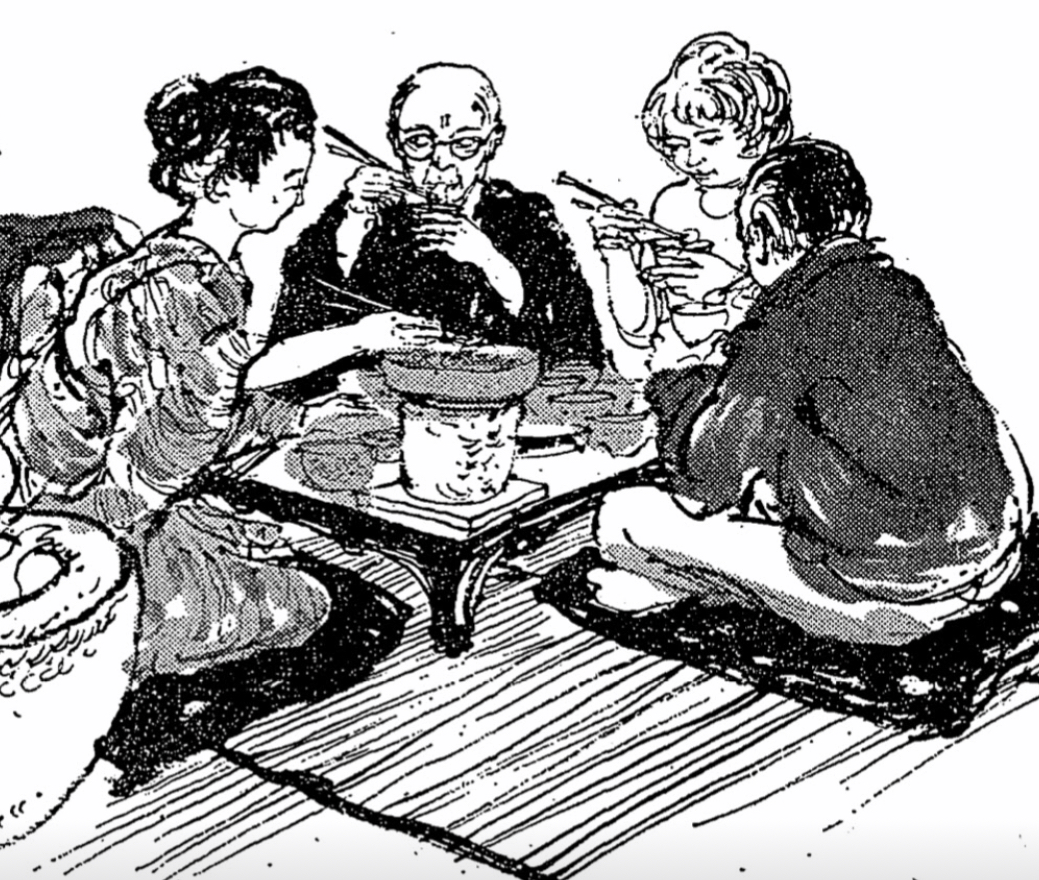
Sucking in the breath is Japanese etiquette for respect and appreciation, and when I intimated anything derogatory to the daikon to a Japanese acquaintance, he commented on our lively cheese. 

When She Ate Her Evil Smelling “Daikon”

Certainly, she had a way of sucking in her breath that put our teeth on edge, and we fled the house when she ate her evil smelling “daikon,” a long white radish, which also would make a skunk remark, “there's no use in living.” But sucking in the breath is Japanese etiquette for respect and appreciation, and when I intimated anything derogatory to the daikon to a Japanese acquaintance, he commented on our lively cheese. Thus the races keep tabs on one another and suppress vainglory. But I silently reflected that a foreigner cooking and eating alone would soon come to serving himself out of sardine boxes and baked beans from the can.

The root of this difference seems to lie in the fact that in the Orient, house-keeping is almost the only profession open to women. This is why they are so expert and pleasing in their methods. From the Empress to the maid there is but one law. In the handbook, which every Japanese woman knows by heart, “The Code of Morals for Women,” No. 16 of the eighteen articles reads: “Though a woman have many servants, it is the rule of women that she do all the business herself. She shall sew the clothing and cook the food of her father and mother-in-law; she shall wash the clothing and sweep the mat of her husband, and when she nurses the child she shall wash the linen herself. Women shall always live within the house, and also not go out without any business.” — From “The Aesthetic Housekeepers of Japan,” by Mary Gay Humphreys, 1904


 🍽Etiquette Enthusiast, Maura J Graber, is the Site Editor for Etiquipedia© Etiquette Encyclopedia