Saturday, December 11, 2021

Chinese Dimsum Etiquette

Fingers, Forks or Chopsticks: Dimsum are finger and/or chopstick foods but forks are usually provided. As a finale, moist fingertip towels, rolled into small cylinders and warmed are a welcome touch. Some Chinese restaurants offer the packaged towelettes after meals as the use of fingers is inevitable at the Chinese table.

Dimsum Etiquette: How and when to serve at Chinese restaurants and tea parlors dimsum are served piping hot from bamboo and metal steamer trays and serving carts. As the endless profusion of carts tempt diners, trays and platters accumulate on the table. 

Proper etiquette is to stack, not remove, as you’ll be charged for the number of trays/platters/plates of dimsum you’ve consumed. Tea is the appropriate accompaniment. Once you’ve sampled an impressive variety the meal may be topped off with a soup or a noodle dish and a sweet dimsum. The meal may be breakfast, lunch, brunch or tea lunch, called “yum cha” by the Chinese.

Fingers, Forks or Chopsticks: Dimsum are finger and/or chopstick foods but forks are usually provided. As a finale, moist fingertip towels, rolled into small cylinders and warmed are a welcome touch. Some Chinese restaurants offer the packaged towelettes after meals as the use of fingers is inevitable at the Chinese table.

“Come to Yum Cha”: Now savvy hostesses can invite guests for “Yum Cha” instead of brunch. Using the five dimsum now available as the main part of the meal, supplementary tidbits may be prepared in advance to round out the menu: thin slices of Chinese roast pork, sliced abalone, savory stuffed bits of red and green pepper, zucchini cut into 1½ inch pieces make dainty cups for meat filling, pieces of spareribs, radish fans and crunchy cucumber sticks can be prepared well in advance. A hot pepper sauce, white vinegar and soy sauce make appropriate sauces.

What's for dessert?: Miniature buns with a sweet filling made of lotus seeds or bean paste are usually offered. Flaky pastries, miniature custard tarts, sesame rice balls, steamed sponge cake, almond cookies and assorted fruits served on a pick are also available. Preserved ginger, kumquats, lychee, mandarin orange, persimmons, melon and seasonal fruits are often favored over pastry by the Chinese.

Breads: East and West Americans are accustomed to crusty breads oven baked. Most Chinese homes don't have ovens so steaming and sauteeing are practical cooking methods for them. Some dimsum are sauteed or deep fried. These are crisp and crunchy. But many dimsum are steamed. They have a shiny, translucent appearance, unfamiliar to the Western world. They look uncooked because of their pale color. But seasoned cooks know that steaming is a good cooking method for preserving natural flavors of most foods.

The Art of Steaming: Families who appreciate the natural flavor of vegetables and cereals have turned to steaming in recent years. Small, perforated-steamers that collapse to fit a variety of sizes of saucepans are available in most housewares stores. But a steamer can be improvised by using a deep saucepan, roaster or electric skillet with domed lid. 

Use custard cups or small potted meat cans on the bottom of the utensil, set a wire rack over that, and place dimsum on a perforated foil plate. Or if you have a strainer or colander that fits over a deep saucepan, that can also be used. Bamboo and aluminum steamers that fit over the Chinese wok are available from mail order houses and specialty stores, but they are not necessary.

What about steaming dimsum in a double boiler? Not recommended. That is cooking over hot water. Dimsum need to be exposed to live steam to cook thoroughly. How long can dimsum be held before serving? They should be served piping hot, right out of the steamer as cooling congeals the wrapper and fillings lose their fluffy texture. – The Desert Sun, 1979


Etiquette Enthusiast, Maura J. Graber, is the Site Editor for the Etiquipedia© Etiquette Encyclopedia

Friday, December 10, 2021

Polish Your Poise and Vocabulary

Vulgarity IS no substitute for wit, as the Dowager Countess would say. And Jennifer L. Scott most likely agrees with her. This post comes from her wonderful book, “Polish Your Poise with Madame Chic” – “… how can you deal with a society that increasingly devalues language and lauds the curse word? When I hear people cursing loudly in public, especially when I'm with my girls, I long to give the curser an etiquette smack-down. But I resist because I think setting a good example is more effective. You can commit to being a good example too.”


Polishing Your Poise with MADAME CHIC 
By Eliminating Vulgarities


Poised people do not have potty mouth. If you struggle with this, and are committed to cultivating poise, it's time to clean up your language. I have not always been an angel in this area. When I was younger, I thought it was cool to swear and did so regularly when talking with my friends. Then after I observed how carefully Madame Chic always chose her words, swearing with my friends no longer felt funny to me, it just felt crass. When I decided to cultivate poise, I knew it had no place in my life. Cleaning up your language isn't always easy. I'm not promising that when I stub my toe an expletive won't come out of my mouth, but on the whole, I commit to being conscious about the words I speak. 

When you commit to cleaning up your language, you might have to clean up the music you listen to and the entertainment you watch as well. The other day my husband and I decided to watch a popular detective show from a cable net work because we had heard from many people that it was the “best ever.” We had to check it out! Twenty-five minutes into the first episode, I had to turn it off. My husband agreed. I don't care how brilliant a show is, I don't feel like listening to the f-bomb being dropped every ten seconds. Now that I've committed to cleaning up my language, listening to someone litter their speech with swear words is like watching a big black fly floating in a pretty china teacup. Perhaps this is why I like Downton Abbey so much? I'm sure that's one of many reasons.

So how can you deal with a society that increasingly devalues language and lauds the curse word? When I hear people cursing loudly in public, especially when I'm with my girls, I long to give the curser an etiquette smack-down. But I resist because I think setting a good example is more effective. You can commit to being a good example too. When you are at lunch with your friend who casually says the f-word repeatedly over salad and iced tea, you can commit to not joining in. You can commit to making all the sounds that come out of your mouth beautiful and empowering. Perhaps she will get it. Perhaps she won't. It doesn't matter. All that matters is that you are making a choice as to how your speech will affect the world. You have viewers, and they will be attracted to how intelligent and levelheaded you sound. Madame Chic never cursed. Nary a “zut alors!” came out of her mouth. She chose her words carefully, and now I choose to do the same.


When she arrived at Madame Chic’s Parisian apartment as a foreign exchange student, Jennifer Scott was a casual California girl who thought sweatpants were appropriate street attire. Madame Chic took Jennifer under her wing and tutored her in the secrets of how the French elevate the little things in life to the art of living. Years later, Jennifer was back in California with a husband, two young daughters, a dog, and her first home. Every day she confronted mundane duties like folding laundry and unloading the dishwasher, and she began to think about Madame Chic’s home—how the breakfast table was set beautifully the night before, the music that always played in the background, the calm of Madame and Monsieur Chic’s ritual cocktail hour together. Jennifer wanted that life. She decided to see what would happen if she didn’t perform her chores impatiently or mindlessly, if, instead, she could live like Madame Chic… This is just one of the books from her marvelous series.

🍽️Etiquette Enthusiast, Maura J. Graber of The RSVP Institute of Etiquette, is the Site Editor of the Etiquipedia© Etiquette Encyclopedia

Thursday, December 9, 2021

Dining Table Customs in Mexico

If your food doesn’t arrive to the table in the tortillas, you can use them as they were used in 1883. Just don’t try spitting on the floor. It’s definitely fallen out of fashion, and in restaurants, is most likely illegal and violates health codes.
-Image source, Etiquipedia private library

Fannie Brigham Ward, in a letter from the City of Mexico to the St. Paul Pioneer-Press, thus relates some experiences in dining in that suburb of the United States: “During eight months’ residence in Mexico, I have not seen a bit of butter, potato, chop or steak, egg cooked by itself, tea, sauce, cake, pie or pudding, or those common vegetables which we consider so indispensable. Napkins are rarely used, each person wiping his or her face and hands on that portion of the tablecloth which happens to be nearest, and afterward, patronizing one of the before mentioned corner wash-stands. 

Eating with the fork is not at all according to etiquette, but the knife or spoon must be used, or – more properly– a tortilla. Mexicans manage the latter with as much dexterity as a Chinese does his chop-sticks, curving it between the fingers till it forms a something like a spoon, and scooping up the food with it– eating spoon and all. The very old people and the lower classes use tortillas altogether instead of knives, forks or spoons, the latter “new fangled notions” being of comparatively recent introduction. It requires considerable practice to successfully manage the tortilla scoop, as I have learned from sad experience. 

After the banquet is ended, and at intervals during its progress, if one feels so inclined, the mouth is filled with water from the goblet, rinsed with more or less emphasis between the teeth, and then the water is squirted upon the floor. In this process they all become expert, from the lady of the house to the smallest child. When fresher water is required, that in the glasses is carelessly tossed up on the dirt floor, where it can do no harm. – The Napa Register, 1883

 Etiquette Enthusiast, Maura J. Graber, is the Site Editor for the Etiquipedia© Etiquette Encyclopedia

Wednesday, December 8, 2021

Etiquette Found in Nature

No “social pressure” can have been put upon the raccoons at the zoo to make them conform to the laws of the ‘coon etiquette, but they do so all the same…
-Image source, Cliff C. Graber


The Raccoon

The common American Raccoon (or “Coon”) is a slave to an unusual form of etiquette, which in its case has grown almost beyond the forms of conventional observance and become a kind of conscience to it. It will wash everything which it eats, if there is any water near. The fact seems to have been questioned by some writers, but it is certainly the habit of raccoons when kept in captivity with access to water. They are very fussy, particular creatures, much given to picking up and carrying off anything odd which takes their fancy. And this, whatever it may be, is duly taken to the water and well “rinsed out,” whether vegetables or bits of cloth, or even solid hard things, like shells and shiny stones.

No “social pressure” can have been put upon the raccoons at the zoo to make them conform to the laws of the ‘coon etiquette, but they do so all the same, and it is a fact that, last spring, one which had a litter of young ones, to which she was much attached, was suddenly seized with a desire to wash them, and carrying them down one by one to her little stone bath paddled and washed the poor little creatures as if she had been washing cabbages. It may be doubted whether the kittens did not owe their death to this perverted feeling of social duty in their parent, for they did not long survive their immersion. – London Spectator, 1895 


Etiquette Enthusiast, Maura J. Graber, is the Site Editor for the Etiquipedia© Etiquette Encyclopedia

Tuesday, December 7, 2021

When the Fork First Evolved

Selection of early types of forks. Originating in Africa and the Middle East, and considered truly an oddity at first, forks slowly grew popular in royal European courts. Books on courtly manners and courtly customs were also being written and more frequently read, though most of the European public was oblivious to them. Silver utensils of all sorts, along with specialized tableware, was created for the wealthy, upper classes. Many travelers carried their utensils with them, either in cased sets or as foldable articles. 
⚜️⚜️⚜️⚜️⚜️⚜️⚜️⚜️⚜️⚜️⚜️⚜️
We must wait 4,000 years before we find the fork. Or, as a French writer on table etiquette has said, “from the creation of the world to the beginning of the seventeenth century, man ate only with his fingers.” This is, however, a mistake of 400 years…

-Image source Etiquipedia private library and collection
Table Manners… How They Have Evoluted (sic) Out of Savage Customs

How did table manners arise? Where do they come from? Like Topsy and other human institutions, “they just growed.” And it is surprising how slow of development has been the sentiment of cleanliness and neatness which was the principal cause of the invention of the implements and dishes used in serving food and eating.


In good old paleolithic times, when human beings were always within 24 hours of starvation, man ate only with his fingers. He hunted for his food in the woods or by the seashore, and he picked the bones clean. Two table articles are found among uncivilized people – the knife and the spoon. The knife was originally a weapon of attack and defense. It was used for cutting and carving flesh, but its convenience in eating soon became apparent.

The origin of the spoon is uncertain. It must have been invented at a very ancient date, for it is found among people that have never come into contact with civilization. The necessity of having some implement for dipping water seems to have led first to the invention of the calabash or the use of the cocoanut shell and later on to the spoon.

We must wait 4,000 years before we find the fork. Or, as a French writer on table etiquette has said, “from the creation of the world to the beginning of the seventeenth century, man ate only with his fingers.” This is, however, a mistake of 400 years, for we find forks as early as the thirteenth century, when they are mentioned as being kept for special purposes. Thus John, Duke of Brittany, is said to have used a fork to pick up “soppys,” and Piers Graveston had three for eating pears with.– Lee J. Vance in Lippincott's, 1895


Etiquette Enthusiast, Maura J. Graber, is the Site Editor for the Etiquipedia© Etiquette Encyclopedia

Monday, December 6, 2021

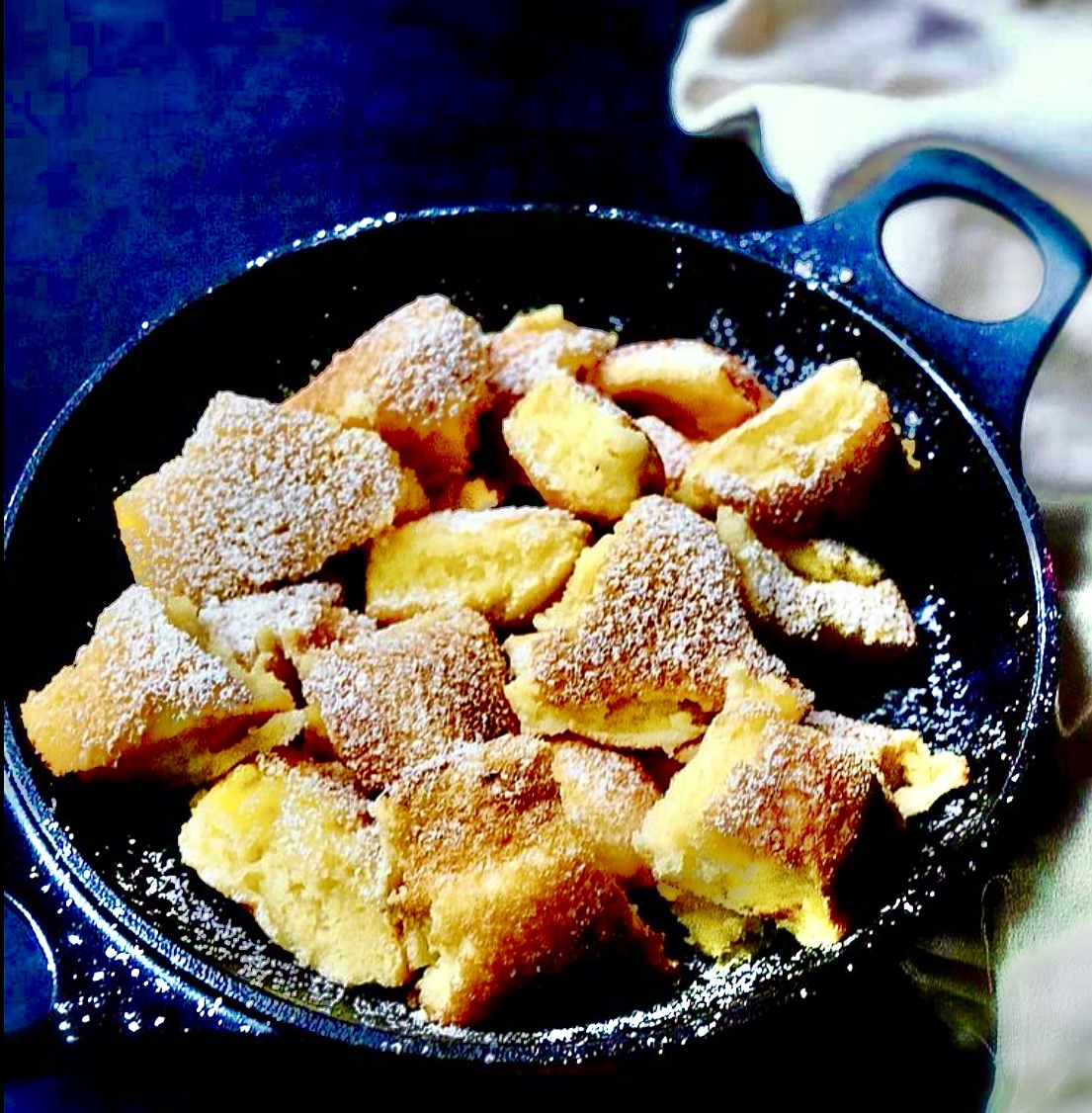
Etiquette and the “Emperor’s Pancake”

It was a lot like eating with Queen Victoria… As you left her table, you were still famished –‘As Royal Court etiquette dictated that everyone stop eating as soon as the Kaiser put down his fork, the young officers at the end of the table often managed no more than a tantalizing smell of the delicious “Kaiserschmarrn.”’


A Famous German Pancake


Near the turn of the century, Austrian Emperor Franz Josef I, reportedly ate the pancake with such relish that he frequently finished eating before the rest of the Royal table had been served.

As Royal Court etiquette dictated that everyone stop eating as soon as the Kaiser put down his fork, the young officers at the end of the table often managed no more than a tantalizing smell of the delicious “Kaiserschmarrn.”

“Schmarrn” soon came to mean “nothing,” as someone is not worth a “schmarrn.” It also translates as “fluff” which accurately describes the golden, souffle-like pancake.


Kaiser’s Pancakes

Truly fit for a King, this oven baked pancake is an easy adaptation of the German-Austrian “Kaiserschmarrn” or Emperor's Pancake. 

Serve the pancake immediately, hot from the oven, dusted with powdered sugar or with a fruit sauce. Divide the pancake into servings by tearing with two forks.

For variation, fresh fruit or raisins soaked in rum may be added as the last ingredient before baking. Pour 2 cup of blueberries, apples or peaches into the center of the batter in the Dutch oven. Stir lightly. Soak raisins in rum 2 hour, drain and add to batter.

Recipe may be doubled. Add 15 minutes to the baking time.

2 tablespoons butter/mar.


garine 2 eggs, beaten


1½ cups milk 1 cup flour


1/4 teaspoon baking powder


1/4 teaspoon salt


1. Preheat oven to 325°.

2. Melt butter in a 5-quart non-stick finished Dutch Oven or a 10-inch skillet over low heat. Combine remaining ingredients and mix until nearly smooth. Pour into Dutch Oven or Skillet. Bake 45 to 50 minutes in preheated oven until golden brown. Slide pancake onto serving plate. Cut or tear into wedges. Garnish with powdered sugar. – Recipe from The
 Desert Sun, 1979


Etiquette Enthusiast, Maura J Graber, is the Site Editor for the Etiquipedia© Etiquette Encyclopedia

Sunday, December 5, 2021

Thrifty Ex-Queen’s Manners and Meals

We can well believe that the French Reds are mightily tickled with the notion of the ex-Queen of Spain, the lineal descendant of Charles V. and Philip II., being sued by her provision dealer and grocer. This is certainly unlike the grand manners of the Kings and Queens of other days. The chief cook of Charles V., for example, wore decorations, which he doubtless earned in the kitchen, and his cookery-book was for two centuries an authority in great houses and palaces of Europe. 


A FRUGAL QUEEN


Let extravagant Americans who never know what goes on in their kitchens, and who think it a light matter to spend fifty or one hundred dollars for “a little dinner for a few friends,” read the contract of ex-Queen Isabella with her cook. Here was a thrifty Bourbon, who not only had presence of mind enough to seize her jewelry aud loose cash when she fled over the Pyrenees, but who rigorously binds down her cook to all of the details of breakfast, dinner, and supper. It cannot be said that her ex-Majesty of Spain is pinched for cash. She has had money enough to help set up Alfonso when that rash youth went into business as King of Spain. She even helped that hapless pair, Prince Perkins and wife, when they were skirmishing with Paris boarding-house women, and passing around the hat among the Bourbon family. Isabella comes of a money-making stock; the Bourbons have usually put aside a snug sum for a rainy day. Wherever they are found, all of that house, unless we except the eccentric Chambord, of the elder branch, are supposed to be at least “forehanded.”

The ex-Queen, in her contract with Mr. Alfred Blanchard, her chief cook, stipulates for the class of food and drink to be put upon her table, and for their price. Not only so, but she compels that functionary to specify the kind of provender to be furnished to the servants in the house. And, in order that there shall be no waste, it is set down that, in addition to certain dishes, the people below stairs shall be given “some leavings from her Majesty's table.” We see no provision as to “dripping,” that frequent cause for strife in frugal households. It is uncertain whether it is a perquisite of Mr. Blanchard or a subject of royal bargain with the soap-fat man. But it was agreed between the ex-Queen and the cook that the latter should "some leavings from her Majesty's table." We see no provision as to "dripping," that frequent cause for strife in frugal households. It is uncertain whether it is a perquisite of Mr. Blanchard, or a subject of royal bargain with the soap-fat man. But it was agreed between the ex-Queen and the cook that the latter should pay for the “wasting” in the kitchen, a prudent arrangement which must have put a stop to all larceny of coal, candles, and sugar by that imaginary foe of the household, the “harmless, necessary cat.” 

But Isabella, though the Queen, like John Gilpin's wife, had a frugal mind, she was also on pleasure bent. Her bill of fare was liberal as well as cheap: Two soups, eight dishes of meat, vegetables, cheese, and stowed fruit, were the daily fare of her Catholic Majesty. And all this was washed down with Spanish and Bordeaux wines. For this comfortable allowance of food and drink the ex-Queen agreed to pay only twelve francs a head per day, ten persons being guaranteed by the royal “party of the first part” to this unique contract. Two dollars and forty cents a day is certainly not high living for an ex-Queen. There are plenty of New Yorkers who spend more than that on what they eat and drink, and yet think they are severely republican in their tastes. But we do not believe that our lavish housekeepers would be at all satisfied with Isabella’s arrangement for the entertainment of her guests.

In order to screw down the cook to the lowest point, the exiled Majesty of Spain agreed to pay for each extra cater at the rate of six francs for breakfast, and twelve francs for dinner, and due notice was to be given the cook at that. No ordering “dinner for ten, with plates for twelve” in that house. Doubtless the frugal Bourbon thought to herself, as she regarded the poverty-stricken Perkins, or his managing spouse, at her table: “You cost me twelve francs this day,” which must not have been pleasant for poor Perkins. We can well believe that the French Reds are mightily tickled with the notion of the ex-Queen of Spain, the lineal descendant of Charles V. and Philip II., being sued by her provision dealer and grocer. This is certainly unlike the grand manners of the Kings and Queens of other days. The chief cook of Charles V., for example, wore decorations, which he doubtless earned in the kitchen, and his cookery-book was for two centuries an authority in great houses and palaces of Europe. 

The chefs of the time of Louis XIV. and “Good Queen Bess” were very fine folk indeed; and a nobleman's account of the good things that loaded royal tables in those days would almost create an appetite under the ribs of death. But the times have changed, and the manners of royalty have changed with them. If the ex-Queen does not like the quality of garlic and macaroni with which she is served, there is no good reason why she should not complain to her cook, and invite a civil process from her green-grocer. An ex-Empress of France brings a suit in the courts to recover her share of the loot of the Chinese Summer Palace. Why should not another royal relic scrutinize her provision bills and insist upon having her money's worth of victuals and drink? We have heard so much ill of this royal exile from Spain that her sensible little stroke of business should be put down to her credit. If she is economical, she has at least one virtue. She reminds us of that frugal Queen whose disposition of a famous plum pudding is celebrated in English rhymes:

“And what they did not eat that day
The Queen next morning fried.”

—The New York Times, 1875


Etiquette Enthusiast, Maura J. Graber, is the Site Editor for the Etiquipedia© Etiquette Encyclopedia

Saturday, December 4, 2021

19th C. French Wine Service Etiquette

With meat, one serves what is called 'les grands ordinaires': Burgundy or Bordeaux; but Burgundy is preferable.


The Order of Serving Wines at Dinner — 

After the soup, guests are given a glass of Madeira or Marsala. 

After the fish and oysters, white wine is served: Chablis, Sauterne, Moselle, etc…

With meat, one serves what is called 'les grands ordinaires': Burgundy or Bordeaux; but Burgundy is preferable. Bordeaux is better for entrées and large roasts; but with roasts, nothing prevents one from serving a Burgundy wine de grand cru, and with vegetables, a fine Bordeaux. 

After the vegetables and until dessert, Champagne is served. — From “French Silver Cutlery of the XIXth Century”


Etiquette Enthusiast, Maura J. Graber, is the Site Editor for the Etiquipedia© Etiquette Encyclopedia