Tuesday, October 29, 2019

Etiquette for the Dessert Course

When your dessert consists of both harder and softer textures, a fork and spoon will be included and both will be used. (Tip: The spoon is not for your coffee or tea.)

How to Eat Dessert Gracefully and Properly

For many of us, dessert is the favorite course of the meal. There's always something to love about dessert!

The dessert utensils are at the top of your place setting.

When your dessert consists of both harder and softer textures, a fork and spoon will be included and both will be used.
(Tip: The spoon is not for your coffee or tea.) 


Here's how it's done.

The meal has ended, and dessert has been served.
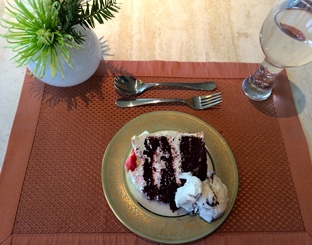


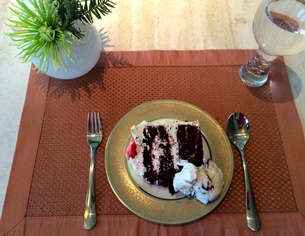
Once dessert is served, move the spoon and fork down to either side of the plate - fork on the left and spoon on the right.
(Sometimes, a server will do this for you.)


The fork is placed in the palm of the left hand and the spoon is placed in the palm of the right hand.
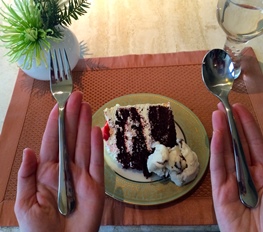


The spoon first serves as a knife and the fork is used to steady the solid portion of the dessert.
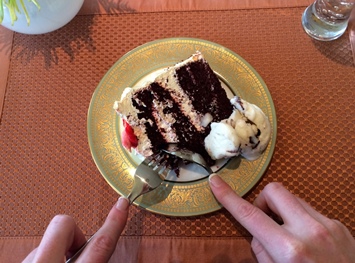


The spoon is then re-positioned in the right hand, holding in ‘pencil’ position. The fork becomes a ‘mover’ assisting in positioning both the cake and the ice cream on the spoon.
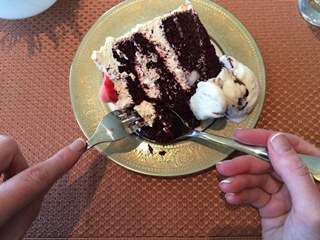


The fork as a helper tool will remain steady in the left hand, and the spoon is loaded with a delicious bite.   (In other words, only the spoon will come to your mouth. The fork remains in your left hand.)

As with other courses, there are resting and close-out positions for your utensils.

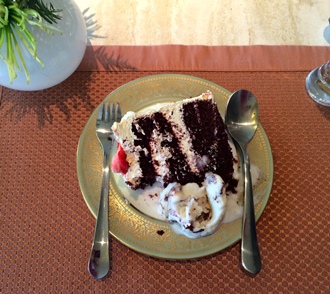
The dessert resting position is your fork on the left side of the plate, and your spoon on the right as shown here.


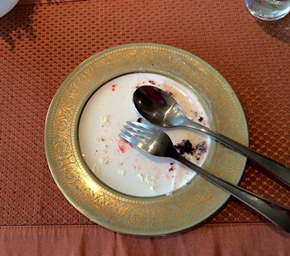
The close-out position is the same as other courses, with fork and spoon diagonal on the plate, or in the 6 o'clock position.


Serve cake and ice cream or pie a la mode at your next family meal, and practice using both a fork and a spoon to enjoy your dessert.

Other times, if your dessert is solid, you only need a fork. If your dessert is liquid or soft, you only need a spoon.

If you are setting the table, include only the utensils that are needed to eat the particular dessert that is to be served.


A retired, national award-winning secondary school educator, Candace Smith teaches university students and professionals the soft skills of etiquette and protocol. She found these skills necessary in her own life after her husband received international recognition in 2002. Plunged into a new “normal” of travel and formal social gatherings with global leaders, she discovered how uncomfortable she was in many important social situations. After extensive training in etiquette and protocol, Candace realized a markedly increased confidence level in meeting and greeting and dining skills and was inspired to share these skills that will help others gain comfort and confidence in dining and networking situations. Learn more at http://www.candacesmithetiquette.com/


Etiquette Enthusiast, Maura J Graber, is the Site Editor for the Etiquipedia Etiquette Encyclopedia

Thursday, October 17, 2019

Finger Glass Etiquette

The use of "finger glasses," or "finger bowls" after dinner is quite a modern innovation in Germany, introduced from England.


The use of finger glasses after dinner is quite a modern innovation in Germany, introduced from England. Until about ten years ago, glasses were indeed brought round at dessert at the very end of the meal, but this was for the purpose of rinsing the mouth, and a very comical sight it was indeed to see gentlemen and ladles, in plain dress or en grande tenue. washing their mouths at a sumptuously furnished table —or for the matter of that, in any private or public assembly room—instead of retiring to some private chamber for this purpose. In Bavaria it often happens that persons of talent, but without much knowledge of the manners of what is called polite society, are invited to dine with royalty, and not unseldom has the mistake above referred to been made there. 

The following little anecdote, however, contains the details of a practical joke played by a number of artists on a colleague still living who had for the first time received an invitation to dine with the Prince Regent at the schloss at Munich. Several masters of the brush had received similar invitations, and, as the painter in question was somewhat elated and excited by the honor conferred upon him, and at the same time singularly nervous and inquiring as to the way he would be expected to behave at the royal table, his confreres put their heads together and determined to play a practical joke upon him. He was accordingly told: 
“The first time anybody is invited to dine at Court, a special drink is handed round in glass bowls and the newly-invited guest is expected, according to strict etiquette, to take one of these bowls in his hand and to rise and exclaim, ‘I drink to the health of his Royal Highness,’ and then to quaff the contents of the bowl at a draught, make a profound bow towards the Prince Regent, and so resume his seat!’” The gentleman in question acted to the letter according to the instructions given him. To the manners of the Court must be attributed the suppression of all suspicion of a giggle, and it is stated that the royal host did not appear in the least disconcerted, but afterwards over the beer the merriment was unrestrained.— London Telegraph, 1901 


Etiquette Enthusiast, Maura J Graber, is the Site Editor for the Etiquipedia© Etiquette Encyclopedia

Wednesday, September 25, 2019

Manners Spring from the Heart

Courtesy to older people and to women is of great importance. The absence of haste or noise in the partaking of food and the avoidance of lounging attitudes at the table, are also important.


Good Manners Leave Impression Upon Observers 
Learning Courtesy and Avoiding Rudeness in Manners is Quite Essential


A well-modulated voice in men or women and a clear-cut, distinct enunciation in speech are important facts in an agreeable personality. These can be acquired by a little practice. Courtesy to older people and to women is of great importance. The absence of haste or noise in the partaking of food and the avoidance of lounging attitudes at the table, are also important. In conversation with our fellow beings there are two well-known quotations which may be serviceable. One is: “Three things observe with care: Of whom you speak, to whom you speak, And how and when and where.” 

The other is—before repeating any unpleasant news or disagreeable gossip about any one, to ask one’s self, “Is it true, is it kind, is it necessary?” Sometimes an important statement may be true, but it is neither kind nor necessary to repeat. Sometimes it is true and not kind, and yet necessary to repeat. It is necessary to tell a woman with a baby in her arms if she is about to call at a house where there is an infectious disease, that such a condition exists within. But it is only where there is necessity to warn or where there is a possibility of helping and changing the existing conditions, that one is really justified in repeating and commenting upon the disagreeable and painful things of life. 

People who possess the refinement of good manners always leave a pleasant and stimulating impression upon those with whom they converse. Even in a brief interview in which only the ordinary events or happenings of health and weather are touched upon, the really good mannered individual whose manners spring from a good heart will find an opportunity to leave an agreeable and brightening effect. Dig deep in your heart first, young man, then call your brains, your memory, your powers of observation to bear upon life, and you will need no book of etiquette to direct you, although it may not harm you to read one. – Los Angeles Herald, 1915


Etiquette Enthusiast, Maura J Graber, is the Site Editor for the Etiquipedia© Etiquette Encyclopedia

Tuesday, September 24, 2019

Life's Best Etiquette Teacher

Perhaps the most frequent, and at the same time most annoying breach of etiquette to the hostess, is the failure to reply promptly to invitations extended. The receiver seems to think that if the acceptance reaches the house the day of the entertainment that is sufficient, and yet a little reflection should convince the most thoughtless of the inconvenience of such replies to a hostess. – Photo source, Pinterest


Pupils in the School of Society

THE school of society is reckoned as, perhaps, the best place for learning all the little courtesies and etiquette that make up the well-bred man or woman. Ease, tact and charm are gained in the constant gilt-edged intercourse with the refinements of life, and the companionship of accomplished members of society. A cultured, gracious woman diffuses an atmosphere of refinement around her that is unconsciously absorbed by others less gifted in her arts of entertainment. Self-possession is developed in the drawing room, at the banquet board and in the mazes of the cotillon. 

Conversational powers increase by constant association with brilliant talkers. In proportion as “evil communications corrupt good manners” does the mingling with genuine “ladies” and “gentlemen” in the accepted terms of the words refine and polish even the most-crude and boorish climbers in the social realm. Timidity, that awful bane of youths and maidens just entering upon their social careers, is quickly and effectively cured in the merry company of tactful associates. When Belinda's blushes are pronounced lovely they cease to pain her, and when John's faltering speeches meet with sympathetic appreciation and encouraging smiles, he no longer hesitates, but forgets himself in the eyes of his charming companion. 

Undoubtedly this training school for manners is a wholesome and beneficial institution, which should receive justice for its advantages to the human family. But it should always be the care and desire of its members and followers to keep a high standard of politeness; not forgetting, as is ofttimes the temptation, the simple but comprehensive Golden Rule, “Do unto others as you would have them do to you.” The mother of one of the most popular belles who has ever reigned in this city, says the San Antonio Express, was asked what was her method employed in investing her daughter with the gracious and engaging personality for which she was noted. “My precept to my daughter was that to move in society one must, first of all, be absolutely unselfish and forgetful of self,” replied the mother, who had practiced as well as preached this beautiful theory. And indeed her counsel may well be taken to heart by each and everyone. 

Society is meant to be enjoyed, forsooth, not made a business of, and taken too seriously, but never to be enjoyed at the expense of another's feelings. “Laugh and the world laughs with you,” if the joke is a kindly and jovial one. Then, too, one should not grow careless in the points of courtesy that require punctilious attention, as is sometimes the case, even with the most careful. Perhaps the most frequent, and at the same time most annoying breach of etiquette to the hostess, is the failure to reply promptly to invitations extended. The receiver seems to think that if the acceptance reaches the house the day of the entertainment that is sufficient, and yet a little reflection should convince the most thoughtless of the inconvenience of such replies to a hostess. 

Especially is this true in regard to dinners, luncheons and card parties, where an exact number is to be accommodated and the desired number filled in if the regrets and acceptances come soon enough for an accurate estimate. With receptions and dances, the answer is almost as imperative, as 200 invited guests must be provided for, unless informed to the contrary. How often has a man’s slowness in response caused an anxious heartache to a girl whose chance of going is dependent on his acceptance. A struggle against thoughtless selfishness should be the aim of every well-bred man and woman. – Los Angeles Herald, 1909


Etiquette Enthusiast, Maura J Graber, is the Site Editor for the Etiquipedia Etiquette Encyclopedia 

Sunday, September 22, 2019

Etiquette and Behavior in Worship

If refined social manners are essential in the home, they are equally important in the house of God. 
Photo source, Pinterest 

Rev. Frank Dewitt Talmage Discourses Upon Manners

Rev. Frank DeWltt Talmage delivered a sermon yesterday upon “Church Manners,” taking his text from I Timothy 3:15, “That thou mayest know how thou oughtest to behave thyself in the house of God.” His discourse was a good-natured rebuke to the lack of decorum among worshipers and a plea for certain reasonable etiquette In the church. He said in part:

“Are you a parent? Have you ever dressed up your little children and sent them forth alone to visit, when they were about ten or twelve years of age? Then you have known the anxieties of a mother or father as to their social behavior.

“Before they go, you say: ‘Now, son, be careful about : your manners. When you enter Mrs. So and So’s home take off your hat and place it upon the hall rack. Be careful and don't handle the vases in the parlor, and don’t squirm on your chair. When you are at dinner, be sure and keep your hands off the table, and don’t spill the food upon the table cloth, and don’t ask for a second helping of anything, or talk with your. mouth full. When Mrs. So and So passes you a plate, say “Thank you.” Remember, my boy, that your mother's home is to be judged by your table manners.

“When that child leaves the house, your mind follows him and stays with him all day long. And oh, the pride that sweeps into the parental heart when, next day, you meet your friend, at whose home your little children dined, and she congratulates you in these words: ‘We had such a lovely children’s party yesterday. And Mrs. So and So, I want to tell you how well your children behaved. Your boy was a perfect little gentleman, and your daughter a little lady.’ Ah, such congratulation as that is as a sweet savor to the maternal heart.

“If refined social manners are essential in the home, they are equally important in the house of God. So essential are they to a consecrated Christian life that Paul wrote a long epistle to his young lieutenant, Timothy, concerning them. In this letter, wherein are found the words of the text, the great apostle tells how bishops and their wives should act, and also how deacons and deacons’ wives.

“But today, instead of my showing how our ministers and church officers should behave in the house of God, I would preach a sermon on church manners directly to the pew. I would try to inculcate the reverential spirit with which our congregations should assemble for worship.

“I would try to teach this reverence, because more and more in this irreverent age there is a tendency to look upon church buildings as places fitted for secular enjoyments, rather than as sanctuaries consecrated to the presence of Jesus Christ.

“The Lord loveth the gates of Zion more than all the dwellings of Jacob. No man ought to place foot in God's sanctuary unless he can do it with the solemn feeling of Habakkuk, who declared: ‘The Lord is in his holy temple, let all the earth keep silence before him.’”– Los Angeles Herald, 1905


Etiquette Enthusiast, Maura J Graber, is the Site Editor for the Etiquipedia© Etiquette Encyclopedia 

Saturday, September 21, 2019

Edwardian Table Manners in England

Oyster forks in the Delmonico pattern – “Oysters are another puzzle in eating. I have often seen young ladies, who from their actions one might judge to be dining out for the first time, try to cut the bivalve in half; and sometimes the results would be very amusing. Oysters should, of course, be eaten whole, balanced on a fork. Then again, thoughtless people will often smother said food in cayenne pepper and nearly choke themselves when trying to digest it.” 


He had been a waiter in a smart West End hotel, London, and had come to Los Angeles, California, for his health. “Speaking of manners,” he said, pointing to an article in a recent woman’s magazine upon that subject while we were eating at the same table in the Vegetarian Cafe, “it is queer the atrocious manners people, even in so-called polite society, exhibit in public, especially at the public dining table.”

“Apropos of what are your remarks” we inquired timidly. “So far as my experience goes,” he went on, “I have seen a great deal of bad manners in waiting on public dining-tables in London, some through ignorance of table etiquette; others because they were careless of the laws governing table politeness. He lifted up his eyes in a somewhat critical way.

“For instance both asparagus and Indian corn should be eaten with the fingers. I have often seen such tackled with knife and fork. Of course, this is not a crime, but how embarrassing it made those thus misusing the knife to discover their fellow-diners using their fingers. What to do with the knife they knew not! They could not very well lay it back on the table and to leave it on the plate would cause them to be minus what they would need for the next course. In such cases, I have often mercifully removed the used tools and supplied clean ones in their place. Of course, I was usually tipped for my trouble.

“Again, olives are usually a puzzle to diners. These should be taken in the fingers from the dish, and eaten between courses. I have seen amateur diners-out place them on the plate with whatever dish they were eating, and frantically strive to cut them into pieces with a knife; and often the olive flies off into a neighbor’s lap. Tipping one’s soup plate toward one is a common error. It should be tipped away from the eater.

“Oysters are another puzzle in eating. I have often seen young ladies, who from their actions one might judge to be dining out for the first time, try to cut the bivalve in half; and sometimes the results would be very amusing. Oysters should, of course, be eaten whole, balanced on a fork. Then again, thoughtless people will often smother said food in cayenne pepper and nearly choke themselves when trying to digest it.

“Then there is the finger-bowl. One would think that this was such a common thing that people knew what it was for. But I saw one man at a hunt dinner in a country house in England actually pick up the bowl and drink the water therefrom, to the great astonishment of the other guests.”– Los Angeles Herald, 1908


🍽Etiquette Enthusiast, Maura J Graber of The RSVP Institute of Etiquette, is the Site Editor for the Etiquipedia© Etiquette Encyclopedia 

Friday, September 20, 2019

Mistaken “Ideas of Etiquette”

I know one woman of exceedingly modest menage who labors under the delusion that her growing social importance demands that her good-byes must be said in her parlor, even if the has no other guest at the time! Both common sense and courtesy surely demand that the solitary guest should be escorted to the door by her hostess— and even to the front gate if there be one. 


Again, it is surprising how many mistaken ideas of etiquette have gained currency among people, who, while not “in society,” certainly ought to know better. For instance, in churches, you often see the occupant of the end of a pew next the aisle putting his own collection into the plate before passing it on. This is quite wrong; he should pass it first and add his own contribution last. Again, take the question of “seeing a friend to the door.”

I know one woman of exceedingly modest menage who labors under the delusion that her growing social importance demands that her good-byes must be said in her parlor, even if the has no other guest at the time! Both common sense and courtesy surely demand that the solitary guest should be escorted to the door by her hostess— and even to the front gate if there be one. A large establishment with servants waiting in the hall— a drawing room full of guests, or a man caller— make it right for the hostess to remain in the drawing room, but in the absence of these conditions she must assuredly escort her guest herself, if she has no daughters to do it for her.

I once heard a man criticized because he was sufficiently courteous to pull out his fellow boarders chair at table before she sat down and later helped her on with her coat — this without previous acquaintance except, the usual conversation and courtesies of a small boarding house table of six. Of, course he was right — and showed not only his good breeding but his knowledge of the world. It is only the man who cannot be courteous without being familiar, who cannot help a woman with her coat without giving a suggestion of “tucking” her into it — it is only this kind of a man who need fear a snub on such an occasion from a well-bred woman.

In answer to the every day apology, “I beg your pardon” — many persons are wont to reply “certainly”— or more vaguely “not at all.” Both answers are out of place –the first, because it implies that pardon was needed; the second—because it means absolutely nothing. “Don't mention it” is the proper answer, although punctilious people are still heard to reply in courteous tones “The fault was mine.” If you do not hear aright a question asked you, do not ask “What is it?” Say, “Excuse me?” Or, colloquially, “I did not catch that.” If someone comes to ask you something never bluntly demand “What do you want?” Rather say “What can I do for you?” Do not say plain “yes or no,” nor embellish your conversation with “yes sir” and “no ma'am.” “Yes indeed,” “no, I think not” are preferable. – Los Angeles Herald, 1906


Etiquette Enthusiast, Maura J Graber, is the Site Editor for the Etiquipedia© Etiquette Encyclopedia 

Etiquette and Manners Simplified

The little courtesy of suggesting to an interested acquaintance that you will be glad to see him in your own home, can not be improper. It offers dignified hospitality and suggests friendly good will, so it is kind. It is surely in better taste to meet your friends in your home than at dances or public entertainments of any sort. 


MANNERS are the gracious way of doing things. No better rule for “good form” and “etiquette” can ever be evolved than this simple little statement. Kind hearted people have the first asset toward good manners. If they govern their kindly impulses by good taste and common sense, they are sure to act in a manner that far exceeds “the proper thing” in human value. 

Take the simple question of whether a girl shall ask a man to call on her or not. The little courtesy of suggesting to an interested acquaintance that you will be glad to see him in your own home, can not be improper. It offers dignified hospitality and suggests friendly good will, so it is kind. It is surely in better taste to meet your friends in your home than at dances or public entertainments of any sort. 

And common sense ought to indicate to any girl whether a man is sufficiently interested in her to want the opportunity of seeing her again or not. For most of any question where you doubt the certainty as to what is the proper thing to do, just apply kindness, common sense and good taste. And you will be as well off as if you had studied manners in a finishing school or a book of etiquette. – By Beatrice Fairfax, 1916


Etiquette Enthusiast, Maura J Graber, is the Site Editor for the Etiquipedia© Etiquette Encyclopedia