Sunday, November 5, 2017

Etiquette of Dinner à la Russe


An 1890’s oyster fork in the Shrewsbury pattern. Oyster forks can be placed on the right side of the place setting if there are already three forks on the left side of each place setting. – Oysters are usually at each place when the company assembles, having been kept very cold, on ice and salt, up to the moment of serving. A quarter of a lemon and very thin slices of brown bread, buttered, are the usual concomitants. No person should ever be left without a plate before him, except at the time of the clearing of the table, preparatory to the introduction of the sweet course, this is one of the primary rules of serving. 

Dinner is Now Served... à la Russe

To serve à la Russe, which is at once the simplest and most elegant manner when guests are present, it is only necessary to pass the dishes of each course in rotation, beginning alternately at the right and the left of the guest, writes Mrs. Van Koert in the Ladies Home Journal. Some think it more courteous to serve all the ladies first, but it is not now considered a breach of strict etiquette to serve in regular order.

The old French custom required that the dishes, elaborately garnished, and the meats, sometimes stabbed with silver skewers, like crossed swords, should be placed upon the table, before the host and hostess alternately, for a moment, to give the guests an opportunity of admiring them previous to them being carved, but this formality has gone out of fashion even among the French themselves.

Oysters are usually at each place when the company assembles, having been kept very cold, on ice and salt, up to the moment of serving. A quarter of a lemon and very thin slices of brown bread, buttered, are the usual concomitants. No person should ever be left without a plate before him, except at the time of the clearing of the table, preparatory to the introduction of the sweet course, this is one of the primary rules of serving.

Under each oyster plate it is customary to have a dinner plate, upon which also the one containing the soup is placed. A dinner can hardly be served with elegance by less than two persons, although attention to the prescribed rules greatly simplifies the matter. The soup should be served from a side table, a ladleful to each plate. Plates are then carried one by one to their destination. — Sacramento Daily Union, 1893


Etiquette Enthusiast, Maura J. Graber, is the Site Editor for the Etiquipedia© Etiquette Encyclopedia

Gilded Age Dinner-Sleeve Etiquette Fad

“Just think... I will be a trendsetter a hundred years from now!” – Long before pop singer Madonna made fingerless gloves fashionable in the 1980’s, they were a staple of the British Regency Era women’s wardrobe. They briefly became a dinner party fad of the Gilded Age.

A New “Dinner Sleeve?”
“The most curious sleeve ever designed for fashionable women is the new dinner sleeve, which forms an old fashioned mitt when it reaches the hand, serving as a sleeve and glove in one. It just covers the knuckles, allowing the rings to show to great advantage.” — The Pittsburg Dispatch, 1899

 🍽Etiquette Enthusiast, Maura J. Graber of The RSVP Institute of Etiquette, is the Site Editor for the Etiquipedia© Etiquette Encyclopedia

19th C. Chinese Courtship Etiquette

A drawing depicting bride-to-be, Ah Leen – “The bridegroom-elect may see his future bride, he may even converse with her from opposite sides of the room, but the proprieties would be completely outraged if the betrothed couple were to shake hands. Two or three times a week the fiance makes a call of from five to ten minutes duration, and if he is desperately enamored, he never goes empty handed. Sausages are a gift that is highly appreciated, and Chinese vegetables are also much esteemed. Fruit is frequently brought to the engaged ladies, both in the Presbyterian and the Methodist missions, but it would outrage Mongolian etiquette to bestow candy.”

The Romance of Ah Leen –How a Chinese Girl Can Be Made Love To at the Missions 
Presents of Jewelry Are Frequently Given, but Sausages Are Not Scorned

Many and unexpected are the ways by which sinners are sometimes led into the fold, and the approaching marriage of Ah Leen furnishes an instance of this. Ah Leen is a good little girl who lives in the Presbyterian mission, away from the pomps and vanities of this wicked world. Every Sunday, however, she goes religiously to church along with the other girls who have been rescued by the kindhearted ladies of the Occidental Board. The passing of this procession is an opportunity eagerly seized by the eligible bachelors of Chinatown, who turn out en masse and line the sidewalks along the route, each good one cherishing the intention of asking Miss Culbertson for the hand of the girl who strikes his fancy most. 

As for the wicked, they know that it is useless to apply. Now, one gay and sprightly bachelor was particularly struck a couple of months ago by the beauty of Ah Leen. He watched the procession pass with eyes only for her, and when she had entered the sacred edifice, instead of resigning himself to go home, he made a mighty effort to overcome the prejudices of early education and followed her into the church. From that date a change has come over the bachelor. He no longer burns punk at the shrines of his countrymen, nor does he dissipate money in having his fortune told; in fact, he has become in every way worthy of Ah Leen, to whom he is soon to be united. During the present strained condition of things in Chinatown, however, he shrinks from the notoriety of having his changed condition commented on by his friends and foes.

Courtship, as it is understood in Chinese circles, is a somewhat tame and practical affair. There is a regular routine at the mission, in which a compromise is made between American and Chinese customs. The bridegroom-elect may see his future bride, he may even converse with her from opposite sides of the room, but the proprieties would be completely outraged if the betrothed couple were to shake hands. Two or three times a week the fiance makes a call of from five to ten minutes duration, and if he is desperately enamored, he never goes empty handed. Sausages are a gift that is highly appreciated, and Chinese vegetables are also much esteemed. Fruit is frequently brought to the engaged ladies, both in the Presbyterian and the Methodist missions, but it would outrage Mongolian etiquette to bestow candy.

The love-making is generally monosyllabic on the part, of the young lady, and even the man finds his gift of conversation languish. At the Presbyterian mission a charming young Chinese girl named Ah Cheng, a professional interpreter, satisfies etiquette by being present during all the interviews. Many Chinese merchants have offered to lay their hands and heart at Ah Cheng's feet, but she has seen so much of love-making as an onlooker that she refuses to go through the ordeal of entertaining a fiance on her own account. Even the touching romance of Ah Leen has not inclined the little interpreter to follow her example. – The San Francisco Call, 1895

Etiquette Enthusiast, Maura J.Graber, is the Site Editor for the Etiquipedia© Etiquette Encyclopedia 

Parties Can Help Teach Manners

Party experiences lead to habits, attitudes, and knowledge. But the kind and influence of the experiences depends a lot upon the adults behind the scenes. There are the little decencies and etiquette of behavior. To feel at ease at mixed social affairs is a blessing, many times in life. The party offers the chance to give that feeling to children at an early age. 

Your Child’s Manners and School Parties 

In large sections of the country, February is the “party month.” It is because many states observe Washington's birthday and Lincoln’s birthday, and always there is St. Valentine’s Day. I like to think of them educationally, for they do represent opportunities. In the first place, the party itself is an educative situation, since after all education is the acquisition of experiences. In turn, party experiences lead to habits, attitudes, and knowledge. But the kind and influence of the experiences depends a lot upon the adults behind the scenes. There are the little decencies and etiquette of behavior. To feel at ease at mixed social affairs is a blessing. Many times in life, the party offers the chance to give that feeling to children at an early age. 

Through games and stunts, we can help build an attitude toward sportsmanship. We can make fun the primary object of playing. If we’re very wise, we can do more for the self-conscious, shy, retiring child than by any other means at our disposal. The “eats” are always important, of course. While we shouldn’t talk health diets at parties, we can discover attractive and tasty combinations of fruits, custards, ice cream, and cakes. For beverages, fruit punches and iced chocolate milk drinks can’t be beat. A pure sweet at the end is never objectionable. Finally, we can, as sponsors, observe the bedtime rule in the case of evening parties. – Dr. Allen G. Ireland, Director of Physical and Health Education, New Jersey State Department of Public Institutions, 1935


Etiquette Enthusiast, Maura J. Graber, is the Site Editor for the Etiquipedia© Etiquette Encyclopedia 

Etiquette for Calling the Detectives

“New times, new customs—and new developments, must be met and settled once and for all. What the books of etiquette might find a ‘best seller’ feature just now, is the final word as to who is the one to engage the private detective.” Adding in some etiquette for being a thoughtful guest and not stealing items from other guests, is also an excellent subject to address!


Who Calls the Detective When Someone Steals from a Member of the Smart Set?

Need, crying need, exists for definite rulings as to points of good form in our richest and smartest circles. Strange, indeed, that there should be hesitation as to what is quite the correct thing under any and all conditions among the socially elect. But, new times, new customs—and new developments, must be met and settled once and for all. What the books of etiquette might find a “best seller” feature just now, is the final word as to who is the one to engage the private detective. 

Now, don't be alarmed, don't be misled. This is nothing scandalous. Jealousy plays no part in this little meditation on the smart set. But when there is a house party. When things—things of value —disappear. When the others of the house party are all friends tried and true. When the servants are all of the family variety. Who, oh, who, should engage the detectives? Those detectives who ask such questions—my dear, you would hardly believe me if I told you the way those men pry into one’s finer affairs. But the consolation is that you sometimes get the things back that are lost. 

Of course, it was easy to arrange matters when the Crocker pearls and the De Sabla diamonds disappeared. Those were both in hotels, and no one felt any sort of bread and salt scruples. In fact, it was a sort of a contest as to which could get the detectives first. But at the home of a girl you went to school with—or whose husband used to be one of your very best friends—what then? Within the 50 mile circle around the city, not so very long ago, a diamond brooch disappeared. They were very gorgeous diamonds and they disappeared very thoroughly over night. It was a small and intimate house party.

When the loss was realized, the hostess said, “Send down detectives at once.” Only what she did say was “private detectives.” That seems to take the curse off the dreadful publicity of such things. The one-time owner of the diamonds said: “I didn't send down a detective. I don't like to do such a thing in any one’s house. It seems such a liberty. Of course, if she had had one herself, I would not have objected, but I couldn't suggest that.” The hostess said: “So strange she wouldn't send down a detective, but if she didn't do it herself, I felt she had some reason, and I couldn't do anything. I would have been more comfortable if it had been thoroughly sifted.” Then again, a sable muff mysteriously evaded its owner at one of these house parties.

It might have been in San Rafael, or perhaps it was Woodside. Anyway, the muff was gone, and it was of Russian sables, that made the heart of womankind like unto water just to gaze upon it. Again, the hesitation as to the sleuths supplied by an agency or the police department. Again, the hostess and the bereaved guest bowed and urged each other. Some one suggested that it be left to the men of the two families involved. Then there would be no hesitation in the matter. Not so, however. In matters of social form American men are prone to let their womenfolk take the initiative. Neither husband would do anything more definite than say, “I leave it to you, my dear.” Will some social authority step forward and settle the matter? It can't be left to the police. They are concerned merely with the transgressions of social observances, and to decide upon the reverse, would be out of their line of action. But who should engage the detectives? – The San Francisco Call, 1913


Etiquette Enthusiast, Maura J. Graber is the Site Editor for the Etiquipedia© Etiquette Encyclopedia 


Saturday, November 4, 2017

More Old Wedding Customs


To our knowledge, no shoes were thrown after this wedding.

Throwing a shoe after the bride is the survival of a custom based upon ancient symbolical usages in connection with sandals or shoes. Delivery of a shoe was used as a testimony in transferring a possession. A man plucked off his shoe and gave it to his neighbor, and this was a testimony in Israel. 
Throwing a shoe on property was a symbol of new ownership. 

From these ancient practices came the old English and Scottish customs of throwing an old shoe after a bride on her departure for a new home, symbolizing that the parents gave up all right or dominion over their daughter. In Anglo-Saxon times the father delivered the bride’s shoe to the bridegroom, who touched her on the head with it to show his authority. In Turkey, the bridegroom is chased after marriage by the wedding guests and pelted with slippers. – Sausalito News, 1923

Etiquette Enthusiast, Maura J. Graber, is the Site Editor for the Etiquipedia© Etiquette Encyclopedia 

Friday, November 3, 2017

Old Scottish Marriage Customs

On Gretna Green and “Red Hot Marriages” : Runaway marriages were once a staple of English fiction. Readers of Jane Austen’s “Pride and Prejudice” will remember how distressed the Bennets were to find that Lydia, their flighty daughter, had not gone to Gretna Green with militia officer George Wickham, but much more socially disastrous for the family, was living with the scoundrel in London! 

Historically couples married in the ancient tradition of a 
'handfasting' ceremony, or 'marriage by declaration,' which was law in Scotland until as recently as 1940.  This simple ceremony enabled couples to marry by declaring in front of two witnesses their wish to be husband and wife, then and they were legally bound. Gretna Green became famous for these ceremonies following the 1754 Marriage Act, which outlawed clandestine marriages in England. Lord Hardwicke, the English law lord who introduced this law, was determined to quash the desires of young couples from becoming husband and wife through this 'quickie' ceremony.

Scotland was famous for its distinctive marriage arrangements, which owed much to pre-Reformation canon law, and were based on principles of mutual consent rather than religious ceremony. Both 'regular' and 'irregular' marriages were recognised by the law. A 'regular' church marriage, requiring marriage banns to be read in the church some weeks in advance, was the usual practice, and from 1834 'priests and ministers not of the established church' were also allowed to conduct legal marriage ceremonies. In Scotland, regular marriages did not have to take place within a church building; indeed, they were more likely to take place in private homes. Even so, at first sight, Scotland's system seemed more religious in practice than England's, because civil ceremonies in a register office were not possible until after an Act of Parliament in 1939.

But Scotland's fame for distinctive marriage practices stemmed from 'irregular' marriages. There were three ways of forming a legal marriage without banns or a minister being present.

  1. A couple were legally married if they declared themselves to be so in front of witnesses, regardless of whether this was followed by a sexual connection. Marriage contracted in this way without witnesses was also legal, but much harder to prove in court unless there was other evidence, such as letters that confirmed what the couple had done.
  2. A promise of marriage, followed by a sexual relationship, was regarded as a legal marriage - but this had to be backed up by some kind of proof, such as a written promise of marriage, or an oath sworn before witnesses.
  3. Marriages 'by habit and repute' were also legal if a couple usually presented themselves in public as husband and wife, even if no formal declaration of marriage was made.

Irregular marriages were frowned on by law and the churches, and couples who admitted to them were fined, but they had the same inheritance rights as regularly married couples, and their children were legitimate. Although the Church of Scotland did not approve of irregular marriages, it tolerated them because it feared that if the law did not recognize such relationships, the couple would end up 'living in sin.' The system was believed to protect women from unscrupulous men who might seduce them with promises of marriage or fake wedding ceremonies. After registration was introduced, an irregular marriage could be registered if the couple presented themselves before a sheriff or magistrate, were 'convicted' as parties to an irregular marriage, and paid a fine. Some found it quicker and cheaper to have their irregular marriage entered in the schedules by the registrar under sheriff's warrant than to go through the expense of banns and a regular marriage ceremony. Marriages established in court by a Decree of Declarator could also be registered, on production to the registrar of an extract of the Decree and payment of £1, but this was not common. In fact, irregular marriages notified to the registrar were infrequent in Scotland in the mid-nineteenth century, and fewer than 100 per year took place between 1855 and 1870. After that, the numbers rose steadily, and then rapidly in the early twentieth century, until they accounted for over 12% of all Scottish marriages in the registers in 1914. They remained at this level until the Second World War. 


Contrary to the national myth, most took place not on the Scottish border, but in the larger towns. This may have been due to a decline in the influence of the churches, or to the relative cheapness of 'irregular' marriages, but it also reflected the growing number of divorces. Since many churches would not remarry a divorced person, and civil marriage was not possible in Scotland, couples in this position had no alternative but to marry by sheriff's warrant. Although so-called 'irregular' marriage by sheriff's warrant technically attracted a 'fine' until the law was changed in 1916, it was becoming a more frequent legal alternative to a church ceremony. In 1939, marriage registered by sheriff's warrant ended, and it was possible, as in England, to marry by a civil ceremony in the registrar's office. Legal textbooks described all types of marriage outside the churches as 'irregular' until the early twentieth century, but, given the rise in numbers of marriage through sheriff's warrant, the public no longer saw anything irregular in the proceedings.-  An excerpt from the University of Glasgow


Etiquette Enthusiast, Maura J Graber, is the Site Editor for the Etiquipedia© Etiquette Encyclopedia 

Wednesday, November 1, 2017

Etiquette and Scottish Courtship

 “In the lower grades of society it may be supposed that courtship is equally delightful, but appearances are decidedly against it. There is nothing approaching restraint in the code of etiquette here.” 
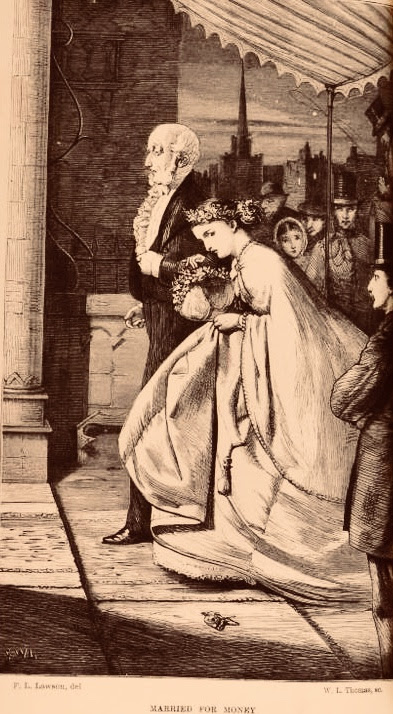
 Pictured above–– “Married for the Money” from Belgravia Magazine. 


In Scotland it is difficult for a man to draw the line between courtship and a connubial condition. That which in the Englishman is but a flirtation would become in the Scotchman rank matrimony. Most people in Scotland are married, but they are not aware of the fact, as Monsier Jourdain did not know that he had been talking prose all his life; the distinction is drawn when they do so become aware, and then the marriage is avowed. In Wales, courtship takes a material form — among the humbler classes at least — and resolves itself into what we call romping. 

In England there are different ways of doing the same thing. When Lady Clara Vere de Vere was a pretender in her own rank of life (and she has not always trifled with the “foolish yeoman” of Tennyson's poem), the arrangements between the pair were conducted with reference to a certain degree of etiquette; but etiquette does not rule entirety, and the Lady Claras have the same tendencies to make tbe most of the situation us ladies and gentlemen who are not quite her equals in rank. She is not restrained to the same extent she would be in France; and it is hard if in the course of walks, drives and dances, croquet, cantering, exhibition-seeing, picnicking, and all the various incidents of town and country life, the pair do not manage to meet some seven days in the week, and to give the chaperone now and then the go-by. 

In the lower grades of society it may be supposed that courtship is equally delightful, but appearances are decidedly against it. There is nothing approaching restraint in the code of etiquette here. When Miss Jemima Higgs  has “her young man,” and he is on such terms with her family as not to be turned out of doors, he may go to the house and take her out whenever he pleases, and no one dreams of interfering. Jemima is probably a presentable style of girl — girls of her class are far more so than they were, and especially dress better than they did, albeit in rather an exaggerated style — but her betrothed is decidedly rough. See him when he comes to take her out to walk in Battersea or Victoria Park, or it may be to go by the steamer to Greenwich, he is far from being on a par with her, either in manners or attire, especially if the latter be his holiday costume. 

He is tolerably sure, too, to have a pipe or a cigar in his mouth ; for this appendage, among certain classes of young men, seems to be considered a necessary part of fall dress. His talk is sad slang, and not over-refined. The girl goes off gaily with him, but one cannot help wondering at her taste, and the question inevitably occurs — what do they talk when they are alone? She has read a few novels, and picked up a certain vocabulary of sentiment ; but he cannot have an idea on this head, and his range of subjects must be a very narrow one— very different from the world of beautiful fancies open to Lady Clara Vere de Vere and the young “lord lover” who pays his homage at her shrine. It is not to be supposed that humble station and want of culture prevent people from loving as deeply as our aristocratic friends. 

The late Robert Brough, in a poetical version of a tale from Boccaccio, writes very prettily of a pair of lovers who sat together saving nothing, but simply “engaged in loving,” which, the writer adds, “is quite an occupation, I assure you in its way.” Jemima and “her young man,” doubtless bring all their tender instincts toward the “occupation” in question ; but it is sad to think she will express her regret at having to sit opposite him in the bus on their way home, and that when his words take an affectionate form they will connect her with the description of “old gal.” 

However, I am here writing of miserable cockneys. Village courtships must be very different affairs, or poets would not have glorified them as they have done, from the earliest period to the present time. I have my suspicions that rustic lovers are not always Damons and Philises ; but they are not likely to be without a certain rural simplicity, and are at least free from the slang of the town. The saddest kind of courtships must be those of couples who do not care about one another. It is easy enough to make people believe you love them less than you do, but very difficult to make them believe you love them more.— Belgravia, 1874


Etiquette Enthusiast, Maura J Graber, is the Site Editor for the Etiquipedia© Etiquette Encyclopedia