Sunday, May 25, 2014

Vintage Airline Travel Etiquette

“Contrary to general belief, any size or amount of baggage may be transported by flagships of airlines. With his ticket, the passenger is allowed transportation of forty pounds of baggage.” 1940 

Travel In The Sky 
Come as you are and do as you please! That's the rule aboard the big, comfortable, fast airliners that fly the airways of the United States.

The casual note predominates. Formality is left behind on the ground when you soar into the skies. No special wardrobe is required for air passengers, and for the best of reasons: flights are so brief. It is only overnight from Atlantic to Pacific on the big mainliners.
Reservations 

“Who's going to Atlantic City?”
It is so easy for the public to accept this fast, luxurious service, that a passenger "can't go wrong." Just about all he has to do on his own is pick up the telephone and tell any airline agent that he wants to make a reservation. The employees to do the rest and assume complete responsibility for getting the passenger to his destination in the quickest, most convenient manner known to the transportation world.
Baggage 
In connection with the added conveniences of travel by air, the passenger meets a few customs not found in other methods of transportation.

One of them is the matter of baggage. Contrary to general belief, any size or amount of baggage may be transported by flagships of airlines. With his ticket, the passenger is allowed transportation of forty pounds of baggage. This is about the weight of a large suitcase or bag filled to capacity. Since such flights as those between New York and Washington are made in slightly more than an hour, the passenger does not need as much baggage as he would for slower means of travel.

For example, many passengers now commute in a single day between New York, Chicago and other distant places, and therefore do not take any baggage.

Airline passengers check their baggage at the ticket counter at the place of departure, and it is returned to them at their destinations. Those making overnight flights are given attractive "overnight kits" for toilet articles and other things needed during the trip.
Overnight Flights 
On overnight flights, Flagship "skysleepers" provide large, comfortable berths. Aboard such a ship's the passenger may enjoy the luxury of breakfast in bed, as well as the conveniences of electric shaving and separate dressing rooms for men and women.

Toward the front of the “skysleeper” is the “skyroom,” where passengers meet chat, play cards, or read late until they are ready to turn in for a good night's rest.
Introducing the Stewardess 
                        
The stewardess does not serve liquors, and passengers are urged not to “have a cocktail” before going aboard. The stewardess offers late “snacks” as well as between-meal refreshments.’

Complimentary stewardess service aboard all ships of American Airlines includes full-course meals, the latest newspapers and magazines, cigarettes, writing material and stamps, blanks for wires. Taking advantage of this service, many passengers boarding early-morning flagships wait until they are aloft to have breakfast.

The stewardess does not serve liquors, and passengers are urged not to "have a cocktail" before going aboard.

The stewardess knows her passenger's name and uses it in addressing him. Her name is posted in the flagship, so the passenger may call her by name, if he wishes. She stops to chat with the passenger, points out places of interest along the route, and answers questions concerning air transportation.
The Captain 

Flight crews of airlines are friendly and interested in doing all they can to ensure a pleasant flight. 
The Captain of the flagship may come back into the cabin to see that everyone is enjoying the flight. He sends back to those aboard "Up-to-the-minute flight reports" to keep passengers posted on flight conditions and where they are at the moment.

In a word, flight crews of airlines are friendly and interested in doing all they can to ensure a pleasant flight.
Children
      
Circa 1930: Miss Ellen Church became the first airline stewardess after convincing Boeing Air Transport that female nurses on board each plane would be a relief to nervous airline passengers. 
Mothers with children find the stewardess especially helpful. She is a registered nurse and takes care of the baby while the mother rests. If the airline is notified in advance, the baby's formula will be on hand at feeding time en route.

Children traveling without parents receive special attention and arrive at their destination after a pleasant trip with their new friend, the stewardess.
Manners 
“And just think Martha, we can chew gum too!” Airline meals (also known as “in-flight meals") were started by United Airlines in late 1936 to early 1937. Food consultant Donald F. Magarrell established the airline industry’s first flight kitchen in Oakland, California. Before that time, simple meals, like sandwiches and fruit, were being served by 1935. 
Ordinary rules of courtesy and politeness prevail, of course, as they do anywhere that people of standards gather. It is not correct, of course, to move around and be a nuisance, introducing yourself to fellow passengers, talking to them whether they appear to want it or not.

It is entirely correct to fall into conversation with a seat-mate, or with the man across the aisle, or with the stewardess. Normal, natural questions and comments about the flight, the speed, the altitude, scenic wonders far below on the ground, spectacular sky effects of clouds or sunsets, the amazing features of air transportation -- all these things are as proper to open conversation with as similar comments on shipboard. And long-established custom have outlined unwritten rules of conduct aboard ship.

Two minor items are somewhat unusual. Usually gum-chewing is frowned upon and yawning is customarily not encouraged. Aboard a big passenger plane, both of these are correct. Just as a high-speed elevator in a tall skyscraper sometimes affects a person's ears, giving a "tightening" effect, so too, a board a plane, the variation in atmospheric pressure with a change in altitude causes the same mild sensation. To many people it is not unpleasant at all. The gum-chewing and yawning however, tend to relieve the feeling and both are encouraged on all airlines.
The Flying Wardrobe 

Stewardesses have a responsibility to all passengers onboard. 

It is important to stress that wardrobe worries do not exist when you travel by airliner. Warm, heavy clothes are not needed because the interior of the passenger cabin is held to a constant, comfortable temperature, in the winter. In hot weather, air conditioning equipment keeps the cabins cool and comfortable so again special clothing worries need not beset you.


The passenger who starts out on a trip by air need give thought only to his destination, his length of time away from home, or perhaps his other modes of travel if his trip will require some form of surface transportation.

Air-wise passengers also know that light colored clothes may be worn with complete security. Aboard a plane there is no dirt to blacken garments.
Table Manners 

Firmly fixed habits are holding back a general public acceptance of this renaissance of the old-fashioned mode. Don F. Magarrell, director of passenger service for United Air Lines, recently contributed greater liberty to passengers on United's planes. He ruled it was perfectly correct to tuck a napkin into one's collar while eating meals served on all mainliners. Firmly fixed habits are holding back a general public acceptance of this renaissance of the old-fashioned mode, fashionable in grandfather's day, but some bolder spirits are taking advantage of Mr. Magarrell’s edict and pronounce it an excellent move.


From The New American Etiquette by Ms. Lily Haxworth Wallace


Etiquette Enthusiast, Maura J. Graber, is the Siite Editor for the Etiquipedia© Etiquette Encyclopedia

Friday, May 23, 2014

Etiquette, Daniel of Beccles and The Book of Civilized Man


The Latin, "Urbanus Magnus Danielis Becclesiensis," or "The Book of Civilized Man" by Daniel of Beccles, is thought to be the first English book of manners, or courtesy book.  It most likely dates from the beginning of the 13th century.  To date, there is no full translation into English, but there is an edited Latin edition of 1939 by the Irish scholar Josiah Gilbart Smyly. It is a significant book, because in the later Middle Ages dozens of this type of courtesy book were produced. 


Books of etiquette, both ancient and modern, have a long history. As a general rule, a book of etiquette is a mark of a dynamic and spirited society, as opposed to a stable society. Beccles' book, being the earliest known, represents the awakening to etiquette and decorum in English court society. 

The royal court of Henry II~ Historians believe that Daniel of Beccles may have been a member of Henry II's court.  In the 16th Century, John Bale, wrote that he had seen a document showing Daniel in Henry's court for over 30 years. A Henry is mentioned in the text, and some of the manuscripts can be dated to the early 13th century, make it very probable the poem dates from that period.
The Book of Civilized Man is a 3000 line, Latin verse poem, offering proper advice on a wide range of social situations encountered in daily, typical medieval life.  These examples include:
  • 'If you wish to belch, remember to look up to the ceiling.' 
  • 'Do not attack your enemy while he is squatting to defecate.' 
  • 'If there is something you do not want people to know, do not tell it to your wife.' 
  • 'Say thank you to your host.' 
  • 'Don't mount your horse in the hall.' 
  • 'If visitors had already eaten, give them drink anyway.' 
  • 'Loosen your reins when riding over a bridge.' 
  • 'Receive gifts from great men with gratitude.' 
  • 'If you are a judge, be just.' 
  • 'Eating at the table of the rich, speak little.'
  • 'Sitting at table as a guest, you should not put your elbows on the table.'
  • 'In front of grandees, do not openly excavate your nostril by twisting your fingers.'
  • 'While food is hidden in your mouth, let your tongue not minister to words.' 
The book ends with 'Old King Henry first gave to the uncourtly the teaching written in this book.'


🍽Etiquette Enthusiast, Maura J. Graber, is the Site Editor for Etiquipedia© Etiquette Encyclopedia

Thursday, May 22, 2014

Gilded Age Tobacco Etiquette

If you are so unfortunate as to have contracted the low habit of smoking, be careful to practise it under certain restrictions; at least, so long as you are desirous of being “being considered fit for civilized society.

SMOKING


IF you are so unfortunate as to have contracted the low habit of smoking, be careful to practice it under certain restrictions; at least, so long as you are desirous of being “being considered fit for civilized society.

The first mark of a gentleman is a sensitive regard for the feelings of others; therefore, smoke where it is least likely to prove personally offensive by making your clothes smell; then wash your mouth, and brush your teeth. What man of delicacy could presume to address a lady with his breath smelling of onions ? Yet tobacco is .equally odious. -The tobacco smoker, in public, is the most selfish animal imaginable.  He perseveres in contaminating the pure arid fragrant air, careless whom he Annoys, and is but the fitting inmate of a tavern.

Smoking in the streets, or in a theatre is only practiced by shop-boys, pseudo-fashionables — and-the "SWELL MOB."

All songs that you may see written in praise of smoking in magazines or newspapers, or hear sung upon tne stage, are puffs, paid for by the proprietors of cigar divans and tobacco shops, to make their trade popular, — therefore, never believe nor be deluded by them.

'Chewing tobacco Is an abominable habit. One which has ascended to the better ranks in Africa from those "ancient mariners" who were the followers of the original settlers.  It is a custom, therefore, essentially vulgar — often lamented, indeed, by those unfortunate enough to practice it, who are without the strength of mind sufficient to discontinue it. The spitting consequent on chewing tobacco, has been made matter of grave comment, or of well-founded ridicule, by all foreigners who have visited the United States. It is, indeed, directly at variance with all the decencies of life. What an article is a spittoon as an appendage to a handsomely furnished drawing-room! What a nasty receptacle for a secretion entirely the result of an unnecessary practice!  Half the consumptions in America are brought on by people spitting up their lungs. Besides, how few men would like to "do the sentimental" to a lady given to "chaw"! Gentlemen, then, should reverse the case, and ask themselves whether ladies would not, at all times, give a preference to those who are not addicted to so disagreeable a practice.

In public places, too, only reflect on the offensive necessity of stepping over pools of brown spittle! or the still more disgusting task of wading through it! The first step towards becoming " gentlemen " is the abandonment of habits universally reprobated in civilized life.”

Never be seen in cigar divans or billiard rooms; they are frequented, at best, by an equivocal set. Nothing good can be gained there — and a man loses his respectability by being seen entering or of coming out of such places.

Those who have any brains never take snuff at all.

SNUFF


As snuff-taking is merely an idle, dirty habit, practised by stupid people in the unavailing endeavor to clear their stolid intellect, and is not a custom particularly offensive to their neighbors, it may be left to each individual taste as to whether it be continued or not. An " Elegant" cannot take much snuff without decidedly " losing caste."

" Doctor," said an old gentleman, who was an inveterate sriuff-taker, to a physician, " is it true that snuff destroys the olfactory nerves, clogs, and otherwise injures the brain ? " " It cannot be true," was the caustic reply, " since those who have any brains never take snuff at all.”  From George Rippey Stewart, 1895's, “Hints on etiquette and the usages of society with a glance at bad habits ; adapted to American society.” 

Smoking Etiquette


“In every class of life, in all professions and occupations, good manners are necessary to success. The business man has no stock-in-trade that pays him better than a good address. If the retail dealer wears his hat on his head in the presence of ladies who come to buy of him, if he does not see that the heavy door of his shop is opened and closed for them, if he seats himself in their presence, if he smokes a pipe or cigar, or has a chew of tobacco in his mouth, while talking with them, or is guilty of any of the small incivilities of life, they will not be apt to make his shop a rendezvous, no matter how attractive the goods he displays.

It is neither respectful nor polite to smoke in the presence of ladies, even though they have given permission, nor should a gentleman smoke in a room which ladies are in the habit of frequenting. In those homes when the husband is permitted to smoke in any room of the house, the sons will follow the father's example, and the air of the rooms becomes like that of a public house.” – From John H. Young, 1879's “Our Deportment / Or the Manners, Conduct and Dress of the Most Refined Society.” 


On Smoking


“One must never smoke, nor even ask to smoke, in the company of the fair. If they know that in a few minutes you will be running off to your cigar, the fair will do well—say it is in a garden, or so—to allow you to bring it out and smoke it there. 

One must never smoke, again, in the streets; that is, in daylight. The deadly crime may be committed, like burglary, after dark, but not before. 

One must never smoke in a room inhabited at times by the ladies; thus, a well-bred man who has a wife or sisters, will not offer to smoke in the dining-room after dinner. 

One must never smoke in a public place, where ladies are or might be, for instance, a flower-show or promenade. 

One may smoke in a railway-carriage in spite of by-laws, if one has first obtained the consent of every one present; but if there be a lady there, though she give her consent, smoke not. In nine cases out of ten, she will give it from good nature. 

One must never smoke in a closed carriage; one may ask and obtain leave to smoke when returning from a pic-nic or expedition in an open carriage. 

One must never smoke in a theatre, on a race-course, nor in church. This last is not, perhaps, a needless caution. 

In the Belgian churches you see a placard announcing, ‘Ici on ne mâche pas du tabac.’ One must never smoke when anybody shows an objection to it. 

One must never smoke a pipe in the streets; one must never smoke at all in the coffee-room of a hotel. 

One must never smoke, without consent, in the presence of a clergyman, and one must never offer a cigar to any ecclesiastic.

But if you smoke, or if you are in the company of smokers, and are to wear your clothes in the presence of ladies afterwards, you must change them to smoke in. A host who asks you to smoke, will generally offer you an old coat for the purpose. You must also, after smoking, rinse the mouth well out, and, if possible, brush the teeth. 

You should never smoke in another person’s house without leave, and you should not ask leave to do so if there are ladies in the house. When you are going to smoke a cigar you should offer one at the same time to anybody present, if not a clergyman or a very old man. You should always smoke a cigar given to you, whether good or bad, and never make any remarks on its quality.
 – From Cecil B. Hartley's 1873, “The Gentlemen's Book of Etiquette and Manual of Politeness / Being a Complete Guide for a Gentleman's Conduct in all / his Relations Towards Society.”


Etiquette Enthusiast, Maura J. Graber, is the Site Editor for the Etiquipedia© Etiquette Encyclopedia

Wednesday, May 21, 2014

Retro Etiquette for Smokers (and Nonsmokers, Too)

In all fairness, it must be admitted that smokers annoy nonsmokers.

On the Genial Vice of Smoking


Now, most etiquette books seem to contain more gravy than meatballs. They tend to shut their eyes to life as it is lived. But not every boat you get into is the good ship Lollipop. Not every story has a jolly ending, or every situation a perfect solution. Bearing these things in mind, then, let us consider the existing cold war between the smoker and the nonsmoker.

Smokers and nonsmokers will never see eye to eye. The nonsmoker can't comprehend that good raw clutch at the bronchials and the resultant feeling of dim placidity which the smoker feels with his first drag on a fresh cigarette. The smoker can't understand what the nonsmoker does with his time. The best the two can hope for is an armed truce.
 
A place setting from a Lyndon Johnson White House State Dinner, with cigarettes and ashtrays for the guests at the table.  It wasn't until the Clinton administration that smoking was banned in the White House at the dining tables.
In all fairness it must be admitted that smokers annoy nonsmokers. I know of no smokers who ever got sick from watching a nonsmoker not smoking. But I do know some people who turn pea green at one sniff of the smoke from a cigarette or a pipe or cigar.

Furthermore, the smoker's sins against etiquette outnumber the nonsmokers, five to one. Still, the nonsmoker can usually comfort himself, as he digs the butts out of the dirt around his philodendron, by reflecting on the latest lung-disease statistics. And the smoker can always assuage his hurt feelings--caused by that lady's icy stare on the bus--by lighting another cigarette.

Let's remember, too, that smokers annoy other smokers. One complicating factor is the international butting order: The pipe smoker looks down on the cigarette smoker, and they both look down upon the cigar smoker.

So let us consider the basic rules each group should abide by, in order to live in moderate comfort together.
“Excuse me, but I believe your nose is lit.”

Good Manners for the Nonsmoker


He really ought to provide some decent ash trays* in his quarters, at least one ash tray per room.  This will cut down on the number of butts in the potted plants.  And if you will keep some sand-filled flower pots outdoors, on the patio or the lawn, smokers won't be so apt to grind out their cigarettes on the tile or flip them onto the grass to ugly themselves away.

He shouldn't expect to be asked, by a cigarette smoker, if he objects to smoking, unless he is over 90 or unless this ill-matched pair should find itself in a small closed compartment, like a telephone booth.  Asking permission is expected today only of pipe and cigar smokers.

He mustn't whisk an ash tray away the minute it holds an ash, for the smoker doesn't really notice these things until this ash tray runneth over.  The big danger here is that the nonsmoker will whisk away an ash tray holding the true shank of the smoke: A cigarette which has burned down to its -- for the smoker -- precisely perfect length and feeling of lived-with comfort. (With some smokers this is 1 5/8 inches, with others, 1 1/2 inches.)

And the nonsmoker must use a pleasant Approach Direct, instead of a pained look, when the wind wafts smoke in his face.  He must ask the smoker to please move his cigarette or the ash tray. (Smokers are often absent-minded and unperceptive, although they don't mean to annoy people. But pained looks annoy them, and they tend answer with a good puff.)
"Some people say I was hard on smoking in my new book on etiquette. Actually, I was hard on smokers--some smokers.  I do not like ash droppers. I dislike cigarette butts on my hearth, in my potted plants and ground out on my best china. I do not like to see people smoking throughout their meals. I like considerate smokers. I like to see a man light his woman companion's cigarette. I like to know my escort is thoughtful enough to carry my brand, which, not so incidentally, is Lucky Strike." Amy Vanderbilt, on "The Etiquette of Smoking" in 1950's magazine advertisement for cigarettes

Good Manners for the Smoker


He mustn't smoke in elevators. Cigarette smokers are especially prone to palm their cigarettes for the short ride down to 5, which is against most building regulations and burns holes in people's clothes.

He mustn't smoke where there are No Smoking signs, for these usually mean business. It is bad form to explode a plane load of people or blow a hospital sky high. He must use whatever self-control he can scrape together on long bus rides, especially in bad weather when the windows are closed.
Pipe smokers have long been considered the nobility of the smoking fraternity, for reasons that are not immediately clear... 
He mustn't go smoking to the table when he is a dinner guest in someone's house. Perhaps it holds no ash trays; the hostess may have planned to set them forth later. If she does not, by the end of the meal, the smoker may correctly ask for one. Using his saucer or plate is Pigsville. (So is dropping a cigarette butt into the toilet without flushing it promptly.)

Pipe smokers have long been considered the nobility of the smoking fraternity, for reasons that are not immediately clear, and the longer you think about them, the fuzzier they become. The pipe smoker's ash tray, full of decayed yellow pipe cleaners garnished with dottle, is actually pretty disgusting, no matter how virile the pipe smoker may look biting his briar. Pipe smokers should clean up after themselves and quickly.

Also, remembering some people dislike pipes just on general principles, from the pipe smoke itself to the sucking noises pipe smokers so often make while playing with their pipes, the pipe smokers should, in most indoor situations, ask permission. Then, when he gets it, he should pay particular attention to the audience reaction. The all-pervasive aroma of some of the sweet rum-fudge-and-butterscotch mixtures would gag a goat.
The cigar smoker must be careful, too, about invading feminine quarters with stogie in hand.
Cigar smokers must always ask permission anywhere. And they must leave those big, fat, chewed, soggy cigar butts in ash trays. They can bury them or flush them or swallow them -- no matter, but they must do something.

The cigar smoker must be careful, too, about invading feminine quarters with stogie in hand. A cigar smoking man, picking up his wife at the hairdresser's, can quickly have the shop smelling like the City Hall. This is unkind to go to the ladies and to Mr. Tony.

Women Who Smoke


Etiquette rules for the woman smoker are the same as those for men, except for the fact that she can't smoke on the street and look ladylike. Even today, this gives her a Sadie Thompson or beatnik or washerwoman effect, depending on her age and build.
When should a man light a woman's cigarette?  According to 1953's The New Esquire Etiquette: A Guide to Business, Sports & Social Conduct, on secretaries who smoke, "If she's sitting within reach of a lighter and if she's not crippled, nobody expects you to walk a mile with a match." but  "Light her cigarettes, be you ever so far across the room whenever she is apparently lightless." 
Two errors in etiquette are still committed occasionally by the woman smoker. One is never having cigarettes or matches, only the habit. Most men consider this fairly charmless. (And these lassies learn quickly, of course, that they can't get away with it at all, with other women.)  The second error is expecting her cigarettes to be lit for her even though matches are on the table beside her. I know a camellia blossom who will sit endlessly with cigarette poised, waiting for some man to quit whatever he's doing and light it. This is bad manners, for it makes other people uncomfortable, and it is not the action of a lady, but of a blob of glup.

Which brings up the question: When should a man light a woman's cigarette? Most women would answer, not when he must cross the room to do so.**  If a man lunges with a lighter from 15 feet away every time she fumbles, a woman will presently get the uneasy feeling that she's smoking too much.  And he shouldn't butt in if she has her own cigarette lighter already to flick.  After all, she didn't bring that cute little gadget along for a paperweight.  She likes to use it and show off its pretty monogram.  Also, lighting her own cigarette gives her a small feeling of accomplishment, which, in this push-button age, isn't to be sneezed at.

One more tobacco crumb: Formerly, when two smokers were lighting up, it was de rigueur to light one's own cigarette first. But that was in the days of sulfur matches, when the first cigarette lit was apt to taste of the fumes of hell. Today, courtesy dictates that the lighter light his own last.


*Smaller than a breadbox, bigger than a tangerine, and grooved for the specific purpose of keeping cigarettes from a) burning themselves out and b) slipping off on the table top.  No porcelain pin trays; no lalique shells.

**Although if she is using and unobtrusive matchbook imprinted HYMIE'S GAS STATION, he might as well.


Main text from “I Try  to Behave Myself” Peg Bracken's Etiquette Book, 1959


Etiquette Enthusiast, Maura J. Graber, is the Site Editor for the Etiquipedia© Etiquette Encyclopedia

Tuesday, May 20, 2014

More Retro Etiquette for the Bedroom

When she wants to climb down in the morning, don't forget to ask in French, “So soon?”
   
My last contribution, the previous post on Etiquipedia, was two chapters from the first volume of a two volume book.  The first two chapters were originally published in the 1934 book, “Bed Manners.”  These two chapters are from the 1936 sequel, “Better Bed Manners.” I do hope you find them as interesting and as entertaining as I do.

From “Better Bed Manners”


In Bed With an Etiquette Teacher

The great etiquette teacher's dinner party was coming to an end.  Without bustle or confusion, each guest was saying goodnight and thank you to the host.

Deft servants helped the ladies to adjust their wraps, and the gentleman to find their hats and coats in the coat-room. What a well-managed party it had been! How delicious the sherry with the soup, the white wine with the fish, the red wine with the joint! How beautifully the napkins had been folded, each containing a dinner roll! How correctly the knives have been laid at the right hand of each plate!

Yes, it had been a lovely party. Not a flaw in it anywhere. As each guest said "good night and thank you" in well modulated tones, the great teacher of etiquette made some graceful, correct little remark like: "Dear Mrs. Dusenpeffer, so good of you to come." All the men wore white ties and waistcoats with their tail coats. All the ladies were perfectly dressed for the evening -- none more perfectly than the great teacher herself.

In her restrained yet expressive voice, when the last guest had gone, she said: "Goodnight, Bung," to the butler. And then, because it is a mark of breeding to be appreciative of good service, she added: "Everything was well done, indeed."

"Good night, madam," replied the excellently trained butler, with a slight bow. It would not have been correct for him to thank his mistress for a compliment. All that remained for him to do was to put out the two cats, Etty and Quetty, and then retire for the night to his own butler's pantry, where convention required him to guard the silver.
The great etiquette teacher and poor Harry’s solar plexus.
The great teacher walked gracefully upstairs. No human eye was on her, but a true lady never slouches. Mentally she reviewed her party. She had caught the Archbishop eating asparagus with his fingers. She scratched him off her mental list for her next dinner. And that flighty Mrs. Constant Wreeder. She had hurried into the dining room without waiting for Mr. Crumplewaite to offer his arm.

The great teacher sighed. Well, her own manners have been above criticism -- surely an inspiration for every guest. She shut the door of her bedroom. And with it, she shut every thought of good manners out of her mind.

Instead of getting undressed, she just came to pieces.

Her underclothes laying in a puddle on the floor.

She put her hair in curlers and smeared her face with cold cream.

She looked at her husband, who was happily reading himself to sleep and said "Well, Harry, is your firm going into bankruptcy or not?" 

Then she asked him to get up and shut the window.

Then she turned on the radio.

Then she turned it off, and brought the conversation back to her husband's financial affairs.

Midway in this disagreeable chat, she saw a mosquito on the ceiling. In a sudden effort to kill it, she trod heavily on poor Harry's solar plexus.

A bit later she was sound asleep on her back, snoring loudly.

In the morning she jumped up, dragging the bedclothes off Harry's form. Without bothering to tuck him up, or even to notice if she had waked him, she breezed over to her desk. A happy thought had  struck her. "Well bred people," she wrote, "demonstrate the exquisite courtesy of good manners at every moment in their lives."

How to Invite Somebody to Bed

You “date yourself” far more by what you say than by the way you look. The use of worn out language (especially slanguage) is fatal to the best efforts of your barber and tailor, your gymnasium instructor, and all the others who try to make you seem youthful and sprightly.  And if you're a lady -- why, you may spend your allowance ten times over at the modiste's and the beauty parlor, and still be recognized for a grandmother if you use a grandmother's wise-cracks.

If you say: “Let us retire!” you date from the 1870's.

If you say: “Let's hit the hay!” you date from the 1880's.

If you say: “How about pounding your ear?” or speak of your bed as “the feathers,” you are using slang of nearly as ancient vintage.  To speak of going to bed as “flopping” is also not very new. In fact there is nothing safer and more modern to say than “Let's go to bed.”

But people do get tired of saying this over and over again, especially if they have to say it several times every evening, before good results are attained. Comical bishops in English novels usually vary it by making up a phrase such as "Let's all go to Bedfordshire!" But this is also old.

“Let's hit the selected South American horsehair, full of correctly tempered hour-glass springs, and magically insulated with fleecy felt,” probably would not have struck gold on the music charts as did “Let's Spend the Night Together”

To be thought young and dashing you need a wholly new piece of slang. It is always piquant to make it up yourself, and not depend on seeing it in the newspaper, or overhearing it at a party. Here is the way to proceed:

It was funny to call a bed "the hay" for a few years after the mattress was stuffed with hay. But your mattress is now stuffed with selected South American horsehair, full of correctly tempered hour-glass springs, and magically insulated with fleecy felt. If you don't believe us, cut it open. Or read the advertisement of that mattress.

You would surprise and perhaps charm also anybody, even your husband, if instead of saying "Let's hit the hay!" you said "Let's hit the selected South American horsehair, full of correctly tempered hour-glass springs, etc. etc.". But maybe this is too long to learn by heart -- and it certainly won't sound funny twice.

What you need, to refresh your way of speaking, are some good, reliable words that mean dead. Are short list includes bunk, berth, palett, crib, cot, shakedown, lit (French) and palang (Hindu.) Then you want a few good words that mean "lie down," "yawn," "snore," "take a rest," and so forth.  You might trust the dictionary, but never trust a dictionary too far. Or you will find yourself saying to some startled person, who never went to school in Boston, something that he or she won't understand. 
Only if your wife was a Boston girl can you say: “I am somniferous. Are you statuvolvent? Shall we oscitate in our palang?” It is really simpler to say: “Let's go to bed.”


Contributor Maura Graber has been teaching etiquette to children, teens and adults, and training new etiquette instructors, for nearly a quarter of a century, as founder and director of The RSVP Institute of Etiquette.  She is also a writer, has been featured in countless newspapers, magazines and television shows and was an on-air contributor to PBS in Southern California for 15 years. 


Etiquette Enthusiast, Maura J. Graber, is the Site Editor for the Etiquipedia© Etiquette Encyclopedia

Monday, May 19, 2014

A Book of Retro Bedroom Etiquette


Claudette Colbert wasn't taking any chances in the motel room, alone with Clark Gable ~ "Even the kindest people are savage at night." Sir Walter Scott

 I have an odd habit of giving away copies of the 1936 book, "Bed Manners and Better Bed Manners." This, and its 1934 predecessor, "Bed Manners." It's not that I don't want the book. I just bought another copy a month or so back. It's that I try to show my etiquette instructor trainees that there is a whole world of etiquette out there to ponder.  The world of etiquette isn't just tea parties or sending out notes of thanks. It surrounds us. It is kinetic. And it is also, sometimes, hysterically funny. Take for example the sales pitch that permeates the first two chapters that I have posted here. I will post more of this tomorrow.   
Much human misery would be eliminated if fathers took their boys aside and talked with them frankly about many things.
Acknowledgement 
This book is based upon Harford Powel's epoch-making article entitled "Bed Manners," which appeared in Vogue. As Mr Powel said, the subject has never before been discussed in print, and deserves the careful study which we have given it. We extend thanks to numerous readers who have helped us by describing the heinous errors in good taste and etiquette committed by their husbands, wives, sweethearts, college roommates, etc. May this little book fill your nights with sunshine.
Ralph Y. I Hopton, PhD
Anne Balliol

How to Use This Book

What? A new etiquette book in a world already groaning under the weight of thousands of etiquette books? Yes. Because this book pioneers in a new field of good manners in good form.

Every etiquette book written up to now has a missing chapter, which would be the most valuable of all if the writer had only dared to print it. Such a chapter would follow the section on Table Manners, and the section on Party Manners. It would be called Bed Manners, and fully instruct you how to behave in a nice way between bedtime and breakfast time.

Of course, you may be living all alone on a desert island, to which you have fled to escape your creditors, your wife, or the like. If so, it doesn't matter how you behave at night. Only the owls and the fireflies can see you, and it makes no difference to them if you snore, mutter in your sleep, kick the clothes off the bed, or commit any other breach of social etiquette.

But probably you are not alone, or don't want to stay that way.

Civilized life is full of strange adventures. Some people explore the jungles, others work in laboratories with deadly germs, others get a kick out of polo, or mountain climbing, or cruising in deep water in tiny boats like cockleshells.

But the strangest adventure of all is to find yourself locked in a bedroom with a person of the opposite sex, with whom you are required to go to bed and get up for thousands and thousands of nights. This is called "marriage." It may have happened to you already. Or it may happen just when you least expect it and are least prepared.
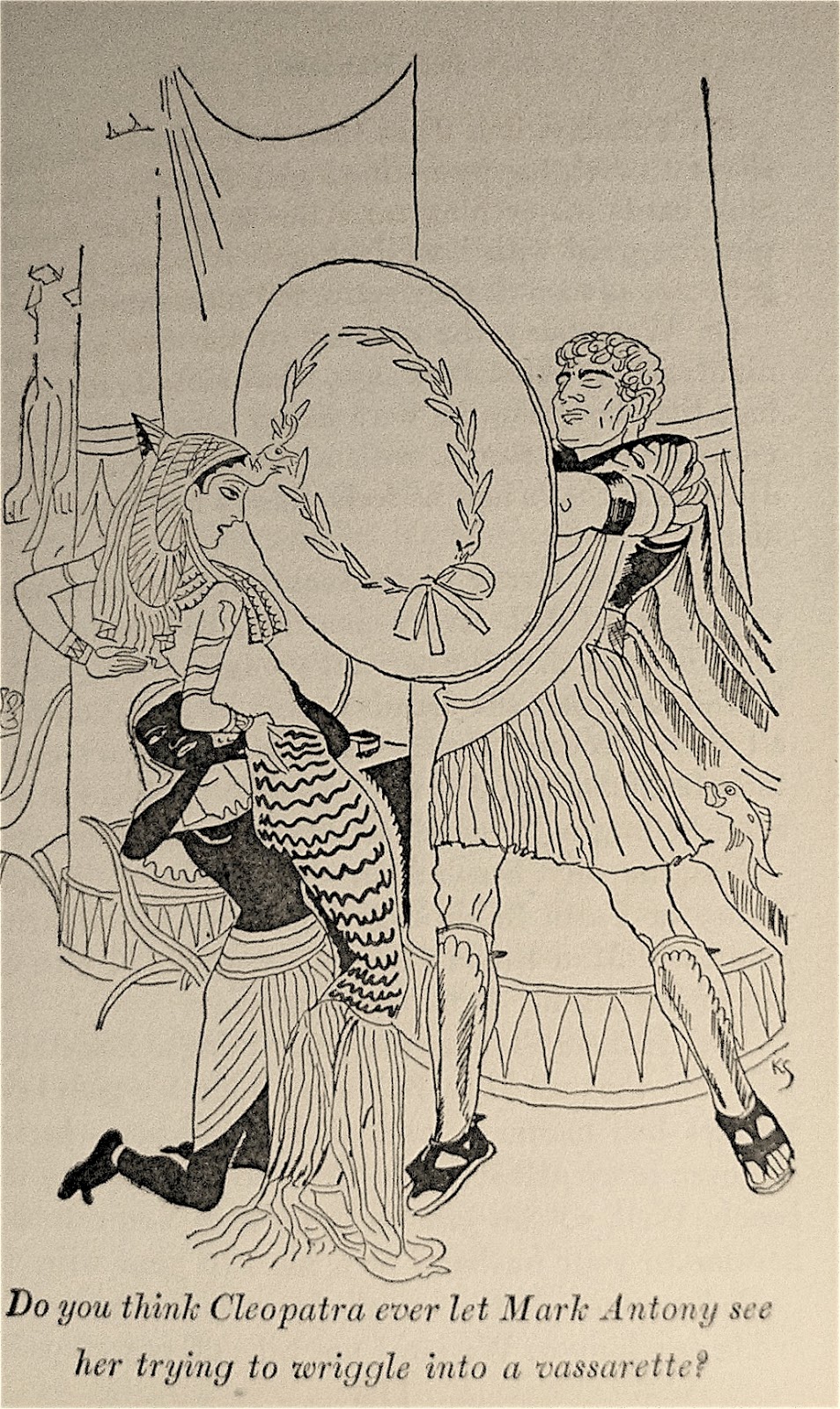
Did Cleopatra own a dreaded vassarette?
Very well. How are you going to act? How are you going to make the other person act? The schools of America teach many valuable subjects like geometry, ancient history, football and algebra, but they do not teach bed manners. As a result, our young graduates plunge into marriage with no idea how to behave. They can read the etiquette columns in the newspapers and the etiquette books in the library until they are black in the face, and still fail to find a single word of advice on this important topic.

During the past year, to prove our point, we have studied more than one million words written by every authority on etiquette in America. We have listened to the radio as well. Make this test yourself, and what do you get?

You get a lot of information about visiting cards, and lawn fetes, and the right way to eat asparagus, and how to write a letter to a United States Senator, and how to set the table for a formal luncheon. This is all good, as far as it goes. But it never goes past bedtime. You might think these authorities wanted you to sit up all night in the parlor, writing formal letters, or practicing the correct way to grip asparagus, or something.

Now, you know better than that. You know that you can't sit up all night for more than a very few nights without feeling very tired and wanting to get some sleep. Very well. This little book which you are now reading tells you, in a few practical lessons, everything you need to know about good form in the bedroom.

Knowledge is power.

Grasp it firmly, and you will be able to remodel the behavior of the person who sleeps with you. This person has no doubt been behaving very badly, for lack of good, practical information, such as this book supplies. If this is not checked, at once, it will lead to quarrels, injured feelings, and eventually to divorce. You probably will not be able to afford a divorce this year. Avoid all such expense by leaving this book in plain sight, where your bedfellow will see it and absorb its lessons. If it doesn't work a cure, nothing can.

If you wish to do good in your community, like a good citizen, you should extend the usefulness of this book by giving it to every married couple who are beginning to crack under the strain. In the very next home on your street, you may have reason to know that the husband is a boor. Or the wife may behave is if she has been brought up in the monkey cage at the zoo. Your course of action is obvious. Buy a copy of this book and leave it on their pillow. They may be surprised when they see it, but they will thank you in the end, when they learn how much happier it will make them.

You have a duty to young people, too. Instead of letting them grow up and marry in blind ignorance of the natural pitfalls caused by imperfect bed manners, you must see that a copy of this book goes to every prospective bride and groom in town. A young woman who finds it in her bridal shower will appreciate your kind thoughts. So will the college student who receives it as a graduation gift from you.

Another splendid use of this book is as a gift to your physician. He meets dozens of discontented married people in his daily rounds. He will want to prescribe this book to all of them, as soon as he has read it, digested it, and learn what it can do to make his own married life bearable, even happy.

One word of warning. This is the first and only book ever printed about Bed Manners. The subject is a vast one. The happiness of many million people depends on it. Therefore, do not attempt to read this book rapidly. Meditate each chapter before you take up the next one. You must think as you read. You can do this in the privacy of your home, or in the subway, or out riding with friends, or in odd moments at the office or factory where you work.

For this reason, you cannot rent this book at a library, and gallop through it, and expect to get its full benefit. Own your own copy it all times. Carry it around with you, and give its magic a full chance to work.


Contributor Maura Graber has been teaching etiquette to children, teens and adults, and training new etiquette instructors, for nearly a quarter of a century, as founder and director of The RSVP Institute of Etiquette.  She is also a writer, has been featured in countless newspapers, magazines and television shows and was an on-air contributor to PBS in Southern California for 15 years. 


Etiquette. Enthusiast, Maura J Graber, is the Site Editor for the Etiquipedia© Etiquette Encyclopedia