Friday, October 17, 2014

Etiquette and Eating Fruits Properly

Apples and Pears - 

Informally eaten in the hand, but at table they are taken onto the fruit plate and spirally peeled, or quartered with a knife, then peeled. The sections are then cored and eaten with the fingers or with the fruit fork. Lady apples, tiny as crab apples, are eaten in the fingers like plums.
    
Life is just a bowl of ... kumquats? Cherry forks are ideal for eating kumquats.

Apricots, Cherries, Kumquats, Plums -

 Apricots, cherries, plums are eaten in one or two bites, and the stones, cleaned in the mouth, are dropped into the cupped hand and placed on the side of the plate. Kumquats are bitten into or eaten whole depending on size.

Halved Avocados - 

In their shells these are eaten with a spoon, scooped out and taken spoonful by spoonful, with the dressing (perhaps lime juice and powdered sugar, or a little lake of French dressing) provided. Halved or quartered avocados in salads or on fruit platters are eaten with the fork after being broken into manageable bites.
             
Fried banana servers are rare in the world of silver flatware collecting.
Bananas - 

Very informally (at picnics and by small children) bananas are peeled down with the end of the skin as a protective holder. When eaten at table from a fruit dish they are peeled, then broken as needed into small pieces and conveyed to the mouth with the fingers.

Berry servers and berry forks shown with berries and strawberries.  Strawberries are not actually berries, but bananas and zucchini are botanically designated in the berry plant family.

Berries - 

Eaten with a spoon. Large strawberries are sometimes served whole with their stems on. These are grasped by the stem and dipped in
powdered sugar on the plate, then eaten in one or two bites, with the stem remaining in the fingers.
Grapes - 

Cut a bunch or section of bunch from bunches in bowl with knife or scissors (never absent-mindedly pull off grapes from centerpiece or arrangement of fruit) . Eat one grape at a time, after placing bunch on serving plate. Grape skins, if you can't eat them, should be cleaned in the mouth but not chewed, then removed in the cupped hand with the pits and placed on the side of the plate. Or, holding the grape with the stem end to the lips, pop the inside into the mouth and lay skin on side of plate if they will pop.

Once refrigerated railroad cars were in use, pointed spoons, originally designed for oranges, had serrated edges added to them, which made them ideal for grapefruit.

Grapefruit -  

Eaten, halved, with a pointed fruit spoon. Sections should be loosened with grapefruit knife before serving. Do not squeeze out juice at table, except en famille if the family can stand it.      

A selection of mango forks from Holland and Ecuador.
Mangoes - 
Wits say the only place to eat them is in the bathtub. But they may be used in a fruit bowl and eaten at table, even though the best way to serve them is peeled, quartered, pitted, and chilled. A whole ripe (spotted) mango should be cut in half with a sharp fruit knife, then quartered. Then, with the quarter turned skin up and held in place with a fork, the skin should be carefully pulled away rather than peeled from the fruit. The juicy sections are then cut in one-bite morsels. Finger bowls or at least paper napkins are necessary, as this fruit stains badly.
     
An ornate, Gilded Age, gilded orange spoon. The vermeil finish on the bowl of this spoon, protected the silver from the citric acid.
Oranges -

Peeled with a sharp knife in one continuous spiral (if you're adept), then pulled apart into segments and, if the segments are small, eaten segment by whole segment. If segments are large they are cut in half cross-wise with the fruit knife and eaten with fingers or fruit fork. Navel oranges are sometimes more easily eaten if the skin is quartered, then pulled down toward the navel and pulled off. The navel is then cut off and the orange segmented or cut in slices and eaten with the fork. At breakfast, oranges may be served halved like grapefruit, with the segments loosened, and are eaten with a fruit spoon.

Most gentlemen carried a personalized fruit knife with them, to cut and quarter not only their own fruits, but those of ladies whom they may have been picnicking with.
 Peaches-
Halve, then quarter with fruit knife. Then lifting the skin of each quarter at an edge, pull it off. Eat sections in small pieces with fork, preferably, as peach juice stains table linen.
    
Many fruits, sadly, were "Rodney Dangerfields"... they got no respect and no special utensils designed for them. Persimmons, papayas, kiwis, watermelon, peaches, cantaloupes, apples and pears are some of those "Rodney Dangerfields." And though the pineapple never had its own silver flatware, it did grace centerpieces at many tables in the New England states, as well as in England, and has become a symbol of hospitality.

Persimmons- 

Often served as a first course with the top cut off well below the stem and the base cut flat so the fruit stands firmly on the plate. Grasping the persimmon with the left thumb and index finger, scoop out and eat a spoonful at a time, keeping the shell intact. Avoid the skin which, unless dead ripe, is puckery. The large pits are cleaned in the mouth, dropped into the spoon, and then deposited on the side of the plate. Persimmons in salad are peeled and quartered too difficult a procedure to attempt at table, and persimmons in a fruit arrangement firm enough to be decorative are likely to be all but inedible anyway. They should be dead ripe and slightly spotted.

Pineapple-

 
Eaten with a spoon if served cut-up for dessert. If served on flat plates in quarters or eighths, peeled pineapple is eaten with a fork, after being cut with fruit knife.

Stewed or Preserved Fruit-
 

The pits or bits of core of cherries, prunes, plums, apples, etc., eaten in compote form with a spoon are dropped into the spoon, then deposited on the side of the plate.
Citrus peelers were popular items for the Victorian and Edwardian Era table.
Tangerines-
Stripped of their skins, segmented, and eaten in the fingers without cutting or breaking the segments.


Watermelon- 

If served cubed and chilled (often in white wine), eaten from a compote with a fruit spoon. Otherwise eaten with the fork. If seeds are present, the fruit is taken seeds and all into the mouth, then the seeds are cleaned in the mouth, dropped into the cupped hand, and placed on the side of the plate, entirely dry.

Etiquette instructions from Amy Vanderbilt's Complete Book of Etiquette.  

Photos of fruits and utensils courtesy of Etiquipedia© Etiquette Encyclopedia Site Editor, Maura J. Graber 


Thursday, October 16, 2014

Etiquette and "Israeli Frankness"

Israelis have a reputation for straight-talking, a quality that visitors are not always prepared for. But what lies behind it?
After BBC Watch ran the column that follows below, in April of 2013, and the comments from readers that followed, BBC Watch posted this query: "The subjects of ‘politeness’ and ‘manners’ are, of course, entirely culture dependent – as this perplexed Israeli discovered when a fellow passenger stood on her foot at Manchester’s Victoria railway station and then proceeded to publicly berate her for not responding to his apology with one of her own. So what do BBC Watch readers think about this item? Does it represent a light-hearted attempt to explain part of the Israeli culture or is it superficial – merely reinforcing and spreading existing stereotypes? Has Berg actually gone any way towards explaining to readers and listeners around the world why Israelis (like most other cultures) may have different perceptions of politeness and manners than the British, or is it in fact an example of cultural colonialism?"

There's an old joke in which a reporter says to an Israeli, a Russian and an American, "Excuse me, can I get your opinion on the food shortage in Africa?"

The Russian says: "What's an opinion?" The American says: "What's a shortage?" and the Israeli says: "What's 'Excuse me'?"

Now, of course before anyone accuses me of stereotyping, I realise the punchline will work with pretty much any nationality.
Israelis have a certain straightforwardness, a brusqueness of manner, so familiar to frequent visitors to Israel that they treat it as a source of humour.
But, on a recent reporting trip to Israel, I did encounter that special trait for which Israelis have gained a bit of a reputation - a certain, shall we say, straightforwardness, a brusqueness of manner, so familiar to frequent visitors to Israel that they treat it as a source of humour.


In fact, there were daily encounters - from the taxi driver who argued with me over where I wanted to go, to the hotel receptionist who insisted it was my own incompetence rather than a defective key which was stopping me opening my door, to the museum official who questioned why I asked permission to take a photograph, saying: "Just take. Why bother asking when we might say 'No'?"

Not to mention being barked at "Wodyawant?" by a stony-faced girl serving ice-cream at a parlour in Jerusalem, after having been queue-jumped by an elderly Israeli unimpressed by my patient waiting.

Now again, I know that queue-jumping happens everywhere, and the ice-cream girl might have just been having an off day, and that none of these incidents prove a thing, but it did get me thinking. Was all this really impoliteness, or a cultural misunderstanding, or something more deep-rooted?

To try to shed some light on it, I asked Professor Shalom Schwarz, a social psychologist at the Hebrew University of Jerusalem.

"There's certainly something of a tendency to be direct, and it's more common in Israel than in many other places. Most Israelis are aware of this reputation," he says.


Could politeness have become diminished by the blending of so many different cultures in Israeli society?


Schwarz doesn't think so, and has an alternative theory. "There's a very strong pragmatic strain here and that's helped along by being direct and not wasting time and effort on niceties - that may partly stem from army culture, which many people have come through, where you're expected to be straightforward and focus on the task."

He also suggests that what might seem like poor social graces to outsiders might actually help explain Israel's remarkable achievements. After all, the country is an economic success story, a powerhouse of technological innovation and a world leader in medical and scientific research. 

"It could be that, say, in business relationships, what some perceive as rude actually contributes to something - in the sense that there is somewhat less concern if you have something to say and say it in a straightforward manner. Then ideas can get out more in a more straightforward way," says Schwarz.
    
"Let's do as we say in the Middle East, Let's talk 'dugri.' That means straightforward", Netanyahu addresses the UN General Assembly in 2011. | Photo credit: AP
There is little doubt Israelis' penchant for directness is partly a product of living amid the harsh realities of the Middle East. They even have a word for it in Hebrew - "dugri", which roughly translates as "frank" or "down to earth". It's also an Arabic word meaning "straight" or "straight ahead". It was used famously by Israeli Prime Minister Benjamin Netanyahu who told Palestinian leader Mahmoud Abbas at the UN that only by talking "dugri" could they achieve peace.

After that, Israelis liked the phrase so much, they started to wear it on T-shirts. But Israelis are not really deserving of their reputation for bluntness, says one of the country's leading image gurus, Tami Lancut Leibovitz.
    
Flowers of the "sabra," or "prickly pear"
Leibovitz, who's coached Israeli executives and politicians in the art of etiquette for 30 years, says her compatriots are a sensitive people who have just developed a thick skin.

Her analysis chimes with another Hebrew word, "sabra", slang for a native Israeli. It comes from the name of a cactus fruit - prickly on the outside but tender within - characteristics which perhaps define Israelis best.


Thursday, October 9, 2014

Amy Vanderbilt on Dining Etiquette

Even when one uses the American zigzag method, it is sensible to convey food one has just cut to the mouth with the fork in the left hand, if one wishes. –  The traditional European style of dining was originally what was considered the American style. The dining style division was the result of British colonists sailing across the Atlantic, bringing their multi-step, or “zig-zag” method to the New World. The Continental (or European, as in the continent of Europe) style of dining became fashionable. A French etiquette book from that period read: “If you wish to eat in the latest mode favored by fashionable people, you will not change your fork to your right hand after you have cut your meat, but raise it to your mouth in your left hand.” 


The Use of the Knife and Fork

Knives and forks may be used American or Continental fashion, but a combination of the two systems is now often seen and is quite acceptable. Even when one uses the American zigzag method, it is sensible to convey food one has just cut to the mouth with the fork in the left hand, if one wishes. In other words, if you have cut off a bit of chop, it is not necessary, even conservative American style, to lay down the knife, place the fork, tines up, in the right hand and convey the meat to the mouth. Instead, one may use the fork in the left hand, with the tines of the fork down. 

Also, in eating a bit of bread and gravy by impaling the bread on the fork (in either hand), tines down, and sopping up the gravy it is now more usual than otherwise to convey the bit to the mouth with the fork tines down rather than up. Of course, nothing that would leak off the fork apple pie or other things needing a shoveling technique should be eaten this way. In the European fashion, food eaten with fork and knife is piled with the knife on the back of the fork, held in the left hand, and pressed down so it won't fall off or in the case of meat, impaled on the tines. The fork is then conveyed to the mouth, upside down, with the left hand.


Drinking Beverages at the Table

In drinking any beverage at table, a sip is never taken until the mouth is empty and has been wiped with the napkin. This keeps cup and glass rims free from food marks.


The Napkin

Napkins are placed on the lap entirely open if they are lunch-size or in half if they are dinner napkins. Guests wait until the hostess has taken up hers before placing their own. Napkins are tucked in only for children. They are never refolded; at the end of the meal, they are gathered and laid casually to the right of the place setting. Paper napkins are preferable to napkins to be used for more than one meal and placed in rings, but, if rings are used, they are given only to the family. A guest staying over should have a clean napkin each meal. Napkins reused are as incomprehensible to me as beds which have only one sheet changed. There are so many more sensible ways to economize.


Tipping of Dishes

The tipping of soup or dessert dishes is acceptable if the plate is tipped away from the spoon, not toward the eater.
          

The Soup or Bouillon Cup

Soup or bouillon served in a handled cup or even in a small cup-size bowl (Oriental fashion) is drunk. If there are dumplings or decorative vegetables or other garnish floating on top, these may be lifted out first with the spoon before the soup is drunk. Noodles or other things which may be in the bottom of the cup are spooned up after the liquid has been drunk.


Testing Liquids

Coffee or tea may be tested for heat or sweetening by one sip from the spoon, then drunk. If it is too hot, it must be allowed to stand until it is tolerable it may not be blown, spoonful by spoonful, until it is cool enough to drink.


“Stirring” Food

Nothing should ever be stirred up or mashed into a conglomerate heap on the plate. Gravy unless it is a gravy in which meat, fish or other protein is incorporated (rarebits, curries, blanquettes, chilis, etc.) is never poured or ladled onto rice, noodles, or other than meat on the plate. It is an insult to the cuisine to inundate everything on your plate with gravy or with that American favorite, catsup. If you want to eat your potatoes with gravy, you dip a forkful into the gravy that has escaped from the meat.


Conserves and Jellies

Conserves and jellies (jam and marmalade are for breakfast and tea) may be served at dinner or lunch with meat and are placed on the side of the plate, as are horse-radish, cranberry sauce, apple butter, relish. They are incorporated onto the fork as the food is taken into the mouth. Hard sauce is placed on the side of the dessert plate and incorporated with the pudding with dessert fork or spoon. Dessert sauces are ladled onto the dessert. Liquid sauces (mint, Chateaubriand, Worcestershire, etc...) meant for the meat are poured only onto it.


When Food is Too Hot

Too hot foods taken accidentally into the mouth are never hastily spit out in any way but are quenched with a drink of water before being swallowed (exception to rule against drinking with anything in the mouth).


“Spoiled” Food

Spoiled food, not even a bad clam, is ever spit, however surreptitiously, into a napkin. But it is sheer masochism to down, for the sake of manners, something really spoiled, once you have got a goodly mouthful. Anyone with experience in those foreign countries where such things are common knows it is better to seem unmannerly than to brave ptomaine or worse. Certainly, a partly chewed mouthful of food looks unappetizing to one's dinner partner if it has been necessary for you to deposit it from your fork on the side of the plate. It should be screened, if possible, with some celery leaves or, perhaps, a bit of bread. And, in taking it out of your mouth, try not to look as if anything were the matter. After all, if you were eating stewed or canned cherries, you would place the pits in the spoon with which you were eating, then place them on the side of your plate without anyone thinking the procedure disgusting.


Coughing at the Table

Ordinary coughing at table is done behind the hand, without excuse, but a coughing fit, brought on by something being caught in the windpipe, indicates that you must leave the table immediately without excuse (you can't talk, anyhow). If necessary, your partner at table offers help in the next room a pat on the back or a glass of water. If there is a servant present he or she attends to this unless the hostess indicates to some member of the family or to a nearby guest that help might be better from that source.


Blowing One’s Nose at the Table

If the nose must be blown at table, it is done as quietly as possible, without excuse to draw attention to the fact.


“Foreign Matter” in Foods

Foreign bodies accidentally taken into the mouth with food gravel, stones, bird shot are removed with thumb and forefinger, as are fish bones and other tiny bones. If a gnat gets into a beverage or some other unappetizing creature turns up in or on a diner's food, he fishes it out, unobserved (so others won't see it and be upset), and then either proceeds or leaves the drink or dish untouched, depending on the degree of odiousness of the intruder. A gnat or a tiny inchworm on lettuce shouldn't bother anyone, but most fastidious people draw the line at a fly or worse. If the hostess notices an untouched dish, she may say, "Do let me serve you a fresh portion," and she has the dish or drink removed without remarking clinically as to the need for the move. Or if a servant notices, she asks if the guest would like a fresh serving. In a restaurant, if host or hostess does not notice (and both should be alert for this sort of thing) that something is amiss, the guest may tactfully murmur to the waiter that the dish or drink needs changing preferably when host or hostess's attention is directed else-where.


When You Need Silverware

Your own wet spoon should never be placed in a sugar bowl, nor your butter knife in the jam or butter dish. If the serving utensils have been forgotten, pause long enough for the hostess to notice what's happened.


Tasting Another's Food

Sometimes a couple dining in a restaurant wish to taste each other's food. This is informal but permissible, though only if a fresh fork or spoon is used, with the possessor of the dish then handing the "taste" implement, handle first, to the other person. The other must not reach across the table and eat from a companion's plate, no matter how many years they have been married. If one of the two has had included some item say French fried potatoes in his order and doesn't wish them, he asks the waiter to serve them to the other, if desired he doesn't take them on his plate, then re-serve them.


Using Bread as a “Pusher”

A bit of bread, if available, is used to push food onto a fork never use the fingers. At formal dinners when bread is not served one may always switch to the Continental style, if one is adept, and chase the peas onto the back of the fork held in the left hand, pressing them down before conveying the fork, upside down, to the mouth. Or, holding the fork in the right or (French and Italian fashion) left hand, tines up, on plate, one may guide difficult food onto it with the side of the knife.


Reaching at Table

Reaching at table is now preferred to asking neighbors to pass things one can well take up himself, but one should not have to rise out of his seat.


From the original Amy Vanderbilt's Complete Book of Etiquette


Etiquette Enthusiast, Maura J Graber, is the Site Editor for the Etiquipedia© Etiquette Encyclopedia 

Wednesday, October 8, 2014

Victorian Plea for Civic Etiquette


Never did Egyptian war chariot rush upon the foe more desperately than these fellows upon their victims; and the suave qui peut (every man for himself) is the constant alarm.
It would be pleasant to have a few questions of civic etiquette settled definitely; and when settled, sanctioned by some legal means to make them obligatory. Thus the side of the pavé to which the pedestrian is entitled and is currently understood to be at his right hand. Gentlemen – by which for the nonce we mean men of ordinary tact and manners – conform to this understanding, and give the pas to the passer. But boors and brutes, whether in broadcloth or satinet, are recusants; and they unfortunately are the very men, to avoid whom such regulations more especially exist. Is there no way of giving a prescriptive right a legal form? 
If a quiet, inoffensive personage, pursuing his ideas and his solitary path dinnerwards at the extreme right of the walk, and confiding in that fact to save him from concussion, is deliberately rundown and prostrated buy some overgrown scoundrel, is he to have no other amend than the – ‘D**n your eyes! Why don't you mind how you go!’ of the trespasser? Might not the ability to call a policeman – supposing, (and we admit the violence of the assumption,) such a character to be within vocal range – help to prevent these frequent acts of rudeness? Grievous, indeed, it is to see, as we are at times obliged to, delicate women run down and half annihilated by some wanton wanderer from ‘his own side.’
It strikes us that a treaty should once be entered into between equestrian and pedestrian to prevent these contre-temps.
Then again at the crossings. Upon what principal did the decisions upon cases arising thereabouts hinge? It is, perhaps, natural and just that the tide of unmounted mortals should be dammed, while a tide of vehicles is passing the street. It is no more than a reasonable act of forbearance. The unrestricted freedom of trade, and a desire to encourage commerce, would oblige us to yield where a train of loaded carts is fairly under weigh. But we have no right to demand some trifling consideration in return? Why is it that drivers of car and hack and milk-wagon charge relentlessly upon the “unprotected female,” the confused crowd, or the abstracted philosopher, creating, at each street corner, daily astounding miracles in the way of escapes? Never did Egyptian war chariot rush upon the foe more desperately than these fellows upon their victims; and the suave qui peut is the constant alarm. 
It is all very well for agile people, lithe man and brisk young folk, to be thus stirred up to unwonted exercise; but who can look on tender women or tottering sires fearfully frightened, and well-nigh ground into the cobble-stones, by these knights of the lash, without experiencing a glow of virtuous indignation? It strikes us that a treaty should once be entered into between equestrian and pedestrian to prevent these contre-temps. The law of etiquette should be solemnly determined, and a penalty should be annexed to violation, with competent authority in the hands of somebody to enforce it. The right of might is the present rule, and requires modification. – 1852, New York Times


Etiquette Enthusiast, Maura J. Graber, is the Site Editor for the Etiquipedia© Etiquette Encyclopedia 


Monday, October 6, 2014

Etiquette for Dining in Ukraine

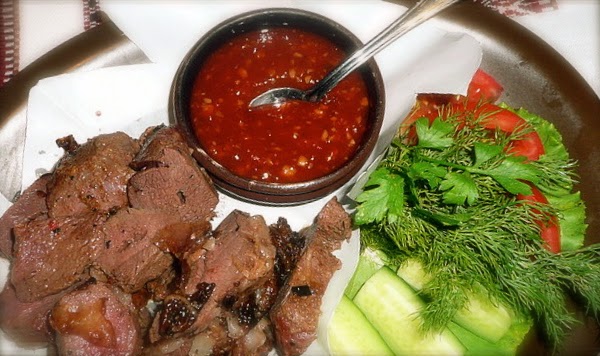
"Dining refinements are key because you never get a second chance to make a first impression, like after spilling shashlik sauce on your pants." A great secret to eating in Ukraine, if you are just visiting the country, is to not ask for a "restaurant," according to ukraine.pacsys.com  "The word restaurant has a different connotation in Ukraine. The Ukrainian word 'restaran' implies a high-class, elegant dining experience, often with live music. They are mostly used for weddings, banquets and big celebrations. For a delicious, inexpensive meal in Ukraine, ask for a cafe. These are the standard places for everyday dining in Ukraine."


Looking Fine, While Fine Dining in Ukraine


Table manners play an important part in making a favorable impression, and are essential to one's personal and professional success. Dining refinements are key because you never get a second chance to make a first impression, like after spilling shashlik sauce on your pants.

Obviously, there is a degree of flexibility involved. It can be hard to project success in certain Kyiv restaurants, where you have to get down on your knees and beg your waitress for a menu, or stand on your chair at the conclusion of your meal and wave your napkin semaphore-style in order to secure the bill. In other words, not every dinner calls for a complete working knowledge of table manners.

     
The goal is to behave with graciousness and poise at the table... Slouching is not approved of, regardless of how good you may look. Remember, your posture silently speaks volumes about you.

“The goal is not, after all, to demonstrate utter mastery of the most arcane details of etiquette,” says an article oncuisinenet.com. “[but] to behave with graciousness and poise at the table.”

Napkin Use


As soon as you are seated, place your napkin on your lap, and use it sparingly and gently throughout the meal. Leaving it loosely folded on your seat when standing up from the table signals you’ll be returning. Leaving it to the right of your dinner plate signals you have concluded your meal.

The Table Setting

Not every dinner calls for a complete working knowledge of table manners, but, again, watch that posture. Good manners means no slouching! And please keep your elbows off of the table too.

Faced with a baffling arsenal of cutlery and dishware, follow two basic rules: Imitate the actions of your host or fellow diners and typically eat from the outside in, proceeding with those forks and knives furthest from the center of your setting and working your way inwards.

On the far left is typically found the salad fork, followed by the fish fork and meat fork. On the far right you may find a small oyster fork, followed by the soup spoon, fish knife and meat knife. Spoons may also accompany a serving of dessert or coffee and tea. Once used, each should be returned to the saucer (but not bowl) on which it arrived, but never to your dinner plate.


Holding On

The guides describe the European style as less formal, since you can use your knife both to cut up your food and load up items like peas on your fork.
Etiquette guides define two styles for holding utensils: the American or “Zig-Zag” style, and the European or Continental style. The first system refers to the habit of cutting at most two bites of meat with the fork in the left hand and knife in the right, and then placing the knife on the rim of the plate and switching the fork to the right hand before taking a bite. The guides describe the European style as less formal, since you can use your knife both to cut up your food and load up items like peas on your fork. In general, however, food should be eaten off of the fork with the tines pointed downward. “The position of the knife and fork when not in use acts as a sort of semaphore,” cuisinenet.com adds.

Soiled utensils should never touch the table, but remain on the plates for which they were designed (salad fork on salad plate, meat/fish fork and meat/fish knife on dinner plate, etc...). Keep the blade of the knife pointed toward you and the fork tines preferably pointed up or down, but never facing another person. When taking a small break in eating, the fork and the knife should balance on the rim of the plate; when receiving a second helping, they should lie parallel on the right side of the plate; and when you’ve finished your meal, they should lie parallel either across the plate or on a diagonal.


Brushing Up

Eaten with the fingers ~ Foods which may be eaten with the fingers include artichokes (until you reach the heart), asparagus (when not covered in sauce), crisp bacon... 
There certainly is no shortage of dining rules. Foods which may be eaten with the fingers include artichokes (until you reach the heart), asparagus (when not covered in sauce), crisp bacon, bread and rolls (always broken, never cut), cookies, corn on the cob, hors d’oeuvres, sandwiches and fruit.

Inedible foods should come out of the mouth the way they went in – olive pits in the hand, chicken bones on the fork. But, to repeat, style and flexibility are all-important.

“When a piece of fat is too big to be removed with the fork, use a napkin discretely to discard the meat,” advises the askmen.com Web site, which clearly hasn’t heard of salo, and doesn’t know it should simply be swallowed.


Main article used was originally published in 2003 in the Kyiv Post

🍽Etiquette Enthusiast, Maura J. Graber of The RSVP Institute of Etiquette, is the Site Editor for the Etiquipedia© Etiquette Encyclopedia

Sunday, October 5, 2014

19th C. Etiquette and Chivalry on the Rails


"Railroad Etiquette and Chivalry"


"One of those occasions which now and then permits the sterling temper of chivalry to display itself, happened the other night on the railroad between New York City and Philadelphia. At New Brunswick, where passengers are apt to slip out in search of a cup of coffee, or a glass of more stirring stimulus, Mr. Fayette McMullen, of Virginia, left his seat in charge of an umbrella, while he refreshed himself at the counter. A Mr. Titsworth, of Plainfield, entered with his lady during his absence, and occupied the seat. Mr. McMullen requested Mr. Titsworth to give up the seat, which the latter, yielding to the entreaty of his companion, finally consented to do; but not without informing the Virginian of what might seem an obvious fact, that he (McMullen,) was no gentleman. Mr. McMullen, after the passengers had taken the boat at Tacony, encountered Mr. Titsworth again, and smarting under the imputation of ungentlemanly behavior, demanded an apology from the Jerseyman. It was not only refused, but the charge was distinctly repeated; whereupon chivalry applied his cane to the offender's shoulders, and would unquestionably have received an active return-fire but for the interference of the spectators. Mr. McMullen, who is a member of Congress, has been bound over in the sum of $1000 to answer for the assault.
Politeness consists of a good nature that cannot be ruffled, and a cheerful forgetfulness of self, that throws petty annoyances to one side, as the spray is flung off by the ship.
The rules of etiquette that should govern in travel are too indefinite to admit of dictation on the part of any individual. Of the right a traveler may have to reclaim an abandoned seat, views are undetermined. A through passenger, who leaves his seat, and marks of ownership upon it, would certainly seem to have a right paramount to that of an interloping way-traveler. So far had the affair of been simply between one gentleman and another, Mr. McMullen would perhaps have been perfectly correct. But it was not. There was a lady interested; and every rule of gentlemanly propriety requires that rights, however unimpeachable, should in such case, be relinquished. The presence of a lady ought to have shielded her escort from insult; and the blow, which might have deprived her of escort, can hardly be excused. Under ordinary social rules, therefore, we think Mr. McMullen is clearly condemned.
   

To show what he should have done to rid himself of Mr. Titsworth epithet, we have only to imagine the behavior of the gentleman under the circumstances. Finding his seat so occupied by a gentleman and a lady, apparently traveling together, he should have politely and blandly withdrawn, submitting to any self-negation rather than enter into a violent controversy in a public place, and upon such premises. No inducement could have persuaded a gentleman to take the exacting course he thought proper to pursue and his subsequent conduct places him out of the reach of excuse. Mr. Titsworth, it may be added, would have been in a better position to call Mr. McMullen in question, had he vacated the seat at the first intimation of the latter's proprietorship.


There never need be any casuistry about the duty of a gentleman in a railway car or anywhere else, so long as we remember that politeness consists of a good nature that cannot be ruffled, and a cheerful forgetfulness of self, that throws petty annoyances to one side, as the spray is flung off by the ship.


From the NY Times, 1852

Friday, October 3, 2014

Etiquette of a Gilded Age Dinner Ball


“What is the chief end of man? – To get rich. In what way?–dishonestly if we can; honestly if we must.” Mark Twain, 1871 


A gilded macaroni server, circa 1880 ~ The Gilded Age unofficially is believed to be the period between 1870-1900. “Gilding” is to cover, or coat, with gold, as many silver items were at the time. The period also got its name from the title of a book. "The Gilded Age: A Tale of Today" was an 1873 novel by Mark Twain and Charles Dudley Warner 

During the “Gilded Age,” every man was a potential Andrew Carnegie, and Americans who achieved wealth celebrated it as never before. In New York, the opera, the theatre, and lavish parties consumed the ruling class’ leisure hours. Sherry’s Restaurant hosted formal horseback dinners for the New York Riding Club. Mrs. Stuyvesant Fish once threw a dinner party to honor her dog, who arrived sporting a $15,000 diamond collar. 

This gilded age ball at the Astors’ 5th Avenue residence, a “double mansion” according to the news’ account, hosted nearly 300 guests. All of whom were “prominent representatives of New York society.” The midnight supper (menu below) required the entirety of Mrs. Astor’s “solid silver table service” as any menu of that size and amount would require, in the Gilded Age. The menu was as follows:

Consommé à la Princesse 
Térapène
Filet de boeuf aux champignons frais et truffes
Canard canvasback rôti
Salade de céleri et laitue
Sandwiches assortis
Glaces de fantaisies
Biscuit glacé biscuit Tortoni
Gâteaux assortis
Gelée macédoine 
Charlotte Parisienne
Fruits 
Bonbons
Café Champagne Claret Cup Lemonade Poland water

The supper was immediately followed by the cotillion. The party favors were “novel and artistic” and were pulled in “by ribbon bands, on an old French Sleigh, mounted on castors, a copy of one formerly used by Louis Quatorze.” The goodies given to guests were quite a haul! The swag for the guests included; “Wands of roses with little bells attached, tartan plaid silk sashes, with the monogram of Mrs. Astor in gold, with the date of the ball; Beardsley poster blotters, and sachets with large bouquets attached.” (Aubrey Beardsley was one of the most controversial artists of the Art Nouveau Era, and he died a year after this ball was held.) For the men, favors included; “Handsome leather tobacco pouches, with silver tops, gold and silver trimmed golf sticks and golf balls, and jeweled orders with gold chains.”

Guests were required to attend a dinner party like the Astor’s in “full dress.” Just what that meant, was a question of time and place. Strictly interpreted, it allowed gentlemen very little choice. 

A black dress coat and trowsers (sic), a black or white vest and cravat, white gloves, and pumps and silk stockings were formerly rigorously insisted upon. But the freedom-loving “spirit of the age” has already made its influence felt even in the realms of fashion, and a little more latitude is now allowed in most circles.

–––––––––––––––––––––––––––––––––––––––––––

The “American Gentleman’s Guide” enumerates the essentials of a gentleman's dress for occasions of ceremony in general, as follows: 
“A stylish, well-fitting cloth coat, of some dark color and of unexceptionable quality, nether garments to correspond, or in warm weather, or under other suitable circumstances, white pants of a fashionable material and make, the finest and purest linen, embroidered in white, if at all; a cravat and vest of some dark or neutral tint, according to the physiognomical peculiarities of the wearer and the prevailing mode; an entirely fresh-looking, fashionable black hat, and carefully-fitted modish boots, white gloves, and a soft, thin, white handkerchief.”
A lady’s “full dress” in 1897 was not as easily defined, and fashion allowed her much greater scope for the exercise of her taste in the selection of materials, the choice of colors, and the style of making. However, she had to arrive dressed “in the fashion.” 

The following is a list of just some of the notable female guests, and notes on what they wore:


Articles with highlights of what the socialites wore, written about in great detail and featured in the nationwide and international newspapers, were precursors to modern day, award shows and red-carpet, "Best Dressed and Worst Dressed" lists given out in entertaining television shows, magazines and blogs. 

While the rich wore diamonds, many wore rags. In 1890, 11 million of the nation's 12 million families earned less than $1200 per year; of this group, the average annual income was $380, well below the poverty line. Rural Americans and new immigrants crowded into urban areas. Tenements spread across city landscapes, teeming with crime and filth. Americans had sewing machines, phonographs, skyscrapers, and even electric lights, yet most people labored in the shadow of poverty. 

To those who worked in Carnegie's mills and in the nation's factories and sweatshops, the lives of the millionaires seemed immodest indeed. An economist in 1879 noted "a widespread feeling of unrest and brooding revolution." Violent strikes and riots wracked the nation through the turn of the century. The middle class whispered fearfully of "carnivals of revenge."

For immediate relief, the urban poor often turned to political machines. During the first years of the Gilded Age, Boss Tweed's Tammany Hall provided more services to the poor than any city government before it, although far more money went into Tweed's own pocket. Corruption extended to the highest levels of government. During Ulysses S. Grant's presidency, the president and his cabinet were implicated in the Credit Mobilier, the Gold Conspiracy, the Whiskey Ring, and the notorious Salary Grab. 

Europeans were aghast. America may have had money and factories, they felt, but it lacked sophistication. When French prime minister Georges Clemenceau visited, he said the nation had gone from a stage of barbarism to one of decadence -- without achieving any civilization between the two.


Sources for this post: PBS, Maura Graber Etiquette Sleuth, The “American Gentleman's Guide” and 1887's “How to Behave” by Samuel R. Wells

 🍽Etiquette Enthusiast, Maura J. Graber of The RSVP Institute of Etiquette, is the Site Editor for the Etiquipedia© Etiquette Encyclopedia