Thursday, June 6, 2013

Opera and Theatre Etiquette for Ladies and Gentlemen

It is correct for the young man to inquire if the young woman prefers a box, or, if not, he should state in what part of the house he proposes to secure seats. This will enable her to determine how to dress. 
Theatre

A young man may invite a young woman to the theatre or opera, even if he has but a slight acquaintance with her, but of course he should secure the permission of her parents or chaperone.

It is correct for the young man to inquire if the young woman prefers a box, or, if not, he should state in what part of the house he proposes to secure seats. This will enable her to determine how to dress.

If the young woman wears street toilette, her escort may take her in any public conveyance but if she wears evening dress, he should provide a carriage. At the theatre he should precede the woman down the aisle to the seat or box; but if it is the latter, he should open the door and wait for her to pass.

A man may use his judgment as to the aisle seat. If a better view can be had, or seemingly objectionable people are next the inside seat, it is perfectly proper to give the woman the aisle seat.

A man should never leave his companion
between the acts. The custom of both men and women going into the foyer at that time is a growing one, and is a relief to the audience.

Refreshments at some fashionable place may follow after the entertainment.

For a man to call on an acquaintance in an opera box does not relieve one of the duty of
making a formal call in return for social favors.

Bonnets

A woman of any consideration will either wear no bonnet at all or remove it as soon as the curtain is raised.

It would be in place for a man or woman whose view is hampered by a bonnet to politely ask the wearer to remove it, and when it is done, to thank her.

Men —Leaving Cards


After a theatre party given by a man, he should call within three days on the woman he escorted or leave his card.

Precedence

In entering a theatre a man precedes the women of his party, but after he has handed his coupons to the ushers he gives the women precedence, and follows them to their seats.

Talking

Conversation during the progress of the play or the opera should be avoided, and confined to the intermissions.

The theatre goer should avoid all noise, gestures or actions tending to annoy others or to render himself conspicuous.

A man would be justified, when annoyed by a person talking loud near him, in asking him politely to speak lower.

Conversation during the progress of the play or the opera should be avoided, and confined to the intermissions. 
Conversation during the progress of the play or the opera should be avoided, and confined to the intermissions.

Theatre and Opera Parties Given by Men


A man giving a theatre or opera party should secure one or more chaperones if women are to be present.

Calls

The host should call upon his guests within three days or a week after the event.

Carriages

The host may, if he choose, send carriages or a stage to collect all the guests. This is a formal and agreeable way to begin the evening's pleasure. 

The chaperone should be called for first. A more informal way is quite popular. The invitations having been given and accepted, the host informs each of his guests as to the others, and leaves a ticket with each one. All then meet
informally at the place of amusement. If a dinner is given before the entertainment,
carriages are provided to convey the guests to the theatre.

Chaperone

A chaperone should always be present if women are to be members of the party. And if a stage or carriage calls for the guests, it should call first for the chaperone.

The chaperone who acts as hostess should decide the hour to close the festivities.

Dinners

If a dinner is given before the performance, it is generally given at six o'clock, the usual customs being followed. If preferred, the dinner may follow the performance, and may be given at any fashionable restaurant or hotel.

If it is given before the play, at its termination the guests are conveyed in carriages or stage to the theatre at the expense of the host.

After the entertainment it is a good plan for the party to return to the banqueting-room to partake of slight refreshments.

A woman should avoid conspicuous manners, loud conversation, laughing, or acting in any way to attract attention. 
A woman should avoid conspicuous manners, loud conversation, laughing, or acting in any way to attract attention.

Dress

Men wear evening dress. Women wear full evening dress.

Invitations

He may invite his guests in person or by note. In either case he should secure the parents' permission to allow the young women to attend, and should be ready to supply all information regarding the men who will be present, and also the chaperones.

Men 

The escorts should see the women home unless they are called for by the male members of their families, in which case they may be accompanied to their conveyances. If a young woman is called for by her maid in a carriage, her escort may take her home.

Intimacy of the parties largely regulates the etiquette of such occasions. They can decide whether evening or street dress shall be worn, and seat themselves accordingly. A carriage should be provided.

When entering an opera or theatre box for a short call, a man should stand and bow, making some pleasant remark to the chaperone.

If there is an empty chair, he may sit and talk a few minutes and retire as others enter.

Women

Between the acts it is perfectly proper to go into the foyer with the escort, who should carry the woman's wraps and see that all her wants are attended to. Should she desire anything, she should call on him first.

The hat or bonnet should be removed.

In a box the women occupy the front row while the men sit or stand in the rear.

A woman should avoid conspicuous manners, loud conversation, laughing, or acting in any way to attract attention.

Given by Women 

This is a popular form of entertainment during the season. They are given by married women, and the guests are invited by note.

A dinner is given at the house or at a restaurant before the departure for the opera or play.

Refreshments may also be given after the
entertainment at either the house or restaurant.

At the dinner the same ceremonies are followed as to arrangements of guests and escorts as at any formal dinner.

After the entertainment it is a good plan for the party to return to the banqueting-room to partake of slight refreshments. —From “The Book of Good Manners”


Etiquette Enthusiast, Maura J Graber, is the Site Editor for the Etiquipedia© Etiquette Encyclopedia

Friday, April 26, 2013

Gilded Age Toilette Etiquette


Patent for a Ladies’ Toilet Cabinet, November 1869 


The Toilette of Yesterday 


Madame Rowley’s “Toilet Mask,” or “Face Glove” 

Propriety requires that we should always be clothed in a cleanly and becoming manner, even in private, in leaving our bed, or in the presence of no one. It requires that our clothing be in keeping with our sex, fortune, profession, age, and form, as well as with the season, the different hours of the day and our different occupations. Let us now descend to the particulars of these general rules. 

What the fashionable men are wearing throughout the day. 


The dress for a man on his first rising, is a cap of cotton, or silk and cotton, a morning gown, or a vest with sleeves; for a lady, a small muslin cap, (bonnet de percale,) a camisole or common robe. It is well that a half corset should precede the full corset, which last is used only when one is dressed; for it is bad taste for a lady not to be laced at all. 


Madame C.J. (Sarah) Walker, founded her own business and began selling her own product called “Madam Walker's Wonderful Hair Grower,” a scalp conditioning and healing formula, after suffering from a scalp ailment that caused her to lose some of her hair and experimenting with homemade remedies of another. To promote her products, she embarked on an exhausting sales drive throughout the South and Southeast selling her products door to door, giving demonstrations, and working on sales and marketing strategies. In 1908, she opened a college in Pittsburgh to train her “hair culturists.” Madame Walker became the first known African-American woman to become a self-made millionaire, catering to the toilette needs of African-American women. 

The hair papers, which cannot be removed on rising (because the hair would not keep in curl till evening,) should be concealed under a bandeau of lace or of the hair. They should be removed as soon as may be. In this dress, we can receive only intimate friends or persons, who call upon urgent or indispensable business; even then we ought to offer some apology for it. To neglect to take off this morning dress as soon as possible, is to expose one's self to embarrassments often very painful, and to the appearance of a want of education. 


Laurence Olivier in morning dressing gown, “The Prince and the Showgirl” — “In this dress, we can receive only intimate friends or persons, who call upon urgent or indispensable business; even then we ought to offer some apology for it. To neglect to take off this morning dress as soon as possible, is to expose one's self to embarrassments often very painful...” 


Moreover, it is well to impose upon yourself a rule to be dressed at some particular hour (the earliest possible,) since occupations will present themselves to hinder your being ready for the day; and you will easily acquire the habit of this. Such disorder of the toilet can be excused when it occurs rarely, or for a short time, as in such cases it seems evidently owing to a temporary embarrassment; but if it occur daily, or constantly; if it seems the result of negligence and slovenliness, it is unpardonable, particularly in ladies, whose dress seems less designed for clothing than ornament. To suppose that great heat of weather will authorize this disorder of the toilet, and will permit us to go in slippers, or with our legs and arms bare, or to take nonchalant or improper attitudes, is an error of persons of a low class, or destitute of education. Even the weather of dog-days would not excuse this; and if we would remain thus dressed, we must give directions that we are not at home. On the other hand, to think that cold and rainy weather excuses like liberties, is equally an error. You ought not to be in the habit of wearing large socks (this is addressed particularly to ladies,) as socks of list and similar materials; much less noisy shoes, such as wooden ones, galoshes lined with fur, shoes with wooden soles, socks, etc... this custom is in the worst taste. 


Visiting Toilettes 1897 — “... a lady of good breeding should not go out in a morning dress, neither with an apron nor cap, even if it is made of fine cloth and trimmed with ribbons; nor should a well-bred man show himself in the street in a waistcoat only, a jacket without sleeves, etc...”

When you go to see any one, you cannot dispense with taking off your socks or clogs before you are introduced into the room. For to make a noise in walking is entirely at variance with good manners. However pressed one may be, a lady of good breeding should not go out in a morning dress, neither with an apron nor cap, even if it is made of fine cloth and trimmed with ribbons; nor should a well-bred man show himself in the street in a waistcoat only, a jacket without sleeves, etc... We said before that the dress should be adapted to the different hours of the day. Ladies should make morning calls in an elegant and simple négligé, all the details of which we cannot give, on account of their multiplicity and the numerous modification of fashion. We shall only say that ladies generally should make these calls in the dress which they wear at home. 


I would never be caught dead out of the house in this attire— “Gentlemen may call in an outside coat, in boots and pantaloons, as when they are on their ordinary business.” 


Gentlemen may call in an outside coat, in boots and pantaloons, as when they are on their ordinary business. In short, this dress is proper for gentlemen's visits in the middle of the day. With regard to ladies, it is necessary for them when visiting at this time, to arrange their toilet with more care. Ceremonious visits, evening visits, and especially balls, require more attention to the dress of gentlemen, and a more brilliant costume for ladies. There are for the latter, head-dresses particularly designed for such occasions, and for no other, such as rich blond caps, ornamented with flowers, brilliant berets and toques, appropriate to the drawing-room. 

The nicest cloth, new and very fine linen, an elegant but plain waistcoat; a beautiful watch, to which is attached a single costly key, thin and well polished shoes, an entirely new hat, of a superior quality -- this is a dress at once recherché and rigorously exact, for gentlemen of good taste and tone. One's profession requires very little modification of this costume; we should observe, however, that men of science (savans) and literary men and those in the profession of the law, should avoid having a fashionable or military costume, which is generally adopted by students, commercial men, and exquisites, for the sake of tone or for want of something to do. Situation in the world determines among ladies, those differences, which though otherwise well marked, are becoming less so every day. 


Everyone knows that whatever be the fortune of a young lady, her dress ought always, in form as well as ornaments, to exhibit less of a recherché appearance and should be less showy than that of married ladies. Costly cashmeres, very rich furs, and diamonds, as well as many other brilliant ornaments, are to be forbidden a young lady; and those who act in defiance of these rational marks of propriety make us believe that they are possessed of an unrestrained love of luxury, and deprive themselves of the pleasure of receiving these ornaments from the hand of the man of their choice. 

All ladies cannot use indiscriminately the privilege which marriage confers upon them in this respect, and the toilet of those whose fortune is moderate should not pass the bounds of an elegant simplicity. Considerations of a more elevated nature, as of good domestic order, the dignity of a wife, and the duties of a mother, come in support of this law of propriety, for it concerns morality in all its branches. We must beware of a shoal in this case; frequently a young lady of small fortune, desiring to appear decently in any splendid assembly, makes sacrifices in order to embellish her modest attire. But these sacrifices are necessarily inadequate; a new and brilliant article of dress is placed by the side of a mean or old one. The toilet then wants harmony, which is the soul of elegance as well as of beauty. Moreover, whatever be the opulence which you enjoy, luxury encroaches so much upon it, that no riches are able to satisfy its demands; but fortunately propriety, always in accordance with reason, encourages by this maxim social and sensible women. Neither too high, nor too low; it is equally ridiculous either to pretend to be the most showy, or to display the meanest attire in an assembly. The rules suitable to age resemble those which mediocrity of fortune imposes; for instance, old ladies ought to abstain from gaudy colors, recherché designs, too late fashions, and graceful ornaments, as feathers, flowers, and jewels. 


From “The Gentleman and Lady's Book of Politeness and Propriety of Deportment, Dedicated to the Youth of Both Sexes” by Elisabeth Celnart 


 🍽Etiquette Enthusiast, Maura J. Graber of The RSVP Institute of Etiquette, is the Site Editor for the Etiquipedia© Etiquette Encyclopedia

Friday, April 5, 2013

19th C. Women’s Etiquette and Dress

Victorian Attire for Women 

Women in pink capes, France, 1860
“A lady is never so well dressed as when you cannot remember what she wears.”

No truer remark than the above was ever made. Such an effect can only be produced where every part of the dress harmonizes entirely with the other parts, where each color or shade suits the wearer's style completely, and where there is perfect neatness in each detail. One glaring color, or conspicuous article, would entirely mar the beauty of such a dress. It is, unfortunately, too much the custom in America to wear any article, or shape in make, that is fashionable, without any regard to the style of the person purchasing goods. If it is the fashion it must be worn, though it may greatly exaggerate a slight personal defect, or conceal or mar what would otherwise be a beauty. It requires the exercise of some judgment to decide how far an individual may follow the dictates of fashion, in order to avoid the appearance of eccentricity, and yet wear what is peculiarly becoming to her own face or figure. Another fault of our fair countrywomen is their extravagance in dress. No better advice can be given to a young person than to dress always according to her circumstances. She will be more respected with a simple wardrobe, if it is known either that she is dependent upon her own exertions for support, or is saving a husband or father from unnecessary outlay, than if she wore the most costly fabrics, and by so doing incurred debt or burdened her relatives with heavy, unwarrantable expense. If neatness, consistency, and good taste, preside over the wardrobe of a lady, expensive fabrics will not be needed; for with the simplest materials, harmony of color, accurate fitting to the figure, and perfect neatness, she will always appear well dressed.

GENERAL RULES.

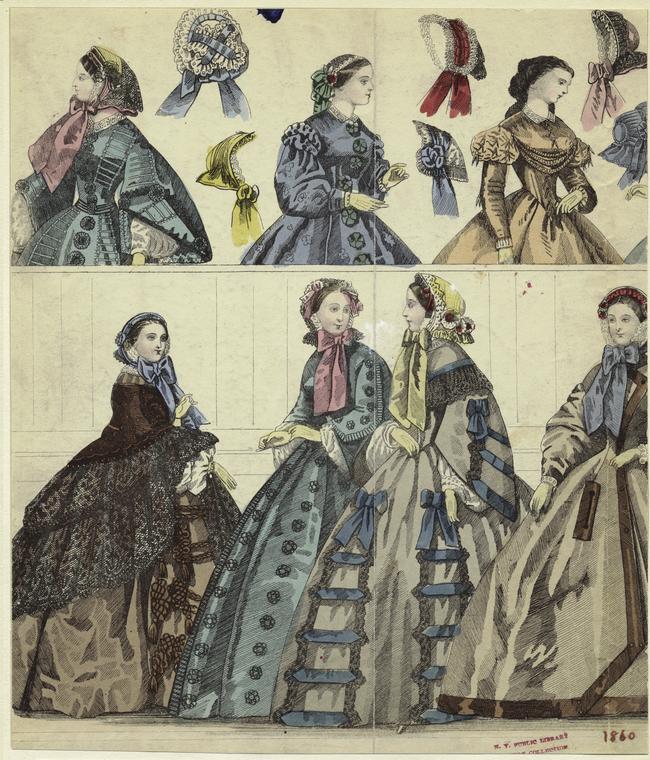
Women in dresses and bonnets, 1860

NEATNESS—
This is the first of all rules to be observed with regard to dress. Perfect cleanliness and careful adjustment of each article in the dress are indispensable in a finished toilet.  Let the hair be always smooth and becomingly arranged, each article exquisitely clean, neat collar and sleeves, and tidy shoes and stockings, and the simplest dress will appear well, while a torn or soiled collar, rough hair, or untidy feet will entirely ruin the effect of the most costly and elaborate dress. The many articles required in a lady's wardrobe make a neat arrangement of her drawers and closets necessary, and also require care in selecting and keeping goods in proper order. A fine collar or lace, if tumbled or soiled, will lose its beauty when contrasted with the same article in the coarsest material perfectly pure and smooth. Each article of dress, when taken off, should be placed carefully and smoothly in its proper place. Nice dresses should be hung up by a loop on the inside of the waistband, with the skirts turned inside out, and the body turned inside of the skirt. Cloaks should hang in smooth folds from a loop on the inside of the neck. Shawls should be always folded in the creases in which they were purchased. All fine articles, lace, embroidery, and handkerchiefs, should be placed by themselves in a drawer, always laid out smoothly, and kept from dust. Furs should be kept in a box, alone, and in summer carefully packed, with a quantity of lump camphor to protect from moths. The bonnet should always rest upon a stand in the band-box, as the shape and trimming will both be injured by letting it lie either on the face, sides, or crown.


ADAPTIVENESS —
Let each dress worn by a lady be suitable to the occasion upon which she wears it. A toilet may be as offensive to good taste and propriety by being too elaborate, as by being slovenly. Never wear a dress which is out of place or out of season under the impression that "it will do for once," or "nobody will notice it." It is in as bad taste to receive your morning calls in an elaborate evening dress, as it would be to attend a ball in your morning wrapper.


HARMONY—
To appear well dressed without harmony, both in color and materials, is impossible. When arranging any dress, whether for home,  street,  or evening,  be careful that each color harmonizes well with the rest, and let no one article, by its glaring costliness, make all the rest appear mean. A costly lace worn over a thin, flimsy silk, will only make the dress appear poorer, not, as some suppose, hide its defects. A rich trimming looks as badly upon a cheap dress, as a mean one does upon an expensive fabric. Observe this rule always in purchasing goods. One costly article will entirely ruin the harmony in a dress, which, without it, though plain and inexpensive, would be becoming and beautiful. Do not save on the dress or cloak to buy a more elaborate bonnet, but let the cost be well equalized and the effect will be good. A plain merino or dark silk, with a cloth cloak, will look much better than the most expensive velvet cloak over a cheap delaine dress.

"The war stopped being a joke when a girl like you doesn't know how to wear the latest fashion. And those pantalettes: I don't know a woman in Paris who wears pantalettes any more..." Rhett Butler after bringing Scarlett O'Hara the gift of a new hat, and she doesn't know how it's worn

FASHION—
Do not be too submissive to the dictates of fashion; at the same time avoid oddity or eccentricity in your dress. There are some persons who will follow, in defiance of taste and judgment, the fashion to its most extreme point; this is a sure mark of vulgarity. Every new style of dress will  admit of adaptation to individual cases, thus producing a pleasing, as well as fashionable effect. Not only good taste, but health is often sacrificed to the silly error of dressing in the extreme of fashion.  Be careful to have your dress comfortable and becoming, and let the prevailing mode come into secondary consideration; avoiding, always, the other extreme of oddity or eccentricity in costume.


STYLE AND FORM OF DRESS—
Be always careful when making up the various parts of your wardrobe, that each article fits you accurately. Not in the outside garments alone must this rule be followed, an ill-fitting pair of corsets, or wrinkles in any other article of the under-clothes, will make a dress set badly, even if it has been itself fitted with the utmost accuracy. A stocking which is too large, will make the boot uncomfortably tight, and too small will compress the foot, making the shoe loose and untidy. In a dress, no outlay upon the material will compensate for a badly fitting garment. A cheap calico made to fit the form accurately and easily, will give the wearer a more lady-like air than the richest silk which either wrinkles or is too tightly strained over the figure. Collars or sleeves, pinned over or tightly strained to meet, will entirely mar the effect of the prettiest dress.

ECONOMY—
And by economy I do not mean mere cheapness. To buy a poor, flimsy fabric merely because the price is low, is extravagance, not economy; still  worse if you buy articles because they are offered cheap, when you have no use for them. In purchasing goods for the wardrobe, let each material be the best of its kind. The same amount of sewing that is put into a good material, must be put into a poor one, and, as the latter will very soon wash or wear out, there must be another one to supply its place, purchased and made up, when, by buying a good article at first, this time and labor might have been saved. A good, strong material will be found cheapest in the end, though the actual expenditure of money may be larger at first.


COMFORT—
Many ladies have to trace months of severe suffering to an improper disregard of comfort, in preparing their wardrobe, or in exposure after they are dressed. The most exquisite ball costume will never compensate for the injury done by tight lacing, the prettiest foot is dearly paid for by the pain a tight boot entails, and the most graceful effects will not prevent suffering from exposure to cold. A light ball dress and exquisite arrangement of the hair, too often make the wearer dare the inclemency of the coldest night, by wearing a light shawl or hood, to prevent crushing delicate lace or flowers. Make it a fixed rule to have the head, feet, and chest well protected when going to a party, even at the risk of a crushed flower or a stray curl. Many a fair head has been laid in a coffin, a victim to consumption, from rashly venturing out of a heated ball room, flushed and excited, with only a light protection against keen night air. The excitement of the occasion may prevent immediate discomfort in such cases, but it adds to the subsequent danger.

DETAILS—
Be careful always that the details of your dress are perfectly finished in every point. The small articles of a wardrobe require constant care to keep in perfect order, yet they will woefully revenge themselves if neglected.  Let the collar, handkerchief, boots, gloves, and belts be always whole, neat, and adapted to the dress. A lace collar will look as badly over a chintz dress, as a linen one would with velvet, though each may be perfect of its kind. Attention to these minor points are sure tests of taste in a lady's dress. A shabby or ill fitting boot or glove will ruin the most elaborate walking dress, while one of much plainer make and coarser fabric will be becoming and lady-like, if all the details are accurately fitted, clean, and well put on. In arranging a dress for every occasion, be careful that there is no missing string, hook, or button, that the folds hang well, and that every part is even and properly adjusted. Let the skirts hang smoothly, the outside ones being always about an inch longer than the under ones; let the dress set smoothly, carefully hooked or buttoned; let the collar fit neatly, and be fastened firmly and smoothly at the throat; let shoes and stockings be whole, clean, and fit nicely; let the hair be smooth and glossy, the skin pure, and the colors and fabric of your dress harmonize and be suitable for the occasion, and you will always appear both lady-like and well-dressed.

HOME DRESSES

Woman in a "Home" or "Promenade" Dress 1860

MORNING DRESS—
The most suitable dress for breakfast, is a wrapper made to fit the figure loosely,  and the material, excepting when the winter weather requires woolen goods, should be of chintz, gingham, brilliante, or muslin. A lady who has children, or one accustomed to perform for herself light household duties, will soon find the advantage of wearing materials that will wash. A large apron of domestic gingham, which can be taken off,  if the wearer is called to see unexpected visitors, will protect the front of the dress, and save washing the wrapper too frequently. If a lady's domestic duties require her attention for several hours in the morning, whilst her list of acquaintances is large, and she has frequent morning calls, it is best to dress for callers before breakfast, and wear over this dress a loose sack and skirt of domestic gingham. This, while protecting the dress perfectly, can be taken off at a moment's notice if callers are announced. Married ladies often wear a cap in the morning, and lately, young girls have adopted the fashion. It is much better to let the hair be perfectly smooth, requiring no cap, which is often worn to conceal the lazy, slovenly arrangement of the hair. A few moments given to making the hair smooth and presentable without any covering, will not be wasted. Slippers of embroidered cloth are prettiest with a wrapper, and in summer black morocco is the most suitable for the house in the morning.


DRESS FOR MORNING VISITS—
A lady should never receive her morning callers in a wrapper, unless they call at an unusually early hour, or some unexpected demand upon her time makes it impossible to change her dress after breakfast. On the other hand, an elaborate costume before dinner is in excessively bad taste. The dress should be made to fit the figure neatly, finished at the throat and wrists by an embroidered collar and cuffs, and, unless there is a necessity for it, in loss of the hair or age, there should be no cap or head dress worn. A wrapper made with handsome trimming, open over a pretty white skirt, may be worn with propriety; but the simple dress worn for breakfast, or in the exercise of domestic duties, is not suitable for the parlor when receiving visits of ceremony in the morning.

 
EVENING DRESS—
The home evening dress should be varied according to circumstances. If no visitor is expected, the dress worn in the morning is suitable for the evening; but to receive visitors, it should be of lighter material, and a light head-dress may be worn. For young ladies, at home, ribbon or velvet are the most suitable materials for a head-dress. Flowers, unless they be natural ones in summer, are in very bad taste, excepting in cases where a party of invited guests are expected. Dark silk in winter, and thin material in summer, make the most suitable dresses for evening, and the reception of the chance-guests ladies in society may usually expect.


WALKING DRESSES—
Walking dresses, to be in good taste, should be of quiet colors, and never conspicuous. Browns, modes, and neutral tints, with black and white, make the prettiest dresses for the street. Above all, avoid wearing several bright colors. One may be worn with perfect propriety to take off the sombre effect of a dress of brown or black, but do not let it be too glaring, and wear but little of it. Let the boots be sufficiently strong and thick to protect the feet from damp or dust, and wear always neat, clean, nicely fitting gloves. The entire effect of the most tasteful costume will be ruined if attention is not paid to the details of dress. A soiled bonnet cap, untidy strings, or torn gloves and collar will utterly spoil the prettiest costume. There is no surer mark of vulgarity than over dressing or gay dressing in the street. Let the materials be of the costliest kind, if you will, but do not either wear the exaggerations of the fashion, or conspicuous colors. Let good taste dictate the limits where fashion may rule, and let the colors harmonize well, and be of such tints as will not attract attention.

FOR MORNING CALLS—
The dress should be plain, and in winter furs and dark gloves may be worn.


FOR BRIDAL CALLS—
The dress should be of light silk, the bonnet dressy, and either a rich shawl or light cloak; no furs, and light gloves. In summer, a lace or silk mantle and white gloves should be worn.


SHOPPING DRESSES—
Should be of such material as will bear the crush of a crowded store without injury, and neither lace or delicate fabrics should ever be worn. A dress of merino in winter, with a cloth cloak and plain velvet or silk bonnet is the most  suitable.  In summer,  a dress and cloak of  plain mode colored Lavella cloth, or any other cool but strong fabric, with a simply trimmed straw bonnet, is the best dress for a shopping excursion.

Women's fashions for winter in England

STORM DRESSES—
A lady who is obliged to go out frequently in bad weather, will find it both a convenience and economy to have a storm dress. Both dress and cloak should be made of a woolen material, (varying of course with the season,) which will shed water. White skirts are entirely out of place, as, if the dress is held up, they will be in a few moments disgracefully dirty. A woolen skirt, made quite short, to clear the muddy streets, is the proper thing. Stout, thick-soled boots, and gloves of either silk, beaver-cloth, or lisle thread, are the most suitable. The bonnet should be either of straw or felt, simply trimmed; and, above all, carry a large umbrella. The little light umbrellas are very pretty, no doubt, but to be of any real protection in a storm, the umbrella should be large enough to protect the whole dress.


MARKETING—
Here a dress of the most inexpensive kind is the best. There is no surer mark of vulgarity, than a costly dress in the market. A chintz is the best skirt to wear, and in winter a dark chintz skirt put on over a delaine dress, will protect it from baskets, and the unavoidable soils contracted in a market, while it looks perfectly well, and can be washed if required.


"A friendly hint to young ladies who wear those dear delightful barege dresses. Always let the slip (or whatever the mysterious garment is called) be as long as the outer dress?"- Punch


TRAVELING—
Traveling dresses should be made always of some quiet color, perfectly plain, with a deep mantle or cloak of the same material. When traveling with a young babe, a dress of material that will wash is the best, but it should be dark and plain. A conspicuous traveling dress is in very bad taste and jewelry or ornaments of any kind are entirely out of place. Let the dress be made of dark, plain material, with a simple straw or felt bonnet, trimmed with the same color as the dress, and a thick barege veil. An elastic string run through a tuck made in the middle of the veil, will allow one half to fall over the face, while the other half falls back,  covering the bonnet, and protecting it from dust. If white collars and sleeves are worn, they should be of linen, perfectly plain. Strong boots and thick gloves are indispensable in traveling, and a heavy shawl should be carried, to meet any sudden change in the weather. Corsets and petticoats of dark linen are more suitable than white ones, as there is so much unavoidable dust and mud constantly meeting a traveler.

Woman in Ball Costume 1860

EVENING DRESSES—
Must be governed by the number of guests you may expect to meet, and the character of the entertainment to which you are invited. For small social companies, a dark silk in winter, and a pretty lawn, barege, or white muslin in summer, are the most appropriate. A light head-dress of ribbon or velvet, or a plain cap, are the most suitable with this dress. For a larger party, low-necked, short-sleeved silk, light colored, or any of the thin goods made expressly for evening wear, with kid gloves, either of a color to match the dress or of white; black lace mittens are admissible, and flowers in the hair. A ball dress should be made of either very dressy silk, or light, thin material made over silk. It should be trimmed with lace, flowers, or ribbon, and made dressy. The coiffure should be elaborate, and match the dress, being either of ribbon, feather, or flowers. White kid gloves, trimmed to match the dress, and white or black satin slippers, with silk stockings, must be worn.

"There is such a variety of opinion upon the subject of mourning, that it is extremely difficult to lay down any general rules upon the subject." Mourning Dresses 1860

MOURNING—
There is such a variety of opinion upon the subject of mourning, that it is extremely difficult to lay down any general rules upon the subject. Some wear very close black for a long period, for a distant relative; whilst others will wear dressy mourning for a short time in a case of death in the immediate family. There is no rule either for the depth of mourning, or the time when it may be laid aside, and I must confine my remarks to the different degrees of mourning.

For deep mourning,  the dress should be of  bombazine, Parramatta cloth, delaine, barege, or merino, made up over black lining. The only appropriate trimming is a deep fold, either of the same material or of crape. The shawl or cloak must be of plain black, without border or trimming, unless a fold of crape be put on the cloak; the bonnet should be of crape, made perfectly plain, with crape facings, unless the widow's cap be worn, and a deep crape veil should be thrown over both face and bonnet. Black crape collar and sleeves, and black boots and gloves. The next degree is to wear white collar and sleeves, a bow of crape upon the bonnet, and plain white lace facings, leaving off the crape veil, and substituting one of plain black net. A little later, black silk without any gloss, trimmed with crape, may be worn, and delaine or bombazine, with a trimming of broad, plain ribbon, or a bias fold of silk. The next stage admits a silk bonnet trimmed with crape, and lead color, dark purple, or white figures on the dress. From this the mourning passes into second mourning. Here a straw bonnet, trimmed with black ribbon or crape flowers, or a silk bonnet with black flowers on the outside, and white ones in the face, a black silk dress, and gray shawl or cloak, may be worn. Lead color, purple, lavender, and white, are all admissible in second mourning, and the dress may be lightened gradually, a white bonnet, shawl, and light purple or lavender dress, being the dress usually worn last, before the mourning is thrown aside entirely, and colors resumed. It is especially to be recommended to buy always the best materials when making up mourning. Crape and woolen goods of the finest quality are very expensive, but a cheaper article will wear miserably; there is no greater error in economy than purchasing cheap mourning, for no goods are so inferior, or wear out and grow rusty so soon. 

From “The Ladies’ Book of Etiquette and Manual of Politeness” by Florence Hartley, 1860

🍽️Etiquette Enthusiast, Maura J. Graber of The RSVP Institure of Etiquette, is the Site Editor for Etiquipedia© Etiquette Encyclopedia


Wednesday, March 20, 2013

Wise Words; Lillian Eichler's "Book of Etiquette"


“The power of manners is incessant -- an element as unconcealable as fire. The nobility cannot in any country be disguised, and no more in a republic or a democracy than in a kingdom. There are certain manners which are learned in good society, of that force that, if a person have them, he or she must be considered, and is everywhere welcome, though without beauty, or wealth, or genius.” From “Emerson's Essays”

From “BOOK OF ETIQUETTE” by Lillian Eichler, 1921


WHAT IS ETIQUETTE?


At a meeting of army officers during the Civil War, one of them began to relate a questionable story, remarking, as if to excuse his lack of good taste, that "there were no ladies present."  General Grant, who was acting as chairman of the meeting, remarked, "No, but there are gentlemen" --and he refused to allow the officer to continue the story.

What is a gentleman?  The question is an old one.  It cannot be ancestry, for often the son of most noble and honored parentage is merely a coarse compound of clay and money, offered to society as a gentleman.  It cannot be dress--for surely Beau Brummell was not what the world loves to call a gentleman, despite his stiffly starched cravats and brightly polished boots. It cannot be money, for then many a common thief, made wealthy by his ill-gotten gains, would be entitled to the name of gentleman.

No, it is something that goes deeper than ancestry or dress or wealth--something that is nobler and finer than any, or all, of these. Perhaps it can be best expressed by this beautiful example of what true etiquette can mean:

Henry Ward Beecher, on a very cold day, stopped to buy a newspaper from a ragged youngster who stood shivering on a corner. "Poor little fellow," he said, "aren't you cold standing here?" The boy looked up with a smile and said, "I was, sir--before you passed."

The word "etiquette" itself does not mean very much. It comes from the same origin as the word "ticket" and originally meant the rules of court ceremony printed on tickets that were given to each person presented at court. But through generations the ideal of perfected culture surged, until to-day we have a code of manners that is the pride and inspiration of refined living.
“Henry Ward Beecher, on a very cold day, stopped to buy a newspaper from a ragged youngster who stood shivering on a corner. 'Poor little fellow,' he said, 'aren't you cold standing here?' The boy looked up with a smile and said, 'I was, sir--before you passed.'” Henry Ward Beecher was a prominent Congregationalist clergyman, abolitionist, social reformer and speaker in mid-late 19th century.

LAWS OF SOCIETY

Etiquette, after all, is not the finished work, but merely a tool that opens the portals to a broader life, to a greater social happiness.  Through its influence we are brought into close companionship with the really worth-while minds of our day. By faithful constancy to its rules we gradually mold our characters until, in our outward dignity and charm, the world reads and understands our ideals.

There is in every human nature the desire for social happiness --which is, frankly, in other words, the desire so to impress by one's manner that one will be welcome and respected wherever one chances to be. And it is only by adhering to the fundamental laws of good society that this social happiness can ever be attained.

In observing the established etiquette of modern society it is necessary to pay particular attention to one's appearance, manner, and speech. It must be remembered that the world is a harsh judge and isperfectly willing to condemn us by outward appearances. In the street-car, in the ball-room, at the theater -- every day people are reading the story of our characters and ideals.

Society has its own definite code of manners that must be observed before one can enter its portals. There are certain rules that must be followed before one can enter its envied circle. There are conventionalities that must be observed in requesting a lady to dance, in acknowledging an introduction, in using the knife and fork at the dinner table. There are certain prevailing modes in dressing for the theater and reception. To know and adhere to these laws is to be admitted to the highest society and enjoy the company of the most brilliant minds.
“Black and White Beaux” depiction,  NYC 1832
Etiquette is an art -- the art of doing and saying the correct thing at the correct time -- the art of being able to hold oneself always in hand, no matter how exacting the circumstance. And like music or painting or writing, the more you study it, the more you apply yourself to its principles, the more perfectly your own character is molded.

CONTROL OF THE IMPULSES
He may be greatly enthusiastic about some unexpected happening, but he never becomes excited, never loses control of his reasoning faculties.
The cultured man is never angry, never impatient, never demonstrative. His actions and speech are tempered with a dispassionate calmness and tranquility that the French admiringly call "sang froid." He knows how to control his emotions so effectively that no one can read, in his self-possessed expression, whether he is angry or pleased, discouraged or eager.

Perhaps the most striking and admirable thing about a man of breeding is his carefully disciplined impulses. He may at times lose control of himself, but he is never petulant, never incoherent. He may be greatly enthusiastic about some unexpected happening, but he never becomes excited, never loses control of his reasoning faculties. He never gives the appearance of being in a hurry, no matter how swift his actions may be--there is always about him the suggestion of leisure and poise.

Swearing is essentially vulgar.  It was Dr. Crane, the famous essayist and philosopher, who said in one of his delightful talks, "The superior man is gentle. It is only the man with a defective vocabulary that swears.  All noise is waste.  The silent sun is mightier than the whirlwind. The genuine lady speaks low.  The most striking characteristic of the superior ones is their quiet, their poise. They have about them a sense of the stars." Strong feeling, anger, have no place in the social life.

We are all uneasy at times. We all have our embarrassing moments. But the well-bred person knows how to conceal his emotions, and impulses, so well that no one but himself knows that he is uneasy or embarrassed. It is not only exceedingly unpleasant, but it is also very poor form to show by our gestures and frowns and speech that we are annoyed by some circumstance that is entirely beyond our control.

Impulsiveness is often the cause of serious breaches of etiquette -- breaches that are, socially speaking, the ruin of many a rising young man, of many an otherwise charming young woman. The gentleman never shows by hasty word or angry glance that he is displeased with some service. The lady never shows, either in her speech or manner, that she is excited with some unexpected happening, or disappointed because something did not happen the way she planned it. It is only by studying the rules of etiquette and knowing absolutely what is right to do and say under all conditions that one acquires this splendid self-possession and composure of manner.

REGARD FOR THE RIGHTS OF OTHERS

William DeWitt Hyde was an American college president. He graduated from Harvard University in 1879 and Andover Theological Seminary in 1882He wrote the book “Practical Ethics”
William De Witt Hyde, in his book, "Practical Ethics," says, "Politeness is proper respect for human personality. Rudeness results from thinking exclusively about ourselves and caring nothing for the feelings of anybody else.  The sincere desire to bring the greatest pleasure and least pain to everyone we meet will go a long way towards making our manners more polite and courteous."

The man or woman who is truly cultured, truly well-bred, tries to make everyone happy and at ease. It is only the exceedingly vulgar person who finds pleasure in hurting the feelings of the people with whom he comes into contact. It makes no difference how wealthy or how poor a person is, how ignorant or educated he happens to be--as a fellow-being he is entitled to a hearty sympathy and respect. Both servility and arrogance are ungentlemanly. Gentleness, simplicity and a sincere regard for the rights of one's companions are the distinguishing marks of a fine character.

THE DANGER OF INTOLERANCE

There is no room for intolerance in the social world. To be honored, respected, one must have a certain friendliness of spirit. The gentleman, the lady treats everyone, from the lowliest beggar to the most distinguished personage with consideration. It is only the man who is unpretentious, who is always eager to please, who is as courteous and considerate in manner to his inferiors as to his equals, that fully deserves the name of gentleman.

The author recently chanced to witness an amusing incident which might be of value to repeat here. It shows forcibly how important the little things are, and how they reveal to the gaze of the world the true story of our actual worth:

An elderly man, who showed quite obviously by his lordly and self-satisfied manner that he was accustomed to travel about in his own car, was on one occasion forced to ride home in the subway. It was rush hour, and thousands of tired men and women were in a hurry to get home. The man impatiently waited his turn on a long line at the ticket office, constantly grumbling and making it disagreeable for those about him. When he finally did reach the window, he offered a ten dollar bill in payment for one five-cent ticket and deliberately remained at the window counting and recounting his change while the people behind him anxiously awaited their turn. When at last he did move away, he had a half smile, half frown of smug and malicious satisfaction on his face which, interpreted to the people he had kept waiting, said that he now felt repaid for having had to travel in the same train with them.

This man, in spite of his self-satisfied manner and well-tailored suit, was very far from being a gentleman. The shabby young man behind him, who also offered a bill in payment for his ticket, but stepped quickly to one side to count his change, and smiled cheerfully at the man behind him, was infinitely more of a gentleman than the one who maliciously, and with evident keen enjoyment, kept the long line waiting.

The true worth of a gentleman is revealed, not in his fashionable clothes or haughty demeanor, but in his regard for the rights of others. It is the little kindnesses that count -- and the instinctive recognition of the rights of others. As England's inimitable J. M. Barrie has so aptly remarked, "Those who bring sunshine to the lives of others cannot keep it from themselves."

WHY IT PAYS TO BE AGREEABLE
Miss Una Ware looks agreeable, but Mrs. Gorham Ware does not look agreeable when meeting Mr. Bessemer Steele

Why should we know the laws of etiquette? Why should we know the way to do and say things? Why should we be agreeable? These are questions that will undoubtedly arise in the mind of the young man or woman who is eager to cultivate and refine his or her manner and speech.

The answer is: to make one's own life happier -- to bring into it a new sunshine, a new joy of living that was not even dreamed of when the mind and spirit were shrouded in the gloom of discourtesy, coarseness and vulgarity.

For how can the boor be happy? With his gloomy face, sour disposition, complaining habits and inherent lack of good taste and culture, he sees only the shadows of life. People are repulsed by him, never attracted. Brilliant men and women, people of refinement and taste, will have nothing to do with him. He lives his own life -- his ill-bred, complaining, gloomy, companionless life -- an outcast from that better society of which we all long to be a part.
Greer Garson always at her best, when in roles looking cultured and cheerful
Culture and cheer go hand-in-hand. The cultured man or woman is always cheerful, always finding something good and beautiful in all mankind and nature. Cheerfulness itself means poise -a wholesome, happy, undaunted poise that makes life well-balanced and worth the living. The person of low, vulgar tastes and desires is seldom contented, seldom happy. He finds everywhere evil, ugliness, selfishness, and a tendency for the world generally to degrade itself to the lower levels of coarseness. He finds it because he looks for it. And he looks for it because it already exists in his mind.

And yet, he may be educated; he may be a recognized power in the financial world; he may even possess enviable talents. But if he lacks that glorious open-hearted generosity, that sincere sympathy and simple understanding with all mankind, that helpful, healthful, ever-inspiring agreeableness of mind and spirit -- the world will have none of him.

The man who feels constantly grieved and injured at some injustice, real or imaginary, is sacrificing some of the best things life has to offer. He does not know what it means to be greeted with a smile of pleasure and a warm handclasp. He does not know what it means to be taken whole-heartedly into one's confidence, to be relied upon, to be appealed to. He does not know what it means, in his hours of darkest adversity, to receive the genuine sympathy and encouragement of a friend.

But with culture, with development of mind and spirit, with the desire to adhere truly to society's laws and regard as inviolable the rights of others, there comes a new understanding of human relationship. Where once everything seemed narrow and selfish, one now sees love and beauty and helpfulness. Instead of harsh words and unkind glances, there are words of cheer and encouragement, smiles of friendliness and understanding. The world that once seemed coarse, shallow and unpolished, seems now strangely cordial and polite.

THE SIMPLEST CULTURE

Culture is of the heart and spirit rather than of the outward appearance. But it is by what we do and say that we prove that it truly exists within us.

Yes, it pays to be agreeable. We are all like huge magnets, and we tend to attract those things which we ourselves send out. If we are coarse and unrefined, we attract to our company those people who are also coarse and unrefined. If we are disagreeable and unmindful of the rights of others, they in turn will be disagreeable to us, and unmindful of our rights. And similarly, if we are kind and agreeable, we are bound to meet and attract people of the same kind.

There is a pretty little story of a woman and a child, in which the simple friendliness of a little girl opened the door for a woman whose life had been embittered by much hardship and disappointment. She was strolling one day through a mountain farm-house. She did not know where she was going, and she did not care. She just wanted to forget, forget.

She stopped near a well and gazed angrily about her, wondering how there could be so much peace and quiet in a world that held nothing but turmoil and heartache for her. She was an attractive woman, and her smart clothes and haughty bearing were a disappointing contrast to her scowling face and angry eyes.

Suddenly she glanced down. A tiny girl was watching her intently--a little girl who had lived all her seven short years in the untutored expanse of the mountains. The woman was annoyed, and she did not hesitate to show it.

"What are you looking at; what do you want?" she demanded irritably.

Instead of returning the frown, the child smiled and stepped a little closer. "I was just thinking how pretty your face would be if it smiled instead of frowned," she answered.

The woman's face relaxed. The bitter look in the eyes vanished and was replaced by a bright new light. The scowl became a grateful smile, and with an impulsive sob of pure joy, she knelt down and hugged the little girl who had been the first in a long time to speak gently to her, the first in a long time to return her frowns with sincere smiles of friendliness. And when she finally left the little child, and returned to the exacting conventionalities of the town, she was a nobler, better and finer woman.

The simple heart of a child who knew no other creed or law than the sincere love of all mankind triumphed over the bitterness of a woman who had known years of education and worldliness.

Culture is of the heart and spirit rather than of the outward appearance. But it is by what we do and say that we prove that it truly exists within us. — Lillian Eichler, 1921


Etiquette Enthusiast, Maura J. Graber, is the Site Editor for the Etiquipedia© Etiquette Encyclopedia