Wednesday, October 19, 2022

Etiquette and Smart Stationery

The correspondence paper for an older woman is more than ever elaborate this year. One style in pale French gray, with a heavy monogram in silver and black is decidedly distinctive. 

Pure white is the most elegant style of stationery, especially for an elderly woman, for the debutante a tinted paper is in very good taste. This comes in pale salmon, oyster blue and in Dresden. Well in from the edge of the sheet and envelope, runs a fine hair line in a darker shade to harmonize with the lighter tint, for instance, the salmon paper has a dull rose hue and the oyster blue a cadet blue hair line. Formerly a monogram was engraved in a corresponding shade in the corner of the sheet, but fashion no longer decrees this. 
The correspondence paper for an older woman is more than ever elaborate this year. One style in pale French gray, with a heavy monogram in silver and black is decidedly distinctive. Likewise a natural colored oak with a dull brown and gold monogram, or perhaps the shaded tints of lavender and violet, with a two tone silver monogram are in good taste for a woman who wishes something that will truly bespeak her personality.– The Los Angeles Herald, 1914

🍽Etiquette Enthusiast, Maura J. Graber, is the Site Editor for the Etiquipedia© Etiquette Encyclopedia 

Tuesday, October 18, 2022

French Leave Etiquette

Gilded age calling card tray with card. T ake your visiting card and write “P. P. C.” on it, which is the French for “Pour prendre congé” and means “to take leave.” 

Taking French Leave

If you are unexpectedly obliged to leave a town where you have been entertained without returning any calls, send back a card to those to whom you are indebted. Take your visiting card and write “P. P. C.” on it, which is the French for “Pour prendre congé” and means “to take leave.” Send these cards by post to all those to whom you owe calls. This will show that you are not unmindful of them and were prevented from calling.–The Morning Union, 1915


🍽Etiquette Enthusiast, Maura J. Graber, is the Site Editor for the Etiquipedia© Etiquette Encyclopedia 

Monday, October 17, 2022

A Novel 1915 Way to Match Partners

Matching seating partners at one’s dinner party is just as important as what foods will be served and every other detail that goes in to hosting a successful dinner party.
Matching Partners

 A good way to match partners at any social affair is the following: Get two kinds of a variety of candies – say two caramels, two chocolate drops, two peppermint sticks, two gumdrops, two butter scotches, etc… Pass one piece to the men and one to the women, and when candies are matched, partners will be found. Another good way is to match flowers or animal crackers. —The Morning Union, 1915


🍽Etiquette Enthusiast, Maura J. Graber, is the Site Editor for the Etiquipedia© Etiquette Encyclopedia 

Sunday, October 16, 2022

Georgian and Regency Era Dining

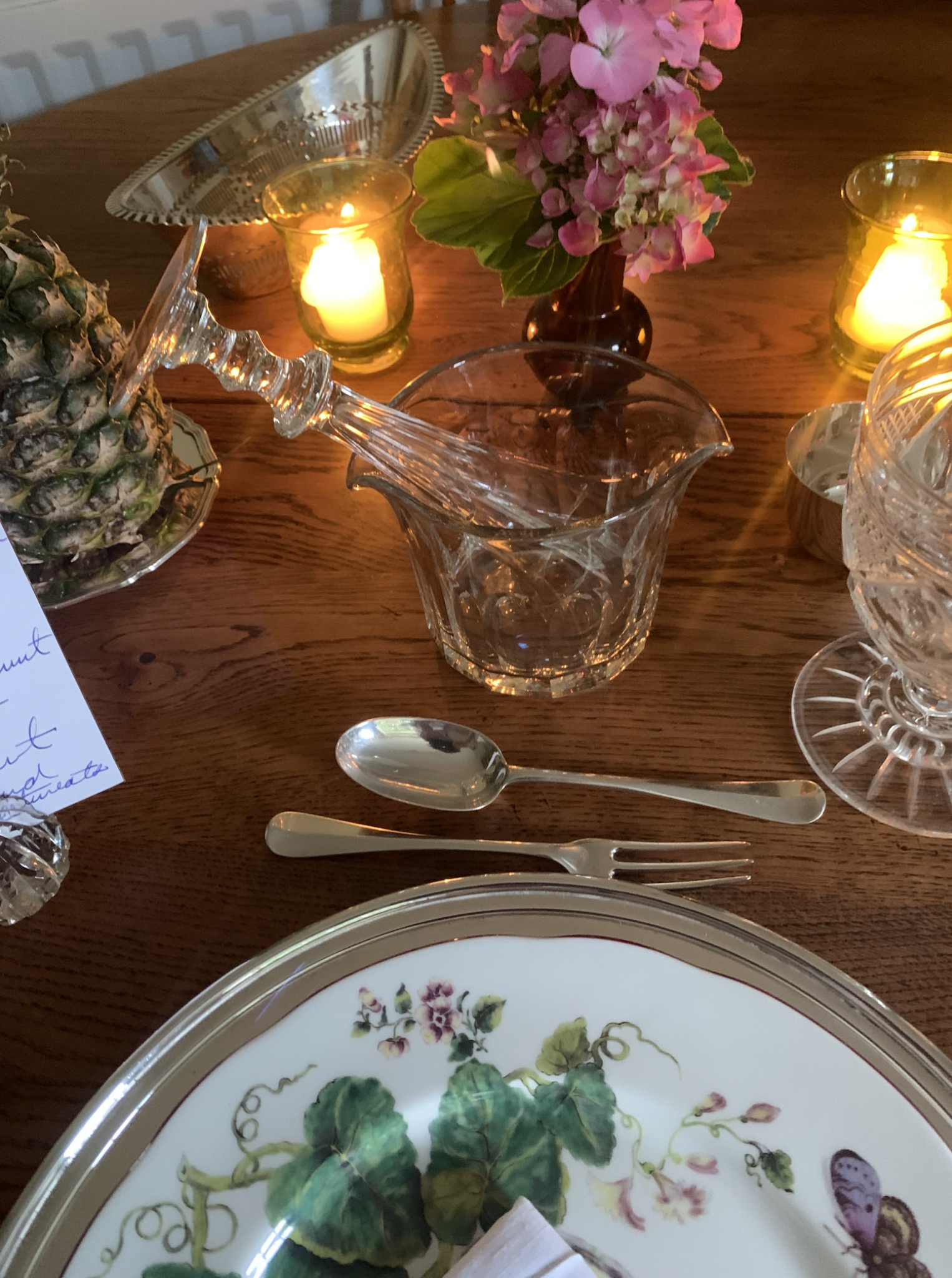
Amy Willcock was the Best in Show winner for the Professional category in the 2nd Annual Etiquipedia International Place Setting Competition with this spectacular Georgian Era place setting. Amy is an author who contributes to several publications and has authored several books. The following post is an extract from a book she wrote for English Heritage.

The Customs and Culture from the Georgian Era to the Regency Era: An Age of Elegance,        from 1714-1837, with Four Georges and a William (IV), by Amy Willcott


While we can see that so far people were entertaining from Eve taking the apple to up to this moment, the Georgians seemed to take dining to another level.

The middle and professional classes were growing and the aristocracy and gentry were still enjoying the high life but for the majority of the population little advance in their standard of living. Bread and wheat, still a staple went through ups and downs due to wheat prices falling because of a number of bad seasons. Spiced buns and fruit breads were still popular and muffins so popular in the North moved South and were eaten with lots of butter. Butter was extensively eaten from very early times but you could also say that butter, cream and nutmeg were major features of Georgian cookery. Fashionable families built Ice houses and ice was (Edwardians brought it over from America) taken off the estate ponds. It was used for preserving and the making of elaborate Ices- ice cream. 

The English were well known throughout the continent for being massive meat eaters and the enclosure of land and the new game laws made poaching an offence with a death penalty attached to it if caught; making Game highly prized and only legally available through a land owner. Rabbit was still able to be eaten by the ordinary people but hare was not. Jugged Hare was a favourite dish in the 18th century. Fish eating habits changed. Gone were the compulsory “fish days” of the church. Salmon and trout was plentiful but salmon still reigning as the king of fish and was expensive. Towards the end of the Georgian period ice houses were being built along the salmon rivers in Scotland so that Londoners and other towns could enjoy fresh iced packed salmon. One dish that I am glad has not survived is turtle soup. Green turtles would be kept alive in fresh water tanks on ships from the West Indies. 

The skills of the Head Gardeners and the wealth of their employers were shown off in the fruits and vegetables they served in and out of season. The masses still ate greens, roots and potatoes regularly. While the upper classes and the aristocracy were eating asparagus, cucumbers and melons. Pineapples now a little more accessible were the great show off – If you wanted to stick it to your neighbour you grew and served pineapples. Greenhouses were built so that pineapples, grapes, melons, nectarines and peaches could be grown by the great estates. 

Dairies were also a great source of pride so much so that one Gentleman in his 70’s courted a fine Dairy maid and eventually married the dairy maid. Dairy Maids were well known for their beautiful complexions and soft skin. (The reason was down to cox pox – the dariy maids became immune hence the first vaccines) Cream was eaten in abundance and cheese was so popular that cheese mongers ran their own fleet of ships to distribute the cheeses from Liverpool to London. Stilton was named after a village near Peterborough. The landlord of the Bell Inn at Stilton was supplied by his sister in law, a farmer’s wife who made a variety of cheese now known as Stilton although back then it was eaten with a spoon so that you didn’t miss the maggots! Cheese was, for the fashionable set the end of the meal with it being eaten in pieces or in savoury dishes such as Welsh Rabbit. 

Because of the political troubles with France, wines and brandies were not being brought into the country legally and were very expensive, (a lot of smuggling was going on) so wines from Portugal and Spain were drunk instead. The government encouraged the production of home-made wines and brandies to combat the lack of and price of imports. Gin was cheap and widely available. Also known as Geneva, from the French genievre-juniper- that it was estimated that over 9,000 children died in 1751 after being given gin to keep them quiet. 

As well as the rise in spirit drinking Tea was taking the nation by storm and so to was the rise in sugar consumption. The introduction of treacle, a by-product of sugar was used for sweetening cakes and biscuits. Coffee and chocolate while remaining expensive were gaining momentum. Bell calling systems in houses appeared around 1760’s. Georgian kitchens were moved to a separate part of the house and in some cases a whole other wing. The risk of fire was quite high. Cooking ranges became more sophisticated and kitchen equipment and eating utensils changed. 

Eating times changed from mid-day to 3pm around 1780’s but by the early 1800’s it was 7pm. Dining rooms were now fitted out with side boards, wine coolers, knife boxes. The Family plate was shown off -The Georgians were all about showing off the new dining rooms and furniture to great effect. Up until the early part of the 19th century, the furniture was arranged around the room leaving the centre of the room open. By the end of the century, it was fashionable to leave the table and chairs ready for dining. 

Soon into the 1780’s people, especially in the country, started changing for dinner. It was considered important for dinner guests to wash and change into their finery and eating etiquette was moving in fast. By this time the usual seating arrangements of women at one end of the table and men at the other had made way to the “promiscuous” seating arrangements of boy girl boy girl…or should I say gentleman lady gentleman lady! Precedence was hugely important and had to be given great thought.

Huge white table cloths down to the floor were used not only for covering the table but in place of napkins. Although thankfully napkins, which were indeed used earlier, came back into fashion especially in sophisticated house with French habits.

Table decorations were very important to the Georgians. Silver candlesticks, fruit bowls and other silver was laid down the centre of the table and the food was arranged around it then later sugar was molded and shaped into bucolic scenes or seascapes and were placed on mirrors. In some houses porcelain figures adorned the tables. 

Forks were by now three pronged and knives round bladed. Fish was eaten with two forks. It is worth noting that forks were placed face down to avoid lace cuffs catching the tines. Food and Fashion once again intermingling. Glass was still very expensive and “rinsers” were common so one could rinse the same glass before starting a different wine. Porcelain and bone china were being pioneered by the likes of Spode, Worcester and Wedgwood (names still around today) and Chinese porcelain although highly desirable and expensive was making way for English porcelain. 

Food was all brought to the table at the same time, with soup served in large tureens followed by fish then meat. That is why we see so many large silver covers as decoration scattered around dining rooms now. Kitchens today are much closer to the dining room and courses come out one at a time. Dessert was the grand finale to dinner and was a whole course on its own. The table would be deconstructed, cloths removed and everything changed. Fresh napkins, glass dishes and water bowls for rinsing, dipping and freshening of the fingers and mouth – quite disgusting really! 

The dessert was taken to extreme lengths with lots of the confectionery and sweet meats being bought from continental confectioners. Glass tazza’s were piled high and on top of one another in diminishing order and were covered with candied fruits, dried fruits, flowers and sweet meats. All of it shimmering and sparkling against fantastically polished wooden tables. Port, Madeira, claret or sherry would be served. And passed round the table – there are many stories about how and why port is passed to the left - in my research none of them have been conclusive but the one I like the best is a Naval tradition. The Port passes to Port. Port of course being on the left.

The ladies would then withdraw and the men would then and “speak freely” around the dining table. — By Amy Willcock, 2022


🍽Etiquette Enthusiast, Maura J. Graber, is the Site Editor for the Etiquipedia© Etiquette Encyclopedia

Saturday, October 15, 2022

Condolences, the Bereaved and Cards

Persons vary extremely about this, and while some like to see friends, others do not wish their sorrow invaded. It is the privilege of those in mourning to receive or not, as they choose, although after a month one is supposed to be at home to all intimate friends.

Etiquette

Condolences on any bereavement are imperative from all persons who pretend to be polite. To ignore the sorrow through which a friend, even an acquaintance, maybe passing, is to intimate entire indifference.To formal acquaintances a visiting card alone is sufficient, and on hearing of a death in a family, a friend takes her card and that of her husband if she is married and incloses it in an envelope.

Should the person bereaved also be married, and it is not her husband who has died, the regular rule of cards for married persons obtains. That is, the married woman would send one of her own and two of her husband's, one of his being required for both the other man and his wife. If the bereavement is one which leaves a woman a widow, naturally only one card of each would be sent her.

If cards of condolence are going to a man and his wife the envelope should be addressed to both. Nothing is written on the cards, nor is a corner turned. The bit of paste board represents a call which is not made in person, as those in affliction would not be receiving visits.

Visiting Cards Sent After Death Announcement—

The cards should be sent as soon as announcement of the death as soon as announcement of the death is made. It is a very gracious act of courtesy to go within a month to call, but there should be no feeling of an noyance if the visitor is not received. Persons vary extremely about this, and while some like to see friends, others do not wish their sorrow invaded. It is the privilege of those in mourning to receive or not, as they choose, although after a month one is supposed to be at home to all intimate friends.— San Francisco Call, 1908


🍽Etiquette Enthusiast, Maura J. Graber, is the Site Editor for the Etiquipedia© Etiquette Encyclopedia

Friday, October 14, 2022

The Chinese Man’s Coffin

“The rules around death are very important to all members of Chinese society. Special attention is paid to the care of the dead and very specific rules are followed. It is widely believed that bad luck will come to the family that does not honor the rules. In Chinese culture, traditions can vary depending on the deceased’s role in the family, their age, the manner of death, and their position in society. Care for one’s parents is complete and without question, so when a parent or elder dies, funeral planning falls to the eldest son and his children. A parent may not perform funeral planning for their child, so an unmarried person is taken to a funeral home upon death. Chinese rules also say that an older person must not show formal respect to a younger person. A child is therefore buried in silence and no funeral ceremonies are performed.Funeral traditions differ throughout China. Some Chinese people follow Christian beliefs and burial traditions. In Mainland China, there is land available for cemeteries, so Christian burials take place. Some Chinese people believe in the teachings of Buddha. In Hong Kong, the Buddhist practice of cremation is encouraged because the land there is needed for farming.” —Royal Palm Memorial 

The idea of the Chinese man is that when he dies he ought to be buried in the trunk of a tree, and so it comes about that all coffins are designed with a view to keep up the illusion. They consist of four outside tree boards, and are so fashioned together as to look very much like a tree at a little distance. They are, of cource, tremendously heavy; but then that is considered an excellent fault. If a son wishes to be very polite to his father, or one friend desires to obtain the good will of another, he makes him a present of a good, solid, heavy coffin. 

The gift is put in an honored place in the house, ready for use, and is shown for the admiration of any friends who may call. The owner would rather go into his coffin than part with it, and generally speaking, though a Chinaman may get into debt and be very harshly treated by his creditors, they will leave him his coffin, not wishing to prejudice his entry into the next world, which, according to the Celestials, depends very much upon the way in which a man is buried. I was told that half the Chinese living in Hong Kong were already in happy possession of their coffins, and ready to enter them when wanted.— The London Telegraph, 1884


🍽Etiquette Enthusiast, Maura J Graber, is the Site Editor for the Etiquipedia© Etiquette Encyclopedia

Thursday, October 13, 2022

Gilded Age Vocal Etiquette

There is no one thing that love so much needs as a sweet voice to tell what it means and feels, and it is hard to get it and keep it in the right tone. 
Cultivate a Sweet Voice

There is no power of love so hard to get and keep as a kind voice. A kind hand is deaf and dumb. It may be rough in flesh and blood, yet do the work of a soft heart, and do it with a kind touch. But there is no one thing that love so much needs as a sweet voice to tell what it means and feels, and it is hard to get it and keep it in the right tone. One must start in youth, and be on the watch night and day, at work and play, to get and keep a voice that shall speak at all times the thought of a kind heart, but this is the time when a sharp voice is apt to be got. 
You often hear boys and girls say words at play with a quick, sharp tone, as if it were the snap of a whip. When one of them gets vexed you will hear a voice that sounds as if it were made up of a snarl, a whine and a bark. 

Such a voice often speaks worse than the heart feels. It shows more ill-will in the tone than in the words. It is often in mirth that one gets a voice of a tone that is short, and sticks to him through life, and stirs up ill-will and grief, and falls like a drop of gull on the sweet joys at home. Such as these get a sharp home voice for use and keep their best voice for those they meet elsewhere, just as they would save their best cakes and pies for guests and all their sour food for their own board. I would say to all boys aim girls, “Use your guest voice at home.” Watch it by day as a pearl of great price, for it will be worth more to you in the days to come than the best pearl hid in the sea. A kind voice is a lark’s song to a hearth and home. It is to the heart what light is to the eye. —Humboldt Times, 1884


🍽Etiquette Enthusiast, Maura J Graber, is the Site Editor for the Etiquipedia© Etiquette Encyclopedia

Wednesday, October 12, 2022

An Interview with Amy Willcock

The Best in Show Winner for the Etiquette Community in our 2nd Annual Etiquipedia Place Setting Competition is Amy Willcock of the United Kingdom. Amy is shown above with her Georgian Era dinner place setting.
🍽 🍽 🍽 🍽
Amy Willcock is a successful writer of nine cookery and entertainment books. Born in Chicago, she moved to the UK in 1980. Specialising in country living and game recipes, Amy wrote a regular monthly column for The Shooting Gazette for over 19 years writing about food, country lifestyle and gundogs. During the Covid lockdown in Spring 2020, Amy started a new venture, KBO Cakes. The only way she could “send a slice of home” to her children serving in the forces and at university, was to send them a cake. “Nothing says “I’m thinking about you” more than a homemade cake. Everyone needs a little morale booster every now and then” says Amy. www.kbocakes.co.uk Amy was previously in the hotel business - one of which, The George on the Isle of Wight, had a Michelin starred restaurant. Amy held Lifestyle, Cookery and Aga Workshops teaching people to cook, arrange flowers and set beautiful tables along with how to run a house. Her lifestyle and Aga workshops have been described as ‘finishing schools for people in their 30’s’ and Nigella Lawson wrote in Vogue, “Amy Willcock, hand holder to Aga owners everywhere”. She is a founder member of Yarmouth Women’s Institute, the subject of a BBC 4 documentary, and is a WI Cookery and Preserves judge. Amy has appeared on Market Kitchen, Kirstie’s Homemade home, Celebrity Masterchef, and judged the perfect Sunday Lunch with John Torode and Gregg Wallace on Masterchef and is a regular Food and Lifestyle contributor to local radio. Amy lives in Yorkshire where she manages Warter Priory Shoot office, trains her gundogs, endlessly entertaining friends and family.
Amy’s formal Georgian setting was our Best in Show for the Professional and Etiquette Community entries. It is a mix of 18th century elements  that work beautifully together to create a real feel for the era. Starting with the candle light reflecting off of the silver and warm wood, the table is set with the pistol grip handled flatware so common to the time period. The pineapple is the quintessential Georgian fruit to accompany a fine, formal meal... all of these elements, along with the colors chosen, work seamlessly together. We’d love to dine at this table!

A few etiquette notes on Amy’s setting: 

Amy’s place setting and the overall look  and feeling it evoked was absolutely charming. She went into great detail in her description, so we only sent a follow-up request for explanations on each piece of flatware. You will find her explanation below the photo of Amy’s menu,


Six questions for Amy: 

1. How did you choose the menu and various elements you used in your setting and why? Please explain each of the utensils at your setting… For which of the foods on your menu (or course) was each different item intended? 
Amy’s menu is a perfect melange of Georgian fare and suits the setting to a T. The utensils are for the foods as follows: On the far right the small knife is a bread knife and the tablespoon is for soup. The small forks on either side are for fish (fish used to be eaten with two forks before fish knife and fork sets were created in the 19th century.) The joint knife and fork are for the lamb. The pudding-fork and spoon are for Cambridge burnt cream (“they slide down when main course is cleared”) and the small knife closest to the plate is for the dessert course.
“I always cook according to the seasons and what is easy to prepare and serve when you are the cook, hostess and bottlewasher! I collect silver it is a passion of mine along with old glass but I do love William Yeoward glasses.

“Soup spoons didn’t exist in the Georgian era, table spoons were used,which is so sensible – I do not possess a soup spoon!
In the late 17th and early 18th century knives were made of carbon steel and would taint delicate foods such as fish so two silver forks would be used. Much later in Victorian times silver fish knives and forks were used, although some are very beautiful, I use small silver forks and pistol handled knives with stainless steel blades and set two forks at dinner parties and it’s always fun to watch you guests try and figure out what is going on.

“I am rather fond of three pronged forks as you can see and my pistol handled knives do have very old blades so they need a bit of TLC every now and then. Rack of Lamb is so tender it should cut like butter and of course it is quite correct to pick up the bones and eat, just remember to give everyone a finger bowl after the main course!

“Cambridge Burnt cream is a delicious thick cold custard topped with a layer of crispy caramelised burnt sugar so a good whack with a sliver spoon will do the trick in England, apart from ice cream we always serve “pudding” as we call the sweet course, with a fork and spoon. 

The dessert course is always fruit, nuts, and sweetmeats – little candied bon bons made of marzipan and dates. That’s also where the pineapple comes in and you will see form the photo that the pineapple is taken out of it’s skin and then reassembled back inside, rather cleverly acting as a table decoration and fruit course.”

2. Why did you choose this particular period in time to set your table? Please go into as much detail as you can.


“I love everything about the Georgian period – the silver, the architecture, the china etc… that is when the dining room came into it’s own.”
Later this month we will be posting an extract from a book Amy wrote for English Heritage.
3. How, if at all, did Covid-related social restrictions affect your choice of setting? Were you ready to celebrate? Feeling in the mood to do something different? Etc…

I live in the middle of the country and covid had very little effect really except entertaining was out, but I still set a beautiful table every day.

4. Have you always enjoyed a properly set table? Or, if not, was the table setting something you learned to enjoy through your social life and/or business later on in life?

My mother always insisted on a properly laid table at every meal – breakfast lunch and dinner–  and never put a milk bottle on the table! I have always loved setting fun, beautiful tables. In the UK Tea is served around 4-5 pm and was usually served in the drawing room or sitting room, delicious little sandwiches, and cake- FYI cake would not be served with cake forks! High tea would be things like cottage pie or boiled egg and soldiers for children around 5pm. A properly laid table transforms whatever you are eating, even if it is just bread and cheese. My biggest tip is use everything all the time, don’t save anything for “best”, enjoy everything. I love Joan Didion’s reply when she was asked why she used the good silver every day, Didion replied, “Well every day is all there is.”

5. Did you do any research on table setting etiquette before setting your elements at the table? 

I entered the professional section as I have written, lectured and worked on tables in stately houses such as Castle Howard in Yorkshire extensively.


6. Do you plan on entering again next year? 

Definitely!

More on AmyWillcock–

Nigella Lawson wrote in Vogue, “Amy Willcock, hand holder to Aga owners everywhere”

Books published by Ebury Press

Amy Willcock’s Aga Bible

Troubleshooting tips for your Aga

Cooking for One

At home with Amy Willcock

Amy Willcock’s B&B Know How

Amy Willcock’s Aga Seasons

Amy Willcock’s Aga Know How

Amy Willcock’s Aga Baking

Aga Cooking

Magazines– Amy is a contributor to The Shooting Gazette, Country Life, The Lady, Aga Living, Homes and Garden, Country Kitchen, Waitrose.   

Elizabeth Soos and I would both like to congratulate Amy on her award winning setting. We are honored that she entered our contest and love meeting others who are so willing to share their talents, enthusiasm for etiquette, and their wealth of knowledge. Congratulations!


🍽Etiquette Enthusiast, Maura J. Graber, is the Site Editor for the Etiquipedia© Etiquette Encyclopedia