Thursday, July 8, 2021

A View of Etiquette from 1900

The rules lay down are all calculated to produce one result —harmony— and are as incumbent upon one as the other. No member can shirk responsibility, and no one can transgress without exposing himself to censure. 

Who Makes Social Laws?


The laws governing society are the product of men, and differ very little in any matter of consequence, no matter where we go. Their value is understood. At the root of all lies self-denial, forgetting of self, and kindly desire to do good to all. Good society‘s laws are inexorable; only the refined and apparently moral can enter the charmed circle. The rules lay down are all calculated to produce one result —harmony— and are as incumbent upon one as the other. No member can shirk responsibility, and no one can transgress without exposing himself to censure.


The first duty of society is to unite the many elements of which it is composed, so that an easy exchange of ideas and kindly intercourse may be had. We are but parts of one great whole. Without the restraining and educative force of society’s laws, we should relapse into barbarism. No one‘s rights would be respected, and might and brute force would govern the social fabric. All this changed by the dictates of Etiquette. In good society, no word is uttered disparagingly of another; charity for the foibles of its members is enjoined; there is a gentle deference shown toward women, grounded in a chivalric respect. Would all this be possible did not men and women acknowledge the importance of those duties that society thrust upon them? — From Twentieth Century Etiquette, 1900


 Etiquette Enthusiast, Maura J. Graber, is the Site Editor for the Etiquipedia© Etiquette Encyclopedia

Wednesday, July 7, 2021

Adopting a “Healthy” Gilded Age Fashion

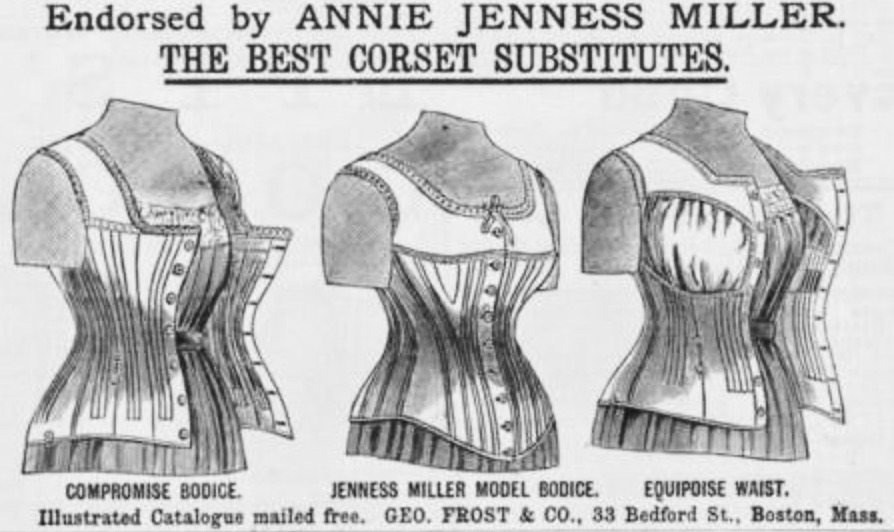
‘It is fashionable, too, to be clean in this day and generation and “tubbing” is English, so that the semi-weekly baths of our grandmothers have become bi-daily with her progeny; tennis, yachting, riding, and all elegant sports– facts which rather discount in the fashion world of some of Mrs. Miller‘s reforms.’ – A true pioneer in clothing design in an age when women’s roles were evolving and expanding, Annie Jenness-Miller was an advocate for reforming how women dressed. She pushed for physical development, proper posture, good hygiene and healthy living for both women and men. A popular Gilded age speaker, she lectured on a variety of healthy topics to help prevent the spread of disease, and assist with the equality and human rights for the working classes.


Her Point Of View

Mrs. Jenness-Miller of dress-reform fame has begun her career, if indeed, a reformer so well established may still be regarded as a beginner, in most sensible fashion. Realizing the power which the world of fashion wields far outside of its actual limit, she has interested fashionable women in her ideas and has designed her beautiful and artistic gowns upon models which the most punctilious of fashion's votaries can adopt without offense to her priestess. 

It is not, however, the fashionable woman who most needs the “divided skirt” and the “gown form,” and Mrs. Miller suggestion about bathing exercise and physical culture are not the blessing to the so-called society woman that they will be to some of her less favorably circumstanced sisters. So far as it influences her appearance, the care of her figure and her health is nowadays a very important study in the curriculum of the developing belle. She and her elders abhor her poor stooping shoulders, angles, and prominent bones as much as Mrs. Miller herself, even if she does not resort to the same sensible and permanent means to relieve them. The majority of fashionable women carry themselves well, straight, and not ungracefully, and a plump, rounded figure, is by no means rare among the “400,” although marred and rendered less beautiful than possible by the dress and corset maker’s art. 

It is fashionable, too, to be clean in this day and generation and “tubbing” is English, so that the semi-weekly baths of our grandmothers have become bi-daily with her progeny; tennis, yachting, riding, and all elegant sports– facts which rather discount in the fashion world of some of Mrs. Miller‘s reforms. One cannot help hoping as one listens to her forcible presentment of the evils she inveighs against, and as one admires the comfortable garments she has designed, that she may sometime bring her skill and persuasion to the cognizance of a class of laboring women to whom the adoption of such a helpful and convenient dress would be of vast value. 

To convince convince shop girls, sales women, any woman, indeed, whose occupation necessitates tramping about the streets in all weathers or standing for hours every day at desk or counter, that they could increase their strength and comfort and actually prolong their lives by merely adopting a different dress, would be a deed of almost incalculable benefit.– New York Times, 1890


Etiquette Enthusiast, Maura J. Graber, is the Site Editor for the Etiquipedia© Etiquette Encyclopedia

Tuesday, July 6, 2021

1950’s Dating Etiquette for Teens

“Everything was just so. And he knew exactly what to do!” is what teen-age girls love to tell their admiring congregation of girl friends, after they have had the “big dates.” 


In a Restaurant 

“He took me to the fanciest place. Everything was just so. And he knew exactly what to do!” is what teen-age girls love to tell their admiring congregation of girl friends, after they have had the “big dates.” There is no doubt about it, a boy must know what to do always. 

If he accidentally makes a mistake, on the other hand, he need not be ashamed. It is best for him to learn how and what to do before he takes his young girl friend out, however. For instance, when the boy takes the girl to a restaurant, he should know that he must step to the door, open it, hold it open until his girl friend companion enters the food center, then he must follow her in. 

Usually there is a head waiter or waitress to take care of the new arrivals, but if he doesn't get there immediately, the young couple should stand a little to the side and wait. The boy should be ready to tell the head waiter he wishes a table for two. The girl then follows the waiter and the boy again follows her. Should there be no head waiter, the boy leads the way and selects the table, for he is the host of this little party! — Grace Ramquist. 1953


Etiquette Enthusiast, Maura J. Graber, is the Site Editor for the Etiquipedia© Etiquette Encyclopedia 

Monday, July 5, 2021

Retro 1950’s Etiquette for Teens

As soon as you come to the car, become delicate. If that is difficult, then pretend you don't know how to turn the handle. A boy would feel insulted if you open the door for him. 


In the automobile, don't touch that car door handle, girls! As soon as you come to the car, become delicate. If that is difficult, then pretend you don't know how to turn the handle. A boy would feel insulted if you open the door for him.


It would be embarrassing to have a young man say “Thanks for opening the door for me. I'm too weak.” There is no doubt if he ever said such a thing, he would say it with all the sarcasm he could muster.


Most young men take great pleasure and pride in getting out of their cars, going around the back of them, and then coming around to the side to open the door for their girl friends. Most of the time, it is the fault of the girl if she does not get the proper treatment from the boys. She rushes in when she should have waited.


Girls must remember that it takes time to get around the opposite side of the car, they must be patient! — By Grace Ramquist, 1953


Etiquette Enthusiast, Maura J. Graber, is the Site Editor for the Etiquipedia© Etiquette Encyclopedia

Sunday, July 4, 2021

An Intrusive Royal Court Etiquette

“Etiquette and custom require that the Queen of Spain shall not nurse her own child. According to immemorial custom, a wetnurse is obtained from the provinces of the Asturias, in Northern Spain, where the Royal family originally came from, and where the people are very vigorous. A nurse possessing the requisite qualifications has already been engaged for Queen Victoria. The reasons for entrusting the baby to a nurse are that the province of the Asturias has a historic right to care for the Royal progeny, that the Queen may not be capable of nursing her own child, and that, being a foreigner, she may not be disposed to give it that care which child of the blood Royal of Spain requires.” – 1907


BARBARIC ORDEAL FOR NEW BORN ROYAL CHILD

Nowhere in the world has the barbarism of traditional etiquette reached such depths as in the Royal Court of Spain. There it strips privacy from that which one considers most sacred. It insisted that King Alfonso should woo the Princess Ena of Battenberg in public. It will not allow the Queen to become a mother in private, and when she dies it will not permit her to pass through her last agony without official witnesses. 

The etiquette of the Spanish court is not only barbaric, it is medievally absurd. This publicity, according to modern and especially American ideas, is nothing less than revolting. It is part of the Court etiquette of the most ceremonious Court in the world, and has been handed town practically unchanged since the middle ages. It utterly destroys the privacy of what most civilized people regard as the most intimate and delicate of all family occasions. It must cause unutterable distress and embarrassment to the mother, if she possesses the most rudimentary feeling of modesty, and must seriously endanger her life.

The publicity begins as soon as the probability of an addition to the Royal family becomes apparent. King Alfonso ordered a three days’ festival at Madrid in honor of the approaching event. In the churches, prayers are offered that the new baby may be a boy; he will be named Alfonso; if a girl she will be named Isabel Christina. It is anticipated by the doctors that there may be twins. Spanish law and Court etiquette require that an immense number of officials shall be actually present at the birth of the Queen’s children. 

Among these are all the higher officials of the Royal household, representatives of the various classes of Grandees, the Prime Minister and all the members of the government, the ambassadors of foreign powers, representatives of the two houses of the legislature, the mayors of Madrid and of various municipalities that have a historic connection with the Spanish Monarchy. As soon as the probable hour of the birth is known, notification is sent to all these functionaries and they hasten to the Royal Palace. 

These important persons fill the great saloon, which looks on the Queen’s bed chamber,while the stairs of the Palace are crowded with legislators and municipal councilors and the court yard is filled with ordinary Madrilenos. The sensations of the poor Queen at such a time in presence of a large assemblage of men of all kinds, most of whom are total strangers to her, are indescribable. One purpose of this publicity is to make sure that the child is really born to the Queen and not a changeling, for, at least in earlier times, the people would have considered themselves very seriously defrauded if a baby not of the Royal blood had been palmed off on them. Etiquette and the national custom require that the doctor in attendance on the Queen shall be a Spaniard, even though he may have had no previous experience with her. Queen Victoria has had this rule modified so far that her English doctor is permitted to work with his official Spanish colleague.

As soon as the birth takes place, a salute of 21 guns, if the child is a boy, is fired from the Palace grounds to announce the fact to the people. The babe is immediately placed on a huge gold plate and handed to King Alfonso. In this way, the King carries the tiny, blinking, new baby to the head of the line of waiting functionaries, at the head of which is the Prime Minister. The Spanish doctor keeps his hand on the right hand side of the gold plate and the English doctor stands on the left. Accompanying the King are the Duke of Sotomayor, who is Majordomo of the Palace and the highest of all Court functionaries, and the Duchess of Medina de la Torres, who is Mistress of the Nurse, in national costume, stands near at hand, in order to render service when required. The King marches up to the old Prime Minister and shows him the baby. The old gentleman bows profoundly, adjusts his eyeglasses, and robes and the chief female official of the household. The Spanish veteran examines the little red infant carefully. 

Then, if his examination warrants it, he exclaims: “It is a Prince! God bless the Prince!” Prolonged applause from the line greets this remark. The King passes the long line of officials and ambassadors and exhibits the baby to each of them in turn. As the baby is presented, each of them bows profoundly. Finally the baby is shown to a notary, who has a book prepared relating the ancestry and parentage of the child for the last 500 years. He now makes an entry of the sex of the child, the date, hour and place of its birth. This is witnessed by the Archbishop of Toledo and the Majordomo of the Palace. When this task is accomplished, the King hands the baby over to the Duchess of Medina de la Torres, Mistress of the Robes, who may, if she sees fit, intrust the infant to the nurse. The child now has been exhibited to a great many more strange old men than is good for him. He is at last handed back to his unfortunate mother.

Etiquette and custom require that the Queen of Spain shall not nurse her own child. According to immemorial custom, a wetnurse is obtained from the provinces of the Asturias, in Northern Spain, where the Royal family originally came from, and where the people are very vigorous. A nurse possessing the requisite qualifications has already been engaged for Queen Victoria. The reasons for entrusting the baby to a nurse are that the province of the Asturias has a historic right to care for the Royal progeny, that the Queen may not be capable of nursing her own child, and that, being a foreigner, she may not be disposed to give it that care which child of the blood Royal of Spain requires. 

The nurse, or “ama,” as she is called in Spanish, wears a short velvet skirt, trimmed with scarlet velvet and gold braid; low shoes, with silver buckles; silk stockings, satin apron, gold embroidered bolero over lawn chemisette, hair in the Spanish national style and knotted behind under flowing ribbons; long earrings, and a shower of chains about her neck. A professional nurse has also been engaged for Queen Victoria. She is Miss Gertrude Bunting of Nottingham, England. She has a high reputation for efficiency on occasions of this character. She is a Catholic and recently acted as nurse at the birth of the Marquis of Bute's daughter, Lady Mary Stuart. The Marquis is one of the richest noblemen in England and a leading Catholic. 

“I shall nurse my own child,” declared Queen Victoria, when this custom of the substitute mother was pointed out to her. For a time it seemed that she would win her way despite the tradition of fifty Spanish dynasties. But the King, who sided with her in her claim of motherhood, found that little short of an uprising was threatened unless he yielded to the law. Finally the Royal couple compromised. A woman of English extraction was found in the Kingdom who would nurse the child according to custom and still comply with the Pope's demand that it be taught nothing but Roman Catholic tenets from the day it first begins to lisp. Already this woman has been brought to the castle, where she diets daily under the eye of the Royal physician in preparations for her pseudo motherhood.– Marysville Daily Appeal, 1907

Etiquette Enthusiast, Maura J. Graber, is the Site Editor for the Etiquipedia© Etiquette Encyclopedia


Saturday, July 3, 2021

Henry’s Breach of Etiquette

Henry was a morganatic descendant of the Grand Ducal House of Hesse and joined the British Royal family when he married Queen Victoria’s daughter, Princess Beatrice. Through his own daughter, Princess Victoria Eugenie of Battenberg, who became the Queen of Spain by marriage, Henry is a direct ancestor of current members of the Spanish royal family.
Public domain image of Prince Henry of Battenberg

At Queen Victoria's recent state ball, Prince Henry of Battenberg first appeared wearing black gloves. These were seen to leave marks on the white dress of the Princess Victoria. Then the Prince of Wales approached him and whispered in German, “English etiquette prescribes white gloves.” Prince Henry soon slipped out of the room, and when he returned, his hands were clothed in white.—Pioneer Press, 1897


 Etiquette Enthusiast, Maura J. Graber, is the Site Editor for the Etiquipedia© Etiquette Encyclopedia

Friday, July 2, 2021

Etiquette of Queens, Kings and Dukes

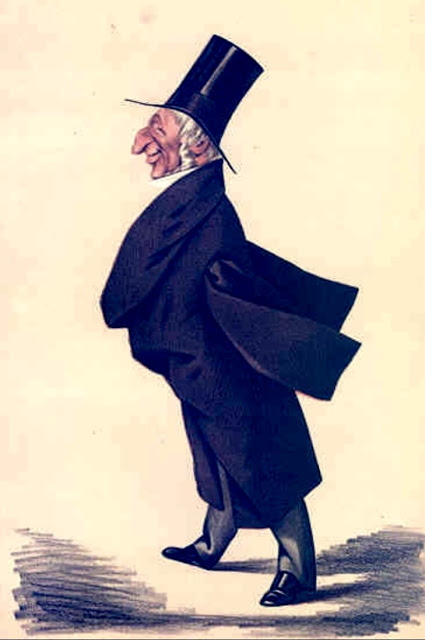
“The son of Waterloo” – The Duke of Wellington (or Weggington) as caricatured in Vanity Fair, June 1872


On one occasion Queen Victoria, Louis Philippe and the Duke of Wellington paid a visit, to Eton college. They were invited to sign the visitor’s book. The French King thoughtlessly took up the pen and signed his name at the top of the page. Etiquette, however, forbade Queen Victoria to sign her name under, any other. She therefore signed on the top of the next page. She then took up the pen and handed it to the Duke of Wellington, who was so excited at the contretemps that he actually signed his name “Weggington.” And, by the way, it may be recorded that etiquette forbids the Queen to converse with tradesmen. When a purveyor waits upon her, the Queen addresses her remarks to an equerry, who in turn, addresses the expectant merchant.—Philadelphia Times, 1896


👑Etiquette Enthusiast, Maura J. Graber, is the Site Editor for the  Etiquipedia© Etiquette Encyclopedia

Thursday, July 1, 2021

Summer of 1891’s Fads and Fancies

“Most of the Louis IV jackets have elaborate jabots of old Mechlin lace or of embroidered chiffon drawn to the front.”
 –
Photo source, Pinterest


What is the Proper Thing to Be Worn by Society Ladies? They say we are to wear all summer mittens up the arm. 

All the imported street dresses are made with a bias velvet ruffle running round the feet. 

Turquoises are being extensively worn, especially with necklaces, mingled with diamonds. 

Umbrellas and parasols designed to carry with mourning costumes have ebonized or onyx handles. 

A unique bracelet is the one of woven chain showing strands of silver, different golds and platinum. 

A bride's jewel-case is not complete when it does not include a diamond bracelet, earrings, finger-ring and brooch. 

It is the correct thing now to add a souvenir spoon to the conventional Christening present of pap-bowl and mug. 

Most of the Louis IV jackets have elaborate jabots of old Mechlin lace or of embroidered chiffon drawn to the front. 

Tables are now bought on purpose for the large lamps, which are so much used. White enamel tables, about knee high, are used for the delicate colored, porcelain lamps and ebony tables are used for the various kinds of iron lamps, some of these tables have a space underneath for a piece of bric-a-brac. 

This season a fancy crops out for long chains worn about the neck and hanging loosely over the bust. At the first ball of the season Mrs. Cornelius Vanderbilt wore a string of diamonds a yard long that went round her neck twice and fell almost to her belt. Mrs. Edmund Russell always wears at her art lectures a string of gold beads, superbly carved. Some of the gold chains have whole pearls introduced every two inches. Then there are the gem chains of plain polished stones, such as carbuncles, turquoises, amethysts, spinels, moonstones and onyx, none cut but the diamond. 

In favor of the woman who adorns herself, the feathers of the peacock begin to vie with rosettes and mock jewels. But let each fair maid pause and question with herself before she puts them on. There are conditions; can she fulfill them? In the days when poets and singers went about the world as troubadours they plucked the long feathers from the tails of peacocks and stripped them to leave on the midrib only the central eye. This, each troubadour wore upon his cap, and it meant that the eyes of the world were turned upon him. Are the eyes of the world turned upon you, fair maid, in attention and admiration? If so, you may wear on your cap peacock's eyes.— San Francisco Call, 1891


Etiquette Enthusiast, Maura J. Graber, is the Site Editor for the Etiquipedia© Etiquette Encyclopedia