Friday, December 8, 2023

Finer Points of Letter Writing

The girls said, “Mother didn’t lick the envelope, Miss Allen, honestly, she didn't.” They seemed to think that the teacher might believe that they had opened the envelope to read the note.
The Children Learn Fine Points Of Letter Etiquette

The two Green sisters had a note for teacher. Mother had sent it with them. As the teacher took it in her hands the girls saw her eyes fall upon the open flap of the envelope before she looked at the address on the envelope itself.
The girls said, “Mother didn’t lick the envelope, Miss Allen, honestly, she didn't.” They seemed to think that the teacher might believe that they had opened the envelope to read the note.

Miss Allen said, “I am sure you did not open this, girls. You see, your mother knows that it is not correct to close the flap when she sends a note by messenger. Suppose we talk about letter writing
when the last bell rings.” During the ensuing discussion the children learned the following things about letter writing:
  • First, that simple, plain letter paper is better than any gaudy or heavily decorated stationery. Correct letter paper is always unlined and certainly not perfumed. 
  • Fashions in monogramming change but rather plain initials, not too large, are always in good taste. 
  • Gold edged cards, monograms heavily embossed or engraved in silver or gold are not as correct as the smaller ones, embossed in a color. 
  • Any note should be enclosed in an envelope, not sent with a corner of the folded paper turned down.But when the note is delivered by anyone other than a professional messenger the flap of the envelope is left unsealed. 
  • The envelope may carry the words, “kindness of,” but this is unnecessary. The recipient will know it has been brought by the bearer, so why state it on the envelope? 
  • It is silly to use colored inks. There is nothing easier to read than black on white or cream. 
  • Lavender ink, green ink, red ink may have their place on invitations for special affairs, such as a Saint Patrick's day party or a Christmas affair, but for every day use there is nothing nicer than black, or a blue so deep it looks black. – By Florence La Ganke, aka “Nancy Page,” 1936


🍽Etiquette Enthusiast, Maura J. Graber, is the Site Editor for the Etiquipedia© Etiquette Encyclopedia

Thursday, December 7, 2023

Table “Dressing” Etiquette

“Attention, objects and creativity have developed more and more consistently around everything that substantiates the equipment, but often with completely correct principles and rules. Giving vent to creativity is certainly a plus for welcoming our guests, but the rules of etiquette help us to set the table and furnish the house with harmony, elegance and above all with logic in order to create solid welcoming environments, honest marvelous (let's also think about how many amazing wedding tables you see insistently proposed on social media or in glossy magazines) and at the same time functional.”

From “CHAPTER III – The art of receiving: The table The menu” in the new book by contributor, Petra Carsetti and Carlo Cambi,“Galatime ACT II: Life as a stage of elegance”
“With this chapter we get to the heart of one of the topics that arouse the most interest and are most sought after in the field of etiquette: the table and the art of receiving.

“Attention, objects and creativity have developed more and more consistently around everything that substantiates the equipment, but often with completely correct principles and rules. Giving vent to creativity is certainly a plus for welcoming our guests, but the rules of etiquette help us to set the table and furnish the house with harmony, elegance and above all with logic in order to create solid welcoming environments, honest marvelous (let's also think about how many amazing wedding tables you see insistently proposed on social media or in glossy magazines) and at the same time functional.

“First of all, the various types of table must be distinguished: from the square one for four with about 80 centimeters on each side or eight with at least 130 centimeters as a side used for intimate lunches or for a few people, to the rectangular one with six seats which usually has a length of 120 centimeters and a width of 70 centimeters; or the rectangular table for ten people with a length of 220 centimeters and a width of at least 80 centimeters: this is the most used; the oval table is not uncommon and very elegant, it respects the dimensions more or less of the rectangular one and is more useful in narrow spaces with more guests. 

“Finally there is the round table with a diameter of at least 110 centimeters for six people and 150 centimeters for eight people; this typology "resets" or thins out hierarchies because it puts everyone on the same level (it is no coincidence that King Arthur is known for his round table and his desire for equality among all knights), but it hides a pitfall because It often happens that the napkins or placemats set overhang the edge and look sloppy!

“It must be kept in mind that each diner must have approximately 60 centimeters of space between their center of the plate and that of the next and approximately 45 centimeters in height; spaces are reduced in buffet lunches and even more so in cocktail invitations.

“When starting to set the table, the first thing to do is place a clip (it must never go down from the sides beyond the tablecloth) to muffle all the noises of the crockery, plates or glasses, as well as to protect the table from the heat of the food, with the green side towards the table and the white side towards the tablecloth.

“A table correctly set with springboard has a completely comforting consistency to the touch: it transmits solidity and comfort at the same time. The sensorial aspect of what is done and what is proposed should never be overlooked. There is a non-verbal language that is just as significant as words. It is no coincidence that etiquette pays so much attention to gestures, spaces, postures and non-verbal etiquette is also an ancient code of behavior and communication.

“The tablecloth must be in natural fabric such as linen, cotton or Flanders and must be in neutral colors such as white, pearl, beige; it must go down beyond the edge of the table for about 30-35 centimetres, but no more because otherwise it would disturb leg movements and could create problems. Only for buffet tables are floor-length tablecloths provided or possibly for very formal events where there are multiple tables set up or horseshoe-shaped equipment and imperial tables.

“Ban runners or placemats (allowed for breakfast or in the family) and above all never overlap them with a tablecloth: it would be a useless duplication! In recent years, "american cutlery" have become widely used, they have become a very fashionable accessory and are set as a substitute for the placemat: for etiquette it is not really advisable and in any case it is recommended at least not to put cutlery on them! Would you place cutlery on a charger? Never! So don't even do it on the placemats set together with the tablecloth.

“Colored or patterned tablecloths are also fashionable, but even if they are adorable, it is best to use them only on more informal occasions such as a joyous arrangement in the garden or possibly at Christmas, a day on which a little more excess is permitted, but it is mandatory that all fabrics are well ironed, without creases so as not to give the impression of neglect.

“The napkin goes to the left, never under the cutlery, but rather more externally (or more to the left) of them. In the ceremony the position above the plate is foreseen and in the etiquette this position is used if for example there is a small gift or a single bouquet of flowers set up or if the space is really limited. It can be folded into four parts and then in half creating a booklet-like rectangle the open part towards the left and the rounded part towards the plate, or in a triangle always with the rounding on the right and although they are very spectacular or fun other types of folds are not at all recommended also because the napkin should be handled as little as possible without using napkin holders.

“A royal curiosity: at the Habsburg court the fantasy with napkins - perhaps on the basis of an oriental suggestion that recalls origami - was considered such a precious art to the point that the only two experts in folding (it is often customary to insert sandwiches between the folds of napkins) never traveled at the same time to avoid the tradition being lost in the event of an accident. These skills can still be understood today by visiting the imperial palace of Hofburg in Vienna where there are still two workers in charge of these delightful practices and where the royal collection of crockery is kept, perhaps the richest in Europe. As we know, the napkin was introduced to the Sforza court by Leonardo Da Vinci who had the task of master of ceremonies, but throughout the Middle Ages up to the Baroque many tablecloths were set, where the diners wiped their hands (alternatively they used the sleeves of clothes), for how many food services were foreseen. With every change of dish, a layer of tablecloth was taken away!” —From Carlo Cambi and Petra Carsetti in “Galatime ACT II: Life as a stage of elegance.” 2023


Petra Carsetti was born into a gastronomic minded family… true lovers of excellent foods and wines. From an early age she showed a great passion for the table, which she later developed by working in important, well-known Italian restaurants. Since 2005, she has written many books on food and wine, along with guides to Italian restaurants, specializing also in galateo and etiquette at the Accademia Italiana Galateo and ANCEP (the Association of Ceremonialists for Public Institute). She teaches etiquette in schools to adults and children, is a consultant for various political and economic authorities, and she has a weekly column in a historic newspaper. She also writes for various other newspapers, is a frequent television guest and is very active on Instagram @galateopetra_carsetti


🍽Etiquette Enthusiast, Maura J. Graber, is the Site Editor for the Etiquipedia© Etiquette Encyclopedia

Wednesday, December 6, 2023

1930’s Wardrobe Advice

Choosing a Smart Wardrobe for College or University in 1936– Fussy, elaborate dresses were tabu. Black velvet was a favorite, followed by the rich jewel colors in moires or velvets. There was a definite “picture” appeal in the dress-up clothes. Simple, durable, plain and practical by day, and “smooth” and glamorous by night seemed to be the rule for college girls whether they claimed an Eastern or Western alma mater.

Sweaters, Skirts, and Ski Suit  
Are All Three “S-entials”

Claire and a college classmate were giving the final checking to the outfits they were taking to college. Felice was going to a college on the West Coast and Claire was returning to her college on the Eastern seaboard. That meant they did not agree on all the accessories or details, but in the main they both were taking the same kind of outfits. 
Sweaters, a whole raft of them, slip overs and Cardigan style were included. Claire was taking a pair of well fitted wool culottes. Felice said the girls in her college did not wear them, or at least had not during the spring of the last year. Both girls were taking two shirtwaist dresses of soft wool, cashmere, or jersey.

With these they planned to wear gay and various colored neckerchiefs or scarves. Claire had a two-piece dress with blouse, having patch pockets and a slide fastener that extended down the front. She could see the ease with which she could slide into this on a morning when she had overslept and had just a second or two to get into a dining room before the doors were closed.

Both girls had top coats, Claire’s was of tweed, Felice’s was of a smoother wool with a fur collar. The girls differed on sports outfits. Claire had a ski suit which she said was almost a campus uniform in cold weather. Felice had a shaggy fur coat.


There were plenty of socks packed in each girl’s wardrobe. The underwear was silk or synthetic fabric which could so easily be laundered. There were no night gowns, pajamas taking their place. Hats were conspicuous by their absence. Shoes were simple, with a square or blunt toe, as a rule. Evening clothes were simple, but of excellent quality. 
Fussy, elaborate dresses were tabu. Black velvet was a favorite, followed by the rich jewel colors in moires or velvets. There was a definite “picture” appeal in the dress-up clothes. Simple, durable, plain and practical by day, and “smooth” and glamorous by night seemed to be the rule for college girls whether they claimed an Eastern or Western alma mater. – By Nancy La Ganke, aka “Nancy Page,” 1936


🍽Etiquette Enthusiast, Maura J. Graber, is the Site Editor for the Etiquipedia© Etiquette Encyclopedia

Tuesday, December 5, 2023

Bad Manners Are a Great Handicap

“If an American young man possessing the average American manhood could have the courteous, deferential manner toward women (I mean all women, old and ugly as well as young and beautiful) that we find in most foreigners whom we meet he would be simply irresistible. For women like brain and brawn as well as manners, but sometimes bad manners can destroy the effect of every other virtue.” — Etiquipedia believes that while the sentiments expressed here have much merit, this young woman tosses the words, “old.” “pretty” and “ugly” about when discussing other women, a little too freely. Maybe she needs to take her own advice and exhibit some better manners!

Trifles Proclaim the Gentleman 
What I Would Tell a Man — If I Dared 
By a “Pretty Girl”

I can’t say that I have ever really been in love, but I can say that I have been disillusioned more than once, and the reason therefore- well, it can be traced to the same cause. I have been out for some three sessons and my experience extends to several cities and includes one winter abroad. Ah, that winter abroad! I suppose it was during that time that my eyes were opened to the glaring breaches of etiquette and incongruities of conduct committed daily by our American young men. Mind, I don't say that I prefer any foreigner to our own young men, only their manners.

If an American young man possessing the average American manhood could have the courteous, deferential manner toward women (I mean all women, old and ugly as well as young and beautiful) that we find in most foreigners whom we meet he would be simply irresistible. For women like brain and brawn as well as manners, but sometimes bad manners can destroy the effect of every other virtue.

Not long ago I thought I was really in love with a certain young man who was very attentive. He was quite handsome and I felt highly flattered and pleased-and something more. He danced with me oftener than any one else at balls and cotillons. He sent me flowers and I always managed to be at home when he called. For some time our affairs ran smoothly enough, but one evening we were guests at dinner at the same house and were placed opposite to each other at table. Our affair had not progressed far enough for us to count upon being always placed together. “Umph! I'm sorry for Hal,” murmured the young man on my right, indicating my friend opposite. “I happen to know that he doesn't like to talk about art, and there he is next to Miss Escher, who can talk of nothing else.”

“But at dinner we should fit into our surroundings,” I replied. “I suppose he'll behave as though he adored the subject of art.”
And I watched to see. For one evening I tried to look at my hero with disinterested eyes. I saw him deliberately turn his back upon poor Miss Escher and devote himself to a pretty little thing on his left. While watching him thus through other eyes, as it were, I saw other things which had heretofore escaped me. I saw that his napkin was tucked into his collar, his spoon was in his cup, and his knife and fork reposed on the table with one end on his plate. The scales began to fall from my eyes, for it is my belief that all these little things proclaim the man and the gentleman.

Another time I liked a young man enough to think I was in love with him until one day I saw him use a toothpick is public! I know all these things seem trivial, but then life is made up of small things, and these trifles are more important to a woman than some of the great things. Impoliteness seems to be a common fault of the young men of today, as the hostesses who suffer inconvenience therefrom can testify.

How often do you see one of these young men deny himself the pleasure of a smoke in order to rescue some pining wallflower? How many of them ever make a “party call”? When you think about it seriously, are we young women so much to blame when we become fascinated with the ways of gentlemen across the water? I firmly believe that if our young men of today were equally as gracious in their manners as their foreign rivals we would seldom hear of an American girl marrying any other than an American man. At present I am saving my smiles for some American of congenial tastes and disposition whose manners will not offend, but he is hard to find. — San Francisco Call, April, 1909


🍽Etiquette Enthusiast, Maura J. Graber, is the Site Editor for the Etiquipedia© Etiquette Encyclopedia


Monday, December 4, 2023

Table Set for New Year’s 1930

  
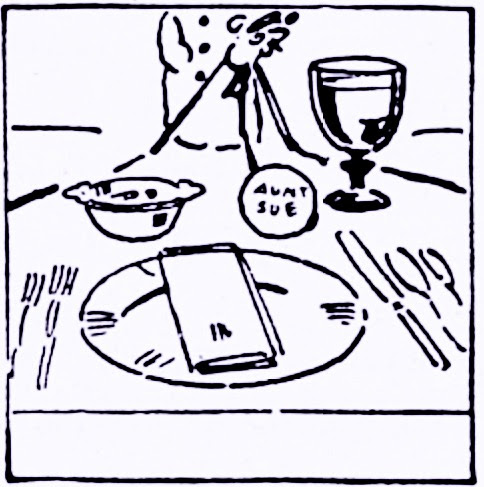
Early Depression Era Entertaining Crafts and Place Setting ~ Not only was this dinner party thrown in the early days of America’s Great Depression, but it was held during Prohibition in the U.S., as well. As, presumably, no wines would be served at this multi-course dinner, the water goblet is the lone glass at the setting.– The snow man was made by taking a cardboard cone standing 15 inches high. He was padded with cotton. Over this was put well crushed and crinkled white crepe paper. Bulges were made for arms, tucked apparently into overcoat pockets for warmth.

SNOWY WHITE AND BLUE SHADOWS ARE ON TABLE

One of the prettiest tables Nancy had seen in a long time was the New Year’s table at the Jack Pettingills’ home. The cloth was white damask. In the center was a large snow man in white. His features were back but his hat was deep blue. He held a bouquet of freesia and laurel in the crook of his arm. Leading from his snow overcoat were ribbons of blue. They extended to the place cards and favors combined, snowballs of white crumpled crepe paper.

The goblets were of deep blue glass. The condiment dishes were of pewter. The whole effect was of white snow with its blue shadows and its wintry gleam under the frosty moonlight. Near the snow man's abiding place were flecks of artificial snow. Flakes of it were on his coat and hat. The wall sconces of pewter gleamed in the candlelight. Pure white candles were in deep blue candle holders.

The snow man was made by taking a cardboard cone standing 15 inches high. He was padded with cotton. Over this was put well crushed and crinkled white crepe paper. Bulges were made for arms, tucked apparently into overcoat pockets for warmth.

The buttons of the coat were of black crepe paper. Small wads of this same paper made his features. He smirked over his necktie of broad blue ribbon. The head had to be stuffed like a ball and extended beyond the apex of the foundation cone. The bow the was placed about two inches below the peak, thus giving the effect of a slender neck. – By Florence La Ganke, aka “Nancy Page, 1930


🍽Etiquette Enthusiast, Maura J. Graber, is the Site Editor for the Etiquipedia© Etiquette Encyclopedia

Sunday, December 3, 2023

An Etiquette “Idiotorial” from 1919

“There are usually so many different kinds of knives, forks and spoons at the average dinner party that it might be a good idea to have the jeweler engrave its use on the handle… When the jewelers are marking forks they ought to move the tines closer together, so that the food won't sip through the cracks and fall on your chest and spoil your rented dress suit. With clothes the price they are, somebody ought to invent a spotless food.” ~ Above– Four forks which never became popular – An American-made, “left handed” fork and three, British-made forks. The three to the right were designed by Ellington in 1867 as “gravy forks or pea forks”. The tines are melded together all except for the ends in order to more conveniently scoop up one’s gravey, or one’s peas. Pease were a staple of British life in the 1800’s and many people in 1867 were still eating their peas from their knives.

Table Manners Not as Necessary As the Food to Practice Them On

There is a school in town which teaches table manner. This may be a good idea, but before we learn how to eat our food we ought to learn how to get it. If it wasn't for table manners, we could just have a set of knives and save ourselves the expense of a lot of silverware.

A lot of people claim that good table manners help them in getting invited out to dinner often. The bird who gets invited out is the one who doesn't cop too much of the table silver when he's visiting.

There are usually so many different kinds of knives, forks and spoons at the average dinner party that it might be a good idea to have the jeweler engrave its use on the handle.

Or it might be a good plan to make the handle longer and print on it everything that may be eaten with it. Take a spoon, for instance. It could have written on it “To be used for soup, coffee, ice cream, pudding, tea, jelly, prunes and mush.”

If you get some food which you never saw before, you could just look over the different silverware and find out which tool to eat with. If the name didn't happen to appear on any of the knives, forks or spoons, just tell your host or hostess that he doesn't care for any.

Grapefruit spoons should be equipped with a windshield or some other contrivance to keep the Juice ont of your neighbor's eye. Either this, or pass goggles to all of the diners.

When the jewelers are marking forks they ought to move the tines closer together, so that the food won't sip through the cracks and fall on your chest and spoil your rented dress suit. With clothes the price they are, somebody ought to invent a spotless food.

Can you imagine how nice it would he to have an egg which you could drop on your white shirt front without soiling it. Of course, it's hard enough to get any kind of an egg at all without going out and hunting for a non-spot. 
 
This table manners school ought to teach diners not to hit you in the stomach with their elbow every time they try to cut their meat. You can't tell whether they're eating or giving you a massage. 
People should stop using little squares of butter and eut them into balls so that you can roll them around the table instead of passing a heavy plate. An amateur would have to practice playing pool in order to be able to direct the balls. 
The same thing could be done with peas and olives. Instead of the maid passing the dish, she could just stand at one end of the able and roll five or six peas to each guest. After a little practice, a diner could soon get them to roll up his knife and into his mouth. This would save a lot of dishwashing. 
Still, this would confuse the diners. They wouldn't be able to tell whether they were eating or playing tennis. There’s only one suggestion we’d like to make. Tell us how to get the food and we’ll find a way to eat it. 
*On a side note: Amber is believed by the Turks to be an infallible guard against injurious effects of nicotine; hence its extensive use for mouthpieces of pipes.– From “Love, Laughter, Life: An “Idiotorial,” by humorist, John P. Medbury, 1919


 🍽Etiquette Enthusiast, Maura J. Graber, is the Site Editor for the Etiquipedia© Etiquette Encyclopedia

Saturday, December 2, 2023

The Importance of Good Table Manners

How do your manners appear? Eve knows her manners are not a pretty sight and that they can offend others whom she is dining with at a table.
Eve doesn't know her table manners offend the nice friends she longs for. It's not a pretty sight to play with ice-cream in all-day, sucker fashion. Nor is it charming to carry food half-way to the mouth, then plunge at it the way a duck dives for his dinner. It looks pleasanter and it's so much better manners to lift food straight to the mouth and take the whole spoonful at once.

To be uncertain about table service is a give-away, too. If the host passes a filled dinner plate to a guest, the plate should be kept, not passed around with cries of “you first.” Second helpings, if they're wanted, should be accepted without excuses for “large appetites.” Be at ease, learn the correct code for table manners. – Santa Ana Journal, May, 8, 1957


🍽Etiquette Enthusiast, Maura J. Graber, is the Site Editor for the Etiquipedia© Etiquette Encyclopedia

Friday, December 1, 2023

The Decay of Pretty Manners

With the last generation, we buried all of the old-fashioned women…

ON THE DECAY OF PRETTY MANNERS IN WOMEN

IS the decay of pretty manners in women nowadays, to put it plainly, to be found in the absence of prettiness in the women themselves? The streets are filled with fine, athletic girls, but the pretty little girl, with her smile, her blush, her little foot and hand, her gracious “ways,” her thanks for some small service rendered, where is she? She has vanished from the highways of the world, or it would seem that at her first fluttering essay into the open, she has been pounced on and hidden away by greedy man for his own secret joy and pride, himself a willing slave to those winning arts that so much more appeal to his heart than the mannish habits, the cool insolence of the over emancipated, over-athletic girls of today.

For the dismal fact remains that as the health and growth of the female race advances, beauty recedes, becomes almost a lost quantity, as you may easily ascertain by going on foot for several successive days through the West End of London, passing in review the thousands of women driving, motoring, cycling, and on foot. If during those days you see in all half a dozen faces that fulfill your idea of beauty in form, coloring and expression, you are fortunate, but the chances, one might almost say, the certainties are, that you will meet miles of tall, aggressive, striding lasses who contemptuously shoulder you out of their way, returning you cold glance for glance, or crowds of carefully made-up middle-aged women, whose attempts to attract your admiration are even more disagreeable than the total indifference to your good or bad opinion displayed by the “grenadiers” of the sex.

If you happen in a dewy-soft, modest, sweet little face, you may be pretty cure that it came straight from the country, and will shortly return there, for it is only in town that I affirm this rarity of beauty— the place where freedom of gait and thought is carried to such lengths that “I care for nobody. No, not I. And nobody cares for me,” may well appear to be the guiding motto of women.

Men complain that when they offer some such slight act of courtesy to women as grandpa and even father offered as a matter of course, they do not receive one word of thanks or acknowledgment, consequently the pretty-mannered women (and they are yet to be found) have to suffer for the rudeness of their sisters — and are tarred with the same brush of man's disgust. On the one hand you hear bitter complaints of decline in men’s manners; on the other, men talk contemptuously of the change for the worse in women’s, yet when all is said and done, it is the mistress or the daughter of the house who gives the tone to the manners of the men who live in or visit it.

Where the women are careless, immodest, illbred, mocking at all the gracious amenities and restraints of social and family life, there will be found men only too willing to let themselves go on in their company, gladly discarding those restraints that formerly hid their seamy side, as much from themselves as from others. Thus a moral support of incalculable value is withdrawn, for to leave off one’s manners, is equivalent to never changing one's clothes at the proper times, and just as a slovenly negligence of the person inevitably degrades and undermines it, so does a careless bearing tend to similar conduct, and rapid deterioration of character.

Briefly then, what is the reason of this falling off in good breeding in both women and men? There are three reasons— of which this is the first and most important, that there are not enough men to go round: thus a vast surplus of women have no chance of marriage and motherhood, which is the state for which they were born, nature having emphatically laid down the law that for every Jill there should be a Jack, and so a chance of happiness afforded her. 

Nothing tames and sweetens a woman like love; to be wooed, to be companioned, to know herself first with one human being is this supreme joy. and though the woman without a lover may not be actually conscious of this want, will even fiercely deny its existence, still it is there, embittering and hardening her, till at last her speech, and gait correspond with the defiant, starved heart within her.

Let the right man take the aggressive toward the most self-contained, self-willed, woman the of most them all, and teach her love, and she will soften hour by hour before his eyes; love gives humility, endows with charm, her manner, informed by her heart, becomes gentle, this is the type of woman who treats man as an enemy because she secretly wants him as a lover, whereas the born old maid remains neutral and tepid all her life long, neither to be sweetened nor soured by man, since he does not enter into her scheme of existence.

There is, of course, a certain minority of women who honestly do not wish to marry, and mistrust all men, but again the question arises, have men sufficiently tried to overcome their prejudices, and do they not unduly flat- ter themselves on their brain and will power to live happily in a celibate state? The woman who, looking back on a successful career that has had no love in it, counts herself happy, is not a woman at all, but a freak of nature, in which something warm and human has by accident been left out, rendering her frustrate and incomplete.

The second reason (and it is a very grave one) for the general discourtesy between the sexes, is the springing up in our midst of a class of women, always married, usually middle-aged, who refuse to grow old gracefully and decently, and whose manners may be described as carneying or fascinating. according to taste, but who will submit to any sort of treatment, brutality even, rather than let go of men who take them about, amuse them, pay for their menus, and give them generally what they call “a good time” – and at what a price!

Men are not good at classification, have not time to differentiate between women and women, thus the pure women are made to suffer for the fast, the flighty, the ridiculous, and can only withdraw into themselves, standing apart from those who enjoy the pleasures flung to them by man's contemptuous hand, having indeed no taste for a familiarity that strikes at the very root of their self-respect and womanliness.

I do not say that such women are met everywhere-there are vast tracts of English society into which they have never penetrated, but that they exist as a type is painfully well known to many a fresh young girl, who sees her bit of pleasure filched from her by those who, having eaten their cake, are determined to have it also.

It is a misfortune, I know, to feel young inside and be old out, but there are other ways of working off this vitality than by aping Ninon de l'Enclos' airs, and is not the antagonistic attitude of daughters to mothers nowadays, often due to the total lack of dignity with which these mothers behave?

There is something revolting in the sight of clean, fresh-faced boys dancing attendance on women whose sons are of the same age as themselves- youth to youth-age to age-dignity to the meridian of life, and the ripe charm that experience gives, thus should it be now, as it has in the past.

It is a hard saying, but it seems to me that with our own dear mothers of the last generation we buried all that are left of the old-fashioned pattern, and that until the present day women initiate a vast forward movement to a change in manner toward men so long will men fall in theirs toward, the other sex. The remedy lies in the women's own hands-where shall they make a beginning?

From time immemorial they have been the bulwark of the country, whose importance as rearers of sons and daughters is more vital, more important to the state than the statesmen themselves and without whom (should they become universally corrupt) England must go to pieces, inevitably destroyed like other great nations, from within.

For to keep the home together, to look properly after husband and children, fulfilling daily a thousand acts of duty that no one else can, that is the work for which woman was born, and in the main it is very strenuous work, engaging every faculty of heart and brain, and not all the successes of women who usurp men's places and professions will leave the mark on posterity that this one, by the bringing up of her sons, the molding of her husband, will.

There is a third reason for the decay in courtesy between men and women- and perhaps it is the saddest and most menacing to all our womanhood (being as it is almost a direct result of the two reasons I have given above). It is when a certain type of girl realizes that in addition to the scarcity of men her chances of marriage are still further reduced by the depredations of older women, and too often she becomes a freelance, picking up eagerly a bit of pleasure here and there and gradually cheapening herself to the restaurant or the theater, the smoke and the whisky-and-soda girl, who no more exacts fine manners from man than he expects them of her.

Probably there is no real vice in her, but knowing that there is no fun possible to her without a man to take her about, she drifts into a false position, and sometimes, very rarely, is married by a man whose reputation is as off-color as her own. For men worth having decline to marry the girls who place their good looks, their charm, their agreeable company at the disposal of chance comrades. 

As a rule a man marries because he wants some particular woman all to himself, but is it to be wondered at that between his disgust at grandmothers, who ape the manners of girls of 16, and contempt for the facile girls who will go anywhere, do anything he pleases, a man’s own manners and self-restraints, and he decides not to marry at all?

With the whole dessert laid on the table before him, he reckons that he would be a fool to sit down for the rest of his life with an especial fruit or diet, and, often disgusted with the profusion, he turns his back on the banquet and will have none of it. If a man of breeding (and though some female members of the aristocracy set the worst examples of all, their men who despise them, never show it) he will keep silence, and only by his avoidance of women show his contempt for them, but the harshest misogynist of them all may have all the harm light women who have done him undone by a single good one, and if he go sufficiently far afield, he can still find her.

For as surely as violets hide under their green leaves, and come back year by year to rejoice our hearts, so surely do good, pretty and charming girls lurk In this island of ours, only awaiting the resolute seeker, breathing that atmosphere of womaliness, of charm, natural to them as the perfume is to the violet, being the emanation of physical, moral and mental health. From them you will get the old fashioned, pretty manner that answered so much better with our mothers and grandmothers, that answered so much better (in the matter of lovers) than the rude, the carneying and the so-called fascinating one of to-day. 

Roughly, then, we may divide women into two classes nowadays, those who use violent, and meretricious means to attract men for mercenary purposes. and women who deliberately revolt men by their aggressively rude manners, claiming not only an equal status, but an actual superiority over them in physique, brains and position, so that one might suppose their aim to be a race of brainy Amazons, placing pigmy man behind them for protection and patronage.

That women must work is one of the sad conditions of their overpowering 1.umbers; it may also be taken as granted that no woman likes long and sustained effort, for which, as fashioned by nature, she is eminently unfitted; still she can do that work quietly if she pleases, and there is no need to antagonize by her attitude th by nature, she is eminently unfitted; still she can do that work quietly if she pleases, and there is no need to antagonize by her attitude the only legitimate worker in the open market that God and nature ever intended man.

As I said before, work she has enough at home, and to spare. Let her then, with her sisters, turn over a new leaf- the grandmothers discard their wigs and capering foolishnesses, the married women who cannot live without admiration turn to the cultivation of their homes, the girls who are contemptuously allowed to share men’s pleasures emigrate, and become honest wives of honest men; then, though there must still remain a vast amount of suffering, incomplete womanhood, we may look for a return of those pretty manners in women that men secretly cherish so deeply, and to meet which their homage, so long forgotten, will inevitably spring again. – By Helen Mathers in the San Francisco Call, 1904


🍽Etiquette Enthusiast, Maura J. Graber, is the Site Editor for the Etiquipedia© Etiquette Encyclopedia