Monday, August 30, 2021

Etiquette and Protocol for New King

 
As soon as he had spoken the cheers broke out again– “Vive le Roi! Vive le Roi!” and soon there was added to it, “Vive la Reine!” for the two are immensely popular. The Queen looked about as if wondering whether this were correct protocol, then seeing that her little son was waving she waved too, raising her right hand high and joyously.– Public domain image of King Leopold III of Belgium

Leopold Ascends Belgian Throne; Pledge to Serve Nation Cheered

Country's Grief Melts as King Takes Oath After Triumphal Horseback Ride-Cries of ‘Vive le Roi!’ Drown Shouts of Reds-3-Year-Old Prince Finds It Day of Fun


BRUSSELS, Feb. 23. Standing with his right hand stretched up ward, the index and middle fingers joined, and facing his Parliament, King Albert's eldest son Leopold in a clear loud voice took this oath to his people today:

“I swear to observe the Constitution and laws of the Belgian peo ple and to maintain the national independence and integrity of terri tory.” There had been a dead silence as he spoke. Then from every throat in the great building a cry rose thunderously: “Vive le Roi!”


Leopold III, fourth King of his dynasty, at the age of 32 had as sumed in succession to his father the task to which he was born and for which he was trained-that of guiding and inspiring the govern ment of his country. To Leopold's left, as he took the oath, sat his wife, Queen Astrid, with their two children. Everybody's eyes were as much on them as on the King himself. She was dressed in deep mourning, but her veil was pushed back from her beautiful face. Her children, dressed in white, sat on each side of her Princess Josephine Charlotte and Prince Baudouin, who now becomes Crown Prince.


Today the little Prince's cares were far in the future. He fidgeted on his big chair, looked at his mother, then slid down and climbed up onto her lap. Later when the cheering broke out he got down again, laughing and waving his hand joyously. For he is a merry 3-year-old and everything was fun today. For everybody, his presence lightened what would have been a solemn, if not sad proceeding. It gave it life and continuity and removed the shadow of death that would otherwise have lain over it.


That scene was the climax of a morning that was splendid in simple pageantry. On his favorite horse, a big chestnut, none too easy to manage amid these cheering crowds and thundering bands, Leopold rode out this morning just after 9 o'clock from his château at Laeken, on the outskirts of Brussels, to take possession of his capital. In front of him went a bugle band of guides on horseback. Before him and behind him rode two squadrons of lancers and all his army staff. Two paces in front of him were his immediate aides and two paces behind him his brother, Prince Charles.


Looks Straight at People


If one had picked him for the rôle of King one could not have found anywhere a finer face or finer figure. His high-colored, sunburned face was calm and solemn. His large brown eyes looked straight at his people, turning from right to left as mile after mile he rode in his khaki uniform with scarlet hatband through their cheering ranks, saluting continuously. He rode easily and handsomely, for, although he is not so tall as his father, he has a fine cavalryman's figure.


There was grief in his rather tight-set mouth. But as the ceremonies of the day wore on, that expression changed. One may be a loving son, but it is also much to be a young King whose people have shouted themselves hoarse in loyalty and affection. It is perhaps no easy task to govern, but it is a glorious thing to be a young King with a lovely wife and two jolly children. For his people, today’s pageantry ended on that scene – King Leopold and Queen Astrid on a balcony of their palace in Brussels, she with their daughter and he holding their son in his arms, all four waving.


There were very many, both men and women, whose eyes filled with tears and whose throats tightened on the final “Vive le Roi!”


Burgomasters Meet Him


Along the route, both before and after the taking of the oath, there had been other ceremonies. Outside the château gates, as he entered what is technically Brussels territory, he was met by the Burgomasters of all districts headed by that veteran friend of his father, Burgomaster Adolphe Max, who came to welcome him into the city.


Burgomaster Max, who could talk to a German military governor without flinching, spoke today with emotion. It was just twenty-five years ago that he had welcomed at the same place, King Albert, when he made his joyous entry into the capital. Briefly, he recalled that dawn of another reign and its glorious, if tragic, memories. In two sentences, he told of the immense sorrow that the nation had felt at King Albert's death and how only yesterday the nation had sought to express it.


There was complete sincerity, backed by knowledge, in his compliments that today the people of Brussels would acclaim the Prince who had merited their respect and affection by the dignity of his life and by his constant effort to prepare himself for the high task that faced him.


Then there was another ceremony beside the grave of the Unknown Soldier. Where only four days ago, the body of King Albert had lain in silent communion with the spirit of the unknown one who had died in his service. Leopold remained at salute on his horse for a full minute. For once the cry of “Vive le Roi!” was stilled. There was immense emotion in the crowd. But as Leopold’s arm fell from the salute the music of the “Brabançonne,” the Belgian national anthem, broke out, gay and lilting. Today was a beginning, not an end.


Colorful Assembly Gathers


In the parliament house, which is known as the Palace of the Nation, had been gathered not only members of the Senate and the Chamber, but a great assembly of dignitaries. On one side making a patch of purple and black were the bishops and the clergy. In scarlet on the other side sat the high justices and magistrates of Brussels. In gold and black with many nodding plumes among them were the members of the diplomatic corps. Behind the Queen and her children, in the bright uniforms of all nations, stood the Princes who had come from England, Italy, Sweden, Norway, Denmark, Yugoslavia, Bulgaria, Rumania and Siam to represent their Kings and countries at yesterday's sad and today's joyous ceremonies.


Everyone else was in uniform or full evening dress– everyone except two. They came in ordinary business suits rather unpressed and with soft collars just to prove they were Communists. Perhaps that was Moscow’s order although when invited to dinner elsewhere in the world, Moscow’s representatives mostly conform with ordinary etiquette. But dressing out of harmony was not enough for these two. They felt it their duty to try to make a disturbance. If, as they had announced yesterday, they had other plans for today, these plans failed to materialize. For along the whole royal route, which took al most three hours to ride, there was never an incident, never even a seditious cry.


But when on the stroke of 11 o'clock the doors of Parliament were thrown open and an usher in a majestic voice cried out, “Le Roi!” there was a burst from these two throats– a kind of squeal that may have been, “Vive les Soviets.” Immediately, it was drowned in an immense roar of welcome from everybody else.


Leopold Walks to Throne


Unhurriedly, indeed rather slowly, Leopold, a gallant figure in his uniform and top boots, walked toward the throne, which had been prepared for him in the place of the usual presidential seat and speaker’s tribune. Long draperies of red velvet hung from the ceiling. A great crown surmounted the throne. On scarlet cushions, with golden fringes, had been embroidered the letter “L.” The rampant lion of Belgium and the national motto, “l'Union fait la force,” were emblazoned on the throne and on the curtains behind it.


For a moment Leopold stood facing the audience. There was no call for order. Gradually the cheering died away. Even the two bold Communists did not dare break that silence as he raised his hand and took the oath. He spoke it first in French and then, as the law demands, in Flemish for his is a dual country, and he speaks both languages, as well as English, with equal fluency. His voice round and pleasing.


As soon as he had spoken the cheers broke out again– “Vive le Roi! Vive le Roi!” and soon there was added to it, “Vive la Reine!” for the two are immensely popular. The Queen looked about as if wondering whether this were correct protocol, then seeing that her little son was waving she waved too, raising her right hand high and joyously. – By P. J. Phillip, Wireless to The New York Times, February 24, 1934


Etiquette Enthusiast, Maura J. Graber, is the Site Editor for the Etiquipedia© Etiquette Encyclopedia

Sunday, August 29, 2021

Etiquette for Ex-Presidents

“Referring to ex-President Roosevelt's criticism of his policy concerning Mexico, and also to ex-President Taft's comment on affairs in the Philippine Islands,” President Woodrow Wilson, “said jokingly that it might be time to draft a code of etiquette for the guidance of ‘ex-es.’”

President is Quite Facetious

Would Have Code of Etiquette for Guidance of “Ex-es” Drafted, Referring to Criticisms of Roosevelt and Taft

WASHINGTON, March 30.– America’s answer to the British order-in-council, detailing plans for the blockade of Germany, will be forwarded to London within the course of the day, President Wilson told callers at the White House today. He declined to give any intimation as to the contents of the reply until after its receipt by England. Referring to ex-President Roosevelt's criticism of his policy concerning Mexico, and also to ex-President Taft's comment on affairs in the Philippine Islands, the Chief Executive said jokingly that it might be time to draft a code of etiquette for the guidance of “ex-es.” 

At the same time, he said he considered that former Presidents were justified in criticising the course of those who follow them. President Wilson is undecided whether to push the proposed Presidential primary law to a conclusion. He said he believed legislation along this line was necessary, but that he feared that it would require a constitutional amendment.– Riverside Daily Press, 1915

 Etiquette Enthusiast, Maura J. Graber, is the Site Editor for the Etiquipedia© Etiquette Encyclopedia


Saturday, August 28, 2021

Gilded Age Chafing Dish Party Etiquette


The etiquette of these parties is tacit but pronounced. A butler must not appear, or other servant, after the merest preliminaries of the supper, and a chafing-dish story or confidence, is one that would have been impossible in the formality of a dinner.
–Image Source, Pinterest


Chafing-dish parties have never been more fashionable than this season. Many of the thẹatre parties finish off in one of these informal feasts, in modish preference to a restaurant supper. The utensils from which the affairs take their name grow in elegance, naturally with the demand for them. Exquisite gold chafing dishes are by no means rare, and silver ones are on every side. And their use has extended from the swell artist set where it originated to the heart of the old Dutch aristocracy.
 

Receipts for rum omelet, oyster stews with a dash of old Madeira, creamed oysters, terrapin, and dozens of other chafing dish receipts, are carefully treasured in the amateur cook's handwriting... and followed to the letter. The etiquette of these parties is tacit but pronounced. A butler must not appear, or other servant, after the merest preliminaries of the supper, and a chafing-dish story or confidence, is one that would have been impossible in the formality of a dinner. – New York Times, 1893

🍽️Etiquette Enthusiast, Maura J. Graber of The RSVP Institute of Etiquette, is the Site Editor for Etiquipedia© Etiquette Encyclopedia

Friday, August 27, 2021

Royal Dining Etiquette for Charles II

 “This charming portrait of Charles II as Prince of Wales was painted for his mother by Sir Anthony van Dyck in 1637 or early 1638. Little did anyone think at the time that armour was to be necessary to his young life, not just as a romantic costume for a portrait but also for his very survival.” —From “At the King’s Table”

The five-year-old Charles, Prince of Wales (later Charles II, 1660-85) dines in state with his parents at Whitehall Palace. He sits at the end of the table, to the left of his mother, Queen Henrietta Maria, who sits at the left hand of the King, Charles I. The young Prince already has his own silver-gilt vessels, made by the Jewel House. 

Sewers, or servers, on bended knee offer dishes to the King and his family. The Prince chooses from the food offered, and the gentlemen carve and taste each portion before it is placed before him. A procession of liveried servants carry in more dishes and lay them on the table, where none but the Royal family dines. Over the King’s head is the canopy of state, erected for him alone. Behind a balustrade at the end of the chamber, well-dressed courtiers and men (mainly men) of quality press to witness every mouthful of the Royal meal. As if to counteract all this formality, a clutch of dogs play and probably defecate around the table. 

This is the formative experience of having dinner for Charles I's eldest son, who, after years of struggle, heartbreak and exile, will return to England to re-create almost exactly this ritual of Royal public dining. In between, he will know danger, hunger and despair, but also loyalty, comradeship and love. He will remember that bread and cheese are better than an empty stomach, but he will never forget that he is the rightful heir to the English and Scottish thrones. — By Susanne Groom, in “At the King’s Table”


Etiquette Enthusiast, Maura J. Graber, is the Site Editor for the Etiquipedia© Etiquette Encyclopedia

Thursday, August 26, 2021

Diplomat Broke Royal Court Etiquette

The real identity of Diplomat, “Multy Millions,” may never be known. His name is not mentioned in the article or the story– In 1867, a serious illness accentuated a hereditary deafness that Alexandra suffered from and also left her lame. In turn, she devoted much of her time, and also her income, to the poor and suffering. As Queen, Alexandra founded the Imperial Military Nursing Service in 1902 and started Alexandra Rose Day to raise funds for British hospitals.


Royal Court Etiquette:
“Multy Millions” Fractured It and Lost His Diplomatic Post

A witty New York society man said, at a dinner, apropos of court etiquette: “Court etiquette is, after all, very like ordinary etiquette-the laws of common sense govern it.

“Did you ever hear how Multy Millions lost his under secretaryship at our legation in London? Multy deserved his fate. His common sense was lamentably lacking.

“It happened years and years ago. King Edward had just come into his own, and Multy Millions was dining for the first time at Buckingham Palace.

“The dinner was a state one. The splendid gold plate from Windsor glittered on table and sideboard. To Multy, when the entremets came on, the deaf Queen Alexandra asked: ‘How long have you been living abroad, Mr. Millions?’

‘Four years, ma'am,’ Multy replied in a loud voice, for he knew enough, of course. to speak high and to say ‘ma'am.’

‘What? I did not hear,’ said Queen Alexandra. ‘Four years, ma'am,’ Multy shouted.

But she repeated, ‘What?’

“Then Multy leaned forward, and, with a polite and amiable smile, he waved four fingers to and fro before Queen Alexandra’s face. He resigned the next morning.” – The Exchange, 1912


Etiquette Enthusiast, Maura J. Graber, is the Site Editor for the Etiquipedia© Etiquette Encyclopedia

Wednesday, August 25, 2021

An Interview with Elena Gorelik


Unexpectedly, we had a tie for the Best in Show Winner for the Amateur Community in our 1st Annual Etiquipedia Place Setting Competition. Our second of the tie-winning tables is that of Elena Gorelik of Russia. Elena is shown above with her historical themed, dinner place setting. After reading her bio, we realized Elena would have been a better fit in the “Professional” category, as opposed to Amateur, but we don’t know how well everything translates in other languages. And “Professional” means different things to different people. Next year, with her new business venture though, she will definitely be placed in (and fit in beautifully!) to the “Professional” or “Etiquette Community” categories.
🍽🍽🍽🍽
Elena Gorelik lives in Moscow, Russia. In the 1990s-2000s she made a career as a Personal Assistant to CEOs and Boards of Directors for airline companies. She was in charge of protocol procedures and office hospitality at the top levels of management. In the 2010s Elena worked in the Marriott Moscow Royal Aurora Hotel (5*) as a Department Head of the Food and Beverage Service. Now, Elena is developing a business as a tabletop stylist for table settings and home events, in order to help women feel confident and provide the best version of hospitality to their families and guests. You can find her @serviruem on Instagram.


Elena’s place setting intrigued me from my first look. Antique flatware is always inviting, and it looked lovely with the chosen complementary antique elements, like the stemware and other pieces on the table. The menu was interesting and all were excellent choices for the era chosen.

This envisioned dinner and place setting for the menu was for Peter Durnovo. Durnovo was, over his lifetime, an Imperial Russian lawyer, politician, ambassador and statesman. He was also a member of the Russian nobility, belonging to House of Durnovo and, in 1915, he was the last Russian Imperial Minister of Interior to die from natural causes. Six successors were all killed during the Revolution and Red Terror, from 1918-1922.

The setting has almost a masculine look to it; it’s not fussy in the least, even with the antique flatware. The dark colors and equally dark patina on the flatware mixes very well together. One can just imagine 19th century diplomats and politicians, discussing weighty matters over a late meal at this setting, and several others exactly like it at the table.

MENU

Champignon Cream Soup
Potato Croquettes

Pozharsky Cutlet garnished with Potatoes, Beans and Peas

Fried Duck and Hazel Grouse

Boiled Artichokes

Hot Vanilla Creme


Wrote Elena, “ I have made this place setting for a historical home dinner of November 30th, 1857. I took its menu from the book about Mr. Peter Durnovo, a member of the State Council of the Russian Empire.”

A few etiquette notes on Elena’s setting: 

Elena’s choice of old flatware added to the overall beautiful look. There was one element of the place setting that was correct, while also incorrect at the same time… The soup spoon placed where it was, was correct. The size and type of soup spoon was incorrect as it does not correspond with the soup bowl. It is a creamy soup, and that is and oval dessert or cream soup spoon, however the bowl is the incorrect size. That being said, in 1857, it would be hard to find a household with a large variety of soup spoons.

A small, round-bowled, bouillon spoon or a larger, round-bowled cream soup spoon would have been more appropriate for eating soup from this soup bowl, however most households this early into the Victorian era didn’t usually have more than one or two sizes of soup spoons, and did not have the 5 or 6 different varieties commonly seen later in the 1800’s and early 1900’s.

Looking at the spoon, tends to only make the size stand out more, dwarfing the smaller knife and fork, acting as a “bird set”, for the Pozharsky Cutlet, which is on the menu after the soup.
 But again, this may not have been an era in which the soup spoon would have been available for this type of bowl in Russia. I have to defer to her knowledge of Russian flatware until I can investigate soup spoon history there.
The size of the large Damask napkin is the appropriate size for a formal dinner, and often missed by many people. It is folded narrowly, but I can tell by the amount of folds, about how large it is when opened up.

The largest of napkins are the correct choice for formal dinner settings.
  
The stemware and other glass appears period and the design on the stemware is very subtle, adding to the overall antique look for this inviting place setting.


1. Have you always enjoyed a properly set table? Or, if not, was table setting something you learned to enjoy through your social life and/or business, later on in life? 


I started from the table setting for my dolls when I was a very little  girl. I had a toy table and chairs, some toy food and a lovely doll china set.  Since I was 5 or 6 years old, my grandmother delegated me setting a table for all home parties and for family’s Sunday dinners as well (a table for 5).


Like many families in the Soviet Union, ours had some holidays-only dishes and others for everyday meals. I really enjoyed floral porcelain plates and teacups. I loved to be on duty for setting a table, yet I did not know any of the strict etiquette rules then.


First time I learned how to set a table properly was at school. Those days, girls had a course on housekeeping. I was so excited to study how to place forks and knives, what types of plates exist and other basic rules of dining etiquette. It made me a family expert on table setting.


The most useful course I took at the Secretary School. – It was a Diplomatic Protocol delivered by an officer from the Ministry of Foreign Affairs. Meanwhile, I read a lot – in the early 90s we got foreign books on etiquette available here in Russia.  


Then my working experience gave me many chances for practice.


2. How did you choose the various elements you used in your setting and why?


I decided on a historical setting from the very beginning because I like to learn details of everyday life in the past. So, I was looking for a good source of such information, and I was super lucky to find it.


I used old family china, glass and silver, the most “historical” of what I had at home. Of course, I had to add some modern items, for example I took the crystal service plate and vase because I thought they would look appropriate to the chosen legend, I mean the time and social status of the heroes.


3. How, if at all, did Covid related social restrictions affect your choice of setting? Were you ready to celebrate? Feeling in the mood to do something different? Etc…


Not much actually. As I said, I needed a reliable source of data, so I chose and pre-ordered several books at the Russian State Library’s site.


Big libraries in Moscow were already open and worked almost normally, we just had to follow some procedures like temperature measurement at the entrance, keeping the social distance and wearing masks and gloves the whole time of visit.


Of course, it was not as comfortable as usually, so I tried to do everything quickly. That is why I missed the information about drinks first and had to make a library trip once more.


As for my mood, the contest cheered me up. I felt very inspired and involved. However, I did understand the low spirits of people from the countries where longer lockdowns were still in force. 


4. Same for the menu chosen as question number three… Did Covid related social restrictions affect your menu choices at all? 


The menu was my biggest concern and then my biggest luck. The book contained original dinner menus; I just copied those sounded more or less clear to me (because some of them were rather weird) and then made my choice. 


As for the drinks, they were not on the menu, so that issue required more investigation, analysis, and some kind of deductive method, I would say.


5. If yours was a historical setting, why did you choose that particular period in time?


My favorite epoch in Russian history is the 19thcentury, and Saint Petersburg is a city I am in love with. When I found such a detailed description of family dinners from that very city in that very time (1850s), I could not wish for more.


6. Do you plan on entering again next year?


Oh, yes, I would love to participate again because I feel it inside as a challenge, an adventure, and enjoyment – all in one. Let me thank you Maura and your co-sponsor Elizabeth for hosting the contest and for choosing my place setting as the best in the show.


You are most welcome, Elena. Elizabeth and I both wish you great success in your new business venture! – Maura Graber


 Etiquette Enthusiast, Maura J. Graber, is the Site Editor for the Etiquipedia© Etiquette Encyclopedia

Tuesday, August 24, 2021

1893’s Etiquette Fads and Fashions

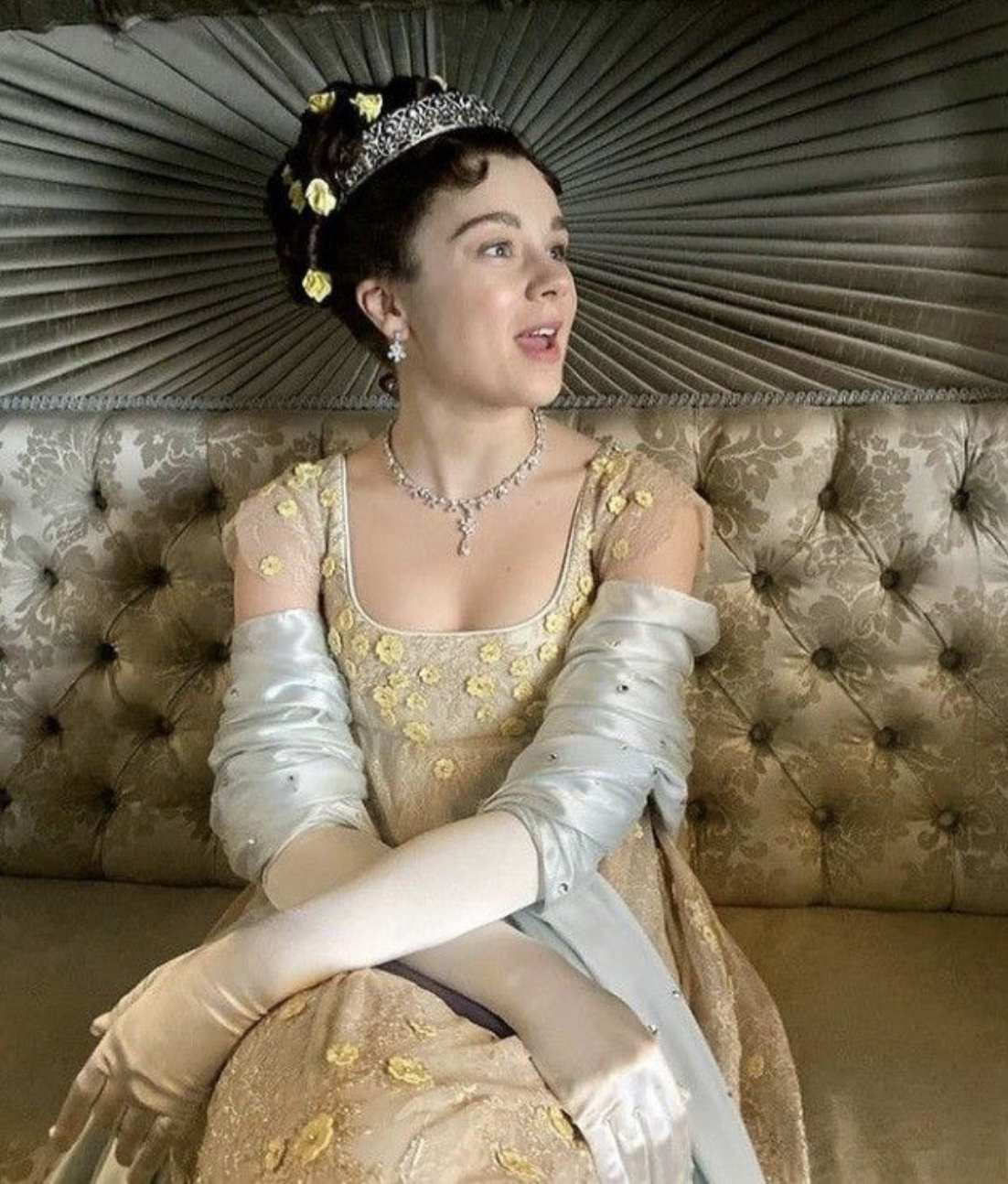
One popular girl, or popular family, can cause a raging fashion for an entire season and beyond. – Eloise Bridgerton in opera gloves.– Photo source, Pinterest

It is a caprice of the moment with a certain set of girls who strive for fads and eccentricities to omit all punctuation marks in their letters. Probably some one who couldn’t put them in, started the fashion. Just as a girl at the operá a few years ago, found that a sore finger throbbed and ached desperately if her hand lay on her lap, and was much relieved when she held it upright. So she sat all the evening in a conspicuous box, with one slender gloved-hand touching her cheek – with the result of making the attitude a marked and raging fashion that entire season.


It is a suggestion to slip a salted almond into the vacuum left by a date or French prune stone and try the surprise.

English tennis cakes are offered at the house tennis parties of the season. They are a good sized loaf cake, tasting like a pound cake, with a little fruit. A New-York caterer introduced them and still monopolizes the custom in them.

Up to a year or so ago, doilies were used in moderation for finger bowls and occasional small dishes. Then they suddenly became fashionable for nearly every separate bit of china. The table was dotted with them until it looked like the counter of a linen store. They were used to set the cup upon in one’s saucer– certainly the silliest and the furthest from neat of all napery whims. Now the reaction has set in. It is no longer form to employ doilies, save in the occasional manner of a twelvemonth.

A late Parisian novelty– Bats in diamonds are bizarre enough to attract the attention of those seeking after new and strange effects. Old jewels can be reset and rearranged in these bats, which are described as setting off to striking advantage a ball costume.

Linen collars and cuffs are again in high favor, but worn with a difference. The cuffs are no longer a mere strip of white below the sleeve, but protrude for an inch or two, like a man's wristbands. This would seem another saucy attempt to seize upon the masculine belongings. –“Her Point of View”, NYT, 1893


Etiquette Enthusiast, Maura J. Graber, is the Site Editor for the Etiquipedia© Etiquette Encyclopedia

Monday, August 23, 2021

When a Spoon Became Superfluous

Not a superfluous spoon in site… “The teaspoon is restricted to the teacup and that alone.” 1893 – “One of the biggest mistakes I am used to seeing in Competition Tablescaping or Table Setting, is the error of a superfluous spoon at the place settings. If there is not a soup course or anything else that etiquette requires a spoon for, the spoon is an extra appendage unnecessary at the settings and the table loses much needed points.” – Maura J. Graber, Etiquipedia© Site Editor and director of The RSVP Institute of Etiquette
The teaspoon has been banished from the table of the ultra elegant. Its use has long been forbidden to assist in eating any sort of kernel and soft vegetables, but it survived for a time as an aid to consuming what our grandmothers called “sauce,” and for certain desserts of a custard nature or ices and ice cream. 
Now, its employment is considered, as the fashionable woman told her child, “worse than wicked vulgar” in any such service, and so, like Fatima in the ‘Arabian Nights’ eating her grains of rice, we pick at all those yielding, gelatinous, and elusive substances, with a little fork. The teaspoon is restricted to the teacup and that alone.–New York Times, 1893


Etiquette Enthusiast, Maura J. Graber, is the Site Editor for the Etiquipedia© Etiquette Encyclopedia