Wednesday, May 10, 2023

Onion Soup Etiquette

How to Eat French Onion Soup 
and Other Soup Tips
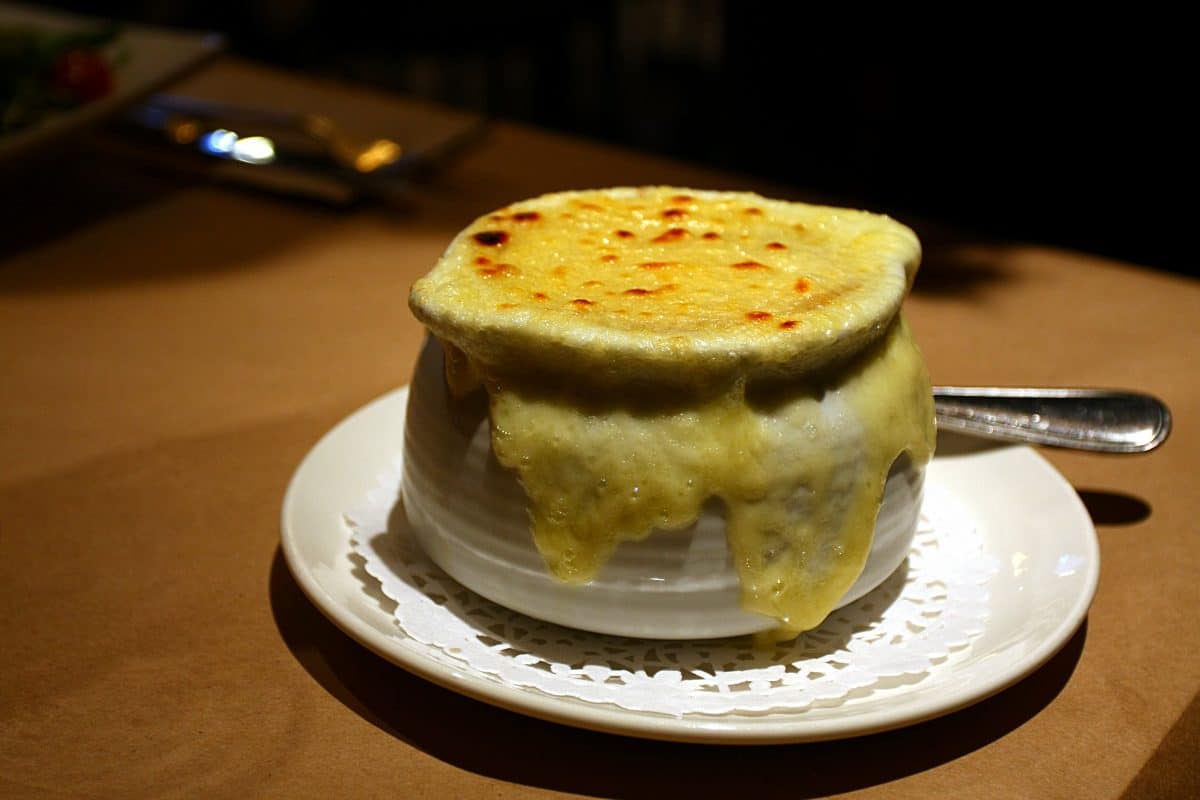
French Onion Soup

A friend recently shared an interview experience with a person who was applying to work at his law firm. The employment offer was off the table after having lunch with the applicant. The person completely blew eating their French Onion soup! (Details left to the reader’s imagination.)

How to Eat French Onion Soup

It’s interesting how one little bowl of soup can bring about the level of anxiety this one does. Although steeped in tradition, served in French market cafés primarily as late-night fare, the bread and cheese hooding the fragrant broth and onions creates confusion for those hoping to eat it with some semblance of decorum. 

So, how DO you eat French Onion Soup with confidence and fewer drips?  Etiquette experts, Emily Post and daughter, Peggy, have shared, “With such a soup, a knife is your friend, not your enemy.” That’s right, it is acceptable to use a knife when eating this soup, especially when it helps avoid your wearing strings of cheese on your face.

  • Much can depend on the soup as prepared by the chef.  If, as in the picture above, cheese has baked down firmly onto the sides of the bowl, the diner must be careful with the first knife move to avoid a possible burst of steam.
  • With the soup spoon in your dominant hand and a knife in the other hand, push the cheese from the middle outward to the rim of the bowl.
  • Use the knife to cut and nudge bits of cheese onto your spoon. In the case of long strands of cheese that are difficult to get into the spoon, you can twist the strand around the wide part of the spoon and then cut it with the knife.
  • You can also switch hands and use the knife to cut the crispy bread, while using the soup spoon to leverage it.
  • It's tricky!

Doing Business During a Meal

If your business includes working with clients, the business lunch is a perfect social occasion with a goal that is professional. On a very small scale it is like a networking event with food and drink involved. And, if you are being interviewed over lunch, know that the potential employer will be imagining how you will interact with their clients. Having good dining skills is paramount. 

When you are dining with a potential employer, it’s no time to be adventurous with food. Make sure your meal is within your skill level comfort zone. If you order soup, make sure that it is creamy or a broth and that can easily be eaten with a soup spoon alone, never requiring the use of any other utensil or bread. 

When you order soup at a business lunch or dinner:

  • Order “easy” to eat soup that will allow you to concentrate on the conversation at hand.
  • Never add salt or pepper without first tasting. 
  • Hold the spoon so that the bowl of the spoon is angled away from you.
  • Do not fill the bowl of the spoon too full or make any slurping sound.

A business or working lunch, like any meal, is meant to nourish you and be enjoyed. But primarily, it is intended to make doing business more convenient and in a social context.

In most gatherings where people are eating, we tend to make food the primary subject. But when business is being conducted during mealtime, business should be the primary subject. Which makes knowing how to eat French onion soup, and many other foods that require special knowledge, worth the time and practice.


 Contributor, Candace Smith is a retired, national award-winning secondary school educator, Candace Smith teaches university students and professionals the soft skills of etiquette and protocol. She found these skills necessary in her own life after her husband received international recognition in 2002. Plunged into a new “normal” of travel and formal social gatherings with global leaders, she discovered how uncomfortable she was in many important social situations. After extensive training in etiquette and protocol, Candace realized a markedly increased confidence level in meeting and greeting and dining skills and was inspired to share these skills that will help others gain comfort and confidence in dining and networking situations. Learn more at http://www.candacesmithetiquette.com/


 🍽Etiquette Enthusiast, Maura J. Graber, is the Site Editor for the Etiquipedia© Etiquette Encyclopedia

Tuesday, May 9, 2023

“Crudities” and Forks

Early in the Tudor period, a type of fork which was really a rudely wrought piece of silver with two prongs at one end, and a small spoon bowl at the other, was known. This was used for lifting “suckets” such as plums or other fruits preserved in syrup. 


An interesting reference to forks was published in a book called “Crudities,” written at the beginning of the seventeenth century. The allusion is the expression of the author, Thomas Coryate, an Englishman traveling in Italy in 1620. “I observed a custom in all those Italian cities and towns through which I passed that is not used in any other country that I saw in my travels, neither do I think that any other nation of Christendom doth use it, but only Italy. The Italian, and also most strangers that are commorant in Italy, do always at their meals use a little fork when they cut their meat... their forks being for the most part made on iron or steel, and some of silver, but these are used only by gentlemen. The reason of this their curiosity is because the Italian cannot endure by any means to have his dish touched by fingers, seeing that all men’s fingers are not alike clean. Hereupon I myself thought to imitate the Italian fashion by this fork cutting of meat, not only while I was in Italy, but also in Germany, and often-times in England since I came home.”

It seems incredible that in a period of English history so famed for its extravagance and luxury, that forks were rarely used. This new display of refinement was indeed slow in being generally accepted, as evidenced by the few specimens made. However, their use may have been retarded somewhat, because ministers contended it was an insult to God not to touch meat with one’s fingers. As more and more travelers noted their use and general advantages in the consumption of food, silversmiths produced forks in greater quantities. It was not until late in the eighteenth century, however, that they were in common use.

The earliest forks made were probably used only for serving pieces, as one in the inventory of the Royal Plate of 1399 weighed fifteen and one-half ounces. Another in a will of 1463, was listed as being used for “grene Gynger.” Early in the Tudor period, a type of fork which was really a rudely wrought piece of silver with two prongs at one end, and a small spoon bowl at the other, was known. This was used for lifting “suckets” such as plums or other fruits preserved in syrup.
 — From The Book of Old Silver, by Seymour B. Wyler, 1937


 🍽Etiquette Enthusiast, Maura J. Graber, is the Site Editor for the Etiquipedia© Etiquette Encyclopedia

Monday, May 8, 2023

Early Etiquette and Travel Utensils


A Continental fork and spoon combination, age unknown, along side a 19th C. German made antique reproduction fork.

Even after the introduction of forks, it remained customary for dinner guests to provide their own utensils for eating. This undoubtedly explains the ingenious one-piece combinations which were made to serve the purpose of a spoon and fork. The three pronged fork would serve as the handle for a spoon bowl, by fitting the prongs in two loops and fastening it to the back. The handle hinged back to permit folding for convenience when carrying in the pouch. Surviving examples of these of English origin are very rare, and the few known today are all of continental make. — From The Book of Old Silver, by Seymour B. Wyler, 1937


 🍽Etiquette Enthusiast, Maura J. Graber, is the Site Editor for the Etiquipedia© Etiquette Encyclopedia

Sunday, May 7, 2023

Joys and History of Eating


“The great Alexandre Dumas, in his Grand Dictionaire de Cuisine, insisted that salad is not a natural food for man.” Had he never tried a Shrimp Louie?!?”

In a chapter titled “After The Fork,” for example, the book discloses that three things revolutionized eating habits during the 17th century: the fork, the plate and the potato. It was in 1100 that a lady from Constantinople caused a furor in Venice by picking up her food with a two-pronged device instead of her fingers, as was customary. But not until 1500 did the fork come into general use in Italy and Spain; and in England and the rest of Europe not until 100 years after that.

The first plate was used in England in 1641; before that, food was piled into a scooped-out loaf of bread called a “trencher”; and that, too was eaten. And the potato, brought to Spain from America in the late 1500’s, was at first a rather suspect novelty, then a luxury in France, and later an absolute necessity for survival throughout Europe.

All this and much more come to life in these pages: observations on the first use of the table napkin, the niceties (and vulgarities) of serving food and consuming it; and such piquant facts that the great Alexandre Dumas, in his Grand Dictionaire de Cuisine, insisted that salad is not a natural food for man.

Which brings me to the book's visual delights: its dozens of drawings, sketches, illustrations and reproductions in superb color of renowned paintings of all ages and cultures related to various aspects of cookery, table settings, meat carving, meals of the humble and the mighty. There is not a page of these graphics combined with the text that will not hold your attention and charm you.

And as a grand finale, there is a section of 68 pages of recipes. But what recipes! Roman, Greek and old European; as well as Asian, Middle East and Early American, with full instructions on how to duplicate the original ingredients into modern counterparts. Here are opportunities for you to try to create a dish of the time of Caesar or Socrates; Ptolemy, or a Samurai war-lord or the Pennsylvania Dutch.

This is a splendid book. Whether or not you cook, surely you eat, and “The Joy of Eating” will give you joy. – From a 1997 book review by Jane Barry Williams


 🍽Etiquette Enthusiast, Maura J. Graber, is the Site Editor for the Etiquipedia© Etiquette Encyclopedia

Saturday, May 6, 2023

Coronation Street Party Etiquette

British markets and online sites are bursting with street party treats, drinks and festive decor. For over a century, street parties in England have been localized festive celebrations for Coronations and Royal weddings. The British love these street parties are use them to mark all kinds of special occasions and build community spirit with one’s neighbors at the same time. —Image source, Instagram

How About Some Royal Manners for the Coronation of Charles III and His Queen?

Grant Harrold was butler to Prince Charles at Highgrove from 2004 to 2011. For a well-mannered Coronation street party, he says everyone should be invited ‘and that means everyone’.

Don't be a fancy-dress fascist, he says: ‘Not everybody is comfortable with fancy dress, so if you do want a theme, make it clear the dress code is optional with a “or come as you're comfortable”. There's nothing worse than making your less-showy guests dread the day.’

And have a team of hosts. 'The King is an excellent host because he's always thinking of others and making sure everyone feels personally welcomed.

‘At my job interview, he served me tea and biscuits himself.

‘Get a team of hosts together and space them out evenly along the tables. It's their responsibility to make sure everyone in their section has their glass topped up, plenty to eat and is feeling included in any conversation or games.’

Don't forget to lay your tables: this isn't a school canteen: ‘Not only will a fully laid table look wonderfully inviting, it's also the best way to ensure everyone seated has a glass, plate, cutlery and napkin.’

Grant’s biggest bugbear is people who text at the table. ‘Only get your phone out to take pictures and videos of all the fun going on around you. And if you really can't manage to keep your phone on silent, at least set your ringtone to God Save The King.’

And don't let everyone just sit next to their pals: ‘The temptation at a party like this is to make a beeline for the neighbours you know best, have a riotous time and ignore everyone else. But a street or village party is a brilliant chance to build a sense of community. The royals are consummate minglers and always opt for “how nice to see you” as an opener.

‘They also talk to the guest on their left during the main course, and the one on their right during pudding.’ — From Mail Online, April 2023


 🍽Etiquette Enthusiast, Maura J. Graber, is the Site Editor for the Etiquipedia© Etiquette Encyclopedia

Friday, May 5, 2023

17th C. Flatware and Persons of Quality

Early table forks had only two tines. Above are 2, two-tined forks. One is a travel fork which fits into a bowl end, creating a spoon.


LIVERPOOL, Feb. 19– Letters and other documents dealing with manners and customs of daily life in the 17th century which came to light recently tend to show that it was customary in those days for “persons of quality” to have sets of their own spoons, knives and forks which they took with them when invited out. These papers were of particular interest just at this time to collectors of antiques in connection with an addition made recently to the British Museum. This was the earliest hallmarked table fork known, engraved with the crest of Manners and Montagu, 1632. 

About the same time a silver spoon of identical hallmark and crest was taken to Haddon Hall. Mention of such a set is made in the will of Mrs. Katherine Ridgeway, dated May 9, 1627, which was among the documents destroyed in a fire some time ago at the Four Courts, Dublin. 

The will says: “I bequeath to the Right Honorable the Lord Chancellor my little seller of crystal bottles item. I give and bequeath to my Ladye of Elye my gilt spoone with the forks and penknife suitable to it.” Mrs. Ridgeway was widow of George Ridgway, secretary of the Irish Council, and the Lord Chancellor was Adam Loftus, Lord Loftus of Ely.

Books on etiquette and table manners were far from being the prerogative of the Victorian age, it is revealed, as in 1663 there was published in London a book entitled “The Accomplished Lady’s Rich Closet of Rarities,” in which the following rules. are laid down: 

“A gentlewoman being at table abroad or at home must observe to keep her body straighte, and lean not by any means upon her elbowes –nor by ravenous gesture discover a voracious appetite. 
“Talke not when you have meate in your mouth, and do not smacke like a pig – nor eat speene-meat so hot that tears stand in your eyes.
“It is very uncourtly to drink so large a draught that your breath is almost gone, and you are forced to blow strongly to recover yourself. Throwing down your liquors as into a funnel is an action fitter for a juggler than a gentlewoman. 
“In carving at your own table distribute the best pieces first, and it will appear very decant and comely to use a fork; so touch no meat without it.”
Reference to the fork was of particular interest to the museum authorities, for those present-day indispensable instruments had not then been long introduced, it appears. 
Forks were first imported from Italy, and their use in England at the time was considered pedantic and laughable. One writer of the time speaks of a silver fork as “being used of late by some of our spruce gallants,” which did not tend to make the fork popular at all among certain sets.– By Associated Press, 1925


 🍽Etiquette Enthusiast, Maura J. Graber, is the Site Editor for the Etiquipedia© Etiquette Encyclopedia

Thursday, May 4, 2023

Etiquette Breach Miffs Duchess

Public Domain image of Lady Evelyn Cavendish, Duchess of Devonshire in 1912, wife of Victor Cavendish, 9th Duke of Devonshire.

WOMEN GUESTS CRY “VOTES” ARE BANISHED

Duchess of Devonshire Won’t Tolerate Breach of Etiquette

LONDON, June 17— There was a meeting at Devonshire House today at the Colonial Nursing Association. Princess Henry of Battenberg was present while Lewis Harcourt, a member of the cabinet, was speaking two suffragettes interrupted him with their cry of “Votes for Women.”

The Duchess of Devonshire reminded the women they were guests in the house and in the circumstance she had no alternative but to request that they withdraw. The women were led from the room. — Chico Record, 1912


 🍽Etiquette Enthusiast, Maura J. Graber, is the Site Editor for the Etiquipedia© Etiquette Encyclopedia

Wednesday, May 3, 2023

Talking Brides Breach Etiquette

An artist’s depiction of a traditional Korean wedding in 1889

MUST BE MUTE FOR A DAY

If This Bride Says a Word She Becomes an Object of Ridicule

In Korea, during the whole of the marriage day the bride must be as mute as a statue. If she says a word, or even makes a sign, she becomes an object of ridicule; and her silence must remain unbroken, even in her own room, though her husband should attempt to break it by taunts, jeers or coaxing, for the female servants are all on the watch for such a breach of etiquette as speech, hanging about the doors and chinks to catch up and re- peat even a single utterance, which would cause her to lose caste forever in her circle. 

This custom of silence is observed with the greatest rigidity among the higher classes. It may be a week or several months before the husband knows the sound of his wife's voice, and even after that, for a length of time, she only opens her mouth for necessary speech. With the father-in-law the custom of silence is still more rigid, and the daughter-in-law often passes years without raising her eyes to his or addressing a word to him. In Bulgaria, a month’s silence is imposed on brides, unless specially addressed by her husband.— San Jose Mercury News, 1899


 🍽Etiquette Enthusiast, Maura J. Graber, is the Site Editor for the Etiquipedia© Etiquette Encyclopedia