Tuesday, March 25, 2014

Etiquette of Roman Empire Dining

Some foods which we take for granted today such as potatoes, tomatoes and chocolate, were unknown to the Romans. Likewise, many Roman dishes are unheard of now. The menu at a Roman banquet could include sows' udders and larks' tongues, though most people never ate such extravagant meals.
An 1882 print titled, “A Roman Bakery, Restored from the excavations at Pompeii”
Poorer Romans and slaves had to live on basic food, such as bread, porridge and stew, but wealthier people had a more varied diet. For breakfast, they ate a snack of bread or wheat biscuits with honey, and lunch was a simple meal of eggs, cheese, cold meat and fruit.

Many people hardly ate at all during the day, waiting instead for the evening meal. For average Romans, this was roast poultry or fish, but the wealthy often enjoyed lavish dinner parties.

The Romans drank lots of wine, and people in Rome could choose from around 200 types which were made all over the Empire. Wine was often spiced, or sweetened with honey, and it was usually diluted with water -- drinking it undiluted wasn't considered respectable.

In the early days of the Republic, women were forbidden to drink wine, but during the Empire this rule was dropped. Other popular drinks included grape juice and goat's milk, and people could also drink water from public fountains.

Depiction of cooking in an ancient Roman kitchen
A Roman kitchen was equipped with many of the same utensils that we use today; saucepans, cheese graters, and strainers to drain water away. These items were usually made of bronze, which could make food taste strange, so some pans were coated with silver.

Food was boiled, fried, grilled, stewed, or roasted on a spit. With no freezers or cans to keep food fresh, it had to be smoked, pickled or salted to preserve it. Rich Romans loved spicy food, and most of their meals were highly seasoned or eaten with a strong sauce. One of the most popular sauces was a thick, salty concoction called liquamen, made from pickled fish.

In town, very few people did their own cooking. Most people lived in apartment blocks with wooden beams and floors, and it was forbidden to light cooking fires inside, in case the building burned down. Instead of cooking at home, people usually bought hot foods, such as pie, sausages and stews, from snack bars in street.

 
Depiction of a Roman Banquet ~ “Menus written on tablets were known in ancient Greece and Rome, but far more common at feasts was the custom of someone -- either the host or a specially instructed slave -- pointing out the different dishes, explaining on occasion what each contained and how it had been made, and informing guests of the provenance, the freshness, the age of the foods and wines. The need for written menus at modern feasts is the result of an important change in the way for more formal meals were constructed, which spread to Europe and America from about the mid-nineteenth century.” From Margaret Visser, The Rituals of Dinner
A Roman Dinner Party

Ancient Roman dinner guests, depicted lounging on a triclinium... “If they were too full to finish their food, they could wrap the leftovers in a napkin to take home.”— “The first napkin was a lump of dough the Spartans called ‘apomagdalie,’ a mixture cut into small pieces and rolled and kneeded at the table, a custom that led to using sliced bread to wipe the hands. In Roman antiquity, napkins known as sudaria and mappae were made in both small and large lengths. The sudarium, Latin for 'handkerchief,' was a pocket-size fabric earned to blot the brow during meals taken in the warm Mediterranean climate. The mappa was a larger cloth spread over the edge of the couch as protection from food taken in a reclining position. The fabric was also used to blot the lips. Although each guest supplied his own mappa, on departure mappae were filled with delicacies leftover from the feast, a custom that continues today in restaurant ‘doggy bags’.”

Wealthy Romans loved to eat extravagant and fancy foods. They threw lavish dinner parties to show off their great power and wealth. Important Romans tried to outdo each other by making their banquets more and more extravagant.

A dinner party would usually begin in the early evening. The guests would remove their sandals at the door and have their feet washed by a slave. They were then announced by an usher and shown to their places. Their hands were then washed with perfumed water. Washing their hands was an important ritual as Romans usually ate with their fingers.

Wealthy Romans reclined on three cushioned couches, or a triclinium, while dining. In the Roman Empire, only slaves and children sat on chairs while eating. Women and men ate together, with up to nine people lounging around a table. Romans didn't have forks, but were known to sometimes use knives and spoons. People ate straight from serving dishes as opposed to using plates, and between courses slaves washed the guests' hands with more perfumed water.

A full Roman banquet was made up of seven courses and could last as long as ten hours. Starting with a couple of cold courses, such as sardines, mushrooms, and eggs, they then moved on to more exciting dishes. They could include flamingoes' tongues, doormice in honey, or even elephants' trunks. How the food looked was just as important as how it tasted and chefs took great enjoyment in disguising one type of food to make it look like another. The writer Petronius boasted that his chef could make a pig's belly look exactly like a fish. Between courses, guests were entertained by poets, conjurers, clowns, or musicians. After dinner, there would often be games. For example the host would pick a number and everyone would have to swallow that number of drinks.

To show that they had enjoyed the meal, guests would belch loudly. If they were too full to finish their food, they could wrap the leftovers in a napkin to take home. Very greedy guests would tickle their throats with a feather until they became sick and then would start eating all over again. The writer Seneca was disgusted by guests who indulged in this habit, and wrote scornfully, "They vomit to eat and eat to vomit."
Elagabalus's guests being smothered when the petals were released from a large net above the table.


Emperor's spies were everywhere, so guests had to be careful about what they talked about at dinner parties. If someone was heard criticizing the Emperor, he might suddenly be tied up in chains and dragged away. Some dinner parties were even more dangerous. 

The crazy emperor Elagabalus smothered his guests to death with thousands of rose petals falling from the ceiling. A nineteenth-century painting depicts Elagabalus's guests being smothered when the petals were released from a large net above the table.


Sources include the "Usborne Encyclopedia of the Roman World" and Margaret Visser's "The Rituals of Dinner" and "The Art of the Table"


Etiquette Enthusiast, Maura J. Graber is the Site Editor for the Etiquipedia© Etiquette Encyclopedia

Monday, March 24, 2014

Gun Range Etiquette

Practicing good gun range etiquette isn’t just good manners—it’s good sense! Gun range etiquette is a blend of common sense, courtesy and safety. A day at the range is fun, and good gun range etiquette makes it even better. 

Women with Rifles, circa 1889, from the Wisconsin Historical Society

What you need to know before you hit the range:

Most clubs and ranges require shooters to attend a safety class prior to using the range. This certifies that you’ve read and understand the NRA Basic Rules of Gun Safety and the specific rules that apply at the range you’re using. Remember that there may be other gun safety rules that are enforced on your range, but these three rules are ALWAYS appropriate, no matter where you are:

1. ALWAYS keep the gun pointed in a safe direction.
2. ALWAYS keep your finger off the trigger until ready to shoot.
3. ALWAYS keep the gun unloaded until ready to use.

Most ranges have Range Safety Officers (RSOs, also known as Range Masters) whose job is to supervise shooters, to enforce the rules and regulations of their ranges, and to handle any problems that may occur. Pay attention to the RSOs, who will tell you what to do in case of an emergency. Remember that the Range Safety Officer has absolute authority on the range. Compliance with his or her instructions is mandatory.

When you arrive at a range, introduce yourself to the RSO and let him/her know if this is your first visit to the range. The RSO will tell you what you need to know before you set up your gear.

Know the basic range commands, and learn other commands that are used at your range. If you don’t understand what they mean, ask the Range Safety Officer. He or she will be happy to explain it to you. Remember that asking questions is a sign of intelligence and maturity.

Two of the most common range commands are Ceasefire and Commence Firing, although sometimes it is said differently. Instead of “ceasefire,” some ranges are using the words, “Stop shooting!” and instead of “Commence Firing,” some are using the phrase, “You may begin shooting.” This is because we want our instructions to be as clear and as easy to understand as possible.

Ceasefires are used whenever all shooting must stop, whether it is because time’s up or because a potential problem has arisen. Whenever the RSO’s attention must be away from the firing line, he or she will call a ceasefire. Whenever someone needs to go downrange for any reason, a ceasefire is called. Ceasefires are also called when it’s time to post, change or retrieve targets.

However, the RSO is not the only person who can call a ceasefire. Anyone who spots a potential problem should call “Ceasefire!” The RSO will repeat the words and see to it that all firing stops immediately. If you aren’t sure what’s happening, it’s okay to call a ceasefire. It’s better to call a ceasefire and be safe than not to call one and be sorry.

Ceasefires are used in all kinds of situations—not just when it’s time to change, post or retrieve targets. Perhaps a person has inadvertently wandered out onto the firing range, or perhaps a shooter in the point next to you has become ill. It’s your duty to call a ceasefire so that the RSO can take control of the situation and provide a solution or direct others to provide assistance if necessary.

During a ceasefire, there should be no handling of firearms. The key things to remember are:

1. Chamber is empty and ammunition source (magazine) is removed.
2. Action is open.
3. Hands off!
4. Step away from the firing line.

Before anyone goes downrange, the RSO will do a visual check to see that everyone has stepped away from the firing line, and then ask, “Is everyone clear?” Everyone else on the line should also make this visual check, because safety is everyone’s responsibility.

Clear means that all shooters have made their firearms safe, that no one has a gun in his/her hand, and that there will be no handling of firearms until permission is given. Then, and ONLY then, may anyone go downrange.

When the ceasefire is over, the RSO will ensure that no one is downrange before stating, “The range is going hot.” This alerts everyone that the range is shifting from a ceasefire, but it doesn’t mean that shooting may begin. You must wait until the “commence firing” command has been given before you can shoot.

Commence Firing is the command given that tells everyone it’s safe to shoot. That doesn’t mean you start blazing away. It means that when you are ready, you may shoot your gun. These are two of the sweetest words a shooter will hear.

Marines in Europe at Gun Range


Remember, safety is everyone’s job. You are responsible for your own safety, the safety of others and for the behavior of your guests. If you see that someone else isn’t following the rules, you should leave the range. Go to a safe place and report the situation as soon as possible to the authorities.

A few other rules of Good Gun Range Etiquette are:

1. Do not fire at posts, supports or target frames. These are expensive and time-consuming to replace.

2. Shoot only range-approved targets. Check with your range to find out what types of targets are allowed. Some ranges allow only approved paper, cardboard, club-furnished metal targets and clay targets.

3. If you set out target frames to support your targets before you started shooting, you will need to return them to the storage area once you are done.

4. If your club or range allows pets, keep them on leashes or under control at all times. Give careful consideration to bringing a pet to a shooting range. Remember that shooting may hurt your pet’s hearing the same way it may hurt yours. Pets that scavenge (eat things that may or may not be food) should not come to a shooting range with you. Be aware that pets unused to gunfire might panic on a range.

5. It’s good etiquette to leave the range better than you found it. Picking up trash, cleaning your firing station, and obeying all of the range rules are not only good gun range etiquette—they’re good manners!


Originally posted December 17, 2013  


Etiquette Enthusiast, Maura J. Graber, is the Site Editor for the Etiquipedia© Etiquette Encyclopedia

Sunday, March 23, 2014

The Unclassified Laws of Etiquette

From “Hill’s Manual of Social and Business Forms: Guide to Correct Writing with Approved Methods in Speaking and Acting in the Various Relations of Life” 

 Thomas E. Hill, 1875

Hill's Unclassified Laws of Etiquette

  • Never exaggerate.
  • Never point at another.
  • Never betray a confidence.
  • Never leave home with unkind words.
  • Never neglect to call upon your friends.
  • Never laugh at the misfortunes of others. 
  • Never give a promise that you do not fulfill.
  • Never question a child about family matters.
  • Never send a present, hoping for one in return.
  • Never speak much of your own performances.
  • Never fail to be punctual at the time appointed.
  • Never make yourself the hero of your own story.
  • Never pick the teeth or clean the nails in company.
  • Never fail to give a polite answer to a civil question.
  • Never present a gift saying that it is of no use to yourself.
  • Never read letters which you may find addressed to others.
  • Never fail, if a gentleman, of being civil and polite to ladies.
  • Never call attention  to the features or form of anyone present.
  • Never refer to a gift you have made, or favor you have rendered.
  • Never associate with bad company. Have good company, or none.
  • Never look over the shoulder of another who is reading or writing.
  • Never call a new acquaintance by their first name unless requested.
  • Never appear to notice a scar, deformity, or defect of anyone present.
  • Never arrest the attention of an acquaintance by touch. Speak to him.
  • Never punish your child for a fault to which you are addicted yourself.
  • Never answer questions in general company that have been put to others.
  • Never, when traveling abroad, be over boastful in praise of your own country.
  • Never lend an article you have borrowed, unless you have permission to do so.
  • Never attempt to draw the attention of the company constantly upon yourself.
  • Never exhibit anger, impatience or excitement, when an accident happens.
  • Never pass between two persons who are talking together, without an apology.
  • Never enter a room noisily; never fail to close the door after you, and never slam it.
  • Never forget that, if you are faithful in a few things, you may be ruler over many.
  • Never exhibit too great familiarity with the new acquaintance, you may give offense.
  • Never will a gentleman allude to conquests which he may have made with ladies.
  • Never be guilty of the contemptible meanness of opening a private letter addressed to another.
  • Never fail to offer the easiest and best seat in the room to an invalid, an elderly person, or a lady.
  • Never neglect to perform the commission which the friend entrusted to you. You must not forget.


  • Never send your guest, who is accustomed to a warm room, off into  a cold, damp, spare bed, to sleep.
  • Never enter a room filled with people, without a slight bow to the general company when first entering.
  • Never fail to answer an invitation, either personally or by letter, within a week after the invitation is received.
  • Never accept of favors and hospitality without rendering an exchange of civilities when opportunity offers.
  • Never cross the leg and put one foot in the street-car, or places where it will trouble others when passing by.
  • Never fail to tell the truth. If truthful, you get your reward. You will get your punishment if you deceive.
  • Never borrow money and neglect to pay. If you do, you will soon be known as a person of no business integrity.
  • Never write to another asking for information, or a favor of any kind, without enclosing a postage stamp for the reply.
  • Never fail to say kind and encouraging words to those whom you meet in distress. Your kindness may lift them out of their despair.
  • Never refuse to receive an apology. You may not receive friendship, but courtesy will require, when a apology is offered, that you accept it.
  • Never examine the cards in the card-basket. While they may be exposed in the drawing room, you are not expected to turn them over unless invited to do so.
  • Never, when walking arm in arm with a lady, be continually changing and going to the other side, because of change of corners. It shows too much attention to form.
  • Never insult another with harsh words when applied to for a favor. Kind words do not cost much, and yet they may carry untold happiness to the one to whom they are spoken.
  • Never fail to speak kindly. If a merchant, and you address your clerk; if an overseer, and you address your workman; if in any position where you exercise authority, you show yourself to be a gentleman by your pleasant mode of address.
  • Never attempt to convey the impression that you are a genius, by imitating the faults of distinguished men. Because certain great men were poor penmen, wore long hair, or had other peculiarities, it does not follow that you will be great by imitating their eccentricities.
  • Never give all your pleasant words and smile to strangers. The kindest words and the sweetest smiles should be reserved for home. Home should be our heaven.

Monday, March 17, 2014

Etiquette and Nude Dining

A group of nudists eat together at a New York City restaurant. (Reuters) 
*Once upon a time, etiquette was important: One needed to know which fork to use, which glass to sip from. Those days, my friends, are over. Now, questions of etiquette mainly revolve around how many Instagrams each guest is allowed to take during dinner. But there remains one corner of the world where table etiquette remains a vexing and important issue: at nude resorts. And it’s a problem for a growing number of people. 

“We’re seeing a rise in ‘nakations,’ especially among people in their thirties,’” says Sue Nerud, spokesperson for the American Association for Nude Recreation. Exact statistics are hard to come by, however, since many nudists prefer to remain anonymous. (In fact, several nudists in this article spoke only on the condition their names not be used.) And while Nerud said recent studies show that nakations are great stress relievers, there remain those pesky etiquette issues—which we are about to solve for you. (*Etiquipedia believes etiquette is still VERY important!)

1. Towel On

“Naked butts at the table are a big no-no,” says travel writer and photographer David Lansing, who likes to take off his press hat (and everything else) at nudist resorts around the world. For reasons of basic health and safety, everyone brings a towel to sit on. More proof that, as fans of the Hitchhiker’s Guide to the Galaxy know all too well, a towel is “the most massively useful thing an interstellar hitchhiker”—or hungry nudist—”can have.”

2. Just Because We’re All Naked Doesn’t Mean We’re All Friends

“You should wait to be invited to a table,” says Lansing. “This isn’t like going on a cruise; even though there may be eight or 10 people at a large table, they usually all know each other, and there will be a very uncomfortable pause in the conversation if you just sit down at a table uninvited. That said, nudists are some of the friendliest people I’ve met and invariably you’ll be asked to join one group or another for lunch or dinner. But do wait to be asked.”

3. Listen to Your Mother—Use a Napkin!

“As a matter of etiquette,” says advice columnist April Masini, “covering your private parts with a napkin while at a nudist event is good manners the same way not chewing with your mouth open is. We all know it’s there; we all know what’s happening; we don’t need to see everything at dinner. Just because you take your clothes off doesn’t mean you should strip yourself of manners.”

4. Some Don’t Like It Hot

“Most nudists resorts will hold traditional barbecues, and first-timers need to be careful around the ‘weenie roast,’” says Tom Mulhall, who owns the Terra Cotta Inn in Palm Springs, California, and writes about nudism for the Huffington Post. Nor is the grill the only danger—the dinner table, too, can be hazardous. “Don’t allow your waiter to serve you a bowl of hot soup. He can spill into your lap,” notes photography instructor Eugene Louie, who visits clothing-optional resorts for self-reflection.

5. Listen to Your Mother, Part 2

“Sit up straight,” says Masini. “Good posture at the dinner table is always a way to show good breeding and good manners, but when you’re nude, slouching and elbows akimbo are not only more noticeable—they create a silhouette that is less attractive than if you have clothes on. Sit up straight!”

6. No One Will Pardon Your Reach

“Don’t reach—even if you think it’s not a reach,” says Masini. “Nude or naturist dining requires a greater margin of coordination and control. Without a bra, and with a well-endowed chest, reaching—even a little—may result in your breasts in the marinara sauce.”

7. There Is Such a Thing as Too Casual

“Casual dining doesn’t mean you can put your ankle across your knee, or your feet up on the coffee table—even if it’s an outdoor barbecue with paper plates,” says Masini. “Reconsider the view others will have while eating.” Of course, if you keep a napkin in your lap, this won’t be an issue.

8. Eyes Up Here, Buddy!

“I’d say the most important table etiquette for nudists is no staring,” says Lansing. “It’s not unusual for nudists to just wrap a gauzy sarong around them as they go straight from the pool (or beach) to the table, so you want to try really hard to maintain eye contact.” Instead of discussing people’s bodies, it’s safer to talk about the food.

9. Food Porn, OK. Real Porn, No Way!

Go ahead and Instagram your dinner if the resort allows it, says Nerud, but don’t shoot other guests unless they sign a photo release form.

10. Chill Out

If you’re nervous about dining in the buff, don’t be. The resort owners I spoke to all said concerns about being naked usually go away after 15 minutes. Nude dining seems naturally relaxing: You don’t have to think about what to wear (or dry-cleaning bills), and you never have to loosen your belt if you overeat. Although, actually, I can’t think of a better motivation to lose weight than the fact that everyone can see your gut (and everything else).


By Ruth Wertzberger Carlson 
Originally published March 07, 2014 bon appetit


Etiquette Enthusiast, Maura J. Graber, is the Site Editor for the Etiquipedia© Etiquette Encyclopedia

Etiquette and Creation of Modern State Banquets in Great Britain

HRH Queen Elizabeth II ~ Address her as ‘Your Majesty’ at first and after that, as ‘Ma'am’ - rhyming with jam or ham, not palm, or harm.


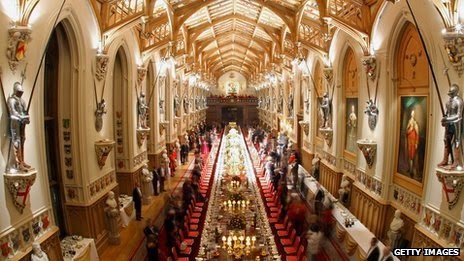
The Royal Household staff start laying the table for a banquet two days before the event, although preparations will have been underway for days before this. One of the most striking elements on the banqueting table is the magnificent service of silver gilt. It comprises not only the dining place itself, but also decorative items such as dessert stands and centerpieces. Numbering over 4,000 pieces, the service was commissioned by George IV when he was Prince of Wales, and it was supplied by the Royal goldsmiths Rundell, Bridge and Rundell.

At a famous dinner held at Carlton House in 1811, the Prince sat against a backdrop of silver guilt at the head of a table that stretched the entire length of the building. Along the centre of the table was running stream of water with banks of moss and aquatic flowers, cascading from a waterfall and falling into a series of pools at the foot of the table. Real fish swam in the stream. In this contemporary caricature (below), the fish are disconcerting the guests by staring at them.

29 June 1811, Hand-coloured etching ~ A farmer (John Bull) and his family gape in amazement at the arrangements for the Regency fête on 19 June. The narrow table extends across the design receding from left to right, the cloth hanging over the seats of chairs in the foreground. The famous canal decorates the centre of the table with its gold and silver fish, and the table is laid with gold plate, and ornate cut-glass goblets and decanters labelled 'Dry Champain', 'Claret', and 'Burgundy'. There are three-branched gold candelabra. The Prince's chair is on the extreme right; beside it stand a man in livery and an attendant in plain clothes. Behind the chair large ornate gold salvers are arranged on shelves covered with white drapery. This was 'a kind of circular buffet . . . lined by festoons and antique draperies of pink and silver'. The sightseers are on the farther side of the table (left) with their backs to the windows, John in the centre; he says, pointing: "Why Odd Zookers this is marvellous fine indeed. Oh Nan how we should relish a rasher on one of they monstracious beautifull Plates, why now I think I shan't grumble to pay three or four Bank Tokens towards this grand treat—methinks I should Just like a nippikin too." His wife puts out her hands protestingly: "Oh John one of our milk white Chickens roasted by myself by our wood fire would be Luscioscious indeed." His daughter says: "La Feather do zee how they gilded Fishes be stareing at yow." There are three loutish sons; one says: "I say Sue I thinks I should not like that dry Shampain, but a Dobbin of our home brewed in that there gilded gold thing would be dreadfully noice indeed"; another (looking up at the (invisible) ceiling : "Dang it if the top 0 the pleace beant all Eel pottles I'll be hang'd.
👑👑👑👑👑👑👑👑👑👑👑


The Grand Service includes 14 tureens, 20 sauce tureens, 140 dishes, 288 dinner plates, 118 salts, 12 ice pails, 12 mirrored plateaux, 58 desert stands and centerpieces and 107 candelabra. Unlike a modern dinner service, it has no single style of decoration. The goldsmiths of the day were influenced by Greek, Roman, Egyptian and other styles.

Originally some parts of the service for plain silver, although items intended for the desert course we're always gilt. However, George IV gradually ordered every piece to be gilded. This may have been because of the impression gained by one visitor to a ball at Carton House in n 1814: "All was in gold or silver gilt which made the silver plate, set out in the deep recessed windows, look cold and poor, although in reality it was very massive and handsome."

Today the Grand Service is kept under the care of the "Yeoman of the Silver Pantry." When not in use, it is kept in a controlled atmosphere. For a State Banquet it must be at its most gleaming and every piece is taken apart, thoroughly washed and cleaned with soft brushes, then dried and polished with soft cloths before being placed on the table. When everything is dismantled, there are over 8,000 components to clean. It takes 8 people 3 weeks to prepare.The Grand Service provides cutlery for every course and includes more obscure items like marrow scoops, ice spades and olive spoons. Today over 2000 pieces of cutlery are needed to serve and eat the banquet all drawn from the Grand Service.

The Queen's table is always decorated in the most magnificent style. She and her most important guest are usually flanked by the grandest pair of candelabra in the service -- which stand at 1.25 metres (4 ft) tall. These were designed by the sculptor John Flaxman and relate episodes from myths of Bacchus and Mercury. The Queen uses a salt that is not part of the Grand Service but was made much earlier, in 1721, by Nicholas Clausen.
 
Don't think about asking the Queen to "Please pass the salt."  She has her own salt dip, or salt cellar, and it is not part of the 8,000 plus pieces used for State Dinners.

At Windsor, on the single long table, a candelabrum portraying St. George and the Dragon is used -- this stands even taller at almost 1.5 metres (5 ft.) This huge piece was William IV's contribution to the elder brother's dinner service -- a final addition to the grandeur that has served every monarch since George IV.
  • Takes two days to lay the 175ft-long dining table at Buckingham Palace
  •  Each place setting measures 45cm and a rod is used to achieve the exact alignment of chair and table
  • 1,104 glasses are used, six for each guest
  • George IV's 4,000-piece Grand Service is used
  • Takes eight people three weeks to clean the service
  • 170 linen napkins, with the Queen's monogram, are folded by one man in the shape of a Dutch bonnet 

The Etiquette at the Table: 


At the dining table, don't start eating until the The Queen has started her meal. 

When it comes to utensils, start at the outside (with the outermost spoon or fork) and work in. If you drop something, don't make a fuss - servants will spot it and deal with it.


Watch for clues and cues with regard to how to properly use your utensils.  Let others who have been there before, guide your actions.


It goes without saying that taking large gulps of your wines, talking with your mouth full, any loud slurping or chewing, and eating with your mouth open, are all the poorest of table manners.


Don't think about asking the Queen to "Please pass the salt."  She has her own salt dip, or salt cellar.


When she has finished her course and stops eating, you have finished your course, too.


Asking for seconds is never allowed, as is asking to be excused to use the restroom facilities. 


Sources; BBC News, The Royal Collection and "For the Royal Table: Dining at the Palace"

🍽Etiquette Enthusiast, Maura J. Graber of The RSVP Institute of Etiquette, is the Site Editor for the Etiquipedia© Etiquette Encyclopedia

Saturday, March 15, 2014

Past Dining Etiquette, Foods and Customs of the British Royal Meals

What makes a dish fit for a Queen? If past royal delicacies are anything to go by then pretty much anything, including seagull, marigolds or peacock - with the skin and feathers put back on after cooking, of course.

Lavish banquets and feasts have always been part of royal celebrations and as part of the Queen's Diamond Jubilee, schoolchildren in the UK were asked to create a special menu for Her Majesty. The winning school saw its recipes served to the Queen at a special reception.

But what was on the menu in times gone by and would serving a canape directly to the monarch have resulted in you losing your head?

There was a very well established etiquette. Victoria's famous line “we are not amused” was uttered when someone told her a joke at the dinner table, breaking strict rules.  Ironically, Queen Victoria had fairly poor dining manners by today's standards, but many of today's rules about manners were formalised in the "Victorian era" named for her reign.

Queen Victoria 1837-1901

There were big changes in service style through Queen Victoria's 63-year reign, says food historian Annie Gray. Towards the end food was served to guests at the table sequentially, known as “a la russe.” It's silver service as we now know it.

There were four to six courses, with seven to nine dishes in each. For big occasions dishes often included cod with oyster sauce, ballotines of duck in Cumberland sauce and roast lamb. There would be a dessert course, with dishes like chocolate profiteroles. A buffet of hot and cold meats was also kept on a sideboard during the meal, just in case you got hungry between courses.

What was unusual about Victoria was the speed with which she ate. Usually a banquet would last for hours, but she could put away seven courses in 30 minutes, says Gray.

The Victorian Era is regarded as one of gentility and graceful manners, though Queen Victoria herself was known to have very poor table manners.  A speedy-eater, Queen Victoria could eat seven courses in 30 minutes, while a number of dinner guests of hers were left hungry.  Royal protocol was that Queen Victoria was served each course first.  Her numerous guests were then served as well.  Protocol dictated that after Queen Victoria finished eating each course, all guests' plates were to be cleared for the next course.  As Victoria didn't wait for guests to be served before eating, her guests were barely served before their plates were taken.  Many guests of Queen Victoria's considered invites to dine at the palace, onerous honors; Dining, yet not really dining at all with the Queen.

"For many people eating with her was purgatory. Everyone was served after the Queen and when she had finished all the plates were cleared for the next course. If you were the last person served often you wouldn't get a chance to eat anything before your plate was taken. She also insisted on all the windows being open whatever the time of year because she got hot."

Like all monarchs Victoria had a master chef, but on big occasions help was bought in. For her Diamond Jubilee banquet 24 chefs were brought over from Paris to help, according to the Royal Collection.

There was a very well established etiquette. Victoria's famous line “we are not amused” was uttered when someone told her a joke at the dinner table, breaking strict rules, says Gray. Many of today's rules about manners were formalised in the Victorian era.


Top table: For the most important guests, with the most favoured at the Queen's direct right.

Other guests: Seated in order of importance, highest ranking closest to top table.

Food: At start of Victoria's reign food would be placed on table and guests would serve themselves.
 

Flowers: After self-service went out of fashion and dishes were not left on table, elaborate flower displays were used as decoration.
 

Drinks: Fine wine and Madeira would be served, but Victoria often had whiskey with her meal.
 

Minor guests: Furthest away from the Queen and served last, they often hadn't even eaten by the time plates were cleared for the next course.
 

Public gallery: On big occasions members of the public were allowed to watch the banquet from viewing galleries.

By Charles II's reign, a dessert course had developed. Charles loved fruit and was one of the first people in the country to eat a pineapple.  This painting depicts Charles II being presented with a pineapple, a rare and exotic fruit for the time period.

Charles II 1660-1685


For Charles II dining was extremely important, it was one of the things that defined him as a king.

At a banquet he would sit at a top table, under a canopy. The table would be raised so he could be seen by everyone and to show his status. Only a very select group of people could sit with him, a maximum of just six.

The King would always be served on bended knee. He had three "officers" to attend to him - a carver, a server and a cup bearer. Cleanliness was extremely important and Charles would have someone whose sole job was to dab his mouth during the meal.

“At that time dining was one of the things that absolutely defined royalty,” says English Heritage's Dr Anna Keay. "Even when Charles was in exile and living in poverty in Germany, he followed the royal form of dining and was served on bended knee."


At state banquets no table decorations were needed as elaborate dishes did the job. They included a 2ft-high, silver salt cellar, made in the shape of a castle and encrusted with jewels. Often there were also silver fountains on the table flowing with wine or water.

There were not courses as we know them, more stages of service. Each could involve hundreds of plates. At one banquet in 1671, guests were served 145 dishes alone during the first course, says Kathryn Jones, curator at the Royal Collection and author of For the Royal Table: Dining at the Palace.


By his reign a dessert course had developed. Charles loved fruit and was one of the first people in the country to eat a pineapple.

Charles II

Seating: Only people who could sit with the King were his own family, royalty from another country and high-ranking officials.

Table
: Fine linen, gold and silver plates and crystal glasses. No decoration due to amount of food and ornate serving dishes. 

Dishes
:  First recorded mention of ice cream is on a banquet menu for Charles II. Root vegetables were considered common. 

Customs
: Dinner would start at about 3pm. It was someone's job to design exactly how food would be laid out in front of the King.

"We have a lot of mistaken ideas about how the Tudors ate. They didn't gnaw chicken greedily and throw bones on the floor, and there were no dogs fighting over scraps under trestle tables.  In a well-conducted house, the dogs - except for little spaniels - were exiled to kennels. Table manners were strict and refined.  Knowing how to cut your bread and what to do with your napkin was an infallible social signal that separated a gentleman from an oik, and every young noble learned to serve at table and to carve." Writer, Hilary Mantel

Henry VIII 1509-1547

Food in the Tudor era was very exciting, say historians. Big feasts could include venison, swan, peacock, heron, porpoise and seagull.

"Sometimes the skin of a peacock would be carefully removed along with the feathers," says Peter Hammond, author of Life In A Medieval Town. "Once cooked they were replaced, as if it were still alive. They did this to show wealth."

While a lot of meat was served, there were also vegetables. Whatever could be grown was served, including cabbage, peas and lettuce. Flowers were also eaten, such as marigolds. They were used in salads and as a garnish.

There was a top table and the highest ranking and most highly favoured guests would sit on the right of King Henry VIII. Everything was about hierarchy, even the way you walked into the room. Gold and silver dishes were also displayed on sideboards to show wealth.

Food was served in stages called "removes". These consisted or up to 20 dishes. They were not all served together, individual dishes would be served in procession. Only the King's table was offered all the dishes.

It's a misconception that banquets were raucous and messy. "The way banquets are portrayed in many films is ridiculous," says Hammond. "They were extremely civilised, with a very firm code of etiquette."

Dining with Henry VIII ~ If you were wealthy, your cakes would be decorated with marzipan, and after dinner there would be nuts, thin and delicate wafers, and sweets made with aniseed and ginger to help digestion.

Henry and his guests would have eaten with a knife and fingers, as forks hadn't been introduced. This would have been very delicately done and again involved very complicated rules about what could be touched with fingers. 

Henry VIII

Seating: Top table including King and the most important guests, the most favoured to the King's direct right.

Table: Fine linen tablecloths, laid with gold and silver plates, dishes and crystal glasses. No forks
.

Dishes:  Sweet dishes were served throughout the meal, not at end. Fruit and nuts were eaten at the end
.

Customs:  Definitely no bone throwing or feeding dogs from the table. That would have been the height of bad manners
.


A medieval banquet

Edward IV 1461-1470 and 1471-1483

Royal banquets got a lot more elaborate under Edward IV and the whole notion of behaviour more complex, says Chris Woolgar, professor of history and archival studies at Southampton University. Courtesy books were produced to explain the etiquette.
 

Edward would have "servants of honour" to tend to his needs at banquets. These were people senior in rank. Often their tasks were menial, but it was still considered a great honour.

A very important servant was the carver, who would cut the King's meat at the top table. Guests would have their meat carved in the kitchen and brought up to them.

One of the "servants of honour" would test the King's food using a "unicorn's horn", basically a fossil shell. In an elaborate performance they would use the "horn" to touch the food, then deem it safe.
 

Elaborate silver salt cellars would be on the table. Often shaped like a ship, they would be encrusted with jewels. Fine wines were served for the higher ranking guests and ale for others.
 

In between the stages of services there would be dramatic performances, usually with a political message. Some were more entertaining, like someone jumping out of a cake, says Prof Woolgar.

Edward IV

Seating : A top table seating the King and important guests, most favoured to the King's right.

Table : Fine linen tablecloth, with gold, silver and silver-gilt plates and cups. No glass or forks
.

Dishes : The finest meats and fish. Sweet dishes were served with meat and fish, not separately
.

Customs: The King and guests would sit for a banquet from 11am and it could last for up to four hours
.


William the Conqueror traveled with a very large household .  If they stayed a long time, it could nearly bankrupt the lord who was their host.

William the Conqueror 1066-1087

During William the Conqueror's reign a trestle table was used and it would only be set up after the King was seated. It would then be laid with a linen table cloth and the finest gold and silver. Lower ranking guests would have eaten out of a trencher, this was a piece of stale bread cut into a square shape and used as a plate. At the end of the meal, having soaked up all the juices from the food, they were frequently given as alms to the poor.

The top table would seat high-ranking guests, with a cleric seated directly to the right of William. Sometimes it was his almoner, an official who gave out alms to the poor on the King's behalf.

All of the King's food would be cooked separately from everyone else. He would often give out food from his plate to guests, this was considered a great honour and a sign of favour.

There were several stages of service, with many dishes. Food would get more elaborate as each dish was served. Only the top table would have roast meat, those of junior ranks would be served boiled meat.

Banquets in Norman times were very dignified affairs, with strict etiquette rules. Noise and mess were not acceptable, neither was burping.

William the Conqueror

Seating: King would sit at a top table with senior guests, including important religious figures 

Table: Elaborately embroidered linen, gold and silver plates and cups. No glass or forks 

Dishes: The finest meat, including venison and game birds, and fish, including turbot, were served

Customs: Would sit from 11am. The King would often give out alms to the poor from the banquet
. –
Originally printed January 2012, 

Friday, March 14, 2014

Etiquette, Italian Renaissance Style

They dine and hold court with sprezzatura. "Sprezzatura" is an Italian word originating from Baldassare Castiglione's The Book of the Courtier, where it is defined by the author as "a certain nonchalance" or "slightly contemptuous indifference." 

Even before Louis XIV contained the nobility of France at court, groups of French aristocrats had performed an important experiment in manners. They were following in the tradition of Italian Renaissance treatises on behaviour, such as "Il Libro del Cortegiano" (The Book of the Courtier) by Baldassarre Castiglione, (published: two years before Erasmus's book "de civilitate"), the Galateo of Giovanni della Casa (the word for "etiquette" in Italian is still "il galateo") (1558), and "La Civil Conversazione" by Stefano Guazzo, (1574). These works --more philosophical, ethical, and political then regular manners books had set out to be -- were addressed to aristocrats only, although like Erasmus's treatise they soon became much more widely read, translated, adapted, copied, and discussed.

They emphasized the uniqueness, the grace, the innate good taste of the ideal courtier. You do not learn these graces, you just have them, and you know them when you see them; you recognize them in yourself and the people you choose to associate with. People who do not possess them are pitiable perhaps, but most probably irredeemable. You try your best to keep them out of your life.

An essential part of the charm of those with taste is its effortlessness: you must, says Castiglione, show "sprezzatura", a word meaning slightly contemptuous indifference. You are not trying to be charming --to try is to ruin the entire effect, for you become thereby pretentious. To "reach" in this manner is by definition to pretend to a level you have not attained. Indeed, the very fact that you are pretentious means you can never achieve it. Pretentious people sweat and struggle in their attempt to be what they are not -- whereas the elect, the born "powerful because best" (which is the original meaning of the Greek term "aristocrat"), must achieve nonchalance, literally, the state of "not being heated." Apart from the quality of being cool (that is, relaxed and unpretentious), it was very difficult to say in what, exactly, such charm consisted. One was forced to fall back on admitting that it could not be explained. The person in question just had a je ne sais quoi, an "I don't know what."- By Margaret Visser, from "The Rituals of Dinner"
Judith Martin, aka “Miss Manners”
“Galateo” by Giovanni Della Casa, published in 1558 
Of the three most prominent surviving Italian books on conduct, “Galateo,” by Giovanni Della Casa, published in 1558 and now out in a new translation by M. F. Rusnak, is the one that promotes civilized manners for their own sake. The respective aims of Baldassare Castiglione’s “Courtier,” which recommends sprezzatura, the Renaissance equivalent of being cool, and Machiavelli’s “Prince,” devoted to realpolitik (and therefore stressing effective, rather than genial, behavior), are admiration and glory.


Don’t Be Disgusting
A book review by Miss Manners


In Renaissance Europe, Italy was Etiquette Central, attracting all the fascination and ridicule that go with that honor.

English readers in the early 17th century assumed Tom Coryate, a professional jester turned travel writer, was joking when he reported that Italians did not attack their food with hands and hunting knives as did normal people, even normal royalty. Those finicky Italians wielded forks, a nicety that did not become common in the rest of Europe for another two centuries.

Italian princes, courtiers and patricians sought instruction on improving their behavior toward others. That was not a goal that often appeared on the to-do lists of the power elite elsewhere.

Although “Galateo” is addressed to a favorite nephew, only in passing does Della Casa, an ecclesiastical diplomat, mention career advancement as an incentive to learn the ways of society. Nor, although he was an archbishop, albeit a worldly one who wrote salacious poetry, does he evoke God as his source, as did the earliest writers of rules of behavior. Rather, as a classics scholar, he uses an aesthetic standard.

Della Casa’s message is: Don’t be disgusting. Pretty much everything that comes out of a bodily orifice meets his definition of disgusting — so much so that the mere sight of someone washing his hands would upset people, as their minds would leap to the function that had necessitated that cleansing.

“Don't be disgusting.” Giovanni Della Casa 

Spittle is not the only unpleasant thing emerging from the mouth, he warns. People who recount their dreams or brag about their children or sing off key are also offensive. Other unfortunately surviving etiquette problems he mentions include checking mail when in company, monitoring what others are eating, grooming in public and joking about disabilities.

Another one is targeting individuals for correction, always a conundrum for the etiquette writer. Della Casa squeaks himself through as a father figure who wishes someone had so instructed him in his youth. But he also excuses his hero, Galeazzo Florimonte, the bishop whose Latinized name he gave to this book. It seems the original Galateo, whose name even now is a synonym for good manners in Italy, once ran after a departing guest to inform him that he ate disgustingly. But because the complaint was bathed in compliments, Della Casa classifies it as a kindness.

A worse handicap is the general belief, then as now, that concern with how people mistreat one another, short of violence, is trivial and pretentious. The author, already known for his writing on subjects considered serious, anticipated that his latest interest would be considered frivolous. Being “appropriate, pleasant and polite,” he writes in response, “is either virtue or something very like virtue. And even though being liberal-minded or loyal or generous is in itself undoubtedly more important and laudable than being charming and courteous, nonetheless perhaps pleasant habits and decorous manners and words are no less useful to those who have them than a largeness of spirit and complete confidence.”

But he might not have expected his subject to be ridiculed by someone who took the trouble to translate “Galateo” (as dozens of others have, in many languages, over the centuries). In his introduction, Rusnak suggests that the book is intended to be comic, not only in its charmingly related examples but also in the above defense of etiquette, which he considers “too presumptuous to be anything but ironic.”

He then claims that “Giovanni Della Casa would be shocked” to be classified with the early- and mid-20th-century etiquette writers Emily Post and Amy Vanderbilt, having nothing in common with their presumed preoccupation with “finishing schools, regulations for place settings, bridesmaids’ gifts and formal invitations to showers.”

On the contrary. The Americans emphasized the underlying moral impetus of kindness and consideration. And while Della Casa was unfamiliar with bridal and baby showers, he stresses the necessity of observing prevalent customs and even fashions, and he devotes a chapter to the importance of ritual. The Americans kept making the point that etiquette could be acquired by all; Della Casa, being of his time and station, declared that gentle ways are not for the lower classes and that “silly and tender manners are best left to the ­women.”

Therefore, implying that etiquette has lately taken a turn for the foolish and snobbish is not the way to tout “Galateo.” It holds an important place in the long and rich history of etiquette books, written at a time when the medieval openness about bodily functions was being discouraged. From Erasmus of Rotterdam, in his “On the Civility of Children’s Behavior,” to the late-16th-century Jesuits who wrote rules that are often mis-attributed to George Washington (because he copied them), Renaissance etiquette writers were all begging their readers to stop spitting and touching themselves in public.

More significant, they were coaxing people — or rather, the upper classes — into the modern idea of refined urban life. This is what makes the book of interest historically — its vivid picture of the widespread behavior being condemned. Della Casa’s explanation for his rules of dress, table manners, gestures and speech is the need to avoid offending others. That is the basic bargain required to live in peaceful communities.

Naturally, it never happens without a struggle. Although the fork had been introduced in France by the Italian Catherine de’ Medici when she married the future Henry II, Louis XIV was so annoyed to see a court lady use one a century later that he had hair put in her soup. In “Richard II,” Shakespeare has the Duke of York complain to the dying John of Gaunt about “proud Italy, / Whose manners still our tardy apish nation / Limps after in base imitation,” surely a violation of Galateo’s rule against lecturing people to death.

So the French and the English disparaged Italian etiquette, only to lay claim in succeeding centuries to being Etiquette Central themselves; the translator of “Galateo” disparages American etiquette, and Della Casa writes that snobbery and “affected ceremonies have been brought into Italy from Spain.”

Can’t we all just get along?


—Originally printed on NYTimes.com- Judith Martin writes the Miss ­Manners books and newspaper and internet columns.


🍽Etiquette Enthusiast, Maura J. Graber, is the Site Editor for Etiquipedia© Etiquette Encyclopedia