Thursday, December 8, 2022

Gilded Age Tabletops and Manners


The teaching of table manners cannot be begun too soon. But children should never be allowed to trouble guests. If not old enough to behave well at table, guests should not be invited to the meals at which they are present. It is very trying to parents, guests, and servants.

It is well in all households, if possible, for the children to breakfast and lunch with their parents. The teaching of table manners cannot be begun too soon. But children should never be allowed to trouble guests. If not old enough to behave well at table, guests should not be invited to the meals at which they are present. It is very trying to parents, guests, and servants.

When luncheon is to be an agreeable social repast, which guests are expected to share, then the children should dine elsewhere. No mother succeeds better in the rearing of her children than she who has a nursery dining-room, where, under her own eye, her bantlings are properly fed. It is not so much trouble, either, as one would think– and no matter if it is trouble.

Table mats are no longer used in stylish houses, either at luncheon or at dinner. The waiter should have a coarse towel in the butler’s pantry, and wipe each dish before he puts it on the table. Menu-cards are never used at luncheon. Salt-cellars and small water carafes may be placed up and down the luncheon-table.

In our country, where servants run away and leave their mistress when she is expecting guests, it is well to be able to improvise a dish from such materials as may be at hand. Nothing is better than a cod mayonnaise. A cod boiled in the morning is a friend in the afternoon.– From “Manners and Social Usages,” by Mrs. John Sherwood, 1884


 🍽️Etiquette Enthusiast, Maura J. Graber, is the Site Editor for the Etiquipedia© Etiquette Encyclopedia

Wednesday, December 7, 2022

Gilded Age Formal Lunch Etiquette

If a lady gives a more formal lunch, and has it served à la Russe, the first entrée– let us say chops and green pease– is handed by the waiter, commencing with the lady who sits on the right hand of the master of the house. This is followed by vegetables. Plates having been renewed, a salad and some cold ham can be offered. The waiter fills the glasses with sherry, or offers claret. When champagne is served at lunch, it is immediately after the first dish has been served, and claret and sherry are not then given unless asked for.

If a hot luncheon is served, it is not etiquette to put the vegetables on the table as at dinner; they should be handed by the waiter. The luncheon-table is already full of the articles for dessert, and there is no place for the vegetables. The hot entrées or cold entrées are placed before the master or mistress, and each guest is asked what he prefers. The whole aspect of luncheon is thus made perfectly informal.

If a lady gives a more formal lunch, and has it served à la Russe, the first entrée– let us say chops and green pease– is handed by the waiter, commencing with the lady who sits on the right hand of the master of the house. This is followed by vegetables. Plates having been renewed, a salad and some cold ham can be offered. The waiter fills the glasses with sherry, or offers claret. When champagne is served at lunch, it is immediately after the first dish has been served, and claret and sherry are not then given unless asked for.

After the salad a fresh plate, with a dessert-spoon and small fork upon it, is placed before each person. The ice-cream, pie, or pudding is then placed in front of the hostess, who cuts it, and puts a portion on each plate. After these dainties have been dis- cussed, a glass plate, serviette, and finger-bowl are placed before each guest for fruit. The servant takes the plate from his mistress after she has filled it, and hands it to the lady of first consideration, and so on. When only members of the family are present at luncheon, the mistress of the house is helped first by the servants.

Fruit tarts, pudding, sweet omelette, jellies, blanc- mange, and ice-cream are proper desserts for luncheon; also luncheon cake, or the plainer sorts of loaf-cake.–
From “Manners and Social Usages,” by Mrs. John Sherwood, 1884


 🍽️Etiquette Enthusiast, Maura J. Graber, is the Site Editor for the Etiquipedia© Etiquette Encyclopedia


Tuesday, December 6, 2022

Gilded Age Luncheon Etiquette


“If you cannot afford salad and dessert, choose the former by all means. The happiest closing to a real good dinner is a crisp salad well dressed, served with a bit of cheese and bread and butter or toasted cracker.” – Sarah Tyson Rorer, 1898 — Image of Towle lettuce serving fork and a matching Towle lettuce serving spoon, sitting alongside an individual Towle salad fork. All 3 feature gilding on the functional ends. Salad forks did not exist prior to 1885, making them creations of the Gilded Age.

It is well for people living in the country, and with a certain degree of style, to study up the methods of making salads and cold dishes, for these come in so admirably for luncheon that they often save a hostess great mortification. By attention to small details a very humble repast may be most elegant. 
A silver bread-basket for the thin slices of bread, a pretty cheese-dish, a napkin around the cheese, pats of butter in a pretty dish, flowers in vases, fruits neatly served— these things cost little, but they add a zest to the pleasures of the table.—From “Manners and Social Usages,” by Mrs. John Sherwood, 1884

🍽️Etiquette Enthusiast, Maura J. Graber, is the Site Editor for the Etiquipedia© Etiquette Encyclopedia

Monday, December 5, 2022

Etiquette of Service Flag Stars

“The term ‘man’ and ‘enlisted man’ means a person, whether male or female,” according to that act, that settles the matter of sex, Moreover, the act tells us that such persons are all in active service in the military or naval forces of the United States, including non-comissioned and petty officers and members of training camps authored by law.


“If it be aught toward the general good,
Set honor in one eye, and death in the other,
And I will look on both indifferently.” -Shakespeare

Whether or not a woman engaged in war work should have a star on the service flag of her family, the church to which she be- longed or the business where she was employed is a question that has come up for some little dispute. According to the best authorities on the subject sex has nothing to do with it. It is all a matter of kind of service.

The idea is that anybody in military service should be represented on the service flag was the idea of the retired captain who devised the service flag shortly after war was declared. Now in order to discover just who is and who isn't in military service those who have made a study of the etiquette of the service flag go to a certain act of congress relating to war risk insurance in which that body clearly defines just what person in military service really is.

“The term ‘man’ and ‘enlisted man’ means a person, whether male or female,” according to that act, that settles the matter of sex, Moreover, the act tells us that such persons are all in active service in the military or naval forces of the United States, including non-comissioned and petty officers and members of training camps authored by law.

As a matter lot of stars of fact there are service a flags all on over the country that ought not to be there. This does not mean the that persons for whom they were put there are not doing a big bit in the war, but it means that they are not doing what can be called active service in the military or naval forces.

For this reason we ought not to include on service flags stars representing any one on war boards or commissions even when that work takes the person's entire time. Not even Y.M.C.A. secretaries at the front are entitled to be represented since they are not regularly commissioned by the United States Army.

Here is another question that has arisen concerning the etiquette of service flags. Is a person who is serving in one of our Allies’ armies entitled to a place on our service flag if he would be there were he in our own army? That is, may a family with a son in the Canadian army, or a concern with an employee  fighting under the Italian colors, place a star on its banner for that soldier? The answers to that question, according to best authorities, is emphatically yes.— By By Mary Marshall Duffee, 1918


 🍽️Etiquette Enthusiast, Maura J. Graber, is the Site Editor for the Etiquipedia© Etiquette Encyclopedia

Sunday, December 4, 2022

Etiquette and Patriotic Rings, 1918

Until recently diamonds —either a solitaire, a cluster or circlet— set in platinum were most in vogue, but the recent plea on the part of the government for the conservation of platinum has put this type of engagement ring out of the list of things patriotic. 


What Readers Ask 

“Will you please tell me what is the most approved style of engagement ring at the present time? Is it usual to have the ring bought ready to present at the time of proposing marriage or is it usually purchased afterward?”

A man would have to be a mind reader or pretty sure of his own powers of persuasion to be sure before asking the young woman of his choice that he was going to be successful in his suit. Most young women wouldn’t like to be so taken for granted, and besides it is usual to consult the one who must wear the ring as to her taste in settings and stones. Until recently diamonds —either a solitaire, a cluster or circlet— set in platinum were most in vogue, but the recent plea on the part of the government for the conservation of platinum has put this type of engagement ring out of the list of things patriotic. Diamonds are still the usual stones, but they should be set in gold. —Mary Marshall Duffee, 1918


 🍽️Etiquette Enthusiast, Maura J. Graber, is the Site Editor for the Etiquipedia© Etiquette Encyclopedia
Saturday, December 3, 2022

Quiet Manners Always the Best

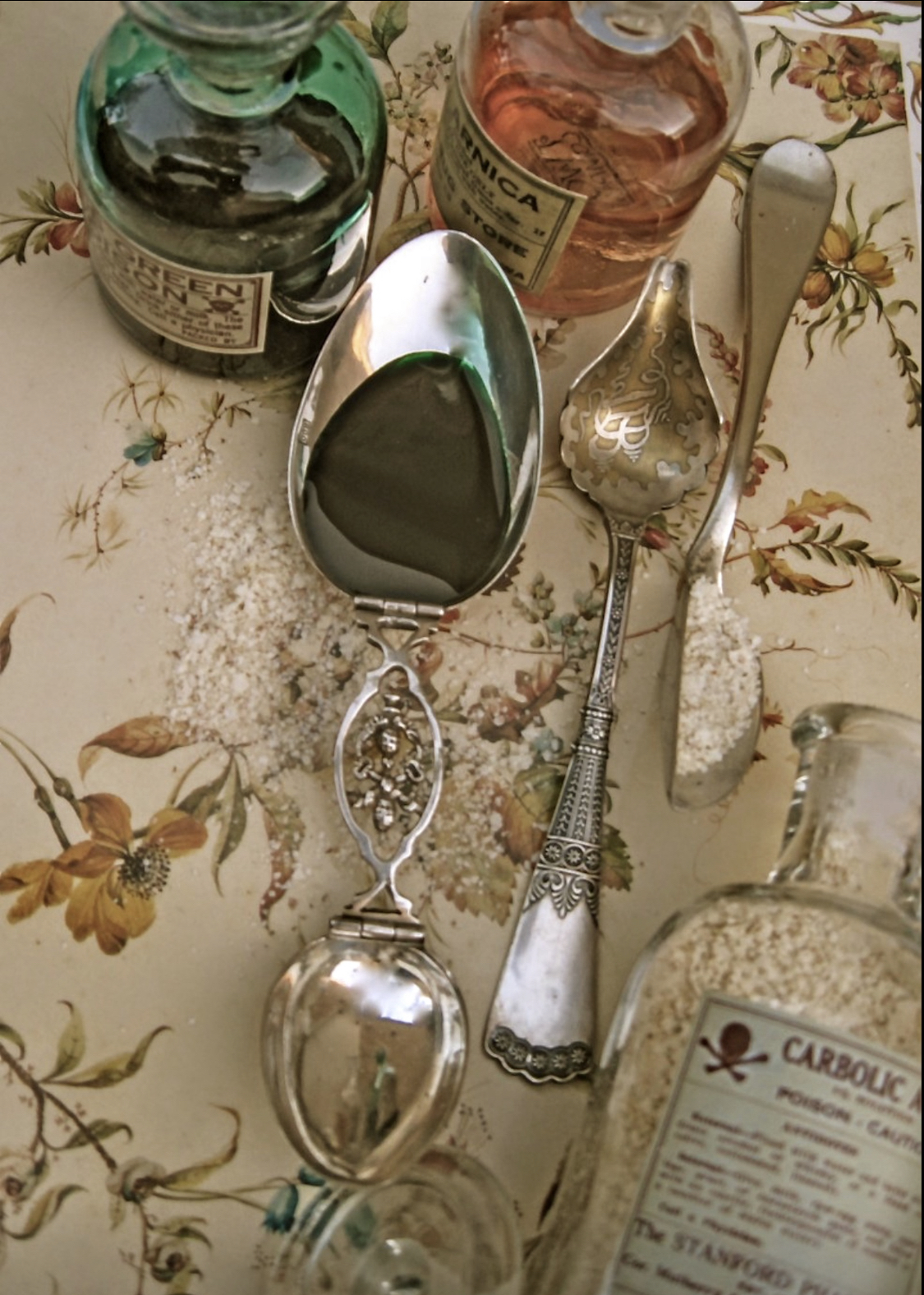
A folding doctor’s medicinal spoon, a pap spoon and a half teaspoon measuring spoon.— A doctor once told me that if women in the home wanted to learn but one branch of nursing and wanted that to be the most helpful it should be this matter of manner and professional etiquette.

“If there be a regal solitude it is the sick bed. How the patient lords it there!”— Charles Lamb

One of the best things about a good trained nurse is her manner, and it for that alone that a doctor sometimes requests the services of a nurse, when some member of the patient’s family might be perfectly to read thermometers, competent to keep charts and otherwise attend to the bodily wants of the patient. But the nurse's professional manner does much to soothe the nerves of the sick person and it does quite as much to expedite the doctor’s calls, and to accomplish what would be impossible to accomplish without the protection of the nurse's manner.

A doctor once told me that if women in the home wanted to learn but one branch of nursing and wanted that to be the most helpful it should be this matter of manner and professional etiquette. As a matter of fact few women do the right thing at the right time when the doctor comes. There is nothing that a doctor dreads so much, outside of a relapse or a weak heart, as an anxious mother with a taste for recounting anecdotes— long drawn out anecdotes that begin when the doctor enters the house and extend through his visit and then follow him down the stairs and keep him standing there hat in hand for whole minutes at a time till she brings the tale to completion. Then, of course, there are the deluded women who like to cheer the doctor on with a piece of fresh cake or some doughnuts.

There are times, however, when it is extremely considerate to provide some sort of refreshments for the doctor. If he has been watching some sort of refreshments for the doctor. If he has been watching through a long night of sickness it would be inconsiderate not to think of his hunger. Then it is courteous to prepare a dish of bouillon with bread and butter sandwiches, or a cup of coffee or tea and bring it to the doctor on a tray. If you ask him beforehand, do not ask him whether he will have it. Rather say some- thing like this: “I am sending up a tray for you. You are surely faint. Do you prefer bouillon, tea or coffee?—all are in readiness.”

It is in extremely bad form— in fact the worst offense against the etiquette of the sickroom for members of the family to remain in the room after the doctor has come. One member of the family, who is acting as nurse only, should remain during the visit, but she should make no uninvited comments on the patient, and it is considerate to leave the doctor alone within the patient’s hearing, if only for a minute or so, as many sick persons have some usually fanciful, confidences to make to the doctor. There is something about the room that worries them and they are unwilling to tell the faithful mother or sister who is nursing them, relying on his tact to have the change made without giving offense. — By Marshall Duffee, 1918


 🍽️Etiquette Enthusiast, Maura J. Graber, is the Site Editor for the Etiquipedia© Etiquette Encyclopedia 

Friday, December 2, 2022

Ocean Etiquette

War workers and the men in the expeditionary forces were transported under such very different circumstances from those of pleasure travel that as far as the small points of manners go it was an entirely different proposition.


Good breathing is the result of much good sense.— Chesterfield

IT IS so many months since Americans have taken trips for pleasure that we must brush up a little on the question of the etiquette of ocean travel. War workers and the men in the expeditionary forces were transported under such very different circumstances from those of pleasure travel that as far as the small points of manners go it was an entirely different proposition.

Under ordinary circumstances the woman ocean voyager has a good many letters to write during the first few hours of her voyage because it is considered only courteous for her to send off little notes of thanks to those who have sent flowers, books or other presents, by the mail that is taken off with the ship’s pilot. However, these letters need not be long... as surely no one would expect you to miss all the pleasure of being on deck during the first of your voyage in order that you might dwell at great length on your appreciation of their generosity. The question is sometimes asked whether it is in good form to use the stationery such as is provided by the ocean lines, or whether it is not better to use one’s own stationery. Good form seems to sanction the use of the ship’s stationery, and it is surely more interesting to those who received letters to have them on this paper.

Suppose you know no one on ship-board. Must you therefore keep to yourself because there is no way for you to have introductions to the other passengers? Certainly not. It is quite good form for you to begin with a courteous good morning addressed to those whom you meet at table or whom you pass every day on deck. At least by the second or third day out you would naturally start a conversation with the person seated next to you on deck and to resent any such friendliness on the par of others would indeed be unkind. If for any reason you wish to be left entirely to yourself you should make a special request that your steamer chair be placed in an isolated part of the deck.

It will then become apparent that you do not wish to mingle with the others and you will have no trouble in keeping by yourself. But by far the most agreeable thing is to accept the friendly advances of persons whom you meet and if they appear congenial there is no reason why you should not let the friendship progress quite as if you had had a formal introduction. — By Mary Marshall Duffee, 1922


 🍽️Etiquette Enthusiast, Maura J. Graber, is the Site Editor for the Etiquipedia© Etiquette Encyclopedia 


Thursday, December 1, 2022

Candy Etiquette

So if somebody opens a box of candy in your presence and passes it to you, you naturally take but one piece. If the possessor of the candy places it open on a table and says help yourself, you help yourself very charily.


THERE is really a very nicely balanced table of etiquette concerning candy. Of course, the keynote of it is not to be greedy and not to be selfish— that is, not to be greedy if the candy belongs to somebody else, and not to be selfish if it is yours.

That’s the whole case in a nutshell. So if somebody opens a box of candy in your presence and passes it to you, you naturally take but one piece. If the possessor of the candy places it open on a table and says help yourself, you help yourself very charily. One or two pieces more are all that you really would take without further invitation. For you to eat half the contents of the box, as some persons do, would be the height of rudeness.

And, on the other side of the question, if you have a box of candy you should generously open it and pass it to your guests. Candy is a passing joy, anyway, and if you keep the box unopened and eat it all yourself, you will quite likely suffer a headache for your selfish indiscretion.

If a young man brings a young woman a box of candy when he calls on her, it is customary for her to open it immediately, and pass it to him, and to anybody else who may be in the room. — By Mary Marshall Duffee, by McClure Newspaper Syndicate, –1922


🍽Etiquette Enthusiast, Maura J. Graber, is the Site Editor for the Etiquipedia© Etiquette Encyclopedia