Tuesday, December 17, 2024

Chuck-Wagon Etiquette


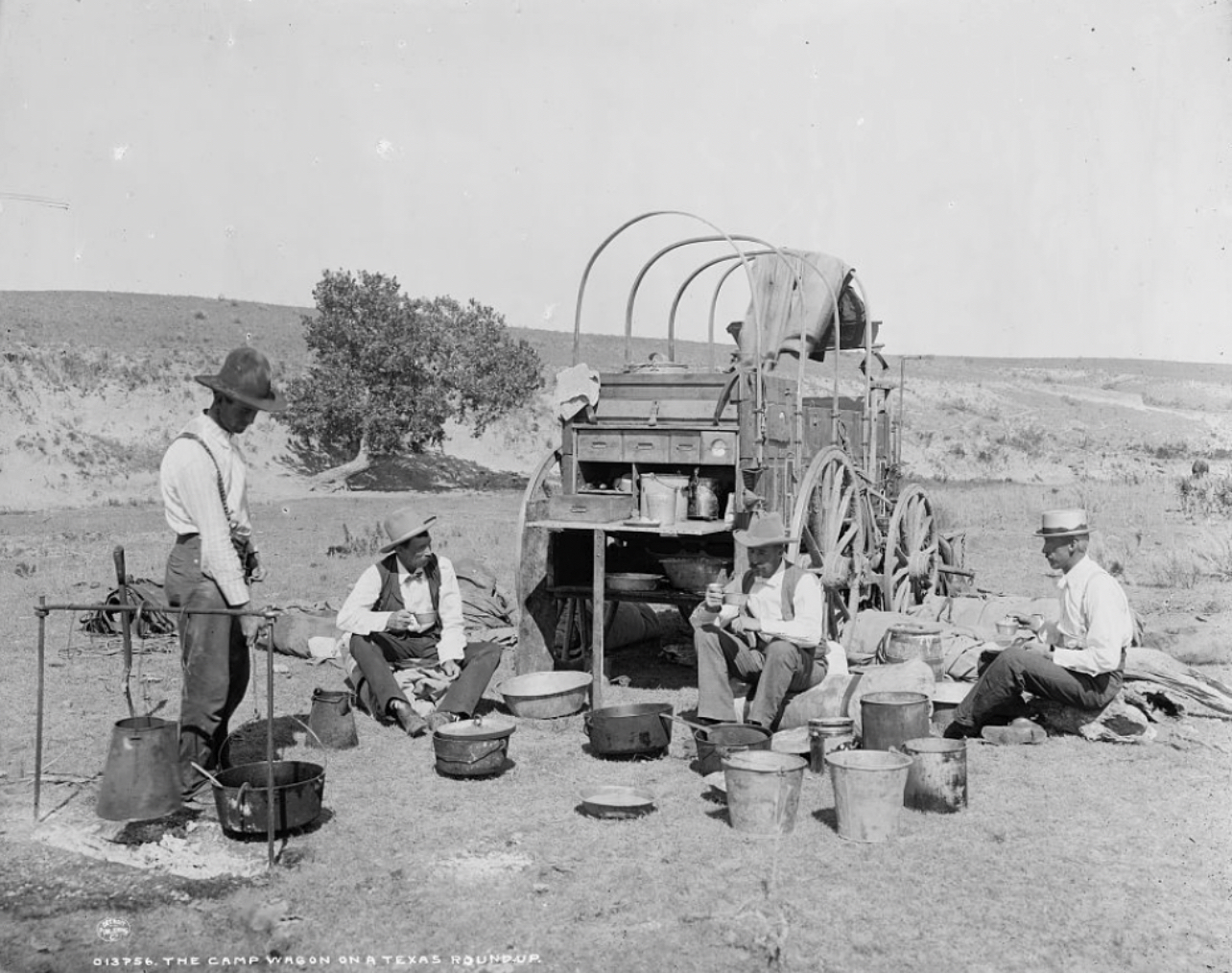
It's a serious breach of etiquette to fail to place dirty utensils in the “wreck pan,” the range name for dish-pan. And only an utter fool would ever complain about the food!— Public domain image of a chuckwagon from 1900

Pickup Truck Replaces Chuck-Wagon at Roundups

It doesn't take an iron-clad stomach, a hard day's work or lots of fresh air to enjoy food from an old fashioned chuck-wagon. On the high plains of eastern New Mexico, it's still the fashion.

Twice each year, spring and fall, most New Mexico ranches hold roundups. During those brief weeks of frenzied activity the most feared, most respected, least liked but most sought after men is the cook.

Most cooks these days use pickup trucks instead of the old fashioned chuckwagons. Some are even equipped with butane powered stoves and refrigerators. Running water comes from large tanks stored beneath the truck beds.

The menu? It's plain and simple:
  • Breakfast: Fried steak, stewed peaches or prunes, fried potatoes, biscuits or “hot rocks” and coffee.
  • Lunch: Beef sandwiches ог barbecue. canned peaches, beans and more coffee. 
  • Supper: Stew, consisting of choice beef cuts, potatoes, onions, canned tomatoes and seasoning; baked bread and still more coffee. With luck fresh peach or berry pie.

Baker's bread is called “gun wadding” at the roundup and is not popular. The cook who can whip up a batch of biscuits, slow baked in a Dutch oven over mesquite coals, is the man of the hour. Contrary to western lore, the pancake is seldom made. In the words of one cook, “they're too damn messy.”

The chuckwagon, pickup truck or cook tent is considered private property of the cook, and wranglers stick to their own ground. It's a serious breach of etiquette to fail to place dirty utensils in the “wreck pan,” the range name for dish-pan. And only an utter fool would ever complain about the food!

Cooks go under various titles. The printables are coozie, cookie, dough wrangler, biscuit shooter, belly cheater, Sally, the old woman, grease puncher and pot slinger. Canned goods are called “air tights;” sugar or molasses are both called “lick.” Knives and forks are called “artillery.”

At the end of the roundup the cooks generally drift back to their cafe and side order cooking jobs in nearby towns. Few ranches these days employ large enough crews all year long to keep a steady cook. — Santa Fe, N.M. (UPI) , 1964


🍽Etiquette Enthusiast, Maura J. Graber, is the Site Editor for the Etiquipedia© Etiquette Encyclopedia

Monday, December 16, 2024

Worlds Apart

Empty subway car seats in Hong Kong in 2018

Hong Kong & Mainland China…

Found to be Worlds Apart

Here I am, standing in a crowded van-bus full of people who don’t know even one word of English. There are little kids staring at me along with a few people wearing U.S. Army uniforms. On this particular bus, some of the people are not even speaking Mandarin but some sort of local dialect. Imagine a bus full of Chinese farmers and me. In this place, I was not just Sean the UC Davis student, I was ambassador of a whole different world. I’m from a world of McDonald’s, the Internet, private cars, movies, TV, video-games and fancy schools. 

The world of the Chinese countryside is much different from the Chinese metropolitan cities. Here it is rare to find a person with a private car. Taxis almost don’t exist outside of larger cities, and the normal Western food chains are all absent. It is a slower-paced world, and many people can be seen just taking their time walking around the streets or sitting on some empty steps, Students wearing colorful uniforms are racing around on bicycles, and small shops are selling produce instead of clothes or knockoff watches. However there is one thing I have found consistent no matter where I am in mainland China: The people are all so friendly and so willing to help. And they are always very surprised if you can speak a few words of Mandarin — even badly. Traveling to mainland China has once again renewed my interest in learning Mandarin. 

Cantonese, as is spoken here in Hong Kong, is also interesting, but it is so much harder to learn with the nine tones (most locals can’t make all nine). The locals are not as willing to help you speak it and are not very patient if you speak it badly. Plus, I always think Cantonese people sound angry when they talk. Cantonese is a very limited-use language, while Mandarin is spoken by countless millions of Chinese. 

On the way back to Hong Kong I made a quick stop in Shenzhen, a city on mainland China just across the border of Hong Kong. Since the subway is new there, I decided to give it a try. On my particular trip I saw men lying down on the bench seats, taking up three or four spaces while others, most likely from Hong Kong, were getting annoyed. There were many empty seats, but no one seemed to be particularly interested in sitting. Since this is a new subway, maybe the “rules of etiquette” are not yet totally established, but in Hong Kong they clearly are. 

On the Hong Kong subway system people generally move about at a normal to lazy pace on the escalators, in the gate areas, or wait on the platform. However, when you get to an interchange station, something totally different happens. It is easy to tell when an interchange station is coming up; all the people on board who had previously been maneuvering for the best seats now totally shift their attention to being the first one to the doors that will soon open. Then there is a mad rush. Everyone is like a racehorse out of the gate, and people literally run across from the one train to the other. The goal is to be the first to the new train and once again get the best seat. However, as soon as you get to the seat, it seems you have to stand in front of it, stretch a little, act like you don’t really want it, and then slowly sit. 

So it seems mainland China and Hong Kong are very different worlds; the people look the same but that is about where it ends. The food is very different, the language is different, the actions are different and the way of thinking is different. I personally like both places, and I always feel at ease when in mainland China. — By S. Donohoe for California Aggie, 2006


🍽Etiquette Enthusiast, Maura J. Graber, is the Site Editor for the Etiquipedia© Etiquette Encyclopedia 

Sunday, December 15, 2024

Charm School for WAFs

Throughout WWII, American women worked in a tremendous variety of fields in which women had never worked before. Joining the ranks of the WAFS or other military services took women out of offices and placed them in some dangerous situations. By 1951, it was determined that women were part of the military to stay. Adding etiquette and social skills training was one way to boost recruitment.

WAFs Got the Word On Personality, Poise


Join the air force, lady, and learn about poise, confidence and personal appearance. Experts will teach you. Classes in personal appearance have been added to the training schedules for WAFs at sprawling Lackland air force base here.

“Women, especially those in uniform, can be just as dainty. feminine and carefully groomed as ever,” explained Robert L. Detchemendy, head of the Personal Appearance Department at Stephens College, Columbia, Mo. Detchemendy spent a week at Lackland lecturing, demonstrating and organizing the courses.

Individual styling of hair and skin grooming are part of the courses. Cleanliness, wholesomeness and neatness are stressed. Posture and etiquette are treated extensively. Points are given on diet, as an aid to naturally attractive complexion and to sports and exercise as aids to maintaining a trim figure. — San Antonio, Texas (AP), 1951


🍽Etiquette Enthusiast, Maura J. Graber, is the Site Editor for the Etiquipedia© Etiquette Encyclopedia

Saturday, December 14, 2024

Elizabeth II Chafed at Royal Etiquette

  A timely 2nd Debut article from 2016

Queen Elizabeth and the Duke of Edinburgh at the opening of Parliament in 1952

Elizabeth & Consort, Chafe At 

Rituals Of Royalty

Queen Elizabeth and the Duke of Edinburgh, as young folks might be expected to do, are chaffing a bit these days at the stupendous ritual and custom that hedges them around in the royal court. Wise courtiers say nothing and wait for the irritation to subside, as they know it will in the course of time. It always has.

Modernization of court proceedings is always in progress but it moves slowly. There are certain to be changes during the anticipated long reign of Elizabeth II, but nothing as dramatic as some of the sensational press are now demanding.

For one thing, it is obvious that pressure on the Queen, if the buffering army of functionaries were removed or cut radically, would be greater than it is under the present system. Thus, cutting away too much red tape would expose the Queen to the very evil from which her self-appointed saviors seek to rescue her.

The court of St. James is a very old court, and, in a county where tradition is venerated as nowhere else, there is a reluctance to drop customs for any reason whatsoever. It is quite true that there are servants in the royal households who have servants to wait upon them. But it has always been that way, and, despite the unionization of the palace help, there might be considerable unrest if this were changed.

It comes down to a question of whether the nation wants a court or doesn't want one. And Elizabeth is known to love the pomp, the panoply, the ceremonial which blazes about the British throne.

The royal household is an immense establishment. There are eleven private secretaries and assistants to the sovereign. There are 23 officials in the privy purse, treasury and royal charities office. There are 36 royal chaplains. There are 20 physicians and surgeons and a special coroner. And many others.

Before Queen Mary's time there were even greater numbers of royal courtiers, but the redoubtable old lady - as other queens before her - chopped away a few of the jobs. And her granddaughter, Elizabeth, will doubtless whittle away a few more.

By court etiquette, Elizabeth must not do anything directly. She can give orders to her private secretary, to her ladies of the bed-chamber or ladies in waiting, to her principal advisers and these, in turn, relay her orders to the lower echelons.

This has irked the Duke of Edinburgh more than any single rule of the palaces, and he has broken it more than once by strolling down corridors asking the desired information or giving orders in person. Queen Elizabeth is expected to shorten the chain of command down the line from the throne as her contribution to the streamlining of etiquette.

Another windmill at which the critics are tilting is the strict procedure for public engagements. The newspapers contend that the Queen should not be tied up a year ahead to visits such as the one to New Zealand. The implication is that these things ought to be spun-of-the-moment affairs quickly accomplished by plane instead of great processions by sea with public interest drummed up over a period of time.

This is a rather naive approach. New Zealand will invest a fortune in the Queen's visit and it may well be the event of the year there. Security has to be considered. Shops will get ready for extra business. New Zealanders from out-country may want to arrange to be at the points visited by the Queen. She will open playgrounds, lay cornerstones, attend ceremonials, make speeches. – (LONDON (U.P.) 21 January 1953


🍽Etiquette Enthusiast, Maura J. Graber, is the Site Editor for the Etiquipedia© Etiquette Encyclopedia

Friday, December 13, 2024

Post vs. Vanderbilt on 1950s Etiquette

Emily Post felt that employers may be embarrassed if a pregnant woman was working him an office. Amy Vanderbilt strongly disagreed. Lucile Ball broke a barrier on her hit television show by showing herself pregnant on screen in 1952. According to ScreenRant.com, “As one of the first hit TV series, I Love Lucy had to tread the murky waters in establishing what networks, censors, and audiences would and wouldn't accept on TV.  When Lucille Ball, the actress who played lead character Lucy Ricardo, got pregnant, the series had to figure out how to handle an expectant mother on TV. Luckily for the network, Ball was married to co-star Desi Arnaz, who played her TV husband Ricky Ricardo, meaning that there was little scandal with the actress being pregnant, only how to present it to viewers. The major problem that CBS had with the pregnancy was not the state of Lucy, but with the word pregnancy itself. Noted as a medical and indecent word, CBS refused to allow the word to be spoken on screen. Dancing around the facts for the whole episode, and even using the French word for pregnancy, "Enceinte" in the title, in the last moments of the episode Lucy tricked her husband into figuring out that they were in the family way. 55 years later, ‘Knocked Up’ premiered. We've come a long way.”– Image source, Pinterest

To the Ladies: From the Editor

Emily Post, arbiter of etiquette, lays down the rule: “If a pregnant woman works in a small office she can stay at work, provided it does not embarrass her employer. But in a large office, she should leave when her condition becomes obvious.”

Amy Vanderbilt, another authority on etiquette, who says that she herself worked in a big office until six weeks before the birth of her second son, disagrees, contending that “this is a completely accepted thing to-day.”

The turning point so far as etiquette is concerned, Amy Vanderbilt says, was during World War II, when women were desperately needed in their jobs.

Obstetricians, according to the New York Times, “are all but unanimous in praise of the trend. There is nothing harmful about a pregnant woman working, they say, provided she feels comfortable about it.”

The main problem, it seems, in many cases is transportation to and from work. In crowded buses and streetcars women have found that there is not a vast number of cavaliers who will offer a seat to a pregnant woman.

One woman who worked until three days before delivery reported that other women occasionally gave their seat. But male travelers: “Never!” Guess Mothers’ Day, like Christmas, comes only once a year – The East Bay Labor Journal, 1958

🍽Etiquette Enthusiast, Maura J. Graber, is the Site Editor for the Etiquipedia© Etiquette Encyclopedia

Thursday, December 12, 2024

1950s Office Etiquette and Social Rules

“Mopsy” explaining her office etiquette for when the wife of her boss dropped by.  Mopsy was a comic  strip by Gladys Parker, who was said to have created the character after herself and her mop-like head of hair. Parker was one of just a few female cartoonists of her era. The strip's run was over three decades, from its inception in 1937 through the 1960s.  

Q. & A. With Amy Vanderbilt…
Special Social Rules Apply In Business Office Conduct
Does business etiquette differ from social etiquette in regard to a gentleman's treatment of a lady? Yes, in many cases it does.

A subordinate woman employee, for example, usually rises if a top male executive approaches her desk to give her some instructions. She does not do this for her immediate superior, as it would mean she would be jumping up and down all the time. She rises for a superior woman executive, too, under the same circumstances – that is, if her desk is visited by a superior with whom she is not in constant contact. And she rises for an important client or customer of the firm to whom she is introduced, whether male or female.

Following is a question on office etiquette:
 
“Dear Miss Vanderbilt: I am a secretary who works for two men. We all work in one office. Is it correct for my bosses to introduce me to an outside visitor? 
Recently we had a visitor from England who spent an afternoon with my bosses. He sat no more than three or four feet away from me I felt embarrassed at not being introduced, particularly when they left the room and I was alone with him. What do you think? -JM, Detroit, Mich.”

You should have been introduced to him. In a case like this, which concerns business, a subordinate woman worker is introduced to a male superior. Socially, of course, a man is always introduced to a woman. – By Amy Vanderbilt, November 1954

🍽Etiquette Enthusiast, Maura J. Graber, is the Site Editor for the Etiquipedia© Etiquette Encyclopedia
Wednesday, December 11, 2024

Gilded Age Etiquette of Audiences

In 1896, a question of the etiquette of audiences arose in New York…

A question of the etiquette of audiences arose once in New York when the Symphony society’s concert was given. Mr. Joseffy played the second Brahms concerto, which threw the audience into a state of intense enthusiasm. He was called out a dozen times, and yet the audience persisted in its applause. Finally Mr. Damrosch, the conductor, made as if to proceed with the programme, but the audience kept up their applause. Mr. Damrosch waved his baton and began the next number. The sounds of the orchestra were drowned, however, by the noise of the audience. Mr. Damrosch then rapped sharply upon his desk, and the musicians and the audience both became silent. He turned to the audience and gave them a sharp rebuke for the manner in which they had conducted themselves, saying to them that to ask a pianist, no matter how much he might have pleased them, to add to his exhausting labors after playing such a concerto was neither an appreciation of his art nor an evidence of good manners. The audience very sensibly accepted the rebuke, and the performance went on. – The Hanford Journal, 1896


🍽Etiquette Enthusiast, Maura J. Graber, is the Site Editor for the Etiquipedia© Etiquette Encyclopedia

Tuesday, December 10, 2024

1960’s “Sidewalk Santa” Etiquette

Kris Kringle has to be a model of diplomacy. One cardinal rule forbids the Santas from promising children they will get the gifts they ask for. But at the same time, Santa must send the youngsters away “hopeful and happy.”

Sidewalk Santas Need More Than “Ho-Ho-Ho!”

It takes more than an ability to voice a hearty “Merry Christmas, ho-ho-ho” to make a good sidewalk Santa Claus, according to the Volunteers of America. The 2,000 Santas on duty across the United States for the Volunteers, also must master rigid rules of sidewalk etiquette.

The Kris Kringles attend special schools where they are taught the “do’s and don’ts” of their profession before they can receive their red costumes, white beards and chimneys.

The Schools for Santas are directed by Col. John Ford, National social welfare organization, who said “it’s vital that Santa is exemplary. We insist that our Sidewalk Santas not only are courteous, but live up to what children have been told by their parents,” Ford said.

Kris Kringle has to be a model of diplomacy. One cardinal rule forbids the Santas from promising children they will get the gifts they ask for. But at the same time, Santa must send the youngsters away “hopeful and happy.” Other rules formulated by the Volunteers of America for its Santas cover the range from sweet breath to sweet disposition.

“Keep your breath clean avoid eating garlic or onions and do not eat, drink or smoke while on duty.” is one of the basic commandments. The Santas also are advised to be courteous and pleasant at all times, to avoid arguments or disputes and to avoid obstructing traffic.

Most of the Sidewalk Santas are older men. Some have themselves been rehabilitated by the Volunteers of America in the program supported by funds collected during the Christmas season. But the campaigns, which date. back to 1901, play a much bigger role.

They provide free Thanksgiving and Christmas dinners to thousands of homeless individuals and needy families in cities across the nation and holiday baskets of food, fuel and toys to families. The funds collected in the chimneys also help support the Volunteer's year round social welfare program. – New York (UPI), 1961


🍽Etiquette Enthusiast, Maura J. Graber, is the Site Editor for the Etiquipedia© Etiquette Encyclopedia