Saturday, March 8, 2025

19th C. Etiquette of the Dutch Sexes

Picturesque Holland : newly wedded couples returning from church at Edam.

Dutch Etiquette of Ladies and Gentlemen 
in Holland of 1884:
Ungallant Street Manners of the Men… An Engaged Couple... Woman at Home…


The Dutchwoman lives in constant fear of insult; and when she is out on the street she acts as if she was afraid that her ursine brothers were going to bite, paw or hug her. Not that the men are dangerous, for rarely it is heard that the bears have bitten. Look out on the street and you will see that the ladies walk in the road and the gentle- men on the sidewalk. Always so, no matter how muddy or dusty the road is, or how many teams are passing. Watch them, and you cannot help but notice that the gentlemen and ladies never speak to each other on the street. That would be a breach of etiquette that society would hardly pardon. Even when a man meets his wife he is not permitted to ask what he shall bring home for dinner! 

The gentleman bows first. the same as in France, and a lady may have bows from any number of men whose names she does not even know. And the bowing is a marvel! The forehead almost touches the kees in the act, and there is no half-way work about it-no nodding or a sweeping touch of the hat, but an entire removal of the hat to supplement that intense bow. Everybody bows, then take off their hats to one another and profoundly bow. 

Your friend's coachman or lackey does the same toward you as his master does, and the servants are just as polite to each other. A lady is bowed to by all the friends of her father, husband or brother; and your housemaid's friends as well. Every man bows to the house of his lady acquaintance when he passes; bows, smiles, and raises his hat, no matter whether the ladies are visible or not. They return the bow with an over- polite bend of the whole body.

If a lady, alone or accompanied by other ladies, must needs enter a con- fectionery, a library or other place where men will naturally go, and finds a gentleman or two there, she will re- tire as precipitately as if she had seen a case of small-pox. The men know this, but unless my lord, the man, has quite finished his business he will not retire. The lady retreats in a most undignified manner, and the human bear finishes. his book or his chocolate, even though the lady is waiting at the door for him to leave.

As soon as a young lady becomes engaged she has to take the young man around to call on all of her friends, sweetly introducing him to all as her promised husband. After that they pay visits together like a married couple, with the difference that unlike man and wife they sit hand-in-hand, and speak with the utmost pride of their engagement. A hug or a kiss are very common in those days of courtship; but when marriage comes the two are as stiff to each other in company as strangers would be, and they address each other in company as strangers. would, and they address each other as mynheer and meyrouw.

But a change comes over the woman at home. No longer is she the afraid body of the street. She has at hand the kettle of hot water, the flat irons and the other articles of defense that a woman can use if necessary, and no longer does she fear the bears. She is quite “at home.” She does not put herself to any trouble for the sake of her guests. In the morning she never dresses for breakfast, but comes to the table en demi-toilet, her hair on the crimping pins, a calico gown loosely buttoned over skirts by no means new, with no collar, her shoes unbuttoned and frequently without stockings. After breakfast it is quite a while before she gets dressed, and meantime if she receives callers she goes into the parlor in her breakfast toilet.– 
Springfield Republican, April 1884


 🍽️Etiquette Enthusiast, Maura J. Graber, is the Site Editor for the Etiquipedia© Etiquette Encyclopedia

Friday, March 7, 2025

The Etiquette of Dinner Service Styles

Butler Service or Service à la Française (“French Service”) a diner helps himself from a serving plate held by the waiter or the butler. Traditionally, this type of service was used on Sunday evenings, when the wait staff had the evening off and the butler helped serve the dinner.

A 2nd Debut Article from 2019

Silver Service (in British English) or Service à l’Anglaise (French for “English Service”) is a method of serving food that normally will include serving food at the table. It is a method of transferring food from the service dish to a guest's plate from the left. It is performed by a waiter by using service forks and spoons from a diner’s left hand side.

Butler Service or Service à la Française (“French Service”) a diner helps himself from a serving plate held by the waiter or the butler. Traditionally, this type of service was used on Sunday evenings, when the wait staff had the evening off and the butler helped serve the dinner.

Russian Service or Service à la Russe, is at once the simplest and most elegant manner when guests are present, as it is only necessary to pass the dishes of each course in rotation, beginning alternately at the right and the left of the guest.

Buffet Service is when the food is placed and displayed on a separate table or sideboard, in a public area, from which diners help serve themselves to the food, before being seated at a dining table to eat. “Buffet Service” comes from the least humble of beginnings in 18th century Europe, when chefs and confectioners wanted to impress those coming to balls and parties in grand homes, upon their arrival. Foods designed to impress were laid out for guests to feast their eyes on, prior to dining. 

Family Service dining, also known as “Homestyle Service” or “Casual Service” is the least formal style of dining.  Popular in private homes worldwide, food is placed on the table in large serving dishes from which diners serve themselves. — Compiled from numerous articles on the Etiquipedia Etiquette Encyclopedia

🍽Etiquette Enthusiast, Maura J. Graber of The RSVP Institute of Etiquette, is the Site Editor for the Etiquipedia© Etiquette Encyclopedia

Thursday, March 6, 2025

How One 1922 Glutton Ate Breakfast

What Have We Here? — A “Shredded-Wheat dish” made by George Jones & Sons in the 1930's. The dish features a blue and white scene of an Abby with a stonewall, large gateway and arched windows and garden landscape on a white background. It is approx. 7-1/4" long by 6-1/2" across by 1-1/2" deep. Marked on the bottom is “Shredded Wheat Dish Abbey, 1790, Geo. Jones & Sons, England” – By the 1930’s, ready-to-eat breakfast cereals were well ingrained in American, and even British, societies after being developed and cleverly marketed as the healthiest way to start one’s day, by William Kellogg and then Charles Post, among others, in the late 19th and early 20th centuries.

DISDAINED KNIFE AND FORK

“Swell” Fooled Both Men Who Made Bets as to His Manner of Eating Breakfast

Tex Rickard said to a group of correspondents the other day:

“It isn't only scrappers that make bad mistakes in etiquette. I was eating breakfast in one of the swell New York restaurants one morning when a fat man came in.

“‘He's one of the biggest swells in the town,’ says my friend. Watch him.

“The fat man he was dressed like a prince - ordered two portions of ham and eggs, two of country sausage, two of buckwheat cakes and maple sirup, and, along with all that, mush and milk, lamb chops, liver and bacon, fried potatoes, oatmeal and corned beef hash.

"All these things were brought to him together, and he dumped them into a big soup dish and proceeded to cut them up and mix them round well.

“‘Hanged if that ain't the worst sight I've ever seen,’ I said to my friend. ‘I'll bet you three to one, George, he eats it with his knife.’

“‘No, no.’ says George. ‘He's a big swell, I tell you. I bet he eats it with his fork.’

Mr. Rickard shook his head gloomily.

“We both lost,” he said. “He ate it with a ladle.” – Trinity Journal, 4 March, 1922 


 🍽️Etiquette Enthusiast, Maura J. Graber, is the Site Editor for the Etiquipedia© Etiquette Encyclopedia 

Wednesday, March 5, 2025

Gilded Age Practices in Polite Society

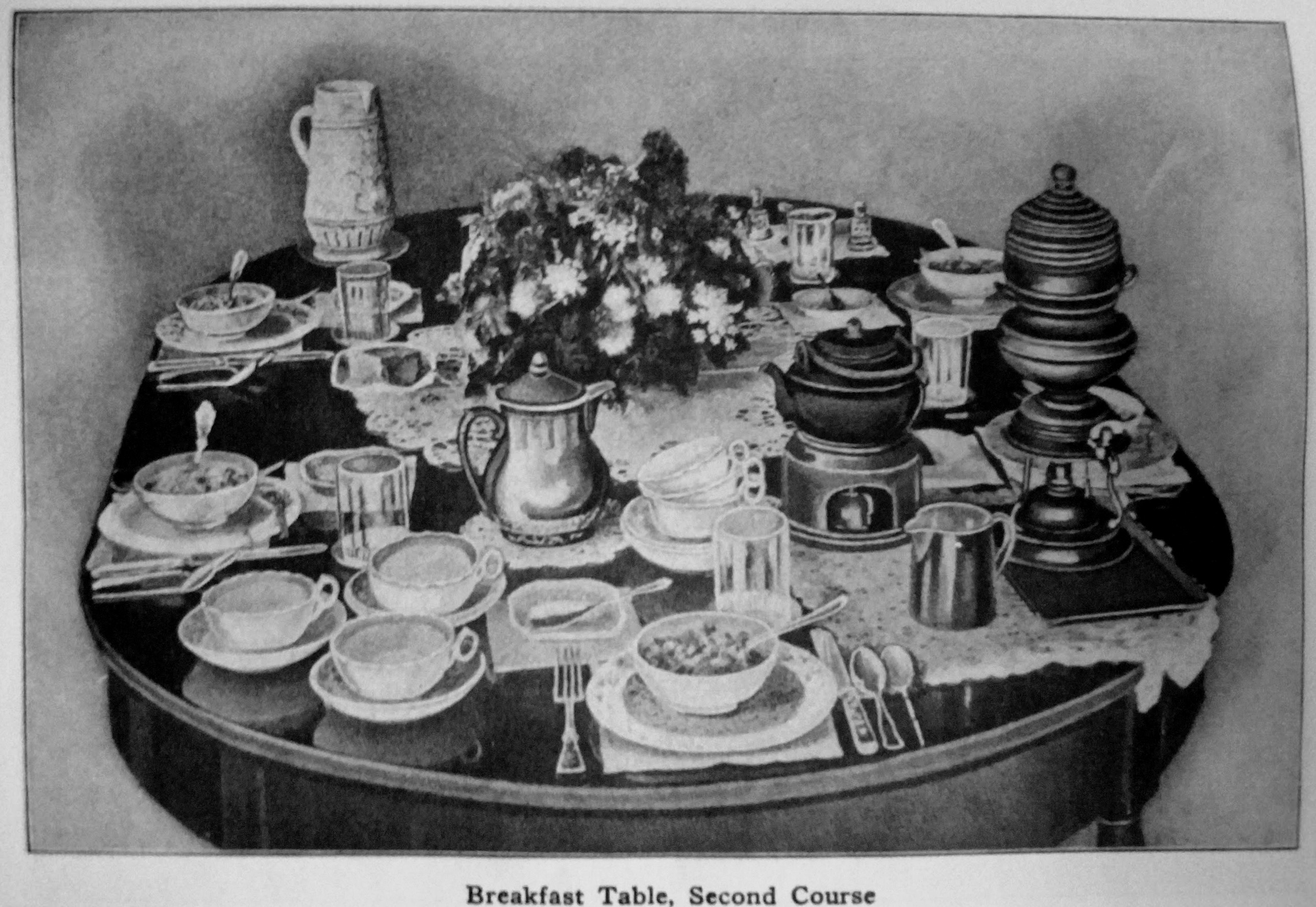
A Gilded Age Table set for the second course of a breakfast. – The American breakfast is all placed upon the table, unless oatmeal or other porridge are to be served as a third course. Changes of plates are also necessary when cakes requiring syrup are served, or when fruit is served.


Manners and Social Usages Practiced in Polite Society

It is at the present time a pleasant custom for a bride to announce with her wedding cards one or more reception days during the season after her marriage on which her friends can call upon her. The certainty of finding a bride at home is very pleasing. On the occasion of these receptions she should not wear her wedding, dress, but receive as if she had entered society as one of its members. The wedding accessories are all put away, and she wears any handsome reception dress she chooses. 

As regards a bride wearing her wedding dress to balls or dinners after her marriage, it is perfectly correct to do so, provided she divests herself of the veil and the orange blossoms.

Over Supply is Not Hospitality

Never overload a plate nor over supply a table. It is a vulgar hospitality. At a small dinner no one should hesitate to ask for more if he desires it. It will only be considered a flattering tribute to the dish. At large companies, where there is necessarily a greater variety of dishes, the most voracious appetite must be satisfied with a little of each. 

The French understand better than the people of any other nation how to supply a table. Their small family dinners are gems of perfection. There is plenty for every person, yet every morsel is eaten. The flowers or plants are fresh and odoriferous; the linen is a marvel of whiteness: the dishes are few, but perfect of their kind.

Writing Notes

The writer of notes ought to carefully discriminate between the familiar note and the note of ceremony, and consequently should learn how to write both. Custom demands that all notes written in the first person should begin with “My Dear Mrs. Smith,” and close with the expression “Yours cordially,” “Yours with regards,” etc… 

The laws of etiquette do not permit the use of numerals, as 1, 2, 3, but demand that one, two, three be written out in full. Abbreviations are considered inelegant.

A common mistake much indulged in by beginners is the confusion of the first and third persons. A note in answer to an invitation should be written in the third person, if the invitation was expressed in the third person. Formal notes are usually thus written. It is not considered good forin to write a note on ruled paper.

Breakfast at Home and Abroad

In France the first breakfast consists merely of a cup of coffee and a roll, with sometimes a little fruit. A second breakfast, at 11 o'clock, is more substantial, dishes being served which may be eaten with a fork. 

In England breakfast is a very informal meal, the breakfast hour being at any time one chances to be ready for it. The substantial dishes are served from the sideboard, where they are kept hot in chafing dishes. 

The American breakfast is all placed upon the table, unless oatmeal or other porridge are to be served as a third course. Changes of plates are also necessary when cakes requiring syrup are served, or when fruit is served. – Riverside Enterprise, 1891


🍽️Etiquette Enthusiast, Maura J. Graber, is the Site Editor for the Etiquipedia© Etiquette Encyclopedia 
Tuesday, March 4, 2025

Gilded Age Social Etiquette

After a lady is married her acquaintances should soon call upon her.

Calls Which Courtesy Demands Should Be Made Promptly

“First calls should always be promptly returned; that is, within seven days,” says a New York woman of society and fashion, in a useful little treatise on manners. “If a first call is immediately followed by an invitation to some entertainment, the call should be returned at once and not delayed until after the entertainment. After the entertainment a second call should be made.

“The recipient of any special hospitality, such as a dinner, luncheon, breakfast, dance, etc..., should call thereafter as soon as possible. After having been invited to visit in a country house, a call should be made upon those extending the invitation immediately after their return to the town residence. After a lady is married her acquaintances should soon call upon her.” – Riverside Enterprise, 28 February 1891


🍽️Etiquette Enthusiast, Maura J. Graber, is the Site Editor for the Etiquipedia© Etiquette Encyclopedia 

Monday, March 3, 2025

The Art of Wine Tasting

Don’t drink too much of one wine. Mix up your tasting pattern to include wine you normally do not buy. Napa is a place to experiment with new wines and different wineries.

The Etiquette of Wine Tasting

Picture this scenario in any four-star restaurant. You and your party of six are seated at your table and the waiter passes out the menus. He then deposits the wine list in your hands. The list looks like a telephone book from Chicago. When you open it, total confusion rears its head. Where do you start? What goes with the dinner you and your guests are going to have tonight? What wine goes with fish and beef?

Here are your choices: 
  • Panic
  • Fake it
  • Ask for help
  • Drink the house wine
  • Promise yourself you will try to learn more about wine before this happens again 
However you handle the choices of 1 through 4, option 5 can be satisfied at Napa Valley.

IS THERE AN ART TO WINE TASTING?

The simple answer to this question is no, but here are some recommendations on how to make your tasting more fun and memorable. Evan Goldstein, director of the Sterling Vineyards School of Service and Hospitality, offers these suggestions:

1. Don't drink too much of one wine. Mix up your tasting pattern to include wine you normally do not buy. Napa is a place to experiment with new wines and different wineries.

2. Experiment by tasting different foods with one wine. This will help you explore how different wines and foods mix, complement or contrast each other.

3. Ask the winery personnel questions about the wines they are pouring. These trained personnel can give you great tips how their wine is priced, what foods it is best paired with, and what characteristics are common in the winery’s other wines.

4. Compare two different wineries on the same wine at the same time (Pinot Noir vs. Pinor Noir). This direct comparison tasting shows you the differences in winemaking styles. Sometimes it's subtle and sometimes it's dramatic.

5. Take simple notes on what you tasted. Finding great wines at Napa Valley is easy, trying to remember them may be more difficult. With your simple notes you can purchase these wines with confidence in a restaurant or in the grocery store. – From an article for the Napa Valley Register, 1992


🍽️Etiquette Enthusiast, Maura J. Graber, is the Site Editor for the Etiquipedia© Etiquette Encyclopedia  

Sunday, March 2, 2025

Dog Ownership Etiquette of 1901

Dogs must be kept upon the owners’ premises, unless accompanied by the owner or some member of the family.

THE RESPONSIBILITY OF OWNING A DOG

1. Dogs must be kept upon the owners’ premises, unless accompanied by the owner or some member of the family.

2. If a dog annoys travelers upon the public highway by scaring horses and frightening children, the owner is responsible for damages.

3. The owner of a dog is responsible for damages caused by his dog trespassing upon the public highway in running after teams or doing other damages.

4. If a dog not accompanied by its owner annoys travelers upon the public highway, he may be killed, without any claim of damages on the part of the owner of the dog. When a dog becomes a nuisance he may be killed anywhere except on the owner’s premises.

5. If a dog kills sheep or destroys or injures any other domestic animals, the owner is responsible for damages.

6. Every owner of a savage and dangerous dog must keep him properly chained or otherwise secured that no injury may to done to others.

7. If a person on a social or business errand is bitten or otherwise injured by a savage dog on the premises of the owner, the owner is responsible. Dangerous animals are not permitted to run at large, even on the owner’s own premises, unless he has sufficient safeguards to protect his neighbors against injury.–From “The Busy Man’s Friend”, 1901


🍽️Etiquette Enthusiast, Maura J. Graber, is the Site Editor for the Etiquipedia© Etiquette Encyclopedia 

Saturday, March 1, 2025

Spotlight on Elena Gavrilina-Fujiyama


Meet our Contributor in the Spotlight for March 2025, Elena Gavrilina-Fujiyama

Elena is a specialist in Japanese protocol and etiquette, and European social etiquette. The founder of the project Etiquette748, Elena is also a member of the National Association Specialist of Protocol. She authored the best-selling book “Japanese Etiquette: Ancient Traditions and Modern Rules” after living in Japan for over 20 years.


Below are links to Elena Gavrilina-Fujiyama’s articles on etiquette which you’ll find on Etiquipedia:

The following is a Q. & A. with Elena Gavrilina-Fujiyama:

What was the impetus for starting your Etiquette business or career involving Etiquette?

I have always been interested in the traditions of different countries, especially in the East. While working at the Institute of Asian and African Countries of Moscow State University (named after M.V. Lomonosov), I was lucky enough to take part in the organization of international conferences and meetings, as well as participating in international conferences and internships in Kazakhstan, Uzbekistan, China and Japan. It was from studying the history and culture of Eastern countries that my interest in the rules of Eastern etiquette began, which ultimately led me to my current profession. After graduating from Waseda University, I work for an international company in Tokyo. I play golf, study Japanese calligraphy. Both hobbies are related to culture, tradition of respect, politeness, observance of rules of etiquette and showing consideration for other people.

I studied European etiquette, visiting the UK for this purpose, where I studied at Debrett’s Academy (London) and International Social etiquette consultant (The International Etiquette and Protocol Academy of London), where I received the Trainer certificate. I also studied European etiquette in France and Italy in 2014. Those studies  were with my friend Kseniia, we created a page on Facebook, “Etiquette 748”, and on other social media networks. 

For 10 years now, every week I have been writing an article on etiquette in Japan. During this time, I wrote more than 500 articles on the topic of etiquette and protocol. Most of the articles were devoted to Japan. In 2020, my book “Japanese Etiquette: Ancient Traditions and Modern Rules” was published in Moscow. The book became a bestseller and I received a national award for the top book in the field of protocol and etiquette.
For 10 years now, every week I have been writing an article on etiquette in Japan. During this time, I wrote more than 500 articles on the topic of etiquette and protocol.

What (or who) do you find the most enjoyable with regard to Etiquette and your work? 
Thanks to my work, I often travel to other East Asian countries, such as China, South Korea, Singapore, Indonesia, India, and Mongolia. I am very interested in learning about the etiquette which is representative of these cultures.
Currently, I teach etiquette online in Japan and offline for undergraduate and graduate students at leading universities in Russia.
What do you find the most rewarding aspect of your career regarding Etiquette?
I like the ethical aspect – the moral principles of etiquette – and how it combines with ancient traditions in Japan. Also how historical events influence the development of etiquette.
In Japan, I conduct my own “World of Japanese Etiquette” tours, where I give lectures and master classes on Japanese etiquette and protocol, and also conduct an excursion program to the very places which are the basis for Japanese culture and Japanese etiquette.
What types of classes or training do you offer, if any? If you don’t offer classes or training, how do you share your expertise?
Currently, I teach etiquette online in Japan and offline for undergraduate and graduate students at leading universities in Russia. In Japan, I conduct my own “World of Japanese Etiquette” tours, where I give lectures and master classes on Japanese etiquette and protocol, and also conduct an excursion program to the very places which are the basis for Japanese culture and Japanese etiquette.
I really enjoy conducting master classes and seminars on table etiquette. In Japan, table setting and food culture are very important.
What age group do you enjoy working with most when it comes to etiquette? And why?
I like to work with children when they take their first steps in the field of communication, based on knowledge of behavioral etiquette and traditional culture. I also like teaching students because they ask interesting questions, and we explore topics on etiquette from the point of view of historical events. I really enjoy conducting master classes and seminars on table etiquette. In Japan, table setting and food culture are very important. Japanese table setting is a work of art. For the Japanese, a meal is a journey into the world of beauty and harmony, which is why elegance, grace and tradition are so important in table setting.                       

I like the Mitsui Memorial Museum and my reference book now is: “Generations of Mitsui Family Treasures”.
I enjoy reading old works of Japanese authors, especially Tetsuo Owada’s, “Bushi no sahou” and I like the Mitsui Memorial Museum and my reference book now is: “Generations of Mitsui Family Treasures”. 

If you would like to reach Elena, you can can contact her via her Instagram page or on Facebook @Etiquette748

🍽️Etiquette Enthusiast, Maura J. Graber, is the Site Editor for the Etiquipedia© Etiquette Encyclopedia