Friday, March 17, 2023

When Irish Eyes Smile for Green

In the book of etiquette it says that all personal notes should be written in either dark blue or black ink. Well, how about a professional Irishman who uses nothing but green ink?


DEAR ABBY: I am enclosing a copy of a well-worn clipping that I've carried in my wallet for 15 or 20 years. I could be the person described here. It fits me to a “T.” I'm Irish and buy everything in green that I can furniture! - even my office

Please print that letter again. The Irish will love it. - R.E. MEVERS, CHARLESTON, S.C. -

DEAR MR. MEVERS: I saved your letter for St. Patrick's Day:

DEAR ABBY: In the book of etiquette it says that all personal notes should be written in either dark blue or black ink. Well, how about a professional Irishman who uses nothing but green ink?

This man is so proud of the fact that he is Irish that he never lets anybody forget it for a minute. His house is painted green. He drives a green car, and has cute little sham- rock designs on everything from his business stationery to his mailbox.

Don't you think someone ought to tell that Jolly Green Giant that using green ink for correspondence is not considered good etiquette, in case he doesn't know better? Sign me... KNOWS BETTER.

DEAR KNOWS BETTER: I'm sure it wouldn't faze him, but you can bet your shillelagh he's gained more by being a professional Irish- man than he's lost. – Dear Abby, Desert Sun, 1989


🍽Etiquette Enthusiast, Maura J. Graber, is the Site Editor for the Etiquipedia© Etiquette Encyclopedia

Thursday, March 16, 2023

Etiquette and “English People”

Queen Victoria Giving the Bible to an African Chief (The Secret of England’s Greatness) —Image of painting by Thomas Jones Barker

“HOW TO TREAT ENGLISH PEOPLE”

THE highest lady in the realm, Queen Victoria, is always addressed by the ladies and gentlemen of her household, and by all members of the aristocracy and gentry, as “Ma’am,” not “Madam,” or “Your Majesty,” but simply, “Yes, ma'am,” “No, ma'am.” All classes not coming within the category of gentry, such as the lower professional classes, the middle classes, the lower middle classes, the lower classes (servants), would address her as “Your Majesty,” and not as “Ma’am.” The Prince of Wales is addressed as “Sir” by the aristocracy and gentry, and never as “Your Royal Highness” by either of these classes, but by all other people he is addressed as “Your Royal Highness.”

The other sons of Queen Victoria are addressed as “Sir” by the upper classes, but as “Your Royal Highness” by the middle and lower classes, and by all persons not coming within the category of gentry; and by gentry, English people mean not only the landed gentry, but all persons belonging to the army and navy, the clergy, the bar, the medical and other professions, the aristocracy of art (Sir Edward Poynter, the President of the Royal Academy, can always claim a private audience with the sovereign), the aris tocracy of wealth, merchant princes, and the leading City merchants and bankers. The Princess of Wales and all the princesses of the blood royal are addressed as “Ma’am” by the aristocracy and gentry, but as “Your Royal Highness” by all other classes.

A foreign prince is addressed as “Prince” and “Sir” by the aristocracy and gentry, and as “Your Serene Highness” by all other classes; and a foreign princess would be addressed as “Princess” by the aristocracy, or “Your Serene Highness” by the lower grades, but never as “Ma’am.”— From “Manners and Social Usages,” by Mrs. Sherwood, 1884


 🍽️Etiquette Enthusiast, Maura J. Graber, is the Site Editor for the Etiquipedia© Etiquette Encyclopedia

Wednesday, March 15, 2023

Iced Tea Etiquette


Iced tea is believed to have been invented at the 1904 St. Louis World Fair by expatriate Englishman, Richard Blechynden. More Americans drink their tea iced, as opposed to hot tea. 

Richard Blechynden, a British expatriate, is credited with inventing “iced tea” at the St. Louis World’s Fair in 1904, though it is believed that many Americans in the deep Southern American states had already been drinking their tea chilled by that time. It is the most popular way of drinking tea in the United States.

 Fresh-brewed tea is usually served in a tall glass with ice cubes, a slice of lemon slotted to the rim, and a long spoon for stirring in sugar or honey. Combination “Straw-Spoons” were produced in silver, aluminum and stainless steel, throughout the 19th and 20th centuries to  enable stirring and drinking one’s iced tea, so that the spoon did not have to be removed, thus avoiding staining one’s table or tablecloth.

Iced tea is the only beverage that you can properly drink with a spoon still in the glass. If you are not given a straw or straw spoon for drinking your iced tea, clever hostesses  will use a “butter pat” or similarly sized, iced tea spoon caddy  (a tiny silver plate to the right of your glass) to rest the bowl of your spoon in. Most restaurants will serve your iced tea on a saucer for the same purpose. 
If you are offered none of these options above,  it’s best to leave the spoon in the glass. The spoon handle can be held in place with the tip of the index finger, while sipping from the glass.— Maura J. Graber, 1990


 🍽️Etiquette Enthusiast, Maura J. Graber, is the Site Editor for the Etiquipedia© Etiquette Encyclopedia

Tuesday, March 14, 2023

Bachelors and Etiquette

Except in a fashionable society, the bachelor who leaves cards of courtesy on all the friends of his social circle once a year is rare. Women are much more thoughtful about sending notes of condolence and congratulation than men. In fact, bachelors as a class bother their heads very little about the nice points of etiquette unless they find themselves in a position where it will be clearly to their advantage to do so. 


Certain Universal Rules


“Bachelors have a right to be fussy, especially old bachelors.”— Fanny Fern

In the minds of some persons bachelors are more or less beyond the pale of conventional etiquette. This is especially true of the American point of view, for here social matters are left much more largely to women. Women are supposed to conform to the laws of etiquette, but bachelors —when they are not in the society of women of their own families —may supposedly give conventional etiquette very little thought. 

No one expects a bachelor to pay party calls. Men never do, anyway, unless their wives or sisters or mothers lead them to it. Except in a fashionable society, the bachelor who leaves cards of courtesy on all the friends of his social circle once a year is rare. Women are much more thoughtful about sending notes of condolence and congratulation than men. In fact, bachelors as a class bother their heads very little about the nice points of etiquette unless they find themselves in a position where it will be clearly to their advantage to do so. 

Some of us seem to agree with Franklin that “bachelors are a nondescript in human society, like the odd half of a pair of shears of little use until joined to its mate.” It will be recalled that in Colonial New England bachelors were especially taxed, and that the puritanical legislators stipulated that every bachelor should either live with some family whose duty it should be to see that be attended meeting on Sunday with certain regularity and otherwise to watch over his behavior. Apparently, then as now, bachelors were supposed to be the class of persons most indifferent to social regulations and social requirements. 

At the present time, however, especially in large cities the man who is not married is coming to be regarded as a more responsible sort of person. He can no longer excuse himself on the ground that rules of etiquette were not made for him. In fact, there is a social code of etiquette especially devised and applicable for the unmarried man who is no longer a youth. If he wishes to have the comforts of his own home, he may keep house and he may entertain his friends in his home—but all this has to be done with a certain conformity to convention or he is just as much, criticized as is the woman who defies convention.— By Mary Marshall Duffee, Morning Union, 1918


 🍽️Etiquette Enthusiast, Maura J. Graber, is the Site Editor for the Etiquipedia© Etiquette Encyclopedia

Monday, March 13, 2023

Etiquette for Cutting a Steak

Modern steak knives by Towle, without the customary, not to mention helpful, serrated edges. Earlier steak knife blades were made of steel.


What Readers Ask— “When you go to dinner with a gentleman and are served a steak, who should cut it and how should the knife and fork be held in cutting the meat.” 

The man who orders the steak may carve it, but it is more usual nowadays for him to ask the waiter to carve at a side table and then pass the steak. 

Needless to say, steel knives should be at each place when steak is served and a special carving knife should be supplied if it is to be cut at the table. In carving, the knife is held in the right hand and the fork in the left. The carver grasps the knife and fork firmly, but takes eare not to let his fingers touch anything bu!t the handle. 
In cutting it on the plate, one cuts off just a morsel at a time. To cut it all up at once is, of course, childish. The knife is held in the right hand and the fork in the left. The European way is to eat with the fork always in the left hand, but it is permitted in this country to take the fork in the right hand if for convenience sake.”— Mary Marshall Duffee, the Morning Union, 1918

 🍽️Etiquette Enthusiast, Maura J. Graber, is the Site Editor for the Etiquipedia© Etiquette Encyclopedia

Sunday, March 12, 2023

Etiquette and Traveling with Nutmeg

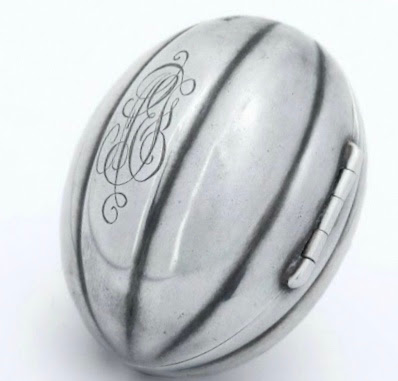
A monogrammed, Gilded Age gentleman’s sterling nutmeg grater in the shape of a melon. This was made by the Gorham Manufacturing Company. The melon was a popular design for nutmeg graters from as early as the Georgian and Regency Eras. The pocket sized grater is inside the melon, which also holds the nutmeg, so it was safe during travel. A generous gentlemen who would pull such an item of the precious spice from his pocket, would certainly offer to share with his peers, but it would be impolite to first request a gentleman share his nutmeg.— According to Antique Trader.com, “Nutmeg was highly coveted and revered by wealthy and fashionable people, so much so that they carried around their own pocket-sized nutmeg graters to add a dash of the spice to anything at any time, which was usually punch and other beverages. These graters are now valuable collectibles.”


Small boxes suitable for carrying in the pocket, and used to contain nutmeg were particularly popular during the eighteenth century. At this time nutmeg and other flavors had been introduced from the East and were in great favor throughout England. A nutmeg grater was actually a small silver container fitted with an inner grate attached to the cover on the inside. This permitted the dust to fall through into the box. The graters were made in a great variety of styles and shapes, but the general purpose of all was alike. It is interesting to note that they were in use throughout the first half of the Victorian era. — From “The Book of Old Silver,” by Seymour B. Wyler, 1937


🍽️Etiquette Enthusiast, Maura J. Graber, is the Site Editor for the Etiquipedia© Etiquette Encyclopedia 

Saturday, March 11, 2023

Traveling Utensils and Fork History

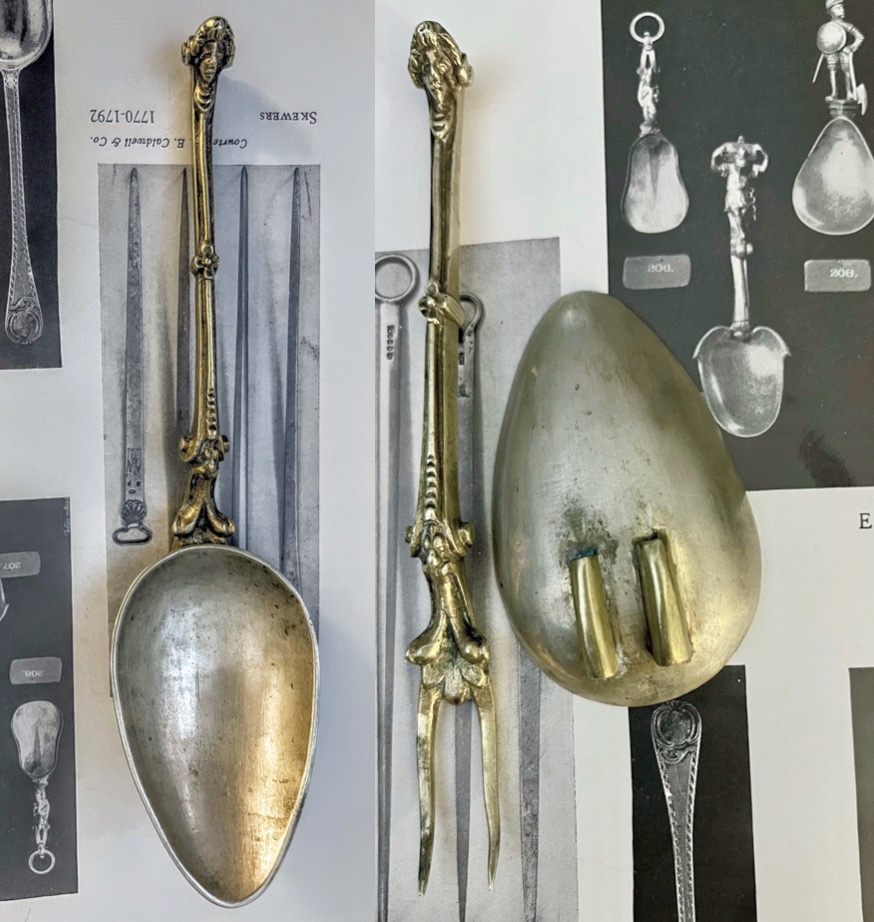
Photo of a retractable travel spoon bowl with the fork attached, alongside a photo of the back of the spoon bowl, sitting next to the two-tined fork which fits inside it to make a spoon. Presumed age is any time from the mid-1500’s to early 1700’s

Around the year 1400, when people carried their eating utensils with them, a folding silver spoon was made to fit the pocket. Later a fork was added. Even the wealthy did not provide these utensils; only royalty seemed to have had enough for their feasts and banquets.

Everyone carried his knife in a scabbard fastened to his belt, to use at mealtime and on any other occasion when a knife was needed. Those who could not afford silver used spoons, knives, and forks of pewter. Copper and brass spoons were used, too, by persons of limited means, although copper soon lost favor due to its tendency to rapid oxidation. 

During the fifteenth and sixteenth centuries, in the Tudor period, it was fashionable to give a christening gift of twelve spoons, each adorned with a miniature statue in silver of one of the twelve apostles. Sometimes a “Master” spoon bearing the figure of Christ was included. These sets are exceedingly rare today. Our “pitcher spoon” originated in Elizabethan days, when great starched ruffles were worn around the neck, making long-handled spoons a necessity.

In Italy, in the 1500s, knives and forks generally appeared on the tables of the cultured, but it was another century before they were popular in France and England. At one time in England it was considered effeminate to use a fork and it took several decades for the people other than the upper classes to adopt it. The clergy even protested its use “as a substitute for God-given fingers.”

In America, too, forks were freakish novelties: when the first fork was imported by Governor Winthrop in 1633, people thought it comical. They could not see any need for it, since most of their meats were cut up and cooked in ragouts and stews. Recipes of the time called for meat to be “y-mynced, hewed on a gobbet, hacked, diced and skerned.” Two-pronged forks to spear food were the most commonly used at first, but early models were made with three and four prongs too.— From “The Book of Old Silver,” by Seymour B. Wyler, 1937


🍽️Etiquette Enthusiast, Maura J. Graber, is the Site Editor for the Etiquipedia© Etiquette Encyclopedia

Friday, March 10, 2023

An Interview with Alisa Kazka

Meet Alisa Kazka. Alisa is a Blue Ribbon Award Winner from our Second Annual International Place Setting Competition. Alisa is shown sitting at her Regency Era place setting.
🍽️🍽️🍽️🍽️🍽️🍽️
Alisa Kazka is an etiquette consultant and a table setting specialist from Ukraine. Alisa writes, lectures and provides etiquette training. She told us that she is currently living in Kyiv, because her hometown is not safe. Alisa wrote, “The love for this topic appeared in my childhood and I gradually studied and got acquainted with etiquette and art of table setting. I really love the beauty and cosiness in the house, so I apply the knowledge that I share with my students to my home. I love beautiful porcelain and use it every day in serving.” 
Congratulations, Alisa!
Alisa’s choice of table elements was surprising, until we learned of her circumstances. Alisa was living away from her home and her country, due to the war in Ukraine. She could only use what was on-hand where she was temporarily living.   
           What an inviting menu for an Italian with a love for Italian foods! This is a table I’d love to sit at for dinner. We would have loved to have seen a menu more in line with foods that one generally thinks of during the Regency Era, but I’m certain that a soup, vegetables with pasta, fish with white wine, and ices, etc… were likely served on fine tables of the era.
              

1. How did you choose the menu and various elements you used in your setting and why? Please explain each of the utensils in your setting… For which of the foods on your menu (or course) was each different item intended? 

1) My table setting consists primarily of knowledge and love for porcelain, history, etiquette, and beauty. The menu is made up of favorite dishes of the Italian kitchen, which I am a fan of.

You may notice that cutlery is not from the same collection and modern production. Unfortunately, due to the war in Ukraine, I am far from home, my favorite dishes and serving items were left at home, so I didn’t have to choose dishes and cutlery. But, it was very important for me to take part in this competition, to represent my country and myself as a professional, so I took what was in my temporary home and fit the beautiful Regency Era theme.

I wanted to create an airy, romantic table setting that would capture the spirit of the era - Royal Albert porcelain did a great job of emphasizing this, and antique-style glasses from a nearby store helped to set the necessary accent.

2. Why did you choose this particular period in time to set your table?

2) Regency Era is my favorite, it's an inspiring time with a unique style and exquisite porcelain, the spirit of that era, dresses and balls, good manners, and incredibly beautiful table setting. When I saw the proposed list, I didn’t doubt for a second what to choose! I really wanted to show this in my table setting.

3. How, if at all, did Covid-related social restrictions affect your choice of setting? Were you ready to celebrate? Feeling in the mood to do something different? Etc… 

3) Covid did not affect the choice of conditions. And if my family were nearby, I would gladly celebrate with them. But, due to the events in Ukraine, I was forced to leave the house, so I will celebrate with my relatives via video call.

4. Have you always enjoyed a properly set table? Or, if not, was the table setting something you learned to enjoy through your social life and/or business later on in life? 

4) I have loved tableware since childhood. It has always been important for me that the table should be beautiful: a white tablecloth, porcelain, and beautiful tea pairs for breakfast.

I often helped my grandmother to decorate the table, and arrange cutlery. Like many years ago, I still love the perfect table, beautifully served food, English porcelain, and French faience, always flowers and appropriate decor. In such an atmosphere, communication with family becomes special.

5. Did you do any research on table setting etiquette before setting your elements at the table? 

5) Yes, sure! I professionally study the subject of etiquette and table setting. Before participating in the International Place Setting Competition, I also re-read Maura Graber's articles about the Regency Era and was inspired by films about this era.

 6. Do you plan on entering again next year?

6) Yes, with great pleasure! I was very happy to take part in the International Place Setting Competition, it gave me inspiration and the push to move on! I want to thank Elizabeth Soos and Maura J. Graber for the opportunity to participate and show my knowledge, experience, and love for table setting, to be inspired and filled with strength to go forward!


Elizabeth Soos and I would both like to congratulate Alisa on her award winning setting. We are honored that she entered our contest and love meeting others who are so willing to share their talents, enthusiasm for etiquette, and their wealth of knowledge. Congratulations!


🍽️Etiquette Enthusiast, Maura J. Graber, is the Site Editor for the Etiquipedia© Etiquette Encyclopedia