Tuesday, February 18, 2014

Google Glass Etiquette

GOOGLE'S GLASS ETIQUETTE GUIDE

Breaking the rules or being rude will not get businesses excited about Glass and will ruin it for other Explorers.

DO:

Explore the world around you. Glass puts you more in control of your technology and frees you to look up and engage with the world around you rather than look down and be distracted from it. Have a hangout with your friends, get walking directions to a fantastic new restaurant, or get an update on that delayed flight.

Take advantage of the Glass voice commands. Glass can free your hands up to do other things like golfing, cooking, or juggling flaming torches while balancing on a beach ball (but also see Don’ts #2). This is great for looking up how many ounces in a cup while you cook, or taking a one-of-a-kind photo from your unique perspective.

Ask for permission. Standing alone in the corner of a room staring at people while recording them through Glass is not going to win you any friends (see Don’ts #4). The Glass camera function is no different from a cell phone so behave as you would with your phone and ask permission before taking photos or videos of others.

Use screen lock. Glass screen lock works like your smartphone’s screen lock: it passcode-protects your device to help prevent others from using it. If you ever lose your device or have it stolen by a budding online resale entrepreneur, you can turn off Glassware and perform a remote wipe (e.g. factory reset) of the device, removing all your information from the device. All you need to do is go to your MyGlass page on your browser, or the MyGlass App on your phone.

Be an active and vocal member of the Glass Explorer Community. The Explorer Program was created in order to have a place where our Explorers can give feedback, share content and communicate with the Glass team. It’s been hugely successful over the past year and this is due to our wonderful group of Explorers. They are constantly sharing their worlds with us and with each other, allowing us to hear and work on all the great feedback and stories our Explorers give us (and, wow, do they give us a lot!).

DON’T:  

Glass-out. Glass was built for short bursts of information and interactions that allow you to quickly get back to doing the other things you love. If you find yourself staring off into the prism for long periods of time you’re probably looking pretty weird to the people around you. So don’t read War and Peace on Glass. Things like that are better done on bigger screens.

Rock Glass while doing high-impact sports. Glass is a piece of technology, so use common sense. Water skiing, bull riding or cage fighting with Glass are probably not good ideas.

Wear it and expect to be ignored. Let’s face it, you’re gonna get some questions. Be patient and explain that Glass has a lot of the same features as a mobile phone (camera, maps, email, etc.). Also, develop your own etiquette. If you’re worried about someone interrupting that romantic dinner at a nice restaurant with a question about Glass, just take it off and put it around the back of your neck or in your bag.

Be creepy or rude (aka, a “Glasshole”). Respect others and if they have questions about Glass don’t get snappy. Be polite and explain what Glass does and remember, a quick demo can go a long way. In places where cell phone cameras aren’t allowed, the same rules will apply to Glass. If you’re asked to turn your phone off, turn Glass off as well. Breaking the rules or being rude will not get businesses excited about Glass and will ruin it for other Explorers.– As reported by NBC News


Etiquette Enthusiast, Maura J. Graber, is the Etiquipedia© Etiquette Encyclopedia

Etiquette and Roots of Hospitality


“Eating, and hospitality in general, is a communion, and any meal worth attending by yourself is improved by the multiples of those with whom it is shared.” - Jesse Browne 
Image from Pinterest~ Russian hospitality during the time of Ivan the Terrible, from a painting by Schwartz

Omotenashi: A Very Japanese Hospitality
Any foreigner who has lived in Japan for an extended period of time will have been asked this question: "What's your favorite Japanese word?" In my own case I have often answered the enquiry with omotenashi and, without exception, my reply has garnered instant murmurs of approval. The tacit implication is that I have "understood." But what, exactly, is it?


Japanese Tea Ceremony

Omotenashi is a singularly difficult word to define, let alone translate. It is very close to the Western phrase 'Hospitality', yet it is palpably something else, one of those semi-mystical Japanese keywords that seem to tap into the very heart of the Japanese cultural DNA, yet remain somehow beyond literal explanation. One of my personal favorite attempts to decipher its meaning, comes from an unlikely source, the PR department of a major Japanese cosmetics corporation:

"Omotenashi is a word you have to translate with your heart" says their copy, "It is a subtle connection in which trust, pleasure and respect are interwoven in an approach steeped in a natural sense of deference; an exquisite approach to the art of receiving guests." Not a bad stab at it, methinks.

My own attempt goes something like this: "Omotenashi describes an atmosphere of conviviality and welcome in which individual needs and preferences are catered to impeccably, and of which an essential element is the unobtrusive, meticulous attention to detail. The term is primarily used in modern Japan in the hospitality and service industries, most notably in high-end hotels and restaurants, though its use is not exclusive to those trades; it may even be used to describe the hospitality found in the confines of a private home."

Text By John Ashburne


The Protector of Hospitality? The Greek god Zeus:


Abusing a defenceless stranger is disgraceful. Strangers are especially protected by the gods in many cultures; In ancient Greece, Zeus himself is called Xenios, Protector of Hospitality

Hospitality in Homer’s Time

Hospitality in Homer’s time was well shown through long travels such as Odysseus' in The Odyssey as well as the guest-friend relationship, known as xenia. There are many possible reasons why hospitality was more prevalent in those times. Traveling in Homer’s time was much more extensive and lengthier than in modern times. The less advanced methods of transportation used in Homeric times, such as by boat or by foot, were much slower than modern forms of transportation. Because of this, many more nights were spent away from home in many different locations. Also, there were not hotels or inns where travelers could pay and stay the night. Even if there were, travelers probably could not afford to pay for every night they were gone. Because of this, travelers had to rely on the hospitality of others for shelter, food, and protection. There was, however, some payment for this hospitality in the form of a gift exchange. Another possible reason for this hospitality was the fact that there were not nations that would allow travelers to enter their territory safely. Without such hospitality, strangers could be captured or even killed for entering a foreign land. The Greek guest-friendship xenia may have been formed from this. Xenia is the Greek relationship between two people from different regions. This allowed for the members of the relationship to safely travel into the other member’s territory and receive a place to stay and something to eat. Another possible explanation for the amount of hospitality shown is that the Greeks believed the gods wanted them to show hospitality to anyone who showed up at their homes. It was also believed that turning away someone and not providing them this hospitality would result in some form of punishment from the gods. Finally, hospitality could have been used to spread ones name and bring them a sense of fame if they would provide a high standard of hospitality to strangers.

It also could have been a way to show how wealthy one was. These can be shown from this quote from The Odyssey: “Come, friend, and give me something; for you seem to be no lowly man among the Greeks, but their most noble lord-indeed a chief. So you should offer more than others can-I’d make you famous then in endless lands. I, too, was once a man of means; my house was rich; I often gave to vagabonds, whoever they might be, who came in need”.

Is hospitality as customary now as it was in Homer’s time, and if not, why? It seems as though modern people do show hospitality towards others, but in a different way than those in Homeric times. It is not custom anymore to provide food, protection, and shelter to a stranger that arrives at someone’s door. This could be because there are hotels and restaurants almost anywhere one can go. There is no need to for someone to ask for these. Also, protection is not a large concern for most travelers, especially in the United States. Hospitality is still shown, however, in modern society. For example, when someone’s car breaks down most people would welcome them into their homes and help them in any way they can without even asking who they are. Also, most people know of someone, be it family or friend, in a different city that would welcome them and provide them with a place to stay and food, which is similar to the xenia in Homer’s time. Although the hospitality customs of Homer’s time are not still around, there are similarities to them and hospitality is still visible.

Fear of Gods

Throughout The Odyssey there are many ongoing themes, but one of the most important themes of this story is the tradition of Greek hospitality or xenia. This type of hospitality was very unique and it played an important role in the ancient Greek society. As a matter of fact, this kind of hospitality was so unique that it almost seems unbelievable, because very few societies have behaved in this manner towards their guests. From the very nature of this behavior, one can easily come to the conclusion that the people of ancient Greek society were truly hospitable. However, fear of the gods, rather than pure decency, is a possible cause of the actions of ancient Greeks towards their guests.

The hospitality of ancient Greek society is very clearly seen throughout the Odyssey. During the travels of both Odysseus and Telemacus, one can easily see how strangers were greeted and treated upon their arrival to a new place. It seems as if strangers were invited in for a feast, showered with gifts and luxuries, and then asked who they were and what their business was. As anyone can see, this type of hospitality is very unusual and distinctive. Not very many cultures would treat strangers in this manner. Therefore we are led to believe that there is some other reasoning behind all of this generosity.

The people of ancient Greek society did not show all of this hospitality solely out of the goodness of their hearts, but rather they did it for the gods. During this time, hospitality was treated as a test from the gods. In Book XIV, Eumaeus says: “for it is Zeus who sends to us all beggars and strangers; and a gift, however small, means much when given by a man like me…” This means that it is the god Zeus who demands magnificent hospitality upon all mortals. Since hosts had no way of knowing who their visitors were, they were forced to treat every visitor as if they were a god. By treating every guest like a god, there is no mistake of accidentally treating a god differently, just in case one was to show up at their door disguised as a stranger. This appears to be done through fear, not generosity.

The fear of the gods’ wrath is seen in many of Odysseus’ travels. Many of the hosts ask Odysseus to pray for their happiness to the gods in return for their hospitality. This leads us to believe that they only shower him with gifts and feed him because it is what the gods want. There is, however, an adventure where Odysseus is not shown good hospitality. This adventure is the encounter with the Cyclops, Polyphemus. When entering the cave of Polyphemus, Odysseus relies on the expectation of hospitality and helps himself to food and shelter. When Polyphemus returns, however, we see that he does not follow the rules of Greek hospitality. The reason he does not abide by these rules is because his father is the god Poseidon. He does not fear the wrath of the gods because he feels his father will protect him.

As anyone can see, the people from ancient Greece were very hospitable. It is possible, however, that this Greek hospitality comes from the fear of the gods, and not only from pure politeness. Not only can this be seen in the story of The Odyssey, but it can be seen in other ancient Greek stories as well.

The Unwanted

There are many things in life that come unwanted, and there are also things in life that we must do unwillingly. In The Odyssey, providing hospitality often fell into these unwanted areas. There were instances in this epic poem where Odysseus was offered and/or provided hospitality that he did not necessarily want, and there was also one major illustration of characters that felt obligated to provide hospitality that they did not want to provide.

The fact that Odysseus wanted to get home to his wife, Penelope, and his son, Telemachus, is undisputable. When speaking with Alcinous, he once said, “…For if a man is far from his own home and parents, then even if he is housed in opulence within that foreign land, no thing he finds can be more sweet than what he left behind.” This statement proves how Odysseus felt about the hospitality he had been offered and/or provided, and how he much more longed to be home. Calypso, a fair goddess, had wanted to keep Odysseus in her cavern as her husband, but he refused. Círce also tried to keep Odysseus in her halls and keep him there as her mate, but her attempts failed as well. Although both of these women had fine homes and fine things to offer him, their hospitality was too much for Odysseus. He instead left each with the goal of returning to Ithaca and reclaiming his family and his home.

Another case where hospitality came in an unwanted abundance was when Telemachus encountered Nestor. It was here that Telemachus found himself more welcome than he wanted. Nestor seemed to enjoy Telemachus’ company and entertained him by telling him many stories. While Telemachus appreciated all the hospitality in this instance as well, he just wanted to continue his journey and learn about his father’s whereabouts.

Throughout his journey, Odysseus also begins to reject hospitality when he finds himself encountering troubles at each place he comes to. Eventually he is the only man left alive. When he first wakes up on the island of Schería, he says, “What misery is mine? What mortals must I meet in this new land that I now touch?” The hospitality he is offered is unwanted because he has begun to question the motives of the people he meets. He starts to wonder if they are actually kind or if they are only trying to please the gods with their hospitality.


On the opposite side, back at home, Telemachus and Penelope found themselves feeling obligated to provide hospitality when they did not necessarily want to. The suitors came to their home and expected proper hospitality to be offered to them. Because of the importance of hospitality back in those times, most people assumed it. In the case of the suitors, however, there was a larger assumption made on their part. When the suitors first showed up at the doors of the palace, Penelope and Telemachus intended for them to stay for a feast or two. The suitors more or less intruded and welcomed themselves far more than Penelope and Telemachus had wanted them to. Even after the prophecy of Halithérses, who said: “Odysseus…won’t stay away from those he holds most dear; he is already near; and he has planted the seed of death and slaughter for the suitors…”, the suitors remained in the palace and continued to feast and try to impress Penelope until Odysseus returned and slaughtered them.

Hospitality… Or Else!

Hospitality in today’s world has become little more than being friendly and considerate to your guest. There are no universal rules for the conduct of the host or the guest; much less a threat of violence if a person does not behave in a certain manner. The Odyssey, takes its reader to a very different world of rules and manners. In the story, the importance of hospitality goes beyond being a gracious host; there is a threat of violence if the host or guest does not fulfill their responsibilities.

When Odysseus arrives on Kirké’s island, his men are being turned into animals and he goes to confront the witch. On his way to met with her Hermes advises him on how to deal with the witch. The ways in which Odysseus must deal with Kirké is by threatening her with his sword. There are a few factors that may have motivated Hermes to help Odysseus confront Kirké. One very important reason is that the goddess was violating the code of conduct between host and guest and not even a goddess can violate the rules. From her confrontation with Odysseus, Kirké was taught a lesson by the other gods so that she would become more hospitable.

The meeting with the Cyclops, Polyphemos, is another violent example of what happens with there is a violation between host/guest relations. When the Cyclops decides to eat rather than welcome Odysseus and his crew, the men poke his eye out. This event does not bother the gods at all. The father of the Cyclops, Poseidon, is only upset by the event because it was his son who was hurt. Zeus even praises Odysseus after the event by claiming that, “There is no mortal half so wise”. This statement proves that violence was an acceptable answer when a host was not gracious.

The most violent reaction to the disregard of the responsibilities between a host and his guests occurs when the suitors are killed. These men were not only killed with the gods’ permission, but they were killed with the help of the gods. Even when Odysseus wants to warn Amphînomos, the only suitor with honest intentions, he is bound to the palace by Athena.

Violent penalties for not respecting the “rules” of hospitality are not only found in the world of the ancient Greeks. In the biblical story of Sodom and Gomorra three angels search in the city for someone who will welcome them into their home. When they do not find anyone inside the city, they travel to the home of Abraham. According to the story, Abraham was recovering from a circumcision and in a great deal of pain when he saw the strangers. Even with his pain he welcomed the strangers and was saved from the destruction of the city.


In both the Bible and The Odyssey violent penalties are given as a threat to anyone who is not hospitable and accommodating to their guest. Because of this, it is not difficult to see that hospitality was one of the most important aspects to both societies.

Given and Received

Hospitality plays a major part in the Odyssey, but the actual hospitality is not as important as the way that that hospitality is received, and the consequences of that reception. For our first example we will look at how the suitors respond to the hospitality given to them at the house of Odysseus. Throughout the duration of Odysseus’ absence, the suitors are treated well, and in response to this, they refuse to leave when asked. The suitors are fed and housed, and after a number of years they overstay their welcome. In response to this Telemachus, prompted by Athena, informs the suitors that his father is returning home and they are all to vacate Odysseus’ home. The suitors, in turn, ignore him and continue to eat drink and be merry, at the cost of Telemachus and Penelope’s household. What are the consequences of these actions taken by the suitors? Although the primary consequence is their death, they also lose the hand of Penelope. None of them are able to pass the test of stringing the bow of Odysseus except Odysseus himself. This is followed by the main consequence of the suitors’ execution at the hands of Odysseus and Telemachus. By not respecting the hospitality given by Penelope, they set the stage for their own deaths.

Our next instance of hospitality occurs on the island of the Cyclops. The Cyclops meets Odysseus and his crew with undesirable hospitality. Although not without cause the Cyclops’ reaction and subsequent actions against Odysseus and his crew ultimately resulted in an attack on him. Although the hospitality of the Cyclops was objectionable the reaction of Odysseus, in the form of blinding the Cyclops, brings only more trouble onto himself. Since the Cyclops was Poseidon’s son Poseidon was angered and brought about more problems for Odysseus and his crew. Just like with the suitors, undesirable hospitality and a bad reception of that hospitality ultimately results in a break in the sacred guest host relationship.


Next we shall look at Odysseus’ stay on the island of Calypso. Here he is met with exceptional hospitality. Odysseus received this hospitality well and continued to please Calypso. Only at the end did he ever try to refuse her hospitality and leave, and even this caused no serious problems. Here we have an example of the guest-host relationship working well. Calypso is provided with a companion, even if it was not permanent, and Odysseus was provided with shelter, provisions, and protection for his men. In the end it proves to be a beneficial situation for them both.
From "The Value of Hospitality"

Odysseus and Hospitality to Strangers

Our world could scarcely be more different from that of Odysseus (Ulixes, Ulysses) in The Odyssey.
"Tell me, O Muse, of that ingenious hero who travelled far and wide
after he had sacked the famous town of Troy. Many cities did he visit,
and many were the nations with whose manners and customs he was
acquainted; moreover he suffered much by sea while trying to save
his own life and bring his men safely home ...."

Odyssey Book - In the World of Odysseus Gods Walked Among Men

It's not so much that gods walked and talked among mortals -- although today there are sometimes dire consequences for people claiming to hear divine voices.

"A certain man has been abroad many years; he is alone, and the god Poseidon keeps a hostile eye on him. At home the situation is that suitors for his wife's hand are draining his resources and plotting to kill his son. Then, after suffering storm and shipwreck, he comes home, makes himself known, attacks the suitors: he survives and they are destroyed."
-Aristotle's summary of The Odyssey according to Robert Fagles on the PBS March 13, 1997 Online News Hour.

In the World of Odysseus There Were Fantastic Temptresses

Nor does the difference lie in the existence of monsters and fantastic, villainous temptresses like the Sirens, Circe, or Calypso. Such vixens hardly seem out of place today with our daily dose of television and tabloids.

"First you will come to the Sirens
who enchant all who come near them. If any one unwarily draws in too
close and hears the singing of the Sirens, his wife and children
will never welcome him home again...."
Odyssey XII

The Important Difference is Hospitality

In antiquity children read and memorized the Epics of Homer (Iliad and Odyssey) because they showed patterns and standards of behavior citizens were expected to emulate. Among these was the all-important ethic of hospitality.

Etiquette vs. Safety

Today, if we're wise, we don't open our bolted doors to strangers without proof of identity, we fear hitch-hikers, and we expect visitors to bring a dish or bottle of wine when they come for a visit. Rules of etiquette require us to make our guests feel at home, but not to make people we don't know our guests.

Strangers are the bogey-men we warn our children about. This hasn't always been the case.

Before the advent of coins, credit cards, Motel 6, and McDonalds, hospitality to strangers saved lives.
From About Ancient History


 🍽Etiquette Enthusiast, Maura J. Graber of The RSVP Institute of Etiquette, is the Site Editor for the Etiquipedia© Etiquette Encyclopedia   

Saturday, February 15, 2014

“Pell-Mell” Etiquette

Pell-Mell:
Adverb
In a confused, rushed, or disorderly manner.
“the contents of the sacks were thrown pell-mell to the ground”

Synonyms:
helter-skelter, headlong, (at) full tilt, hotfoot, posthaste, hurriedly, hastily, recklessly, precipitately

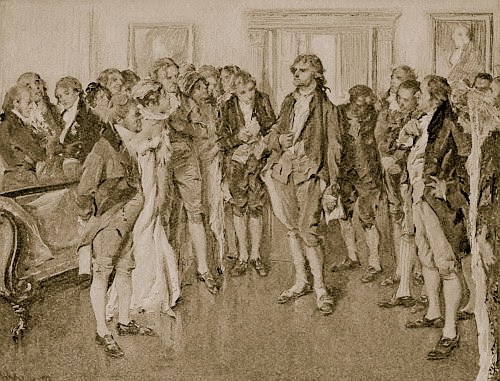
“The new British diplomatic representative to the United States, Anthony Merry, and his wife were shocked and insulted when the President received them in worn clothing and slippers. In December 1803 at a formal dinner in the White House, no one offered to escort Mrs. Merry to dinner. In the dining room, Merry and his wife had to scramble for places at the table in competition with the other guests. The Marquis d'Yrujo, the Spanish diplomat, had the same experience. He and Merry agreed that this treatment was an insult to them and to their countries. The two diplomats and their wives sought to retaliate.” 
The Merry Affair
Jefferson believed that the president's dress and manners should reflect the republican simplicity and informality of the country. Pomp and show reminded him too much of the European courts. In fact, Jefferson worked so hard to avoid ostentation that he began to dress not merely plainly, but sloppily. As for manners, he refused to observe the rules of protocol in seating his dinner guests. First come, first served was the rule in the presidential mansion, the White House. Jefferson explained: In social circles, all are equal, whether in, or out, of office, foreign or domestic; and the same equality exists among ladies and gentlemen … “pell mell” and “next the door” form the basis of etiquette in the societies of this country.
Rudeness is no proper response to another's rudeness! Portrait of Mrs Elizabeth Merry, wife of the new British diplomatic representative to the United States, Anthony Merry – “The two diplomats and their wives sought to retaliate. At their parties, for instance, no one escorted the wives of the Cabinet members to the dinner table. This social war greatly enlivened Washington.” 

The new British diplomatic representative to the United States, Anthony Merry, and his wife were shocked and insulted when the president received them in worn clothing and slippers. In December 1803 at a formal dinner in the White House, no one offered to escort Mrs. Merry to dinner. In the dining room, Merry and his wife had to scramble for places at the table in competition with the other guests. The Marquis d'Yrujo, the Spanish diplomat, had the same experience. He and Merry agreed that this treatment was an insult to them and to their countries. The two diplomats and their wives sought to retaliate. At their parties, for instance, no one escorted the wives of the Cabinet members to the dinner table. This social war greatly enlivened Washington. The president refused to retreat from his pell mell rule, and Merry and Yrujo became increasingly angry and receptive to the plottings of Jefferson's opponents, the Federalists and Aaron Burr. -From www.knowsouthernhistory.net

Dinner Etiquette

When President of the United States, Thomas Jefferson promoted “pell-mell” etiquette. It was a much more informal style of dinner etiquette than that observed by his predecessors. In 1788 Jefferson consoled a French diplomat disillusioned by his initial experience of the new American republic: “I am sorry that your first impressions have been disturbed by matters of etiquette, where surely they should least have been expected to occur.” Such matters, he said, “are the most insusceptible of determination, because they have no foundation in reason,” adding that “it would have been better, in a new country, to have excluded etiquette altogether.”
Thomas Jefferson, third president of the United States (1801-1809) 
In March 1801, when he took up residence in the President's House, he seized his chance to banish etiquette at the highest executive level and to reorganize the social mechanism of the national capital on a rational plan. First to go was the presidential levee, the weekly focal point for society in the capital in the two previous administrations. Jefferson replaced it with a series of small, informal dinners, but retained the established custom of open house on New Year's Day and the Fourth of July.

To ensure that the American public should never mistake its president for a king, he adopted a purposeful informality in his own behavior as chief executive: shaking hands instead of bowing, riding without an attendant servant, issuing his dinner invitations in his own name rather than as president, and dressing informally for official receptions. As one foreign visitor observed, "It was the object of Mr. Jefferson to preserve, in every trifle, that simplicity which he deemed the most appropriate characteristic of a republic. . . . He wisely judged that in this matter, as in most others, example was better than precept, and set about new-ordering the manners of the city."

The new Jeffersonian order became most famous for the policy of “pell-mell,” especially as applied to a moment charged with significance for those conscious of their rank - the procession of dinner guests to their appointed places at the table. Defying custom of long standing, especially in diplomatic circles, Jefferson declared, “At public ceremonies, to which the government invites the presence of foreign ministers and their families, a convenient seat or station will be provided for them, with any other strangers invited and the families of the national ministers, each taking place as they arrive, and without any precedence.”

The deprivation of his precedence in the pell-mell passage to the dinner table was too much for British minister Anthony Merry. Bolstered by his large and equally offended wife and another sensitive diplomat, Merry withdrew from official Washington society. The ensuing social tempest came close to clouding the course of American foreign and domestic policy, but Jefferson stood firmly behind the principle at the root of pell-mell: “When brought together in society, all are perfectly equal, whether foreign or domestic, titled or untitled, in or out of office.”


United States Capitol, Completed Northern Wing (circa 1801)

Many American observers concluded that Jefferson had been too systematic in his application of republican principles to social forms. His two Republican successors pursued the Jeffersonian political course but tempered the leveling social practices of the first Republican administration. The Madisons instituted a weekly “drawing room” and introduced more formality into official dinner parties.
The ancient and universal custom of drinking healths at the dinner table.

There was, however, one practice abolished by Jefferson that was restored by neither Madison nor Monroe - the ancient and universal custom of drinking healths at the dinner table. The tradition of capping a meal with a session of toast-drinking was firmly entrenched in the early American republic. 

Increase Mather and other seventeenth-century Puritans had fulminated against the practice. Post-war patriots had recommended throwing out offensive English customs, including health-drinking, to complete the revolution. Yet the habit of raising a glass to drink the health of fellow guests, absent friends, and political figures and principles seems to have been almost universal at the tables of upper-class Americans.
“In a penetrating study of political life in Washington during the Jeffersonian period, The Washington Community, 1800-1828, James S. Young described the dinners as one of Jefferson's 'power techniques'. The only President to give dinners extensively, he had abolished the aristocratic levees which were a hallmark of the Federalist administrations. Considering political distinctions to be important, Jefferson rarely mixed Federalists with Republicans, nor did he invite Cabinet members along with Congressmen. Just as the guest list was planned, so a great deal of attention was given to physical surroundings. To encourage conviviality and discourage a feeling of inequality, a round table was used; to insure privacy, a dumbwaiter was used in place of servants. A French chef, imported wines and Jefferson's informal wardrobe completed the picture. Politics were subtly removed as a province of conversation, and everyone was invited to participate freely in verbal exchanges.
 
“Another recent historian, Claude Bowers, also found the dinners to be useful instruments for 'conciliating political opponents' in Jefferson in Power. But, he noted that when Congress was out of session, Jefferson invited members of the local community to share his hospitality. They were not disappointed, for frugality was never in evidence at the President's House. Etienne Lemaire, Jefferson's head of household, estimated that he spent fifty dollars a day on food and wine.” –www.monticello.org


🍽️Etiquette Enthusiast, Maura J Graber of The RSVP Institute of Etiquette, is the Site Editor for the Etiquipedia© Etiquette Encyclopedia

Thursday, February 13, 2014

Etiquette’ and Manners’ —Word Usages and Origins

  “The ancient kings were watchful in regard to the things by which the mind was affected. And so they instituted ceremonies to direct men's aims aright; music to give harmony to their voice; laws to unify their conduct...” Confucius,  on clarifying manners and civility 

Confucius (551/552-479 BC) was a Chinese teacher, philosopher and politician during the so-called Hundred Schools of Thought era.

Manners

The Root of "Manners" is "Hand" — Middle English manere, from Old French maniere, from feminine of manier, handmade, skillful, from Vulgar Latin *manuārius, convenient, handy, from Latin, of the hand, from manus, hand; see man-2 in Indo-European roots. 

That speaks volumes about manners to HAND-le with skill.
From freedictionary.com

Manners

The manner of doing something is via ...

Fr. maniire, from LL. manuarius, be- 
longing to the hand. Manual, both as 
a handbook, and in manual labor, is 
from the same source. Emancipate is a 
bit more roimdabout, dating from the 
days when the parent had power over 
the son: only the head of the family 
could acquire property: L. manceps, 
mancip — , one that acquires property, 
from manu-]rcapere, capt—, to tala by 
hand (whence also capture, captivate, 
etc Captive and caitiff are doublets, 
from L. captivus, from capt — . Captain is 
from quite other source ; see achieve.) : 
ex, out, whence emancipare, emancipat — , 
to take from the property holder. 
From the Dictionary of Word Origins Joseph T. Shipley 1937

et•i•quette (ˈɛt ɪ kɪt, -ˌkɛt) 

noun.

1. conventional requirements as to proper social behavior.
2. a prescribed code of usage in matters of ceremony: court etiquette.
3. the code of ethical behavior among the members of a profession: medical etiquette.
[1740–50; < French étiquette, Middle French estiquette ticket, memorandum, derivative of estiqu(i)er to attach < Germanic]
Random House Kernerman Webster's College Dictionary, © 2010

 Etiquette- 

 This may have come natural to the ancients, for it is of Teut. origin. (Remember the story of the old man who walked through the crowded Athenian bleachers at a stadium ; when he came to the Spartan section, the men rose as one, to offer him a seat — whereupon the Athenians applauded. When they were still again, a man from Thessaly observed : "The Athenians recognize virtue; the Spartans practice it.") 
From the Dictionary of Word Origins Joseph T. Shipley 1937


Submitted by Demita Usher of Social Graces and Savoir Faire

Etiquette Enthusiast, Maura J. Graber, is the Site Editor for the Etiquipedia© Etiquette Encyclopedia

Monday, February 10, 2014

Etiquette, Scents and Sensibilities

 Common Scents, Etiquette and Courtesies

According to a 2009 TIME Magazine article, an experiment was conducted to test people's propensity toward charity and good manners by using common scents. Ninety-nine participants were assigned to either a Windex-scented room or a neutral-smelling room and given a list of tasks to complete. Included in the list was a request for volunteers and donations for "Habitat for Humanity".


Researchers on morality and scientists agree that people do strongly associate physical cleanliness with “purity of conscience.” It is the thought at the heart of old sayings like “cleanliness is next to godliness ...”

Results revealed that people in the Windex scented room were more likely to give money and help others than those in the room that was not scented with Windex. According to co-author and social psychologist Adam Galinsky, from Northwestern University's Kellogg School of Management, "Economists and even psychologists haven't been paying much attention to the fact that small changes in our environment can have dramatic effects on behavior. We underemphasize these subtle environmental cues," he says.


Researchers on morality and scientists agree that people do strongly associate physical cleanliness with "purity of conscience". It is the thought at the heart of old sayings like "cleanliness is next to godliness" and "as evidenced by the widespread use of cleansing ceremonies to wash away sins in various religions around the world".

Ninety-nine participants were assigned to either a Windex-scented room or a neutral-smelling room.

Another study, published in a 2008 Personality and Social Psychology Bulletin showed that people are more critical and judgmental about certain moral issues when exposed to the vapors of a commercially available, "fart" scented spray. At Etiquipedia, we'll stick with the Windex, thank you.


Tuesday, February 4, 2014

Hat Tippng Etiquette and History

“Tipping of the hat is a conventional gesture of politeness. This hat tipping custom has the same origin as military saluting, which came from the raising of medieval Knights face visors to show friendliness.” - from “Ask Andy About Clothes” website
The custom of a man tipping his hat to others derived from an ancient practice. When knights in medieval times wanted to express friendly intent, they would raise their face masks and reveal their faces. The practice of saluting is also derived from this friendly exchange between knights.  Lifting one's armor mask eventually evolved into the custom of “tipping” or “doffing” one's hat to greet or acknowledge another, women in particular.  


“If a gentleman meets a gentleman, he may salute him by touching his hat without removing it, but if a lady be with either gentleman, both hats must be lifted in salutation. If a gentleman stops to speak to a lady, in the street, he must hold his hat in his hand during the interview, unless she requests him to replace it. With a gentleman friend etiquette does not require this formality.” - From Frosts Laws and By-Laws of American Society, 1869


“This practice also evolved into the removal of one's hat when entering a building...”
Knights would remove their helmet when entering a building  to signify  a peaceful position, since a knight could not fight or defend himself without the helmet.  Since the removal of his helmet made him vulnerable, it informed others that combat or any type of violence was not his motive. This practice also evolved into the removal of one's hat when entering a building, when hearing the national anthem and in different situations where they would not be going back out in public immediately. Men would hold their hats in their hand when speaking with a lady but would put it back on when they began to walk together if out in public.


Hat Tipping Etiquette

When a gentleman lifts his hat, he does not tip it when he meets or passes a woman he knows or when he is with someone who greets a woman acquaintance.  If he simply passes a woman or if he has to greet her, he falls into step beside her, he replaces his hat at once. Usually if they stop and chat for a moment he stands bareheaded. If the thermometer were hovering in the neighborhood of zero he would probably dispense with this courtesy after a moment - even if the woman did not, as she should ask him to replace his hat. 

When a man passes another man of his own age whom he knows, he merely touches his hat with his fingers. For an older, or very distinguished man, he lifts it. When a lady enters an elevator man takes off his hat. In the corridor of the building he usually keeps it on. In the elevators of office buildings in stores, which are public places, he need not remove his hat, though he often does. When a man passes a woman in a narrow corridor when he does her a trifling service, such as picking up something which she has dropped, or when he is with the woman for whom some other man does a service, he lifts his hat. 


He lifts his hat when the national flag passes, when a funeral goes by, if he belongs to certain religions or when he passes a church.  When a man lifts his hat to a stranger he does not look at the other person. When he lifts it to a friend or acquaintance he usually smiles and bows with whatever degree of cordiality best expresses their relationship.  
Margery Wilson, from "Pocketbook of Etiquette" 1937


This common courtesy has its roots in codes of conduct and communication from ancient practices to ensure a peaceful position was maintained in certain situations, and continues with us today.


Submitted by Demita Usher of Social Graces and Savoir Faire


Sunday, January 26, 2014

2009 State of British Table Manners

British table manners in a plate of crisis as fewer households fork out for knives  

USING a knife and fork at the table was regarded as an essential component of dining etiquette – as crucial as not eating with your mouth open. But research suggests the cutlery double act is being split up as sales figures show forks outselling matching knives by almost two to one. It seems using a knife and fork is rapidly becoming a thing of the past, as British families emulate the American “fork-only” dining habit, according to a new report. British dining etiquette is disappearing thanks to the soaring popularity of the US-style eating habits, a slump in dining out and supermarket ready meals.  The report says that the increasing popularity of pre-cut pizzas, chips, burgers and pasta – all dishes where a knife is not required – is to blame. 

Read Tanya Thompson's analysis here: 

The US-style trend emerged after Debenhams' sale figures revealed that large, main meal forks were outselling their matching knives by almost two to one across the retailer's 155 UK stores.  Further investigation revealed that London stores were spearheading the trend, with customers buying almost three forks to every knife.

So great is the trend that the department store chain Debenhams has decided to launch a Civilised Dining campaign to protect the traditional British way of eatingDebenhams' spokesman Ed Watson said the store's research revealed that the popularity of fast food is the biggest culprit for abandoning traditional etiquette.
“Bad table manners can turn an enjoyable meal into an embarrassment.”
“Bad table manners can turn an enjoyable meal into an embarrassment. Using both a knife and a fork to eat has held this country in good stead for centuries – it's one of the mainstays of being British. It's all about maintaining standards, so we want to act now before the single fork habit becomes ingrained in the next generation.”

Further research showed that almost 32 per cent of customers bought fewer knives because they now preferred to use forks on their own.

An additional 24 per cent were baffled by place settings and almost 28 per cent did not possess fish knives, and could see no reason for buying them.
“I'm sorry. You mean there is a difference between spoons?”
Nineteen per cent could not tell the difference between soup spoons and dessert spoons and 41 per cent did not realise that the safest and most well-mannered way to eat soup was to push the spoon away from you as you ate.

Debrett's etiquette adviser Jo Bryant said good table manners should be second nature – or should appear to be. “When dining, it is essential to remember your manners and to use cutlery correctly. Bad table manners may offend your fellow diners and cause embarrassment.”

The research suggested the popularity of eating food in front of the television may also be having an impact.  “Burgers seldom require the use of a knife, and ready meals are presented using pre-cut, bite-size portions, which slip easily on to a fork,” Mr Watson added. “Good table etiquette may seem like a trivial matter, but many people in Britain still regard it as an essential life skill.”

As part of the campaign, experts will be on hand from next month to offer advice on the correct form of dining etiquette to help customers at stores throughout the UK. 


From The Scotsman

Etiquette Enthusiast, Maura J. Graber, is the Site Editor for the Etiquipedia© Etiquette Encyclopedia

Thursday, January 2, 2014

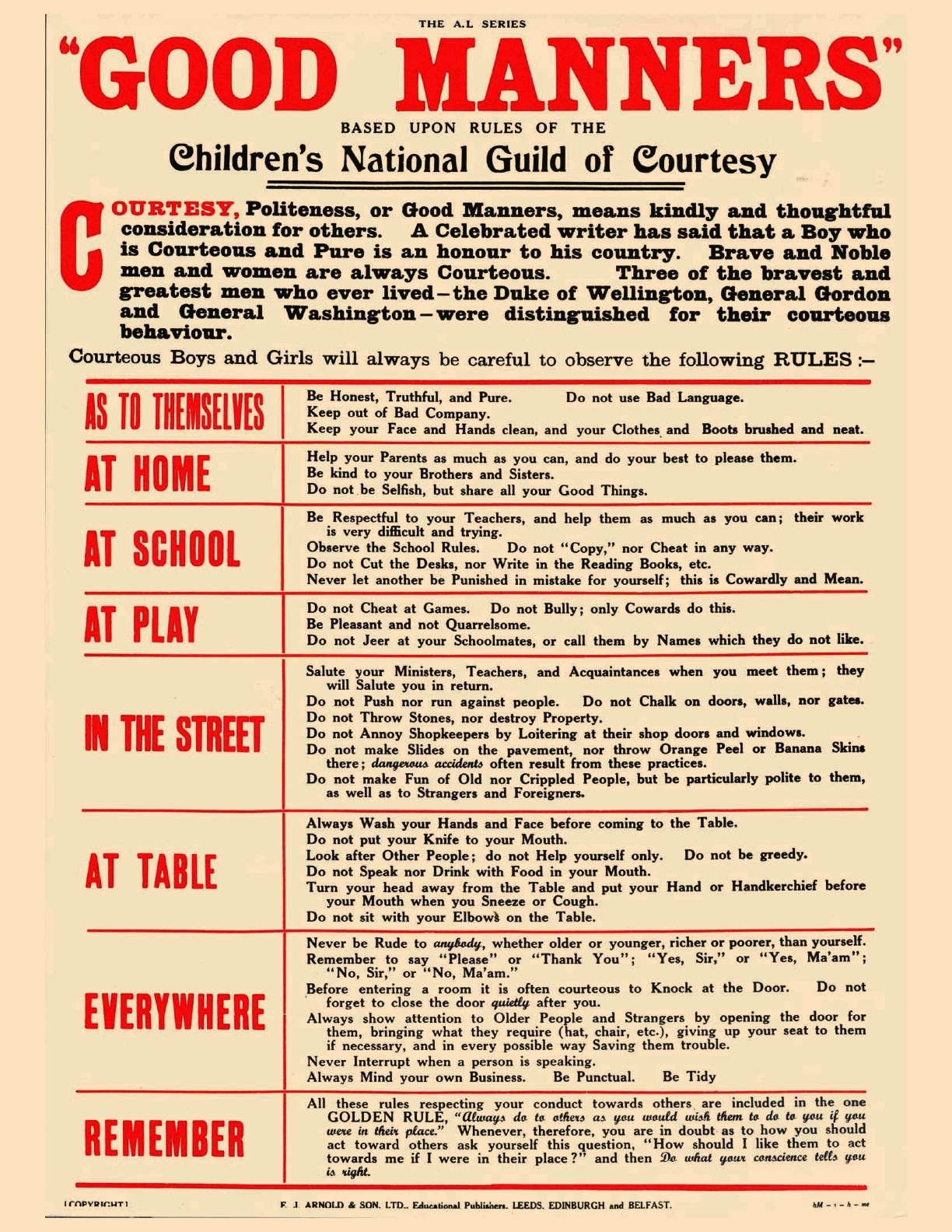
Victorian National Guild of Courtesy Rules

The ‘Good Manners’ chart was first issued to Queensland, Australia schools in 1898 by the Department of Public Instruction as part of the systematic teaching of conduct and manners. The chart was based on rules formulated by the Children's National Guild of Courtesy which had been founded in UK elementary schools in 1889.


Etiquette Enthusiast, Maura J Graber, is the Site Editor for the Etiquipedia© Etiquette Encyclopedia