Showing posts sorted by date for query Child training fork. Sort by relevance Show all posts

Tuesday, January 6, 2026

Polite Classes for Public Schools

It takes a rich man’s stomach to cater to dyspepsia. The poor man’s diaphragm is not so well educated, consequently not so fastidious and is better off in the end. In the homes of wealth may be often seen miserable little nervous dyspeptic wrecks, but who ever heard of a laborer’s offspring having anything so aristocratic and expensive? The public schools are filled with these sprouting sprigs of humanity, whose only stock in trade is a good healthy appetite with a stomach that is grateful for the wholesome treatment it receives, and it is to these children that lessons in politeness and refinement should be considered a moral obligation.

I WISH that I might raise my voice and train my pen that it might shower an avalanche of pleadings for this great need in the public school system. Philanthropists endow institutions for the cultivation of this, the progress of that, and the diffusion of all sorts of weird schemes of charity, but when it comes to needs that beget refinement and add so much to the pleasures of life, they seem to regard such training as superfluous. Moralists, imbued with but one idea, labor in the slums to reform those who do not want to be reformed and wouldn't reform, unless they were too hungry and God-forsaken to do anything else, and forget the refining influence that elevates the very lowliest. Physical “culturists” rave and rant of physical development, and deluge journalistic columns with formulas: “How to get fat” “How to get thin.” “How to sandpaper wrinkles,” and a lot of rot and fads that are suicidal to good looks, unless manipulated by one so expert that the price is far away and beyond the size of the wrinkle.

Hygiene is fairly slobbered over, and mothers made to feel that it takes whole hospital staff to bring up one scrawling, bawling, crawling mite of humanity, that would be a precious sight better off if it were not brought up at all, but just allowed to grow; for it is a melancholy fact that the children even of millionaires are a pitiably sorry crop when compared with the healthy little beggars that feast on little mud pies and have to raise themselves, irrespective of hygiene and sterilized appetites.

It takes a rich man’s stomach to cater to dyspepsia. The poor man’s diaphragm is not so well educated, consequently not so fastidious and is better off in the end. In the homes of wealth may be often seen miserable little nervous dyspeptic wrecks, but who ever heard of a laborer’s offspring having anything so aristocratic and expensive? The public schools are filled with these sprouting sprigs of humanity, whose only stock in trade is a good healthy appetite with a stomach that is grateful for the wholesome treatment it receives, and it is to these children that lessons in politeness and refinement should be considered a moral obligation.

Politeness and refinement exercise a far more potent influence over character than one is prone to believe, and its cultivation should be a matter of pride with the teacher. There is a large spice of temerity in my advocacy of this branch in the public schools, as I have a very distinct recollection of a series of indignant protests in the form of letters from an assortment of teachers scattered throughout the land, many of whom answer with no little asperity. Have not the teachers duties enough? Is not the life hard enough? 

Yes. I admit that it may be, but they forget, in this clamor, that every woman who has to earn her living has more or less a precious hard time of it, with fewer roses than thorns and a larger installment of sorrow than of gladness; but though admitting this, I am of the opinion that a woman’s life is very much more pleasant and that the rough edges are wonderfully smoother when the environment is made more pleasant by withdrawing some of the thorns. Now, to the refined woman, one who has been sufficiently well cultured to be able to secure the appointment as teacher, it must be self-evident that she would be much happier amid refined surroundings, and should they not be so, then her influence should establish such a condition.

One-half hour each week would do wonders in effecting a transformation that will more than repay any extra effort. 
One ambitious, sensitive child as an ally, whose example will accomplish good, will make miracles. In all of the ultra-fashioned schools girls particularly are taken through a regular course of etiquette, to fit them for the social world, and why not the children less fortunate who have no advantages of home training?

A woman of refinement teaching a public school must often feel revolted at the manners of the little people who are so easily corrected when approached in the proper spirit, and it would seem less unpleasant to reform these tender sprigs than to train the hardened shoots of later years. A teacher who meets the children @nfided to her with a pleasant "Good morning" fosters a habit that a child will never outgrow.

The teacher who adopts the rule of saying with a smile. "Thank you, will be more cheerfully obeyed, and we all krow that we comply more cheerfully when asked “Will you kindly do so and so,” than when we are commanded to do “so and so.” No one is ever the loser through extending courtesy, and we all know how much pleasure these trifles add to life. The politeness classes should embrace a series of “talks.” or, as the Italians say, “conversaziones,” in which various topics should be discussed.

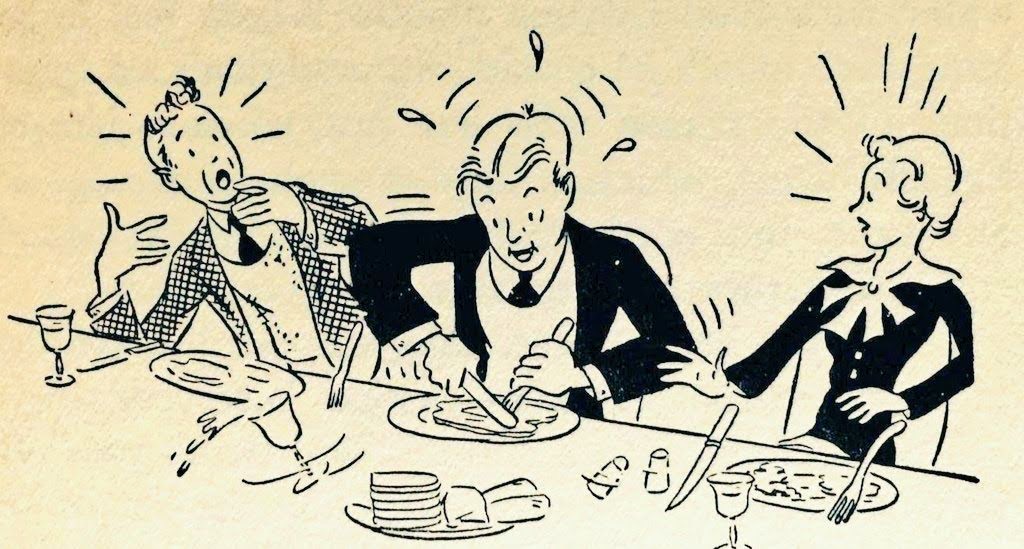
Take, for instance, table manners. Let a knife fork plate, cup and saucer, table and teaspoon, napkin and finger-bowl be provided, and one of the children be seated at the table in full view of the others. The teacher could then proceed to instruct the child in the presence of the whole school as to the proper use of table appointments. After a series of such lectures, which should be repeated at short intervals lest they forget, another phase could be descanted upon.

Two children should be introduced and taught the conventional way of extending and receiving an introduction, and then, by walking in pairs and meeting other pairs, the series of introductions could be invested with such humor as would make it a pleasure to both teacher and pupil. An amiable teacher with a well developed vein of humor would find such classes a pleasant relaxation, but she should cultivate the tact that steers clear of both ridicule and sarcasm. A sensitive child, who felt its lack of polish, would be deeply hurt by ridicule in the presence of a whole school, but this self same sensitive young one would be the quickest to profit by such lessons.

In this splendid country of ours, where fortunes are made in a day and the sons of laborers have an equal chance, through brains and ability, of rising to the very highest positions in the gift of the people, where the daughters, through beauty of person or the indefinable charm of grace, may wed millionaires, the necessity of this species of training is obvious. Many of these children know nothing of the graceful amenities of life, which they are so anxious to learn. They are ambitious and self-rellant, as all American children are, and yet are hampered by the total ignorance of the merest rudiments of social ethics.

In Washington, which is supposed to be the segregation focus of the most brilliant men in the country, the lack of polish is often deplorable, and those having the interests of the rising generation at heart cannot fail to appreciate the value of a course of “polite lessons” in the schools. From the rules of etiquette, the subject of “Cleanliness” should progress and be insisted upon. The hands and nails should be examined each day, and soon the child would learn to take pride in being considered neat.

I confess I have more confidence in a good old-fashioned lathering than in the inexhaustible subject of hygiene. The latter sounds more scientific and grandiloquent, but a real strenuous scrubbing with plenty of old-fashioned soap and a large percentage of elbow grease and muscle will fill the bill as far as young ones are concerned. 
An abiding faith in this enforcement would seem to accomplish much absolute good as lessons in the Bible, as we can certainly serve the Lord with a much cleaner spirit when physically clean.

Mental and physical cleanliness are very closely allied and the child who is taught to be clean mentally and physically is apt to be clean morally. At any rate, lessons in cleanliness will never do any harm, and perhaps a little less science and a little more common sense might be better understood by little people. Home training is undoubtedly the best, but where the mother is ignorant and knows nothing save of hard, unflagging labor and multiplied cares she has little time to teach the brood, even did she know herself, as many of them do not. In fact, she can better learn from them. That children would be immensely improved by the introduction of such classes cannot be denied, and that the teacher also would be benefited goes without saying.

It might come a little hard in the beginning to tone down a crowd of young savages, but the teacher who set the example of good breeding herself and who spoke courteously at all times would be repaid by the influence of her own personality. There are few children who cannot be Influenced by example in this regard, and it seems a pity that so many bright, ambitious and attractive little ones should grow up totally ignorant of the very principles of courtesy, or the little mannerisms 80 graceful in a woman. The children of the public schools go through an awful system of cramming that is often both foolish and useless as far as future use may be concerned, and it would seem a wise provision to substitute practical lessons on politeness for some of the extraneous matters that will amount to nothing In the long run.

Let some of the women so devoted to club life, who are always canting about the betterment of everything under the sun that had better be let alone, do some practical good by agitating this idea. If they have the time to figure in women's conclaves the time so devoted might be better spent in visiting various schools once or twice a week, and instead of poking their noses into all the cupboards in search of water-bugs or little specks of dust and overturning lunch baskets to see if the food were nourishing, thus mortifying and humiliating little people, as is often done if these ladies with hearts so full of morality and meddlesomeness would take this time and do the real good that would better fit these ambitious children for a higher social environment more good would be accomplished. 

And there are precious few children, particularly those in the higher grades, who have received just enough education to enable them to realize its advantages, who would not gladly welcome the chance to learn such little etiquette as would give them confidence should chance th them amid other and better surroundings. Let women who are always in an agitation panic and who have the time to stir things up generally do a little agitation, act on this score, and perhaps where they are now reaping anathemas the tide will turn and blessings will come in their stead. By all means let us try to have politeness classes in the public schools.— San Francisco Call, 1903


 🍽️Etiquette Enthusiast, Maura J. Graber of The RSVP Institute of Etiquette, is the Site Editor of the Etiquipedia© Etiquette Encyclopedia 

Wednesday, December 18, 2024

Etiquette for Spaghetti and Noodles


Many parents tell children to use their best “company manners,” as if good manners are not for families or one’s home, as well. This is a mistake. Good manners are best when used regularly around those we love and live with. It also helps children to develop good manners as good habits. My grandson, Jaxon, is learning good daily manners, though his technique with spaghetti needs a lot of improvement! Below is an image of a painting showing how spaghetti was once properly eaten in Italy, that was until sauce was added. Sauce was a game-changer!
                    
Old Italian artwork in background on magazine cover, shows how pasta was once eaten properly~ Tubular pasta or other shapes are much easier to eat without spilling. If you’re dining in public, try rigatoni, mosticiolli, cannelloni, bow ties, tortellini or even macaroni when ordering Italian. In Asia, and withAsian dining etiquette, unlike American or European etiquette, slurping up long noodles is considered good manners, as is lifting the bowl close to one’s face.

Some pretty interesting gadgets have been invented to help eat spaghetti and other long noodles. This shown above, is one of the least practical Etiquipedia has seen.

Over time, many inventors have tried to invent forks, spoons and other utensils for the eating of pasta, hoping it would make eating pastas easier and cleaner, but few have actually worked. In the end, any way you twirl it, long pasta or noodles can still be very messy.
This 1939 creation resembles a child’s “food pusher,” but is designed with spaghetti – and other difficult foods – to eat in a “highly genteel manner.” ~  The patent description reads, “Accordingly, in use and practice, the implement may be held in one hand with the scraper face 3 flat-wise upon a plate, dish or the like C as shown in Figure 3. A fork D may be held in the other hand, and the gathering of the particular foodstuff upon the fork D for conveyance to the mouth may be facilitated in a simple, convenient, and highly genteel manner, as illustrated in Figure 3, thereby conducing to the ease and satisfaction of the diner and obviating the frequency occurring embarrassment of ‘chasing food around the plate.’”
Practice makes better, so keep practicing when you can

Some spaghetti etiquette tips:

• If you want to twirl, you may use a spoon to help you. 
Leave the bowl of the spoon on the plate, not up in the air, 
and only try to twirl two or three “strings” at a time onto the 
fork with the help of the spoon. If you put too many strings 
on the fork, the result will be too much pasta once it is all 
twirled. 
• Try not to have any “strings” hanging down from the fork 
that you will need to slurp up into your mouth, or bite off, to 
fall back into your plate. 
• Bring the pasta to your mouth, not your mouth to the pasta 
or plate. 
• If you need to, you can cut your pasta with the side of 
your fork, but never use a knife. 
• Make sure you have a napkin on your lap to catch anything 
that may fall to your lap.  Use your napkin to wipe you 
mouth in between bites too, if you think there is a chance 
you have sauce on your face. 
• Practice makes better, so keep practicing when you can. 
From The RVP Institute of Etiquette 

A 1953 "spaghetti twirler fork" ~ On Eating Spaghetti : "The aficionado knows that the only graceful and satisfying way to eat real Italian spaghetti (which comes in full length or perhaps half-length rounds) is to eat it with a large soup spoon and a fork. The spoon is placed in the left-hand more or less upright in the plate (or often platter) of spaghetti. The right-hand uses a fork with the tip of the prongs against the spoon to wind the spaghetti in to a manageable mouthful. It should not drop off the fork. The fork full of spaghetti is then conveyed in the mouth while the spoon remains in the hand and on the platter. As with any sauce dish, it should be eaten without stirring the spaghetti, grated cheese, and meatballs (or other garnish) altogether, infant style.  The timid way to eat spaghetti is to cut it into small bits with knife and fork and eat it with a fork alone. Thick macaroni can't be eaten rolled on a fork so readily and is better cut with a fork as one goes along. Remaining sauce of each dish maybe eaten with a spoon or sopped up with small bits of bread, which are then eaten with a fork." Amy Vanderbilt's Complete Book of Etiquette

Pasta and the Arabs 

In the Jerusalem Talmud, written in Aramaic in the 5th century AD is the first certain record of noodles cooked by boiling. The word used for the noodles was itriyah. In Arabic references this word stands for not homemade noodles, which would have been fresh, but the dried noodles purchased from a vendor. While fresh noodles must be eaten immediately, dried noodles are extremely portable. Pasta was more than likely introduced to Sicilians during the Arab conquests and carried in as a dry staple. The Arab geographer, Al Idrisi wrote that a flour-based product in the shape of strings was produced in Palermo, then an Arab colony.
Macaroni and cheese is not a modern food creation. Numerous recipes for macaroni can be found in cookbooks of the late-19th century. To demonstrate just how popular macaroni was, take a look at these large gilded, macaroni servers from the time period. Only the most popular of foods had utensils designed for serving and eating them at the time. These are excellent examples. The following article is how macaroni got its name. Sadly, as popular as they were, these versatile serving forks fell out of use after the gilded age and never made a comeback . This was despite the fact that they came in numerous styles and were marketed as “fried oyster servers” and as “tomato servers,” as well.

Marco Polo and Pasta

As the Chinese are known to have been eating a "noodle-like food" as early as 3000 BC. Marco Polo describes a starchy product made from breadfruit - hardly what we now know as durum wheat. The myth that Marco Polo brought pasta with him upon his return from China was debunked long ago.  Polo returned to Italy in 1295 after twenty-odd years of travel, but much earlier in 1279, a Genoese soldier listed in the inventory of his estate a basket of dried pasta ('una bariscella plena de macaronis').
A 1933 table-fork designed specifically for any "string-like" food.
New World Tomato Meets Old World Pasta

In the 16th century, the Spanish brought their food discoveries back to the old world. Among the rich assortment of foodstuffs that were to become permanent fixtures in the old world was the tomato. The tomatoes may have been a pale variety as they were given the name 'golden apple' (pomo d'oro) by a Sienese botanist, Pietro Andrea Mattioli. The tomato was born to meet pasta as any Italian might have guessed, and tomato sauce altered the history of pasta forever. The first recipe for tomatoes with pasta wasn't written until 1839, however, when Ippolito Cavalcanti, Duke of Buonvicino, offered a recipe for 'vermicelli co le pommodoro.' A mere thirty years later, La Cuciniera Genovese offered recipes for purées, soups, distinctly different sauces for meats, chicken, veal and pasta. Tomatoes had arrived. 
Vintage and modern table tools for eating long spaghetti~ A simple noodle shaped the history of manners as well as the history of food ~ Until the creation of tomato sauces, pasta was eaten dry, and with one's fingers. The liquid sauce suddenly demanded one's use of a fork.  The manners of the common man were changed forever. 


“A North American father, presumably initiating his son, aged 15, into the world of adult business affairs, took him out to what the boy described as 'a big dinner meeting.' When the company was served spaghetti, the boy ate it with his hands. 'I would slurp it up and put it in my mouth,' he admitted. 'My dad took some grief about it.' The October 1985 newspaper article does not describe the response of the rest of the company. The son was sent to a boarding school to learn how to behave. 'When we have spaghetti,' he announced later, 'you roll it up real tightly on your fork and put it in your mouth with the fork.'

What he described, after having learned it, is the dinner-table ritual --as automatic and unquestioned by every participant in it, as impossible to gainsay, as the artificial rules and preferences which every cannibal society has upheld. Practical reasons can be found for it, most of them having to do with neatness, cleanliness, and noiselessness. Because these three general principles are so warmly encouraged in our culture, having been arrived at, as ideals to be striven for, after centuries of struggle and constraint, we simply never doubt that everyone who is right-minded will find a spaghetti eating companion disgusting and impossible to eat with where even one of them is lacking. Yet we know from paintings and early photographs of spaghetti eaters in 19th century Naples (where the modern version of spaghetti comes from) that their way of eating pasta was with their hands-- not that the dish was likely to appear at a formal dinner. You had to raise the strings in your right hand, throwback your head, then lower the strings, dexterously with dispatch, and without slurping (there are invariably 'polite' and 'rude' ways of eating), into your open mouth. The spaghetti in the picture does not seem to have sauce on it.

Today, spaghetti-eating manners demand forks, and fist fulls of wet pasta are simply not acceptable on any 'civilized' occasion. The son's ignorance cast a dark reflection upon his father: he had not been doing his duty, had not given his child a proper 'upbringing.' Even if the boy had not seen spaghetti before, he subsequently admitted that what he ought to have done was to look about him, watch how other people were eating this awkward food, and imitate them. In any case, the options were clearer after this demonstration of an ineptitude: either the boy learns his table manners, or he would not be asked to 'a big dinner meeting' again by anyone who had heard of his unfinished education.” Margaret Visser, The Rituals of Dinner

In Japan, when you move into a new home, it's customary to present your neighbors with buckwheat noodles known as “hikkoshi soba.”  In addition to being the name of the noodle, soba is a homonym for the word ‘near’ and “hikkoshi soba” is a play on words meaning “We've moved near you.”
A most modern noodle fork.


Contributor Maura J. Graber has been teaching etiquette to children, teens and adults, and training new etiquette instructors, since 1990, as founder and director of The RSVP Institute of Etiquette.  She is also a writer, has been featured in countless newspapers, magazines and television shows and was an on-air contributor to PBS in Southern California for 15 years. Over the past 35 years, Graber has written several books. Her latest,  “Yesteryear… More of What Have We Here?: The Etiquette and Essentials of Past Times to the Mid-20th Century, is available on Amazon.”
      

🍝Etiquette Enthusiast, Maura J Graber, is the Site Editor for the Etiquipedia© Etiquette Encyclopedia🍜

Saturday, September 23, 2023

Chopstick Incompetency Crisis


“If some experts in this country are right, a fast growing number of people, most of them young, cannot properly use an implement so basic that it is virtually a symbol of Asia. A college professor who has studied the situation says that well over one-third of Japanese in their 30s and younger are chopstick incompetents.” 1984 – This unusual rice bowl, circa early 1990’s, has the etiquette for eating from a bowl and etiquette for chopstick use printed on the inside and outside of the bowl. 


Chopstick Incompetency Becomes Crisis for Japan

Chopsticks have become too much to handle for many Japanese, If some experts in this country are right, a fast growing number of people, most of them young, cannot properly use an implement so basic that it is virtually a symbol of Asia. A college professor who has studied the situation says that well over one-third of Japanese in their 30s and younger are chopstick incompetents. 

In a Ministry of Education report released last month, only 48.4 percent of elementary school pupils surveyed said they could correctly wield chopsticks, or hashi, as they are called in Japanese. The Tokyo police department has grown concerned enough to give recruits a crash course in chopstick use and etiquette. "We can't convince them to use chopsticks properly unless we tell them logically that using the hands is good for their brains and things like that,” one police inspector said. 

In this capital’s bustling Shinjuku section, a company called Office Create has gone into the hashi training business, offering two hours of instruction every week for three months. Fee: nearly $80. Department stores and supermarkets now stock “trainer chopsticks,” plastic devices with loops to show youngsters where to put their fingers. According to the manufacturer, Tohoku Kako, sales started to rocket late last year and now approach 10,000 pairs a day. “We expect our business to continue to do well," said Hiroyasu Ito, the company's sales director “Our target population 3 to 8 years old is as large as 8 million." 

Why all this has occurred is one of those questions that start arguments, but there is little dispute that the decline augurs ill for Japan. To some Japanese, chopsticks touch the national soul an outgrowth of the widely held belief that Japan prevails against bigger, better-equipped countries because its people are nimble and quick-witted “Many scholars attribute the dexterity of the Japanese people to hashi, and I myself think that has some validity," said Masaaki Yatagai, a professor at Keihin Women's University in Kamakura, south of Tokyo. His specialty is preschool education, especially how youngsters learn basic life skills.’’ 

“Some people.” Yatagai said, “even think that hashi are responsible for the dexterity and resourcefulness that helped bring about Japan’s economic boom. More than a few Japanese blame the chopstick decline on Western foods and the collateral reliance on knives and forks They cite the many youngsters who now learn to eat with an implement that has a fork on one end and a spoon on the other. Others say no, that the fault lies with an educational system that emphasizes test-taking ability to such an extent that it often ignores teaching children how to get through the day. Repeated studies show that fewer and fewer Japanese children are familiar with skills such as peeling an apple or sharpening pencils with a knife. Yatagai thinks they are all wrong. It isn't the education system or the two-headed fork-spoon or the advent of hamburgers in Japan, he said. 

In research performed in 1935, he noted, the average Japanese child learned to use chopsticks properly at the preschool age of 3. Now the average age has doubled, and many youngsters never attain proficiency “Parents just don’t want to admit that they’re the cause of the problem.” the professor said “They themselves can’t handle chopsticks properly of late.” None of this is meant to suggest that across Japan people are dropping food into their laps. As best as a casual observer can tell, that distinction is still left largely to foreign tourists. “Do you know how to use chopsticks?” is on the list of favorite Japanese questions to new acquaintances from the West.) It is the imprecision of the latter-day hashi technique that shocks the purists. 

The sticks should be held with one cradled between the thumb and index finger, the other planted between the index and middle fingers, with the middle finger kept between the two sticks Instead, many Japanese hold hashi like a pen, or place the sticks between the middle and ring fingers. or cross the sticks, or hold them much too low. To avert the accidents they risk with their poor technique, these people often keep their heads close to the plate This is called mugui dog-style. Some children have been known to spear food with chopsticks, a sin on a par in other countries with eating peas with a knife. – By Clyde Haberman, for the N.Y. Times News Service Tokyo, 1984


 🍽Etiquette Enthusiast, Maura J. Graber, is the Site Editor for the Etiquipedia© Etiquette Encyclopedia

Tuesday, June 27, 2023

More Child Etiquette Training Utensils

On children learning table manners ~ “Every human being without exception must pass through this rite of passage, being forbidden the motherly breast or the bottle and taught to eat solid food. The child must learn for most of its mealtimes to give up sucking, the skill with which it was born. The area inside the cheeks of small children is well provided with taste buds, which adults' cheeks are not; babies taste not only with their tongues but with their cheeks. This is thought to be why they like packing their mouths with food. They must be made to take less at a time.” ~ Margaret Visser, in “The Rituals of Dinner”

A few more examples of
Child Etiquette Training Tools
from the 1800’s & 1900’s

Food pushers for baby were essential in a day when "cleaning the plate" was a rule observed by every child. These pieces were available in almost every popular flatware pattern.
The R. Blackington Company created these fun toddler spoons – “A barrier at one side of the bowl of baby training spoons supposedly frustrated the child who wanted to use his left hand at the table. The manufacturer offered a variety of appealing  animal barriers.” 

The “My Own Set” plate came with a toddler-sized, silver plated fork and spoon set. Some even came with a matching child-sized mug. They were available featuring art depicting boys, girls, and even animals, though most popular was this adorable girl with her teddy bear in a high chair, “learning to eat properly.” The plates were designed to remind the child where his or her fork or spoon should go— on the right or the left side. This is one of the rare plates that was available in Spanish.


These patent and description images, along with a previous Etiquipedia post on Child Etiquette Training Tools and other items, can be found at this link.


— Advertisements and text above from “American Silver Flatware 1837-1910,” by Noel Turner, 1972 and the “My Own Plate Set” is from the Etiquipedia private library and will be featured in an upcoming book by Site Editor, Maura J. Graber


🍽Etiquette Enthusiast, Maura J. Graber, is the Site Editor for the Etiquipedia© Etiquette Encyclopedia

Friday, October 23, 2020

Degree in Etiquette Never Offered

                          
From what we at Etiquipedia have researched, NYU never did offer the degree mentioned in Dix’s 1916 article. It is disappointing, though, as it would have been one way of actually “certifying” someone as knowledgeable in etiquette and manners. — Elizabeth Meriwether Gilmer was an American “Agony Aunt” who wrote under the pen name, “Dorothy Dix.” A forerunner of today’s advice columnists, Dix was America’s highest paid and most widely read female journalist when she died in 1951. Her advice was syndicated in newspapers around the world, with an estimated audience of 60 million readers. Along with her column, she campaigned for woman suffrage.
— Public domain image


School of Manners, Dorothy Dix Says, Is Badly Needed American Child Too Often Lacking in Politeness and Little Graces of Human Intercourse

It is announced that the New York University is going to establish a school of manners, and that the degree of M. E.—Magister Elegantiarium—may be conferred on such students as perfect themselves in the etiquette of polite society. This news sounds almost too good to be true. Let us hope, however, that such a course of study is really to be established in one of our great schools, and that it will be compulsory, for nothing is more sadly needed.

For whatever other charms and virtues the American youth may possess, good manners are seldom among them. As a child he is almost invariably a little savage. As a hobbledehoy he is generally a hoodlum, and as a grown man, he is only too often an awkward blunderer, who is like a bull in the social china shop. On every side we encounter multitudes of men who have intelligence, force, power, men who have achieved success in their own particular calling, but who are as ignorant as babes of any of the graces of human intercourse. 

They cannot enter or leave a room without falling over their own feet. They do not know what to say when presented to a stranger, or how either to pay or receive a compliment. At dinner parties you may see them hopelessly floundering around among the silverware. At restaurants you may observe them with their legs twined like snakes around their chair legs, grasping their forks as if they were about to harpoon an attacking whale, and, alas, you may even pass away an evening listening to them eat their soup. 

Of course, we excuse such men by saying that they have been too busy with big affairs to give their attention to such small matters as the proper use of a fork or a spoon. We say that it's more important that a man’s heart should be of gold than that he. should wear the right sort of coat for the occasion, and we try to gloss over his boorishness by calling him a rough diamond. All of which is sheer nonsense. Nobody will contend that a rough diamond is as valuable as one that is cut and polished, and the truth is that while a man may succeed without good manners, he would succeed better with them. 

To know how to do things, to possess what the French call savoir faire, is always a help, never a handicap in life. People have always appreciated this fact, so far as women were concerned. In all girls' schools special attention is paid to deportment, and girls are taught the niceties of etiquette that they perhaps de not have an opportunity to learn in their own homes. More than that, at home stress is laid on little girls behaving like ladies, and wherever you go, the small daughter of the house will receive you charmingly, drop her little courtesy and endeavor to engage you in courteous conversation. 

But apparently the mothers of the same families make no effort to instill politeness into their boys, and their lads will storm into the room with their caps on. They will never stop to speak to the visitors, and only grunt by way of reply when addressed. And when these boys are sent off to school, no effort seems to be made to supplement their lack of home training in manners. They are grounded in all the arts and sciences except the most important art and science of all, which is that of making oneself agreeable to one’s fellow creatures. 

For, when all is said and dont, good manners will carry one further than anything else in the world. They are a letter of credit» that every one of us honors* at sight. The clown may compel our grudging respect, but present our hearts as a free gift to the courtier. A young man may be of the most sterling worth and yet wear a decollete collar that exposes his Adam’s apple and a coat and trousers and waistcoat of different makes and colors so that he looks like an animated patchwork quilt, but if he and another youth who knew how to dress, applied for the same job, the good clothes would get it. 

A man might he a genius and yet eat peas with his knife, but he would have a hard time getting close enough to those who might help him to get a chance to show what he could do. A man may have almost superhuman ability in any line, but if he is rude and crude in his manners, if he does not know how to please, he lives and dies neglected. On the other hand, the man who has what we call a charming personality, who is gracious in speech and polite in manners, finds a helping hand always at his elbow and a friendly shoulder ready to boost him up the ladder. That is why it is so important to teach boys good manners and why the opening a department in the New York University is epoch-making. — By Dorothy Dix, 1916


Etiquette Enthusiast, Maura J. Graber, is the Site Editor for Etiquipedia© Etiquette Encyclopedia


Monday, September 21, 2020

Russia’s 1990s Etiquette Revolution

In today’s class-conscious new Russia, however, refinement is on the rise, and those pondering careers in international business or diplomacy are seeking to rectify their deficit of graces. From social etiquette classes that have been added to public school curricula to resurrected pre-revolutionary finishing schools like those within the New University of Humanities founded here by Natalia Nesterova, there is growing interest— and income— in the teaching of proper manners.
—Photo source, Instagram

Minding Manners in Moscow


Vera Ignatieva’s lecture on how proper young ladies accept an invitation to dance is interrupted by a door slamming behind a tardy pupil. Ignatieva halts the culprit in her tracks with a glare as powerful as a stun gun.

“Is that any way for a cultured person to enter a room?” she demands of the trembling 7-year-old arriving for a first lesson. “Go back outside and try again— this time in a civilized manner!”

Across town, the latecomer is slightly older, but the reproving glance from Alena Gil is as withering as Ignatieva’s. “You are late again, Vika. And furthermore,” says the appalled etiquette teacher, “how dare you come into my classroom with gum in your mouth!”

Slammed doors, snapping jaws, slouchy posture and sloppy table manners are under attack in places such as Ignatieva’s Ballroom Dancing and Court Etiquette School and the Institute for Noble Young Ladies, where Gil teaches socially aspiring teens.

But after eight decades in which society put more stock in a young person’s skill handling a forklift than in his or her way with a salad fork, the purveyors of polish at Russia’s revitalized charm schools concede that they have their work cut out for them.

Boorish behavior was a hallmark of the Bolshevik era, when civility was thrashed by the coinciding brutalities of war, widespread poverty and social leveling. The remnants of the Russian aristocracy fled abroad to escape exile or execution.

In today’s class-conscious new Russia, however, refinement is on the rise, and those pondering careers in international business or diplomacy are seeking to rectify their deficit of graces.

From social etiquette classes that have been added to public school curricula to resurrected pre-revolutionary finishing schools like those within the New University of Humanities founded here by Natalia Nesterova, there is growing interest— and income— in the teaching of proper manners.

“We could hardly have operated during the Communist era, when the very concept of nobility was officially targeted for destruction,” says Nesterova from beneath the net veil of a milliner’s fanciful creation. “But now that it is possible, it is all the more important that we prepare a new generation of young women to be credits to their families, to their future husbands, to their employers and, most importantly, to themselves.”

The Institute for Noble Young Ladies, which is one branch of her private university, was reconstituted three years ago on the reputation of an imperial-era boarding school that trained the daughters of wealthy merchants and noblemen in the czar’s court.

Nothing but that somewhat antiquated ideal survived the traumas of communism, says Nesterova, and the institute now strives to incorporate the modern demands of society into the structure of education in more traditional spheres.

“In today’s conditions, it is not wise for a woman to be without the intellectual means to compete in the workplace, even if she expects to be a homemaker,” she says. “That is why we have added courses in office management and business to our cultural repertoire.”

Sexology, family planning and body-shaping aerobics are also new twists to the classic agenda, but they are additions graduates need to deal with modern realities, Nesterova says.

Vika Zavalnaya plans to study law at Moscow State University beginning next year, but she enrolled at Nesterova’s institute at the urging of her older brother, a successful businessman who supports her and their widowed mother.

“This is the kind of instruction that will give me an advantage in my profession,” says the exuberant 17-year-old, not yet weaned of her affection for gum. “When you work with clients, especially foreigners, it’s important to know how to conduct yourself gracefully in a restaurant as well as the office.”

Looking for Employees With Polish

Russian and foreign hiring executives say they are on the lookout for employees with polish and that something as simple as a thank-you note after an interview can affect their choices.

“Knowing how to present oneself is as important as professional and technical knowledge,” says Konstantin Korotov, head of personnel development here for Ernst & Young, the international accounting firm that employs 500 local professionals throughout the former Soviet Union. “We’ve always managed to recruit well-educated people, but we want those representing our firm in the CIS [Commonwealth of Independent States] to do so with the same level of quality and professionalism as we have in Sydney or Paris or Cleveland.”

For 15-year-old Nina Babicheva, a charm school diploma is the ticket into the most desirable social circles.

“I’m not very good at math or science. What I love here is the attention to art and culture,” says Babicheva, who is balancing the finishing school program with her high school education. “I don’t have any big career goals. If I have to work, I think I’d like to be a journalist. But what I would really like is to get married and be free to spend my whole day riding horses.”

Private finishing schools such as the institute in central Moscow remain beyond the means of the vast majority of families, even at what might seem a reasonable tuition by Western standards of $1,500 a year.

But programs tailored to local circumstances are growing alongside the charm-school courses for the well-heeled, including weekly etiquette classes introduced in most elementary schools over the past two years. It is mostly young women who have expressed interest in learning social graces, but some schools also aim to prepare boys for a more courtly environment.

“We are educating tomorrow’s business and social leaders, and we cannot do that properly with yesterday’s practices,” says Irina Sirina, vice principal of Moscow Elementary School No. 184 in the far northern suburb of Dmitrovsky. “Personal hygiene and good behavior were discussed in schools indirectly during the Communist era, but there was no encouragement of the individual at that time. Etiquette then existed only as another measure of conformance.”

Her school, like many other public institutions, has taken aim at the surly behavior exuded by older generations, in which even the most highly educated can be found spitting on the sidewalks or hunkering down over their dinner plates like prisoners. The hourlong classes cover both personal and social behavior, from good grooming to diction to table manners.

“In the past, etiquette was not considered important because the measure of an ideal student was his ability to multiply and write properly and learn by heart poems about Communist Party heroes,” says Marina Nayanova, deputy director of a private finishing school with 50 students in the provincial city of Kostroma, 250 miles east of Moscow. “We see how much children’s behavior has deteriorated, and parents now have to work so hard that the last thing they have time for is [worrying about] manners.”

Extensive instruction in the social graces tends to be limited to private schools, where tuition runs to thousands of dollars each year, or to hybrid institutions such as the Donskoy Military Academy, where commercial sponsors augment the fees paid by parents.

Ignatieva, who has been teaching ballroom dancing for 45 years and etiquette since it became politically safe to do so about a decade ago, accepts payment only as individual parents can afford it and relies on connections with the artistic elite to cover the rest of her expenses.

She teaches a few dozen children who come to her studio in small groups twice each week for dance instruction and brutally candid assessments of their social skills.

“All of the popular and elegant dances were forbidden under [Soviet dictator Josef] Stalin— the fox trot, the tango, everything, especially if it was foreign,” says the feisty proprietor of the children’s dance academy. “It wasn’t until a few years ago that there were enough of us to rise up and demand our dignity back.”

The ninth child in a poor family, Ignatieva learned how to behave in high society only after it was banished. She married the son of a count who had been driven into exile after the 1917 Bolshevik Revolution and acquired her knowledge of etiquette from a hidden book on English manners and in whispered lessons from her husband.

“What is nobility and how do you teach it?” asks the snow-haired widow who is long past retirement time but coy about age specifics. “Some are born with it, but it can also be acquired through learning, and one of the most elegant expressions of nobility is ballroom dancing.”

But to dance well requires self-confidence, elegance and poise— commodities she says were hard to come by in the Soviet era, which glorified the spartan lifestyle of the working class.

Those deficits have compelled Ignatieva to broaden her dance instruction to include a general education in social graces.

“You cannot act like a gentleman when you are dressed like a laborer,” Ignatieva admonishes a hapless and humiliated preteen who has come to her studio in jeans and black T-shirt.

Parents Learn Manners From Their Children

The young patrons of Ignatieva’s studio and at etiquette classes being offered across the country bear up determinedly despite the upbraiding, often because they are encouraged by their parents to take advantage of opportunities they never had.

Oksana Abramova, a homemaker whose 8-year-old daughter, Ella, is enrolled in an after-school etiquette class, confides in a visitor that she too is taking instruction— indirectly.

“We like it when she practices at home, because my husband and I are learning from her,” Abramova says of her daughter’s recent recitals on how to set the table.

Older students undertaking more extensive training for entrance into the new elite cite a need to find a middle ground between the crudeness of the past and the garish excesses of the present.

Gil, a former drama instructor who teaches posture and grooming at the Institute for Noble Young Ladies, helps her young charges learn to use makeup with moderation and to dress appropriately for the business environment that is currently populated more by those wearing leather miniskirts and spike heels than by devotees of tailored suits and silk blouses.

“We have many people in our society who are smart and capable, but in the future it will take more than that to be successful,” says 16-year-old Yekaterina Vorontsova, who wants to become a financial secretary after finishing her course work at the institute. “What we need isn’t just a matter of clothes and expensive cosmetics. What we need is sophistication.” — Los Angeles Times, 1997


Etiquette Enthusiast, Maura J Graber, is the Site Editor for the Etiquipedia© Etiquette Encyclopedia

Wednesday, April 1, 2020

Company Table Manners

As soon as a child is old enough to come to the table he should be taught by precept and example what good table manners are... Let it be understood that good manners are not the acquiring of every new wrinkle that fashionable society may prescribe. There is a great difference between good manners and good form. What is good form to-day may be very bad form tomorrow, but good manners are not changeable.

There seems to be an idea among many people that there must be a different set of manners for company from what is observed in everyday life. While it is the proper thing to have for an invited company a more elaborate dinner and a little more ceremony in the service than at the family table, it must be remembered that one should not put on and take off good manners as one would a garment. They are a part of one's self, and whether the family meal consist of many courses, or only a cup of tea and a slice of toast, it should always be served decently and in order, and the manners of the members of the household should be such that one need not blush for them, even in the finest company. As soon as a child is old enough to come to the table he should be taught by precept and example what good table manners are. If the father and mother be so unfortunate as not to have had proper training themselves, they should study to correct any bad habits they may have, for the sake of their children. 


Let it be understood that good manners are not the acquiring of every new wrinkle that fashionable society may prescribe. There is a great difference between good manners and good form. What is good form to-day may be very bad form tomorrow, but good manners are not changeable. Unselfishness, kindly feelings and politeness are the foundation of good manners. Good table manners demand that one shall take soup from the side of a spoon; shall eat with a fork, rather than a knife; shall take small mouthfuls of food and masticate quietly, making no unpleasent sound; shall take in the fingers no food except fruit, confectionary, olives, bread, cake,celery, etc., and that the members of the family shali be as polite to each other as to any guest. Where people rush through their meals there is not much chance fo: table maners or good digestion. If properly managed, the table can be made one of the most refining influences of the home. —Ladies Home Journal, 1892


Etiquette Enthusiast, Maura J Graber, is the Site Editor for the Etiquipedia©️ Etiquette Encyclopedia 

Tuesday, April 2, 2019

Importance of Polite Children

We cannot expect all little children, indeed, to be little Lord Fauntleroys or Eva St.Clairs, but they can be taught to be thoughtful, unselfish, respectful and courteous. 


It seems to me that too many mothers neglect an important element in the training of their children. In fact, do young folks at any time have the manners that distinguished those of two generations ago? There has been a sad decadence of manners generally within the last forty years, and unfortunately children have been affected by it more visibly than others. Gone is the oldtime courtesy which children showed to their elders, especially to the aged. I remember when boys were taught to raise their hats to teachers and the girls to courtesy. In reply to all questions it was the rule rather than the exception to answer, “Yes, sir,” or “No, sir,” to a gentleman, and “Yes, ma'am,” and “No, ma’am,” to a lady. The change is to be regretted.

And yet we cannot blame the children. The fault lies with their parents, principally their mothers. We cannot expect all little children, indeed, to be little Lord Fauntleroys or Eva St. Clairs, but they can be taught to be thoughtful of others, unselfish, respectful and courteous. Especially should they know how to behave politely in the dining-room. If there is one thing more than another that shows our bringing up, to use a common expression, it is our manners at table. The way we eat. Yet how often is one’s whole meal made unpleasant by some unruly or misbehaved child. Mothers cannot be oblivious to the misdemeanors of their children in this respect Possibly, however, they may not realise that the responsibility of their behavior or misbehavior rests upon them; but it is as necessary to teach them good manners as that they must not eat too much.

In the first place, are not children petted too much and allowed too many privileges in these days? In many books the children are the real managers. They monopolize the conversation and continually interrupt older ones while talking. This is all wrong. Such a mode, or, rather, lack of training, fosters their selfishness and vanity, and renders them real nuisances of fault-finding and discourtesy.

Only the other day I was greatly shocked while visiting at a friend's house by the ill-manners of her little boy, who was not quite 10 years old. Before we were all fairly seated at the table, he leaned forward upon the table, knife and fork in hand, and exclaimed: “I want some of the plum pudding, but I won't have any cake.” “You must wait, Carl.” said the father. Afterward he was helped three times to the plum pudding, though several of the older ones had a much smaller amount in consequence. I imagined that his mother might feel ashamed of his want of breeding, but the little fellow afterward remarked to me confidentially: “Mamma always says that I may have the lion’s share of anything.” 


A faultless toilet, quietness of demeanor and a willingness to wait for others, the use of the fork instead of the knife, the absence of fault-finding, the proper use of the napkin, eating and drinking without making any uncouth noise, these are all to be equally observed as a part of table etiquette, and the youngest boy or girl can easily practice them. Nor should they forget the “please” and “thank you” that have so much to do toward making children attractive. I hope that mothers will see to this matter and make it a duty to educate their children in this, as well as other elements of true politeness, so that the next generation will rise up and call them blessed.—Mrs. J. M. Colby, in the Housekeeper, 1896


Etiquette Enthusiast, Maura J Graber, is the Site Editor for the Etiquipedia© Etiquette Encyclopedia 

Thursday, February 18, 2016

Etiquette Essential to Schools

It would be of great importance to the world at large were the public schools of America to institute a "good manners department” in the kindergarten, the primary and intermediate departments of all schools. — Ella Wheeler–Wilcox

Teaching in School —
Need of Instruction to Make Children More Courteous and Refined 


Training in Good Manners Is Essential to a Country Which Is a Smelting Pot of Offspring from Every Nationality on Earth

OUR school system needs revolutionizing. The community is taxed heavily to support school institutions. The introduction of the drawing master, the music master, the district nurse, the visiting dentist and doctor, all means increased taxes for the people. Most of these innovations on the old school system (which consisted of teaching the "Three R’s  — reading, writing and 'rithmetic" ) are of value to the children —the coming generation of men and women. 


It is, however, the opinion of many thinking people that the time and money expended on the teaching of art in our public schools, might well be reduced to a minimum. Not one child in one hundred possesses sufficient talent in this line to make it worth while to continue the study after school years. The child who does possess such talent would be discovered, were not a whole community taxed and the time of an entire school taken a portion of each day, which might well be devoted to something of more universal value. 

One of the most important things in the education of any man or woman is good manners. Manners which do not offend in dally deportment. A man may know nothing of art and nothing of music and yet not offend his neighbors, though he live to be a hundred years old. But the man who knows nothing of the niceties of good manners at the table, or deportment in public vehicles, or places of entertainment, is a continual annoyance and irritation, to his fellow beings. To eat noisily, to display a toothpick in public, to use the knife where the fork is intended, to crowd in front of women and children, to talk loud in public—all these habits interfere with the general well being. 

It is in the early childhood life that right habits should be taught. It would be of great importance to the world at large were the public schools of America to institute a "good manners department” in the kindergarten, the primary and intermediate departments of all schools. Ten minutes each day given to instruction by short talks and demonstrations on these subjects would accomplish miracles of good. 

Listen to the "gum-chewers," the right way of manipulation of the knife and fork at the table, the right attitudes, the proper use of the napkin... are all matters of much greater importance in the education of the average child than instruction in drawing or in dissection of dead animals. Our country is a smelting pot of every nationality on earth. Our schools are composed of children from all classes and all climes.

Many people come to us whose lives in the old countries have been passed in remote places, far from centers of civilization, where no knowledge is obtainable of the niceties of life. The children are reared by these parents in the same habits which characterized their early environments. A large majority of these children will grow up to be intellectually brilliant men and women, and many of them will occupy prominent places, industrially and politically. It is important that they should be trained in good manners in the small things of life as well as in intelectual development. If young children are made to realize that good manners are regarded as a part of education, they will use their influence upon their parents. 
—Ella Wheeler - Wilcox, 1921


Etiquette Enthusiast, Maura J Graber, is the Site Moderator and Editor for the Etiquipedia© Etiquette Encyclopedia

Monday, January 11, 2016

Etiquette in Cultured Society

“So let me get this straight... If I work on my table manners, and I get a knowledge of dining room etiquette and stuff, then I'll get a passport to the most highly cultured society?”

 How many girls who dined out for the first time with their “best beau” fail to enjoy their food, because they do not know the proper table customs?

IT was not until many homes became afflicted with frozen gas that I realized what poor table manners exist in the average home. Many families betook themselves and their ill-mannered children to the nearby moderate priced restaurant. In a suburban restaurant, a mother with two children sat near me. 


There was a boy of 8 and a girl of 6. The unsuspecting waiter put down the usual glasses of water and a semi-sliced half loaf. In the grabbing which ensued the unoffending loaf was deluged with water. “Stop that, you two, or I’ll— I’ll...’’ and then catching my eye she apologetically said, “Isn’t this awful? You see, the children never ate away from home before; our gas is frozen and...” — But here her conversation was interrupted for it was necessary for her forcibly to separate both children from the celery. 

And these bad table manners were not limited to children by any means. Mothers and fathers and other home-bound relatives “forced into the open” by frozen gas or burst pipes, convincingly showed that they never had eaten away from home. Yet it is a simple matter to acquire good table manners, and good table manners are ever an asset. 

The earlier these are acquired, the more fortunate the child. I know a physician of prominence whose early training in this respect was neglected, and today his method of gripping his fork as if it were a cudgel, is a constant source of embarrassment to his highly cultured wife. How many girls who dined out for the first time with their “best beau” fail to enjoy their food because they do not know the proper table customs?

“She surely is a pretty girl.’’ said a young man to me recently, “but it would take me years to teach her table manners before I could let mother see her eat.” One mother of six young children whom I know, has exceptionally well mannered children. When her gas froze up, neighbors with the daintiest of table appointments were only too glad to have these little guests. In answer to my question, “How did you do it?” she told her secret. 

She said that as soon as each child was able to hold a spoon, he was taught to hold it “properly.” He was taught ‘‘respect” for food. The ethical side of eating was impressed upon him. To toy with food was wrong. She believes in one clean white tablecloth a week. And each child felt it his or her duty to keep this immaculate. The boys were taught consideration for ihe girls. The rest was easy. The children had a solid foundation upon which to build their table conduct. The rest came with practice. 

“Elbows close to the sides when eating.” was mother's gentle but constant suggestion. Only food too soft to be conveyed to the mouth with a fork should be eaten with a spoon. The children were taught how to cut or prepare the food on the plate before conveying it to the mouth. No child’s food was hashed up by the mother and then eaten with a spoon. Tlie children used their own muscular power and the food was chosen with an eye to their abilities and this direction. 

Only pleasant conversation was permitted. And crying, wailing, arguing or cave-man methods of obtaining one-share meant that the child had to leave the table before the meal was concluded. "So much trouble." I hear some one whisper. Well, everything worth while takes time and patience. 

This woman may not have much cold cash to leave these children when she passes on, but she will leave them with good table manners and a knowledge of dining room etiquette which is often a passport to the most highly cultured society. — Loretto C. Lynch in the Los Angeles Herald, 1918

Etiquette Enthusiast, Maura J. Graber, is the Site Editor for Etiquipedia© Etiquette Encyclopedia