Wednesday, September 10, 2014

Comic Parody of Victorian Society Etiquette

Charles Dodgson, better known as "Lewis Carroll"

Hints for Etiquette... Or, Dining Out Made Easy was written in Lewis Carroll's youth, and is a comic parody of the strict, often absurd, rules of refined Victorian Era Society etiquette. He later authored  Alice's Adventures in Wonderland


“As caterers for the public taste, we can conscientiously recommend this book to all diners-out who are perfectly unacquainted with the usages of society. However we may regret that our author has confined himself to warning rather than advice, we are bound in justice to say that nothing here stated will be found to contradict the habits of the best circles...”

The following examples exhibit a depth of penetration and a fullness of experience rarely met with:
I. In proceeding to the dining-room, the gentleman gives one arm to the lady he escorts– it is unusual to offer both. 
II. The practice of taking soup with the next gentleman but one is now wisely discontinued; but the custom of asking your host his opinion of the weather immediately on the removal of the first course still prevails. 
III. To use a fork with your soup, intimating at the same time to your hostess that you are reserving the spoon for beefsteaks, is a practice wholly exploded. 
IV. On meat being placed before you, there is no possible objection to your eating it, if so disposed; still in all such delicate cases, be guided entirely by the conduct of those around you. 
V. It is always allowable to ask for artichoke jelly with your boiled venison; however there are houses where this is not supplied. 
VI. The method of helping roast turkey with two carving-forks is praticable, but deficient in grace. 
VII. We do not recommend the practice of eating cheese with a knife and fork in one hand, and a spoon and wine-glass in the other; there is a kind of awkwardness in the action which no amount of practice can entirely dispel. 
VII. As a general rule, do not kick the shins of the opposite gentleman under the table, if personally unacquainted with him; your pleasantry is liable to be misunderstood — a circumstance at all times unpleasant. 
IX. Proposing the health of the boy in buttons immediately on the removal of the cloth is custom springing from regard to his tender years, rather than from a strict adherence to the rules of etiquette.


Etiquette Enthusiast, Maura J. Graber, is the Site Editor for the Etiquipedia© Etiquette Encyclopedia

Tuesday, September 9, 2014

Australian "Bring a Plate" Etiquette

The official definition of a potluck is “a meal or party to which each of the guests contributes a dish,” not a meal or party to which bringing a dish is optional. The latter is called a dinner party. Offering to bring a dish or a bottle of wine to a dinner party is polite, and you should always do that, too. At a potluck, bringing a dish is not polite. It is a requirement. – From “Squid Ink at L.A. Weekly” 

Have you ever been asked to “Bring A Plate”? Most people have, and it is a great way to divide and conquer. You can feed a small army, or just a few friends, in an economical and delicious way.

The expression “bring a plate” has long been common parlance in Australia, so much so it that appears on an Australian Migration Office list of slang that new arrivals need to know. Other cultures may call it ‘potluck.’

As a cultural tradition, it permeates picnics, barbecues, school events, even Christmas lunch. And increasingly it seems, the dinner party.

Fresh Catering’s executive chef Marco Adler says his approach when bringing a plate to a barbecue or dinner party, is to keep it simple. He also advocates making dishes that can be prepared in advance and served from the dish they are cooked in.

“I work in hospitality and the pot-luck idea seems to be a growing trend. If you look at it from an economic standpoint, it takes a lot of pressure off the host. Not everyone can afford to host an extravagant party, so it brings a bit of humbleness to the party,” says Adler, who was awarded Caterer of the Year in 2013, as well as Best Caterer at a Major Event.

Bring a Plate Tips and Ideas: 

Tip 1: Simply gather together your friends, family and colleagues.

Tip 2: Pick a date, time and location. This might be the local park, or somebody's home, to hold the breakfast, lunch or dinner.

Tip 3: As the organiser, make suggestions as to what type of food to bring and/or a theme. For example: Seafood. People can bring salad, dessert, hot and/or cold food.

Tip 4: Make sure there is enough seating, utensils and cutlery for everyone. Always plan for 15% extra, just in case people bring a friend.

Tip 5: Make sure there are sufficient bins and for each individual to throw away any packaging or paper-towels, plastic plates, cups and cutlery.

Tip 6: As for transporting food, if it’s perishable, you should limit the amount of time it’s not refrigerated and transport it in sealed, airtight containers.


Additional Gifts Are Optional – 

Remember, since guests are providing the food, it is customary to accept the fact that the dish could be considered the only gift to you, or at least a portion of the gift. Encourage this and embrace it! You are saving thousands of dollars!

Food is love, and when prepared by your friends and family, it is love, as well as scrumptious scents in the air. The possibilities are endless. People will go out of their way to really show off their skills, and at the same time, impress you.

Having a successfully covered dish at a wedding reception is all about cooperation and fun with people who are important to you. Your friends and family will love the idea and probably go out of their way to really make it a spread that will impress everyone. If done correctly, your wedding reception could turn out to be much better than any catering company could ever deliver.

The word pot-luck appears in 16th century England, in the work of Thomas Nashe. It appears to have meant,"food provided for an uninvited, or possibly unexpected, guest." Or, it could mean "the luck of the pot" referring to whatever food was on-hand. The term "potluck" in Ireland, comes from a time when groups of Irish women would gather together and cook dinner. They only had one pot so they cooked the meal together with whatever ingredients they happened to have that day. Now, to the Irish, a potluck is a meal with no particular menu. Everyone participating brings a dish for all to share. 

Below are our top ideas for when you need to “Bring A Plate” that are "nut free" and can feed all ages:

  1. Fried rice
  2. Potato Salad
  3. Zucchini Slice
  4. Pick “N” Mix Fritters
  5. Apricot Coconut Balls
  6. Rainbow Fruit Skewers
  7. Pick “N” Mix Savoury Pancakes
  8. Guacamole Dip with Vegetable Sticks
  9. Vegetable Sausage Rolls
  10. Gingerbread Men & Women
  11. Pick “N” Mix Rice Paper Rolls
  12. Baked Apple Tarts
  13. Zucchini and Basil Muffins
  14. Banana Apple Cinnamon Muffins
  15. Chew Me Fruit Oat Bars
  16. Zucchini Leek and Ricotta Frittata
  17. Cheesy Vegemite Scrolls
  18. Tomato Risotto Balls
  19. Carrot Cup Cakes
  20. Mini Puff Pizzas


From contributor, Amanda King, of "Success with Manners." , an International Business and Social Etiquette Training Facility in Australia and New Zealand. Amanda King's program is uniquely adapted to meet students' varied needs. Success with Manners Pty Ltd an International Etiquette, Finishing School and certification program is based on the traditional principles of the finest Swiss Finishing Schools, training in European Savoir-Vivre that extends well beyond basic manners to also include style, image and elegance.

Etiquette Enthusiast, Maura J. Graber, is the Site Editor for the 
Etiquipedia© Etiquette Encyclopedia

Monday, September 8, 2014

Women’s Banking Etiquette “Don'ts”

Who is the Bank? 
“A bank is not a building of brick, steel and concrete, with marble fixtures and metal bars with piles of money behind them. The human element is dominant there, just as in every other successful business organization.”


Banking Etiquette “Don'ts” for the Housewife of 1928
Hubby: The bank phoned me today that your account with them was over-drawn. 
Wife: That must be a mistake, as I still have a lot of checks left in my book.
That old joke's been man's standby for years. Mere man has always been of the opinion that it was absolutely impossible for a woman to keep her bank account as it should be kept. 
Without taking the side of either party in the controversy, we're listing below several banking "don'ts" for the housewife, that if strictly adhered to will enable her to keep her account absolutely correct it all times -- and eventually win the argument.
  • Don't — write checks with lead pencils.
  • Don't — use counter checks if you can possibly avoid it.
  • Don't — ever write a check without first filling out the stub in your check book.
  • Don't — fail to keep the amount of your checks totaled, also the amount of your deposits. The difference is the amount you should have in the bank.
  • Don't — write checks for an amount greater than your balance. They will not be honored and will therefore cause embarrassment to you.
  • Don't — fail to make deposit slips out in your own hand when making deposits to your account. Hand the teller your book and have the teller enter the amount of your deposit. This protects both you and the bank.
  • Don't — ask the bank to give you the amount of your balance over the phone. This can not be done accurately for the reason their books might show one amount and a check you have given them previously, may not have been charged your account.
  • Don't — fail to call for your bank statement the first of each month.
  • Don't — leave either your bank or check book laying around — keep them locked up.
As soon as you get your statement, see if the amounts check with your figures and if so, you are ready to start out the new month in balance with your bank.

The officials of the bank you do business with, will gladly assist you in any way possible, in following the suggestions given above.— From The Southerner Magazine, January, 1928

Etiquette Enthusiast, Maura J Graber, is the Site Editor for the Etiquipedia© Etiquette Encyclopedia      

Sunday, September 7, 2014

Savvy Business Seating Etiquette

One tip: If there will be an odd number of guests, request a round table, so that no one sits next to an empty seat. 
In the world of business, much energy goes into getting it right at the boardroom negotiating table. But even the smartest of business execs sometimes forget to play it smart and savvy at another equally important table: The dining table. And this is not just about knowing which fork to use, or silencing your mobile phone and leaving it off of the table.

Where you place your guests, especially those visiting international guests, conveys an instant, unspoken message about the level of esteem you hold them in. It also is a way for them to gauge your own understanding of seating protocol.

Always consider the seating chart as of the most important aspects of any form of business dining and entertaining. “Getting it right” means that everyone feels respected and you look like a pro. It is a clear win-win. Get it wrong, and it is an epic fail.
If multiple languages are to be spoken, include appropriately placed interpreters at the table. 

Below are a few of the finer points of business seating strategies:

■ Always choose a restaurant or venue that you are familiar with, and hopefully one that knows you as a customer. Book the table, or room, well in advance to secure the best.  Make certain your tables don't face a mirror, are nowhere near the kitchen, or the restrooms, for that matter. The fewer distractions, the better.
■ If you have an odd number of guests in your party, request a large, round table. That way, no one is left sitting next to an empty seat. 
■ When creating a seating chart, the position of honor is always to the right of the Host. If you have more than one honored guest then the second highest-ranking guest sits to your left. When there is a third honored guest they sit to the right of your first honored guest. Gender never plays a role in determining a seat of honor. Rank determines someone's level of importance. 
■ If multiple languages are to be spoken, include appropriately placed interpreters at the table. 
■ For larger groups you will find it helpful to use place cards.  Share your seating plan with the maitre'd, and let the waiter know early on of any particular requests, so that there will be no surprises. Let them know that you will be directing seating when your group arrives. 
■ As the host, or hostess, you should always arrive early to make certain that nothing has been overlooked. 
Share your seating plan with the maître d’ and let the waiter know early on of any particular requests.
 ■ Greet your guests at the entrance. If you and a guest arrive at the same time, walk in together, pause and allow the maître d’ to lead you to your table. The guest follows the maitre d' while you follow the guest. 
■ Once you are at your table/s, indicate to your guests where they should sit. 
■ If you must go to the table to await your guests, do not open your napkin, and do not order a drink. You don't want your guests to feel as if they are late, but do want to look as if you have just arrived. 
■ When your guests arrive, stand to greet them. Remain standing until they are all seated. 
■ Placing your napkin in your lap will signal to the wait staff that you are ready to order, or be served, so leave your napkin on the table until all your guests have been seated. If there are any business issues you'd need to address prior to the meal, leave your napkin on the table until those matters have been discussed and the discussions are concluded. 
Remember, that not every point mentioned will apply to every entertaining setting or event. However, using this as a basic guideline, and controlling the atmosphere around you, as much as the situation will allow, demonstrates respect and an understanding of business etiquette and seating etiquette strategies on your part. - Source Sydney Morning Herald, 2014 

Etiquette Enthusiast, Maura J. Graber, is the Site Editor for the Etiquipedia© Etiquette Encyclopedia 

Saturday, September 6, 2014

Basic Dinner Seating Etiquette

“In seating one's self at table a comfortable posture is not incompatible with a dignified attitude. The shoulders should not be thrown back too far, nor should they drop forward. It is the latter pose which produces the inclination of the arms suggestive of the 'all elbows' idea which some people give of themselves.” – Eliza M. Lavin, 1888

Formal Table Seating For Six, Ten, Fourteen, Or Eighteen People  
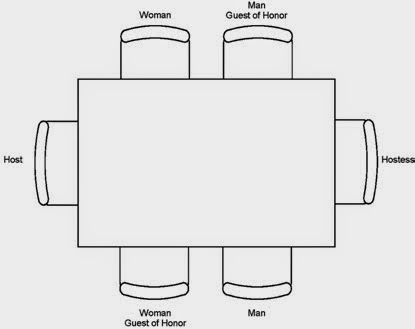
Traditionally at a formal dinner, the Host sits at the head of the table with the Hostess at the other end. This works whenever there are six, ten, fourteen, or eighteen people. Husbands and wives are never seated next to each other.
If the Guest of Honor is a woman, she is seated at the Host's right and her husband at the Hostess' right. The second most important woman is seated across from the Guest of Honor, on the Host's left, and her husband is seated accordingly on the Hostess' left. The remaining guests are seated in between, alternating between male and female guests.
To be fair, the word "important" can be relative to many differing situations and varying cultures. Age may play a factor, especially if there is no Guest of Honor. Giving the eldest member of a group, or the persons who have traveled the farthest distance to the dinner, special places in the seating arrangement, would be an honor. Special accommodations may be also be made for those in wheelchairs, or those using a walker or cane. Guests take note of such matters and will undoubtedly appreciate the kind gestures on a Hosts and Hostess' parts.
Formal Table Seating For Groups Divisible By Four 
When the group of people is divisible by four, it is not possible for the Hostess to sit at the end of the table. In this case, the Hostess moves one place to the left, with the man on her right sitting at the end of the table, opposite the Host. This will keep the tradition of seating guests alternately, male, female, male, female, etc... Again, husbands and wives are never seated next to each other.
For informal dining, the easiest system is to alternate between male and female guests, with the Host and Hostess on either end of the table. 


Contributor Bernadette Petrotta is the Founder and Director of the Polite Society School of Etiquette in Washington State.  She has been teaching etiquette for nearly 20 years and has written The Art of Social Graces and The Art and Proper Etiquette of Afternoon Tea.  She is currently working on her third book and continues to teach and lecture on the art and pleasures of proper etiquette and tea. 


  🍽Etiquette Enthusiast, Maura J. Graber of The RSVP Institute of Etiquette, is the Site Editor for the Etiquipedia© Etiquette Encyclopedia

Thursday, September 4, 2014

Forks for Gilded Age Etiquette

"The safest rule to remember about forks is that, for everything which may possibly be eaten with a fork or cut with a fork, a fork is to be preferred to any other piece of silver."
"Forks, we are told, did not become common until the time of Shakespeare and Queen Elizabeth. The earliest known paragon of perfect manners, the Prioress in Chaucer's Canterbury Tales, very evidently had never seen a fork. Instead, she is featured by Chaucer because 'well she could carry a morsel and well keep, that no drop fell upon her breast.' But, if forks were slow in coming into popularity, they have certainly arrived and are now the most important part of table service next to the actual food itself. 
An 1894 design for a pickle fork.  Many foods were still commonly home pickled at the time, as "tinned," or canned, foods remained quite expensive. Pickled carrots, asparagus, snap peas, a variety of fruits, eggs, etc... were still served regularly at the table.
A selection of oyster, lobster claw and fruit forks from the 1890s.
  1. The safest rule to remember about forks is that, for everything which may possibly be eaten with a fork or cut with a fork, a fork is to be preferred to any other piece of silver. If it proves quite impossible to get the food safely on the fork without assistance of some sort, one may use a small piece of bread or roll or cracker in the left hand as a 'push bread.'" From Etiquette, Jr., by Mary E. Clark and Margery Closey Quigley 1926, Drawing by Erick Berry
  • 1873 design for fruit forks ~ The inverted "umbrella was presumably to catch fruit or fruit juice, that could possibly escape while one ate.  Below is the ornate design for a handle for forks or other utensils.


    Below is another design from 1893. It is a "knork" or knife/fork combination utensil, designed to eat pie more easily.


         Below is another, more interesting tined pie fork, from 1897.


Compiled by contributor, and Etiquipedia site editor, Maura Graber, who has been teaching etiquette to children, teens and adults, and training new etiquette instructors, for over 30 years, as founder and director of The RSVP Institute of Etiquette.  She is also a writer, has been featured in countless newspapers, magazines and television shows. Maura was an on-air contributor to PBS in Southern California for 15 years, and has an odd love of strange and unique dining utensils 

Wednesday, September 3, 2014

Etiquette and Retro Advertising for the Gracious Home of 1930

"Conversations with the cook or maid can be so conveniently carried on by telephone from your bedroom or your living-room. The day's routine can be arranged in no time at all ... meals planned, orders given and without one unnecessary step. And all this over your regular Bell telephones, which you use to call friends across the street, or across the continent. Telephone convenience is a mark of the modern home ... as important to the smaller household, as it is to the larger."

The Gracious Home Reflects the Ease with which it is Managed


Telephones in important parts of the house simplify the direction of the domestic establishment ... yet from them you can call other homes, other cities, other countries.            

 ^     ^     ^


The House that is managed with a minimum of effort is pleasant to live in, or to visit. And telephone convenience within the home plays a large part in this scheme of things. It enables women to give all of their household directions for the day within a few minutes' time. To make sure, with no unnecessary bother, the domestic affairs are progressing smoothly. And to keep fresh their energies for the varied activities of their interesting lives.

This household administration is conducted over the regular Bell telephones ... the same instruments with which you call friends across the street, or in other cities, or even in other lands.
"Calls to the butler's pantry ... before luncheon, while you are dressing for dinner ... assure the smooth functioning of your household and save time, effort and trouble."
At moderate cost you can have telephone service in all parts of your home. Even in smaller houses, enough telephones add enormously to the efficiency of household affairs ... to your ease in calling friends, or in receiving services from the outside.
"Telephones located in all parts of your home ... the laundry, the maid's room, the garage ... play their important part in the ease and efficiency of modern housekeeping."
Your local Bell Company will be glad to help plan the arrangements which will give you the greatest satisfaction. Just call the Business Office today. 
Advertisement for Bell Telephone Company, from Vogue Magazine, 1930

Tuesday, September 2, 2014

Profiles in Etiquette—Maxine Powell

Maxine Powell, the Mother of Motown's Manners, (May 30, 1915 – October 14, 2013), the finishing-school instructor who infused Motown’s young stars with elegance and poise. For almost 60 years, she taught grooming, poise, and the “social graces” to Motown artists before they went out into the spotlight.
Maxine Powell was always interested in the cultivation of social skills and grace. After graduating from high school in 1933, she attended Madam C.J. Walker's School of Beauty Culture; Maxine studied acting, elocution, and dance, as well. In the early 1940s she worked as a model and as a personal maid, and developed a one-woman show, An Evening with Maxine Powell, which she performed with a group at the Chicago Theatre. She moved to Detroit, Michigan in 1945, and taught self-improvement and modeling classes before opening the Maxine Powell Finishing and Modeling School in 1951. 
      
Madame C.J. (Sarah) Walker, founded her own business and began selling her own product called "Madam Walker's Wonderful Hair Grower," a scalp conditioning and healing formula, after suffering from a scalp ailment that caused her to lose some of her hair and experimenting with homemade remedies of another. To promote her products, she embarked on an exhausting sales drive throughout the South and Southeast selling her products door to door, giving demonstrations, and working on sales and marketing strategies. In 1908, she opened a college in Pittsburgh to train her "hair culturists." Madame Walker became the first known African-American woman to become a self-made millionaire, catering to the toilette needs of African-American women.
She and Berry Gordy became friends and, in the early-1960s, he asked her opinion of the young artists that had signed with his record company, Motown. In 1964, she closed her school to be a consultant to Motown's talent. When the company expanded into new offices, specifically Hitsville U.S.A., she was hired into the Artist Personal Development department in 1966 to teach artists such as Smokey Robinson and The Miracles, Marvin Gaye, The Jackson 5 and The Supremes. 
Motown artists heralded her as one of the label’s key behind-the-scenes figures, an unsung hero whose contributions came to be publicly recognized only in later decades.
Powell was enlisted by Motown Records in 1964 to help mold singers such as Diana Ross and Marvin Gaye into performers fit “for kings and queens,” as Powell often put it. She called them her diamonds in the rough, and her training — along with a lot of tough love — aimed to polish their posture, diction, stage presence and sense of self-worth.

As part of Motown’s Artist Personal Development Department, Powell was a vessel for Berry Gordy’s broader Motown vision: an entertainment legacy that crossed cultural and racial borders. “She brought something to Motown that no other record company had,” Gordy said in a statement after her death in 2013. “She was a star in her own right — an original.”


“I teach class, style and refinement,” was her familiar mantra, and those qualities were obvious in Powell herself: Primly attired and delicately mannered, she radiated a natural dignity and grace that often struck those who encountered her.

 Marvin Gaye, Smoky Robinson, the Supremes, the Jackson Five...  Maxine Powell called them her “diamonds in the rough." Her training polished their stage presence, their posture, their diction, and more importantly, their sense of self-worth. Former Supreme Mary Wilson described her mentor and longtime friend as “an extremely earthy black woman.” “She enjoyed life,” Wilson said. “She loved being out there.” 
But it wasn’t all formality with Powell, a Texas native who grew up in Chicago. There was also a twinkle in her eye that revealed a spirited soul underneath. Former Supreme Mary Wilson described her mentor and longtime friend as “an extremely earthy, black woman.” “She enjoyed life,” Wilson said. “She loved being out there.”

Wilson chuckled as she recounted Powell’s commands to the Supremes ahead of a national TV appearance: Dance not with your buttocks, she told the group, but with your knees — “you’re not out on the streets here.” But Powell imparted something far beyond the etiquette drills, Wilson said. “She gave us more than just the tools for the movements and the gowns,” she said. “These were tools for us as human beings.” 


Powell played her role of tutor well into her later years, quick to dole out instruction even to strangers. A slouching teen at a restaurant risked a snap judgment from the elderly Powell, recalled Wilson: “Young men don’t sit like that!”


“She had that magical, angelic instinct for understanding what someone was made of,” said Allen Rawls, the Motown Museum’s interim CEO. “She knew if she could get through to them in some way, she could help them improve themselves.”


Powell had closed her own Detroit finishing school to take the Motown job, and she continued that work after the label’s departure. Powell left Motown in 1969 and began teaching personal development courses from 1971 until 1985 at Wayne County Community College.


“She taught us all — men and women — etiquette, class and what you are supposed to do,” recalled the Four Tops’ Duke Fakir. “That’s artist development.” And they were lessons that became ingrained for life.