Showing posts with label American Naval Etiquette. Show all posts

Monday, May 26, 2025

Gallant Etiquette: Army vs Navy

“Dueling is distinctly frowned upon by the general staff of the United States army, of which General Bell is chief. A mere bloodless question of preсеdence at the breakfast table in the dining car stirred the excitement between the general and the naval officer. The clarion porter shouted his way through the Pullmans with the happy announcing, ‘First call, for breakfast.’”– 1907 Pullman Dining Car Interior Postcard

ARMY AND NAVY IN SHARP CLASH OVER GALLANTRY
  • Army Officer Offers Satisfaction Either Officially or in Unofficial Manner
  • Enlivening Episode Occurs on Southbound Train From Portland Yesterday
  • Major General J. Franklin Bell, Chief of Staff, Gives Naval Officers Stinging Rebuke
  • Lesson in Etiquette as to Precedence at Breakfast in Pullman Diner

ARMY vs. Navy, clashing over gallantry. Major General J. Franklin Bell, chief of staff, U. S. A., rebuking a reputed naval officer for rushing out of turn into a Pullman diner was the elevating lesson in comparative chivalry expounded for the edification of passengers on Southern Pacific train No. 13, southbound from Portland, yesterday morning between Davis and Benicia. The honors went to the fighting man ashore, while the fighting man afloat lowered his lance in token of submission to the teachings that women should first be given places in the diner,

General Bell's pupil in etiquette came to this city and registered at the Hotel Argonaut as "W., C. Read, city." On the train he told General Bell that he was a naval officer, but the naval register contains no such name as "W. C. Read." Perhaps the knight is a raw niddy, graduated from the naval academy since the naval register was published. Read's companion in the episode was E. R. McBlair of Washington, D. C.

Fighting Talk, This

The fact is that when Read was reрrimanded by the general of the army he declared himself to be a naval officer, and General Bell then said, "If you take offense at my action, you know how to get satisfaction from me, officially or unofficially."

The "unofficially", is a pregnant phrase, coming from one fighting man to another. What it might have implied can not be surmised without a shudder. Dueling is distinctly frowned upon by the general staff of the United States army, of which General Bell is chief. A mere bloodless question of preсеdence at the breakfast table in the dining car stirred the excitement between the general and the naval officer. The clarion porter shouted his way through the Pullmans with the happy announcing, "First call, for breakfast."

Out of Their Turn

There was a string of passengers in the passageway leading into the diner. Read and McBlair hustled through, out of order. They paved their way with the announcement that they were not hurrying forward to secure choice seats at the first table they were going into the tourist car to meet two women. So they were graciously permitted to pass on. But when General Bell and the other loiterers in the passageway finally reached the tables they found Read and McBlair seated in comfort.

The gallant General Bell could not stand for the precipitation of the young men. He told them that the two seats they occupied belonged by right to two young women who had long been waiting their turn in line. The young men were conscience smitten. General Bell regarded them with acute displeasure.

Conductor Butts In

Then the Pullman conductor heaved to in the affray between the army and navy. "I'm running this car," he insisted to General Bell, "and I'll attend to these things."

"These two American hogs were trying to grab seats that did not belong to them, and I intend to see that they are not able to do it," replied. General Bell.

"If you interfere any more with the running of this car I will stop the train and put you off," said the conductor.

"That would be very satisfactory to me," said the chief of staff. "I am General Bell, chief of staff of the United States army, and it would please me very much to be put off this train."

The conductor began to apologize. but General Bell stopped him, declaring that he should not be treated with any, more courtesy because he was an officer of the army than if he were a civilian passenger.

No Apology Coming

Read was not calmed by the disclosure of his rebuker's identity. He went to the general. "I heard you make some remark about American hogs," he said. "That does not sound like General Bell. But I'll accept your explanation."

"I want you to understand I am not apologizing." declared General Bell. "I don't consider that I have any apology to make.

McBlair was seen at the St. Francis hotel last evening. "The incident," he said, "was due to a mistake. We went into a forward car to see some ladies. When we returned the head waiter seated us and thoughtlessly we took our places. We did not mean to be seated out of our turn." – San Francisco Call, 1909

🍽️Etiquette Enthusiast, Maura J. Graber, is the Site Editor for the Etiquipedia© Etiquette Encyclopedia

Saturday, February 3, 2024

No Etiquette Breached by Emperor

Secretary Moody received telegrams from newspaper editors and others, inquiring as to the reports that Emperor William’s inspection of the Kearsarge was considered a breach of Naval etiquette. It is long established custom for foreign officials to inspect battleships of friendly nations and is regarded as an honor.
Public domain image of the USS Kearsarge, 1899
No Breach of Etiquette

WASHINGTON, June 29.—Secretary Moody today received telegrams from newspaper editors and others, inquiring as to the published reports that Emperor William’s inspection of the Kearsarge was sharply criticized in the Navy department, and was considered a breach of Naval etiquette. In reply the secretary sent the following telegram:
“No criticism of the Emperor’s inspection of the Kearsarge has been uttered by any responsible person in this department as far as I can ascertain. I am informed, further, by Admiral Taylor, Chief of the Bureau of Navigation, that the Emperor’s inspection is in no way subject to criticism, and can be considered in no light other than courteous attention on the Emperor’s part to us. It is long established custom for foreign officials to inspect battleships of friendly nations and is regarded as an honor. Signed, William H. Moody, Secretary of the Navy. - Los Angeles Herald, June, 1903


🍽Etiquette Enthusiast, Maura J. Graber, is the Site Editor for the Etiquipedia© Etiquette Encyclopedia

Friday, January 26, 2024

American Naval Finger-Bowl Usage

Nothing dainty like a crystal finger-bowl with a matching under-plate would do for the Navy. No, Sir! In 1947, they needed fluted and pierced finger bowls (with gadroon-mounted borders) in silver-plate of heavy quality. A whopping 38,000 of them!

Fred Othman Says: Evidence Concludes Fact That Admirals Must Be Sloppy Eaters

Washington, May 19 (UP)– Careful study of the evidence forces me to conclude that admirals are sloppy eaters. At breakfast they smear strawberry jam between their fingers. They butter their knuckles at lunch. At dinner they dip their digits in the gravy. This explains the Navy's desperate need for 38,000 fluted and pierced finger bowls (with gadroon-mounted borders) in silver-plate of heavy quality.

The gold-braided gentlemen with the sticky fingers never have learned to dampen same gently. The way they splash in their finger-bowls you'd think they were taking a bath. This is hard on the table linen. So the Navy also has asked for bids on 30,000 gadroon-mounted silver-plated finger-bowl trays to match. 

Rear Admiral W. A. Buck, chief of the Bureau of Operations and Accounts and the old sea-dog in charge of finger-bowls, never did get around to the 8,000 discrepancy between trays and bowls. My guess (only a guess) is that some naval officers splash less than others and don't need trays under their bowls.

Rep. Noble J. Johnson of Ind., brought up the subject of the sailors’ gooey fingers. He was disturbed over reports of the Navy buying finger-bowls from the silverware manufacturers while it was peddling other silver finger-bowls as surplus property. The bluff old admiral, veteran of many a meal at sea, said this was not true, except in part. It takes a good, solid finger-bowl to stand up under attack by an admiral or even an ensign. During the war, the Navy had to accept some ersatz finger-bowls of cheap and flimsy silver-plate, like wedding presents.

It has turned 663 of these battered bowls over to the War Assets Administration, along with 5,376 trays, mostly dented and none with piercing, fluting for gadroon-mounted borders. Admiral Buck wasn't sure what his new finger-laving equipment would cost. Inflation seems to have hit the finger-bowl business. He figured that before the war 38,000 custom-built, finger-bowls would have nicked the Navy for $26,700. The bill for 30,000 trays to match would have been $27,000.

Congressman Johnson, who hails from Terre Haute, where oysters and admirals seldom are seen, was interested also in the Navy's stores of oyster forks. The admiral said he was fresh out of oyster forks, but had put in an order for more. We taxpayers can only hope they arrive by September, which has an "R" in it.

"And how about the 23,000 surplus salt and pepper shakers?" demanded Rep. Johnson. "With the cut glass linings?” “Pressed glass,” snorted the admiral. “Not cut glass.” “And further more,”he said, “the Navy is hanging on to nearly all of them.”

“It has offered only 627 surplus salt and pepper shakers for sale, along with 3,750 gravy ladles, 209 unlined silver-plated mustard pots, 57,775 dessert forks and other cutlery too numerous to mention here.”

“The unlined mustard pots cost $7 each; the gravy ladles $1.03. And I think the admiral, the congressmen and I have answered all pertinent questions as to naval eating habits, except one: What is a gadroon-mounted border on a silver finger-bowl?” 

“It is a rim with bumps on it. Intended to discourage splashing.” –  By Frederick C. Othman United Press Staff Correspondent, 1947


🍽Etiquette Enthusiast, Maura J. Graber, is the Site Editor for the Etiquipedia© Etiquette Encyclopedia

Monday, December 18, 2017

Naval Dance Etiquette

Dancing Etiquette Ordained for Gobs

Newport, Rhode Island, March 18 – Dancing etiquette must be maintained at the Saturday afternoon dances at the Naval Training station for the enlisted men. An official bulletin just issued reads: "It has been noticed that a number attending these dances do not ‘request’ the young women, their guests, to dance. The men must realize that these young ladies are pleased to dance with them and, therefore, they should do their part, If they desire to meet any of the ladies, they should ask the chaperon for an introduction. The uniform of the enlisted men of this section for these dances will be dress blue, shoes neatly shined, neat haircut, clean shave and clean white undershirt.” – Los Angeles Herald, 1919


Etiquette Enthusiast, Maura J. Graber, is the Site Editor for the Etiquipedia© Etiquette Encyclopedia 

Wednesday, June 10, 2015

Naval Etiquette

The rules of politeness to be observed by admiral, officers and seamen alike. The honors are paid to the uniform and not to the personality of the wearer. 

NAVAL ETIQUETTE

The fact that the Germans, while in Manila Bay last summer, were said to have no "sea manners," shows how rigidly the etiquette of the sea is observed by those afloat.
Admiral Horatio Nelson
The English and Americans are the greatest sticklers in these matters. And their regulations are laid down with great minuteness. The rules of politeness to be observed by admiral, officers and seamen alike. The honors are paid to the uniform and not to the personality of the wearer. The seaman salutes the officer, who is compelled to return the salute in like way; the junior is always the first to enter a boat and the last to get out: each person must salute the quarterdeck coming up from below, and so on.

A "Nelson Fork"~ It was developed and used from 1797 on, by Horatio Nelson, after he was attacked fighting in the Napoleonic Wars, resulting in the loss of his right arm.  Nelson was given command of the British naval ship, Agamemnon.  He served in the Mediterranean, helped capture Corsica and saw battle at Calvi. He lost his right arm at the Battle of Santa Cruz de Tenerife in 1797. He subsequently used, what came to be known as, a 'Nelson Fork' in order to assist him in cutting and eating food with the same hand.

Between the ships themselves, like rules are laid down. The junior commanding officer must first call upon the senior. The ilag officer in port must send his aide to offer the usual courtesies to the new arrival before more formal calls are exchanged. Consular officers must receive the honors and salutes due their rank, and a failure in the exact number of guns in a salute demand an apology and a new salute. The seamans being comparatively new to the sea have not yet attained such a degree of familiarity as those nations where the customs on board ship are the outgrowth of a century's experience and many of vile faults they committed were rather through ignorance than design.-From The Los Angeles Herald, 1899


Etiquette Enthusiast, Maura J. Graber, is the Site Editor for Etiquipedia© Etiquette Encyclopedia

Monday, July 28, 2014

More on U.S. Military Etiquette of the “Dining-In”

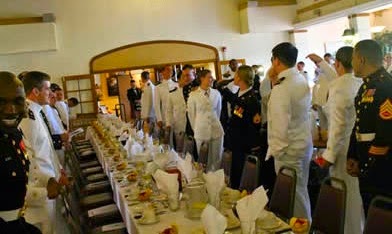
2013 San Diego Dining-In ~ "In November of 1964, the Chief of Naval Operations Naval History Division prepared an article on the mess night for the BUPERS Mess Newsletter. The article was aimed at Commissioned Officers Mess Managers and provided a synopsis of the Navy dining-in. This was the first official mention of the event. A renaissance of the dining-in can be linked to the 200th birthday of both the country and the Navy. During the bicentennial, officials were reviving virtually every traditional event to celebrate the occasion. The Chief of Naval Information (CHINFO) prepared a pamphlet entitled "How to Conduct a Dining-In." The guide was published as an article in the March 1975 issue of U.S. Navy Medicine. This is a most important document because it describes the basic format of the Navy dining-in." From Military Facts, History of the Navy 


Introduction To The Dining-In

1. The purpose of this booklet is to familiarize the junior officer with an old custom that has begun to experience a resurgence of popularity after a period of considerable decline.

This custom is known as the Dining-In. Simply stated, the Dining-In is the assemblage of all the officers of a particular unit for a formal dinner. There is of course much more involved in conducting the Dining-In than just sitting down to dinner. It is a rather complex affair that can and often does include a receiving line, cocktail hour, a ceremonial posting of the colors, a punch ceremony, ceremonial toasts, etc. All of these will be discussed in detail later in this booklet.

2. The formal Dining-In has several purposes. First, it brings together the unit officers on a social basis. Second, it fosters a spirit of team work in the unit as the officers get to know each other better. Finally, each officer has an opportunity to see his place in the unit history. He learns that many brave and capable men have gone before him and have left him a legacy of falor and efficiency. He also learns that his own day-to-day activities become a part of the unit’s history which encourages higher standards of performance from him. It is to this end that the Dining-In should be conducted.

3. The Dining-In should be compared to an officers’ call as far as its purpose and function are concerned. Therefore, when invited you should consider your attendance as obligatory and your absence should occur only for those reasons for which you would be excused from any military formation.


Background On The Dining-In


1. GENERAL. Conduct of the British Officers’ Mess over the years has had great influence on many of the procedures practiced today by US organizations in the formal Dining-In. The British mess was a source of solemn formality; a cause for living above one’s means; and a source of long-lasting customs and traditions.

2. THE OFFICERS’ BILLET


a. Today’s colorful British officers’ dinners continue a custom which arose in the eighteenth century. In those days there were no barracks. Consequently, officers and men were billeted wherever lodging was available. When a battalion entered a town the Quartermaster would select billets for the unit. Then the unit would hold a parade and group the colors at the officers’ billet. This billet became known as the officers’ mess and was the central meeting place for officers.

b. The custom of dining together was especially useful in large units where many officers did not normally come in contact with one another. However, during dinners they were brought together in a fraternal atmosphere. The mess, besides entertaining guests in the surroundings of traditions and customs of the regiment, served to make the officers aware of the social amenities. Young officers received training which enabled them to give formal entertainment later as senior officers.

c. While the mess served a functional purpose it also served as a constant source of satire and junior officer horseplay. Additionally, they served as a method of transmitting the histories and traditions of the Regiment to junior officers.


BACKGROUND ON US ARMY REGIMENTAL MESS


1. GENERAL:

a. US Army Dining-In traditions are related directly to those of the British Army prior to the American Revolution, and in many instances, more modern British Army Mess procedure has been incorporated into our unit social events. The oldest recorded American Dining-In occurred in September 1776.

b. In the regimental mess of the 1920’s the colonel or senior officer presided and sat at the head of the table with the lieutenant colonel to his right and the adjutant to his left. The other officers were seated on both sides of the table according to rank. Dinner was a formal meal with everyone wearing the uniform prescribed. The officers of the mess assembled and upon arrival of the presiding officer followed him into the mess and took seats when he had taken his. In general, the US Army Dining-In has been more formal and restrained than its
usual British Army counterpart.

c. The importance of the mess as related to the image of the officer corps was evidenced by the recommendation that all newly commissioned officers should carefully make arrangements for messing to enable them to “live with the quiet dignity becoming their station.” It was sufficient for expenses, and he owed it to the service to “dress and live, though simply, yet always like gentleman.”

2. TRADITION: As with the British Mess, the US Army Dining-In has served as a vehicle for transmitting the histories and traditions to junior officers. This is particularly true in our Army where rotation between units is quite frequent. As an example of this tradition, the punch bowl for 1st Battalion, 9th Infantry (MANCHU) reflects upon each of the major battles and wars in which that fine regiment fought.


ORGANIZATION AND SEQUENCE FOR THE DINING-IN


1. Principal officers of the mess are listed below. Their duties and responsibilities are also listed. 


a. PRESIDENT OF THE MESS. The Presiding Officer is the company commander. He is the President of the Mess. It is his responsibility to oversee the entire organization and operation of the Dining-In. His operational techniques will follow those of any formal dinner affair and will include appointment of a host and persons or committees to take care of the arrangements, food, and protocol. The President will appoint a Vice-President, Mr. Vice, who is one of the senior trainers of the company; open the mess and close the mess; and call upon Mr. Vice for performance of any duty deemed appropriate during the conduct of the affair.

b. MR. VICE. Mr. Vice opens the lounge at the appointed time. When the dinner chimes are to be used, he sounds them as appropriate. He may be called upon to provide items of unit history, poems, or witticisms in good taste relating to particular personalities present. He is seated at the opposite end of the dining room to permit the President of the Mess to face him easily during the dinner.

c. THE COMMANDER. The formal Dining-In is the one occasion when the battalion commander is a guest. Planning by the President and Mr. Vice should be so thorough that the commander may relax and enjoy a smooth, efficiently run dinner. He may participate actively or remain an observer. The option is and should be his.

d. THE ESCORT OFFICER. Escorts should be appointed for each guest attending the dinner to act as personal hosts.

(1) The Escort should welcome his guest upon his arrival and join his guest immediately after the receiving line.

(2) The Escort should familiarize himself with the guest’s background prior to the night of the Dining-In.

(3) It is the Escort’s job to make the guest feel at home explaning the different portions of the Dining-In and its history.

(4) He should introduce the guest to the members of the mess during the cocktail hour and be sure that the guest understands the Punch ceremony procedure.

(5) The Escort has a large responsibility. Many of the guest’s impressions of the unit will be formed due to the actions of the Escort.

(6) The Escort’s duties terminate when the guest leaves the Officers’ Club, or place of the Dining-In. 

2.  APPROPRIATE DRESS.  Black tie is the appropriate dress for a formal Dining-In and is the designation used on invitations.  Civilians wear the tuxedo while military personnel wear the black bow tie with one of four appropriate uniforms, Army Blue, Army Blue Mess, Army White, or Army White Mess.  The black tie designation also implies the wearing of miniature decorations on the Army Blue Mess or Army White Mess uniforms and the wearing of ribbons, miniature or full size, on the Army Blue or Army White uniforms.  The term military black tie may appear on invitations directed to a predominately military group, but the same uniform implications apply. 


 🍽️Etiquette Enthusiast, Maura J. Graber of The RSVP Institute of Etiquette, is the Site Editor of the Etiquipedia© Etiquette Encyclopedia