Showing posts with label British Royal Manners. Show all posts

Saturday, May 6, 2023

Coronation Street Party Etiquette

British markets and online sites are bursting with street party treats, drinks and festive decor. For over a century, street parties in England have been localized festive celebrations for Coronations and Royal weddings. The British love these street parties are use them to mark all kinds of special occasions and build community spirit with one’s neighbors at the same time. —Image source, Instagram

How About Some Royal Manners for the Coronation of Charles III and His Queen?

Grant Harrold was butler to Prince Charles at Highgrove from 2004 to 2011. For a well-mannered Coronation street party, he says everyone should be invited ‘and that means everyone’.

Don't be a fancy-dress fascist, he says: ‘Not everybody is comfortable with fancy dress, so if you do want a theme, make it clear the dress code is optional with a “or come as you're comfortable”. There's nothing worse than making your less-showy guests dread the day.’

And have a team of hosts. 'The King is an excellent host because he's always thinking of others and making sure everyone feels personally welcomed.

‘At my job interview, he served me tea and biscuits himself.

‘Get a team of hosts together and space them out evenly along the tables. It's their responsibility to make sure everyone in their section has their glass topped up, plenty to eat and is feeling included in any conversation or games.’

Don't forget to lay your tables: this isn't a school canteen: ‘Not only will a fully laid table look wonderfully inviting, it's also the best way to ensure everyone seated has a glass, plate, cutlery and napkin.’

Grant’s biggest bugbear is people who text at the table. ‘Only get your phone out to take pictures and videos of all the fun going on around you. And if you really can't manage to keep your phone on silent, at least set your ringtone to God Save The King.’

And don't let everyone just sit next to their pals: ‘The temptation at a party like this is to make a beeline for the neighbours you know best, have a riotous time and ignore everyone else. But a street or village party is a brilliant chance to build a sense of community. The royals are consummate minglers and always opt for “how nice to see you” as an opener.

‘They also talk to the guest on their left during the main course, and the one on their right during pudding.’ — From Mail Online, April 2023


 🍽Etiquette Enthusiast, Maura J. Graber, is the Site Editor for the Etiquipedia© Etiquette Encyclopedia

Friday, June 25, 2021

Royal Dignity and Etiquette Melted

Rare photo of Queen Victoria dining with members of her family. The Queen was well-known for her terrible table manners. It was said she could easily put away nine courses in 30 minutes.


Queen Victoria’s Dignity Melted

Just about this time, and for a month or more longer, look out for anecdotes of Queen Victoria. There promises to be a large crop of them, and many are already being harvested. Some are quite true and authentic, while more are not, but it is never a good plan to spoil a readable story because of a little question of veracity. 

One of the most recent Victorian anecdotes is told by a correspondent of the Chicago Times-Herald, who declares that Victoria has ever been very exacting in the matter of Court etiquette. When she holds a reception she always insists upon the performance of every detail of custom. Persons who are fortunate enough to be invited to Court have, therefore, to drill themselves and rehearse their parts, for fear of offending the Queen by any little neglect of manners. Now and then, however Her Majesty unbends. 

On one occasion, in very hot weather, she was receiving a line of sweltering noblemen and ladies. Everybody was suffering from the heat. The Queen turned to an attendant suddenly and exclaimed: “My! Ain't it hot!” It is Court etiquette never to contradict royalty, and the lady addressed replied: “Yes, madam, you are!” On this occasion the Queen forgot both her manners and her grammar.– Placer Herald, 1897


Etiquette Enthusiast, Maura J. Graber, is the Site Editor for the Etiquipedia© Etiquette Encyclopedia

Monday, May 14, 2018

British Royal Wedding Etiquette

A point of royal protocol... The formal consent document, signed by Queen Elizabeth II for Meghan Markle to marry Prince Harry, was unveiled to the public last Saturday. Unlike the consent document for Prince William and Kate Middleton, it did not refer to Meghan as “our trusty and well-beloved.” According to a spokesperson for Buckingham Palace, Kate Middleton was referred to by this term as she was a British citizen. “Trusty and well-beloved” is customarily used only for citizens of the “UK and Commonwealth Realms.” 


Royal weddings are full of protocol but how are guests expected to behave on the big day?

For any ordinary wedding-goer, the prospect of attending a royal wedding and meeting royalty, especially the Queen, is a daunting one. What is the correct form in such a situation?

Curtsy

Don't overdo it. Debrett's “New Guide to Etiquette and Modern Manners” says the sweeping curtsy and long, low bow “can be the subject of some amusement within royal circles.” Instead, ladies are expected to make a brief bob with the weight on the front foot, and gentlemen should opt for a small nod, and look down briefly. Do the same when the royal leaves the room.


Touching

Younger members of the royal family will probably have a less formal attitude to introductions, however it is best to refrain from informalities. While it is fine to accept a handshake from the Queen, officials discourage any other form of touching. Former Australian prime minister, Paul Keating, was famously branded the Lizard of Oz in 1992 when he was photographed placing his arm on the Queen's back. However, in 2009, the Queen herself touched US First Lady Michelle Obama on her back during a reception at Buckingham Palace - a gesture which was returned. A palace spokesperson referred to it as “a mutual and spontaneous display of affection and appreciation.”

Photos

At state banquets, guests are not allowed to take photos. A spokesperson for Buckingham Palace said that at all royal events the use of personal cameras is discouraged. The event will, in any case, be covered by a professional photographer. – Sources BBC, Debrett’s and Daily Mail 2011 - 2018

Etiquette Enthusiast, Maura J. Graber, is the Site Editor for the Etiquipedia© Etiquette Encyclopedia 

Monday, January 1, 2018

Reagan’s Royal Etiquette Blunder

The late, Harold Brooks-Baker, an American authority on British nobility who was a sought-after commentator on the doings -- serious, scandalous or merely ridiculous -- of the British royal family, was at one time managing director of Debrett’s. He published in 1978 a tongue-in-cheek, bestselling guide to The English Gentleman, who “does not drive a Rolls-Royce unless it is very old and smells of dogs”, and always “speaks to the engineer before a train trip because of an old belief that he owns the railroad.”

“Princess David?” No, a royal blunder! Charles and Diana may be casual about etiquette, but not their names!

President Reagan made a double gaffe at a White House dinner by first calling his guest “Princess David” and then “Princess Diane,” a royal genealogist said Sunday in London. Reagan erred by not using her official title, the Princess of Wales, and when he tried to correct himself he got it wrong again by muddling Diana's name. “It's like calling Queen Elizabeth II ‘Libby’ or something like that,” said Harold Brooks-Baker, publishing director of Burke's Peerage, one of the bibles of British bluebloods. While the Princess is popularly referred to in the news media as Princess Diana, her official title is the Princess of Wales, which is what she is called at all official functions. Brooks-Baker said he blamed Reagan's speechwriter and the British and American protocol experts who were given advance copies of the speech for the breach of royal etiquette not the President. “He's not to know, but his advisers are to know,” Brooks-Baker told The Associated Press. “It's no wonder the Prince of Wales looked somewhat downcast after the President proposed the toast.” 


The gaffes came while Reagan was making a toast at a White House dinner Saturday night attended by show business celebrities such as Clint Eastwood, John Travolta and Neil Diamond. While millions of Americans watching the Prince and Princess of Wales on television might not notice, Brooks-Baker said the two are changing royal etiquette. “Right at the top is the fact that they behave as equals. It is no longer prince and consort ... or Queen and Consort, as it is still with the Queen and Prince Philip,” he said. “More often than not, on this tour, we have seen the Princess of Wales taking the lead. Then, there are the public displays of affection. Never, previously, would royal couples dream of kissing in public, as the Prince has kissed the Princess.” 

On their Washington trip, Brooks-Baker said, the royal couple are keeping to the “royal, and upper class, tradition of separate bedrooms, though never before would there have been photographs of royal sleeping arrangements as there have been recently, ostensibly to publicize English design. Royalty should never be used for advertising.” He said the choice of Palm Beach for the couple's next stop also surprised many Americans, especially the poor and homeless. “Palm Beach is a symbol of the thoughtless, vulgar, nouveau riche, careless of the plight of others,” the U.S.-born Brooks-Baker said. “It is like asking the Pope to go to Sodom and Gomorrah.”  — (By Edith M.Lederer, AP) San Bernardino Sun, 1985


Etiquette Enthusiast, Maura J.Graber, is the Site Editor for the Etiquipedia© Etiquette Encyclopedia 

Wednesday, July 13, 2016

More on Backward Etiquette

The prospect of breaking etiquette when in the presence of the monarch has struck fear into subjects and foreign dignitaries for centuries. Walking backwards went back to the times when it was considered terribly impolite to turn one's back on the sovereign.

The centuries-old practice of servants and guests walking backwards when leaving a room after seeing the monarch has been dropped after health and safety concerns.

The protocol was observed as a sign of respect but royal aides feared it could lead to someone getting hurt – and potentially suing Buckingham Palace for damages.

Only two visitors are now expected routinely to walk backwards as they exit the Queen’s presence: Charles Gray, the Marshal of the Diplomatic Corps, and Wing Commander Andy Calame, the Queen’s equerry.

Their successors will also be expected to learn to walk backwards safely and discreetly when leaving the monarch’s presence. The Queen, say royal aides, does not want the tradition to die out entirely.

“Allowing only two people in royal service to walk backwards was seen as a pragmatic solution to the health and safety issue,” one royal source said.

The two senior members of the Royal household are expected to walk backwards leaving the room when they have either been summoned to see the Queen personally or they are introducing others – such as senior foreign diplomats – for audiences with the Queen. Such audiences normally take place at Buckingham Place, usually in the magnificent first-floor 1844 Room.

Only one other person now walks backwards in the presence of the Queen, but this is restricted to an annual ceremonial occasion. Tradition dictates that the Lord Chancellor, currently Jack Straw, walks backwards down the steps from the throne after presenting the monarch with the words for the Queen’s Speech at the State Opening of Parliament.

Mr. Straw had made it clear he is happy to continue with the pageantry associated with the State Opening, although his predecessor, Lord Falconer, wanted to scrap the title of Lord Chancellor and, with it, some of its centuries-old traditions. The Lord Chancellor is the monarch’s formal link with Parliament and is sometime known as “Keeper of the Queen's Conscience”.

The prospect of breaking etiquette when in the presence of the monarch has struck fear into subjects and foreign dignitaries for hundreds of years. Today, those introduced to the Queen are asked to refer to her as “Her Majesty” when they first talk to her and then as “ma’am” – pronounced so as to rhyme with spam. Men are asked to give a short bow from the neck – not the waist – and women are asked to curtsy.

Charles Kidd, an expert on royal etiquette and editor of Debrett's Peerage and Baronetage, said that the practice of walking backwards when leaving the monarch’s presence was believed to date back to Medieval times. “It goes back to the times when it was considered terribly impolite to turn one’s back on the sovereign,” he said.

The introductions of foreign ambassadors and High Commissioners are still highly formal occasions. At “credentials”, ambassadors are usually escorted to Buckingham Palace in a horse-drawn, open-top Landau. Dressed in morning suits and accompanied by the Marshal of the Diplomatic Corps, the ambassador is politely instructed about what to do when he enters the presence of the monarch: “One step, neck bow. One step, a second neck bow.” Then he is to hand over formally his Letters of Credence – official papers confirming his status as ambassador.

But the ambassador, and other visitors, are no longer expected to walk backwards from the room, unlike the Marshal of the Diplomatic Corps and the Queen’s equerry.

The Marshal of the Diplomatic Corps is a senior member of the Royal household and widely regarded as the expert on all matters of royal etiquette. He is the Queen’s link with the diplomatic community in London. Mr Gray supervises the attendance of diplomats at state events and organises the regular presentation of credentials.

The post is usually held for about a decade, often by a retired senior military officer. However, Mr Gray, who has been in the post for just a year, is a diplomat rather than a military man. The office was created in 1920, to replace the position of Master of Ceremonies, which dates back to the 17th century.

The position of equerry dates back hundreds of years. Traditionally, “Equerries of the Crown Stable” were responsible for breaking and caring for the monarch’s saddle horses.

However, more recently, the post has involved being in close attendance to the Queen at public and private engagements. The position of equerry is traditionally held by a senior officer from one of the three Armed Services who usually wears his military uniform for official engagements. Wing Commander Calame, who is two years into his three-year posting, recently described the Queen as “the best boss I have ever had”.
— This article, by Andrew Alderson, first appeared in The Telegraph in 2009


👑Etiquette Enthusiast, Maura J Graber, is the Site Editor for the Etiquipedia© Etiquette Encyclopedia 

Tuesday, July 12, 2016

Etiquette or Absurd Custom?

Royal tradition took a step backward, but the Queen moved forward in 2009 ~ HRH Queen Elizabeth II of England bowed down to 'health and safety' concerns. The centuries-old practice of servants and guests walking backwards when leaving the room after seeing the monarch was dropped amid health and safety concerns.

Walking Backward — An Ex-Attache Writes in His Usual Vigorous Style on an "Absurd European Custom"

Sometimes this walking backward gives rise to rather pretty and even pathetic devices on the part of those who desire to avoid accidents, such as happened to the Duke of Argyll. Thus I can recall the case of a relative, who in return for active service, was summoned with several brother officers to Buckingham Palace in order to receive from the hands of the sovereign herself, the Order of the Bath. 


He had lost his right leg in action so near to the hip joint that there was no means of wearing an artificial limb and he was consequently dependent upon his crutches. When he entered the royal presence it was noticed that he held fastened apparently to the handrest of each crutch a couple of lovely bouquets. At a third of the distance up the long room he stopped, made the regulation bow as best he could and dropped one of the bunches of flowers on the floor. Then he made his way to the Queen, tendered her the other bouquet, which she graciously accepted, received his Order of the Bath, which she herself fastened to his uniform with many a kindly word, for he had been a favorite of her husband, and then he proceeded to withdraw from her presence.

If ever there was a case in which the walking backward might have been excused, it was there, and the faces of the Queen and those around her betrayed signs of concern and anxiety lest some mishap would overtake the colonel. He, however, backed away, displaying himself some hesitation and anxiety until he reached that part of the room where he had purposely left the first bouquet on the ground. That gave him his bearings. He knew where be was then and leaving the flowers there reached the door in safety, the Queen kindly nodding and waving her hand to him in appreciation of his somewhat arduous act of homage. 


That her Majesty was moved, thereby was shown by the fact that a few days later he received from the Queen a rather unusual present, namely, a handsome carriage and a pair of horses, together with an expression of the wish that the conveyance might in some measure tend to alleviate the discomfort caused by the absence of the limb which he had lost in her service on the field of battle.  — San Francisco Call, 1897


Etiquette Enthusiast, Maura J Graber, is the Site Moderator and Editor for the Etiquipedia© Etiquette Encyclopedia

Saturday, September 5, 2015

British Royal Etiquette History and Dining


ROYALTY OF OLD BIG EATERS 


Feast at Court of King Richard II Called for Vast Amount of Food


England in the Canterbury days ate much in the French style. Spoons and fingers were good manners and carving was new-fangled. If it was, in fact, practiced to any extent at all. 


Richard II and the Duke of Lancaster once dined in London with the Bishop of Durham. The King, the Duke and the Bishop and their retinues and guests called for 120 sheep, 14 salted oxen and 2 fresh, 1,240 pigs, 12 boars, 210 geese, 720 hens, 50 capons "of hie geze" and eight dozen other capons, 50 swans and 100 dozen pigeons; rabbits and curlews by the score, 11,000 eggs, 12 gallons of cream and 120 gallons of milk.
The usual forms of address for a King for much of the "Plantagenet era" in England were ‘your highness’ and ‘your Grace’. Richard II introduced the terms ‘your majesty’ and ‘your high majesty’ to the court vocabulary, having had a grander and more elaborate vision of kingship than his predecessors.
During the King's later reign, there are accounts of Richard II sitting in splendor on his throne after dinner, while glaring around the room at the courtiers assembled there. It is said that, whomever his gaze rested upon was to fall to their knees in humble appreciation of his royal awesomeness. Eventually wearing thin, in 1399 Richard was deposed by his cousin, Henry Bolingbroke, who took the throne as Henry IV, which abruptly ended an unbroken succession of Plantagenet kings since the 12th century.
Such was a royal feast, says the Detroit News, and every day, whether fast day or eating day, had four meals. Breakfast at seven, dinner at ten in the morning, supper at four and livery at eight. The hour of dinner is said to show the development of cooking in any given country. But there were Chaucerian refinements, nevertheless, aside from dishes of flowers; permissible foods imitating the form of meats on fast days, hen eggs being counterfeited and clever things such as making two capons out of one by skinning it and stuffing the skin. 


There were, besides, the points of etiquette; a pig for a lord should be endored. His cabbage thickened with egg, not crumbs; a pike served whole to a Lord, but cut for the commonality. And mint sauce has a pedigree reaching to Edward I. – From Detroit News as reprinted in Sausalito News, 1924


Etiquette Enthusiast, Maura J. Graber, is the Site Moderator for Etiquipedia© Etiquette Encyclopedia

Sunday, August 3, 2014

6 Famous Etiquette Mishaps and Faux Pas

                          Former President George H. W Bush 

1. George Bush senior may hold the record for the most embarrassing behavior at a state dinner. In 1992, the former president vomited, then fainted, after experiencing sudden and violent gastric distress during a state dinner in Tokyo. Unfortunately, he vomited — as the news reports put it – “copiously” into the lap of then Prime Minister Miyazawa. Mr. Bush, formerly with the diplomatic corps, was always a model of gentlemanliness, manners and propriety. His mortification the next day upon seeing the press reports of the mishap must have been horrific. One writer wondered, "Did Japanese hardliners harbor suspicions that the presidential sickness had been no accident?" After all, 48 years prior, Bush had been shot down by the Japanese while trying to torpedo one of their warships.
                                   
                                      José María Velasco Ibarra

2. José María Velasco Ibarra was President of Ecuador five different times, but sadly, he was always being deposed. On one occasion, he turned up at an embassy reception. Accounts on this vary. He either vomited over the West German ambassador or he urinated in the punch bowl. According to one version of the story, he actually did both. The army immediately deposed him for having “compromised the dignity of the Republic.” 
                 
                    Former British Prime Minister Harold Wilson

3. The White House state protocol took a holiday it seems, when Prime Minister Harold Wilson visited Washington in the 1960s. It was at a time when the sun appeared to be setting on the British Empire — colonies everywhere were clamoring for independence, it was post-Suez canal, there was the free-falling pound, not to mention labor strikes. Upon arriving at the White House for the formal welcoming ceremonies, Wilson pointed out to then U.S. Chief of Protocol, Jimmy Symington, that two of the Union Jacks were flying upside down — the international sign of distress. The next day, the Washington Post newspaper ran an enormous photo of the flags with the caption, “Oops!”
      
These people are dancing the Viennese Waltz. They are not dancing to the Austrian State anthem. 

4. As the story goes, former British Foreign Minister George Brown was at a state dinner in Vienna in 1966, and after enjoying some wine, he turned to "an exquisite creature in violet" sitting beside him, upon hearing the orchestra strike up a tune. Saying, “Madame, you look ravishing. May we dance?” The exquisite creature in violet turned to him and said, in perfect English, “No, Mr. Brown, for three reasons. Firstly, this is a state dinner, not a ball. Secondly, were this a ball and not a state dinner, this would still be the Austrian state anthem, and not a waltz. And thirdly, were this a ball and not a state dinner, and were that a waltz and not the Austrian state anthem, I would still be the Cardinal Archbishop of Vienna.”

                                        
       Polish leader Lech Walesa was unfamiliar with artichokes.

5. When Polish leader Lech Walesa visited Queen Elizabeth II at Buckingham Palace, he was served artichokes. Never having encountered an artichoke before, he began to eat the spiny leaves. The Queen generously offered, “Why don’t you eat the bottom part? It takes so long to eat the leaves.” That’s what's known as noblesse oblige — a French phrase literally meaning "nobility obliges." It is the concept that nobility extends beyond mere entitlements, to acts of generosity and nobility toward those less privileged.

                                            
Mozaffar ad-Din Shah Qajar did not know the etiquette for eating asparagus. 

6. The Shah of Persia, Mozaffar ad-Din Shah Qajar, visited London in 1902. At the Edwardian Era dinner, he was served asparagus, which was a legume evidently unknown to the occupant of the Peacock Throne. After eating each spear, he would toss the stalk over his shoulder onto the floor. Feelings of anxiety ensued with those dining with the Shāh. Not wanting to embarrass the world leader, and in a show of true diplomacy, everyone else began tossing their stalks onto the floor.


🍽️Etiquette Enthusiast, Maura J. Graber of The RSVP Institute of Etiquette, is the Site Editor of the Etiquipedia© Etiquette Encyclopedia 

Wednesday, July 30, 2014

8 Etiquette Breaches Around the World

1. Ben Affleck in a Breach of Yemeni Etiquette 

The sole cause of Ben Affleck's breach of etiquette? His soles.
Ben Affleck was in hot water during his visit to the Persian Gulf in 2004, after shocking a Yemeni prince. The actor had been briefed about local customs but in a moment of tiredness he forgot about etiquette and showed the soles of his shoes. The infringement of Middle Eastern manners earned him an angry ticking off from a bodyguard. 


Affleck said: “They told me, ‘Don't show the soles of your feet.’ I forgot about that. At one point, I was in one of the Middle Eastern airports, going from one place to another, and I was tired,” he explained. “So I was sitting there, kicking back, and apparently there was some Yemeni prince that came through and this guard literally looks over at me and comes charging over. “I thought I was being terrorized on the spot.” He yelled, ‘What are you doing? Your feet!,’ and then he slaps my feet puts them on the ground.”

2. Nobel Etiquette Breached for Monolingual Mo Yan in 2012

The 57-year-old Mo Yan, was the first Chinese resident to win the prize. Chinese-born Gao Xingjian was honoured in 2000, was not a Chinese citizen.
Nobel organizers made a special exception to stringent seating rules for 2012's gala banquet in Stockholm, allowing literature laureate Mo Yan and his wife sit together because they both only speak Chinese.

Who gets to sit next to one of the princesses usually peaks Swedes' interest. That year, chemistry laureate Brian Kobilka was seated next to Crown Princess Victoria's right, as Mrs Kobilka sat directly opposite the heir to the throne. The Swedish speaker of parliament, Per Westerberg, flanked the crown princess on the left, which he usually does.

Princess Madeleine, was to be responsible for entertaining physiology laureate Shinya Yamanaka and Swedish Prime Minister Fredrik Reinfeldt. The laureate's wife Dr. Yamanaka faced the younger princess.

Princess Madeleine had her brother Prince Carl Philip diagonally across from her. He entertained Dr. Yamanaka and Mrs. Westerberg, a psychiatrist, with Professor Yamanaka facing him.

Seating at the top table strictly follows what is commonly known as the ‘Nobel Order’, which takes into consideration the rank of the members of the royal court and then matches them with the laureates in the order set out in Alfred Nobel's last will and testament.

Nobel mentioned physics first, meaning that the laureates, that year Serge Haroche and David Wineland, and their spouses were clustered around King Carl XVI Gustav and Queen Silvia. The regent is also always seated near the president of the Nobel Foundation and the president's spouse, presently Mr. and Mrs. Storch.

“There is a protocol for the seating, but we can make modifications based on for example language abilities,” Nobel Foundation spokesperson Annika Pontikis told the TT news agency. Literature laureate Mo Yan was thus seated next to his wife Quinlan Du. Married couples are usually never seated next to each other but the Foundation found it apt to make an exception.

“Neither of them speaks anything but Chinese,” said Annika Pontikis. Seemingly to ensure the couple was not linguistically cut off from conversation, the wife of the Chinese Ambassador to Sweden was seated next to Mo Yan. Her husband was, in turn, seated next to her.

The top table takes centre stage in the main hall of Stockholm's 1920's City Hall, considered by many an important example of the National Romantic architecture style.

The Blue Hall, which is not actually blue but has walls of exposed brick soaring more than 20 metres up to the ceiling, is most famous internationally for hosting the Nobel banquet, but hosts many other events including ceremonies for immigrants when they become Swedish citizens.

3. The Emperor's Code: Breach Of Protocol Spurs Debate In Japan

Actor turned lawmaker, Taro Yamamoto, handing a letter to Japan's aging and frail monarch, Emperor Akihito, as Empress Michiko looks on, during the autumn garden party at the Imperial Palace in Tokyo on Oct. 31, 2013
 A staid and unremarkable royal garden party suddenly became the stuff of front-page scandal, when rookie lawmaker and passionate anti-nuclear activist Taro Yamamoto slipped a handwritten letter to Emperor Akihito. The mystified monarch hurriedly passed the epistle to an aide, unread — but the damage was done.

There is no audible reaction on video of the Oct. 31 incident, but the collective public gasp over an unusual breach of conduct was heard nationwide in Japan. The lawmaker's sin, officially, was violating Japan's ban on using the emperor for political gain. But the incident showed lingering sensitivity over the emperor nearly 70 years after the end of World War II. That's when Emperor Akihito's father, Hirohito, renounced his divine status.

Japan's emperor has been a titular head since then, as the U.S. imposed a constitution that proscribed royal participation in the business of ruling. His life is confined to a whirlwind of goodwill trips, photo ops with foreign dignitaries, and attendance at arts events.

Since the aging and frail monarch is constitutionally powerless, the letter incident was widely seen as a pointless and shameless spotlight grab. Yamamoto argued he was only trying to draw imperial attention to the plight of Fukushima, particularly children's exposure to radiation, and workers involved in cleaning up the aftermath of the March 2011 nuclear plant accident.

4. The Ultimate Sucker Punch: A Breach of Boxing Protocol in 1991, Cost “Macho Camacho” a Title

The late-boxer, “Macho Camacho” – The crucial moment in the late-Hector Camacho’s loss of his World Boxing Organization junior-welterweight title against Greg Haugen in 1991, came down to an impromptu decision by the bout’s referee, Carlos Padilla.
 At the start of the 12th and final round, Padilla, a 57-year-old Las Vegas resident, watched and waited for the fighters to touch gloves, as boxing protocol dictates. Camacho extended his gloves but Haugen was disinclined to reciprocate, even when Padilla urged him to. That led Camacho, always an impulsive sort, to throw a punch at Haugen, and Padilla to decide this was a breach of conduct. He instructed the three judges to penalize Camacho a point. 

Delighted, Haugen leaped into the air with a big smile on his face for having suckered Camacho into that gaffe. Had he known just what effect Padilla's decision would have on the outcome, Haugen might have gone into orbit. The 1-point deduction turned out to be pivotal in the final result. 

Two judges, Dalby Shirley and Bill McConkey, scored the bout, 114-112, Shirley for Camacho and McConkey for Haugen. The other judge, Art Lurie, had it 114-113 in Haugen's favor. 

Had Camacho not been penalized the point, Lurie's scorecard would have read, 114-114, and the bout would have been declared a draw, with Camacho retaining his title. But that was not the case, and because of that Camacho lost for the first time in a professional career spanning 40 bouts. 

For the time being at least he also lost a chance for a big-money match with Julio Cesar Chavez, the World Boxing Council-International Boxing Federation junior-welterweight champion.

5. The Breach of Etiquette and Cringeworthy "Selfie," Witnessed by the World, at Nelson Mandela's Memorial Service

Etiquipedia cannot think of a better caption than the one penned by Seema Goswami
People around the globe gasped collectively at the sight of  Danish Prime Minister Helle Thorning-Schmidt, US President Barack Obama and British Prime Minister David Cameron clicking a "selfie," not at Disneyland, but at the memorial of the late, great South African leader, Nelson Mandela. "The three world leaders, grinning cheesily into the camera, craned their necks together to get into the frame, oblivious to the thunder-faced Michelle Obama who looked pointedly away." wrote one Hindustand Times columnist, Seema Goswami.

Memorial services and funerals are to remember and honor a life lived. They are definitely not the proper forum for taking "selfies," especially on the world stage.  This almost makes one forget this same U.S. President's breach of etiquette in skipping the funeral of Polish President Lech Kaczynski to go golfing. Almost.

6. Route 40 in the State of Maryland: Breaches of Diplomatic Etiquette and Protocol Cause of International Crises 

Route 40 played a role in the passage of the Civil Rights Act
Diplomats from newly independent African nations suffered a series of indignities during the 1950s and early 1960s, traveling through a segregated State of Maryland, on their way from the United Nations to the White House. Newspapers in their respective home countries, railed against American racism whenever a diplomat was ejected from a “whites only” establishment. 

The State Department eventually was forced to establish an agency just to deal with the discrimination against black diplomats, things had gotten so out of hand. The Kennedy administration officials argued that ending segregation was vital to winning the Cold War. Many believe this ultimately helped pass the Civil Rights Act of 1964.

7. The Man Dubbed “The Lizard of Oz” After a Breach of Royal Etiquette, and Those Who Have Followed in His Footsteps

Well at least he didn't hug her.
In 1992 Paul Keating was given the nickname of 'Lizard of Oz' after he touched the Queen's lower back with his arm as he guided her through a crowd of people.  In 2000 another Australian premier, John Howard, denied touching the monarch as he introduced her to MPs at a VIP reception. 

In 2010, the Queen visited Canada. A racehorse owner, Don Romero, put his hand on her back as she presented a trophy to the owner of the winning horse at the Queen's Plate Stakes in Toronto. This breach of royal etiquette was swiftly corrected, however, by his jockey, of all people. Jockey Eurico Da Silva, showed some real panache and executed two bows so low that his head was level with the Queen's waist.

8. Republic of China's Vice President Wu, Breaches Religious Protocol at the Vatican

Vice President Wu Den-yih, 5th right, is pictured with a group of guests that Wu invited for lunch during his visit to the Vatican City, in May of 2014.

According to the Taipei Times, Vice President Wu Den-yih (吳敦義) was seen partaking in the Sacrament of the Eucharist, which should only be done by baptized Catholics. 

In a letter to the Liberty Times (a sister newspaper of the Taipei Times), a reader surnamed Tung (董) criticized the vice president over what he said was ignorant and imprudent conduct by partaking in the Eucharist. 

“Wu is not a Catholic, but during the ritual he ingested the Eucharist offering of bread and wine. This is very improper conduct. His behavior was disrespectful to the diplomatic relationship between Taiwan and the Vatican,” Tung wrote. “In the future, when the president or the vice president attend an important international event, they should put more effort into learning proper protocol and etiquette. This can prevent them from becoming a laughingstock in the international community,” Tung said. 


🍽️Etiquette Enthusiast, Maura J Graber of The RSVP Institute of Etiquette, is the Site Editor for the Etiquipedia© Etiquette Encyclopedia

Monday, June 2, 2014

Etiquette and the Court of Henry VIII

Henry VIII acted like an animal at times, but not while dining. Yes, even many “etiquette experts” get it wrong. One was quoted as saying this, upon the release of his 2013 book of etiquette: “In Henry VIII's time it was good manners to chuck lamb bones over one's shoulder for the greyhounds to feed. That would cause raised eyebrows these days.” Au contraire, mon frère! When it comes to table manners, we have no grounds to feel superior to Henry VIII.
There are two ‘facts’ that everyone knows about Henry VIII, who was crowned 500 years ago. First that he had six wives. Second that he was a terrible glutton, gnawing on vast haunches of meat at a great table and tossing the bones greasily over his shoulder.

We need to modify this second ‘fact’. Tudor food was far more subtle and refined than the clichés allow. In Hilary Mantel’s magnificent new novel, Wolf Hall, set largely at Henry’s court, the food is so vivid it practically becomes an extra character. Courtiers spoon up junkets, and quinces stewed with honey. They eat syllabubs; poached chicken breast in a tarragon sauce; ‘fat brambles with yellow cream’; and roasted Warden pears. Mantel rightly depicts Tudor dining as a considered affair, where what is eaten reflects not just taste but rank. Mantel imagines Anne Boleyn when she is the king’s mistress, mischievously purloining a ‘fine aged cheese’ given as a gift by the Spanish ambassador to the Queen, Catherine of Aragon. First Anne steals the cheese; next the husband.

Let's get something straight... I may have had several wives, but that doesn't make me a terrible glutton, gnawing on vast haunches of meat and tossing bones greasily over my shoulder.
Both Anne and Henry were great lovers of fruit, particularly cherries and strawberries. Henry is known to have liked quince marmalade and orange pies. In 1534 his household bought an orange strainer, a sign of how often zingy citrus – then a luxury – made its way into his diet. Damsons and grapes were brought from the gardens at Richmond Palace to Hampton Court. It was Henry who introduced apricots to Britain, planting espaliered trees at the garden of Nonsuch in Surrey. He loved artichokes, too, and employed a Flemish gardener to grow salad vegetables for his table.

What of his paunch? There’s no getting away from the fact that vast quantities of meat were delivered to Henry’s kitchens. The annual provision of meat for the Tudor court included 8,200 sheep, 2,330 deer and 53 wild boar, not to mention countless little birds (teal, cygnet, gull and shoveler, as well as quail, pheasant and chicken). But this was not, needless to say, all for the king’s personal consumption. At Hampton Court 600 courtiers were entitled to eat twice daily in the Great Hall. As for the king, he dined in the relative quiet of the Privy Chamber, where – after the master cook had first checked them for poison – he enjoyed such dishes as baked lampreys or cream of almonds.

A Case History of Overeating
Early in his reign, Henry VIII was "an athletic king vigorous enough to tire out horses in the chase and opponents on the tennis court." He was a tireless dancer, and was able to drink his courtiers under the table. But his marvelous constitution could not stand up to the day-in, day-out feasting at court. Even ordinary meals were enormous; the menu for one particular day lists a first course of several salads plus cold dishes of "stewed sparrows, carp, capons in lemon, larded pheasants, duck, gulls, brews, forced rabbit, pasty of venison from fallow deer, and pear pasty." The second course of hot dishes included "stork, gannet, heron, pullets, quail, partridge, fresh sturgeon, pasty venison from red deer, chicken baked in caudle and fritters." This was followed by a lavish array of desserts, and a cordial of spiced wine. Injuries in athletic contests over the years limited the King's activities. Small wonder that he swelled to grotesque size. When he died, King Henry VIII had kidney disease, gout, circulatory disorders, and “tortuously painful” leg ulcer. Although famous for having problems with his wives (six in all, two beheaded) Henry's real trouble may have been with food. –
From "ABC's of the Human Body"
So, far from rudely gobbling haunches, the king observed complex etiquette. True, there was at least one occasion when Henry threw sugar-plums at his guests, and, given the gallons of sweetened wine consumed, meals must sometimes have got out of hand. Yet the general rules of table were politer than our own. If Henry overindulged (and surely he did, his waist thickening to 54in after a jousting accident in 1536), he did so with aplomb. Hands were washed before, during and after every meal.

He had a special fingerbowl – heated in a chafing dish – and a designated napkin to protect his fine ‘manchet’ bread roll. When he had eaten enough, he stood and washed his hands while an usher brushed crumbs from his royal person.

We could do with such a service in my house, where we often rise from dinner in a shockingly greasy and crumb-bespattered state. When it comes to table manners, we have no grounds to feel superior to Henry VIII.


Main article from “The Kitchen Thinker: Henry VIII
Henry VIII, a delicate eater?” 2009, Telegraph News

🍽Etiquette Enthusiast, Maura J. Graber, is the Site Editor for the Etiquipedia© Etiquette Encyclopedia 

Monday, March 17, 2014

Etiquette and Creation of Modern State Banquets in Great Britain

HRH Queen Elizabeth II ~ Address her as ‘Your Majesty’ at first and after that, as ‘Ma'am’ - rhyming with jam or ham, not palm, or harm.


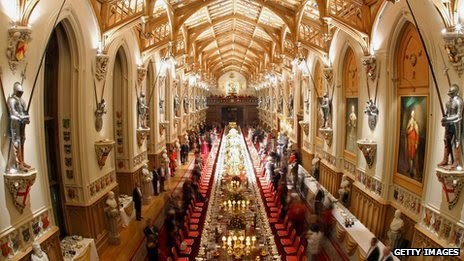
The Royal Household staff start laying the table for a banquet two days before the event, although preparations will have been underway for days before this. One of the most striking elements on the banqueting table is the magnificent service of silver gilt. It comprises not only the dining place itself, but also decorative items such as dessert stands and centerpieces. Numbering over 4,000 pieces, the service was commissioned by George IV when he was Prince of Wales, and it was supplied by the Royal goldsmiths Rundell, Bridge and Rundell.

At a famous dinner held at Carlton House in 1811, the Prince sat against a backdrop of silver guilt at the head of a table that stretched the entire length of the building. Along the centre of the table was running stream of water with banks of moss and aquatic flowers, cascading from a waterfall and falling into a series of pools at the foot of the table. Real fish swam in the stream. In this contemporary caricature (below), the fish are disconcerting the guests by staring at them.

29 June 1811, Hand-coloured etching ~ A farmer (John Bull) and his family gape in amazement at the arrangements for the Regency fête on 19 June. The narrow table extends across the design receding from left to right, the cloth hanging over the seats of chairs in the foreground. The famous canal decorates the centre of the table with its gold and silver fish, and the table is laid with gold plate, and ornate cut-glass goblets and decanters labelled 'Dry Champain', 'Claret', and 'Burgundy'. There are three-branched gold candelabra. The Prince's chair is on the extreme right; beside it stand a man in livery and an attendant in plain clothes. Behind the chair large ornate gold salvers are arranged on shelves covered with white drapery. This was 'a kind of circular buffet . . . lined by festoons and antique draperies of pink and silver'. The sightseers are on the farther side of the table (left) with their backs to the windows, John in the centre; he says, pointing: "Why Odd Zookers this is marvellous fine indeed. Oh Nan how we should relish a rasher on one of they monstracious beautifull Plates, why now I think I shan't grumble to pay three or four Bank Tokens towards this grand treat—methinks I should Just like a nippikin too." His wife puts out her hands protestingly: "Oh John one of our milk white Chickens roasted by myself by our wood fire would be Luscioscious indeed." His daughter says: "La Feather do zee how they gilded Fishes be stareing at yow." There are three loutish sons; one says: "I say Sue I thinks I should not like that dry Shampain, but a Dobbin of our home brewed in that there gilded gold thing would be dreadfully noice indeed"; another (looking up at the (invisible) ceiling : "Dang it if the top 0 the pleace beant all Eel pottles I'll be hang'd.
👑👑👑👑👑👑👑👑👑👑👑


The Grand Service includes 14 tureens, 20 sauce tureens, 140 dishes, 288 dinner plates, 118 salts, 12 ice pails, 12 mirrored plateaux, 58 desert stands and centerpieces and 107 candelabra. Unlike a modern dinner service, it has no single style of decoration. The goldsmiths of the day were influenced by Greek, Roman, Egyptian and other styles.

Originally some parts of the service for plain silver, although items intended for the desert course we're always gilt. However, George IV gradually ordered every piece to be gilded. This may have been because of the impression gained by one visitor to a ball at Carton House in n 1814: "All was in gold or silver gilt which made the silver plate, set out in the deep recessed windows, look cold and poor, although in reality it was very massive and handsome."

Today the Grand Service is kept under the care of the "Yeoman of the Silver Pantry." When not in use, it is kept in a controlled atmosphere. For a State Banquet it must be at its most gleaming and every piece is taken apart, thoroughly washed and cleaned with soft brushes, then dried and polished with soft cloths before being placed on the table. When everything is dismantled, there are over 8,000 components to clean. It takes 8 people 3 weeks to prepare.The Grand Service provides cutlery for every course and includes more obscure items like marrow scoops, ice spades and olive spoons. Today over 2000 pieces of cutlery are needed to serve and eat the banquet all drawn from the Grand Service.

The Queen's table is always decorated in the most magnificent style. She and her most important guest are usually flanked by the grandest pair of candelabra in the service -- which stand at 1.25 metres (4 ft) tall. These were designed by the sculptor John Flaxman and relate episodes from myths of Bacchus and Mercury. The Queen uses a salt that is not part of the Grand Service but was made much earlier, in 1721, by Nicholas Clausen.
 
Don't think about asking the Queen to "Please pass the salt."  She has her own salt dip, or salt cellar, and it is not part of the 8,000 plus pieces used for State Dinners.

At Windsor, on the single long table, a candelabrum portraying St. George and the Dragon is used -- this stands even taller at almost 1.5 metres (5 ft.) This huge piece was William IV's contribution to the elder brother's dinner service -- a final addition to the grandeur that has served every monarch since George IV.
  • Takes two days to lay the 175ft-long dining table at Buckingham Palace
  •  Each place setting measures 45cm and a rod is used to achieve the exact alignment of chair and table
  • 1,104 glasses are used, six for each guest
  • George IV's 4,000-piece Grand Service is used
  • Takes eight people three weeks to clean the service
  • 170 linen napkins, with the Queen's monogram, are folded by one man in the shape of a Dutch bonnet 

The Etiquette at the Table: 


At the dining table, don't start eating until the The Queen has started her meal. 

When it comes to utensils, start at the outside (with the outermost spoon or fork) and work in. If you drop something, don't make a fuss - servants will spot it and deal with it.


Watch for clues and cues with regard to how to properly use your utensils.  Let others who have been there before, guide your actions.


It goes without saying that taking large gulps of your wines, talking with your mouth full, any loud slurping or chewing, and eating with your mouth open, are all the poorest of table manners.


Don't think about asking the Queen to "Please pass the salt."  She has her own salt dip, or salt cellar.


When she has finished her course and stops eating, you have finished your course, too.


Asking for seconds is never allowed, as is asking to be excused to use the restroom facilities. 


Sources; BBC News, The Royal Collection and "For the Royal Table: Dining at the Palace"

🍽Etiquette Enthusiast, Maura J. Graber of The RSVP Institute of Etiquette, is the Site Editor for the Etiquipedia© Etiquette Encyclopedia