Showing posts with label American Woman’s Cookbook. Show all posts

Friday, June 16, 2023

Table Setting – The Napkin

It is no longer good form to put bread or a dinner roll in the napkin– too many embarrassing moments resulted from that custom.

Proper Napkin Placement

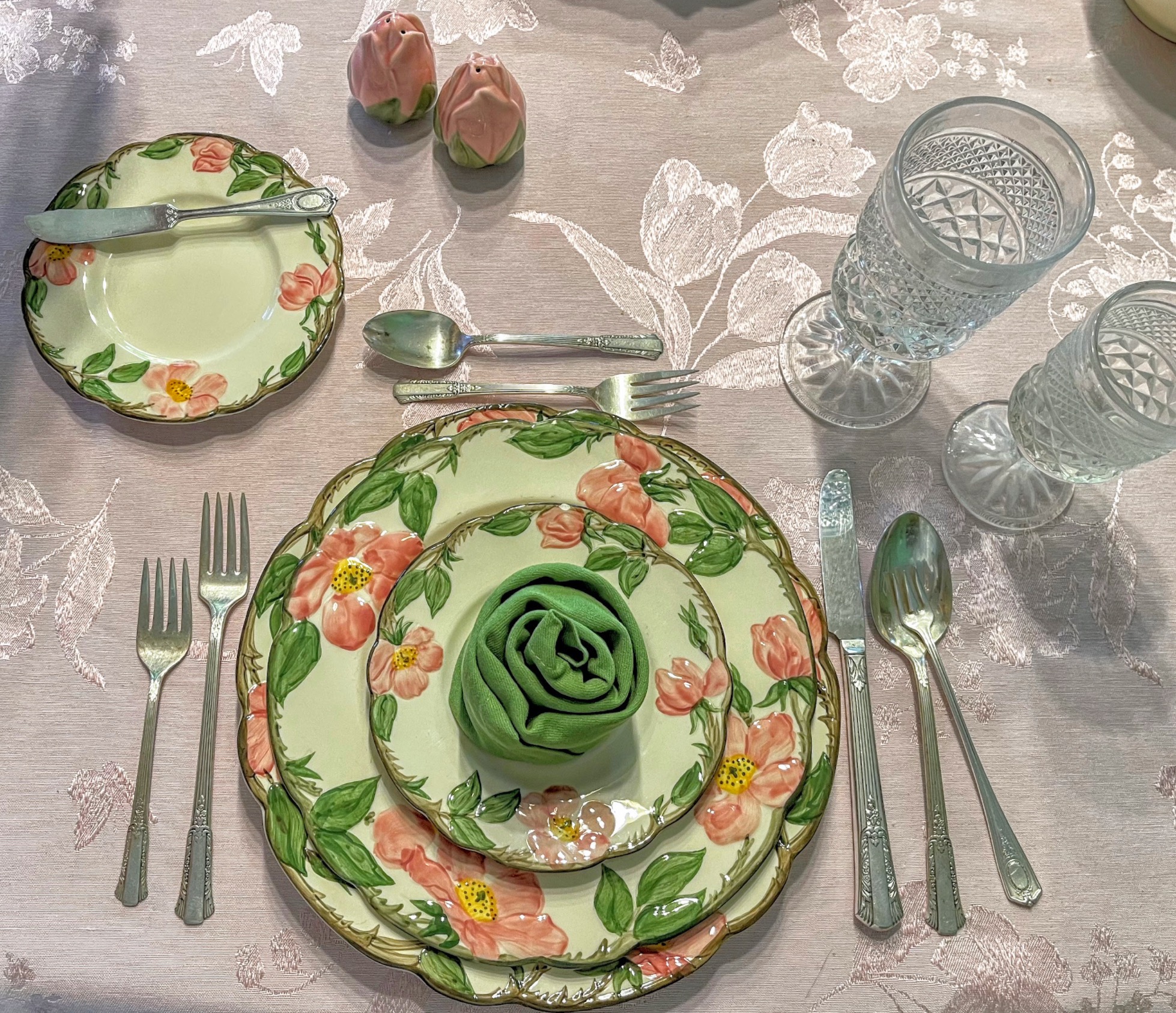
The napkin is usually placed at the left of the forks and parallel with them. If the napkin is folded in a square or otherwise folded so that the corners are up, it is placed so that the open corners are toward the plate.

Often one sees the napkin placed on the service plate, but unless space demands this, it is not to be recommended. Service plates are usually of such loveliness that none of their beauty should be sacrificed.

It is no longer good form to put bread or a dinner roll in the napkin– too many embarrassing moments resulted from that custom, for it was most natural, when one was engrossed in conversation, to take up the napkin unthinkingly and discover the roll flying for the regions under the table. – From “The American Woman’s Cookbook,” 1951


🍽Etiquette Enthusiast, Maura J. Graber, is the Site Editor for the Etiquipedia© Etiquette Encyclopedia

Monday, June 12, 2023

Table Setting — Table Decorations

No table decorations should obstruct the view of the guests (although at large, formal dinners, when the conversation cannot be general anyway, they may be tall). All tall decorations should be narrow (e. g. candles). Avoid over-decoration and inappropriate decorations.

Have in mind a definite plan. Consider carefully the artistic height for your table decorations: table decorations that are too high are awkward, and those that are too low become monotonous to the eye.

No table decorations should obstruct the view of the guests (although at large, formal dinners, when the conversation cannot be general anyway, they may be tall). All tall decorations should be narrow (e. g. candles). Avoid over-decoration and inappropriate decorations. Don't crowd your table or make it look heavy. Discriminate between a formal party and an informal party, and adapt your decorations accordingly.

Keep in mind the color-scheme of your room, and the colors of the food in your menu, and harmonize the color of your table decorations with these.

Adapt your flowers to the type and proportions of your flower-container.

Centerpieces

Centerpieces are of infinite variety, their beauty and distinction being limited only by one's imagination and one's budget. Flowers are still— and probably always will be— the most lovely decoration for the center of the table. The fashion of supporting a few flowers in flower-holders in low silver or glass bowls makes possible simple and very effective arrangements.

Unusual effects may be obtained with central mirrors and with mirrored tables, with fruits, with formal combinations of flowers and fruits, with crystal trees and flowers, with deli- cate figurines, and even with amusing accessories of simple or elaborate kinds. But one must be careful that the designs built with unusual accessories are beautiful and appropriate and not simply bizarre.

Compote Dishes and Candles

To balance the centerpiece, decorative silver or glass-or gold!-compote dishes, two or four in number, are usually placed toward the ends of the table. These dishes, containing bonbons or mints or nuts, may be low, medium, or high, accord- ing to the proportion required by the other table decorations.

Four candles, or more if the table is very large, are used in candlesticks of glass or silver or fine china, and sometimes of pottery for an informal dinner on an Italian or Spanish table. Instead of candlesticks handsome silver candelabra may be placed on each side of the centerpiece.

The candles should be lighted before the guests enter the dining-room, and allowed to burn until they leave the dining- room, even if they stay so long in the dining-room that the candles burn down to their sockets!

The height of the candles should, of course, be adapted to the height of the candlesticks-very tall candles in low stand- ards, and shorter ones in the standard of average height. Low candlesticks with tall slender tapers are interesting and - tive, but their use is more appropriate to informal occasions. Formal functions seem to need the dignity of tall candlesticks.

Candles for formal dinner tables usually are the color of natural wax or, if that is not obtainable, of white. As a matter of fact, many hostesses use candles of this color on their tables for all their parties. Of course colored candles may be used to carry out a decorative scheme, and are festive and appro- priate for special occasions. Candles are now never shaded.— From “The American Woman’s Cookbook,” 1951


🍽Etiquette Enthusiast, Maura J. Graber, is the Site Editor for the Etiquipedia© Etiquette Encyclopedia

Saturday, June 3, 2023

Table Setting — The Monograms

“When the bride-to-be is marking her trousseau linens, it is best form for her to use the initials of her maiden name. However, there is no hard and fast rule for this marking, and she may if she prefers use the initials of the first and last names of her maiden name and the initial letter of the groom's last name.”


Monogramming

The pattern or design of the cloth and napkins and the type, design, and size of the monograms embroidered on them should make a perfect unity.

For table-cloths, the size of the monogram should be from two and one-half to five inches. For dinner napkins from one to two inches. For luncheon and breakfast napkins and doilies, from three-quarters of an inch to an inch and a half.

When the bride-to-be is marking her trousseau linens, it is best form for her to use the initials of her maiden name. However, there is no hard and fast rule for this marking, and she may if she prefers use the initials of the first and last names of her maiden name and the initial letter of the groom's last name.

If an initial is used instead of a monogram it should be the initial of your last name. When only one letter is used, it is usually a block letter-sometimes ornate-since a single letter in script is not very effective-looking.

How to Measure for the Placing of the Monogram

Spread the cloth on the table, place the end of your measuring stick at the corner of the table, and point it in the direction of the corner diagonally opposite. Measure from twelve to fifteen inches, mark this off, and place your monogram there unless it will, in this place, interfere with the design in the damask. In that event, raise it or lower it to make it artistically well-placed. On a table-cloth of two yards square or less usually only one monogram is placed. Larger sizes usually have two monograms diagonally opposite each other. 

Dinner napkins should be marked with a smaller monogram of the same design as that used on the table-cloth. They are now usually embroidered in what is known as the “center of the side.” Fold the napkin into thirds, and again into thirds in the opposite way. On the top of the center square with the selvedge toward you, place the monogram in the approximate center. Tea napkins may be monogrammed with the two or three initials used on the other napkins. In very fine linen ones, cut-out monograms are often used. — From “The American Woman’s Cookbook,” 1951


🍽Etiquette Enthusiast, Maura J. Graber, is the Site Editor for the Etiquipedia© Etiquette Encyclopedia

Thursday, June 1, 2023

Table Setting — Serving Utensils


Whereas most early Olive Servers had both a fork and a spoon on opposite ends, by 1950, most manufacturers were selling one silver olive serving fork or serving spoon.


A List of Useful Serving Utensils

  • 2 or 3 Tablespoon’s
  • 2 or 3 Dinner Forks (for serving)
  • Medium size Carving Set (or steak set) 2 pieces (or large size carving set) 
  • Butter Knife or Butter Pick
  • Gravy Ladle
  • Sugar Tongs Pie or Tart Server, long and flat Cold Meat Fork
  • Olive Spoon (pierced) or Olive Fork
  • Berry Spoon. A very convenient serving-spoon which can be used in serving berries, large vegetables, casserole dishes, and puddings
  • Jelly Server, for jelly, marmalade, honey, etc.
  • Preserve Spoon 
  • Long Handled Fork and Spoon, for serving salad from a central bowl
  • Pickle Fork, usually two-tined
  • Pierced server, usually called a tomato-server, useful in serving sliced tomatoes, fritters, poached eggs, sliced pineapple, etc.
  • Salad Dressing Ladle, smaller than gravy ladle. Can also be used for serving whipped cream.
  • Lemon Fork
  • Asparagus Server
  • Entrée Server, wide and flat
  • Cake fork
  • Sardine Server
  • Ice Tongs
  • Ice Spoon
  • Sugar Spoon
  • Sugar Sifter for powdered sugar 
  • Ice-cream Knife or Ice-cream Server
  • Cheese Server
  • Melon Knife
  • Grape Scissors
—From, “The American Woman’s Cookbook,” 1951


🍽Etiquette Enthusiast, Maura J. Graber, is the Site Editor for the Etiquipedia© Etiquette Encyclopedia

Wednesday, May 31, 2023

Table Setting — Silver Flatware

Pictured above, “Continental” sized flatware can make plates and dishes look rather dwarfed, compared to smaller, American sized flatware. American flatware over the past 80 years or so, has been about an inch shorter and a bit smaller than its British and European counterparts. This except from the 1951, “The American Woman’s Cookbook” (formerly “The Delineator Magazine Cookbook”) clearly promotes using smaller flatware when entertaining.  —  “The luncheon knife and fork offer the greatest variety of uses. They may be used “around the clock,”for breakfast, for luncheon, for supper, and for certain courses at dinner, such as hors d'oeuvres, entrée, fish, salad, for dishes served in a ramekin, for dishes served at informal entertaining, and for large and small sandwiches. Smaller than the luncheon knife and fork are the tea knife and fork, with their increasingly-recognized number of uses.”


The silver on your table is a declaration of your taste. Whether it is sterling or plate, there is, in an excellent pattern and in the perfect form and proportion of the utensils, an unmistakable aristocracy that gives distinction.

Modern methods of manufacturing silver plate have made it not only durable but beautiful as well. Plated silver ranges from the very durable triple-plated ware, (heavy weight) which lasts a lifetime, through the double plate (medium weight) which has good wearing qualities, to the single plate which is light weight.

When you choose a pattern of silver, examine all the pieces, to be sure that you approve of the shapes of all the pieces, that the pieces are perfectly balanced, that the handles are comfortable to hold, and that the tips of the handles of the knives and forks fit perfectly into the center of the palm of the hand. Find out how long the pattern has been on the market, and, if possible, how long it is to be made, so that you will not suddenly discover that the pattern has been “discontinued.”

Place silver, or flat silver as it is sometimes called, consists of the knives, forks, and spoons necessary for general use at table.

Knives and Forks

The dinner knife and fork, although imposing members of the silver-family, are not the most important members, for their use is limited to the main course of dinner. The luncheon knife and fork offer the greatest variety of uses. They may be used “around the clock,”for breakfast, for luncheon, for supper, and for certain courses at dinner, such as hors d'oeuvres, entrée, fish, salad, for dishes served in a ramekin, for dishes served at informal entertaining, and for large and small sandwiches. Smaller than the luncheon knife and fork are the tea knife and fork, with their increasingly-recognized number of uses.

Butter spreaders are necessary in your first list. Later if you are not content to use the medium size knives and forks or the tea knives and forks for special courses like fish, entrée, salad, and fruit, you may buy fish knives and forks. entree knives and forks, and salad knives and forks (or, if you prefer, individual salad forks,) and fruit knives, or preferably, fruit knives and forks.

Spoons

Accompanying the medium size knife and fork, and of a size between a teaspoon and a tablespoon, is the dessert spoon, the spoon of a variety of uses, from eating soup and cereals, to eating desserts such as pudding and compote of fruit. 

Teaspoons have a great variety of uses, and while these are the first kind of small spoon to be bought you will want to add when you can, orange spoons, bouillon spoons, ice-cream spoons, coffee spoons, five o'clock teaspoons, and iced tea spoons. From “The American Woman’s Cookbook,” 1951


🍽Etiquette Enthusiast, Maura J. Graber, is the Site Editor for the Etiquipedia© Etiquette Encyclopedia

Tuesday, May 30, 2023

Table Setting — The Glass

Goblets are always provided with a foot, however small. The goblet is the dominant member of the “place glass” group, and all glasses of a service take their shape from it, following its contours very closely.
GLASS of late years, an awakening appreciation of the charm of glass has taken place. Perhaps the appeal of glorious color, so striking in this substance, accounts for it. Blue in varying tones was some years ago in wide favor; then amethyst dis placed it. Rapidly came amber, and green, which maintain a deserved respect, because of their adaptability. Rose, canary, sapphire, in quick succession-no color today is unrepresented. Glass is often selected to “go with” certain tones of china.

The hostess with a sense of fitness has a glass service for each of her dinner services. For her severely formal tables she uses glittering crystal, etched or cut, engraved or gold decorated. But there is ample opportunity for her to indulge her love for color to the full, to arrange tables with an eye to the dining-room effects, or to build them according to her own color preferences.

Kinds of Glasses

GOBLET. The goblet is the aristocrat of table glass. In its usual form it is a flaring round bowl resting on a tall slender stem. In certain styles, however, the “stem” becomes a mere button. Goblets are always provided with a foot, however small. The goblet is the dominant member of the “place glass” group, and all glasses of a service take their shape from it, following its contours very closely.

OTHER PLACE GLASS. In addition to the goblet, there may be placed at each cover at least one other glass for the cup or other beverages. At very formal dinners two extra glasses are often placed, but never more.

The shapes and sizes of these supplementary glasses vary as their purposes. On the continent, for example, there is a definite type of glass placed for certain wines. Thus a glass for sherry is differently shaped from one for claret: it is more sharply tapered and considerably smaller.

For the most part the glasses of this type that we see in America are either the claret, or the tall shallow champagne glass. The claret, whose capacity makes it a fine utility glass, is used for almost any kind of cup. On the other hand the tall champagne glass is often placed for its high decorative value. Few glasses are as graceful as this shallow bowl on its slender shaft.

SHERBET. The sherbet glass is a medium depth broad bowl on a short stem. In it are served sherbets, ice-cream, frozen desserts. Much used now, however, for this purpose is the tall shallow champagne glass, perhaps because of its more imposing height and dignity.

HOLLOW STEM CHAMPAGNE. This glass is similar to the tall champagne glass, except that the stem instead of being solid is hollow to the very bottom. While its primary use was for serving champagne, today we often serve in it ginger ale, and other carbonated drinks. The hollow stem releasing a train of sparkling bubbles is picturesque indeed.

FINGER BOWL. The finger bowl is a low broad bowl, variously shaped. It is usually seen without a “foot,” but certain styles have such supports. Finger bowls are fitted with matching under-plates, but their use is optional.

GRAPEFRUIT BOWL. This is a double bowl for chilled food cocktails. It consists of a large bowl on a stem. Within it is placed a smaller “cup” or “lining,” The grapefruit or other cocktail is put in the small cup, and the space is filled with crushed ice. between the cups.

TUMBLER. In its simplest form, a tumbler is simply a glass cylinder with one end closed. But the glass designer does wonders with it. He mounts it on a foot: he shapes its sides in lovely contours: often he makes it angular instead of round.

The sizes commonly used are:

Apollinaris Tumbler. This is a small, narrow tumbler used for liquids that are served in small quantities, such as orange juice, grape juice, mineral water. It is often used for water when space is at a premium, as on breakfast trays, or at bridge tables. It holds about five ounces.

Table Tumbler. Also called water tumbler. It is a low tumbler, containing about ten ounces, and is used to serve water informally, at simple meals. There is also a water tumbler of about the same capacity, but narrower and taller, sometimes called the “Ale tumbler.”

Highball Tumbler. A tall tumbler, used to serve “long drinks,” or iced tea, iced coffee, iced chocolate, and so forth. It holds about 12 ounces.

Iced Tea Tumbler. A normal iced tea tumbler, sufficiently large to contain plenty of ice. Its capacity runs from 14 to 16 ounces.

BESIDES THE PIECES IN GENERAL USE DESCRIBED ABOVE, there are all manner of articles blown for special uses: trays for hors d'oeuvres; salad bowls, salt dips, saucers for berries, and plates of various sizes.— From “The American Woman’s Cookbook,” 1951


🍽Etiquette Enthusiast, Maura J. Graber, is the Site Editor for the Etiquipedia© Etiquette Encyclopedia
Monday, May 29, 2023

Table Setting – The China

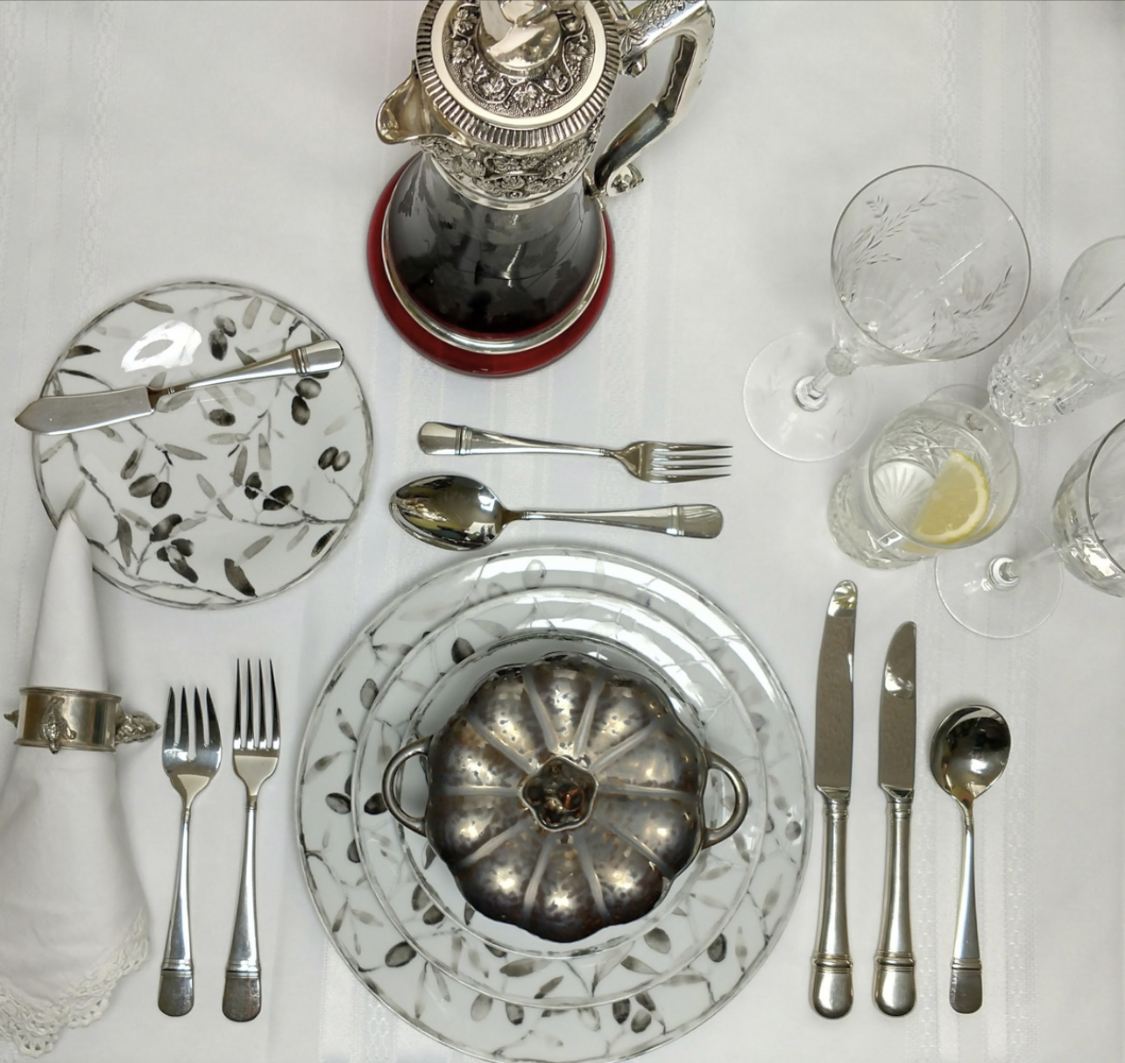
“Today there are patterns for every occasion. Breakfast china is gay, sprightly; color runs rampant upon it; often whole gardens shine on its face. But it would not be used for a dinner, which demands fine china of exquisitely fine design. Luncheon is still another thing. Its china may vary as the season or as the whim of the hostess.” – The term “china” can refer to any plates, porcelain or ceramic ware on the table which are not made of metal or glass. 
                                        

THE social life of a household, whether the household is a simple one or an elaborate one, centers about its dining-table and whether that dining-table is simply or elaborately dressed, it should, by its harmony and unity of setting, indicate that it is arranged according to a definite artistic standard. Every accessory that builds the table-picture – the silver, china, glass, and linen– furthers the art of gracious living in the household.

CHINA

Perhaps in greater degree than any other domestic appointments, does china present an opportunity for indulgence of personal whim and the exercise of good taste on the part of the hostess. Today there are patterns for every occasion. Breakfast china is gay, sprightly; color runs rampant upon it; often whole gardens shine on its face. But it would not be used for a dinner, which demands fine china of exquisitely fine design. Luncheon is still another thing. Its china may vary as the season or as the whim of the hostess.

Modern day impatience with formula and rite is nowhere more eloquently expressed than in the growing custom of using different patterns for different courses, all related by the thread of harmony. The hostess of today considers sameness identical with boredom. If she uses a cobalt and gold service plate, she may elect to use a simple gold-banded entrée plate. The fish plate perhaps may have yellow bands to match the flowers in the center. The roast plate may present a pattern bordertouched with gold, and yellow, and blue. Her dessert plate will be utterly different from any of the foregoing: it may strike an entirely new note; but it will not be discordant or jarring. Obviously, all dishes used in one course should match.

Plates of Various Sizes and How They Are Used

In the following list the measurements, in inches, are from extreme rim to rim:

PLACE PLATE (also called cover plate, service plate, lay plate). 10 to 11 inches.

DINNER PLATE (roast plate). 
10 inches, but seen as large as 10½ inches. The size of the dinner plate is fairly large, due to the current practice of placing attendant vegetables on the plate with the meat. The day of side dishes, each bearing a particular variety of vegetables, has definitely passed.

ENTRÉE PLATE. 
82 to 9½ inches. A most convenient size, for, in addition to its use in serving entrées, it is often employed as a salad plate, or a fish plate: even a dessert plate when the finger bowl is borne in with the dessert silver on the plate, the finger bowl being removed later.

DESSERT PLATE. 
72 to 8 inches. Used for miscellaneous desserts, and salads. It becomes the cake plate at tea. 

BREAD AND BUTTER PLATE. 6 to 6½ inches. Universally used now: the butter chip, for individual butter service is extinct.

SOUP PLATE. 
8 to 8½ inches at rim, for the usual type of soup plate with wide, flat rim. There is also a bowl soup plate, or “coup” soup, which has no rim at all. Soup plates are not as commonly used as at one time, due to the spreading favor accorded the cream soup cup and the bouillon cup for luncheons and informal meals.

Cups and Bowls

CREAM SOUP CUP. This is a low, broad cup, handled on both sides. Its width is from 42 to 5 inches, and its depth about two. It is used for the serving of purées, bisques, cream soups, and is extremely popular for luncheons.

BOUILLON CUP. A tea cup with two handles. Clear soups, consommés, bouillons are served in it.

CHILLED COCKTAIL BOWL. This is distinctly an innovation in china service. It is a low, wide bowl, fitted with a separate small container. The space between the bowl proper and the inner cup is filled with crushed ice. Used for grapefruit, shrimp cocktail, and many other foods best served chilled.– From “The American Woman’s Cookbook,” 1951


🍽Etiquette Enthusiast, Maura J. Graber, is the Site Editor for the Etiquipedia© Etiquette Encyclopedia