Showing posts with label Butler's Etiquette. Show all posts

Wednesday, September 4, 2019

Evolving Etiquette and the Posts

In 1969, publishers Funk and Wagnalls came out with a replica edition of Emily Post’s 1922 book, “Etiquette” for $10.00– for $6.95, they also came out with Elizabeth Post’s revised 12th edition of the same book. A writer compared the two books. – Photo above, Elizabeth Post, circa 1969

Emily Post’s first edition of “Etiquette” vs Elizabeth Post’s updated, twelfth edition of the same book. What has changed since 1922?


Nearly fifty years have passed since Emily Post's first published guide to good manners, but her basic world of etiquette and the underlying reasons for it, live on. It's not the same etiquette to be sure the bewildering world of valets, footmen, chaperones, finger bowls and P.P.C. cards and the rules associated with them, have disappeared as times have changed. What has remained is the idea that etiquette is good manners, “a goal that can be achieved only by making consideration and unselfishness an integral part of your behavior.” 

Comparing the index of Emily Post's first edition which appeared in 1922 with the 12th revised edition, updated in 1969 by Elizabeth Post (the wife of Emily's grandson) shows how informal American living has become. In the original, the topic “Informal Entertaining” is not even included in the index: the only mention along this line is to a “House Party in Camp.” In contrast, seventy-nine pages of the current edition are devoted to “Informal Entertainment,” including cocktail parties, picnics, showers, buffets, etc. No longer are we concerned with the rules for bowing; the sole reference to bowing deals with “bowing to the President of the United States.” Today two pages are devoted to butlers; the 1922 edition contained twelve pages on butlers and three on footmen. It's particularly amusing to compare the Post's pronouncements on the correct way to treat social situations of the day: 

MONEY MATTERS “Everyone has at some time been subjected to the awkward moment when the waiter presents the check to the host ... to avoid this transaction people who have no charge accounts should order the meal ahead, and at the same time pay for it in advance, including the waiter's tip.” 1st edition – “When everyone has finished his meal, the host catches the eyes of the waiter or headwaiter and says, ‘The check please’ He looks at it, checks it quickly for mistakes and returns it to the plate with the necessary money . . .” 12th edition.
LADIES TRAVELING “On a railroad train, if a stranger happens to offer to open a window for her, it does not give him the right to more than a civil ‘thank you.’ If, in spite of etiquette she should on a long journey drift into conversation with an obviously well-behaved youth, she should remember that talking with him at all is contrary to the proprieties.” 1st edition – “On a long journey if you happen to sit next to or near the same person on the dining car for a number of meals, it is extremely unfriendly to sit in wooden silence.” 12th edition.
CHAPERONS “The conventions of propriety demand that every young woman must be protected by a chaperon, because otherwise she will be misjudged. A young girl never goes even to an unmarried doctor's or a clergyman's (unless the latter is very elderly) without a chaperon who in this instance may be a semi elderly maid.” 1st edition – “From an ethical standpoint the only chaperon worth having in the present day is a young girl's own efficiency in chaperoning herself. The girl who has been taught to appraise every person and situation she meets needs no one to sit beside her and tell her what to do.” 12th edition.

To many people, particularly to the younger generation, even the 12th edition may seem a bit stilted and formal. Because of Elizabeth Post's reluctance to leave anything out, the modern edition, too, becomes amusing. For instance under the heading “Smoking in Public” we are told that it is taboo to smoke on the dance floor. “Not only does it look unattractive but there is a very real danger of burning your partner or his or her clothes.” Really, isn't this just common sense? That's what etiquette is all about. – Arleen Abrahams for the Santa Cruz Sentinel, 1969


Etiquette Enthusiast, Maura J Graber, is the Site Editor for the Etiquipedia© Etiquette Encyclopedia 

Monday, August 5, 2019

Etiquette of Modern Era Butlers

“For the new super-rich, an English butler is a status symbol to line up alongside the Swiss banker, French chef, German car manufacturer, and Italian lover. The English are seen as refined, dignified, deferential, reserved, formal when needed, and able to adapt to any given situation without giving way to emotion or anxiety. They are also there to bring sophistication and old-world charm to the halls of their otherwise ostentatious homes; a touch of class alongside the gold taps and garish chandeliers.” –“... the two most desirable qualities in a good butler are loyalty and discretion. Loyalty, but also the ability to ignore his pretensions (and there are many), and discretion as a confidant who can also stay socially aloof.” The Guardian, 2011, photo source Pinterest 

Running households for the rich has payoffs for Coachella Valley’s top domestics 

Imagine having a butler order custom brass or porcelain matchboxes for your party guests. Or employing three butlers; one to oversee household operations, one to take care of paintings and another to polish floors. That might seem a little far-fetched to most people, but not those in the Coachella Valley. Butlers may not be as plentiful now as they were 100 years ago, but the profession is far from dying out. Butlers are in demand, particularly by single business professionals and entrepreneurs with new wealth, according to local butlers and two Palm Springs employment agencies “There is a bigger demand here for butlers because of the influx of wealth into the valley. 


The younger blue bloods in the 1960’s were out there doing their own thing Now they are going back to the old style,” said Michael, a butler for an affluent local businessman. Michael, 40, spoke on the condition his name not be used, thus ensuring anonymity for his employer as well as for himself. “Discretion is of the utmost importance,” he said. “There are some things about an employer that you wouldn't even tell your brother.” Michael has worked his way up through the ranks, learning the business as he went along. “You learn as things happen,” he said, “I used to move with great caution. If I made a mistake around guests, I would move swiftly, like nothing happened. If you make a mistake and get nervous, you’ll make the people around you nervous.” 

He has worked for British aristocrats, royalty and Australian diplomats. The story of his career sounds like a fairy tale. Michael, the youngest of six children, was reared in an old-fashioned home in Ireland At age 16, he landed a job as a pantry man for Sir Edward and Lady Wills, at the tobacco magnate’s eight-bedroom country estate in Berkshire, England His assignments: polishing the silver, cleaning “a huge hallway" and setting aside silverware, glasses and plates for the head butler to set the table. 

Employers with large domestic staffs rank butlers according to their responsibilities. The first or head butler is usually given the coveted duties. His tasks include greeting guests, pouring tea, serving dinner, planning menus and managing the domestic staff. Although Michael was promoted from pantry man to third butler, he soon grew weary of life on the secluded estate. After he and the other domestics returned from the Wills’ annual stay at the family castle in Scotland, he left for London. He then worked as the second butler for the Duke of Gloucester at St James Palace in London. His duties included serving afternoon teas for world figures such as Queen Elizabeth, the Queen Mother, King Hussein of Jordan and Queen Beatrix of The Netherlands. “Working with royalty was more important for my mother than for me.” Michael said “She took great pride in my profession. I was taught a lot about how to work in a very formal environment with people on a one-to-one basis.” 

In England, butlers often exchange notes on the tastes of the people they serve Michael said it was common for butlers to call each other before a dinner party to learn what foods the guests liked or disliked. When guests arrived, they were greeted with their favorite drinks without having to ask. Michael said to be a butler, “you have to have a lot of dedication. And tranquility must prevail at all times.” Sometimes striving for perfection is hard to turn off. Michael admitted he has a habit of arranging other people’s tables when he is a dinner guest. 

Like Michael, valley resident Jackson, who didn’t want his last name used, also worked his way up the ladder to his status as butler Jackson. 36, became a hotel busboy at age 16 and later worked at a variety of jobs. It was in Las Vegas that he entered domestic service, working at a seven-acre home once owned by billionaire Howard Hughes For nine years he took charge of the estate and even managed the rearing and breeding of Andalusian horses. “When you work for a family you become part of the family on the service side. You see children grow up,” Jackson said. When his employers were divorced, Jackson decided he wanted a change His next job was in Beverly Hills. "I worked briefly for a Hollywood’ wife. I wish her husband would find out the truth,” he said, referring to her extramarital affairs. “A lot of those women have their noses up two inches higher than God intended. But they can’t fool the butler because I've seen it all.” 

Jackson, who has been a butler for 14 years, said he doesn’t mind being called a servant. “I’m there to serve the needs of the family. We’re all servants in life. You’re providing a service to your employer,” he said. His present boss is listed in Forbes Magazine as one of the nation's wealthiest men. “I work within a budget and spend the money as if it were my own.” Jackson said money isn’t a concern when planning a lavish party. The key to being a butler, Jackson said, is knowing your employers’ habits and keeping them content and happy. “What makes a good butler is surprising their (the employers) lives with new things, like food. Or using floral arrangements to create a little spark that gives them something new to look at. Doing things always to please them . . never to embarrass them,” he said. Jackson said he loves his job because it enables him to be around the ultra-rich. 

Charles, who also wanted anonymity, said he’s been a butler/houseman for 25 years. His local employer is also well-to-do. “I chose to be a butler because I found it a means of always being employed," he said, “There are always going to be wealthy people and wealthy people can always afford help.” He is an American butler who grew up in an area where there was no work except as domestic help. “I went to school and worked part time as valet," Charles said. “After I finished school, I had trouble finding a job. I went back to being a domestic because you usually have room and board, a very decent salary and ample time off.” Also, a car allowance is often provided. “If you’re smart, you can pretty much keep all you earn," Charles said. 

Palm Springs resident Sonny Karlsson, 45, arrived in the United States from Sweden in 1964. “When I came to America I didn’t have any idea about being a butler, other than what I saw in the movies,” he said. One year later, he was a Beverly Hills butler for Lita Annenberg Hazen, sister of Rancho Mirage resident Walter Annenberg. Five years later Karlsson went into business for himself, mainly serving dinners as an on-call butler. His clients included the late Henry Fonda, Kirk Douglas, Bob Hope, Danny Kaye and the late Walt Disney, he said. Karlsson also worked for Mrs. Henry Ford 11. He served at “very, very formal dinner parties” and once worked for five weeks at her Long Island estate. He is still in business serving dinners, but his 25-year-old son now helps. Karlsson, Charles, Jackson and Michael agreed that a live-in butler’s life is hard work, but they say the pay is good with a $500 average weekly salary. Jan Williams of the Palm Springs Employment Agency said her firm has placed butlers with monthly salaries ranging from $800 to $2,000, depending upon the butler’s experience and the employer’s needs. “Employers usually want incredible reference checks and a great work background,” Ms. Williams said. The wealthy who live on large estates frequently demand security checks with the FBI. 

“When butlers are working with larger estates, naturally they’re going to be in contact with diplomats from all over the world,” she added The head of the household usually interviews butler candidates himself, Ms. Williams said. Ms. Williams and Dorothy “Sully” Sulman, of Surfside Services Agency in Palm Springs, said many people still maintain that the stereotypical English butler is tops. Ms. Sulman said, “A true domestic is one who smiles, does what he is told and keeps his mouth shut. In other words, what goes on in the household is nobody’s business. Butlers are servants, period. They serve.” 

Butlers in Southern California frequently come to Palm Springs in search of work and solitude, she said. “Butlers in Beverly Hills and Hollywood are killing themselves with kinky parties and Mickey Mouse parties,” Ms. Sulman said. “They have to tolerate what goes on there. So, they come here when they get tired of working at that level and under the stress of that particular kind of world.” Ms, Sulman said many local employers who want butlers are “geriatric people” who need to be pampered. Why do Coachella Valley residents hire butlers? “So they never run out of anything and when they reach out for something, it’s there,” Ms. Sulman explained. – By Noel Fletcher, Desert Sun News, 1985 


Etiquette Enthusiast, Maura J Graber, is the Site Editor for the Etiquipedia© Etiquette Encyclopedia 

Sunday, June 19, 2016

An Upstairs-Downstairs Etiquette Snafu

Not all cooks were keen to teach their skills to any of those living “upstairs” —When a servant is engaged, he enters the house for the first time through the front door. After that he regards the back door as his sole means of entrance and exit.
Mistress Fined for Invading Her Own Kitchen! 

LONDON, July 17.—There is no etiquette so strict as that which dominates London life “below stairs.” With all the upheavals of the world war, the dignity of cooks and butlers remains unassailed. 

A case was recently heard in the court wherein a cook took offense because the mistress invaded the kitchen and insisted on cooking some mutton chops herself. The insulted culinary queen immediately gave notice, and in this she was joined by her husband, the butler. Whereupon the mistress locked the back door and thus got herself sued for “wrongful imprisonment.” 

During the hearing of the case the judged asked why, if the mistress had only locked the back door, did not the couple go out by the front. The cook and butler nearly collapsed at the suggestion. “That,” said the butler, painfully surprised at the judge’s ignorance, “is against all kitchen etiquette. When a servant is engaged, he enters the house for the first time through the front door. After that he regards the back door as his sole means of entrance and exit. No self-respecting servant would dream of leaving his employer’s house by the front door!”

On inquiry, it was found that the etiquette ruling such matters was a very real thing to the circle of overlords and underlings of the kitchen, and the aggrieved pair were allowed £5 damages. — Los Angeles Herald, 1920

Etiquette Enthusiast, Maura J Graber, is the Site Editor for the Etiquipedia© Etiquette Encyclopedia

Tuesday, April 5, 2016

New Etiquette for "Below Stairs"

The ladies' maids and valets of the guests will not dine with the help of the house, and the chambermaids, according to the etiquette of high life below stairs, will not sit down with the scrubwoman, and in some places will also decline to eat at the same table as the bellboys. 
Are All Dreadfully Particular 

In the furnishing and fitting of some of the new apartments, and apartment hotels, several interesting features have been under discussion, says the New York Sun. In other days, in the old class of such buildings in this city, a dining room for children and servants was considered sufficient for all requirements. 

To-day in building a hotel, there must be a succession of dining rooms. The ladies' maids and valets of the guests will not dine with the help of the house, and the chambermaids, according to the etiquette of high life below stairs, will not sit down with the scrubwoman, and in some places will also decline to eat at the same table as the bellboys. 

The clerks, telephone girls and numerous other members of the staff form another set. At some of the hotels the clerks are served in the cafe, but it has been found that it is better that the clerical force and the housekeeper and the different heads of departments have a dining room of their own. 

The chauffeur still remains an indefinite proposition. Until lately he has declined in private houses to be classed as a servant, and only last year there was a protest about his wearing livery.  It is quite à la mode this season to register at a resort hotel “Mr. and Mrs. and chauffeur,” just as it has been “maid” or “man servant” on the out going ships— Sausalito News, 1908


Etiquette Enthusiast Maura J Graber is the Site Editor for the Etiquipedia© Etiquette Encyclopedia

Monday, December 9, 2013

Etiquette and Duties of Butlers

“He places the silver and plated articles on the table, sees that everything is in its place, and rectifies what is wrong...”
The domestic duties of the butler are to bring in the eatables at breakfast, and wait upon the family at that meal, assisted by the footman, and see to the cleanliness of everything at table. On taking away, he removes the tray with the china and plate, for which he is responsible. At luncheon, he arranges the meal, and waits unassisted, the footman being now engaged in other duties. At dinner, he places the silver and plated articles on the table, sees that everything is in its place, and rectifies what is wrong. He carries in the first dish, and announces in the drawing-room that dinner is on the table, and respectfully stands by the door until the company are seated, when he takes his place behind his master's chair on the left, to remove the covers, handing them to the other attendants to carry out. After the first course of plates is supplied, his place is at the sideboard to serve the wines, but only when called on.
“After the first course of plates is supplied, his place is at the sideboard to serve the wines, but only when called on.”
The first course ended, he rings the cook's bell, and hands the dishes from the table to the other servants to carry away, receiving from them the second course, which he places on the table, removing the covers as before, and again taking his place at the sideboard.

At dessert, the slips being removed, the butler receives the dessert from the other servants, and arranges it on the table, with plates and glasses, and then takes his place behind his master's chair to hand the wines and ices, while the footman stands behind his mistress for the same purpose, the other attendants leaving the room. Where the old-fashioned practice of having the dessert on the polished table, without any cloth, is still adhered to, the butler should rub off any marks made by the hot dishes before arranging the dessert.

Before dinner, he has satisfied himself that the lamps, candles, or gas-burners are in perfect order, if not lighted, which will usually be the case. Having served every one with their share of the dessert, put the fires in order (when these are used), and seen the lights are all right, at a signal from his master, he and the footman leave the room.

He now proceeds to the drawing-room, arranges the fireplace, and sees to the lights; he then returns to his pantry, prepared to answer the bell, and attend to the company, while the footman is clearing away and cleaning the plate and glasses.

At tea he again attends. At bedtime he appears with the candles; he locks up the plate, secures doors and windows, and sees that all the fires are safe.
 
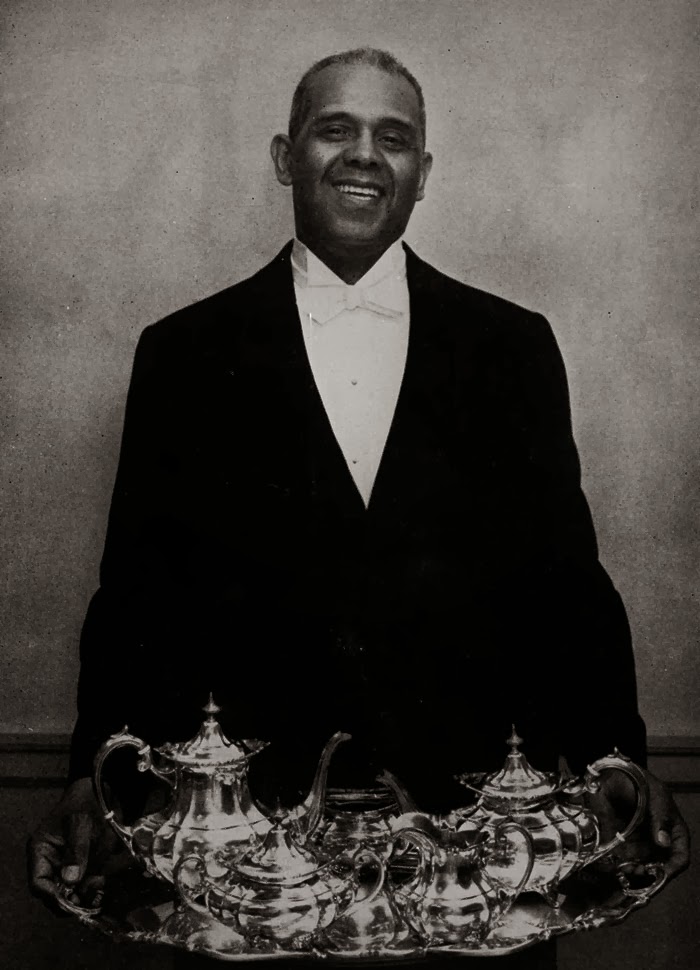
One of the most famous butlers in U.S. history (pictured) was Alonzo Fields (1900-1994). For more than two decades, he served in the White House, under United States Presidents Hoover, Roosevelt, Truman and Eisenhower. – “The office of butler is thus one of very great trust in a household.”

In addition to these duties, the butler, where only one footman is kept, will be required to perform some of the duties of the valet, to pay bills, and superintend the other servants. But the real duties of the butler are in the wine-cellar; there he should be competent to advise his master as to the price and quality of the wine to be laid in; "fine," bottle, cork, and seal it, and place it in the bins. Brewing, racking, and bottling malt liquors, belong to his office, as well as their distribution. These and other drinkables are brought from the cellar every day by his own hands, except where an under-butler is kept; and a careful entry of every bottle used, entered in the cellar-book; so that the book should always show the contents of the cellar.
At tea he again attends.
The office of butler is thus one of very great trust in a household. Here, as elsewhere, honesty is the best policy: the butler should make it his business to understand the proper treatment of the different wines under his charge, which he can easily do from the wine-merchant, and faithfully attend to it; his own reputation will soon compensate for the absence of bribes from unprincipled wine-merchants, if he serves a generous and hospitable master. Nothing spreads more rapidly in society than the reputation of a good wine-cellar, and all that is required is wines well chosen and well cared for; and this a little knowledge, carefully applied, will soon supply.

The butler, we have said, has charge of the contents of the cellars, and it is his duty to keep them in a proper condition, to fine down wine in wood, bottle it off, and store it away in places suited to the sorts. Where wine comes into the cellar ready bottled, it is usual to return the same number of empty bottles; the butler has not, in this case, the same inducements to keep the bottles of the different sorts separated; but where the wine is bottled in the house, he will find his account, not only in keeping them separate, but in rinsing them well, and even washing them with clean water as soon as they are empty.

There are various modes of fining wine: isinglass, gelatine, and gum Arabic are all used for the purpose. Whichever of these articles is used, the process is always the same. Supposing eggs (the cheapest) to be used,—Draw a gallon or so of the wine, and mix one quart of it with the whites of four eggs, by stirring it with a whisk; afterwards, when thoroughly mixed, pour it back into the cask through the bunghole, and stir up the whole cask, in a rotatory direction, with a clean split stick inserted through the bunghole. Having stirred it sufficiently, pour in the remainder of the wine drawn off, until the cask is full; then stir again, skimming off the bubbles that rise to the surface. When thoroughly mixed by stirring, close the bunghole, and leave it to stand for three or four days. This quantity of clarified wine will fine thirteen dozen of port or sherry. The other clearing ingredients are applied in the same manner, the material being cut into small pieces, and dissolved in the quart of wine, and the cask stirred in the same manner.
Having carefully counted the bottles, they are stored away in their respective bins
 To Bottle Wine.—Having thoroughly washed and dried the bottles, supposing they have been before used for the same kind of wine, provide corks, which will be improved by being slightly boiled, or at least steeped in hot water,—a wooden hammer or mallet, a bottling-boot, and a squeezer for the corks. Bore a hole in the lower part of the cask with a gimlet, receiving the liquid stream which follows in the bottle and filterer, which is placed in a tub or basin. This operation is best performed by two persons, one to draw the wine, the other to cork the bottles. The drawer is to see that the bottles are up to the mark, but not too full, the bottle being placed in a clean tub to prevent waste. The corking-boot is buckled by a strap to the knee, the bottle placed in it, and the cork, after being squeezed in the press, driven in by a flat wooden mallet.

As the wine draws near to the bottom of the cask, a thick piece of muslin is placed in the strainer, to prevent the viscous grounds from passing into the bottle.

Having carefully counted the bottles, they are stored away in their respective bins, a layer of sand or sawdust being placed under the first tier, and another over it; a second tier is laid over this, protected by a lath, the head of the second being laid to the bottom of the first; over this another bed of sawdust is laid, not too thick, another lath; and so on till the bin is filled.

Wine so laid in will be ready for use according to its quality and age. Port wine, old in the wood, will be ready to drink in five or six months; but if it is a fruity wine, it will improve every year. Sherry, if of good quality, will be fit to drink as soon as the "sickness" (as its first condition after bottling is called) ceases, and will also improve; but the cellar must be kept at a perfectly steady temperature, neither too hot nor too cold, but about 55° or 60°, and absolutely free from draughts of cold air.

“Sophistication might be described as the ability to cope gracefully with a situation involving the presence of a formidable menace to one's poise and prestige (such as the butler, or the man under the bed -- but never the husband).”  James Thurber 

–From Mrs. Beeton, 
“The Book of Household Management.”


🍽️Etiquette Enthusiast, Maura J. Graber of The RSVP Institute of Etiquette, is the Site Editor for Etiquipedia© Etiquette Encyclopedia