Showing posts with label Chinese Tea Etiquette. Show all posts

Friday, June 17, 2022

Clotted Cream Tea Etiquette

“This looks delicious, but it is not ‘the done thing’ to cut a scone, slather clotted cream and jam on, then put the scone back together to form a kind of bulky sandwich. Scones are broken, much like a bread roll. The scone (pronounced as in “gone” not as in “cone”) is to be eaten in a very particular way. Scones are served whole and preferably warm from the oven, and as with bread you break a scone with your fingers, and spread the jam and cream on, bite-size by bite-size piece. One should never be seen to cut a scone with a knife.” – Etiquette Teacher, Rachel North. 
According to taste.com.au, “Jam or cream first – it’s the ultimate food fight. Scones: they’re the quintessential English dessert and also the cause of a long-running (and often heated) debate around the world. What goes first? Jam or cream?…The two English counties famous for cream teas are Cornwall and Devon, and they differ on order. Cornish cream tea will do jam then cream, Devonians do it the other way around. The nation votes –To help settle the long-running debate once and for all we put it to our Facebook followers: which is the right way to eat a scone? Jam first or cream first. With over 18,000 votes in total, 17,000 of those said jam first, while only 1,000 people said cream. While it’s safe to say it wasn’t a nail-biting vote, people weren’t afraid to let their opinions be known.”

Cream Ladles
A cream ladle with a gilded bowl, used for placing clotted cream in tea, from the Gilded Age. It’s in the 1902 “Poppy” pattern by Gorham. Numerous books for identification of silver patterns and dating your flatware are available. This ladle was photographed on an old book by the late, Richard Osterberg, on sterling flatware, as I was looking at other pieces in the “Poppy” pattern.

Although warm milk was sometimes added to tea in China in the seventeenth century, when tea-drinking was taken up in England in that same century, sugar was the sole additive. The addition of milk was delayed to the early eighteenth century, ‘but... the English epicure who first tempered tea with milk remains unchronicled’. 

The milk for tea was hot during the first quarter of the century, following which cold milk was the rule. Cream was served with tea beginning in the late eighteenth century. The first receptacles for cream were pitchers or jugs with wider mouths than comparable containers for milk, to accommodate the thicker, slower-pouring liquid. There was no need for spoons or ladles.

Such utensils were needed, however, with ‘clotted cream’ (also known as Devonshire cream), which was milk heated until its cream became thick or clotted. (Clotting not only enriched the taste but helped to preserve the cream in the days before refrigeration.) 

The service of clotted cream in small silver pails became a ‘fashionable conceit’ on dessert tables in the late 1740s. The receptacles took other forms, as well, including boats supported on three or four feet and openwork baskets with liners of Bristol blue glass. Small silver ladles accompanied the containers. — William P. Hood, Jr. in 1999’s “Tiffany Silver Flatware”


🍽Etiquette Enthusiast, Maura J. Graber, is the Site Editor for the Etiquipedia© Etiquette Encyclopedia

Wednesday, October 6, 2021

Chinese Etiquette for Guests

“It is the rule to place the guest at one's left hand, though curiously enough this only dates from the middle of the fourteenth century, previous to which the right hand was the place of honour.” – Chinese culture in Marysville, California, with a Chinese dragon for the Independence Day Parade, July 4, 1902
-Photo source, Etiquipedia© Private Library


There is a curious custom in connection with the invariable cup of tea served to a visitor on arrival which is often violated by foreigners, to the great amusement of the Chinese. The tea in question, known as guest-tea, is not intended for ordinary drinking purposes, for which wine is usually provided. 

No sooner does the guest raise the cup of tea to his lips, or even touch it with his hand, than a shout is heard from the servants, which means that the interview is at an end and that the visitor's sedan-chair is to be got ready. Drinking this tea is, in fact, a signal for departure. A host may similarly, without breach of good manners, be the first to drink, and thus delicately notify the guest that he has business engagements elsewhere.

Then again, it is the rule to place the guest at one's left hand, though curiously enough this only dates from the middle of the fourteenth century, previous to which the right hand was the place of honour.

Finally, when the guest takes his leave, it is proper to escort him back to the front door. That, at any rate, is sufficient, though it is not unusual to accompany a guest some part of his return journey. In fact, the Chinese proverb says, “If you escort a man at all, escort him all the way.” This, however, is rhetorical rather than practical, somewhat after the style of another well-known Chinese proverb, “If you bow at all, bow low.” —From “China and the Chinese,” by H. A. Giles, 1902


Etiquette Enthusiast, Maura J. Graber, is the Site Editor for the Etiquipedia© Etiquette Encyclopedia

Tuesday, October 5, 2021

Etiquette for Chinese Hosts

Former US president and civil war general Ulysses S Grant meets Chinese Viceroy Li Hung Chang in Tianjin, 1879. The two enjoyed friendly relations and discussed how to develop China and improve her trade with the world. 
-Library of Congress


Take the case of a Chinese visitor. He should be received at the front door, and be conducted by the host to a reception-room, the host being careful to see that the visitor is always slightly in advance. The act of sitting down should be simultaneous, so that neither party is standing while the other is seated. If the host wishes to be very attentive, he may take a cup of tea from his servant’s hands and himself arrange it for his guest.

Here comes another most important and universal rule: in handing anything to, or receiving anything from an equal, both hands must be used. A servant should hand a cup of tea with both hands, except when serving his master and a guest. Then he takes one cup in each hand, and hands them with the arms crossed. I was told that the crossing was in order to exhibit to each the “heart,” i.e. the palm, of the hand, in token of loyalty. — From “China and the Chinese,” by H. A. Giles, 1902


Etiquette Enthusiast, Maura J. Graber, is the Site Editor for the Etiquipedia© Etiquette Encyclopedia

Thursday, February 18, 2021

Etiquette and Tea Slurping

Slurping shows one’s appreciation to one’s host or hostess. The more, the better!
—Photo source, Etiquipedia private photo library


Slurping Your Tea Is Polite Manners 

HONOLULU (AP) “Chinese connoisseurs of tea are meticulous,” wrote Mary Sia in a Chinese cookbook published by the University of Hawaii Press, and they have their own rules of etiquette. “It is good manners to show appreciation by making plenty of noise while drinking,” she wrote. —The Sun, 1972


Etiquette Enthusiast, Maura J. Graber, is the Site Editor for the Etiquipedia© Etiquette Encyclopedia

Friday, August 14, 2020

Tea Etiquette in China

When paying a call, if the servant should bring in a cup of tea, there is no necessity of taking any particular notice of it, allow the servant to place it where he likes near you, and continue your conversation as though nothing had happened.
— Photo source, Pinterest


The etiquette pertaining to tea drinking in China is curious. If a lady asks you to drink tea with her, and especially if the tea be sweetened, you can count yourself as well received and much liked. If she does not like you, the tea is bitter. Reports sayeth in cases of this sort, drainings are often used. Of course, it is needless to say that after one sip of such tea, the unliked visitor makes a prompt exit.

When paying a call, if the servant should bring in a cup of tea, there is no necessity of taking any particular notice of it, allow the servant to place it where he likes near you, and continue your conversation as though nothing had happened. If your business is pleasant and agreeable to the mistress or the master of the house, he or she will pass the beverage to you; if not, you are expected to leave it untouched; otherwise you are likely to have a quarrel on hand, and a Chinese quarrel, either with a man or woman, is unpleasant.— Hanford Journal, 1907


Etiquette Enthusiast, Maura J Graber, is the Site Editor for the Etiquipedia© Etiquette Encyclopedia

Tuesday, June 30, 2020

Chinese Tea Etiquette

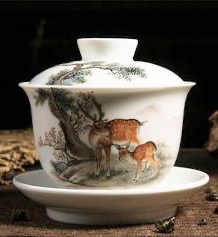
A traditional Chinese covered tea cup in dish, with naturalistic scene 
Photo source, Pinterest 


How the Chinese Man Drinks Tea


The Chinese man, in preparing tea, places a pinch of leaves in a Chinese teacup, which is without a handle, pours boiling water over them and places the cover on the cup. In a few seconds the tea is ready for drinking; the covered cup is raised to the mouth, and, with the fingers of the hand holding the cup, the lid is moved just sufficiently to permit the liquid to flow into the mouth as the cup is tilted. — By United States, Bureau of Foreign and Domestic Commerce, 1919


Etiquette Enthusiast, Maura J Graber, is the Site Editor for the Etiquipedia© Etiquette Encyclopedia

Thursday, November 8, 2018

Chinese Dinner Etiquette

A Chinese butler measuring a place setting’s wine glasses on the table, for perfect symmetry – The Butler’s Uphill Battle in China– “Perhaps due to popularized notions about Western luxury, the European-style butler is making his revival in the Far East. Attracted to the trappings of nobility, China’s nouveau riche pursue extravagance in their consumption and lifestyles, which has boosted the age-old profession. Status symbol aside, hiring a butler and other domestic workers makes sense for those who own multi-million-dollar homes and do not have the time or ability to manage the property. Butlery has become big enough on the Chinese service sector that the Netherlands-based International Butler Academy opened a branch in the city of Chengdu, southwest China. The school seeks to bridge the cultural and linguistic gap that comes with the employment of high-end Western domestic workers by wealthy Chinese. It also trains Chinese butlers.”– Juliet Song forEpoch Times2016
Tea with Dinner is “Faux Chinese”

Americans who sip tea throughout a Chinese dinner might just as well eat chop suey and chow mein with it. The tea-drinking practice is as Western in nature as are the two foods, says Mme. Chu Fang Li, a former first lady of Kwangtung Province. Mme. Li, now a restaurateur in this northern Westchester suburb, added that wine is customary with dinner in China, and tea, like coffee in much of the Western world, is an after-dinner beverage. During a nine-course dinner accompanied by a 1959 German liebfraumilch —Mme. Li talked about authentic Chinese cuisine and customs. She and her husband, Gen. Han Hun Li, a former Chinese army officer and governor of Kwangtung Province, feature dishes from all of China in the nine-page menu of their China Garden restaurant. “Chinese food is logical,” she explained. 

 Notable Chinese wine-producing regions include Beijing, Yantai, Zhangjiakou in Hebei, Yibin in Sichuan, Tonghua in Jilin, Taiyuan in Shanxi, and Ningxia. The largest producing region is Yantai-Penglai; with over 140 wineries, it produces 40% of China's wine

Firepot cookery, a house specialty, was developed in cold regions near the Yangtze River to keep both food and diners warm. Each diner cooks tidbits of food to his taste by dipping them into boiling broth in a Ho-go, a metal firepot with chimney-like center. Bamboo steamers that fit into saucepans and hold heat for long periods are used for another house specialty, roast pork on skewers. These are canape-size sandwiches of roast pork served on special Mandarin-style steamed white bread with plum sauce and raw scallions. Mme. Li said the steamers also are used by tea houses, where Chinese go to talk or relax over cups of steaming tea and steamed tiffin foods such as dim sum, a noodle dough with meat or seafood filling. As for wines, she said each province grows its own, usually from grapes, although there also are rice and wheat wines. She suggested either libfraumilch or chablis – both dry, white wines as suitable substitutes for the Chinese varieties, which are drier and sourer than the Western ones. – UPI, White Plains, 1964 


Etiquette Enthusiast, Maura J. Graber, is the Site Editor for the Etiquipedia© Etiquette Encyclopedia
Monday, August 31, 2015

Etiquette and Pinky Fingers

Please keep your “pinky” curled, and we'll offer you some of these yummy treats.  
Many people mistakenly think, and actually still teach others, that one’s pinky finger should be extended when one is drinking tea from a cup. This is not considered proper by any trusted etiquette authorities. It is what is commonly known as an “affectation” that has been promoted by television and the media for some time now, just as women eating and drinking while wearing gloves, has been promoted in period dramas and films. As Judith Martin put it, these little nuances help with what “is evidently intended to add a touch of what passes for ‘class.’” However, they are absolutely incorrect.
Curl your fingers as much as you can.
Many anthropologists and sociologists believe this habit was acquired hundreds of years ago, when the poor servants of the wealthy landowners and royalty in Europe, watched how their “Lords and Ladies” dined. They believe the servants picked up the habit of keeping a finger extended while drinking and dining.
And look, we don't thrust our pinky fingers out to pour the tea, either...
Only the wealthy could afford to purchase salt and exotic spices, like nutmeg, at their tables. Foods were eaten with one’s hands and a knife. Utensils were not used at many tables then. When dining, these wealthy people would keep the “pinky” finger extended when scooping up foods so that they could keep grease off of that finger. The finger could then be dipped into the salt or spices needed to season their foods. This kept grease and food particles out of the dishes holding the spices.
                          
Pinky fingers are perfect for “pinky rings,” not for sticking out while drinking tea.
Others think it started when tea and handle-less cups from China became popular in Europe. They believe tea drinkers would keep the pinky out because the cup was too hot to hold. However, the Chinese have never extended fingers in that manner, nor have the Japanese when drinking tea from cups without handles, so why would the British? 

The traditional cups that the Chinese use, still do not have handles to this day. These cups are held in the palm of the hand. Old artwork from the time, proves this as well. Perhaps the size of the hand holding the cup affected whether or not a pinky finger was left dangling in the air with some tea drinkers?
Old artwork can be very helpful in showing a period as it truly was lived.
Coffee houses, at which hot coffee was served
, were very fashionable in England prior to tea drinking becoming the trend. There is no debate though on how to drink coffee from a cup with regard to pinky fingers being ridiculously thrust out. The only debate with coffee, is that in many countries, it is still socially acceptable for one to pour his or her hot coffee into the saucer, in order for it to cool down to a drinkable temperature more quickly. Pouring one's coffee into the saucer to drink, has not been socially acceptable in many other countries, since the early to mid-1800s. 

Hot chocolate was also drunk in similar, but oftentimes taller, cups. Saucers with deeper wells or “cages” were the norm for many years with these sets for hot chocolate. Also called “trembleuse” in France or “mancerina” in Spain, the saucers were designed to protect the cups from the “trembling” hands of elderly hot chocolate drinkers. Again, pinky fingers were seemingly not an issue.
Here are two etiquette violations in one image~ Drinking with gloves on and sticking the pinky finger out.
Today, most all etiquette authorities agree; The proper way to hold a tea cup is with one or two fingers of the right hand put through the hole of the cup handle, while balancing the cup with your thumb on the top of the handle. Some etiquette consultants recommend “pinching” the tea cup handles to hold the cup. Either way, your other fingers should be curled beneath the handle. — By Maura J. Graber, The RSVP Institute of Etiquette, 2005


🍽️Etiquette Enthusiast, Maura J. Graber of The RSVP Institute of Etiquette, is the Site Editor for Etiquipedia© Etiquette Encyclopedia

Thursday, February 5, 2015

Han Dynasty Women’s Etiquette

The Han Dynasty, from 206 BC – 220 AD 

Instruction for Chinese Women and Girls, 
by Lady Tsao

All girls, everywhere, Should learn woman's work. When women guests are expected, You should the chairs arrange in order. Let your own dress be neat and suitable.

Slowly and lightly walk ; Move not your hands about ; And let your voice be gentle and low. With such deportment, Invite your guests to enter: Present your salutations, Inquiring after their welfare since last you met.

In conversation with them, Talk not at random. When they questions ask, Do not imitate those who only regard themselves, And show no respect to others. Such receive few guests. Because they know not politeness. As a guest, demand nothing ; As a hostess, exhaust hospitality. 


When you go to a friend's house, Be not eager to receive attentions. Having exchanged greetings and taken tea, Immediately your business then make known, This finished, at once rise to go. Observing all courtesy in departing. 

If the hostess prevails upon you to longer stay, And a feast for you prepares, Remember the wine to only raise to your lips. Your chopsticks, place not on the table crossed. But use them with propriety and graceThe filling your cup with wine continually refuse. Follow not your desires, just to eat, eat ! 

Imitate not those rude women, Who with confusion eat, drink, and talk ; Drinking wine until crazy. They shamefully vomit their food ; In this state going home. Before reaching their house. Many shameful, rude acts will they do.

Outside of your house you should seldom go. Nor into the street for pleasure. If persons unknown you meet, Your head and eyes quickly lower.

Do not imitate stupid women, Who gad about from house to house. These speak many idle words, And cause others evil to speak of them. Such may not escape reproof, Their families by them are injured, Their parents greatly dishonored. Still another class imitate not, Those whose deeds are so evil, That they are shameful, fearful, And disreputable !


The Han Dynasty was one of the Longest of China's Major Dynasties

Etiquette Enthusiast, Maura J Graber, is the Site Editor for the Etiquipedia© Etiquette Encyclopedia