Showing posts with label American Diplomacy. Show all posts

Sunday, January 4, 2026

Gilded Age D.C. Etiquette Advice


Grover Cleveland was the U.S. President in 1894. It was his second term of the Presidency. Women new to Washington D.C. not only would have looked to elder statesmen for etiquette advice, but to the wife of the President, as well. - Above, public domain image of Drawing of President Grover Cleveland’s and Frances Folsom’s, June 1886 wedding, at the White House, Washington, D.C.

The wife of a new Senator once told me that she was determined to make no social mistakes, so - wise woman that she was - she asked Senator Edmunds, who she knew was thoroughly conversant with every detail of official etiquette, by reason of his long career in the Senate, if it was not incumbent upon her to make her first visit to the wives of foreign Ministers. He replied: “Certainly not, madame; a Senator never makes the first visit upon a foreign Minister.”

So, thanks to her good sense in consulting an old Senator, this lady did not make the mistake that a few less wise new Senators’ wives have done of making first visits when etiquette required that they should receive them. Of course, as the Senate has increased in size the last few years, it can hardly be expected that foreign Ministers should call upon new Senators, but they ought to upon the old ones, and upon others whom they wish to know. 

I think the charming wife of one of the diplomats has adopted a very wise rule, as she remarked to a Senator’s wife to whom she had just been presented: “I know it is my place to call on Senators’ wives, but I wait until I meet them, and I shall now give myself the pleasure of calling on you. If the ladies of the diplomatic corps would follow the lead of this popular lady, they would avoid some of the mistakes that they now make in our official etiquette. - Kate Field's Washington, 1894


 🍽️Etiquette Enthusiast, Maura J. Graber of The RSVP Institute of Etiquette, is the Site Editor of the Etiquipedia© Etiquette Encyclopedia 

Wednesday, February 12, 2025

Diplomatic Etiquette And Rank

Until two years ago, when Great Britain raised her representative to the rank of ambassador, and France, Italy and Germany quickly followed, the dean of the corps was always the minister who had seen the longest term of service here. and the dean now is the English ambassador, Sir Julian Pauncefote. Public domain image of Sir Julian Pauncefote


The Question of Rank as Settled in the Early Days of the Republic

Thirty nations are represented at Washington by four ambassadors and twenty-six ministers, each of whom has anywhere from one to sixteen secretaries and attaches to carry on the necessary business. So far as work is concerned, the duties of the foreign representative are not onerous, and are largely social, says the New York Tribune. He sends dispatches to his own government and occasionally addresses communications to the secretary of state. 

Whether these commuications be on matters of international interest or are simply a request to be allowed to land a few cases of wine, household effects, or a trunk full of finery for his wife, they are known as "notes." He is not permitted to transact any business with any officer of the government except through the secretary of state or other high officers of that department, and it would be a great breach of etiquette for him to address the president personally upon any official matter. The code of diplomatic etiquette is strictly followed.

The foreign representative makes the first call upon the members of the cabinet, but is called upon by the senators. The only members of congress officially recognized are the members of the house committee on foreign affairs, in whose good graces he naturally likes to keep. A private citizen calling without an introduction at any of the legations promptly receives a card in return, and the latest addition to the corps makes the first call upon the resident members. None of the wives of the diplomats holds public receptions, except Mme. Romero, who began the custom some dozen years ago, when Washington was not so large as it is to-day, and has never discontinued it, but even her house is open but four times a season to the general public.

The foreign representative makes the first call upon the members of the cabinet, but is called upon by the senators. The only members of congress officially recognized are the members of the house committee on foreign affairs, in whose good graces he naturally likes to keep. A private citizen calling without an introduction at any of the legations promptly receives a card in return, and the latest addition to the corps makes the first call upon the resident members. None of the wives of the diplomats holds public receptions, except Mme. Romero, who began the custom some dozen years ago, when Washington was not so large as it is to-day, and has never discontinued it, but even her house is open but four times a season to the general public.

Until two years ago, when Great Britain raised her representative to the rank of ambassador, and France, Italy and Germany quickly followed, the dean of the corps was always the minister who had seen the longest term of service here. and the dean now is the English ambassador, Sir Julian Pauncefote. As dean he takes the lead at all official functions; foreign ministers call upon him first, and in matters in which the whole corps is interested he is consulted first. When the ambassador first appeared in Washington society there was a good deal of surmising about the matter of precedence at dinners, and for some time it was a much-discussed question, but it has settled itself without much difficulty, and nothing is ever heard about it now. 

In the early days of the republic the question of etiquette became of sufficient importance for the secretary of state, Mr. Adams, to address a letter upon the subject to the president, but it was never settled. Years of precedent have, however, given a certain fixity to the etiquette. here, which is much more rigid than is generally supposed by those who have not lived in Washington long enough to know. Auburn Journal, March 1895


🍽️Etiquette Enthusiast, Maura J. Graber, is the Site Editor for the Etiquipedia© Etiquette Encyclopedia

Saturday, July 13, 2024

Uncle Sam Stickler for Etiquette

Enrique Alfredo Olaya Herrera was a Colombian journalist and politician. He served as President of Colombia from 1930 until 1934.—Public domain image of the 13th President of Colombia


Diplomacy and Protocol
‘The Capitol, Day By Day’ -1930

WASHINGTON— It would doubtless amaze the average citizen of this republic, if he could, but know just what a stickler for form and etiquette his Uncle Sam really is.

Not much is known outside of Washington concerning this. Of course, there was the Gann-Longworth controversy which is familiar to all, but this was more or less a private affair. Uncle Sam held himself aloof-content to let the principals settle the matter themselves. But when an occasion arises where he is called on to show his hand, nothing is spared to make sure that the correct thing is done in the most correct way and at the exact time.

To illustrate with a recent example:
Several weeks ago handsome, smiling Dr. Olaya Herrara left the Colombian legation on Seventeenth street in Washington for his native country to become a candidate for the presidency. At the time he was Colombia's minister to the United States. His departure was without ostentation a bare handful of people gathered at the union station to bid his goodbye.

News dispatches within a few weeks told of his election. It was also reported that he would return to the United States to close his affairs at the legation and get things in shape for his successor whom he will appoint.

Officials in the protocol division of the state department began to worry. How should he be received -as President-elect of Colombia, or as Colombia's minister plenipotentiary to the United States? It was a knotty problem. Conferences and precedent availed them nothing. Finally, as a last resort, they communicated direct with Dr. Olaya, asking him for an opinion. Between the two a reception program was arranged.

So, when the President-Elect of Colombia arrived in New York he was greeted with the roar of 21 guns— the Presidential salute. When he set foot on American soil he was met by a proper escort— Richard Southgate of the protocol division of the state department, H. Freeman Matthews of the Latin-American division of the state department, and Jose M. Coronado, Charge d’ Affaires of the Colombian legation. But, the moment he stepped on the train for Washington he was no longer officially recognized as Colombia's minister plenipotentiary to the United States.

However, if Dr. Olaya remains in Washington until June 4, or after, he will again be accorded all the honors due a President-elect of a sovereign state. On that date, according to the constitution of Colombia, he will be proclaimed President. If he departs before that date he will be regarded as just another minister leaving his post.

— By Herbert Plummer, April 1930

🍽Etiquette Enthusiast, Maura J. Graber, is the Site Editor for the Etiquipedia© Etiquette Encyclopedia

Thursday, June 23, 2022

Ping-Pong Diplomacy in 1971

American table tennis player, Glen Cowan (bottom left), who caught the ride on the Chinese team’s bus, along with the other U.S. table tennis players in China – on the cover of Time magazine, in April 1971

Ping-Pong Diplomacy

When an American competitor at the 1971 World Table Tennis Championships in Nagoya, Japan, missed his team bus back to the hotel, he set off one of the biggest tectonic shifts of diplomacy in world history — and triggered the end of the Cold War.

Jumping on to the Chinese team’s bus instead to catch a ride, one of the Chinese athletes broke strict protocol by handing him a gift of a silk cloth depicting the famous Huangshan Mountains.

When the bus arrived back at the hotel, journalists were astonished to see the two players chatting. Their photographs of this rare meeting of nations dominated news headlines around the world and Mao Zedong, spotting an opportunity, invited the U.S. team to spend a week sightseeing in China.

Capitalising on this new-found good will, President Nixon instigated a visit to Beijing — so began the defusing of the Cold War, and the term Ping-Pong Diplomacy was coined.– Christian Howgill for the Mail Online, June 17, 2022


Etiquette Enthusiast, Maura J. Graber, is the Site Editor for the Etiquipedia© Etiquette Encyclopedia

Saturday, February 15, 2014

“Pell-Mell” Etiquette

Pell-Mell:
Adverb
In a confused, rushed, or disorderly manner.
“the contents of the sacks were thrown pell-mell to the ground”

Synonyms:
helter-skelter, headlong, (at) full tilt, hotfoot, posthaste, hurriedly, hastily, recklessly, precipitately

“The new British diplomatic representative to the United States, Anthony Merry, and his wife were shocked and insulted when the President received them in worn clothing and slippers. In December 1803 at a formal dinner in the White House, no one offered to escort Mrs. Merry to dinner. In the dining room, Merry and his wife had to scramble for places at the table in competition with the other guests. The Marquis d'Yrujo, the Spanish diplomat, had the same experience. He and Merry agreed that this treatment was an insult to them and to their countries. The two diplomats and their wives sought to retaliate.” 
The Merry Affair
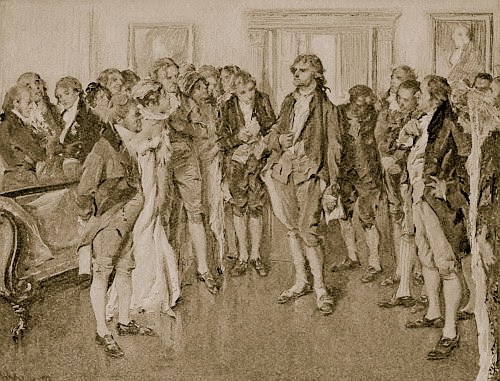
Jefferson believed that the president's dress and manners should reflect the republican simplicity and informality of the country. Pomp and show reminded him too much of the European courts. In fact, Jefferson worked so hard to avoid ostentation that he began to dress not merely plainly, but sloppily. As for manners, he refused to observe the rules of protocol in seating his dinner guests. First come, first served was the rule in the presidential mansion, the White House. Jefferson explained: In social circles, all are equal, whether in, or out, of office, foreign or domestic; and the same equality exists among ladies and gentlemen … “pell mell” and “next the door” form the basis of etiquette in the societies of this country.
Rudeness is no proper response to another's rudeness! Portrait of Mrs Elizabeth Merry, wife of the new British diplomatic representative to the United States, Anthony Merry – “The two diplomats and their wives sought to retaliate. At their parties, for instance, no one escorted the wives of the Cabinet members to the dinner table. This social war greatly enlivened Washington.” 

The new British diplomatic representative to the United States, Anthony Merry, and his wife were shocked and insulted when the president received them in worn clothing and slippers. In December 1803 at a formal dinner in the White House, no one offered to escort Mrs. Merry to dinner. In the dining room, Merry and his wife had to scramble for places at the table in competition with the other guests. The Marquis d'Yrujo, the Spanish diplomat, had the same experience. He and Merry agreed that this treatment was an insult to them and to their countries. The two diplomats and their wives sought to retaliate. At their parties, for instance, no one escorted the wives of the Cabinet members to the dinner table. This social war greatly enlivened Washington. The president refused to retreat from his pell mell rule, and Merry and Yrujo became increasingly angry and receptive to the plottings of Jefferson's opponents, the Federalists and Aaron Burr. -From www.knowsouthernhistory.net

Dinner Etiquette

When President of the United States, Thomas Jefferson promoted “pell-mell” etiquette. It was a much more informal style of dinner etiquette than that observed by his predecessors. In 1788 Jefferson consoled a French diplomat disillusioned by his initial experience of the new American republic: “I am sorry that your first impressions have been disturbed by matters of etiquette, where surely they should least have been expected to occur.” Such matters, he said, “are the most insusceptible of determination, because they have no foundation in reason,” adding that “it would have been better, in a new country, to have excluded etiquette altogether.”
Thomas Jefferson, third president of the United States (1801-1809) 
In March 1801, when he took up residence in the President's House, he seized his chance to banish etiquette at the highest executive level and to reorganize the social mechanism of the national capital on a rational plan. First to go was the presidential levee, the weekly focal point for society in the capital in the two previous administrations. Jefferson replaced it with a series of small, informal dinners, but retained the established custom of open house on New Year's Day and the Fourth of July.

To ensure that the American public should never mistake its president for a king, he adopted a purposeful informality in his own behavior as chief executive: shaking hands instead of bowing, riding without an attendant servant, issuing his dinner invitations in his own name rather than as president, and dressing informally for official receptions. As one foreign visitor observed, "It was the object of Mr. Jefferson to preserve, in every trifle, that simplicity which he deemed the most appropriate characteristic of a republic. . . . He wisely judged that in this matter, as in most others, example was better than precept, and set about new-ordering the manners of the city."

The new Jeffersonian order became most famous for the policy of “pell-mell,” especially as applied to a moment charged with significance for those conscious of their rank - the procession of dinner guests to their appointed places at the table. Defying custom of long standing, especially in diplomatic circles, Jefferson declared, “At public ceremonies, to which the government invites the presence of foreign ministers and their families, a convenient seat or station will be provided for them, with any other strangers invited and the families of the national ministers, each taking place as they arrive, and without any precedence.”

The deprivation of his precedence in the pell-mell passage to the dinner table was too much for British minister Anthony Merry. Bolstered by his large and equally offended wife and another sensitive diplomat, Merry withdrew from official Washington society. The ensuing social tempest came close to clouding the course of American foreign and domestic policy, but Jefferson stood firmly behind the principle at the root of pell-mell: “When brought together in society, all are perfectly equal, whether foreign or domestic, titled or untitled, in or out of office.”


United States Capitol, Completed Northern Wing (circa 1801)

Many American observers concluded that Jefferson had been too systematic in his application of republican principles to social forms. His two Republican successors pursued the Jeffersonian political course but tempered the leveling social practices of the first Republican administration. The Madisons instituted a weekly “drawing room” and introduced more formality into official dinner parties.
The ancient and universal custom of drinking healths at the dinner table.

There was, however, one practice abolished by Jefferson that was restored by neither Madison nor Monroe - the ancient and universal custom of drinking healths at the dinner table. The tradition of capping a meal with a session of toast-drinking was firmly entrenched in the early American republic. 

Increase Mather and other seventeenth-century Puritans had fulminated against the practice. Post-war patriots had recommended throwing out offensive English customs, including health-drinking, to complete the revolution. Yet the habit of raising a glass to drink the health of fellow guests, absent friends, and political figures and principles seems to have been almost universal at the tables of upper-class Americans.
“In a penetrating study of political life in Washington during the Jeffersonian period, The Washington Community, 1800-1828, James S. Young described the dinners as one of Jefferson's 'power techniques'. The only President to give dinners extensively, he had abolished the aristocratic levees which were a hallmark of the Federalist administrations. Considering political distinctions to be important, Jefferson rarely mixed Federalists with Republicans, nor did he invite Cabinet members along with Congressmen. Just as the guest list was planned, so a great deal of attention was given to physical surroundings. To encourage conviviality and discourage a feeling of inequality, a round table was used; to insure privacy, a dumbwaiter was used in place of servants. A French chef, imported wines and Jefferson's informal wardrobe completed the picture. Politics were subtly removed as a province of conversation, and everyone was invited to participate freely in verbal exchanges.
 
“Another recent historian, Claude Bowers, also found the dinners to be useful instruments for 'conciliating political opponents' in Jefferson in Power. But, he noted that when Congress was out of session, Jefferson invited members of the local community to share his hospitality. They were not disappointed, for frugality was never in evidence at the President's House. Etienne Lemaire, Jefferson's head of household, estimated that he spent fifty dollars a day on food and wine.” –www.monticello.org


🍽️Etiquette Enthusiast, Maura J Graber of The RSVP Institute of Etiquette, is the Site Editor for the Etiquipedia© Etiquette Encyclopedia