Showing posts with label Chopstick Etiquette. Show all posts

Monday, May 16, 2022

Japanese Chopstick “Don’ts”

According to an article on Mashable, “Western foods,” like a breakfast of bacon and eggs, are eaten with a knife and fork, but, “In Japanese culture, chopsticks are more than utensils; they can be works of art.  It is common for families to have sets made of abalone or painted gold. Painted sets, which may include designs like cranes or cherry blossoms, are usually sealed with lacquer.”


Chopstick Etiquette
🥢 Saguri-bashi
To look for contents in a soup with chopsticks

🥢 Mayoi-bashi
To wander chopsticks over several foods without decision

🥢 Sashi-bashi
To pick up food by stabbing it

🥢 Neburi-bashi
To lick the tips of the chopsticks

🥢 Yose-bashi
To pull plate or bowl around with chopsticks

🥢 Hotoke-bashi
To stand chopsticks up in rice

🥢 Kaki-bashi
To shovel food into one’s mouth attached to plate or bowl

🥢 Nigiri-bashi
To hold two sticks together as one would grasp a knife to attack

🥢 Hashi-watashi
To pass food to another person, from chopsticks to chopsticks

🥢 Namida-bashi
To drip the sauce from the food or from the chopsticks


🍽Etiquette Enthusiast, Maura J. Graber, is the Site Editor for the Etiquipedia© Etiquette Encyclopedia

Friday, February 26, 2021

Etiquette for When Done Eating


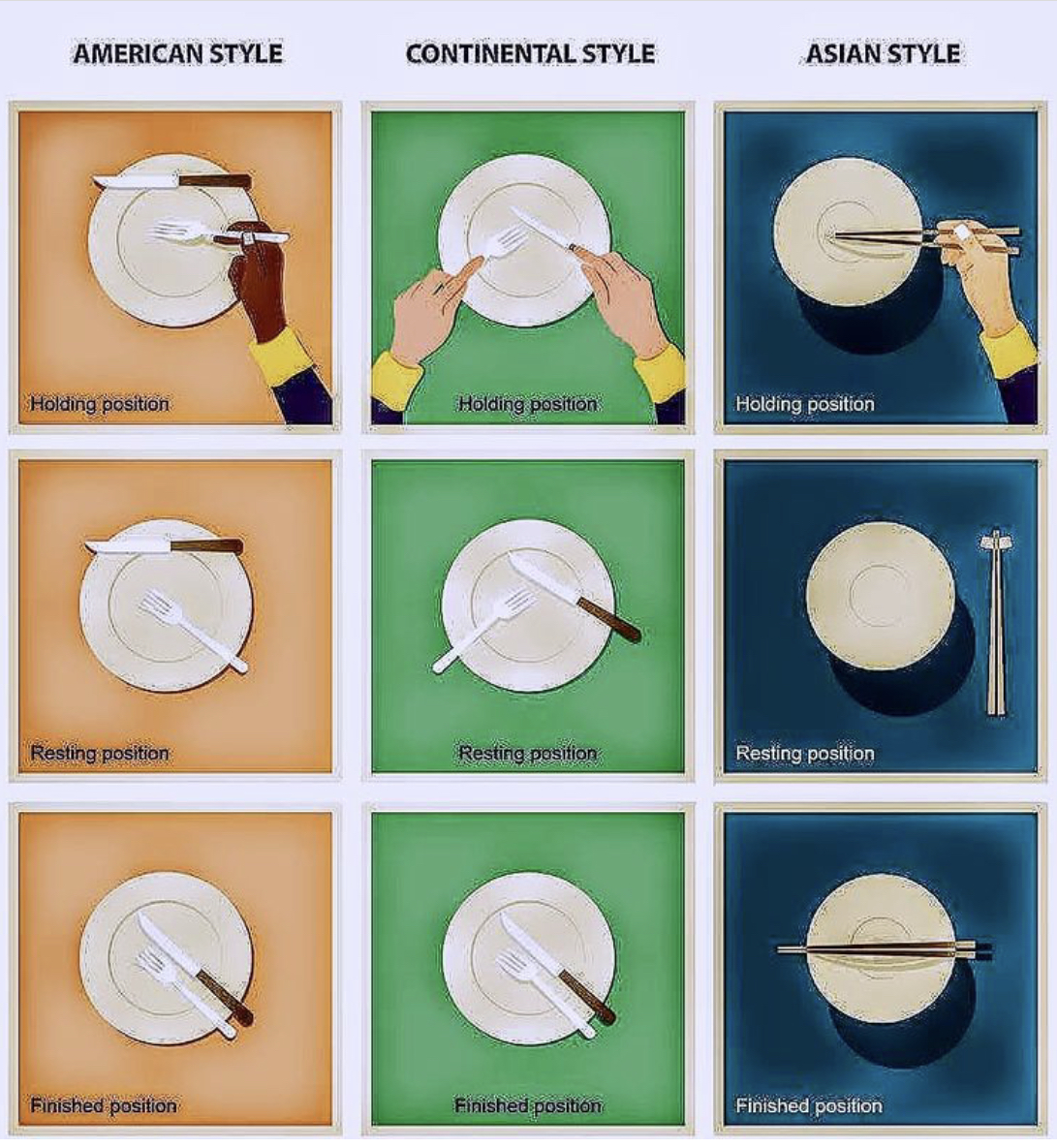
If you must have your plate cleared and wish to silently signal the waiter, these images of signals are probably the most easily and readily recognized as correct. —When done eating, one is not supposed to inform the waiter. Technically, the waiter or the waitress is not supposed to remove any plate until everyone at the table is done eating. How comfortable would you feel if you were still eating while everyone else was done and rushing to have the table cleared? 
Photo source, Pinterest 

When You’re Done Eating, How Do You Notify The Waiter?


Maura Graber, who has been teaching manners to children and adults since 1990 and is the director of The R.S.V.P. Institute of Etiquette, says, “First of all, when done eating, one is not supposed to inform the waiter. Technically, the waiter or the waitress is not supposed to remove any plate until everyone at the table is done eating. How comfortable would you feel if you were still eating while everyone else was done and rushing to have the table cleared?

“I realize many people do not agree with this, and when I do staff training for restaurants or the service industry, this subject comes up often. Waiters and waitresses do not want to offend, yet they also do not want their tips compromised. It is a difficult situation to be put in. If I am out to eat with clients I try to pace my meal with theirs, and make sure they are well taken care of by the wait staff. If the clients want their plates removed early I step in and explain one should wait until everyone is finished. Sitting with an empty plate in front of you for another five or ten minutes should not be looked upon as a chore, but as an opportunity to enjoy the company one is with.”

She further explains, “Dining in the U.S. should be enjoyed more leisurely and more thoughtfully. Meals are very ceremonial things. One is supposed to be concentrating on the companionship with others, not necessarily rushing through the food. Anything humans do of any importance in our lives has food connected to it. For example, birthdays have a birthday cake, weddings have a wedding cake. If someone is sick, we send over a casserole. Even our religious rituals have food involved. If you are at a business lunch or business dinner or even at a social lunch or dinner, you are supposed to sit down and enjoy it with the company at hand. Company is an old Latin root word for the word companionship; the word literally means ‘to break bread with another person.’

“If the table does need to be cleared for some reason, such as not enough ‘elbow room’ (which is technically a contradictory term when it comes to proper etiquette —you should never put your elbows on the table) or the server has not come back after the main course to whisk away the empty dishes and offer you desert, it is best to not let your irritation get the best of you. Never whistle, comment loudly or shake the ice in your empty beverage glass to get the attention of your server. Quietly ask the nearest restaurant or catering employee to ask for your server to come to the table, if he or she is not anywhere nearby. It’s helpful to know your server’s name.

“Speaking from personal experience, not ‘checking back’ in a timely matter is usually due to circumstances beyond the waiter’s or waitress’s control. There could be a disaster in the kitchen. It could be an unusually busy night and/or the establishment is short on staff. Even if it is a lack of foresight on the server's part, he or she is rarely, if ever, purposely performing ‘bad service.’ Some tend to forget that people in the ‘public service’ business are human too; the best waiters and waitresses have ‘off’ nights just like the rest of us. Remember, almost all servers count on their tips for their own ‘bread and butter’ so to speak. Therefore, it doesn't make a lot of sense that they would mess with yours.”— By Maura Graber for Expert Village, 2001


Etiquette Enthusiast, Maura J. Graber, is the Site Editor for the Etiquipedia© Etiquette Encyclopedia

Thursday, September 12, 2019

Chopstick or Hashi Etiquette

The following set of instructions is supplied by an expert in the field. He’s the proprietor of a popular Chinese restaurant in San Francisco’s Chinatown. Since Chinese chopsticks are a bit more difficult to use, are bigger, and have a lacquered surface, if you can master them, the Japanese throwaway type you will find in most of Little Tokyo should be simple for you to manage. 


How do you identify an amateur chopstick or hashi user in a Little Tokyo restaurant? His head keeps moving closer to the plate. All Caucasians seem to think that handling these wooden sticks is as easy as signing their names on credit cards. In actuality, it calls for a bit of skill. So today, for the benefit of you readers who must stab your food with your chopsticks in order not to go hungry for lack of proper skill, we are going to give you a free lesson in etiquette. 

The following set of instructions is supplied by an expert in the field. He’s the proprietor of a popular Chinese restaurant in San Francisco’s Chinatown. Since Chinese chopsticks are a bit more difficult to use, are bigger, and have a lacquered surface, if you can master them, the Japanese throwaway type you will find in most of Little Tokyo should be simple for you to manage. According to our expert, here is the proper technique in numerical order: 
  1. Put one chopstick at right angle to right hand, nesting it in crotch of thumb.
  2. Put third finger right, hand against it. This stick never moves.
  3. Take up second chopstick in right hand the way you hold a pencil.  
  4. Ready? Set? Manipulate!
The traditional test is whether or not you can pick up a raw quail’s egg from a bowl of soup. A more practical test, however, is whether or not you eat. Since the Chinese are close neighbors to us here in Los Angele’s Little Tokyo (Los Angeles’ Chinatown is only a few blocks north) here are a few other items concerning the Chinese and chopsticks you may find interesting:
  • During a time of mourning, for example, chopsticks are taboo. The prestige of the diseased rises in proportion to the number of mourners who eat with their fingers.  
  • Laying chopsticks across your bowl is an indication that you are through eating. If you go to Chinatown, beware. Don’t rest until you finish.  
  • Also, any number of secret messages can be sent with chopsticks such as, “Family Hold Back,” “pass the egg foo yung” or “you spilled some mustard on your coat.” – Shin Nichibei, 1964


Etiquette Enthusiast, Maura J Graber, is the Site Editor for the Etiquipedia© Etiquette Encyclopedia

Wednesday, September 11, 2019

Japanese Table Etiquette

Japanese food is usually cut up conveniently for eating, so a knife is not necessary. 
Photo source, Tumblr

On the whole, this is the same as for foreign meals, but the following points should be noted...
  • 1) When various dishes appear together, for example miso-soup, clear soup, chawanmushi (steamed egg and fish or meat), the hot things should be partaken of first. 
  • 2) The lids of bowls containing hot things are somewhat difficult to remove, owing to the steam inside, so the bowl must be held firmly, and then the lid may be easily taken off, and put upside down on the table. 
  • 3) Japanese food is usually cut up conveniently for eating, so a knife is not necessary. 
  • 4) Chopsticks—One of the two chopsticks is held between the first and second fingers, and moved, the other chopstick is held between the thumb and third finger. 
  • 5) The vessel is taken up in the right hand, placed in the palm of the left, and the food is eaten with the right hand holding the chopsticks. 
  • 6) When the meal is over, all lids must be replaced. 
  • 7) When chopsticks are taken from an envelope, they should be put back in it after use. 
  • 8) When no more wine is desired, the cup should be placed on the stand upside down. –Shin Nichibei, 1954 


Etiquette Enthusiast, Maura J Graber, is the Site Editor for the Etiquipedia© Etiquette Encyclopedia

Wednesday, May 27, 2015

Etiquette, Common Sense and Defiance

One who does not wish to wait till the meal is over before drinking coffee, must either cool it in his saucer or drink it hot, or wait and drink it after breakfast, and all because of the absurd notion that it is not a good manners to pour coffee into your saucer!

Liberty Versus Custom 

Found Under "Household"


Among all the declarations of liberty which American mankind is so fond of making, it seems strange that there is no league, association, party, or other combination to defend honest man against worn-out or absurd customs. For example, will any man tell me why I am forbidden by what is called "good manners" to pour my tea into a saucer, and cool it there? Much reproach has been heaped upon "strong" tea and coffee which properly belongs to "hot" tea and coffee. Everyone knows how much the efficient action of chemical agents is intensified by heat. Scalding tea is far worse than strong tea; but to be both scalding and strong is an attack upon the human body which no man ought to venture who has any regard for health. But etiquette forbids me to cool my coffee in any other manner than by waiting.


Coffee cups, in houses where the secret of making good coffee is known, should be like the human heart, large and deep, and in such cases the beverage will, like true affection, cool very slowly. Hence, one who does not wish to wait till the meal is over before drinking coffee, must either cool it in his saucer or drink it hot, or wait and drink it after breakfast, and all because of the absurd notion that it is not a good manners to pour coffee into your saucer!
                                    
I rejoice in pouring forth the fragrant liquid into a capacious saucer, and, before the wondering eyes, to raise the beverage to my lips. Superstition is rebuked! Health is justified of her children!

The spirit of "Seventy-six" ought to rise with every afflicting gulp of hot coffee! The custom is wanton and cruel. It is tyranny over the inner man, carried on by force, if not by the sword. I count it, therefore a duty to humanity to set at defiance the edicts of this liquid despot— hot drink. For the welfare of mankind I refuse to burn my mouth, or scold my stomach! In behalf of mute devotees of etiquette, I raise a plea for relief! Meantime, endowed with courage, and armed with principle, I rejoice in pouring forth the fragrant liquid into a capacious saucer, and, before the wondering eyes, to raise the beverage to my lips. Superstition is rebuked! Health is justified of her children!
Scalding tea is far worse than strong tea; but to be both scalding and strong is an attack upon the human body which no man ought to venture who has any regard for health. But etiquette forbids me to cool my coffee in any other manner than by waiting.

Even more will be shocked, when I avow myself as an advocate of the rights of the KNIFE. Now, custom has it reduced to the mere function of cutting up one's food. That done, it is laid down and a fork serves every other purpose. By practice, one gains unexpected dexterity in using a fork for purposes to which it is ill adapted. The Chinese, in like manner, make awkward chopsticks rarely serviceable, by practice little short of legerdemain; but is that a good reason for the use of chop-sticks?

                                   
Selection of 19th C. fork designs

A fork, as now made, is unfitted to pierce any morsel upon its times, and yet they are sharp enough to afflict the tongue if carelessly used. They are split so as to be useless for liquids, and yet they are used as if they were spoons. The fork compels the manipulator to poke and push and pile up the food material, which tends to fall back and apart; it is made to peruse the dainty tidbits, in which often the very core of flavor resides, around the plate in a hopeless chase, and at length, a bit of bread is called in as an auxiliary, and thus, while the slim-legged fork, in one hand, is chasing a slim liquid mouthful, wad of bread in the other goes mopping and sopping around to form a corner, and between the two is at length accomplished what is called genteel feeding! 


Meanwhile, a broad knife is fitted for the very function which the fork refuses, and the wad of bread ill performs. The reasons for refusing that knife as an active feeding implement are worthy of the awkward practice. "It is liable to cut the mouth," no more than a fork is to stick into lip and tongue.


If men ate with razors, there would be some reason for avoidance. But table-knives are blunt-edged. It is even difficult to make them cut when one tries, and if they are properly used, the back of the blade will be turned into the mouth. We do not object to the fork; but we demand a restoration of the knife from banishment. We do not desire to enforce its use, but such a liberation as shall leave one free to use the knife for conveying food to the mouth when that is most convenient, and the fork, when that is preferred. Equal rights we demand for black and white, for home-born or emigrant, for rich and poor, for men and women, and for forks and knives. 

H.W. Beecher in The Elevator Weekly Journal ~ "Equality Before the Law"


Etiquette Enthusiast, Maura J. Graber, is the Site Editor for Etiquipedia© Etiquette Encyclopedia

Thursday, May 1, 2014

Chopstick History and Etiquette

"You do not sew with a fork, and I see no reason why you should eat with knitting needles." — Miss Piggy

Chopstick History and Etiquette

"The ultimately restricted, and therefore it may be thought, the ultimately delicate, manner of eating with one's hands is to use the thumb and two fingers of the right hand, only the tips of these ideally being allowed to touch the food. This gesture, we find even more by artificially elongating the fingers and further reducing their number, is of course the origin of chopsticks. Once people became accustomed to fingers remaining clean throughout the meal, napkins used for serious cleansing seemed not only redundant but downright nasty."

Chopsticks have been used in Japan for thousands of years. Also known as "hashi," or "otemoto" in fancier restaurants, Japanese chopsticks reflect the highly artistic culture of the islands. Originally, they were used strictly for religious ceremonies, but soon they were used for casual eating as well. Because of this history, the Japanese tend to be a little more strict about the proper use of chopsticks than the Chinese. At first they were fashioned like tweezers - a single piece of bamboo connected at one end. This connection is how they got the name "hashi" meaning "bridge." By the 10th century AD, they were being made regularly as two separate pieces and used in pairs, as they are today. In the 17th centrury AD, they began to lacquer the wooden chopsticks to make them more durable. This allowed them to become the beautiful Japanese icons that they are today. The ornate designs make them some of the most attractive and unique chopsticks in the world. The hard lacquer finish is not only attractive, but highly functional. It waterproofs them and makes them easier to clean. Japanese chopsticks are shorter than most chopsticks. Adult chopsticks in Japan are typically 7-9 inches long (20-23cm), are typically rounded, and tapered to a point.
Information from www.thechopstickstore.com 
"Father João Rodrigues observed in the 17th century that the Japanese were "much amazed at our eating with the hands and wiping them on napkins, which then remain covered with food stains, and this causes them both nausea and disgust." Napkins laid on knees are still an " ethnic," western affectation in China and Japan. There is, however, a tradition of supplying diners several times during the meal with small rough towels wrung out in boiling water, for hand and face wiping.

Chopsticks seem to have evolved in the East specifically for use with rice: The staple grain in China was originally millet, which the Li Chi insists must be eaten with a spoon, not with chopsticks like rice. Chinese rice is not loose and dry like that chosen by Indians, Arabs, and Africans, who prefer eating it with their hands, but sticky and slightly moist even without sauce; it is easily handled with chopsticks. The earliest word for chopsticks seems to have been Zi, related to the root meaning, "help". This is pronounced, however, like the word for "stop", or "becalm" used of boats. Chinese boatman are said to have renamed them kuai – zi, which sounds like "fast fellows", because Chinese think of chopsticks as swift and agile, the very opposite of halting and being becalmed. This is now their Chinese name; "chopsticks" is of course a western barbarism. In Japanese, chopsticks are called hashi, "bridge", because they effect the transition from bowl to mouth.

Chopsticks are thought of as fast, then, and helpful. Meals in China often surprise visitors by the speed with which they are eaten; chopsticks enable the Chinese and Japanese to eat food which is sizzling hot, but because is often served in small pieces it gets cold if people dawdle. Chopstick users remain more likely than we are to use their hands as aids in eating but it is not at all advisable to get them greasy: chopsticks, and especially the lacquered chopsticks common in Japan and Korea, are extremely difficult to manage with slippery fingers. Porcelain spoons are used for soups and the more liquid dishes; children are allowed to use spoons for everything until they are about three or four years old, when chopstick training begins."
     
Chinese chopsticks are the longest of all chopsticks. This is probably because they were originally used for cooking, and adapted for eating as the food began to be cooked in bite size pieces. Chinese chopsticks are not tapered. They are square at the base and round at the tip, symbolizing the infinite God in heaven feeding the man, bound by four seasons, on earth. Because they are thicker at the tip, chinese chopsticks are great for tearing meat and pushing rice from a bowl into the mouth. Contrary to popular belief, the Chinese do not use chopsticks to pick up pieces of rice in a conventional manner. They lift the bowl to their mouths and use the chopsticks to push the rice in, and the wider chopsticks are well suited to this method. Information from www.thechopstickstore.com 
"Chinese tables are round or square rather than oval or oblong: diners sit equidistant from the dishes of cài (meat, fish, and vegetables), all set out in one "course", in the middle. Each diner gets a small bowl for fán, literally, "food", meaning rice. The rice is the substance of the meal; the cài is merely relish, unless the occasion is a banquet. The host, or the mother, doles out the rice into the bowls. Each guest must take the filled bowl in two hands: receiving in one hand shows disrespectful indifference. You never eat cài before being served rice, because that looks as though you are so greedy and selfish that you would be prepared to eat nothing but meat and vegetables, which are the expensive part of the meal, centrally placed in order to be shared with others.

When the host gives the sign, you may begin to take the cài with your chopsticks. The gestures used by Chinese, Japanese, and others to do this are fascinating for Westerners. They look accomplished. Delicate, precise, and gentle-- much more polished that our own behavior at meals. Roland Barthes in "The Empire of Signs" speaks of eulogies on the Japanese manipulation of chopsticks: "There is something maternal, the same precisely measured care taken in moving a child... the instrument never pierces, cuts, or slips, never wounds but only selects, turns, shifts. For the chopsticks... In order to divide, must separate, part, peck, instead of cutting and piercing, in the manner of our implements; they never violate the food stuff; either they gradually unravel it (in the case of vegetables) or else prod it into separate pieces (in the case of fish, eels) thereby rediscovering the natural fissures of the substance." A Westerner feels like a brute butcher before this Oriental delicacy. Barthe says that we are "armed with pikes and knives "like predators rather than gentle mothers, our food, " a prey to which one does violence."

“Man who catch fly with chopstick, capable of anything.” ― Mr. Miyagi, in The Karate Kid 
B.Y. Chao tells us that the Chinese are aware in themselves of a sequence of commands: "Await, avoid, attack!" You must pause, think of others, consider which piece you want, then zero in on it. You may have to stretch across the path of another's chopsticks – though Chinese, too, try to restrict themselves to taking from the side of the dish more or less facing them; fellow diners cooperate with each other and are not greatly offended by another's "attack." You should never looked too intent on obtaining a particular morsel, however. Chinese children are taught that "the best mannered person does not allow co-diners to be aware of what his or her favorite dishes are by his or her eating pattern."
“Marriage is like twirling a baton, turning hand springs or eating with chopsticks. It looks easy until you try it.” — Helen Rowland
"It is politer to transfer food first to your rice bowl, and eat it from there, then to take it directly from the cài dish to your mouth. Chopsticks must never be licked or bitten. Japanese bad manners include neburi-bashi: licking chopsticks with the tongue; mogi-kui: using your mouth to remove rice sticking to your chopsticks; komi-bashi: forcing several things in your mouth with your chopsticks; utsuri-bashi: one must not break the rule that a mouthful of rice is to be taken between every two bites of meat, fish, or vegetables; saguri-bashi: searching with chopsticks to see if anything you want remains in the dish; hashi-namari: hesitation whether to take one thing rather than another; and sora-hashi: putting back with the chopsticks food you intended to eat.

Mannerly diners with chopsticks never "fish about" for morsels; they must take the bit they touch first. This means that one begins by eyeing one's target carefully: if you prod it, you must take and eat it. Using chopsticks need in no way mean that people eat food touched by implements which have been in other people's mouths. Yet a very western distaste for even the thought of touching the food of all with utensils of each has spread. In 1984, Hu Yaobang, the former Communist Party Secretary, criticized the traditional Chinese way of eating and urged change on sanitary grounds. A good deal of such concern must in fact be a desire to participate in Western  prestige as being somehow more in ineffably "modern." The admiration of people like Roland Barthe 's for superior Oriental wisdom seems to be less satisfying than the allure of technological hygiene and "modern "mental instruments. A compromise with "modernity" is the Japanese pre-wrapped disposable set of wooden chopsticks.

Korean chopsticks are traditionally flat and made of metal, though the Koreans are beginning to use round chopsticks as well. In Korea, chopsticks are called jeokkarak (젓가락). In length, Chinese chopsticks tend to be the longest, and Japanese chopsticks are often the shortest, with Korean chopsticks falling somewhere in-between. So why are Korean chopsticks made of metal? One explanation is that in ancient times pure silver chopsticks were used by the king because the silver would change color if the king’s food had been poisoned. Then the commoners, wanting to emulate royalty, began to use metal chopsticks as well. One may argue that metal chopsticks are more practical and sanitary since they can be easily washed and used again. Another could maintain that since Koreans mostly use a spoon to eat their rice, they can use the more slippery chopsticks to eat their other dishes. It is true that it is significantly harder to eat rice and noodles with metal chopsticks. Whatever the explanation, metal chopsticks are uniquely Korean.
Information from www.thechopstickstore.com 
"Chopstick users remain more likely than we are to use their hands as aids in eating but it is not at all advisable to get them greasy: chopsticks, and especially the lacquered chopsticks common in Japan and Korea, are extremely difficult to manage with slippery fingers. Porcelain spoons are used for soups and the more liquid dishes; children are allowed to use spoons for everything until they are about three or four years old, when chopstick training begins.

The problem that Westerners experience is often the result of attempts to eat rice with chopsticks from flat plates: the small bowl raised towards a face is far easier to manage with the proper zest. Chinese themselves, given food on a  flat plate, prefer to use a porcelain spoon (to stand in for its sister, the bowl). This spoon, like a bowl, has a flat bottom, so they can be laid down without spilling the contents.

 The kind of food we ourselves eat, together with the way we cook and serve it, predisposes us to use knives, forks, and spoons, and our idea of what constitutes "place setting "also influences our food choices. Oriental food is cut up in the kitchen so they can be eaten with chopsticks – but also, as Barthe points out, chopsticks came into being because each mouthful is regarded as comestable partly because it is small; being confronted with a large slab meet on the dish can be a disgusting experience for people from rice – and – chopstick cultures. In addition, rice – growing is a land use which reduces the amount of fuel available, so that meat and vegetables must usually be cooked quickly to save wood. Cutting them up small facilitates stir-frying and other quick-cooking methods.

But unfortunately there is an ecological price to pay for this, as hundreds of millions of trees are chopped down every year to supply throwaway chopstick wood– in 1987, 20 billion chopsticks were used and discarded in Japan alone.  It has never been acceptable to return bitten morsels of meat, vegetables, or fish to the common dish; but because the bowl of rice is "private territory, "a piece of meat or vegetable maybe held in chopsticks and bitten, and the rest put down on the rice in the bowl, to be finished later. One must never, in Japan, stick the chopsticks up right in the rice. This is done only when offerings are made by Buddhist mourners for their dead: standing chopsticks are rather like our own taboos about an empty chair at the table.

The kind of food we ourselves eat, together with the way we cook and serve it, predisposes us to use knives, forks, and spoons, and our idea of what constitutes "place setting "also influences our food choices.
With perfect propriety one lifts the small china bowl in the left-hand and sweeps the contents into the mouth with precise, busy movements of the two sticks together, held in the right. Barthe's delicate gestures suddenly become swift and purely efficient; the bowl held under the chopsticks is moved dexterously about so as to prevent food spills. We ourselves are surprised to see this done because we are never allowed to lift dishes containing solid food – and we count soup, unless it is in a cup, as "solid food"-- to our lips; we gave up doing this and when we agreed that formal politeness involves using our cutlery.

The Chinese may be thought of as treating the little bowl like a cross between a teacup any large spoon, with the chopsticks as "helpers. "Table manners always impose difficult restraints: "if you rattle your chopsticks against the bowl," says the Chinese proverb, "you and your descendants will always be poor." Whatever happens, however, at an ordinary meal every single grain of rice in one's bowl must be eaten before dinner is over. Leaving rice is a disgusting behavior, because it shows a lack of knowledge of one's own appetite in the first place, together with greed for meat and vegetables, and no respect for rice – its culture, its history, and the hard work that has been involved in getting it to the table.

Rice is never to be gripped, lifted, and eaten grain by grain, as Western novices in the art of chopstick-handling find themselves doing with so much frustration and so many complaints. "Picking "at one's food is very rude, in fact, for Oriental manners, more than our own, demand demonstrations of delight and pleasure in eating, and inept fiddling with one's chopsticks is apt to be interpreted not merely as a want of competence but as a depressing unwillingness as well." – Margaret Visser, The Rituals of Dinner


Compiled and submitted by the late- Demita Usher of Social Graces and Savoir Faire


🍽️Etiquette Enthusiast, Maura J Graber of The RSVP Institute of Etiquette, is the Site Editor for the Etiquipedia© Etiquette Encyclopedia

Wednesday, February 26, 2014

Etiquette, Forks and Chopsticks

The Latin “de gustibus” translates to “in matters of taste” – For those who dine primarily with chopsticks or with forks, it does boil down to a matter of taste and personal preference, regardless of the history involved, ease or difficulty of use, or one’s country of origin. For another point of view, we have reprinted a 1990 New York Times’ article.


De Gustibus; Older Than Forks, Safer Than Knives


THIS is a plea for chopsticks. Chopsticks for pasta. Chopsticks for string beans. Chopsticks for french fries. Chopsticks for grilled chanterelles. Indeed, chopsticks for just about anything, except perhaps a thick hunk of meat. I have one friend who even uses them to eat ice cream.

I don't mean to be demanding. I know running a restaurant or arranging a dinner party is tough enough without having to worry about additional utensils. But I have long thought most food just tastes better when eaten with chopsticks, and I think diners should have the choice. Let's face it: there is nothing sacrosanct about an eating utensil. It was not until the 18th century, after all, that most people in the United States even used a fork.

According to “From Hand to Mouth,” a history of the use of cutlery by James Cross Giblin (Thomas Y. Crowell, 1987), the wealthy began using forks in this country in the mid-1700’s. Until that time, people got by with a spoon and a sharp-pointed knife. (Potatoes, like other food, were routinely stabbed and gulped off the blade.) Indeed, the fork met with resistance for centuries.

In “Food in History” (Crown, 1989) Reay Tannahill says that although small forks were first used in the 10th century by the Byzantines (the ancient Egyptians used large forks to display sacrificial offerings), it was not until 1533 that Catherine de' Medici introduced them to France, where they were for the most part ignored.

More than 100 years later, Louis XIV still ate chicken stew with his fingers and forbade the Duke of Burgundy and his brothers to use forks in his presence. The British did not start using forks until the 17th century. As late as 1897, Miss Tannahill writes, sailors in the British Navy were forbidden to use them “because they were regarded as being prejudicial to discipline and manliness.”

In contrast, chopsticks have gracefully provided sustenance since as long ago as 1200 B.C. Nina Simonds, whose book “China's Food,” a travelogue of food in China, is to be published later this year by Harper & Row, says that chopsticks (kuaizi in Mandarin, which is derived from the Chinese word for ‘quick’) have been in common use since the Early Han Dynasty, 206 B.C. to A.D. 8.

Simply put, Mr. Giblin writes, they appear to have provided a polite alternative to knives, which Confucius said reminded the diner of the violent act of slaughter. “The honorable and upright man keeps well away from both the slaughterhouse and the kitchen,” Confucius wrote. “And he allows no knives on his table.” I agree to a certain extent, although men do have their place in the kitchen these days. Chopsticks are serene instruments that permit diners to lift food to their lips rather than spearing it. They are elegant in both their simplicity and their singularity of purpose. But so far as I am concerned, their chief appeal is not their absence of violence. It is the opportunity they provide for gustatory involvement. 

In many ways, chopsticks are the culinary equivalent of the stick shift. They enhance the act of eating and make it more participatory, tactile, not to mention fun. They give a certain ceremony to consumption and force the calorie-conscious diner to focus on the ritual of gustation, and therefore on the amount of food being shoveled into the mouth at any time. This increased awareness, in turn, enhances the attention paid to whatever is being eaten and encourages the diner to focus more on flavor.

But the advantages of chopsticks don't stop there. Chopsticks instantly promote a sense of community and conviviality at the table. Chopstick eaters are far less reluctant to lift up their individual plates and taste around. Even French foods like cassoulet, choucroute and ratatouille lend themselves, in part, to chopsticks. (Clearly a knife and fork are helpful for large chunks of duck.) But so do Indian beef curry, thick Tex-Mex chili and Greek souvlaki.

I know a lot of Westerners who do not use chopsticks. They either have little interest in them or have never learned how. Some have been exposed only to Japanese chopsticks, which are tapered, come to a point at the tip and are more difficult to maneuver than Chinese chopsticks. Like sensible shoes, Chinese chopsticks - square at the head and thick at the base - are clunkier, perhaps, but far more functional. They are perfect for eating shish kebab, asparagus spears, shrimp, linguine with clam sauce or Chicken McNuggets.

Of course, anyone can learn to use chopsticks. Chopstick users outnumber fork eaters throughout the world by at least 2 to 1, some scholars of eating habits say. They simply require a desire to learn. But be forewarned: teaching someone to use chopsticks is a little bit like teaching someone to drive a car. It is best not to be related, and better yet not to be teaching someone who is hungry. “Why can't I just use a fork?” is obviously the kind of question best left unanswered.

Norge W. Jerome, director of the office of nutrition for the Agency for International Development in Washington and a professor of nutritional anthropology at the University of Kansas School of Medicine, is pessimistic about the future of chopsticks in the United States. Knives and forks, she says, have a certain “snob appeal” and are too deeply embedded in the national sense of propriety. But I think it is time to re-evaluate this parochialism. Not that everyone should be forced to eat with chopsticks. Let fork eaters have their forks. But why should chopstick lovers always be made to feel like outcasts? Why do they always have to feel left out? Why can't they feel that they belong?

No question about it. Having to bring your own chopsticks to dinner, and to be instantly made a spectacle, is a form of discrimination - not the most heinous kind, but still a shame. At a time when East and West are being merged more than ever before, isn't it time to reaffirm our sense of tolerance, to re-evaluate our table-setting habits and to give chopstick lovers a chance? – By Dena Kleinman, NY Times, 1990 


🥢Etiquette Enthusiast, Maura J Graber of The RSVP Institute of Etiquette, is the Site Editor for the Etiquipedia© Etiquette Encyclopedia