Showing posts with label Jennifer L. Scott. Show all posts

Saturday, September 3, 2022

Email Etiquette from Madame Chic

We are bombarded with correspondence on a daily basis. With instant communication through text, phone, and email, people want a response and they want it now! For important calls and emails, the general rule is to try to respond within twenty-four hours.
– 
Image source, Pinterest


From “Polish Your Poise with MADAME CHIC”

Email Etiquette


When you first email someone, especially a business contact, you must follow formal email protocol. With friends or coworkers who frequently exchange emails with you, some of the formalities can be dropped, but it’s always a great idea to keep common courtesy at the heart of your communication. Here are some things to consider:

Reply all? Before hitting “reply all” consider if you need to include everyone in this communication.

Forwarding? If you are forwarding an email, be sure to write a personal note before the forward. Never send chain emails.

Tone. Never write in all caps unless you want to give the impression that you are SHOUTING.

Mr. and Mrs. So and So. Don't let the casual nature of email put your guard down; always address your contact with the appropriate level of formality.

It's Jennifer with two n's. Make sure you spell everyone’s name correctly.

Double-check. Don't forget to use spell-check if you've misspelled something.

Angry? Think before you hit send. Once an email is sent, it cannot be taken back.

Dot your i’s and cross your t’s. Use complete sentences rather than informal abbreviations or slang.

Sincerely, Employ polite common courtesies as you would in a letter. Start off with either “Dear” or “Hello.” Inquire about the other person with a pleasantry such as “How are you?” or wish them well with “I hope this email finds you well.” Don't forget to sign off gracefully just as you would at the end of a letter.

Returning calls and emails

We are bombarded with correspondence on a daily basis. With instant communication through text, phone, and email, people want a response and they want it now! For important calls and emails, the general rule is to try to respond within twenty-four hours. If you are busy and can't give a proper response to a call or an email within twenty-four hours, it is nice to respond by saying, “I have your message and will get back to you.” Give a time frame for your response. 

If you are out of town or unable to return messages, you can set your email to send an automatic message saying you are unavailable to answer emails until you return. Do your best to get back to people upon your return. Do not feel the pressure to get back to lower-priority messages instantly; otherwise you will become a slave to text, phone, and email. – From the book, “Polish Your Poise with Madame Chic,” by Jennifer L. Scott, 2015


When she arrived at Madame Chic’s Parisian apartment as a foreign exchange student, Jennifer Scott was a casual California girl who thought sweatpants were appropriate street attire. Madame Chic took Jennifer under her wing and tutored her in the secrets of how the French elevate the little things in life to the art of living. Years later, Jennifer was back in California with a husband, two young daughters, a dog, and her first home. Every day she confronted mundane duties like folding laundry and unloading the dishwasher, and she began to think about Madame Chic’s home—how the breakfast table was set beautifully the night before, the music that always played in the background, the calm of Madame and Monsieur Chic’s ritual cocktail hour together. Jennifer wanted that life. She decided to see what would happen if she didn’t perform her chores impatiently or mindlessly, if, instead, she could live like Madame Chic… This is just one of the books from her marvelous series.


 🍽Etiquette Enthusiast, Maura J. Graber, is the Site Editor for the Etiquipedia© Etiquette Encyclopedia

Wednesday, February 9, 2022

Madame Chic on Table Manners

It's much more fun to lead by example. When toddler my tries to eat her spaghetti with her hands, I pick up my fork and say, “We eat with our forks.” This works so much better than “Don't eat with your hands,” which is a negative command and doesn't provide an alternative.


One of the ways to make your weeknight dinner a formal affair is to observe proper table manners. Pretend you are dining at the Four Seasons and not in your kitchen on a hot summer day. How would you act? How would you expect your family to act? Keep this secret for now. Sit up straight with good posture, eating slowly and enjoying your food. Say please and thank you. After a while your family will just be attracted to the way you eat. If they tend to slump over their food and eat without looking up, rather than asking them not to, just be the change you want to see in them.

It's much more fun to lead by example. When toddler my tries to eat her spaghetti with her hands, I pick up my fork and say, “We eat with our forks.” This works so much better than “Don't eat with your hands,” which is a negative command and doesn't provide an alternative. Also, I try to say it in a lighthearted way. I try to make it intriguing. What is all this about eating with a fork? I want her to think. When she wipes her mouth on her sleeve, I say, "We use our napkins to wipe our mouths," and then I demonstrate. Using positive statements really works well with kids. They won't get it right away, but eventually they will, and there won't be any negative connotations associated with the family meal.

Dinnertime, this marvelous grand finale to your day, is about connection. It is about ritual. It is about tradition. Dinner is about so much more than food. It is a great opportunity to bond with your family and create lasting memories.

Chic Reminders

  • Clear the table of any non-dinner-related material. You don't want to dine with any bills, toys, pens, or pencils.
  • Set the table as simply or as elaborately as you wish. You can choose to use place mats or tablecloths, candles or a simple arrangement of flowers. You might not have any centerpiece at all. The most important thing is that the table is cleared for the meal. Have the children help you set the table. My older daughter loves to do this. She calls it "decorating" the table, even though she's simply laying down the knives and forks. I like her thinking! It is decorating the table. And doing so, even on a busy weeknight, is treating dinnertime with the respect it deserves.
  • Present your food thoughtfully. Even if you are having pizza and carrots, plate it nicely. We often eat what is normally thought of as casual food (our beloved tacos, for example) but it doesn't mean they have to be eaten with sloppy presentation. We will eat them on our nice plates. I'll arrange the tacos (three for my husband, two for me) and decorate them with their toppings so that they look enticing.
  • Lead by example and use positive statements to get your family to observe polite table manners. Think of it as a challenge.
  • If you want to take your time while eating, do so! Don't let anyone rush you. Enjoy yourself. You worked hard for this.


When she arrived at Madame Chic’s Parisian apartment as a foreign exchange student, Jennifer Scott was a casual California girl who thought sweatpants were appropriate street attire. Madame Chic took Jennifer under her wing and tutored her in the secrets of how the French elevate the little things in life to the art of living. Years later, Jennifer was back in California with a husband, two young daughters, a dog, and her first home. Every day she confronted mundane duties like folding laundry and unloading the dishwasher, and she began to think about Madame Chic’s home—how the breakfast table was set beautifully the night before, the music that always played in the background, the calm of Madame and Monsieur Chic’s ritual cocktail hour together. Jennifer wanted that life. She decided to see what would happen if she didn’t perform her chores impatiently or mindlessly, if, instead, she could live like Madame Chic… This is just one of the books from her marvelous series.


Etiquette Enthusiast, Maura J. Graber, is the Site Editor for the Etiquipedia© Etiquette Encyclopedia

Tuesday, January 18, 2022

Madame Chic’s “Manners 101”

Communicate your grace by employing common courtesy on a daily basis.


Common Courtesy
~~~~~~

Common courtesies are the Manners 101 of the etiquette world. Sadly, it's a course that most of society is currently flunking. Common courtesy is saying “please” and “thank you.” Saying “excuse me” when you bump into someone. Holding the door open for the person behind you. Common courtesy should govern the way you interact with everyone from the grocery checkout person to the janitor at your office. I include common courtesy in this chapter on communication because manners communicate respect to other people.

Because common courtesy is so rare nowadays, your manners will stand out like a rare gem to the person you are extending them to. How many times have you seen someone completely ignore the grocery clerk as the person chats on the phone? I'm sure this irks the grocery clerk to not be acknowledged. None of us are too busy or important to acknowledge with eye contact or a smile the people with whom we interact.

Common courtesies include the manners we were taught as children. Whenever I hear someone say, “Give me a cup of coffee,” to a barista, I want to say, “What's the magic word?” “May I have a cup of coffee, please” is much more polite. When ordering at a restaurant, I used to say to the waiter, “I want.” One day my husband (who knew!) said to me, “‘I would like’ is a much better way to phrase your request.” Point taken. “I would like” does sound much more polite than “I want.”

Have you ever let someone into your lane and not been thanked with a wave? If you're driving and trying to get into a lane, have you ever had someone speed up so you couldn't get in? When we practice common courtesy, we can change the climate of our neighborhood and in our small way inspire others to do so as well. Just a small wave of thanks to another driver might make that driver more likely to let others into his or her lane in the future. You never know what a small wave could mean.

Perhaps every morning you pass a neighbor on the sidewalk who ignores you. You could consistently say good morning to that neighbor each day with a cheerful smile. Don't worry if the neighbor responds to you or not. That is none of your business, and don't take offense if he or she doesn't. You are “keeping your side of the street clean” by greeting your neighbor. Sometimes when I encounter a grumpy neighbor who is intent on staring at the sidewalk intensely rather than greeting me, I shrink back and think I better not. But this doesn't feel natural to me. It feels very unnatural to ignore my fellow man. So I always say “hi.” This usually brings the neighbor out of his or her funk, and that neighbor either says a belated “hello” or just looks at me in shock. Has life on earth become so impersonal that a simple greeting has be come shocking? Perhaps.

As a poised person, practice common courtesy. Don't worry what others are doing or not doing in your vicinity. They will either come around or they won't. The point is to not compromise your integrity. Don't let other people get you down! Communicate your grace by employing common courtesy on a daily basis. — From Jennifer L. Scott’s “Polish your poise with Madame Chic, 2015


When she arrived at Madame Chic’s Parisian apartment as a foreign exchange student, Jennifer Scott was a casual California girl who thought sweatpants were appropriate street attire. Madame Chic took Jennifer under her wing and tutored her in the secrets of how the French elevate the little things in life to the art of living. Years later, Jennifer was back in California with a husband, two young daughters, a dog, and her first home. Every day she confronted mundane duties like folding laundry and unloading the dishwasher, and she began to think about Madame Chic’s home—how the breakfast table was set beautifully the night before, the music that always played in the background, the calm of Madame and Monsieur Chic’s ritual cocktail hour together. Jennifer wanted that life. She decided to see what would happen if she didn’t perform her chores impatiently or mindlessly, if, instead, she could live like Madame Chic… This is just one of the books from her marvelous series.


Etiquette Enthusiast, Maura J Graber, is the Site Editor for the Etiquipedia© Etiquette Encyclopedia


Friday, December 10, 2021

Polish Your Poise and Vocabulary

Vulgarity IS no substitute for wit, as the Dowager Countess would say. And Jennifer L. Scott most likely agrees with her. This post comes from her wonderful book, “Polish Your Poise with Madame Chic” – “… how can you deal with a society that increasingly devalues language and lauds the curse word? When I hear people cursing loudly in public, especially when I'm with my girls, I long to give the curser an etiquette smack-down. But I resist because I think setting a good example is more effective. You can commit to being a good example too.”


Polishing Your Poise with MADAME CHIC 
By Eliminating Vulgarities


Poised people do not have potty mouth. If you struggle with this, and are committed to cultivating poise, it's time to clean up your language. I have not always been an angel in this area. When I was younger, I thought it was cool to swear and did so regularly when talking with my friends. Then after I observed how carefully Madame Chic always chose her words, swearing with my friends no longer felt funny to me, it just felt crass. When I decided to cultivate poise, I knew it had no place in my life. Cleaning up your language isn't always easy. I'm not promising that when I stub my toe an expletive won't come out of my mouth, but on the whole, I commit to being conscious about the words I speak. 

When you commit to cleaning up your language, you might have to clean up the music you listen to and the entertainment you watch as well. The other day my husband and I decided to watch a popular detective show from a cable net work because we had heard from many people that it was the “best ever.” We had to check it out! Twenty-five minutes into the first episode, I had to turn it off. My husband agreed. I don't care how brilliant a show is, I don't feel like listening to the f-bomb being dropped every ten seconds. Now that I've committed to cleaning up my language, listening to someone litter their speech with swear words is like watching a big black fly floating in a pretty china teacup. Perhaps this is why I like Downton Abbey so much? I'm sure that's one of many reasons.

So how can you deal with a society that increasingly devalues language and lauds the curse word? When I hear people cursing loudly in public, especially when I'm with my girls, I long to give the curser an etiquette smack-down. But I resist because I think setting a good example is more effective. You can commit to being a good example too. When you are at lunch with your friend who casually says the f-word repeatedly over salad and iced tea, you can commit to not joining in. You can commit to making all the sounds that come out of your mouth beautiful and empowering. Perhaps she will get it. Perhaps she won't. It doesn't matter. All that matters is that you are making a choice as to how your speech will affect the world. You have viewers, and they will be attracted to how intelligent and levelheaded you sound. Madame Chic never cursed. Nary a “zut alors!” came out of her mouth. She chose her words carefully, and now I choose to do the same.


When she arrived at Madame Chic’s Parisian apartment as a foreign exchange student, Jennifer Scott was a casual California girl who thought sweatpants were appropriate street attire. Madame Chic took Jennifer under her wing and tutored her in the secrets of how the French elevate the little things in life to the art of living. Years later, Jennifer was back in California with a husband, two young daughters, a dog, and her first home. Every day she confronted mundane duties like folding laundry and unloading the dishwasher, and she began to think about Madame Chic’s home—how the breakfast table was set beautifully the night before, the music that always played in the background, the calm of Madame and Monsieur Chic’s ritual cocktail hour together. Jennifer wanted that life. She decided to see what would happen if she didn’t perform her chores impatiently or mindlessly, if, instead, she could live like Madame Chic… This is just one of the books from her marvelous series.

🍽️Etiquette Enthusiast, Maura J. Graber of The RSVP Institute of Etiquette, is the Site Editor of the Etiquipedia© Etiquette Encyclopedia

Wednesday, November 24, 2021

Table Manners for Connoisseur Kids

Just in Time for Thanksgiving Dinner…
Jennifer L. Scott is the New York Times bestselling author of Lessons from Madame Chic, At Home with Madame Chic and Polish Your Poise with Madame Chic, Mademoiselle Chic, and Connoisseur Kids. She is also the creator of the blog and YouTube channel, The Daily Connoisseur, where she explores the fine art of living.

⚜️⚜️⚜️⚜️⚜️⚜️⚜️⚜️⚜️⚜️⚜️⚜️
Etiquipedia will be posting more of this charming and gifted author’s work in the coming weeks and months. In the meantime, you can learn more about Jennifer at www.jenniferlscott.com


Using a Fork, Knife, and Spoon

Did you know that people in different parts of the world use their fork and knife differently? 

In America, people hold their forks in their right hand while eating. If you are going to cut your food, you move your fork to your left hand, place the tines (the sharp, pointy parts) down, and cut with a knife in your right hand. After cutting your food, you switch the fork to your right hand and resume eating.

In Europe, people always hold their fork, tines down, in their left hand and their knife in their right hand, not letting go of either for the duration of the meal. No matter how you use your knife and fork, there are a few mannerly rules to remember:

Avoid waving your knife and fork around while you are talking. Keep them low to your plate.

Always use your fork or spoon unless you are eating finger foods like a cheeseburger and fries. Even though it might be faster to eat mac 'n' cheese with your hands, for example, always use a fork or spoon. Then you won't get sauce all over your fingers.

When you are finished eating your entire meal, place the knife and fork side by side on your plate in the 11 o'clock position (as if on a clock).

- Connoisseur KidsActivity -
Family Table Manners Challenge

You've learned a lot of tips on how to have great manners at the dinner table. This week, involve your entire family. Each weekday, you will focus on one skill.

Monday: good posture
Tuesday: proper napkin use 
Wednesday: using your silverware correctly 
Thursday: trying a new food 
Friday: improving your conversation skills

Every night, announce the subject that you will all be focusing on. This isn't just for you; it's for Mom and Dad, too! As you move on to each new day, don't lose the skills you practiced the day before. In other words, by Friday, when you are working on your conversation skills, you will also be sitting with good posture, placing your napkin in your lap, and using your silverware correctly. Soon these good table manners will just naturally radiate from you!

Mealtimes are some of the most special times of the day. They are a chance to bond with your family members, nourish your body, and relax and unwind. When everyone uses their best manners at the table, the experience is even more enjoyable. (Remember, the more you practice, the more naturally they will come to you, and soon, you won't think twice about doing them.) – From
Connoisseur Kids: Etiquette, Manners, and Living Well for Parents and Their Little Ones,” by Jennifer L. Scott, 2019


Etiquette Enthusiast, Maura J Graber, is the Site Editor for the Etiquipedia© Etiquette Encyclopedia

Saturday, November 20, 2021

Etiquette of a Very “Chic Lunch”

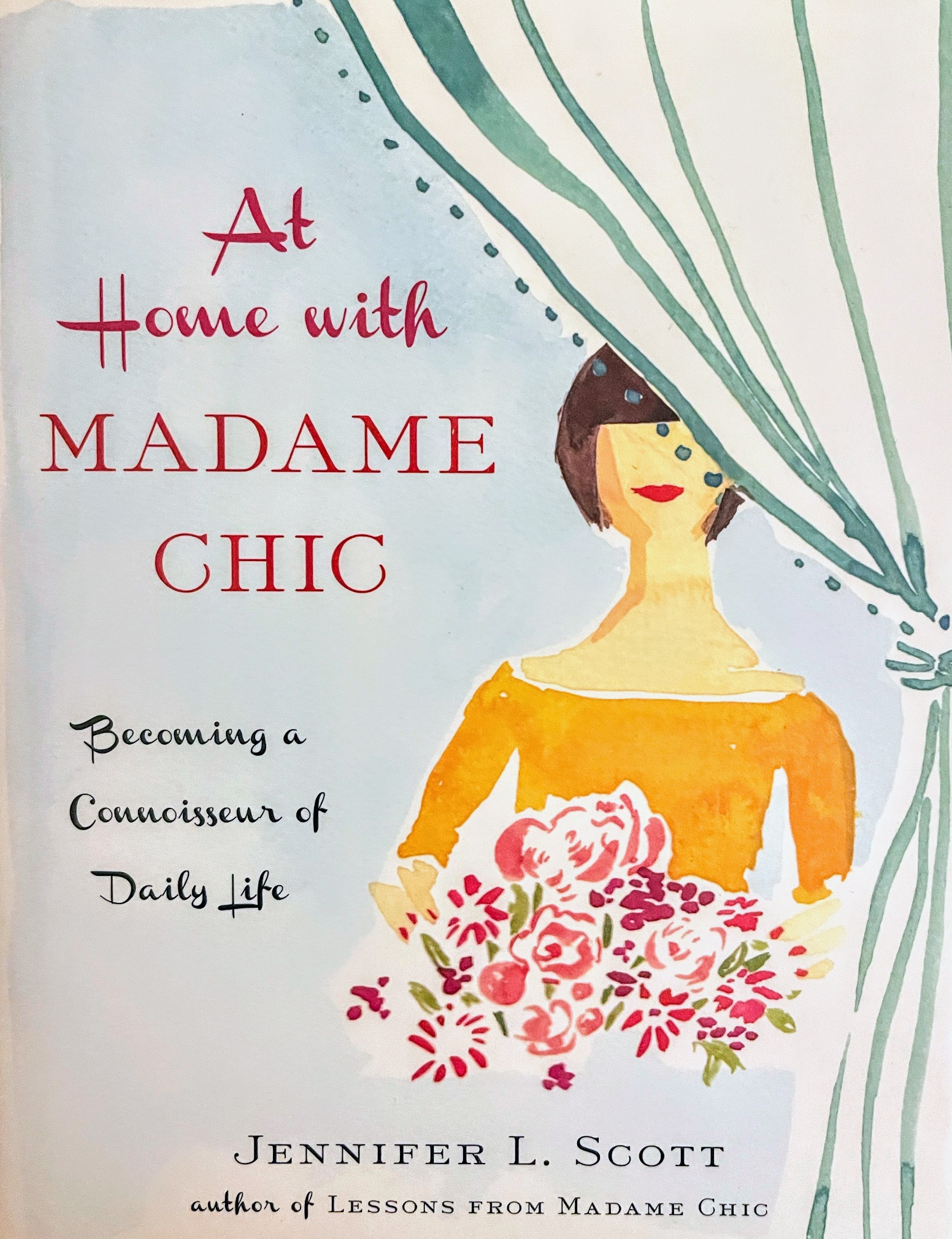
This post comes from Jennifer L. Scott’s wonderful book, “At Home with Madame Chic: Becoming a Connoisseur of Daily Life” – When she arrived at Madame Chic’s Parisian apartment as a foreign exchange student, Jennifer Scott was a casual California girl who thought sweatpants were appropriate street attire. Madame Chic took Jennifer under her wing and tutored her in the secrets of how the French elevate the little things in life to the art of living. Years later, Jennifer was back in California with a husband, two young daughters, a dog, and her first home. Every day she confronted mundane duties like folding laundry and unloading the dishwasher, and she began to think about Madame Chic’s home—how the breakfast table was set beautifully the night before, the music that always played in the background, the calm of Madame and Monsieur Chic’s ritual cocktail hour together. Jennifer wanted that life. She decided to see what would happen if she didn’t perform her chores impatiently or mindlessly, if, instead, she could live like Madame Chic


Want a real mini vacation? Even if you only have five minutes to yourself, sit down at a clear table with good posture, silverware, a plate, and a cloth napkin and slowly enjoy your lunch. We are so rushed and wired the entire day – constantly checking our iPhones, reading the news, texting our friends, checking our Facebook status, and multitasking in our heads, that it is divine bliss to tune all of that out, even for a few minutes, and focus on replenishing our energy, nourishing our bodies, and feeding our souls. You could listen to music while you do this, if you want, but sometimes silence is the most coveted thing.

If you cannot sit at a clear table and must take lunch at your desk, turn your iPhone facedown, put your computer on sleep mode, and clear a small space for yourself. Just focus on eating your food. Eat slowly. Notice how you feel. Check in with yourself. If any problems from the day threaten to rush into your head, just send them right out. There are no problems right now. You are eating lunch. If your phone buzzes, just ignore it. If you have an impulse to go online, notice the impulse and its intensity. Don't give in. Finish your lunch completely. Take a sip of your beverage. Use your napkin. Sit for a few seconds and center yourself. Give yourself that moment.
Then you can go back into the fray. Check to see who texted you. Check the latest celebrity scandal online. Send that email that's been gnawing at the back of your mind. You are back into it, but at least for those blissful few moments, you were completely out of it, in your own magical world. The world of now.

Initially this might feel uncomfortable. But I implore you, of all the concepts in this book, take this one very seriously. Have your lunch with no distractions. No TV, no cell phone, no computer. The only exception is music. Even if you haven't had a chance to check your email all day. Even if there's an article online that you've been dying to read. Don't do it while eating lunch. Try not to think about any problems. Having lunch this way will charge your battery. It will awaken you. Otherwise you will continue to dwell in the rat race of the mind. Eating lunch this way is positively decadent and very chic. – From At Home with Madame Chic: Becoming a Connoisseur of Daily Life,” by Jennifer L. Scott, 2014


Etiquette Enthusiast, Maura J. Graber, is the Site Editor for the Etiquipedia© Etiquette Encyclopedia